LINDA HOFFMAN
Plein Air Poetry
Today is for poetry at Old Frog Pond Farm. This afternoon, twenty-four poets will gather and walk the trail around the pond and through the woods, along the orchard, to the meditation hut, with a stop at the rock turtle, and back to the dam. The poets will be reading the poems they began writing earlier in the year inspired by a visit to the farm.
We need poetry to mine the subtle, the tenuous, the painful, the ecstatic, and elegiac feelings of our humanness. We need poetry when we are tired, hurt, hassled, and missing connection to our own heart. “I come to the farm,/having very nearly forgotten myself,” begins Lucinda Bowen. “And here blooms a memory. . . my surprise at improbable sweetness.”
Early in the year, Susan Edwards Richmond, organizer of the event, and I, choose a theme. This year’s subject, Memoir, “invited the poets to dig deeper, to go beyond surfaces, and draw, sometimes unbidden, wells of feeling from the landscape,” wrote Richmond in her introduction to the chapbook of poems.
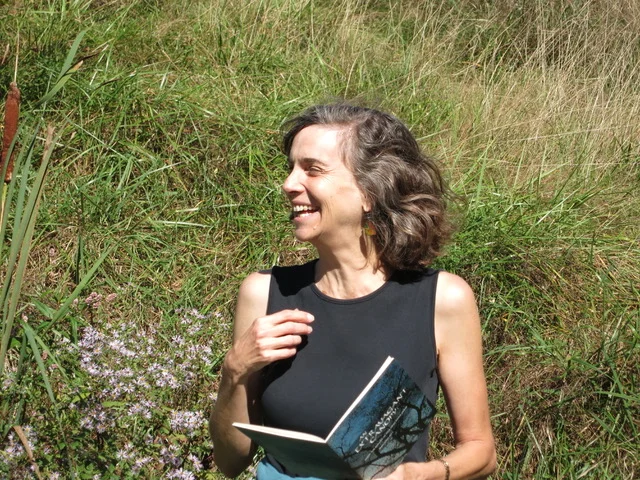
Susan Edwards Richmond, Plein Air Reading, 2013
Poets sign up to participate. Throughout the spring and early summer, they visit the farm and walk the paths. When they come upon a view, a place, a tree, or a sound that awakens their muse, they stop and write. They return home, work on their poems, sometimes visiting again. In mid-summer, they submit their poems to Richmond, editor of the chapbook. For some, Richmond responds with suggestions, working closely with the writer to enhance the poem; others’ work arrives fully fledged. Then Richmond orders the collection, giving shape not only to the book, but to the walking event. Our slow-moving herd of poetry appreciators can’t be running from the dam to the orchard to the bell; then flying to the meditation hut and back again — or the walk would take us far into the evening hours.
Sometimes it is one of the outdoor sculptures at the farm that moves the poet to words. For poet David Davis, the ringing of Paul Matisse’s Olympic Bell brought back memories of Nepal. “Forty years ago in Katmandu/I heard a monk ring a temple bell/That shook my chest and opened my ears.” Polly Brown begins her poem with, “A sculpted figure by the pond,/gathering sky in her round arms,/Is my mother—alive but so lightly tethered/to the place and condition of her body.” She, too, mentions the bell, “hauling on the hammer I sound the bell/in the woods,/ and they [her mother and father] fly to me.”
Some poets invite us to feel the plight of the greater world. Linda Fialkoff writes, “So many refugees/choked into one small boat/fueled by a damp, ragged/body long held hostage.” It is as if she knew that Alicia Dwyer’s Suspended Encampment, a hanging sculpture behind the Medicine Wheel, would be arriving for the sculpture exhibit. Dwyer’s sculpture not only refers to the plight of Monarch butterflies, but to the migrations of people, the refugees throughout Europe, and now, the homeless millions in the aftermath of the recent violent storms and earthquakes.
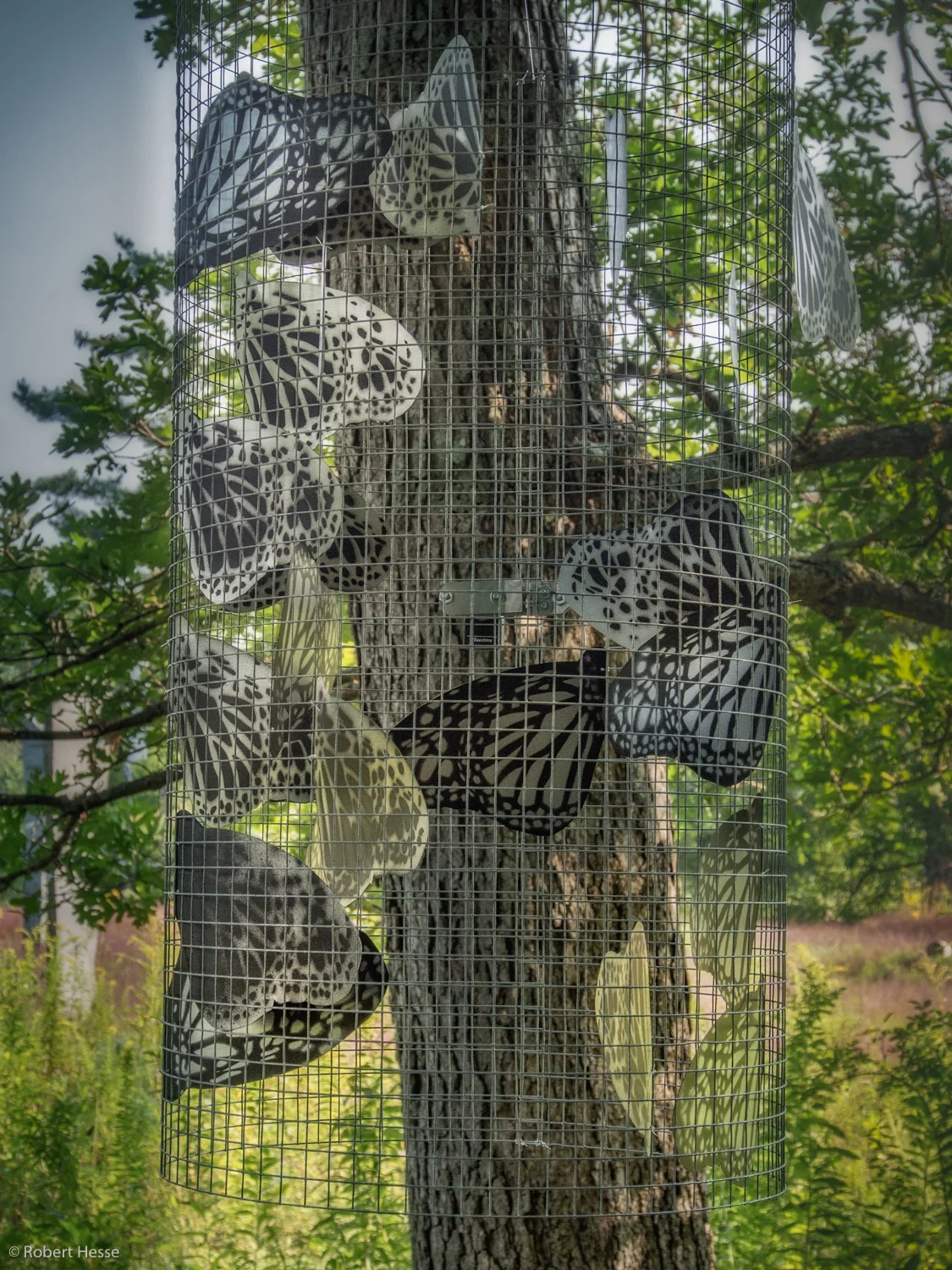
Suspended Encampment, Alicia Dwyer (partial) Photo:Robert Hesse
bg Thurston picks up a stone and hears, “Sometimes sorrow/sits like a stone in your heart/and you are unable to lift it.” For Heather Connelly Bryant, the raspberry patch evokes a strong memory, “Yet I was wrong—now there is new life, new love, new/hope— infidelity no longer hangs in the air, everywhere.” Richmond, also wrote near the raspberries, “each of us now with our own green past, red stained fingers. Only rarely/was there enough/but we were always sated.”
Richmond and her husband brought their children to pick raspberries at this farm years before I moved in, and she was so happy when she learned that I would continue to care for the patch and open it for public picking. Since that time, Richmond and I have collaborated on many projects — Wild Apples, a journal of nature, art, and inquiry, five years of Plein Air Poetry at the farm, and our most recent collaboration, a children’s book, Where’s My Bonkers? about a girl, her mother, and an apple. It’s always about collaboration at the farm. We share, inspire, and co-create together.
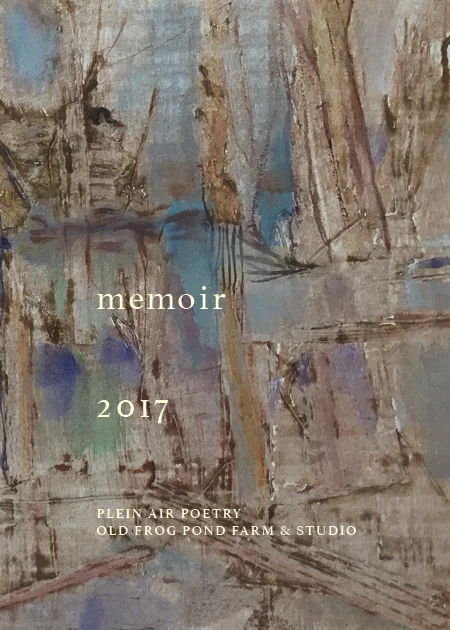
Cover Art & Design: Lynn Horsky
We invite you to join us this afternoon, Sunday, September 17 at 2pm to walk and listen to the poets read their poems. I guarantee you will be sated.
If you can’t make the event, a limited number of chapbooks will be for sale at the farmstand and on the farm’s website. The walk is free and open to the public.
All About Art
A friend of mine paints barns. That is, she makes paintings of the same barn over and over, in all seasons and at all times of day. The angle of her view may shift or the size of her canvas, the palette, or the medium, but the barn remains, a presence in the landscape. In fact, it feels inseparable from the earth, as if she was a painting a mountain or a great tree. Brenda Cirioni’s barns are rooted and alive.
But the real barn, the barn that she connects with through her painting, no longer exists:
When I was sixteen years old my family home burned to the ground. Memories of that experience – both visual and visceral – surfaced in 2012 and found expression in Barn Series.
It was years after the event that Brenda realized that she had never truly mourned that frightening loss. Painting is a way to heal our wounds, even the hidden, unarticulated ones.

The first Barn Series Painting, 2011, Brenda Cirioni Photo:BC
As artists, we are fortunate when we find a subject that captivates us. Like many people, I have an attraction to the natural world, to old objects and worn tools. Growing up with an anthropologist mother and traveling with her to Mexico and Guatemala, as well as to India and Papua New Guinea, I learned to respect material culture and appreciate how it reveals information about people and their worlds. I have a natural affinity for old objects and textiles because they connect me to my childhood and early adolescence. I use them in sculpture, often combining them with small figures. I play.
I think of art as a form of play that connects our inner and outer worlds. Children play naturally. Children like to arrange things, to build towers, to line up stones on a beach, or arrange a series of stuffed animals on a shelf. Artists, when painting a landscape or making a sculpture, also arrange objects. Brush strokes form buildings or trees, people or abstract shapes. If I want to paint grasses that are dark green at the bottom and become pale above, I stroke the canvas with color in a particular pattern and with an intensity and intentionality to recreate the density of green below and the lighter colored, thinner reeds above. It’s the way I imagine Brenda paints a barn, filling her brush with color and forming the angles, the light, the textures — all with intuitively complex decision making that no one else can replicate. It’s authentic playing — the playing of an experienced artist.
When we are self-conscious and trying too hard at this art making, it feels all wrong. It’s only when we find the sweet spot that has similarities to child’s play that discoveries happen. I have a friend who has recently become obsessed with mosaics. She has a tree stump on which she hammers stones to break them down into small mosaic pieces. She then fits them in patterns, setting the stone shards in cement. She loves this work — and can’t find enough time to spend at her mosaic table. She is tapping into her true self. As she breaks these rocks from the earth into small pieces and arranges them in a specific way with colors and shapes, I feel like she is breaking down difficult places in the world and creating peace — like she is breaking down the hard places inside of herself and turning them into art.

Untilted, Shea Ikusei Settimi
Children play with stones, soil, sand, containers, the contents of the kitchen utensil drawer, anything that they can pick up. When we become an artist, we reconnect with that innocent and serious play. Many of the sculptors exhibiting this year at the farm’s annual sculpture exhibit play seriously in this way. Barbara Andrus strung curly willow twigs across the pond. Is this so different than lining up teddy bears? Of course it is – and there is much more work involved and commitment to her vision, but the essence is still there.
We’re fortunate when we find a medium that appeals to us and that we can work and develop. Alicia Dwyer’s Dyads are eyes that peer out from among the forest trees. They seem to be staring at us as we walk along the path; we have the uncomfortable feeling of being followed. Painted on aluminum flashing, the Dyads were made eight years ago, her first time working with aluminum. She has continued with this medium, creating armor women, and this year, a new piece in which beautiful butterflies suspended in captivity remind us of the refugee problems in many parts of the world.
My daughter, Ariel Matisse, has found that wire is her chosen medium of expression. For the sculpture exhibit, she’s making a willow tree growing out of a hollow tree stump. The willow trunk is a twisting shape made from a fistful of long wires, where one end forms the branches and the other the roots. She uses a ball peen hammer to flatten and make the branches reflect light. She grew up watching me drag tree trunks home from the woods or from a trip to Cape Cod. I can easily see my influence on my daughter and also how her own truth leads her in a new direction.
On Samantha Pasapane’s website she writes, “I love steel.” Samantha will be bringing a new sculpture in her Savaging Series to the farm.

Savaging, Smantha Pasapane
Lydia Musco has already installed her sculpture, Organizing Echoes with Ash, on the concrete pier in the middle of the lower pond. The title of her sculpture suggests ‘creating order.’ Lydia’s column is made of ceramic tiles that she combines and stacks. Her sculpture, though abstract, entices the viewer to linger with its physicality. I see a figure or even two figures together, and then when I look again, it seems to be echoing the play of light on the rippling water.
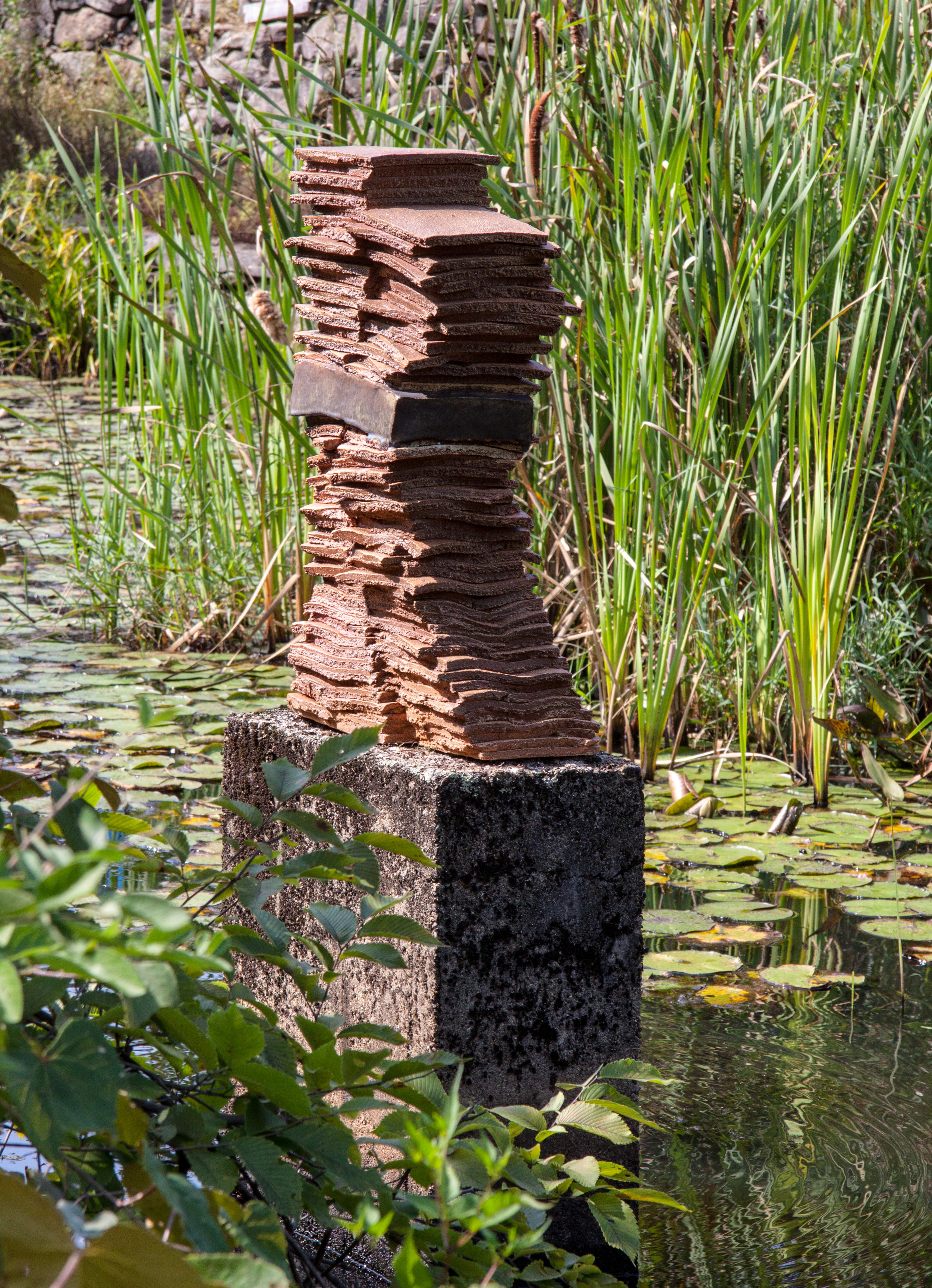
Organizing Echoes with Ash, Lydia Musco, installed at Old Frog Pond Farm, 2017 Photo:LH
Art making connects us to something original inside us, to a truth about who we are and how we relate to our world as human beings from our very origin. Brenda Cirioni’s most recent paintings are what she calls Spirit Houses.

Spirit House I, 2016, Brenda Cirioni Photo:BC
They seem a natural progression from the Barn Series. In these paintings, the landscape with identifiable trees and grasses is gone, but the body of the barn remains without the old story. In the painting above, the white shape is floating as if on a sea. It’s haunting and surreal, yet familiar, a space we have all inhabited — one where we just don’t know. That’s when there’s nothing left to do but find a medium that resonates — words, paint, wire, clay, even fruits and vegetables — and get down to some serious play.
Old Frog Pond Farm's outdoor sculpture exhibit opens on Friday, September 8 and will be open every Friday, Saturday, and Sunday through Columbus Day. Hours are 11-5pm and admission is $7. Join us for an opening reception and meet the artists on Sunday, September 10 from 1-4pm. In the next few weeks I will be writing about more of the artists and fall activities. Join us at the farm!
Search Blog
-
2025
- May 9, 2025 A View from the Tractor Seat
- Apr 11, 2025 Dig
-
2024
- Jan 7, 2024 Winter Wassail
-
2022
- Dec 11, 2022 Keeping Time
- Jun 17, 2022 This Apple-Shaped Earth
- Jan 23, 2022 What is a Jizo?
- Jan 16, 2022 An Invite and Housekeeping Update
- Jan 1, 2022 The Year of the Frog: What Orchardists Do While Apple Trees are Chilling
-
2021
- Oct 24, 2021 Figs
- Oct 3, 2021 The Artist and the Orchard: A Memoir
- Aug 8, 2021 Red-Fleshed Apples
- Jul 25, 2021 When We Were Trees
- Jun 27, 2021 Castor Beans—Who Knew?
- Jun 13, 2021 Spring Training at a Zen Monastery
- May 4, 2021 Our Trees are in Bloom
- Apr 18, 2021 Hooray!
- Jan 24, 2021 Wassailing, virtually!
- Jan 1, 2021 Sitting
-
2020
- Dec 21, 2020 Darkness to Light
- Nov 28, 2020 One Heart
- Sep 18, 2020 Juggling Flowers, Fruit, and Vegetables
- Aug 23, 2020 Refuge
- Aug 9, 2020 Bags of Fertilizer
- Aug 2, 2020 The Sermon of the Blue Heron
- Jul 26, 2020 What's the Buzz?
- Jul 19, 2020 Farm Moments
- Jul 12, 2020 Lost Wax
- Jul 5, 2020 Catalpa: The Hugging Tree
- Jun 28, 2020 Pedaling Peace
- Jun 21, 2020 See Change
- Jun 14, 2020 Lalla Unveiled
- Jun 7, 2020 Pond Alchemy
- May 31, 2020 The Birth of Fruit
- May 24, 2020 An Artist in the Orchard
- May 17, 2020 Walking the Land: Returning Home
- May 10, 2020 Stinging Nettles: Gifts from the Great Mother
- May 3, 2020 The Mystery of Swallow
- Apr 26, 2020 Aerial Bruststrokes
- Apr 19, 2020 Simple Pleasures
- Apr 12, 2020 Weeds and Other Gifts
- Apr 5, 2020 Remembering the Seeds
- Mar 29, 2020 Blow on the Embers
- Mar 22, 2020 Ripples
-
2019
- Nov 16, 2019 Tibet Impressions
- Nov 9, 2019 Forest Tales
- Oct 13, 2019 The Gift
- Aug 4, 2019 The Season is Apples, Berries, and Grandfather Fire
- Jun 8, 2019 Pointers for a Writing Life
- May 12, 2019 Mothers of the Earth
- Apr 6, 2019 The Apple-Shaped Earth
- Mar 23, 2019 You Don’t Know What You Have Till It’s Gone
- Feb 23, 2019 Generations
- Feb 9, 2019 What Are We Doing to the Earth, John Chapman?
-
2018
- Dec 31, 2018 Long Shadows
- Oct 6, 2018 A Pilgrimage to India
- Aug 18, 2018 Scrap Wrenn
- Aug 11, 2018 Off-the-Wall Comments from an Ignorant Farmer
- Jul 28, 2018 Creative Connect
- Jul 14, 2018 How is the Orchard?
- Jun 30, 2018 Which Way?
- Jun 16, 2018 Geese, Herons, Beavers, and the Baby Steps of a Lapsed Blogger
- Feb 24, 2018 Mama's Coupons — Good Forever
- Jan 27, 2018 January Ice
- Jan 13, 2018 The Muse
-
2017
- Dec 30, 2017 A Dream for the New Year
- Dec 23, 2017 A New Year for Apples
- Dec 16, 2017 Intuition
- Nov 22, 2017 Thanksgiving OM
- Nov 4, 2017 East Fork Pottery
- Oct 28, 2017 Putting Down New Roots
- Oct 21, 2017 A is for Art
- Oct 14, 2017 Eve domesticus
- Oct 7, 2017 A String Workshop
- Sep 30, 2017 After Applepicking
- Sep 23, 2017 Two Bad Women and One Good Apple
- Sep 16, 2017 Plein Air Poetry
- Sep 9, 2017 Cutting Off a Leg
- Sep 2, 2017 The Changing Landscape
- Aug 26, 2017 All About Art
- Aug 19, 2017 My First Visit to the Farm
- Aug 12, 2017 The First Food
- Aug 5, 2017 A Teapot, a Woman, and maybe a Boat
- Jul 29, 2017 A Raspberry Dilemma
- Jul 22, 2017 Consider the Miracle
- Jul 15, 2017 Meeting Ekphrasis
- Jul 8, 2017 Ripening Fruit
- Jul 1, 2017 The Voice of The Caterpillar
- Jun 24, 2017 Goumi — An Unusual Fructus
- Jun 17, 2017 Concord, an American Bloomsbury
- Jun 10, 2017 The World Is Bonkers — Shall I Laugh or Cry?
- Jun 3, 2017 Bonkers, a Revolutionary Apple
- May 27, 2017 Guardians of the Swamp
- May 20, 2017 There are Mushrooms and There are Morels
- May 13, 2017 "What's in a Name?"
- May 6, 2017 Bloom Follows Pink: Orchard Pollination
- Apr 29, 2017 The Orchard Is at Pink
- Apr 22, 2017 Natural Farming — Part 2 (continuation from last Sunday's blog)
- Apr 15, 2017 Natural Farming — Part 1
- Apr 8, 2017 Boats, Figures, and Catching Fish
- Apr 1, 2017 A Man with a Mission: The Nuts and Bolts of Bronze Casting
- Mar 25, 2017 A Chalice of Spirit, Art, and Nature
- Mar 18, 2017 Hanami — Blossom Viewing
- Mar 11, 2017 Soil Redemption Song
- Mar 4, 2017 Food is Primary Care
- Feb 25, 2017 Pomme de Terre
- Feb 18, 2017 Organic Certification
- Feb 11, 2017 Tantalizing Fruit
- Feb 4, 2017 The Myths of History
- Jan 28, 2017 The Orchard in Winter
- Jan 21, 2017 The Hi-Line
- Jan 14, 2017 Artistic, Botanical, and Social Diversity
- Jan 7, 2017 Where is Eden?
-
2016
- Dec 31, 2016 The Creative Heart
- Dec 24, 2016 A Christmas Tale
- Dec 17, 2016 Who are the Crones?
- Dec 10, 2016 The Olympic Bell (Part Two)
- Dec 3, 2016 Overheard in the Apple Orchard in Early December
- Nov 26, 2016 The Lessons of a Tortoise
- Nov 19, 2016 In the Studio
- Nov 12, 2016 Even in Darkness
- Nov 5, 2016 Southern Apples, an Elephant, Monkey, Rabbit, and Bird, Two Mango Trees and a Birthday
- Oct 29, 2016 The Tools of Art
- Oct 22, 2016 Labyrinths
- Oct 15, 2016 Repairing the Broken
- Oct 8, 2016 When You Are No More
- Oct 1, 2016 Creation Rain
- Sep 24, 2016 Breaking the Glass
- Sep 17, 2016 String Art
- Sep 10, 2016 Poetry and Photosynthesis: It's all in the Leaves
- Sep 3, 2016 In the Plenty of Time
- Aug 27, 2016 Witch Doctors
- Aug 20, 2016 Listen Coyote
- Aug 13, 2016 Milkweed in the Orchard
- Aug 6, 2016 Some People See a Turtle
- Jul 30, 2016 Arborshaping
- Jul 23, 2016 Joseph Wheelwright: Sculptor of Stones and Trees
- Jul 16, 2016 Asian Pears
- Jul 9, 2016 Gold Leaf, Grief, and the Creative Process
- Jul 2, 2016 The Olympic Bell (Part One)
- Jun 25, 2016 Around the Mulberry Bush
- Jun 18, 2016 Avoiding Apples
- Jun 11, 2016 Fructus
- Jun 4, 2016 Astonishing Apples
- May 28, 2016 Scare the Caterpillars
- May 21, 2016 Join the Club!
- May 14, 2016 The Graft
- May 7, 2016 Rooster, Rhubarb, Rue
- Apr 30, 2016 What do Dolphins and Nettles Have in Common?
- Apr 23, 2016 Art Prunings
- Apr 16, 2016 A Few of the First Arrivals
- Apr 9, 2016 Taste the Spirit of Sustainable Agriculture
- Apr 2, 2016 First Orchard Spray - March 22-24, 2016
- Mar 26, 2016 Hawkeye Apple
- Mar 19, 2016 Desiring the Almata Apple
- Mar 12, 2016 Ugly Fruit
- Mar 5, 2016 Winter Tracks
- Feb 27, 2016 Splash
- Feb 20, 2016 Pruning
- Feb 13, 2016 Orchard Ruminants
- Feb 6, 2016 A Gathering of Seeds
- Jan 30, 2016 Orchard Dragons
- Jan 23, 2016 Tree Rings
- Jan 17, 2016 The Fallen Tree
- Jan 7, 2016 Wassailing the Apple Trees
- Jan 1, 2016 The New Year