LINDA HOFFMAN
Long Shadows
Dear Blog Readers,
Happy New Year!
The last blog I wrote was before I left for a Buddhist pilgrimage to India in early October. When people ask how was the journey, I usually begin to talk about painting. Uncharacteristically, I journaled throughout the trip not with words, but with small watercolor paintings of important sites and experiences. Now, as this year ends, I am turning towards words as a way to understand how I was changed by the trip and to share it with you. It’s been a curious enfolding.
Caw caw caw crows shriek in the white sun over grave stones . . . —Allen Ginsberg’s Kaddish
When I was a young child, a large Arborvitae grew outside our small row house in Chester, Pennsylvania, an industrial city with streets of row houses and screen doors that banged. We were among the few Jewish families, and we drove to Center City Philadelphia to celebrate holy days in the city’s oldest synagogue, Rodeph Shalom. The recitation of the Kaddish was my favorite part of the service because the grownups rose while the children remained seated, and the endless rhythmic chanting of V-im-ru ah-mein in the mourner’s prayer made me feel I belonged to a great sadness. However, when I was fourteen, I became disillusioned with Judaism and became interested in Eastern religions, eventually taking Buddhist vows.
The pilgrimage to India was a journey to the roots of Buddhist spirituality. Our group of sixteen Zen practitioners meditated under the Bodhi Tree where the Buddha attained enlightenment, and listened to the Abbot of our monastery give a talk on Vulture Peak where the Buddha gave many sermons to his followers 2500 years ago. We visited the sites of the Buddha’s birth and of his death, a cave where he meditated, and stupas built to honor his most faithful disciples and his mother. I painted it all.

The Bodhi Tree, India sketchbook, LH

Painting from the bus window, India sketchbook, LH
On the last day of our trip, I saw the headlines, “Eleven Jews killed in the Tree of Life Congregation Synagogue.” I remember thinking something like, ‘it never ends’, but my reaction was shallow.
When I returned home from India all I wanted to do was to paint. The Catalpa Tree was waiting for me outside my studio—this giant of a tree that I had been drawing and painting over the last six months.

Catalpa Tree at Old Frog Pond Farm
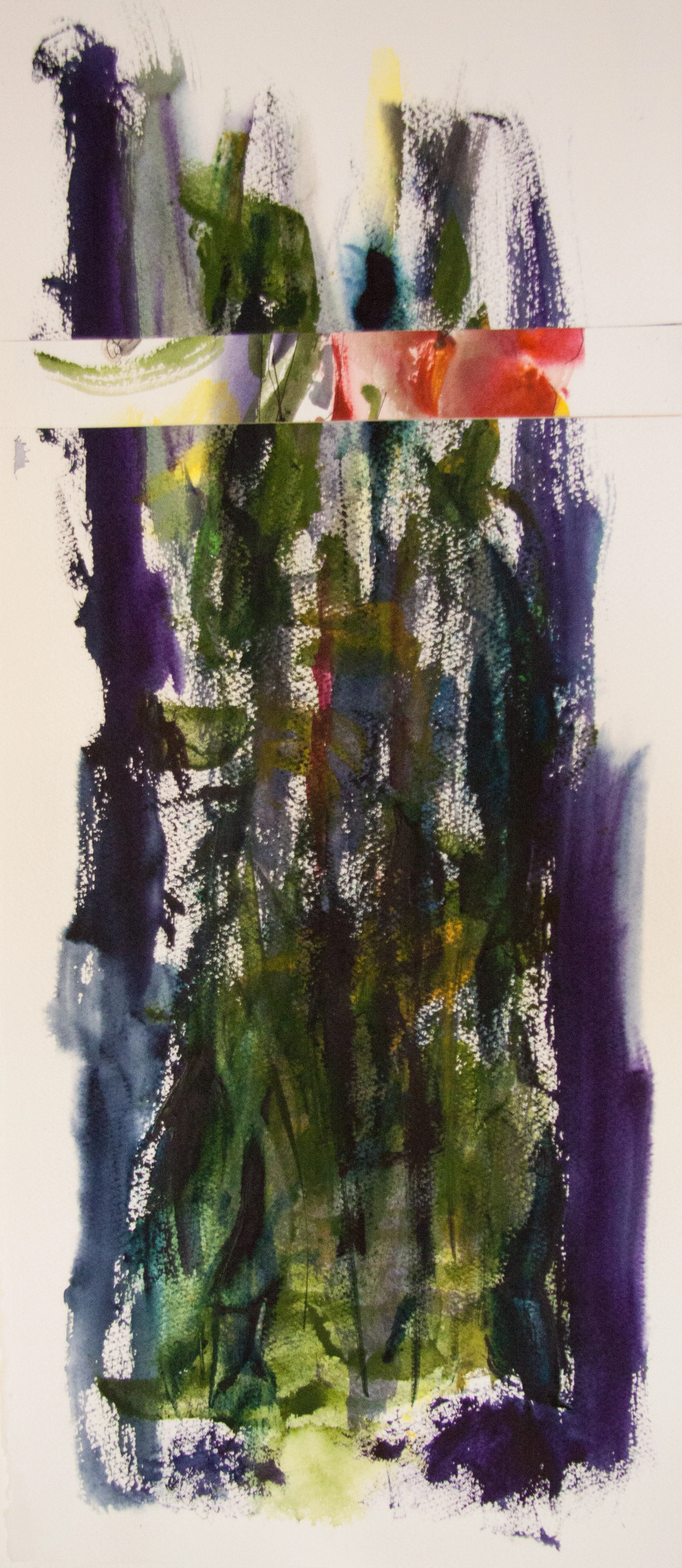
Dissatisfied with my prior efforts to capture its strength, I decided to paint the energy of its massive trunks, not the outer form of the tree. I painted one painting, tacked it to the wall, and started another, sometimes going back to work on an earlier one after it had dried. Around painting number five, this great sadness welled up inside me. What was I doing? Where was it coming from?

Some of the paintings had fire and flame; not just trunk and furrowed bark. I listened closely, and from my heart rose up the words, “On October 27, 2018 eleven Jews were killed at the Tree of Life Temple in Pittsburgh.” I knew I had to paint eleven paintings to honor each person who died. Their names were familiar—Rabinowitz, Rosenthal, Stein. I come from a long line of Steins on my mother’s side.
A few weeks of seeing the paintings on my studio wall, I decided to do something to make the deaths more visible. I cut each painting across at the height to mark each person’s age at the time of the shooting. I added a new section and then restored the painting to wholeness by reattaching the cut-off section.

The Arborvitae of my childhood, the Tree of Life Synagogue in Pittsburgh, the Bodhi Tree in India, and the Catalpa outside my studio at Old Frog Pond Farm in Harvard all blended, each tree unique and yet all sharing the same roots. My journey to India connected me not only to Buddhism’s beginnings, but to my natal tribe.
In creating art we can transcend tragedy. We can also integrate the parts of ourselves that we have kept hidden. When asked about my trip to India, I still begin with, “I painted.”
May all beings have abundant peace in the New Year.
May we always see the perfection in the other.
May we care for the earth with great love.
May we not forget those who came before us and gave us life.
V-im-ru ah-mein (and we say, Amen.)
Note: This series of paintings will be on exhibit in the Camilla Blackman Concert Hall at Indian Hill Music in Littleton, MA beginning March 1 with a closing reception on April 26th. And if you would like to hear a transcendent instrumental piece I recommend listening to Maurice Ravel’s (1875-1937) Kaddish. for violin and piano.
A Pilgrimage to India
Two days after the farm closes, on October 9, I leave for India.
* * *
On August 30, 2017, I was at my desk when I got an email from my Zen teacher, Shugen Roshi. He wrote,
“I hope you’re all doing well and have had a nice summer. We have a student in New Zealand, John Tosan McKinnon, who has been leading small groups on pilgrimages to significant Buddhist sites in India and Nepal for many years.”
I read on. Shugen and Tosan were planning a trip for October of 2018. Shugen was inviting members of the sangha, the community of practitioners, to participate. My heart leapt—India! Over the years, I have planned several trips to India and Nepal, but for one reason and another, none ever materialized. I looked at the dates—October 9 to 29, 2018. I looked at the calendar for 2018, the day after Columbus Day, the day we close the farm. I could do it. I looked over at Blase who was at his desk, also answering emails.
I said, “You won’t believe it, there is a trip to India through Zen Mountain Monastery.”
He heard my excitement.
“Would I also go?” he asked.
I could feel his awkwardness, though he has always been supportive of my Zen practice.
“No, it is only for sangha members.”
Then I asked directly, “Would you support me to go to India on this trip?”
“If it is really important to you,” he said.
“It is.”
Ever since I lived in Japan, I dreamt of walking one of the Buddhist pilgrimage trails. In Japan, the most famous one goes 750 miles around the island of Shikoku. Pilgrims stop at each of the eighty-eight temples to say prayers; to walk the whole circuit takes at least two months. Today, people use buses, bicycles, taxis, and often choose to visit a select number of temples or spread their visit over several years. While researching the Shikoku pilgrimage, I stumbled upon the book The Ox Herding Series, the Buddhist Stages on the Path to Enlightenment, a slender volume of ink drawings, poems, and commentary. The Ox Herding series originated in China in the 12th century, the creation of a Zen master to help his students understand the spiritual journey they were undertaking.
Using the metaphor of the ox, a most valuable possession in ancient China, the journey begins when a young man, whip and tether in hand, heads off into the mountains to find his lost ox. He can’t come home without it. It’s his family’s livelihood: the ox plows the fields, and its manure heats his home. After much searching, the young man sees ox tracks and knows he’s heading in the right direction. He continues on through the steep and winding mountain paths, and he is rewarded with the sight of it. But this moment of recognition is short-lived, for the ox quickly disappears. The young man doesn’t give up, and with single-minded perseverance he finally catches the ox with his rope. Then the struggle really begins. Pushing and pulling, he must tame the ox until they can walk together with ease. Only then are they on the way home.

IV Catching the Ox (Female version) Sculpture: LH Photo:Joe Ofria
I looked up the author of the ox-herding book and discovered he was John Daido Loori, Abbot of Zen Mountain Monastery in Mount Tremper, New York. The monastery website featured a one-week retreat, Wilderness, Art, and Zen, a camping trip on Raquette Lake in the Adirondacks. Here was a retreat devoted to three things I loved. It certainly sounded simpler than the logistics necessary for even an abbreviated Shikoku pilgrimage. I called Zen Mountain Monastery.
“I’m calling to sign up for the Wilderness Retreat.”
“Have you been to the monastery before?” a female voice asked.
“No, I just found the retreat listed on your website.”
“Hmm, then you haven’t attended our Introduction to Zen Training workshop?”
“No.”
“Sorry,” the efficient voice replied. “You have to first attend that weekend workshop before you can go on the Wilderness Retreat. The next one is filled, but you can sign up for the July weekend.”
“I can’t do the July weekend,” I said.
“Well,” she continued, “we offer the wilderness retreat every year.”
“Isn’t there some way I can go without doing the introductory retreat?”
“No, there isn’t.”
“Are you sure?”
Finally, the voice said, “There’s nothing I can do, but you can talk with a teacher. Call back in ten days and ask for Shugen.”
I hung up the phone and wrote Shugen a letter and included a booklet of my sculpture, A Circus Comes to Fruitlands. The sculptures represented circus acts, a Juggler, a Clown, a Tightrope Walker, all made from old agricultural tools. I wanted to do everything I could to convince him to let me go on this trip. Ten days passed and I called Zen Mountain Monastery.
“I’d like to go on the Wilderness Retreat,” I said.
“You can’t go on the Wilderness Retreat without attending the Introduction to Zen Training,” he replied.
“Isn’t there some way?”
“No.”
“Are you sure?”
“Yes.”
I said, “I trained in the Noh Theater in Japan for two years. I know a little about Zen.”
“Zen isn’t the issue.”
I was trying to figure out what was his red flag. I thought maybe he was afraid I would want to go home halfway through the trip.
“I love the wilderness,” I said. “I’ve climbed all of the four-thousand-footers in the White Mountains, I’ve summited Mt. Rainier, climbed in the Tetons, and backpacked through Peru.”

Gathering Wood near Mollepata, Peru Photo:LH
There was a pause. Then he quietly said, “All right.”
“Thank you!” I said.
He added, referring to my sculpture, “By the way, I like your stuff.”
I went on the retreat, eventually attended the Introduction to Zen Training, and have been practicing at Zen Mountain Monastery since 2004.
This pilgrimage to India will take us back to the roots, to where Buddhism originated. We will follow the Buddha’s life from birth, home-leaving, his wandering as an ascetic, to his enlightenment under the Bodhi tree, and visit places where he taught for the next forty years. As a young man, Siddhartha led an protected princely life. But once he encountered the reality of human suffering, once he saw the pain of people with severe illness, the infirmities of old age, and facing with fear their approaching death, his own life became meaningless. He no longer found any satisfaction living in the palace, even with all the wealth and power of his position, even with a lovely wife and young son.
I imagine it was difficult for Siddhartha to leave his family; I know how difficult it is for me to leave for only three weeks! But he was determined to understand why we are put here on this earth. What is the cause of so much suffering? And can we ever be free from it?
Every pilgrim makes a journey for their own reasons. Some to seek an answer to a question, others want to express their gratitude for the teachings or atone for wrongdoings, still others to honor a loved one. Shugen Roshi urged us to reflect on what this trip means to us personally as we prepare to connect with the Buddha, the teachings, as well as the ancestors. He has suggested readings and teachings to help us set our aspirations for the trip.
Preparing for this trip has made me reflect back almost forty years when I first went to Japan to study Noh Theater and lived in a temple in Kyoto. In my one-tatami mat room, I listened to the monks’ deep chanting each morning and evening. I think what propelled me to go on that first ‘wilderness’ trip and gain access to the Buddha’s teachings. As I look back over the last twenty years I recognize the steep trails, the vistas that opened, and the rocky descents of my journey. I can remember meeting my first husband in Japan, my move to Old Frog Pond Farm after our divorce, the decision to bring back the old apple orchard, a new relationship with Blase, a long year of breast cancer treatments, and our marriage three years ago when my son, Nick, spoke so sweetly about Blase’s care during that challenging time. Through all of this, there has always been Art—creating the solid trail I walk on, and my Zen teachers and sangha helping me keep mind and heart centered on what really matters.

Stone Heart Photo:LH
I’m excited to be traveling with Shugen Roshi, Hojin Sensei, whom I met on that first wilderness trip, and thirteen other sangha members, eight from New Zealand. I’m grateful to Blase for taking care of the farm. Sharing this event in my life with you feels like another part of the preparation. Many of you have followed my questions about how Blase and I will continue to cultivate the farm in ways that serve and grow our community, encourage the arts, while also being good stewards of the land. I will undoubtedly carry these questions with me, but unconsciously—for I will purposely let them go. John Daido Loori Roshi, author of the Ox Herding book, said we must empty the backpack we carry. We must empty our minds of all of our conditioned ideas. Otherwise, there is no room for anything new. He was referring to coming into Zen training, but really it applies to beginning everything—a painting, a pilgrimage as well as each new day.
I am grateful for so many people in my life that have helped me to be right here where I am and look forward to sharing more with you when I return. We are all connected, all living on this one fragile planet earth. Walk softly.
Follow the truth of the way.
Reflect upon it.
Make it your own.
Live it.
It will always sustain you.
from the Dhammapada tr. by Thomas Byrom
Scrap Wrenn
Artist Scrap Wrenn and her partner, Jo, arrived at the farm in time for a late dinner on Tuesday in a U-Haul truck from upstate New York. I was introduced to Scrap at Zen Mountain Monastery, where I am known by my Buddhist name, Shinji. I wrote to her shortly after our introduction,
Hi Scrap,
We have an outdoor sculpture exhibit at the farm every fall . . . I know you are about to move into the monastery, but just thought I’d ask if you had a piece you might install here.
You can see the prior year’s work at oldfrogpondfarm.com under the tab for art.
Loved your stormy Instagram post!
Shinji
Scrap posts on Instagram almost every day. Some posts become images she includes in large photographic collages of people and place—magnificent landscapes with hundreds of photographic moments in which we immerse ourselves and journey through. Scrap’s visual language is quick-moving and incantatory. It is like listening to a medieval chant where the polyphony of different voices weaves a tapestry of individual melodies as well as harmonizing together. We engage with the leaps and turnings as questions about the nature of reality and meanings seep into our consciousness. She recently installed an exhibit of these photo collages at the John Davis Gallery in Hudson, New York.

John Davis Gallery, Hudson, New York, (Scrap Wrenn far left)
Scrap is also a sculptor. Inside the large U-haul truck were four identical heavy metal objects, fabricated initially for an installation on Randall’s Island, New York City. On Scrap’s website she explains Awakening Asylum was designed to commemorate both the General Slocum Steamship disaster (June 15, 1904) and Randall’s Island, an “Asylum” in the past for inebriates and the mentally ill.
The location of the sculpture commemorated the ship’s Hell Gate waterway passage where it is thought that the steamship fire likely began. Due to faulty unregulated flotation devices and poor crew response times, over a thousand people perished in the Northern East River on their way to a Lutheran picnic excursion on the sound in Queens.

Awakening Asylum, Scrap Wrenn
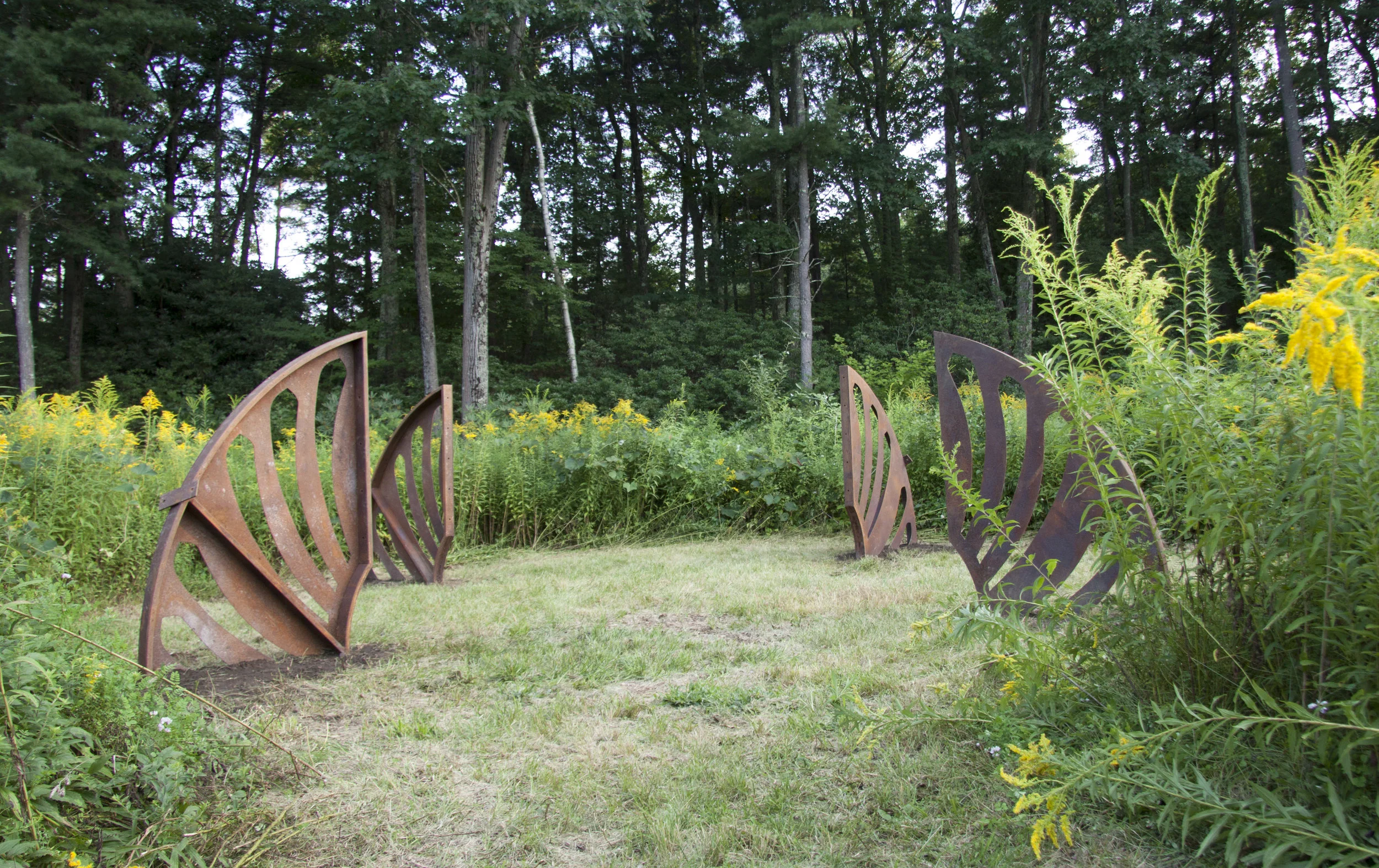
This installation has castings of flotation devices, wood beams suggestive of the old ship, and a collage in the center of the spiraling metal: it is complex and multi-layered. Scrap would be bringing to the farm only the fabricated metal now in four pieces. Sculptors often take apart old sculpture and reuse its materials. I like to re-purpose parts from sculptures in storage, drawn to pieces that I may not have finished my conversation with. Scrap had sent me photos of these four large elements early on. They made me think 'wings' or 'fins'. Though I had no idea what she would do with them, I trusted in the integrity of her artistic vision.

Scrap (left) and Jo.
On Wednesday morning, Scrap and Jo unloaded the U-Haul, loaded Blase's pick-up, and we drove around the pond to their site. That’s where I left them—with a digging bar and shovels, on a hot day. They worked till the Japanese bells sounded for lunch. Dirty, hot, and with two ‘wings’ installed, they went back to work with Holly Ciganiewicz, one of our farmers, and completed the installation just before five o’clock, when we planned to take a swim in Bear Hill Pond.
The working title is Ground Space. These four forms, dug deep into the earth, each rise like a whale’s dorsal fin and transform the space. When you walk among them, around them, or stand in the center, a curious energy also rises and surrounds you, as if walking in a biosphere. But I won’t say anymore. You have to experience it for yourself. Scrap Wrenn is one of the thirty-seven artists whose work will be on exhibit at the farm for our annual outdoor sculpture walk.
Around the Pond and through the Woods opens on Friday, September 7 and will be open to the public on Fridays, Saturdays, and Sundays, 11—5 pm through October 7. If those times don't work for you, we can make other arrangements for your visit. For information about the exhibit and other fall events at the farm check out our website. I’m excited to share this year’s exhibit with you.
Off-the-Wall Comments from an Ignorant Farmer
Hugh Williams is an orchardist I admire. When I read his email reply to my recent blog about our difficulties with the apple crop, I knew I wanted to share some of his insights. I wrote to ask if I could quote him. “Of course you can use my name. More off-the-wall comments from an ignorant farmer!” was his reply.
Hugh and his wife, Hannah Ball, and their two children grow fruits and vegetables and raise a small herd of cows at Threshold Farm in Duchess County, New York. Everything they do is touched by the biodynamic practices first introduced to the world in the early 1900s by the philosopher-farmer, Rudolph Steiner. Hugh started farming on his family’s farm in Australia in the early 1960s. He has learned through careful observation what his plants and animals need to flourish.
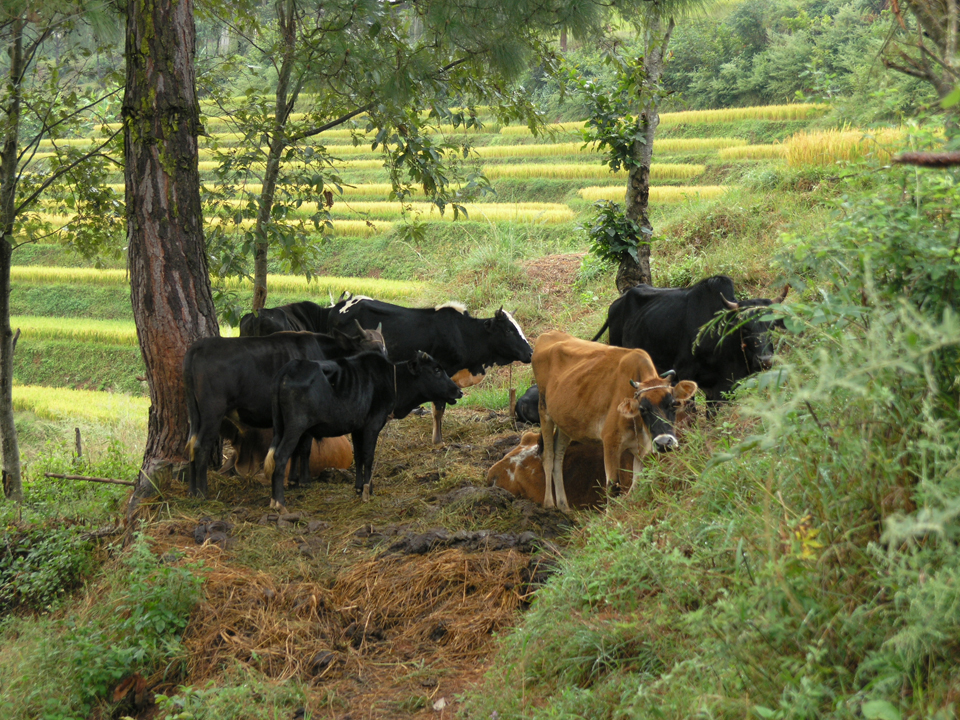
Cows in Bhutan ( Possibly the world's first organic country within the decade) Photo:LH
I first met Hugh at the annual Holistic Apple Growers meeting in western Massachusetts. At the beginning of each meeting, Michael Phillips, the organizer and champion of holistic apple growing, greets everyone and suggests we go around the room and introduce our orchards. The first year I attended, Bill McKintley from Potsdam, New York, then the owner but now retired, of St. Lawrence Nurseries, began. John Bunker, who runs Fedco trees in Maine spoke next. John lives in Palermo, Maine, and is passionate about Maine’s heirloom varieties. Brian Caldwell, a grower in New York, is an organic vegetable researcher at Cornell University. He has two small orchards near his home. I was intimidated when my turn approached.
“I recently moved to a farm with an abandoned apple orchard,” I said, “and I am trying to bring it back, using only organic materials. But I’m a sculptor, and I don’t know anything about apples. “
Everyone was polite; no one hinted I might be getting in over my head.
“How many trees do you have?” asked a handsome man with an Australian accent. That was Hugh Williams. When it was Hugh’s turn to speak, I remember he said he had been growing apples for forty years, and added coyly, “I’m waiting for the day I can be rid of my sprayer.” I wrote that down.
Over the last decade, Hugh has attended every apple growers meeting. Hugh always brings something original to our gatherings, a new enthusiasm, some relationship he hadn’t noticed before, an insight as to how a plant or animal grows. His cows are grass fed, and the calves run with the herd. An interviewer wrote, “We even saw Hugh milking from one side of a cow while a calf was nursing from the other side.”
Hugh knows about challenges. He and his family live solely off the profit from their farm. In a bad year, they have to be creative. Hugh wrote, “We have a very poor apple crop too, except on a few varieties. Enough for our fruit share members, and we have great plums, peaches and pears so we'll eke our way through another year.”
I had written that our crop failure was in part due to biennial production because we don’t thin the fruit from the mature trees. Hugh answered, “For us it was mostly poor pollination. There were no insects, even on the dandelions!” Hugh and Hannah think it's a “global phenomenon” and referred to a “thinning” of the insects. Hugh reminded me that when you stop at a gas station today, there is no longer the need to clean your windshield. It used to be de rigeur, so many squashed insects stuck to the glass. Where did these bugs go? I never clean my windshield anymore.
I think of the avalanche of toxic chemicals we have been releasing onto our planet every day since the end of World War II. The companies that made nerve gas and other toxic materials needed to change their product line in order to continue operating. Someone had the brilliant idea to manufacture chemical pesticides, herbicides, and fertilizers for the farmer. The corporate world is concerned with the bottom line. Inside brick and steel buildings, workers lose all connection to the natural world, to the subtlety of light, to beauty, to the richness of the insect, plant, and animal worlds, to the future of our children.

Two Girls in the Market, Bhutan Photo:LH
There is an article in the July 25, 2014 issue of Science, Defaunation in the Anthropocene. Defaunation is a new word used to describe not only the disappearance of a species but the decline in numbers. Farmers like Hugh and Hannah Williams don’t need scientific studies.
Hugh ended his note saying,
It raises the question of what actually is the function or purpose of agriculture, which certainly is not inherently tied to money, nor perhaps even to cropping! Our spiritual purpose becomes ever closer and more concrete. While yes, our farm is a temple precinct, we cannot avoid the conclusion it is also the very sensitive canary in the coal mine.
Hugh’s spirituality infuses his farm and all who know him, providing deep sustenance to all creatures. He shares his ideas easily, even when they are counter to how much of the world thinks. I admire Hugh because he cultivates the physical demands of being a farmer—the hard work, the selling, the making a living—all with dexterity and wit, and he attends equally to the spiritual, with passion and reverence. Perhaps he would say, these two realms are connected, or are in fact, one and the same. Maybe, that is why his farm is named Threshold, a place of connection between inner and outer, earth and sky, the physical and the spiritual, the material and the ethereal.

Turning a large Prayer Wheel, Bhutan Photo:LH
Search Blog
-
2025
- May 9, 2025 A View from the Tractor Seat
- Apr 11, 2025 Dig
-
2024
- Jan 7, 2024 Winter Wassail
-
2022
- Dec 11, 2022 Keeping Time
- Jun 17, 2022 This Apple-Shaped Earth
- Jan 23, 2022 What is a Jizo?
- Jan 16, 2022 An Invite and Housekeeping Update
- Jan 1, 2022 The Year of the Frog: What Orchardists Do While Apple Trees are Chilling
-
2021
- Oct 24, 2021 Figs
- Oct 3, 2021 The Artist and the Orchard: A Memoir
- Aug 8, 2021 Red-Fleshed Apples
- Jul 25, 2021 When We Were Trees
- Jun 27, 2021 Castor Beans—Who Knew?
- Jun 13, 2021 Spring Training at a Zen Monastery
- May 4, 2021 Our Trees are in Bloom
- Apr 18, 2021 Hooray!
- Jan 24, 2021 Wassailing, virtually!
- Jan 1, 2021 Sitting
-
2020
- Dec 21, 2020 Darkness to Light
- Nov 28, 2020 One Heart
- Sep 18, 2020 Juggling Flowers, Fruit, and Vegetables
- Aug 23, 2020 Refuge
- Aug 9, 2020 Bags of Fertilizer
- Aug 2, 2020 The Sermon of the Blue Heron
- Jul 26, 2020 What's the Buzz?
- Jul 19, 2020 Farm Moments
- Jul 12, 2020 Lost Wax
- Jul 5, 2020 Catalpa: The Hugging Tree
- Jun 28, 2020 Pedaling Peace
- Jun 21, 2020 See Change
- Jun 14, 2020 Lalla Unveiled
- Jun 7, 2020 Pond Alchemy
- May 31, 2020 The Birth of Fruit
- May 24, 2020 An Artist in the Orchard
- May 17, 2020 Walking the Land: Returning Home
- May 10, 2020 Stinging Nettles: Gifts from the Great Mother
- May 3, 2020 The Mystery of Swallow
- Apr 26, 2020 Aerial Bruststrokes
- Apr 19, 2020 Simple Pleasures
- Apr 12, 2020 Weeds and Other Gifts
- Apr 5, 2020 Remembering the Seeds
- Mar 29, 2020 Blow on the Embers
- Mar 22, 2020 Ripples
-
2019
- Nov 16, 2019 Tibet Impressions
- Nov 9, 2019 Forest Tales
- Oct 13, 2019 The Gift
- Aug 4, 2019 The Season is Apples, Berries, and Grandfather Fire
- Jun 8, 2019 Pointers for a Writing Life
- May 12, 2019 Mothers of the Earth
- Apr 6, 2019 The Apple-Shaped Earth
- Mar 23, 2019 You Don’t Know What You Have Till It’s Gone
- Feb 23, 2019 Generations
- Feb 9, 2019 What Are We Doing to the Earth, John Chapman?
-
2018
- Dec 31, 2018 Long Shadows
- Oct 6, 2018 A Pilgrimage to India
- Aug 18, 2018 Scrap Wrenn
- Aug 11, 2018 Off-the-Wall Comments from an Ignorant Farmer
- Jul 28, 2018 Creative Connect
- Jul 14, 2018 How is the Orchard?
- Jun 30, 2018 Which Way?
- Jun 16, 2018 Geese, Herons, Beavers, and the Baby Steps of a Lapsed Blogger
- Feb 24, 2018 Mama's Coupons — Good Forever
- Jan 27, 2018 January Ice
- Jan 13, 2018 The Muse
-
2017
- Dec 30, 2017 A Dream for the New Year
- Dec 23, 2017 A New Year for Apples
- Dec 16, 2017 Intuition
- Nov 22, 2017 Thanksgiving OM
- Nov 4, 2017 East Fork Pottery
- Oct 28, 2017 Putting Down New Roots
- Oct 21, 2017 A is for Art
- Oct 14, 2017 Eve domesticus
- Oct 7, 2017 A String Workshop
- Sep 30, 2017 After Applepicking
- Sep 23, 2017 Two Bad Women and One Good Apple
- Sep 16, 2017 Plein Air Poetry
- Sep 9, 2017 Cutting Off a Leg
- Sep 2, 2017 The Changing Landscape
- Aug 26, 2017 All About Art
- Aug 19, 2017 My First Visit to the Farm
- Aug 12, 2017 The First Food
- Aug 5, 2017 A Teapot, a Woman, and maybe a Boat
- Jul 29, 2017 A Raspberry Dilemma
- Jul 22, 2017 Consider the Miracle
- Jul 15, 2017 Meeting Ekphrasis
- Jul 8, 2017 Ripening Fruit
- Jul 1, 2017 The Voice of The Caterpillar
- Jun 24, 2017 Goumi — An Unusual Fructus
- Jun 17, 2017 Concord, an American Bloomsbury
- Jun 10, 2017 The World Is Bonkers — Shall I Laugh or Cry?
- Jun 3, 2017 Bonkers, a Revolutionary Apple
- May 27, 2017 Guardians of the Swamp
- May 20, 2017 There are Mushrooms and There are Morels
- May 13, 2017 "What's in a Name?"
- May 6, 2017 Bloom Follows Pink: Orchard Pollination
- Apr 29, 2017 The Orchard Is at Pink
- Apr 22, 2017 Natural Farming — Part 2 (continuation from last Sunday's blog)
- Apr 15, 2017 Natural Farming — Part 1
- Apr 8, 2017 Boats, Figures, and Catching Fish
- Apr 1, 2017 A Man with a Mission: The Nuts and Bolts of Bronze Casting
- Mar 25, 2017 A Chalice of Spirit, Art, and Nature
- Mar 18, 2017 Hanami — Blossom Viewing
- Mar 11, 2017 Soil Redemption Song
- Mar 4, 2017 Food is Primary Care
- Feb 25, 2017 Pomme de Terre
- Feb 18, 2017 Organic Certification
- Feb 11, 2017 Tantalizing Fruit
- Feb 4, 2017 The Myths of History
- Jan 28, 2017 The Orchard in Winter
- Jan 21, 2017 The Hi-Line
- Jan 14, 2017 Artistic, Botanical, and Social Diversity
- Jan 7, 2017 Where is Eden?
-
2016
- Dec 31, 2016 The Creative Heart
- Dec 24, 2016 A Christmas Tale
- Dec 17, 2016 Who are the Crones?
- Dec 10, 2016 The Olympic Bell (Part Two)
- Dec 3, 2016 Overheard in the Apple Orchard in Early December
- Nov 26, 2016 The Lessons of a Tortoise
- Nov 19, 2016 In the Studio
- Nov 12, 2016 Even in Darkness
- Nov 5, 2016 Southern Apples, an Elephant, Monkey, Rabbit, and Bird, Two Mango Trees and a Birthday
- Oct 29, 2016 The Tools of Art
- Oct 22, 2016 Labyrinths
- Oct 15, 2016 Repairing the Broken
- Oct 8, 2016 When You Are No More
- Oct 1, 2016 Creation Rain
- Sep 24, 2016 Breaking the Glass
- Sep 17, 2016 String Art
- Sep 10, 2016 Poetry and Photosynthesis: It's all in the Leaves
- Sep 3, 2016 In the Plenty of Time
- Aug 27, 2016 Witch Doctors
- Aug 20, 2016 Listen Coyote
- Aug 13, 2016 Milkweed in the Orchard
- Aug 6, 2016 Some People See a Turtle
- Jul 30, 2016 Arborshaping
- Jul 23, 2016 Joseph Wheelwright: Sculptor of Stones and Trees
- Jul 16, 2016 Asian Pears
- Jul 9, 2016 Gold Leaf, Grief, and the Creative Process
- Jul 2, 2016 The Olympic Bell (Part One)
- Jun 25, 2016 Around the Mulberry Bush
- Jun 18, 2016 Avoiding Apples
- Jun 11, 2016 Fructus
- Jun 4, 2016 Astonishing Apples
- May 28, 2016 Scare the Caterpillars
- May 21, 2016 Join the Club!
- May 14, 2016 The Graft
- May 7, 2016 Rooster, Rhubarb, Rue
- Apr 30, 2016 What do Dolphins and Nettles Have in Common?
- Apr 23, 2016 Art Prunings
- Apr 16, 2016 A Few of the First Arrivals
- Apr 9, 2016 Taste the Spirit of Sustainable Agriculture
- Apr 2, 2016 First Orchard Spray - March 22-24, 2016
- Mar 26, 2016 Hawkeye Apple
- Mar 19, 2016 Desiring the Almata Apple
- Mar 12, 2016 Ugly Fruit
- Mar 5, 2016 Winter Tracks
- Feb 27, 2016 Splash
- Feb 20, 2016 Pruning
- Feb 13, 2016 Orchard Ruminants
- Feb 6, 2016 A Gathering of Seeds
- Jan 30, 2016 Orchard Dragons
- Jan 23, 2016 Tree Rings
- Jan 17, 2016 The Fallen Tree
- Jan 7, 2016 Wassailing the Apple Trees
- Jan 1, 2016 The New Year