LINDA HOFFMAN
The Creative Heart
I watched as my son, Alex, carefully undid the wrapping, opened the wooden box, and lifted a corner of the quilted cloth. On his face, I saw a strange look of disbelief. “It’s broken,” he said. Now it was my turn to be stunned. The beautiful ceramic bowl sat in broken shards on its rose-colored cloth. I was crushed and horrified. It felt like a betrayal.
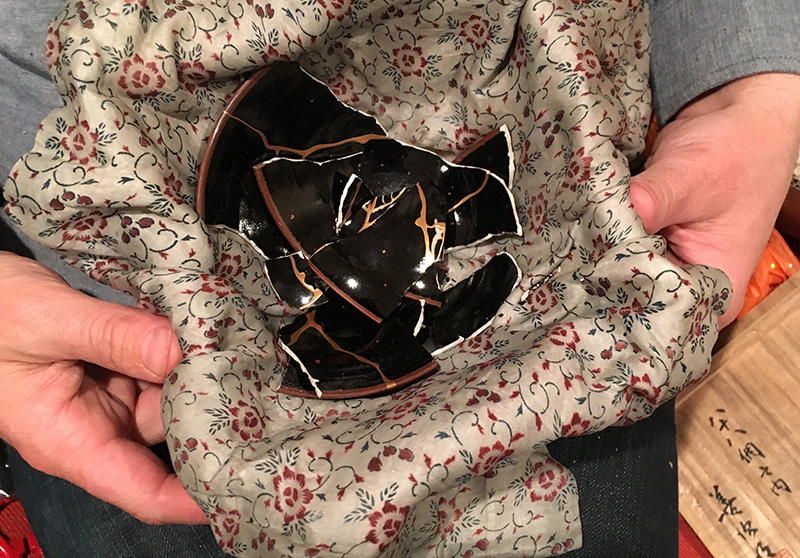
A few months ago, I wrote a blog about Kintsugi — the Japanese art of repairing a broken bowl with gold. For Christmas, I offered a Japanese tea bowl that had been repaired using this method, to Alex and my daughter-in-law, Connie. I felt it would be a meaningful gift as they embarked on married life together. With baby Vita now a hear and half, a new baby on the way, and the opening of a store in Asheville, North Carolina, East Fork Pottery, their life is full. I thought of the Kintsugi bowl with its veins of gold as a symbol of creatively and beautifully overcoming challenges.
A week later, I was still feeling badly about how my gift turned out. I thought to myself, I should make something with these shards — a sculpture — and give it to them. I mentioned my idea to Alex and he seemed a little put off — then he said, “Yes, um, we should do a repair.” And I understood that he wanted to repair the bowl himself. I had kept it anticipating that I would return the broken shards to the gallery, but they graciously refunded the price I had paid. We decided to talk about it in early January when we will next be together.
Everything in our world is impermanent. Wood turns to ash and fallen leaves to compost. The broken pot shards can become something else. Accepting change is about no longer being stuck in what was, but moving on. This moving on is the awakening of our creative heart.
I know that my well-being depends on feeling that I have connected to that place of creativity inside my heart. With days of less meaningful doing, I begin to fall into this dark abyss of my own mind. I become disjointed, my body altogether not my body, my limbs connected like a puppet. I don’t act with spontaneity and wholeness. I can be in the most beautiful place and if I don’t feel connected to it, I can’t appreciate it because I block the beauty from entering my bones. I can be in the most loving relationship and not allow this love to enter.
Each creative act makes use of something that is unresolved in our hearts. Each creative act makes the world whole. In this new year, let’s make whatever is broken whole again. We don’t, in fact, can’t know what it will look like. Who would ever imagine that a river carved a canyon that enthralls millions of people thousands of years later. I can’t imagine what will possibly come out of this box of pot shards, but this is precisely the process that heals broken places and turns them into art.
In this new year, I’d like to remember that broken bowl when I find myself slipping away from my creative heart, when I feel alone and cut off. For I know that in doing the work I will find my way back. We all share this longing that is deeply human, that beseeches us to be fully our own life, to belong completely to the entirety. Our longing is the gift we can offer.
When I started this weekly blog, Apples, Art, and Spirit, one year ago, I thought it would be a one-year project and I would be using the orchard as a springboard to write. With 2016 being a year of no apples, they have been a very silent partner. I’ve decided to commit to another year, and hopefully with some good winter chill, we will have an apple crop and there will be more apple-inspired writing. Please join me, share the blog with your friends, and together let’s lift the corner of the new year, white, and pure, and unknown. It’s ours to create for the very first time.

A Christmas Tale
Babushka is a fairytale set in Russia about a little, old woman. It begins on a snowy and cold night inside a little hut with a warm fire and a rocking chair, and Babushka sitting and rocking quietly when she hears a knocking on her door. In Russia, on a cold winter night, Babushka knows it would be rude not to open the door. She rises from her chair, shuffles over, and opens it. Three colorfully dressed men are cold and wet and hungry and she invites them in. They stomp in with snow and mud and muck on their boots. She feeds them and lets them warm themselves by the fire. Then they tell Babushka why they have come.
“We have come here to ask you to join us. We are wise men and we have studied the stars. We know that a baby will be born tonight in Bethlehem — the Prince of Peace. We were told to stop here and bring you with us.
“What do you have in those wrapped boxes?” she asked.
“We are bringing gifts of frankincense, myrrh and gold, to the newborn child.”
“Oh, I am an old, old lady and my blood is thin and it is cold. I can’t go cavorting out in this weather.”
Annoyed by the intrusion of the three wise men into her peaceful evening, and ashamed because she had no gift for this Prince of Peace, Babushka showed the men to the door and sat back down on her rocker.
She rocked and she rocked, but she was agitated. Why would I want to see this Prince of Peace, she asked herself? Then she imagined this wee baby and her heart opened.
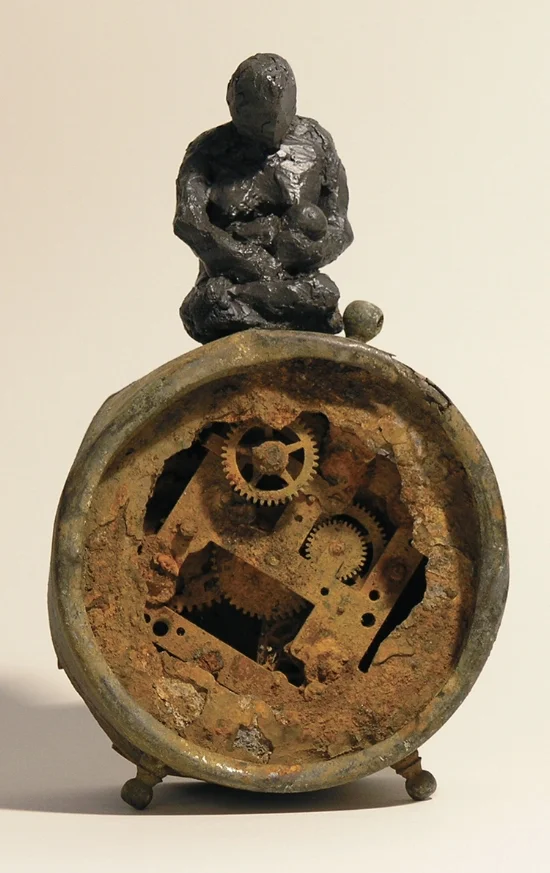
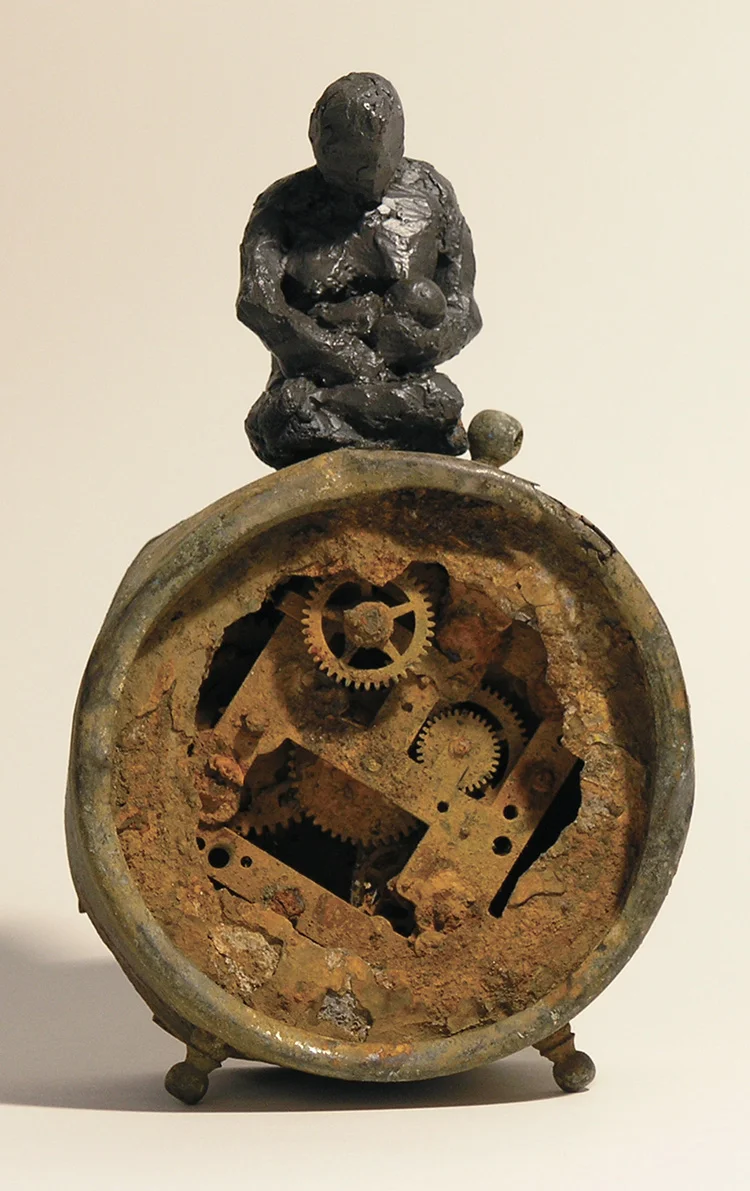
Nursing TIme, Bronze figure and rusty alarm clock, LH
She did have something for the newborn child. No spices and jewels, but, in her closet she had baby clothes, baby blankets, toys, and trinkets — all kinds of things she had saved after her own child had died.
“I will go with them,” she decided. “I will leave in the morning and find these three wise men.”
Babushka set out at sunup wearing all she could fit on her body. Three pairs of socks, three vests, three coats, and a big red shawl over her head and tied around her neck. In a big basket she carried toys and trinkets, blankets and sheets for the baby. She asked everywhere she went if anyone had seen the three wise men, but no one had. Babushka stopped along her way, offering a gift to every household with child.
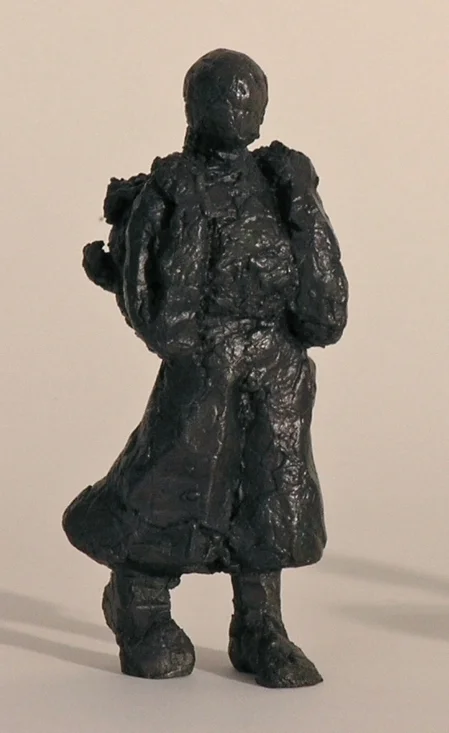
Woman Walking, Bronze Figure, LH
Babushka never caught up with the three wise men, and she never made it to Bethlehem that Christmas morning. But she continued on, walking always to the next house, always farther, trudging onward. Babushka continues to this very day. Every Christmas morning she brings toys and gifts to families with children.
The odd history of this story is that it is not commonly known in Russia, and seems to have been created by the American poet, Edith Matilda Thomson. Apparently Thomson’s poem was so popular it was retold and retold, until the origin of the tale was lost. Which brings me to wonder about our own Santa Claus.
When I looked up the origin, I came upon the book, Santa Claus, Last of the Wild Men: The Origins and Evolution of Saint Nicholas, Spanning 50,000 Years, by Phyllis Siefker. The author makes a case that Santa Claus is not related to jolly old Saint Nicholas, originally from Turkey, but belongs to a lineage of ‘Wild Men’ who were worshiped in fertility rites and came to America with German immigrants who settled in Pennsylvania. Siefker’s Santa Claus belongs to the line of pagan heroes like Robin Hood and Puck, and to harlequins and jesters and those wild men wearing goat skins and bear fur. Perhaps even our own Johnny Appleseed with his horny feet and tin hat shares these same ancestors.
We remember these ‘wild men’ most of all for their generous spirit — food for the poor, trees for the settlers. And we remember Babushka because she transformed her personal loss and loneliness into an offering of love. Babushka has never stopped giving. This is the real message of the Prince of Peace.
Merry Christmas!
Who are the Crones?
We are the crones, the old and wrinkled, wise ones. We have many names— Hecate, Spider Grandmother, Demeter; Siren, Gaea, and Oracle. We wait at the crossroads. We praise and encourage the living, we honor and care for the dying. In times of darkness, we know spring will return.
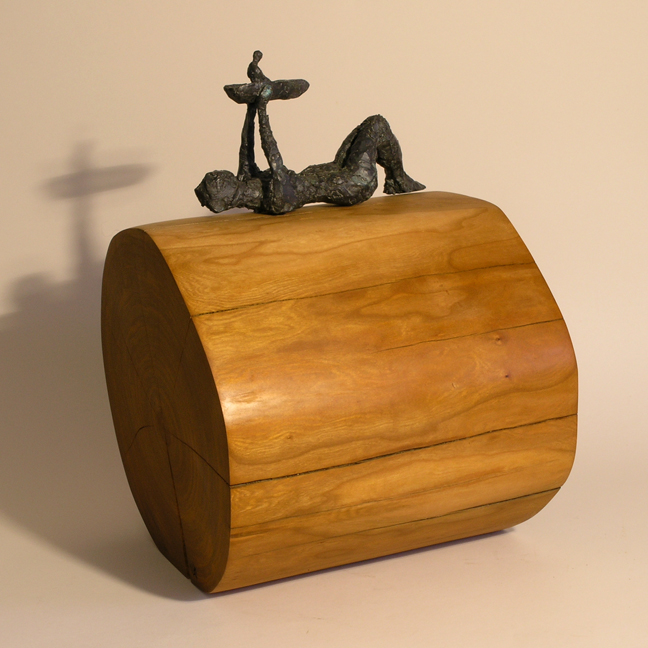
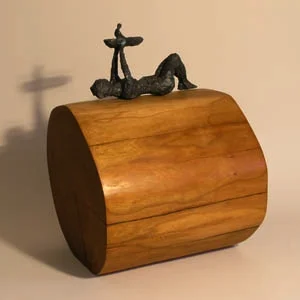
Woman Launching Boat, bronze sculpture, cherry wood, LH
At the time of the winter solstice ancient people believed that we must help the Light to be reborn. In many cultures, the crones facilitated this return. Women carried the mystery of life and death; women labored to guide back the sun.
Then things changed and men took control of women, especially in matters of religion.
Buddhism has traditionally followed the established social norms of the patriarchy into which the Buddha was born. When the Buddha established the rules for his followers, he differentiated between nuns and monks. Any nun, no matter how old or enlightened, had to bow down to a monk, even a novice. In Zen monasteries, the lineage of the transmission from one male teacher to the next has always been chanted as part of the service. Recently, things are changing. At Zen Mountain Monastery we now chant the names of the enlightened women of the way in addition to the male lineage. There were many great and compassionate teachers who taught students both male and female. Today, we have an altar in the front of the meditation hall for Mahapajapati, the first Buddhist nun and teacher.
I began to think about other groups of women left unsung. In the American frontier world, Johnny Appleseed is a celebrated hero. He stands out as a bold revolutionary, spreading seeds and saplings, helping the settlers establish ownership to land by planting an orchard, and sharing his beliefs based on the Swedenborg religion. But who are the frontier women who helped create this country? I found a few famous names—Belle Star, Poker Alice, Pearl deVere, Annie Oakley, Etta Place, and Calamity Jane. Belle was known for riding in a black velvet dress, six guns on her hips, and holding up stagecoaches. Poker Alice—you guessed it—was a devilishly good poker player, and bordello owner. Pearl deVere operated The Old Homestead, a lavishly upscale brothel in Cripple Creek, Colorado. You get the picture. Nice women don’t make history, but the names we choose to remember determine the history we remember.
The myths of ancient people are filled with stories of goddesses whose powers equaled that of their male counterparts. The history of women in the West is much more than brothels, bars, and Wild West shows. It is the story of hardworking American women, Native American women, Spanish-Mexican women, and the Chinese immigrant women who were sold and shipped to California by their impoverished families to work in laundries, bars, and mining camps. We need to remember all of these women and what a dark place the world has been for so many of them.
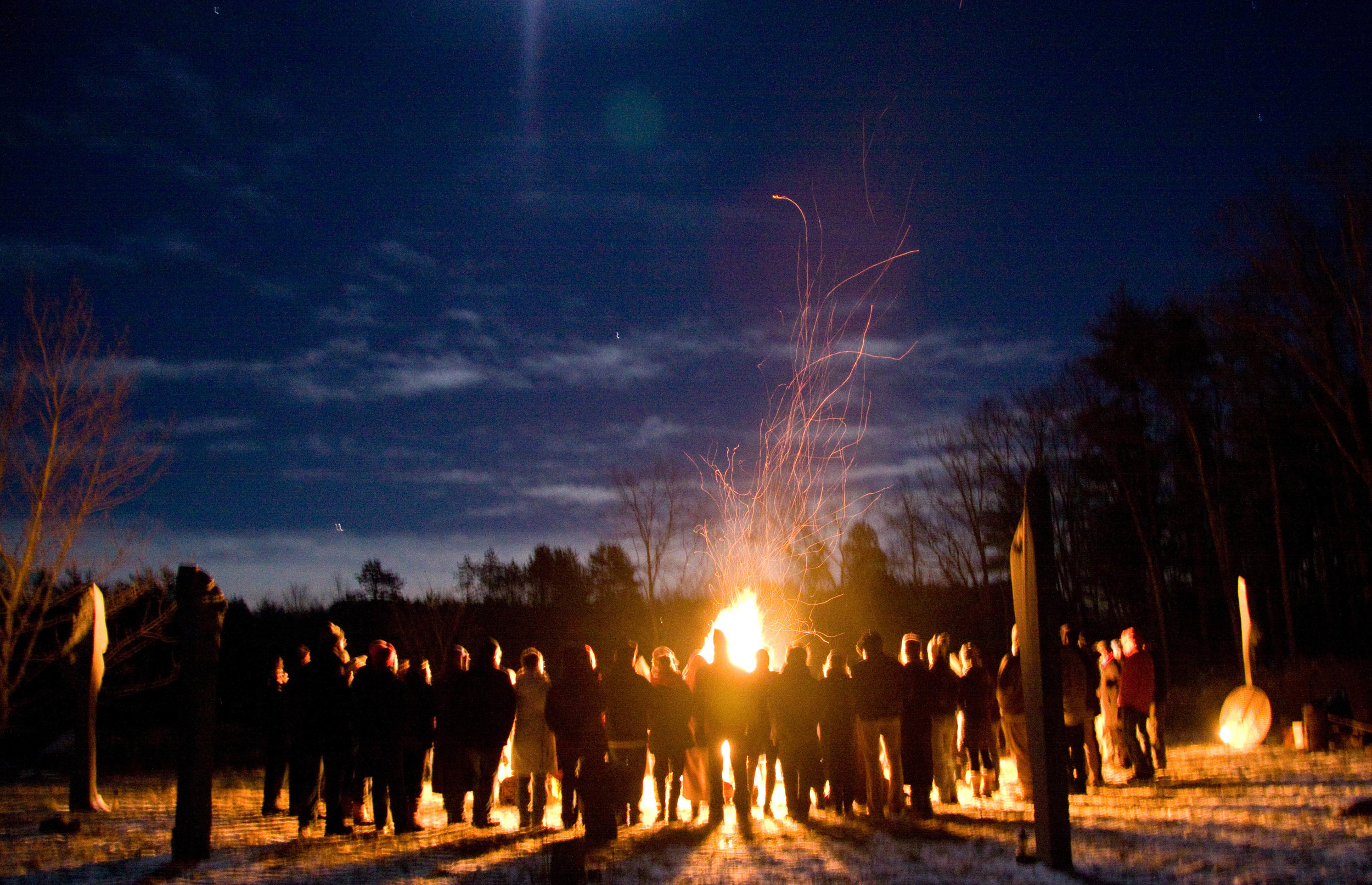
Solstice Fire, Old Frog Pond Farm, photo: Alexis Pappis
December 21st is the winter solstice, the darkest day of the year. At the farm we have a solstice fire where we reenact the return of the sun. In our ritual, it is the crones who go on a journey to find the sun and rebirth the Light. The crones remind us that there are many kinds of darkness. The darkness of racism and sexism, of hatred and war, of injustice, of sorrow and loss. The crones also remind us that there is darkness inside each of us, as well as a light. It is from this light, this often forgotten or darkened light, that the Goddesses labor, and birth the sun. Like Demeter knowing that she will be rejoined with her daughter, Persephone, we need to trust that the light will return, grief will be healed, and plants will bear fruit again.
Carl Jung said, "One does not become enlightened by imagining figures of light, but by making the darkness conscious." In remembering the names of those women who are forgotten, we shine light into the darkness of their cultural obscurity. As we light the solstice fire, we bring light to this world stamped with anger, aggression, and force. In gathering and opening our hearts to one another we grow the light. Happy Solstice!
The Olympic Bell (Part Two)
Last night I shared dinner with two friends, Mike and Ron. We sat around Ron’s dining room table surrounded by a Castor plant with its reddish feathery leaves, the large spear-leaves of a Bird of Paradise, the succulent greens of an enormous Clivia, and the large strong vines of a Night Blooming Cereus. Ron Kearns, a landscaper and plant lover, designed and planted the wildflower garden around the Olympic Bell that is in a quiet grove between our two houses.
The Olympic Bell is an installation by Paul Matisse, my former husband, that now permanently resides at the farm. Paul designed and built the bell for the Olympics in Greece, where it was installed below the Acropolis. I wrote a blogpost, The Olympic Bell – Part 1, during its installation at the farm and posted a photo of its installation in Athens. Now, I want to share its incarnation among New England’s version of stone columns, our majestic white pines.
The installation went smoothly, the bell rang all summer and fall as visitors to the farm discovered its magic and walked away carrying some of its powerful embodiment of depth and conviction. Some people visited it for the first time, and then returned again bringing their friends and family. The bell offers that kind of gift.
I walk out usually once a day to give it a ring, noticing on my way the footprints of other creatures like deer and beaver who make this same excursion. I enter the bell’s grove, stepping over the flat rock threshold. Pulling on its mighty rope, I like to lift the heavy hammer once, let it fall back, and then give a strong, long heave, letting hammer and bell meet. The sound penetrates down from my head and rises through my feet meeting somewhere in my heart space. It’s a deeply satisfying sound, as its maker describes it. I am filled with weight as I take it in. I feel the responsibility and greatness of being alive on this earth.
My friend, Linda Fialkoff, rang the bell and then sent me these words that expressed its sound.
Oceans
Cosmos
Aeons

Linda Fialkoff Ringing the Bell
Another friend said, “You know, Linda, I think it should have another name.” I looked at her in surprise, but asked, “Well, what would you call it?” She paused and then said, “The Earth Bell.” I thought, that does describe it. It is a bell of the earth.
Ron made us vegetarian chili, opened a bottle of red wine, passed a plate of grated cheese, chopped cilantro and avocado. Mike, the other guest, brought thick fried spicy potatoes with onions. I asked Ron what he wanted to do for the next ten years, but he turned the question back to me.
“I want to get my book published.” The words flew out out before I gave it any thought. I have been writing this book for at least five years, and it is time to finish it and move on. The memoir begins when I leave my marriage of twenty years to Paul and move to this small farm in Harvard with an old apple orchard. In bringing back the orchard, I connected to part of myself that was underground, a seed waiting for fertile ground to put out my first tender rootlet. With the bell’s arrival on the farm, it feels like a completion of all that I was trying to understand and share in the writing of the book.
We each have our own way of connecting to our creativity, the seeds deep within. They need our nurturing, and it does take persistence and patience. The wildflower garden that Ron designed and installed creates a sacred grove that takes you outside of the farm, away from time. The sound of the bell opens the door to that fertile field.
You are welcome to come by and ring the bell anytime. Park in the usual spot and walk around the pond. If you have never been here and don't know where to go, please ask. Let’s keep sounding the bell and let its deep sonorous tone fill the air, creating more space for our deepest seeds to resound.
Search Blog
-
2025
- May 9, 2025 A View from the Tractor Seat
- Apr 11, 2025 Dig
-
2024
- Jan 7, 2024 Winter Wassail
-
2022
- Dec 11, 2022 Keeping Time
- Jun 17, 2022 This Apple-Shaped Earth
- Jan 23, 2022 What is a Jizo?
- Jan 16, 2022 An Invite and Housekeeping Update
- Jan 1, 2022 The Year of the Frog: What Orchardists Do While Apple Trees are Chilling
-
2021
- Oct 24, 2021 Figs
- Oct 3, 2021 The Artist and the Orchard: A Memoir
- Aug 8, 2021 Red-Fleshed Apples
- Jul 25, 2021 When We Were Trees
- Jun 27, 2021 Castor Beans—Who Knew?
- Jun 13, 2021 Spring Training at a Zen Monastery
- May 4, 2021 Our Trees are in Bloom
- Apr 18, 2021 Hooray!
- Jan 24, 2021 Wassailing, virtually!
- Jan 1, 2021 Sitting
-
2020
- Dec 21, 2020 Darkness to Light
- Nov 28, 2020 One Heart
- Sep 18, 2020 Juggling Flowers, Fruit, and Vegetables
- Aug 23, 2020 Refuge
- Aug 9, 2020 Bags of Fertilizer
- Aug 2, 2020 The Sermon of the Blue Heron
- Jul 26, 2020 What's the Buzz?
- Jul 19, 2020 Farm Moments
- Jul 12, 2020 Lost Wax
- Jul 5, 2020 Catalpa: The Hugging Tree
- Jun 28, 2020 Pedaling Peace
- Jun 21, 2020 See Change
- Jun 14, 2020 Lalla Unveiled
- Jun 7, 2020 Pond Alchemy
- May 31, 2020 The Birth of Fruit
- May 24, 2020 An Artist in the Orchard
- May 17, 2020 Walking the Land: Returning Home
- May 10, 2020 Stinging Nettles: Gifts from the Great Mother
- May 3, 2020 The Mystery of Swallow
- Apr 26, 2020 Aerial Bruststrokes
- Apr 19, 2020 Simple Pleasures
- Apr 12, 2020 Weeds and Other Gifts
- Apr 5, 2020 Remembering the Seeds
- Mar 29, 2020 Blow on the Embers
- Mar 22, 2020 Ripples
-
2019
- Nov 16, 2019 Tibet Impressions
- Nov 9, 2019 Forest Tales
- Oct 13, 2019 The Gift
- Aug 4, 2019 The Season is Apples, Berries, and Grandfather Fire
- Jun 8, 2019 Pointers for a Writing Life
- May 12, 2019 Mothers of the Earth
- Apr 6, 2019 The Apple-Shaped Earth
- Mar 23, 2019 You Don’t Know What You Have Till It’s Gone
- Feb 23, 2019 Generations
- Feb 9, 2019 What Are We Doing to the Earth, John Chapman?
-
2018
- Dec 31, 2018 Long Shadows
- Oct 6, 2018 A Pilgrimage to India
- Aug 18, 2018 Scrap Wrenn
- Aug 11, 2018 Off-the-Wall Comments from an Ignorant Farmer
- Jul 28, 2018 Creative Connect
- Jul 14, 2018 How is the Orchard?
- Jun 30, 2018 Which Way?
- Jun 16, 2018 Geese, Herons, Beavers, and the Baby Steps of a Lapsed Blogger
- Feb 24, 2018 Mama's Coupons — Good Forever
- Jan 27, 2018 January Ice
- Jan 13, 2018 The Muse
-
2017
- Dec 30, 2017 A Dream for the New Year
- Dec 23, 2017 A New Year for Apples
- Dec 16, 2017 Intuition
- Nov 22, 2017 Thanksgiving OM
- Nov 4, 2017 East Fork Pottery
- Oct 28, 2017 Putting Down New Roots
- Oct 21, 2017 A is for Art
- Oct 14, 2017 Eve domesticus
- Oct 7, 2017 A String Workshop
- Sep 30, 2017 After Applepicking
- Sep 23, 2017 Two Bad Women and One Good Apple
- Sep 16, 2017 Plein Air Poetry
- Sep 9, 2017 Cutting Off a Leg
- Sep 2, 2017 The Changing Landscape
- Aug 26, 2017 All About Art
- Aug 19, 2017 My First Visit to the Farm
- Aug 12, 2017 The First Food
- Aug 5, 2017 A Teapot, a Woman, and maybe a Boat
- Jul 29, 2017 A Raspberry Dilemma
- Jul 22, 2017 Consider the Miracle
- Jul 15, 2017 Meeting Ekphrasis
- Jul 8, 2017 Ripening Fruit
- Jul 1, 2017 The Voice of The Caterpillar
- Jun 24, 2017 Goumi — An Unusual Fructus
- Jun 17, 2017 Concord, an American Bloomsbury
- Jun 10, 2017 The World Is Bonkers — Shall I Laugh or Cry?
- Jun 3, 2017 Bonkers, a Revolutionary Apple
- May 27, 2017 Guardians of the Swamp
- May 20, 2017 There are Mushrooms and There are Morels
- May 13, 2017 "What's in a Name?"
- May 6, 2017 Bloom Follows Pink: Orchard Pollination
- Apr 29, 2017 The Orchard Is at Pink
- Apr 22, 2017 Natural Farming — Part 2 (continuation from last Sunday's blog)
- Apr 15, 2017 Natural Farming — Part 1
- Apr 8, 2017 Boats, Figures, and Catching Fish
- Apr 1, 2017 A Man with a Mission: The Nuts and Bolts of Bronze Casting
- Mar 25, 2017 A Chalice of Spirit, Art, and Nature
- Mar 18, 2017 Hanami — Blossom Viewing
- Mar 11, 2017 Soil Redemption Song
- Mar 4, 2017 Food is Primary Care
- Feb 25, 2017 Pomme de Terre
- Feb 18, 2017 Organic Certification
- Feb 11, 2017 Tantalizing Fruit
- Feb 4, 2017 The Myths of History
- Jan 28, 2017 The Orchard in Winter
- Jan 21, 2017 The Hi-Line
- Jan 14, 2017 Artistic, Botanical, and Social Diversity
- Jan 7, 2017 Where is Eden?
-
2016
- Dec 31, 2016 The Creative Heart
- Dec 24, 2016 A Christmas Tale
- Dec 17, 2016 Who are the Crones?
- Dec 10, 2016 The Olympic Bell (Part Two)
- Dec 3, 2016 Overheard in the Apple Orchard in Early December
- Nov 26, 2016 The Lessons of a Tortoise
- Nov 19, 2016 In the Studio
- Nov 12, 2016 Even in Darkness
- Nov 5, 2016 Southern Apples, an Elephant, Monkey, Rabbit, and Bird, Two Mango Trees and a Birthday
- Oct 29, 2016 The Tools of Art
- Oct 22, 2016 Labyrinths
- Oct 15, 2016 Repairing the Broken
- Oct 8, 2016 When You Are No More
- Oct 1, 2016 Creation Rain
- Sep 24, 2016 Breaking the Glass
- Sep 17, 2016 String Art
- Sep 10, 2016 Poetry and Photosynthesis: It's all in the Leaves
- Sep 3, 2016 In the Plenty of Time
- Aug 27, 2016 Witch Doctors
- Aug 20, 2016 Listen Coyote
- Aug 13, 2016 Milkweed in the Orchard
- Aug 6, 2016 Some People See a Turtle
- Jul 30, 2016 Arborshaping
- Jul 23, 2016 Joseph Wheelwright: Sculptor of Stones and Trees
- Jul 16, 2016 Asian Pears
- Jul 9, 2016 Gold Leaf, Grief, and the Creative Process
- Jul 2, 2016 The Olympic Bell (Part One)
- Jun 25, 2016 Around the Mulberry Bush
- Jun 18, 2016 Avoiding Apples
- Jun 11, 2016 Fructus
- Jun 4, 2016 Astonishing Apples
- May 28, 2016 Scare the Caterpillars
- May 21, 2016 Join the Club!
- May 14, 2016 The Graft
- May 7, 2016 Rooster, Rhubarb, Rue
- Apr 30, 2016 What do Dolphins and Nettles Have in Common?
- Apr 23, 2016 Art Prunings
- Apr 16, 2016 A Few of the First Arrivals
- Apr 9, 2016 Taste the Spirit of Sustainable Agriculture
- Apr 2, 2016 First Orchard Spray - March 22-24, 2016
- Mar 26, 2016 Hawkeye Apple
- Mar 19, 2016 Desiring the Almata Apple
- Mar 12, 2016 Ugly Fruit
- Mar 5, 2016 Winter Tracks
- Feb 27, 2016 Splash
- Feb 20, 2016 Pruning
- Feb 13, 2016 Orchard Ruminants
- Feb 6, 2016 A Gathering of Seeds
- Jan 30, 2016 Orchard Dragons
- Jan 23, 2016 Tree Rings
- Jan 17, 2016 The Fallen Tree
- Jan 7, 2016 Wassailing the Apple Trees
- Jan 1, 2016 The New Year