LINDA HOFFMAN
Figs
A few weeks ago, a friend gave me a New Yorker article: “Love the Fig” by Ben Crair from August 10, 2016. In the autumn issue of my favorite literary journal, Orion, the last essay was on the subject of figs. Why are all these figs coming into my life? Is it because I’m feeling naked as my memoir, The Artist and the Orchard, begins national distribution? Like Adam and Eve, I need to cover myself with fig leaves.
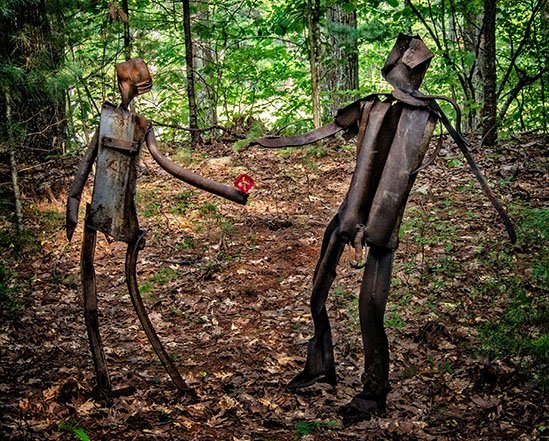
Adam and Eve, 2015 Sculpture by Madeleine Lord
We grow two fig trees at the farm. Right now they are outside my studio in clay pots, shedding their leaves and becoming naked themselves. Once we get consistent freezing temperatures, they will go into an unheated garage space. They’re not cold hardy; they can’t stay out all winter like all the other fruit trees.
Meanwhile, I have been reading about figs. As the fruit grower at the farm, I care for the figs. But I have learned that a fig is not a fruit, it is a flower. A flower that doesn’t strut its stuff like most flowers but hides its blossoms inside its fruit. The fig is an inside-out flower. And because of its uniqueness, it requires a unique insect for pollination.
The fig lives symbiotically with one insect, the only one that pollinates its unusual flower: a fig wasp. There are over 750 varieties of fig trees, and most of these have a unique fig wasp to pollinate their flowers.
The female wasp enters the fig through a tiny opening at the base of the unripe fruit. On her way in through this narrow opening her wings are clipped off. She will never fly again. Once inside the fig, she lays her eggs, and then dies all within a couple of days. When the eggs hatch, the males hasten over to the newly hatched females and fertilize them. Then the males tunnel out of the fruit and die shortly after. The young females follow these tunnels and fly out into the world to look for their own fig tree where they can lay their eggs. Of course, and importantly for the fig tree, they carry pollen from their birth flowers to the new flowers. And from these pollinated flowers grow the seeds of new fig trees.
Biologists say that the fig and fig wasp have been courting each other for more than 60 million years. And for almost as long, a broad range of animals have depended on figs as a food source. Figs in temperate climates fruit all year round, ensuring a steady food supply. They are loaded with minerals and vitamins, and have received the designation ‘superfood’ from humans. Of course, the animals knew this without our branding.
Foresters consider figs to be an important tree for deforested areas. With their quick growth, and attraction to many different species of animals: trees shrews, monkeys, bats, birds, hornbills, squirrels, to name a few, the pollinated seeds deposited from these foraging animals help to quickly create a diversified forest.
We had a small crop of figs this year. I wondered if there had been a fig wasp in the area. But then I checked, and the Chicago fig is one of a few varieties of figs that are self-pollinating. A few apples are also self-pollinating, but they produce a better crop with cross-pollination. We all do better with cross-pollination.

Two Figures on Cherry Wood, Sculpture LH Private Collection
Join me for the book launch for The Artist and the Orchard: A Memoir next Saturday, October 30 at 2 pm at Sanctuary in Maynard, Massachusetts. Proof of vaccination is required. For more information: https://www.sanctuarymaynard.com/.
If you can’t attend the launch, the book is available at your favorite bookstore, online, and at Loom Press. I am also happy to send you a signed copy.
Happy Fall!
The Artist and the Orchard: A Memoir
I now hold the book in my hands. I’m surprised by its slight weight, it’s smooth surface. The cover painting is a detail from a watercolor of the orchard and inside are the rows of trees: training in the Noh Theater in Kyoto, raising my children in the old Baptist church in Groton, Massachusetts, moving to Old Frog Pond Farm in nearby Harvard, restoring an abandoned orchard, Zen Buddhist training, and the important personal relationships that have shaped my life.

The book leaning against the wall sculpture, Repetition of Days, from “The Agricultural Tool Series.”
Like a sapling, this writing has taken years to bear fruit. I have written mostly in winter. However, soon after settling into a writing schedule, the first warmth fills the air and the farming season begins. The doing takes over—the weeding, the planting, the tending. I’ve had to learn patience. While the apple trees have had to withstand a freak October ice storm, vole attacks, and the confusion of spring coming far too early, I’ve also lived through challenging events. The hope, of course, is that I am a little stronger. After all, like the trees, we can learn to be resilient and generous despite the inevitable setbacks the wild beasts leave at our door.
Now the published book is here and I hope many of you will celebrate with me on Saturday, October 30th at 2 pm. We’ll meet at Sanctuary, a recently restored large church in the center of Maynard, Massachusetts. In keeping with the community of individuals of who have contributed to the becoming of the book, a few musicians and poets will share the stage with me. Seating will be around small tables and make it possible to maintain social distances. We’ll wear masks and vaccination certificates will be checked at the door (or a PCR test within three days.)
Copies of The Artist the Orchard: A Memoir will be for sale. If you have already bought one, come anyway and I’ll sign your book. If you live far away, the memoir is now available from the publisher, Loom Press, local bookstores as well as at bookstore.org and other online sites.
Enjoy the new season, and I look forward to sharing this event with you.

Red-Fleshed Apples
Update from a 2017 blog post.
When I moved to Old Frog Pond Farm, rows of Red Delicious apples grew in the back of orchard. An apple mentor told me our pick-your-own customers would not be interested in these apples. I could either pull the trees and replant—a lot of work, or topwork these trees—keep the trunk and roots and grow another variety on top. I preferred the latter.
To topwork an apple tree, you need scion wood—small twigs of first-year growth cut in winter from a dormant apple tree. I attended a scion wood exchange where I grabbed a twig of the Almata apple along with several other varieties that were spread across an old pool table. I chose Almata because it was named after one of the largest cities in Kazakhstan. Almaty means “full of apples” and sits against the foothills of the Tian Shan Mountains, the forests that are the birthplace of the apple we eat today. Returning home with my scion wood I grafted a number of Red Delicious tree. On one of them I grafted the Almata wood.

Scion wood in Red Delicious Trunk
The scion wood inserted all around the trunk grew, and three years later, this tree developed its first flower buds. Apple blossom buds are usually enrobed in a pink sheath, which then open to pale white flower petals. The Almata buds weren’t pink, but dark red, like the scarlet letter stitched on Hester Prynne’s chest in Nathaniel Hawthorne’s novel. Four days later, when the orchard was a cloud of white petals, this tree’s blossoms opened to a lovely pink. When the leaves came in, they were not green but a bronzy color similar to some crab apples. After pollination, its dime-sized apples were dark red, not green, like every other apple in the orchard.

Reddish Leaves on the Almata
All summer long I kept my eye on this tree. Friends walking with me through the orchard would remark, “What’s that?” pointing to the Almata. It was easy to see that this tree was marked. The apples were quite small, but perfectly formed and deep red. In mid-August, I stopped by the Almata to taste one of its fruits. My large bite of apple exposed red-colored flesh. It was crazy and wonderful, and all wrong. It didn’t look like an apple at all, but more like a plum. It was hard and sour, not yet ripe.
Charmed, I hurried back to the house to share my discovery with my family. I looked up Almata and learned that this red-fleshed apple was developed by Dr. Nels Hansen at the South Dakota Agricultural Experiment Station. Dr. Hansen was inspired to breed a red-fleshed eating apple after seeing a red-fleshed wild apple on an 1897 trip to Russia. The Almata is the cross he made between a Russian apple, the Beautiful Arcade and Fluke 38, a crabapple.
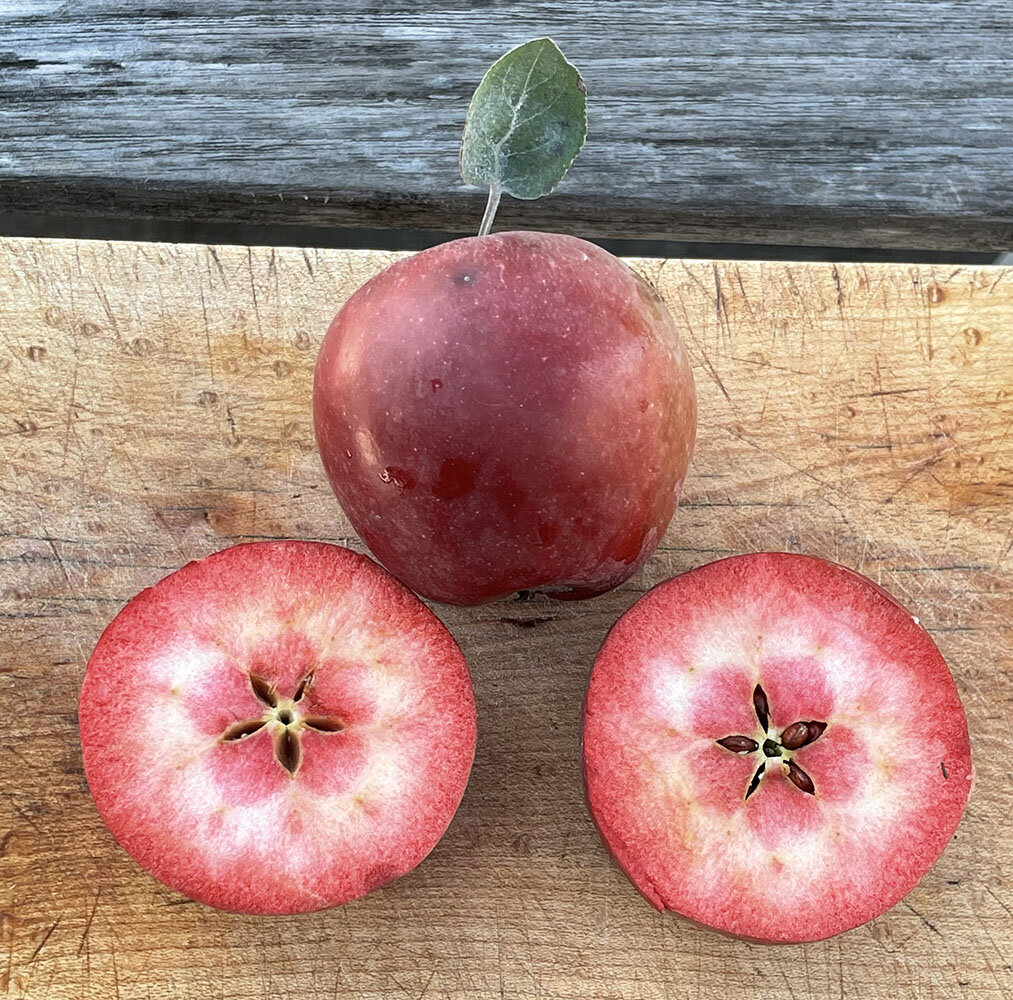
Almata apple cut open on August 6, 2021
When I showed this apple to my partner, Blase, he said, “It looks like a mandala.”
Yesterday I noticed that a root stock I had let grow without grafting a variety on it had fruited. To my surprise, when I took a bite, it, too, was red-fleshed, and bitter!

Apple from Bud 9 rootstock
I’ve cooked Almatas in an apple galette. The Almata wove lovely red ribbons through the mound of white apples—it held its color even when cooked. When I made a Russian apple cake, I was again delighted by the flowing red slices of the Almata. Although some people say that the fruit of the Tree of Knowledge of Good and Evil was actually a pomegranate, I disagree. I can imagine the serpent winding around a branch, tempting Eve with a ripe, red-fleshed apple. With only one tree, we don’t have a lot Almata apples, but if you can’t resist cutting one open for yourself, our limited crop is available at the farm stand.
When We Were Trees
“Yesterday, my daughter Ariel and I walked through our orchard. We pruned out an armful of water sprouts, those twigs that grow several feet straight up in one year on apple trees. We’re working together on a sculpture for an exhibit using apple prunings as the primary medium. Ariel is grafting tree branches, covering the largest wall in the studio while I sculpt the small figures that will populate the tree. We work in silence, usually without stopping for lunch, only speaking when it is about the process.”
—From the blog In the Studio, November 19, 2016
A few weeks ago we were once again in my studio as we prepared for our new two-person exhibit, When We Were Trees, at the Hopkinton Center for the Arts, in Hopkinton, Massachusetts. We hung Grafting A Life, our large grafted “tree,” the first sculpture we worked on together, the one that launched Ariel towards her life as an artist and her signature medium of wire. This piece was originally created for the exhibit, After Apple Pruning. Now the piece is once again on exhibit along with over fifty other works.

Grafting a Life installed in Hopkinton Center for the Arts, 2021

Gallery View, Hopkinton Center for the Arts, July 2021 Photo credit: Dayle Doherty
Ariel is showing her beautiful “Willow” and alongside my “Birthing Tree. We’ve created groupings of sculptures taking up themes such as “hands” and the “female body” as well as a new collaborative piece, “Tangled Up in Trees.” Through the mutuality and interconnectedness of our art we share how women empower each other when they connect with nature and their own bodies.

Trees, watercolor, LH; Woman, wire, AM; Tree Woman, bronze, LH
In Zen training they say, the student must surpass the teacher for the teachings to remain strong. Otherwise, over time, they become diluted. Of course, I know I am biased, but I’d say the same thing. Ariel is grafting her own life, and doing it with it poise, intelligence and great artistry.

Figures, wire, Ariel Matisse and Eve in the Tree Harp, bronze and wood, Linda Hoffman. Photo credit: Dayle Doherty
This fall, while the Artisan’s Asylum is moving from Somerville to Allston, Ariel won’t have a studio and will be working in mine. She wants to try sculpting with wax. I can’t wait to see what she will do and how we will further influence each other. In creating art, we transcend difficulties, we integrate the parts of ourselves that we have kept hidden, and we have the opportunity to tell new stories, and discover new and shared identities. When women empower women, they can heal the world.
The exhibit runs through August 27, 2021. There is a reception on Friday, August 13th and we hope to see you there. For information: Hoffman/Matisse Exhibit When We Were Trees.
Search Blog
-
2025
- May 9, 2025 A View from the Tractor Seat
- Apr 11, 2025 Dig
-
2024
- Jan 7, 2024 Winter Wassail
-
2022
- Dec 11, 2022 Keeping Time
- Jun 17, 2022 This Apple-Shaped Earth
- Jan 23, 2022 What is a Jizo?
- Jan 16, 2022 An Invite and Housekeeping Update
- Jan 1, 2022 The Year of the Frog: What Orchardists Do While Apple Trees are Chilling
-
2021
- Oct 24, 2021 Figs
- Oct 3, 2021 The Artist and the Orchard: A Memoir
- Aug 8, 2021 Red-Fleshed Apples
- Jul 25, 2021 When We Were Trees
- Jun 27, 2021 Castor Beans—Who Knew?
- Jun 13, 2021 Spring Training at a Zen Monastery
- May 4, 2021 Our Trees are in Bloom
- Apr 18, 2021 Hooray!
- Jan 24, 2021 Wassailing, virtually!
- Jan 1, 2021 Sitting
-
2020
- Dec 21, 2020 Darkness to Light
- Nov 28, 2020 One Heart
- Sep 18, 2020 Juggling Flowers, Fruit, and Vegetables
- Aug 23, 2020 Refuge
- Aug 9, 2020 Bags of Fertilizer
- Aug 2, 2020 The Sermon of the Blue Heron
- Jul 26, 2020 What's the Buzz?
- Jul 19, 2020 Farm Moments
- Jul 12, 2020 Lost Wax
- Jul 5, 2020 Catalpa: The Hugging Tree
- Jun 28, 2020 Pedaling Peace
- Jun 21, 2020 See Change
- Jun 14, 2020 Lalla Unveiled
- Jun 7, 2020 Pond Alchemy
- May 31, 2020 The Birth of Fruit
- May 24, 2020 An Artist in the Orchard
- May 17, 2020 Walking the Land: Returning Home
- May 10, 2020 Stinging Nettles: Gifts from the Great Mother
- May 3, 2020 The Mystery of Swallow
- Apr 26, 2020 Aerial Bruststrokes
- Apr 19, 2020 Simple Pleasures
- Apr 12, 2020 Weeds and Other Gifts
- Apr 5, 2020 Remembering the Seeds
- Mar 29, 2020 Blow on the Embers
- Mar 22, 2020 Ripples
-
2019
- Nov 16, 2019 Tibet Impressions
- Nov 9, 2019 Forest Tales
- Oct 13, 2019 The Gift
- Aug 4, 2019 The Season is Apples, Berries, and Grandfather Fire
- Jun 8, 2019 Pointers for a Writing Life
- May 12, 2019 Mothers of the Earth
- Apr 6, 2019 The Apple-Shaped Earth
- Mar 23, 2019 You Don’t Know What You Have Till It’s Gone
- Feb 23, 2019 Generations
- Feb 9, 2019 What Are We Doing to the Earth, John Chapman?
-
2018
- Dec 31, 2018 Long Shadows
- Oct 6, 2018 A Pilgrimage to India
- Aug 18, 2018 Scrap Wrenn
- Aug 11, 2018 Off-the-Wall Comments from an Ignorant Farmer
- Jul 28, 2018 Creative Connect
- Jul 14, 2018 How is the Orchard?
- Jun 30, 2018 Which Way?
- Jun 16, 2018 Geese, Herons, Beavers, and the Baby Steps of a Lapsed Blogger
- Feb 24, 2018 Mama's Coupons — Good Forever
- Jan 27, 2018 January Ice
- Jan 13, 2018 The Muse
-
2017
- Dec 30, 2017 A Dream for the New Year
- Dec 23, 2017 A New Year for Apples
- Dec 16, 2017 Intuition
- Nov 22, 2017 Thanksgiving OM
- Nov 4, 2017 East Fork Pottery
- Oct 28, 2017 Putting Down New Roots
- Oct 21, 2017 A is for Art
- Oct 14, 2017 Eve domesticus
- Oct 7, 2017 A String Workshop
- Sep 30, 2017 After Applepicking
- Sep 23, 2017 Two Bad Women and One Good Apple
- Sep 16, 2017 Plein Air Poetry
- Sep 9, 2017 Cutting Off a Leg
- Sep 2, 2017 The Changing Landscape
- Aug 26, 2017 All About Art
- Aug 19, 2017 My First Visit to the Farm
- Aug 12, 2017 The First Food
- Aug 5, 2017 A Teapot, a Woman, and maybe a Boat
- Jul 29, 2017 A Raspberry Dilemma
- Jul 22, 2017 Consider the Miracle
- Jul 15, 2017 Meeting Ekphrasis
- Jul 8, 2017 Ripening Fruit
- Jul 1, 2017 The Voice of The Caterpillar
- Jun 24, 2017 Goumi — An Unusual Fructus
- Jun 17, 2017 Concord, an American Bloomsbury
- Jun 10, 2017 The World Is Bonkers — Shall I Laugh or Cry?
- Jun 3, 2017 Bonkers, a Revolutionary Apple
- May 27, 2017 Guardians of the Swamp
- May 20, 2017 There are Mushrooms and There are Morels
- May 13, 2017 "What's in a Name?"
- May 6, 2017 Bloom Follows Pink: Orchard Pollination
- Apr 29, 2017 The Orchard Is at Pink
- Apr 22, 2017 Natural Farming — Part 2 (continuation from last Sunday's blog)
- Apr 15, 2017 Natural Farming — Part 1
- Apr 8, 2017 Boats, Figures, and Catching Fish
- Apr 1, 2017 A Man with a Mission: The Nuts and Bolts of Bronze Casting
- Mar 25, 2017 A Chalice of Spirit, Art, and Nature
- Mar 18, 2017 Hanami — Blossom Viewing
- Mar 11, 2017 Soil Redemption Song
- Mar 4, 2017 Food is Primary Care
- Feb 25, 2017 Pomme de Terre
- Feb 18, 2017 Organic Certification
- Feb 11, 2017 Tantalizing Fruit
- Feb 4, 2017 The Myths of History
- Jan 28, 2017 The Orchard in Winter
- Jan 21, 2017 The Hi-Line
- Jan 14, 2017 Artistic, Botanical, and Social Diversity
- Jan 7, 2017 Where is Eden?
-
2016
- Dec 31, 2016 The Creative Heart
- Dec 24, 2016 A Christmas Tale
- Dec 17, 2016 Who are the Crones?
- Dec 10, 2016 The Olympic Bell (Part Two)
- Dec 3, 2016 Overheard in the Apple Orchard in Early December
- Nov 26, 2016 The Lessons of a Tortoise
- Nov 19, 2016 In the Studio
- Nov 12, 2016 Even in Darkness
- Nov 5, 2016 Southern Apples, an Elephant, Monkey, Rabbit, and Bird, Two Mango Trees and a Birthday
- Oct 29, 2016 The Tools of Art
- Oct 22, 2016 Labyrinths
- Oct 15, 2016 Repairing the Broken
- Oct 8, 2016 When You Are No More
- Oct 1, 2016 Creation Rain
- Sep 24, 2016 Breaking the Glass
- Sep 17, 2016 String Art
- Sep 10, 2016 Poetry and Photosynthesis: It's all in the Leaves
- Sep 3, 2016 In the Plenty of Time
- Aug 27, 2016 Witch Doctors
- Aug 20, 2016 Listen Coyote
- Aug 13, 2016 Milkweed in the Orchard
- Aug 6, 2016 Some People See a Turtle
- Jul 30, 2016 Arborshaping
- Jul 23, 2016 Joseph Wheelwright: Sculptor of Stones and Trees
- Jul 16, 2016 Asian Pears
- Jul 9, 2016 Gold Leaf, Grief, and the Creative Process
- Jul 2, 2016 The Olympic Bell (Part One)
- Jun 25, 2016 Around the Mulberry Bush
- Jun 18, 2016 Avoiding Apples
- Jun 11, 2016 Fructus
- Jun 4, 2016 Astonishing Apples
- May 28, 2016 Scare the Caterpillars
- May 21, 2016 Join the Club!
- May 14, 2016 The Graft
- May 7, 2016 Rooster, Rhubarb, Rue
- Apr 30, 2016 What do Dolphins and Nettles Have in Common?
- Apr 23, 2016 Art Prunings
- Apr 16, 2016 A Few of the First Arrivals
- Apr 9, 2016 Taste the Spirit of Sustainable Agriculture
- Apr 2, 2016 First Orchard Spray - March 22-24, 2016
- Mar 26, 2016 Hawkeye Apple
- Mar 19, 2016 Desiring the Almata Apple
- Mar 12, 2016 Ugly Fruit
- Mar 5, 2016 Winter Tracks
- Feb 27, 2016 Splash
- Feb 20, 2016 Pruning
- Feb 13, 2016 Orchard Ruminants
- Feb 6, 2016 A Gathering of Seeds
- Jan 30, 2016 Orchard Dragons
- Jan 23, 2016 Tree Rings
- Jan 17, 2016 The Fallen Tree
- Jan 7, 2016 Wassailing the Apple Trees
- Jan 1, 2016 The New Year