LINDA HOFFMAN
Catalpa: The Hugging Tree
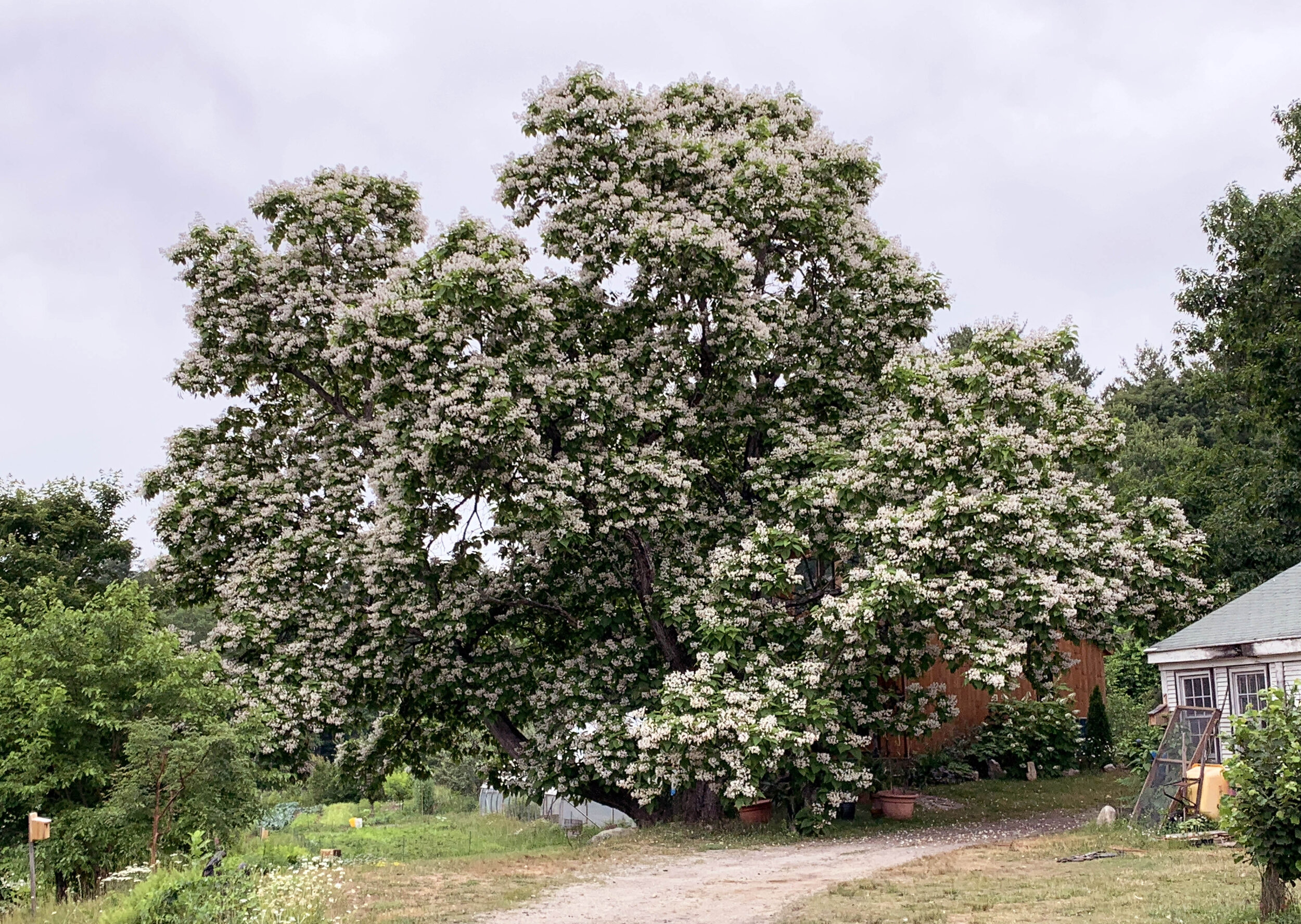
Catalpa Tree in Bloom, June 27, 2020
In full white flowering, a trillion frilly night moths perch on stems, sending out sweet scents of rose and bergamot. These clutches of flowers, each the size of a newborn child, balance at the end of every leaf cluster. The leaves, heart-shaped and lime green, lay open to the sky, each one positioned for the best photosynthesis. Catalpas reach peak bloom near the summer solstice, late for most trees in our climate. Summer is too hot for delicate blossoms.
Everything about this tree is large, embracing, and opulent. The wood, uprising from the ground, a trio of trunks, holds so much weight its steep ascent is inconceivable. It must be in the third octave of its life. Such a magnum opus. The tree dwarfs the building behind, my studio.
From the studio loft window I have watched a pair of swallows sit together, then fly off, soaring, and mating. Their brood began life in the bird box a few paces away. Red-winged blackbirds often sit on a branch and squawk, while nuthatches pace up and down the trunk. These tiny birds peck at bugs in the bark, quietly though, not like the red-hatted pileated woodpecker’s incessant jackhammering.
A few years back we had a tree company put two cables into the tree, worried about losing one of the trunks in a storm. This trinity of trunks now supports each other. One large branch broke two years ago. The branch dove to the ground and shattered, the wound along it—an accordion of frayed wood. But I wanted to leave it, not remove it, to see if it would heal. Now, buttressed by earth, new branches grow, flower, and bear fruit.
The tree grows twenty yards from the pond. I imagine it drinks heartily with every meal. Big tankards of H2O. Its size is quite out of scale for our small farm, but the Catalpa’s nature is to keep growing—water the source of its ecstasy.
The Catalpa makes its own shade, its own ecosystem, its own refuge. But now the bloom is over. The flowers are faded and brown, the scent has turned musky. It’s been such a presence in my life for the last ten days, I took my meditation cushion outside to sit near its trunk. That’s when I started using the pronoun “she” and “her” when I referred to the Catalpa. Her branches, her blossoms. She became more than tree to me. She became protector and guide.
While writing about her, I remembered that in my dream last night. I met an Indian woman, dressed in a drab brown and gray sari, with drab-colored brown and gray hair in a bun, and I knew it was Amaa, the hugging saint. I’ve never met her, but I’ve heard friends tell of their experiences, the process of waiting in a long line sometimes for hours, for the few seconds or minute it takes to receive her hug-blessing. In my meeting with Amaa, she cupped my shoulders with her hands, and then bowed my head so we lost eye contact but our foreheads joined. We were sisters, or mother and daughter, or some connected ancestor. She said, “Baruch Shalom” three times. Baruch is the beginning word of many Jewish prayers and means blessed. Shalom means peace.
The Catalpa tree became Amaa, became the carrier of this message of peace, strength, and resiliency. She communicated that we have untapped powers within us we are not aware of. The passing away of the blossoms became the rising of another voice, a steadfast and calming voice, reaching out to meet us. Inviting us into her embrace, always with open arms, the hugging tree, offering refuge.

Catalpa Tree, July 4, 2020
The Orchard Is at Pink
apple buds fling
pink sweetness
spring frenzy
Apple growers, as well as beekeepers, fruit researchers, and orchard advisory consultants, all casually announce, “The orchard is at pink.” It’s their scientific way of saying, “The festivities are soon to begin.” Pink is one of the growth stages in fruit trees — when each tightly clustered fruit bud opens, and anywhere from five to seven individual flower buds, each enrobed in pink, magenta, or red petals, rise from a whorl of tender green leaves.

The King Bloom is encircled by buds.
Each one of these pink-robed buds is prepared to produce an apple. Before finding myself the owner of a small orchard, I assumed that one fruit bud would create one apple. But the apple tree wants to ensure its own longevity: each fruit bud opens to a cluster of blossoms, with each blossom capable of producing fruit. In the center is the King Bloom, the strongest and largest. All the others are in reserve, princes and princesses waiting to take over the throne should something happen to the King. The King Bloom opens first, and the others follow soon after. It’s possible that each of these pink buds will produce an apple with the King Bloom in the center.
Pink is the time when the banquet table is set. The scurrying and preparation is done. The orchard grasses have greened, the daffodils and dandelions are in bloom, and we have planted out our new trees. The first loud guests arrive. Robins and mourning doves hop from ground to tree; bluebirds flit through the branches. The herons are back and fly their pattern from Delaney wetlands to beyond the orchard and back again, necks stretching, wings flapping, achingly beautiful. Geese honk incessantly defending their nesting areas, and a pair of swans antagonizes any creature not respectful of their water rights.
Last Sunday I saw my first bumblebee, and on Monday, Melissa Ljosa brought two hives of honeybees who will live here all year. I had to take a sculpture to the Design Center in Boston that morning and when I returned, I heard the bees as I walked among our Asian pear trees. I didn't have to look; I could feel their buzzing energy.
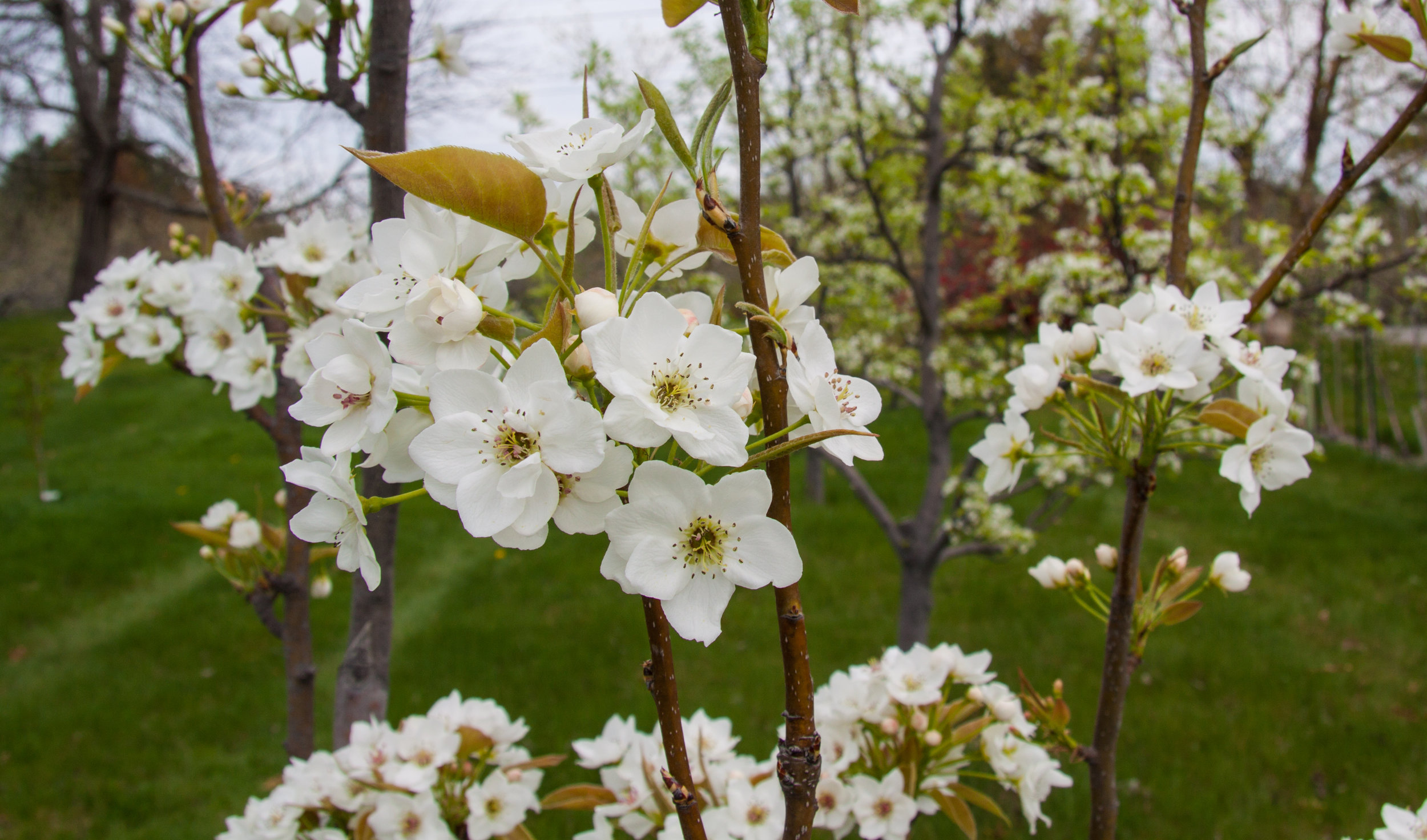
Asian pear white buds.
Our Asian pears are in full bloom, always one stage ahead of the apples. I smelled the trees’ sour scent. Asian pears, so delicious and sweet to eat, give off an unappealing odor, old cheese, (at least judged by this human). Pears, as well as plums and cherries, have white fruit buds, thus, orchardists don’t use the designation pink, but white bud. These clusters of white buds are beautiful, but only apples have a rosette of green leaves with pink rising. This contrast of color makes apple blossoms magical.
When the apple orchard was at pink, I used to call Gus Skamarycz, our beekeeper for many years before he retired. My call at pink would let him know the blossoms had donned their lipstick and were almost ready to greet the bees. He would wait a few days, and then arrive before sunup with two hives. I would meet him in the orchard, his bees still asleep.
“Why so early?” I asked the first year.
“I want the bees to open their eyes in a new place, see the blossoms, and go to work,” he replied.
When I asked, “How long does it take a hive to pollinate an orchard?” Looking around, Gus said, “A strong hive can pollinate this orchard in a few hours, but you have different varieties.”
Not all of our trees will bloom at the same time. The Macintosh apples are the first to open and the earliest to ripen; the Golden Blushing apples reach full blossom two weeks later—their ripening peaks in early October. Gus’s bees would stay for two weeks to provide pollination for all the trees. With Melissa’s two hives now in residence, we don’t worry about pollination and she doesn’t worry about food for her bees.
Next week we will be at bloom in the apple orchard, the stage when the pink buds open. Join us next Saturday, May 6 for Blossom Viewing. We’ll be in the orchard from 3 to 5 if the day is sunny. Bring paints, pen and paper or a poem to share; we’ll listen to the bees and toast the trees, our own free-form, apple blossom viewing.
Search Blog
-
2025
- May 9, 2025 A View from the Tractor Seat
- Apr 11, 2025 Dig
-
2024
- Jan 7, 2024 Winter Wassail
-
2022
- Dec 11, 2022 Keeping Time
- Jun 17, 2022 This Apple-Shaped Earth
- Jan 23, 2022 What is a Jizo?
- Jan 16, 2022 An Invite and Housekeeping Update
- Jan 1, 2022 The Year of the Frog: What Orchardists Do While Apple Trees are Chilling
-
2021
- Oct 24, 2021 Figs
- Oct 3, 2021 The Artist and the Orchard: A Memoir
- Aug 8, 2021 Red-Fleshed Apples
- Jul 25, 2021 When We Were Trees
- Jun 27, 2021 Castor Beans—Who Knew?
- Jun 13, 2021 Spring Training at a Zen Monastery
- May 4, 2021 Our Trees are in Bloom
- Apr 18, 2021 Hooray!
- Jan 24, 2021 Wassailing, virtually!
- Jan 1, 2021 Sitting
-
2020
- Dec 21, 2020 Darkness to Light
- Nov 28, 2020 One Heart
- Sep 18, 2020 Juggling Flowers, Fruit, and Vegetables
- Aug 23, 2020 Refuge
- Aug 9, 2020 Bags of Fertilizer
- Aug 2, 2020 The Sermon of the Blue Heron
- Jul 26, 2020 What's the Buzz?
- Jul 19, 2020 Farm Moments
- Jul 12, 2020 Lost Wax
- Jul 5, 2020 Catalpa: The Hugging Tree
- Jun 28, 2020 Pedaling Peace
- Jun 21, 2020 See Change
- Jun 14, 2020 Lalla Unveiled
- Jun 7, 2020 Pond Alchemy
- May 31, 2020 The Birth of Fruit
- May 24, 2020 An Artist in the Orchard
- May 17, 2020 Walking the Land: Returning Home
- May 10, 2020 Stinging Nettles: Gifts from the Great Mother
- May 3, 2020 The Mystery of Swallow
- Apr 26, 2020 Aerial Bruststrokes
- Apr 19, 2020 Simple Pleasures
- Apr 12, 2020 Weeds and Other Gifts
- Apr 5, 2020 Remembering the Seeds
- Mar 29, 2020 Blow on the Embers
- Mar 22, 2020 Ripples
-
2019
- Nov 16, 2019 Tibet Impressions
- Nov 9, 2019 Forest Tales
- Oct 13, 2019 The Gift
- Aug 4, 2019 The Season is Apples, Berries, and Grandfather Fire
- Jun 8, 2019 Pointers for a Writing Life
- May 12, 2019 Mothers of the Earth
- Apr 6, 2019 The Apple-Shaped Earth
- Mar 23, 2019 You Don’t Know What You Have Till It’s Gone
- Feb 23, 2019 Generations
- Feb 9, 2019 What Are We Doing to the Earth, John Chapman?
-
2018
- Dec 31, 2018 Long Shadows
- Oct 6, 2018 A Pilgrimage to India
- Aug 18, 2018 Scrap Wrenn
- Aug 11, 2018 Off-the-Wall Comments from an Ignorant Farmer
- Jul 28, 2018 Creative Connect
- Jul 14, 2018 How is the Orchard?
- Jun 30, 2018 Which Way?
- Jun 16, 2018 Geese, Herons, Beavers, and the Baby Steps of a Lapsed Blogger
- Feb 24, 2018 Mama's Coupons — Good Forever
- Jan 27, 2018 January Ice
- Jan 13, 2018 The Muse
-
2017
- Dec 30, 2017 A Dream for the New Year
- Dec 23, 2017 A New Year for Apples
- Dec 16, 2017 Intuition
- Nov 22, 2017 Thanksgiving OM
- Nov 4, 2017 East Fork Pottery
- Oct 28, 2017 Putting Down New Roots
- Oct 21, 2017 A is for Art
- Oct 14, 2017 Eve domesticus
- Oct 7, 2017 A String Workshop
- Sep 30, 2017 After Applepicking
- Sep 23, 2017 Two Bad Women and One Good Apple
- Sep 16, 2017 Plein Air Poetry
- Sep 9, 2017 Cutting Off a Leg
- Sep 2, 2017 The Changing Landscape
- Aug 26, 2017 All About Art
- Aug 19, 2017 My First Visit to the Farm
- Aug 12, 2017 The First Food
- Aug 5, 2017 A Teapot, a Woman, and maybe a Boat
- Jul 29, 2017 A Raspberry Dilemma
- Jul 22, 2017 Consider the Miracle
- Jul 15, 2017 Meeting Ekphrasis
- Jul 8, 2017 Ripening Fruit
- Jul 1, 2017 The Voice of The Caterpillar
- Jun 24, 2017 Goumi — An Unusual Fructus
- Jun 17, 2017 Concord, an American Bloomsbury
- Jun 10, 2017 The World Is Bonkers — Shall I Laugh or Cry?
- Jun 3, 2017 Bonkers, a Revolutionary Apple
- May 27, 2017 Guardians of the Swamp
- May 20, 2017 There are Mushrooms and There are Morels
- May 13, 2017 "What's in a Name?"
- May 6, 2017 Bloom Follows Pink: Orchard Pollination
- Apr 29, 2017 The Orchard Is at Pink
- Apr 22, 2017 Natural Farming — Part 2 (continuation from last Sunday's blog)
- Apr 15, 2017 Natural Farming — Part 1
- Apr 8, 2017 Boats, Figures, and Catching Fish
- Apr 1, 2017 A Man with a Mission: The Nuts and Bolts of Bronze Casting
- Mar 25, 2017 A Chalice of Spirit, Art, and Nature
- Mar 18, 2017 Hanami — Blossom Viewing
- Mar 11, 2017 Soil Redemption Song
- Mar 4, 2017 Food is Primary Care
- Feb 25, 2017 Pomme de Terre
- Feb 18, 2017 Organic Certification
- Feb 11, 2017 Tantalizing Fruit
- Feb 4, 2017 The Myths of History
- Jan 28, 2017 The Orchard in Winter
- Jan 21, 2017 The Hi-Line
- Jan 14, 2017 Artistic, Botanical, and Social Diversity
- Jan 7, 2017 Where is Eden?
-
2016
- Dec 31, 2016 The Creative Heart
- Dec 24, 2016 A Christmas Tale
- Dec 17, 2016 Who are the Crones?
- Dec 10, 2016 The Olympic Bell (Part Two)
- Dec 3, 2016 Overheard in the Apple Orchard in Early December
- Nov 26, 2016 The Lessons of a Tortoise
- Nov 19, 2016 In the Studio
- Nov 12, 2016 Even in Darkness
- Nov 5, 2016 Southern Apples, an Elephant, Monkey, Rabbit, and Bird, Two Mango Trees and a Birthday
- Oct 29, 2016 The Tools of Art
- Oct 22, 2016 Labyrinths
- Oct 15, 2016 Repairing the Broken
- Oct 8, 2016 When You Are No More
- Oct 1, 2016 Creation Rain
- Sep 24, 2016 Breaking the Glass
- Sep 17, 2016 String Art
- Sep 10, 2016 Poetry and Photosynthesis: It's all in the Leaves
- Sep 3, 2016 In the Plenty of Time
- Aug 27, 2016 Witch Doctors
- Aug 20, 2016 Listen Coyote
- Aug 13, 2016 Milkweed in the Orchard
- Aug 6, 2016 Some People See a Turtle
- Jul 30, 2016 Arborshaping
- Jul 23, 2016 Joseph Wheelwright: Sculptor of Stones and Trees
- Jul 16, 2016 Asian Pears
- Jul 9, 2016 Gold Leaf, Grief, and the Creative Process
- Jul 2, 2016 The Olympic Bell (Part One)
- Jun 25, 2016 Around the Mulberry Bush
- Jun 18, 2016 Avoiding Apples
- Jun 11, 2016 Fructus
- Jun 4, 2016 Astonishing Apples
- May 28, 2016 Scare the Caterpillars
- May 21, 2016 Join the Club!
- May 14, 2016 The Graft
- May 7, 2016 Rooster, Rhubarb, Rue
- Apr 30, 2016 What do Dolphins and Nettles Have in Common?
- Apr 23, 2016 Art Prunings
- Apr 16, 2016 A Few of the First Arrivals
- Apr 9, 2016 Taste the Spirit of Sustainable Agriculture
- Apr 2, 2016 First Orchard Spray - March 22-24, 2016
- Mar 26, 2016 Hawkeye Apple
- Mar 19, 2016 Desiring the Almata Apple
- Mar 12, 2016 Ugly Fruit
- Mar 5, 2016 Winter Tracks
- Feb 27, 2016 Splash
- Feb 20, 2016 Pruning
- Feb 13, 2016 Orchard Ruminants
- Feb 6, 2016 A Gathering of Seeds
- Jan 30, 2016 Orchard Dragons
- Jan 23, 2016 Tree Rings
- Jan 17, 2016 The Fallen Tree
- Jan 7, 2016 Wassailing the Apple Trees
- Jan 1, 2016 The New Year