LINDA HOFFMAN
Remembering the Seeds

Hoop House, Old Frog Pond Farm, Harvard, MA April 4, 2020
On this cold April day, many seeds still wait underground, but with a few days of warmth, they will crack open, the tiny rootlets will poke out, find their way to sustenance, and their first seed leaves will appear. A seed at birth is already programed to be the fullest expression of itself. It arrives on the planet with all the knowledge it needs. The seed knows when to grow and how to respond to warmth. As it develops leaves, it takes up nutrients, drinks in carbon dioxide and releases oxygen. The seed is a storehouse for a great reservoir of knowledge, of shared history, and experience. As it becomes a mature plant, it knows what to give another plant struggling nearby and to send out warnings to its tribe of approaching danger. The smallest seed only needs to find itself in a hospitable environment to flourish. For it will respond to whatever it encounters. The influences of the outside environment affect it, be it toxins, or a great flood, hail, a heat wave, or a blessed perfect growing season.
I lived my first seven years in a row house in the industrial city of Chester, Pennsylvania. I didn’t know about seeds, but I was always attracted to one plant. When I was about six years old, I remember walking alone into the alley behind our row house, carrying a metal kitchen bowl. It was the insert from the classic Revere Ware double boiler. Then, seating myself on the concrete near a patch of weeds, I gathered the seed stalks of this plant that grew in abundance. I rubbed my fingers up the stem against the grain, and the seeds, small, elongated, and soft, fell silently into the bowl. Myriads of individual entities.
In my world were my parents, my younger brother, Jon, Albert, a boy who lived across the street, Charlene who lived a few doors away and whose mother was always home when we came home from school, our housekeeper, Louise, and somewhere, further away, my parents’ drugstore where they worked every day. My world was small, but this bowl was filled with the largest number of anything I could imagine. So many small bits all neatly together filling the bowl. When it was almost full, I lowered my fingers into the bowl and trailed my fingers through the perfect seeds. Moving my hand around and through and under, the seeds shifted and tickled my fingers. Soothing and sensual is how I remember the experience. Even at this young age, or perhaps because of it, my hand in this bowl of seeds connected me to something peaceful and true.
Later, after I became an apple orchardist, I learned that the weed was plantain, an herbal remedy for insect stings and other skin abrasions. You only have to pick a few leaves, chew them, and rub them or poultice them onto a wound and they withdraw toxins and soothe. The taste is not sweet, not bitter, not pungent or sharp, just a mash of green leaves.

Sketch of Plantain Seed Stalks and Leaves, Linda Hoffman, 2020
I am allergic to bees. When I am stung, which inevitably happens several times a year, I know exactly where to find plantain. It grows on the side our farmhouse near the back door. Growing in this most unglamorous place, it doesn’t announce its presence, but it is tenacious enough to grow despite other weeds and grasses. It even survives the mower. In cities, plantain grows in vacant lots and in cracks of the sidewalk. Plantain seems to be totally nonchalant about its closest neighbors or the soil chemistry. It grows both where soils are poor and where they are fertile. It forges a home in forgotten nooks and crannies.

Plantain beginning to grow along the driveway in front of the Farmhouse, April 4, 2020
Plants offer their unique gifts. For example, poison ivy grows in disturbed areas. It also flourishes in unstable ecosystems like on the dunes on Cape Cod, appearing as if to say, “Keep off of this fragile bank.” When a friend recovering from chemo treatments, mentioned poison ivy had sprung up outside her front door, I smiled and said, “It wants to protect you.” And when I am feeling tired, I lean my head into a tall clump of mountain mint, and its strong menthol scent enlivens my spirit.
I no longer live in Chester, Pennsylvania, but on a small farm where I can plant seeds and tend the earth. I think of the billions of people who can’t do this, I think of my stepdaughters in their small apartment in Brooklyn, listening to sirens, eating rice and beans, and my grandchildren who have been told not to go out because there is sickness outside. I long to bring them to the farm and show them the rows of seeds growing, to listen to peepers and wood frogs, to share the plumping of the apple buds, and see plantain, the healer, poking out. But for now, this is the way it is.
The myriad seeds in that long ago bowl connected me to something outside myself, to something far beyond my immediate world. As I sit alone now in isolation, I think about this world with more people than I can conceive of—almost eight billion people. Every single person on the planet born a unique and perfect being. Like a seed, we must grow in this imperfect world. We, too, have much innate wisdom, we know what needs to be done.

Catalpa Tree, watercolor, Linda Hoffman, 2019
The Creative Heart
I watched as my son, Alex, carefully undid the wrapping, opened the wooden box, and lifted a corner of the quilted cloth. On his face, I saw a strange look of disbelief. “It’s broken,” he said. Now it was my turn to be stunned. The beautiful ceramic bowl sat in broken shards on its rose-colored cloth. I was crushed and horrified. It felt like a betrayal.
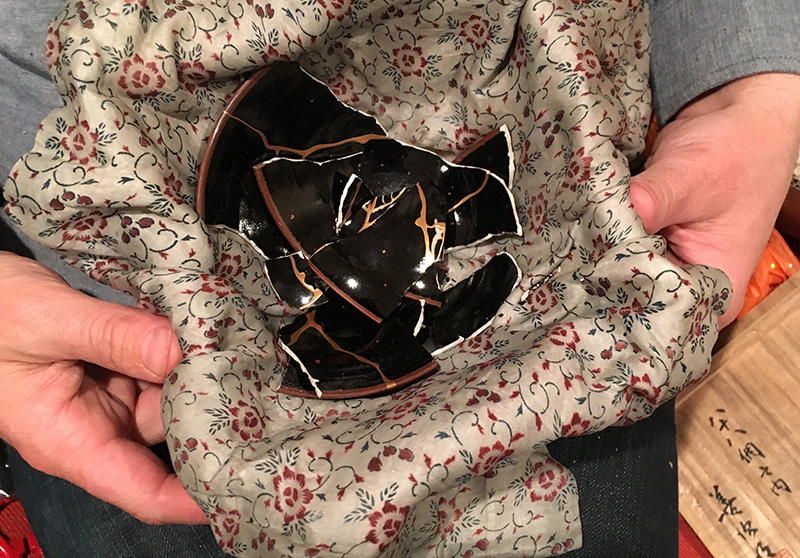
A few months ago, I wrote a blog about Kintsugi — the Japanese art of repairing a broken bowl with gold. For Christmas, I offered a Japanese tea bowl that had been repaired using this method, to Alex and my daughter-in-law, Connie. I felt it would be a meaningful gift as they embarked on married life together. With baby Vita now a hear and half, a new baby on the way, and the opening of a store in Asheville, North Carolina, East Fork Pottery, their life is full. I thought of the Kintsugi bowl with its veins of gold as a symbol of creatively and beautifully overcoming challenges.
A week later, I was still feeling badly about how my gift turned out. I thought to myself, I should make something with these shards — a sculpture — and give it to them. I mentioned my idea to Alex and he seemed a little put off — then he said, “Yes, um, we should do a repair.” And I understood that he wanted to repair the bowl himself. I had kept it anticipating that I would return the broken shards to the gallery, but they graciously refunded the price I had paid. We decided to talk about it in early January when we will next be together.
Everything in our world is impermanent. Wood turns to ash and fallen leaves to compost. The broken pot shards can become something else. Accepting change is about no longer being stuck in what was, but moving on. This moving on is the awakening of our creative heart.
I know that my well-being depends on feeling that I have connected to that place of creativity inside my heart. With days of less meaningful doing, I begin to fall into this dark abyss of my own mind. I become disjointed, my body altogether not my body, my limbs connected like a puppet. I don’t act with spontaneity and wholeness. I can be in the most beautiful place and if I don’t feel connected to it, I can’t appreciate it because I block the beauty from entering my bones. I can be in the most loving relationship and not allow this love to enter.
Each creative act makes use of something that is unresolved in our hearts. Each creative act makes the world whole. In this new year, let’s make whatever is broken whole again. We don’t, in fact, can’t know what it will look like. Who would ever imagine that a river carved a canyon that enthralls millions of people thousands of years later. I can’t imagine what will possibly come out of this box of pot shards, but this is precisely the process that heals broken places and turns them into art.
In this new year, I’d like to remember that broken bowl when I find myself slipping away from my creative heart, when I feel alone and cut off. For I know that in doing the work I will find my way back. We all share this longing that is deeply human, that beseeches us to be fully our own life, to belong completely to the entirety. Our longing is the gift we can offer.
When I started this weekly blog, Apples, Art, and Spirit, one year ago, I thought it would be a one-year project and I would be using the orchard as a springboard to write. With 2016 being a year of no apples, they have been a very silent partner. I’ve decided to commit to another year, and hopefully with some good winter chill, we will have an apple crop and there will be more apple-inspired writing. Please join me, share the blog with your friends, and together let’s lift the corner of the new year, white, and pure, and unknown. It’s ours to create for the very first time.

Search Blog
-
2025
- May 9, 2025 A View from the Tractor Seat
- Apr 11, 2025 Dig
-
2024
- Jan 7, 2024 Winter Wassail
-
2022
- Dec 11, 2022 Keeping Time
- Jun 17, 2022 This Apple-Shaped Earth
- Jan 23, 2022 What is a Jizo?
- Jan 16, 2022 An Invite and Housekeeping Update
- Jan 1, 2022 The Year of the Frog: What Orchardists Do While Apple Trees are Chilling
-
2021
- Oct 24, 2021 Figs
- Oct 3, 2021 The Artist and the Orchard: A Memoir
- Aug 8, 2021 Red-Fleshed Apples
- Jul 25, 2021 When We Were Trees
- Jun 27, 2021 Castor Beans—Who Knew?
- Jun 13, 2021 Spring Training at a Zen Monastery
- May 4, 2021 Our Trees are in Bloom
- Apr 18, 2021 Hooray!
- Jan 24, 2021 Wassailing, virtually!
- Jan 1, 2021 Sitting
-
2020
- Dec 21, 2020 Darkness to Light
- Nov 28, 2020 One Heart
- Sep 18, 2020 Juggling Flowers, Fruit, and Vegetables
- Aug 23, 2020 Refuge
- Aug 9, 2020 Bags of Fertilizer
- Aug 2, 2020 The Sermon of the Blue Heron
- Jul 26, 2020 What's the Buzz?
- Jul 19, 2020 Farm Moments
- Jul 12, 2020 Lost Wax
- Jul 5, 2020 Catalpa: The Hugging Tree
- Jun 28, 2020 Pedaling Peace
- Jun 21, 2020 See Change
- Jun 14, 2020 Lalla Unveiled
- Jun 7, 2020 Pond Alchemy
- May 31, 2020 The Birth of Fruit
- May 24, 2020 An Artist in the Orchard
- May 17, 2020 Walking the Land: Returning Home
- May 10, 2020 Stinging Nettles: Gifts from the Great Mother
- May 3, 2020 The Mystery of Swallow
- Apr 26, 2020 Aerial Bruststrokes
- Apr 19, 2020 Simple Pleasures
- Apr 12, 2020 Weeds and Other Gifts
- Apr 5, 2020 Remembering the Seeds
- Mar 29, 2020 Blow on the Embers
- Mar 22, 2020 Ripples
-
2019
- Nov 16, 2019 Tibet Impressions
- Nov 9, 2019 Forest Tales
- Oct 13, 2019 The Gift
- Aug 4, 2019 The Season is Apples, Berries, and Grandfather Fire
- Jun 8, 2019 Pointers for a Writing Life
- May 12, 2019 Mothers of the Earth
- Apr 6, 2019 The Apple-Shaped Earth
- Mar 23, 2019 You Don’t Know What You Have Till It’s Gone
- Feb 23, 2019 Generations
- Feb 9, 2019 What Are We Doing to the Earth, John Chapman?
-
2018
- Dec 31, 2018 Long Shadows
- Oct 6, 2018 A Pilgrimage to India
- Aug 18, 2018 Scrap Wrenn
- Aug 11, 2018 Off-the-Wall Comments from an Ignorant Farmer
- Jul 28, 2018 Creative Connect
- Jul 14, 2018 How is the Orchard?
- Jun 30, 2018 Which Way?
- Jun 16, 2018 Geese, Herons, Beavers, and the Baby Steps of a Lapsed Blogger
- Feb 24, 2018 Mama's Coupons — Good Forever
- Jan 27, 2018 January Ice
- Jan 13, 2018 The Muse
-
2017
- Dec 30, 2017 A Dream for the New Year
- Dec 23, 2017 A New Year for Apples
- Dec 16, 2017 Intuition
- Nov 22, 2017 Thanksgiving OM
- Nov 4, 2017 East Fork Pottery
- Oct 28, 2017 Putting Down New Roots
- Oct 21, 2017 A is for Art
- Oct 14, 2017 Eve domesticus
- Oct 7, 2017 A String Workshop
- Sep 30, 2017 After Applepicking
- Sep 23, 2017 Two Bad Women and One Good Apple
- Sep 16, 2017 Plein Air Poetry
- Sep 9, 2017 Cutting Off a Leg
- Sep 2, 2017 The Changing Landscape
- Aug 26, 2017 All About Art
- Aug 19, 2017 My First Visit to the Farm
- Aug 12, 2017 The First Food
- Aug 5, 2017 A Teapot, a Woman, and maybe a Boat
- Jul 29, 2017 A Raspberry Dilemma
- Jul 22, 2017 Consider the Miracle
- Jul 15, 2017 Meeting Ekphrasis
- Jul 8, 2017 Ripening Fruit
- Jul 1, 2017 The Voice of The Caterpillar
- Jun 24, 2017 Goumi — An Unusual Fructus
- Jun 17, 2017 Concord, an American Bloomsbury
- Jun 10, 2017 The World Is Bonkers — Shall I Laugh or Cry?
- Jun 3, 2017 Bonkers, a Revolutionary Apple
- May 27, 2017 Guardians of the Swamp
- May 20, 2017 There are Mushrooms and There are Morels
- May 13, 2017 "What's in a Name?"
- May 6, 2017 Bloom Follows Pink: Orchard Pollination
- Apr 29, 2017 The Orchard Is at Pink
- Apr 22, 2017 Natural Farming — Part 2 (continuation from last Sunday's blog)
- Apr 15, 2017 Natural Farming — Part 1
- Apr 8, 2017 Boats, Figures, and Catching Fish
- Apr 1, 2017 A Man with a Mission: The Nuts and Bolts of Bronze Casting
- Mar 25, 2017 A Chalice of Spirit, Art, and Nature
- Mar 18, 2017 Hanami — Blossom Viewing
- Mar 11, 2017 Soil Redemption Song
- Mar 4, 2017 Food is Primary Care
- Feb 25, 2017 Pomme de Terre
- Feb 18, 2017 Organic Certification
- Feb 11, 2017 Tantalizing Fruit
- Feb 4, 2017 The Myths of History
- Jan 28, 2017 The Orchard in Winter
- Jan 21, 2017 The Hi-Line
- Jan 14, 2017 Artistic, Botanical, and Social Diversity
- Jan 7, 2017 Where is Eden?
-
2016
- Dec 31, 2016 The Creative Heart
- Dec 24, 2016 A Christmas Tale
- Dec 17, 2016 Who are the Crones?
- Dec 10, 2016 The Olympic Bell (Part Two)
- Dec 3, 2016 Overheard in the Apple Orchard in Early December
- Nov 26, 2016 The Lessons of a Tortoise
- Nov 19, 2016 In the Studio
- Nov 12, 2016 Even in Darkness
- Nov 5, 2016 Southern Apples, an Elephant, Monkey, Rabbit, and Bird, Two Mango Trees and a Birthday
- Oct 29, 2016 The Tools of Art
- Oct 22, 2016 Labyrinths
- Oct 15, 2016 Repairing the Broken
- Oct 8, 2016 When You Are No More
- Oct 1, 2016 Creation Rain
- Sep 24, 2016 Breaking the Glass
- Sep 17, 2016 String Art
- Sep 10, 2016 Poetry and Photosynthesis: It's all in the Leaves
- Sep 3, 2016 In the Plenty of Time
- Aug 27, 2016 Witch Doctors
- Aug 20, 2016 Listen Coyote
- Aug 13, 2016 Milkweed in the Orchard
- Aug 6, 2016 Some People See a Turtle
- Jul 30, 2016 Arborshaping
- Jul 23, 2016 Joseph Wheelwright: Sculptor of Stones and Trees
- Jul 16, 2016 Asian Pears
- Jul 9, 2016 Gold Leaf, Grief, and the Creative Process
- Jul 2, 2016 The Olympic Bell (Part One)
- Jun 25, 2016 Around the Mulberry Bush
- Jun 18, 2016 Avoiding Apples
- Jun 11, 2016 Fructus
- Jun 4, 2016 Astonishing Apples
- May 28, 2016 Scare the Caterpillars
- May 21, 2016 Join the Club!
- May 14, 2016 The Graft
- May 7, 2016 Rooster, Rhubarb, Rue
- Apr 30, 2016 What do Dolphins and Nettles Have in Common?
- Apr 23, 2016 Art Prunings
- Apr 16, 2016 A Few of the First Arrivals
- Apr 9, 2016 Taste the Spirit of Sustainable Agriculture
- Apr 2, 2016 First Orchard Spray - March 22-24, 2016
- Mar 26, 2016 Hawkeye Apple
- Mar 19, 2016 Desiring the Almata Apple
- Mar 12, 2016 Ugly Fruit
- Mar 5, 2016 Winter Tracks
- Feb 27, 2016 Splash
- Feb 20, 2016 Pruning
- Feb 13, 2016 Orchard Ruminants
- Feb 6, 2016 A Gathering of Seeds
- Jan 30, 2016 Orchard Dragons
- Jan 23, 2016 Tree Rings
- Jan 17, 2016 The Fallen Tree
- Jan 7, 2016 Wassailing the Apple Trees
- Jan 1, 2016 The New Year