LINDA HOFFMAN
What's the Buzz?
Our bees had a productive spring, and our beekeeper, Don Rota, presented us with seven pounds of ravishing, golden, lucid, liquid gold. On Thursday afternoon, we bottled the honey in six- and twelve-ounce glass jars in the farmhouse kitchen.

But what exactly is honey? When bees gather nectar from the flowers, they receive a jolt of energy in the form of carbohydrates (sugars) to keep them going in the hot sun from flower to flower, but the excess is stored in their nectar stomachs. When they return to the hive, they regurgitate the nectar and offer it to another bee. As this nectar is passed from bee to bee, an enzyme in the bees’ stomachs begins the process of turning it into honey. Then the consolidated nectar is put into cells in the hive. Fanning completes the water evaporation process and what’s left is honey. Bees make honey so they can survive the winter.

Bees have been on the planet for 120,000,000 years. A bee was found preserved in amber from Myanmar dating back 100,000,000 years. Despite the longevity of the species, individual worker bees, all female, only live a month in the summer. It’s hard work to be a worker bee, but then they do have the glory of visiting flower after flower, and gorging on lovely nectar. In winter, however, their physiology changes and worker bees live up to three months.
Drones, the male bees, live longer, do no work, just laze around the hive waiting for a queen to be born. After her birth, the virgin makes a maiden voyage outside the hive, sending out a pheromone to attract the opposite sex. The drones mate with the nubile queen and then die soon after, completely spent after such their lovemaking. She stores this lifetime supply of sperm to use as needed, controlling fertilization of her eggs by releasing sperm as the egg passes through her oviduct. Come fall, any drones still hanging around are booted out of the hive, and left to starve to death.
Queens can live for five years. If the hive’s queen is old or ill, the new queen may fight her and possibly take over. Sometimes worker bees bring a new queen into a hive because it is large and needs a queen so part of the hive can swarm. It’s the decision of the workers to feed royal jelly to larvae bees to make new queens. The worker bees democratically decide about everything that happens in the hive. Depending on the size of the cells the worker bees create, the queen lays unfertilized eggs to become drones (male) or fertilized ones to become worker bees (female).
Some people consider bees to be mammals. They view the hive as an animal without its ‘skin bag.’ The different kinds of bees are like cells in a body with different functions. The ‘swarm’ is the offspring. I like this notion because the hive becomes a larger system, one creature, one body, one ecosystem.
In summer the hive may grow to over 30,000 bees, but in the winter they drop down to a thousand bees as they conserve resources to survive the winter. The life of the honey bee is one deep and abiding concern for their food supply. Surely this is why they have survived on the planet for so long. In comparison, our ancestors have occupied the planet for only six million years, and we have become dangerously complacent about our food supply.
Humans have a long desired honey. A drawing on a rock face in Spain dating back to 6000 BCE shows two people climbing a rope ladder to get to a hive high up on a flat rock wall. Another drawing found in Zimbabwe from 8000 BCE shows the wavy lines of natural honeycomb with a person approaching it holding some kind of smoker. People in remote areas of Nepal and Macedonia still ‘hunt’ for hives, sometimes climbing steep rock faces to gather prized honey. In Romania, bee hive trucks follow the flowering from the South to the North, parking for a few weeks off highways, giving their bees lots of wild forage. I imagine the colors and shapes help the bees return to their own hives.

Bee hive truck near Vitri, Romania, 2016
The Egyptians described keeping bees for the medicinal properties of the honey in paintings and writing. They used honey for all sorts of sicknesses from diabetes to contraception. There are even paintings depicting ritual circumcisions with the wound being dressed with honey. Today we know there are high levels of antimicrobial activity in raw honey.
Beekeepers are dedicated to their hives. They also are enthusiastic to share information and help each other. Melissa Ljosa used to keep two top bar hives here until she moved to Vermont a few months ago.

Don Rota is the one without the bee suit. Melissa (left), is checking a top bar hive. We miss her!
Don now takes care of ten hives at Old Frog Pond Farm. He loves to keep them here because we are committed to organic practices, and the farm grows healthy forage all season long for the bees. Don told me one spoon of honey takes twelve bees their entire lives to gather. I think of them each morning with my dollop of honey in my morning tea.
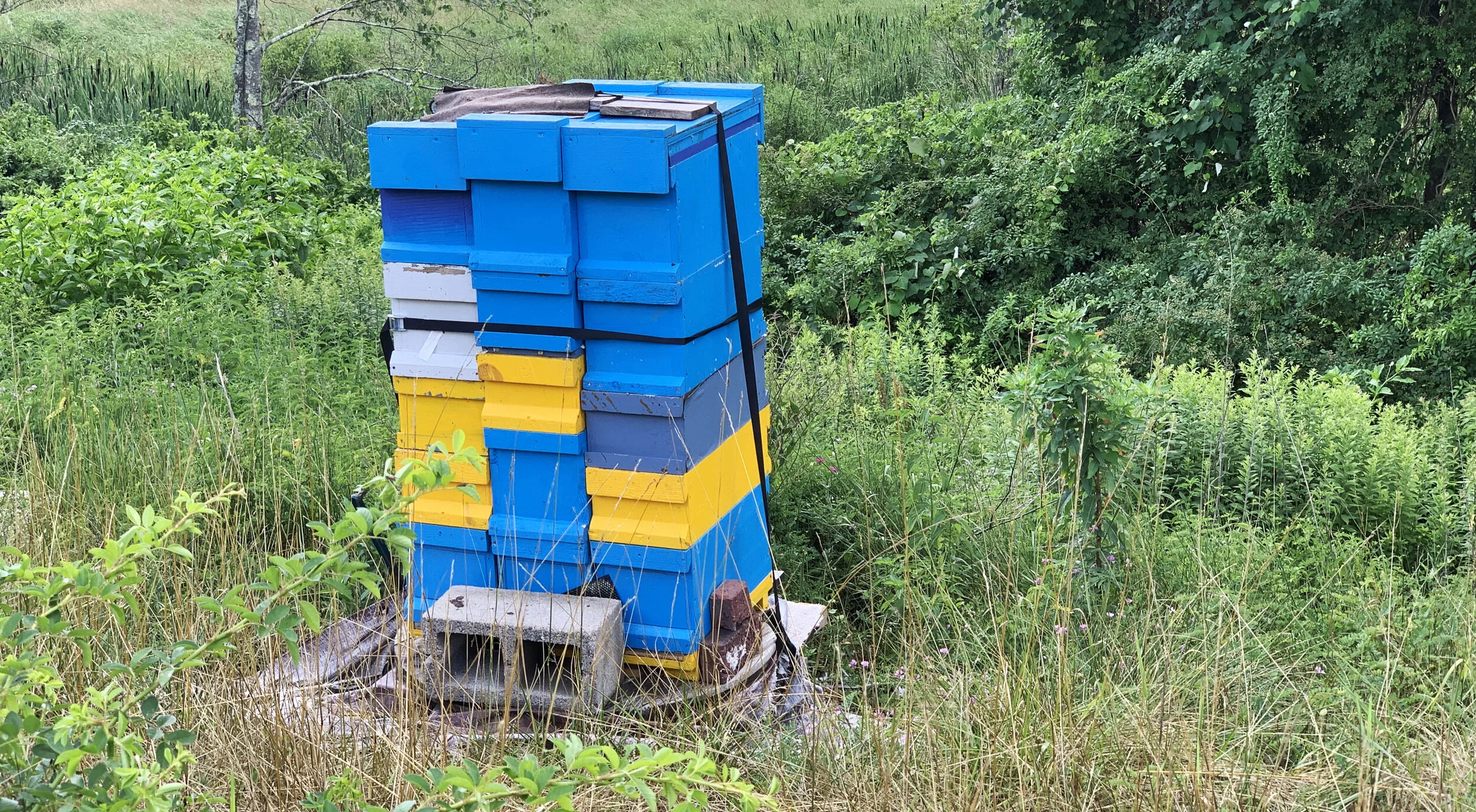
A few of Don’s more colorful hives at the farm. Yellow for the sun and blue for the dome above.
And what’s the buzz? As the bee beats its wings, we hear the vibration as buzzing. But the flower feels the buzzing as movement. Pollen may fall off the flower and onto the bee’s body. Some is carried to the next flower the bee visits; the rest is stashed in the bee’s pollen baskets on its hind legs. It will travel back to the hive for the nurse workers who stay in the hive to feed the young.
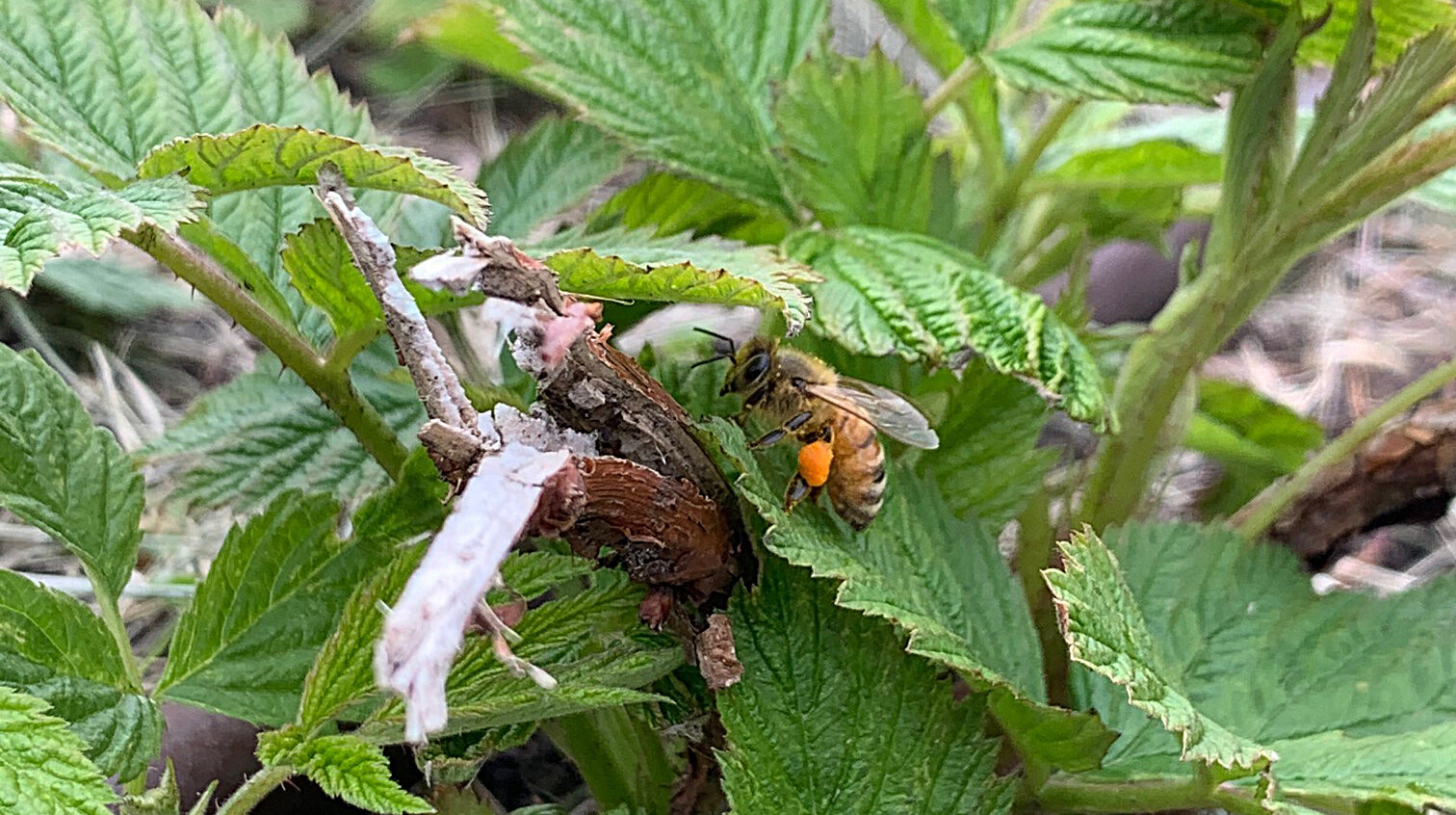
Pollen Baskets are Full
There’s so much more I could write about bees—but perhaps best to stop here and invite you to stop by our farm stand for a taste of local, raw honey. Its truest secrets are only conveyed by the spoonful on the tongue.
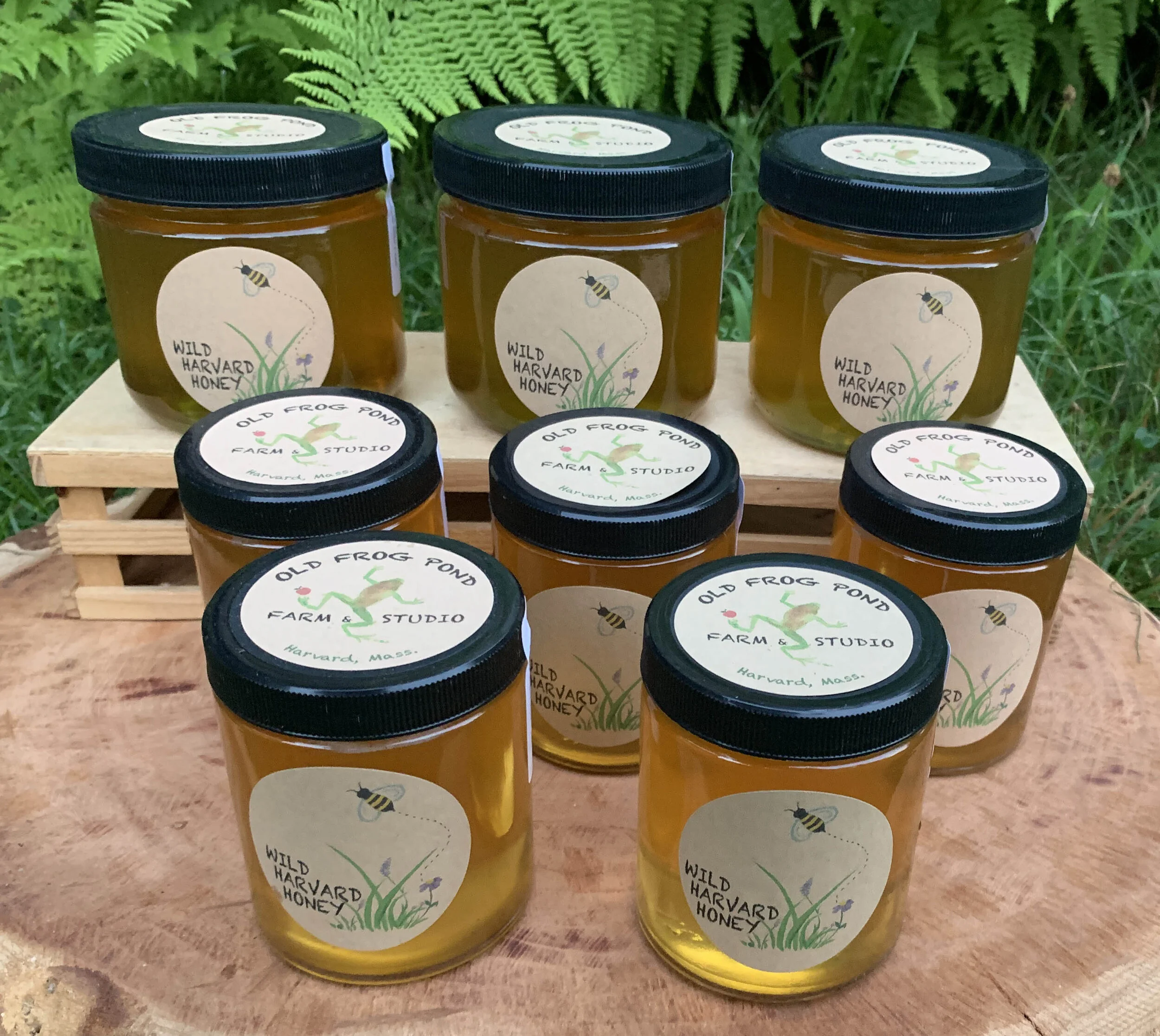
Raw honey for sale at our self-serve farm stand.
Bloom Follows Pink: Orchard Pollination

Bloom is the stage when the closed pink flower buds open to pale, white papery blossoms. This is when the party in the orchard really gets going. You can hear the swoosh of long dresses, the honeybees’ buzz; and follow the flight of the bumblebees, recklessly circling, then landing, the honeybees alighting on flowers, drinking in sweet nectar.
Bees visit a lot of flowers to gather this ambrosia, logging between several hundred and fifteen hundred flower visits on each trip through the orchard. They suck in the sweetness with their long proboscis, then store these sugars in their nectar stomach. Upon returning to the hive with a full belly, another bee will withdraw the nectar, process it, and transfer it into individual cells.

When the bees gather nectar from inside the apple blossoms, they brush across the pollen sitting on small pillows supported by stamens. The pollen grains attach to Velcro-like hairs on the bees’ bodies. When the bee visits another tree, the pollen from one tree is brushed from the bee onto the sticky female stigmas in the center of the blossom of another tree. The pollen grains travel down tubes to reach the ovary. There, sperm in the pollen grain meets the ovules in the ovary. These fertilized ovules become seeds, and the apple grows to protect the growing pips. We find this flesh delicious!
Honeybees need pollen and water, as well as nectar. The bees will divide up these responsibilities for the hive – some gathering pollen, their main source of protein; while others gather nectar for the sugars, and still others water. Some bees including honeybees have ‘pollen baskets’ on their hind legs formed by woven hairs. The bees also have hairs on the inside of their legs that they use like combs to gather the pollen sticking all over their bodies and push it into the basket, mixing in a little sticky nectar, so the pollen packs tightly. You can see the bees sporting bright yellow Turkish pants if you wander through the orchard when they are flying.
This year I am worried about pollination. I can’t remember a bigger bloom in the orchard — or this much spring rain! The bees don’t fly until the temperature reaches fifty-five degrees. In the last week, we’ve only had about five hours of honeybee pollinating temperatures without rain. Fortunately, the native pollinators, like the bumble bees, will fly in cooler temperatures. Only about five percent of apple blossoms need to be pollinated for a good harvest; the tree produces that many ‘extra’ flowers. But, maybe we should not consider them ‘extra.’ These flowers feed the many pollinators. The tree practices generosity. Giving and receiving are one.
If the apples practiced self-pollination, that is one flower on a tree pollinating other flowers on the same tree, it would require less flying. Peanuts, peas, tomatoes, and sunflowers are examples of self-pollinating plants. However, many plants, like most apples, have evolved to require cross-pollination to ensure genetic diversity. In scientific terms, this type of pollination is referred to as self-incompatible, or “unable to survive without another.” These plants all need another plant or tree in their life to bear fruit.
Cross-pollination is critical to a life cycle that ensures the continuity of the species. Maybe human beings aren’t so different. We are not self-compatible either. We need to interact with people different from ourselves to learn and grow. The cross-pollination of cultures, experiences, and ideas may be the ambrosia we need for a healthy, peace-filled world.

A Baltimore Oriole enjoying sweet nectar from a Macintosh tree.
Search Blog
-
2025
- May 9, 2025 A View from the Tractor Seat
- Apr 11, 2025 Dig
-
2024
- Jan 7, 2024 Winter Wassail
-
2022
- Dec 11, 2022 Keeping Time
- Jun 17, 2022 This Apple-Shaped Earth
- Jan 23, 2022 What is a Jizo?
- Jan 16, 2022 An Invite and Housekeeping Update
- Jan 1, 2022 The Year of the Frog: What Orchardists Do While Apple Trees are Chilling
-
2021
- Oct 24, 2021 Figs
- Oct 3, 2021 The Artist and the Orchard: A Memoir
- Aug 8, 2021 Red-Fleshed Apples
- Jul 25, 2021 When We Were Trees
- Jun 27, 2021 Castor Beans—Who Knew?
- Jun 13, 2021 Spring Training at a Zen Monastery
- May 4, 2021 Our Trees are in Bloom
- Apr 18, 2021 Hooray!
- Jan 24, 2021 Wassailing, virtually!
- Jan 1, 2021 Sitting
-
2020
- Dec 21, 2020 Darkness to Light
- Nov 28, 2020 One Heart
- Sep 18, 2020 Juggling Flowers, Fruit, and Vegetables
- Aug 23, 2020 Refuge
- Aug 9, 2020 Bags of Fertilizer
- Aug 2, 2020 The Sermon of the Blue Heron
- Jul 26, 2020 What's the Buzz?
- Jul 19, 2020 Farm Moments
- Jul 12, 2020 Lost Wax
- Jul 5, 2020 Catalpa: The Hugging Tree
- Jun 28, 2020 Pedaling Peace
- Jun 21, 2020 See Change
- Jun 14, 2020 Lalla Unveiled
- Jun 7, 2020 Pond Alchemy
- May 31, 2020 The Birth of Fruit
- May 24, 2020 An Artist in the Orchard
- May 17, 2020 Walking the Land: Returning Home
- May 10, 2020 Stinging Nettles: Gifts from the Great Mother
- May 3, 2020 The Mystery of Swallow
- Apr 26, 2020 Aerial Bruststrokes
- Apr 19, 2020 Simple Pleasures
- Apr 12, 2020 Weeds and Other Gifts
- Apr 5, 2020 Remembering the Seeds
- Mar 29, 2020 Blow on the Embers
- Mar 22, 2020 Ripples
-
2019
- Nov 16, 2019 Tibet Impressions
- Nov 9, 2019 Forest Tales
- Oct 13, 2019 The Gift
- Aug 4, 2019 The Season is Apples, Berries, and Grandfather Fire
- Jun 8, 2019 Pointers for a Writing Life
- May 12, 2019 Mothers of the Earth
- Apr 6, 2019 The Apple-Shaped Earth
- Mar 23, 2019 You Don’t Know What You Have Till It’s Gone
- Feb 23, 2019 Generations
- Feb 9, 2019 What Are We Doing to the Earth, John Chapman?
-
2018
- Dec 31, 2018 Long Shadows
- Oct 6, 2018 A Pilgrimage to India
- Aug 18, 2018 Scrap Wrenn
- Aug 11, 2018 Off-the-Wall Comments from an Ignorant Farmer
- Jul 28, 2018 Creative Connect
- Jul 14, 2018 How is the Orchard?
- Jun 30, 2018 Which Way?
- Jun 16, 2018 Geese, Herons, Beavers, and the Baby Steps of a Lapsed Blogger
- Feb 24, 2018 Mama's Coupons — Good Forever
- Jan 27, 2018 January Ice
- Jan 13, 2018 The Muse
-
2017
- Dec 30, 2017 A Dream for the New Year
- Dec 23, 2017 A New Year for Apples
- Dec 16, 2017 Intuition
- Nov 22, 2017 Thanksgiving OM
- Nov 4, 2017 East Fork Pottery
- Oct 28, 2017 Putting Down New Roots
- Oct 21, 2017 A is for Art
- Oct 14, 2017 Eve domesticus
- Oct 7, 2017 A String Workshop
- Sep 30, 2017 After Applepicking
- Sep 23, 2017 Two Bad Women and One Good Apple
- Sep 16, 2017 Plein Air Poetry
- Sep 9, 2017 Cutting Off a Leg
- Sep 2, 2017 The Changing Landscape
- Aug 26, 2017 All About Art
- Aug 19, 2017 My First Visit to the Farm
- Aug 12, 2017 The First Food
- Aug 5, 2017 A Teapot, a Woman, and maybe a Boat
- Jul 29, 2017 A Raspberry Dilemma
- Jul 22, 2017 Consider the Miracle
- Jul 15, 2017 Meeting Ekphrasis
- Jul 8, 2017 Ripening Fruit
- Jul 1, 2017 The Voice of The Caterpillar
- Jun 24, 2017 Goumi — An Unusual Fructus
- Jun 17, 2017 Concord, an American Bloomsbury
- Jun 10, 2017 The World Is Bonkers — Shall I Laugh or Cry?
- Jun 3, 2017 Bonkers, a Revolutionary Apple
- May 27, 2017 Guardians of the Swamp
- May 20, 2017 There are Mushrooms and There are Morels
- May 13, 2017 "What's in a Name?"
- May 6, 2017 Bloom Follows Pink: Orchard Pollination
- Apr 29, 2017 The Orchard Is at Pink
- Apr 22, 2017 Natural Farming — Part 2 (continuation from last Sunday's blog)
- Apr 15, 2017 Natural Farming — Part 1
- Apr 8, 2017 Boats, Figures, and Catching Fish
- Apr 1, 2017 A Man with a Mission: The Nuts and Bolts of Bronze Casting
- Mar 25, 2017 A Chalice of Spirit, Art, and Nature
- Mar 18, 2017 Hanami — Blossom Viewing
- Mar 11, 2017 Soil Redemption Song
- Mar 4, 2017 Food is Primary Care
- Feb 25, 2017 Pomme de Terre
- Feb 18, 2017 Organic Certification
- Feb 11, 2017 Tantalizing Fruit
- Feb 4, 2017 The Myths of History
- Jan 28, 2017 The Orchard in Winter
- Jan 21, 2017 The Hi-Line
- Jan 14, 2017 Artistic, Botanical, and Social Diversity
- Jan 7, 2017 Where is Eden?
-
2016
- Dec 31, 2016 The Creative Heart
- Dec 24, 2016 A Christmas Tale
- Dec 17, 2016 Who are the Crones?
- Dec 10, 2016 The Olympic Bell (Part Two)
- Dec 3, 2016 Overheard in the Apple Orchard in Early December
- Nov 26, 2016 The Lessons of a Tortoise
- Nov 19, 2016 In the Studio
- Nov 12, 2016 Even in Darkness
- Nov 5, 2016 Southern Apples, an Elephant, Monkey, Rabbit, and Bird, Two Mango Trees and a Birthday
- Oct 29, 2016 The Tools of Art
- Oct 22, 2016 Labyrinths
- Oct 15, 2016 Repairing the Broken
- Oct 8, 2016 When You Are No More
- Oct 1, 2016 Creation Rain
- Sep 24, 2016 Breaking the Glass
- Sep 17, 2016 String Art
- Sep 10, 2016 Poetry and Photosynthesis: It's all in the Leaves
- Sep 3, 2016 In the Plenty of Time
- Aug 27, 2016 Witch Doctors
- Aug 20, 2016 Listen Coyote
- Aug 13, 2016 Milkweed in the Orchard
- Aug 6, 2016 Some People See a Turtle
- Jul 30, 2016 Arborshaping
- Jul 23, 2016 Joseph Wheelwright: Sculptor of Stones and Trees
- Jul 16, 2016 Asian Pears
- Jul 9, 2016 Gold Leaf, Grief, and the Creative Process
- Jul 2, 2016 The Olympic Bell (Part One)
- Jun 25, 2016 Around the Mulberry Bush
- Jun 18, 2016 Avoiding Apples
- Jun 11, 2016 Fructus
- Jun 4, 2016 Astonishing Apples
- May 28, 2016 Scare the Caterpillars
- May 21, 2016 Join the Club!
- May 14, 2016 The Graft
- May 7, 2016 Rooster, Rhubarb, Rue
- Apr 30, 2016 What do Dolphins and Nettles Have in Common?
- Apr 23, 2016 Art Prunings
- Apr 16, 2016 A Few of the First Arrivals
- Apr 9, 2016 Taste the Spirit of Sustainable Agriculture
- Apr 2, 2016 First Orchard Spray - March 22-24, 2016
- Mar 26, 2016 Hawkeye Apple
- Mar 19, 2016 Desiring the Almata Apple
- Mar 12, 2016 Ugly Fruit
- Mar 5, 2016 Winter Tracks
- Feb 27, 2016 Splash
- Feb 20, 2016 Pruning
- Feb 13, 2016 Orchard Ruminants
- Feb 6, 2016 A Gathering of Seeds
- Jan 30, 2016 Orchard Dragons
- Jan 23, 2016 Tree Rings
- Jan 17, 2016 The Fallen Tree
- Jan 7, 2016 Wassailing the Apple Trees
- Jan 1, 2016 The New Year