LINDA HOFFMAN
Generations
Dedicated to Annette Barbara Weiner (1933–1997)
I was recently prompted to read “Once More to the Lake,” the essay E. B. White wrote about returning to his childhood summer home, this time with his eleven-year-old son. For White, then 43, memories flooded back as he gazed at his son’s hands on the fishing rod. White no longer knew who he was—the son of his father or the father of his son. Disturbed by this unsettling dichotomy he wrote:
I looked at the boy, who was silently watching his fly, and it was my hands that held his rod, my eyes watching. I felt dizzy and didn't know which rod I was at the end of.
What is passed between parent and child, and how does this happen?
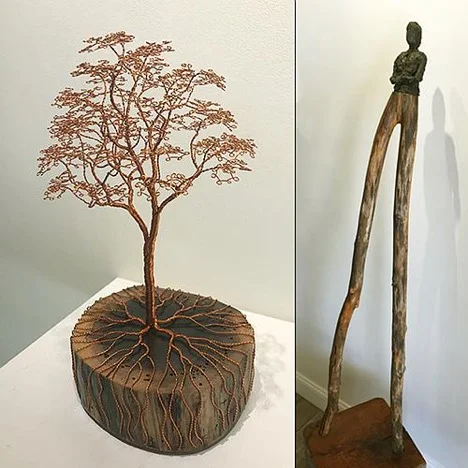
Generations is the title of the current exhibit at Hopkinton Center for the Arts, and the title refers to the relationship of the two exhibiting artists, my daughter, Ariel Matisse, and myself. Less than two years ago, Ariel decided to make an outdoor sculpture for our annual sculpture exhibit at the farm. This was the summer after she helped with the exhibit, After Apple Pruning . Taken with using wire while working on a collaborative sculpture for that exhibit, Ariel wanted to make a wire tree and asked to use a hollow log I had in the studio. I’m always fascinated with hollow logs—the form and the emptiness. The heart sutra, chanted daily in all Buddhists monasteries, says, Form is emptiness, emptiness is form. Ariel wanted to gold leaf the saw cut, the way I have done since making the six-part Inside the Ordinary Maple in 1998.

Inside the Ordinary Maple, wood and gold leaf, LH
“Of course, I will show you.” First you sand it smooth, gradually using finer sand paper. Then it needs to be urethaned to seal the wood. Moisture seeping up into the gold leaf will lift it. Then you need to apply the sizing and wait for it to be the perfect tackiness to receive the leaf.
Gold leaf is between .1 and .125 millionths of a meter or micrometers. One thousand sheets will equal an ordinary piece of paper. It’s not something you can grasp with your fingers. To pick up a small fragment, you will find a soft watercolor brush is useful, rubbing it first in your hair to create some static electricity. For large areas, I use a rolled leaf that comes with a thin backing material. Once the leaf is placed down on the sizing and pressed in gently, you lift off the backing.
Ariel and I sat around the log each on our stool, our hands moving together. I watched her fingers. They knew how to hold the tools, to feel the smooth surface of wood, to lift the backing. I showed her how to shine the gold, to burnish it with a cotton ball.
Then the project was all hers. Cutting wire to length, hanging this Medusa head of tangled wires from a hook on the ceiling, bending, shaping, counting the complex pattern. Twisting the roots and drilling the ends into the trunk. Where did she learn all of this? When? What is transferred between mother and daughter? Or, father and daughter ? Ariel’s father is a gifted ‘maker of things’, as he likes to say.
When the director of the Center, Kris Waldman, needed a show to fill the slot from January 25 to March 15, my name was suggested. She came to the studio on December 24th and took photos. As she was leaving, I said I’d like to do the exhibit with my daughter. She was surprised at first, but then I pointed out two of Ariel’s pieces, Spiral, on the wall, and Willow, her first tree, the one we had gold leafed together. Ariel then sent Kris photos of her newer work.

Tempo V, Ariel Matisse
Kris chose sculptures from each of us and suggested the title for the exhibit. One of my pieces is, Filling the Vessel, a large five-panel sculpture I made in memory of mother. In the gallery, it faces the wall of Ariel’s sculptures. I feel I am in between the two of them. I relate to E.B. White’s uncertain feeling of no longer knowing who he is.
I seemed to be living a dual existence. I would be in the middle of some simple act, I would be picking up a bait box or laying down a table fork, or I would be saying something, and suddenly it would be not I but my father who was saying the words or making the gesture.
Recently, my art no longer feels like something I own; it belongs to something more fluid, a stream, a flooding of creativity across generations. I’m playing my part, doing what is in front of me, inhabiting my life as fully as I can, yet letting it flow. E.B. White describes how, while in the boat with his son, “A school of minnows swam by, each minnow with its small, individual shadow, doubling the attendance, so clear and sharp in the sunlight.” He seems to be seeing himself as one of these minnows, insignificant, one of the schooling fish. It’s points to the conundrum of form and emptiness. The shadow and the real are inseparable. White is not father and not son; and both father and son—a beautiful rising and falling of creation. The living and the dying, and the what never dies.
We hope you will see the exhibit at the Hopkinton Center for the Arts, Hopkinton, MA, and perhaps join us at our reception on Friday, March 1; 6–7:30 p.m. The gallery is open Monday–Saturday, 9–5 p.m. and during the center’s evening events. The exhibit is up through March 15.

Left: Ariel Matisse, In the Garden, 2019, copper wire, walnut, 11" x 6" x 5½". Right: Linda Hoffman, Long-Legged Man, 2006, bronze, branch, wood block, 65" x 16" x 16".
My mother, Annette Weiner, would be so happy to see the exhibit. If I had thought of it earlier, I would have suggested we exhibit one of her paintings along with our sculpture.

Tree, Annette Weiner
When my mother went to college, she already had two children ages six and nine. Starting out as a Fine Arts major at the University of Pennsylvania, she then changed to anthropology and went on to earn a PhD the year I graduated from high school. As in the orchard, the cycle continues from seed, to blossom, to fruit. This poem by Dawna Markova says it well.
I Will Not Die an Unlived Life
I will not die an unlived life
I will not live in fear
of falling or catching fire.
I choose to inhabit my days,
to allow my living to open me,
to make me less afraid,
more accessible,
to loosen my heart
until it becomes a wing,
a torch, a promise.
I choose to risk my significance;
to live so that which came to me as seed
goes to the next as blossom
and that which came to me as blossom,
goes on as fruit.
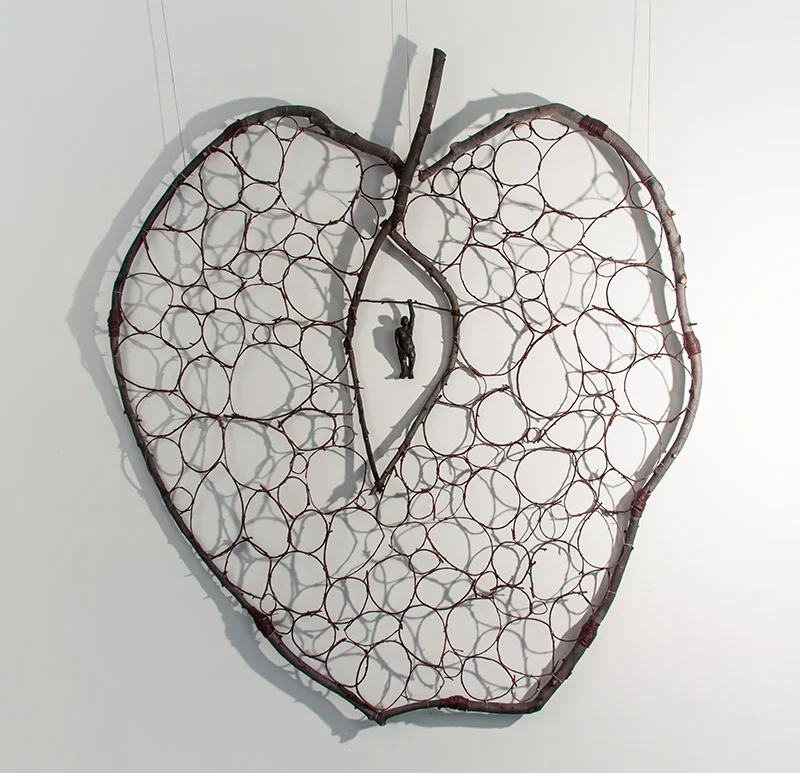
Where is Eden?
“Way to the East, at the source of four rivers” it says in the Bible. But this description doesn’t really help. The Tigris and the Euphrates are two locator rivers for Eden, but they have different sources, and there is no confluence of four rivers nearby. Medieval cartographers placed Eden on the far edge of their maps, beyond Asia, as if in unexplored territory. They often drew a walled garden and a naked little man and woman to mark the location.

Beatus Map, locating Garden of Eden (1109)
For centuries, Eden was considered a real place and it belonged on any map of the world, but no one quite knew exactly where to locate it. When coordinate mapping began in the 15th century, Eden was placed at 0 degrees latitude and 180 degrees longitude — until it became apparent that the coordinates pointed to an area in the middle of the Pacific Ocean. Today, we don’t try to put Eden on the map — but that doesn’t mean we don’t try to find it.
What is Eden, after all, but getting what we want, when we want it? That’s what the Buddha understood 2500 years and built the foundation of his teaching from his understanding that we all suffer because of our desires. When things go our way, we are happy, and when they don’t, we suffer. Eden is that lovely place where every desire is satisfied: the world is our oyster. The Buddha taught that the way out from this suffering was to understand that satisfying our cravings will never bring happiness, because all of life is impermanent. When we think we have it — whatever it is — something shifts — and once again we are looking for the next rosy apple.
Eden and Paradise are often used synonymously. To the Persians, Paradise meant a walled garden, while to the Hebrews it was an orchard. Indeed, I would agree that an orchard is as close as it comes to Eden. Trees that grow and produce sweet fruit year after year are really quite miraculous. There is so much about fruit trees that is astonishing — even simple apple branches — those irregular shaped, pruned and grafted, sculpted limbs, bewitching with their freedom and artistry.
Thus we have the genesis of the exhibit, After Apple Pruning. Using apple branches pruned from dormant trees and a few grafted roots from young trees that died, and with the help of good friends, Lynn Horsky and Gabrielle White, and my daughter, Ariel Matisse, we have created an Eden of apple orchard related sculpture for The Gallery at Villageworks in Acton, Massachusetts. We populated many of the branches with bronze figures that I first sculpted in wax — Adam and Eve, serpents, people sitting, bending, kneeling, reading, mediating, resting, as well as hanging from trees, tempting a snake, or embracing.
A few days ago, in anticipation of the installation, I became almost hysterical with worry. Two large wall panels took most of one day to figure out how to hang, including three trips to the hardware store and two consultations with my neighbor, a retired engineer (No nails in the walls was a gallery restriction). I didn’t want to rent and drive a 15’ truck and the forecast was solid rain for installation day. Moving so many very delicate branches was frightening, because one never knows when reassembling a piece if it will come together the way it did before. I watched as my mind went into a tail spin. I was struggling outside the garden walls.
The installation was smoother than expected; though one small, but important branch broke and caused a small panic. Blase, my partner, helped enormously. Clearly my prior distress was for naught. Today, we no longer look for Eden on a map, but I would place it for the next three months, a little to the east, in Acton. I simply love to be in the gallery space among all of the art. My Eden has been the pleasure of working with Lynn and Gabi, and seeing my daughter fully engage a challenging project. Eden is inside the mind, always nearby, no farther than our next thought.
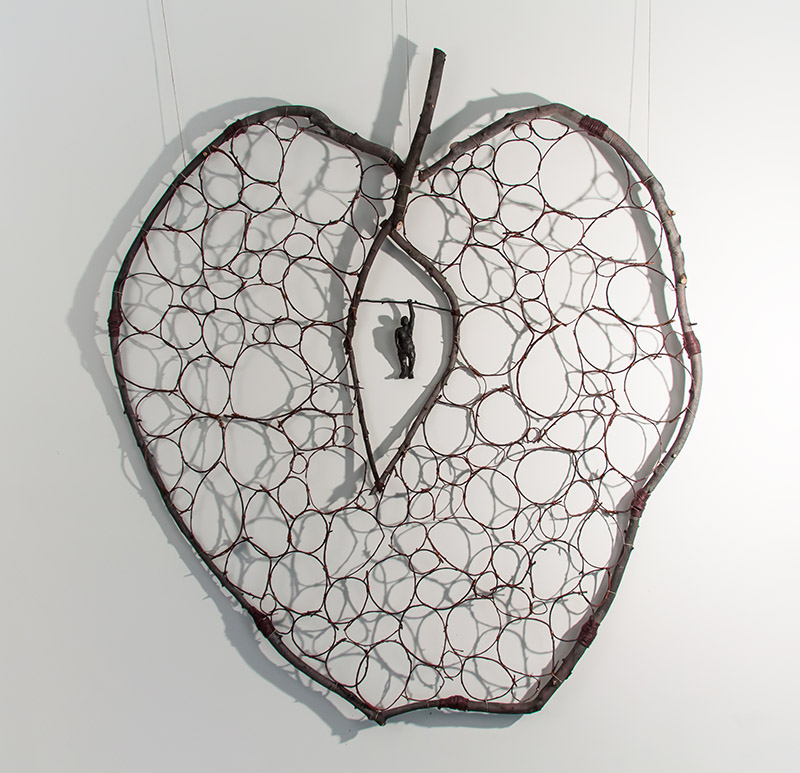
From One Seed, Linda Hoffman & Gabrielle White
Please join us!
Opening Reception for the Artists
Sunday, January 15 from 3-5 pm at 525 Massachusetts Ave, Acton, MA.
Exhibition dates: January 6 – March 30, 2017
Gallery hours: M-F 9-5.
Artist Hours in the Gallery
Fridays, Feb 3, 10, 24; March 10, 24; noon to 2pm
Poetry Reading in the Gallery
Celebrating the publication of "Before We Were Birds"
By Susan Edwards Richmond
Sunday, March 12 at 3pm
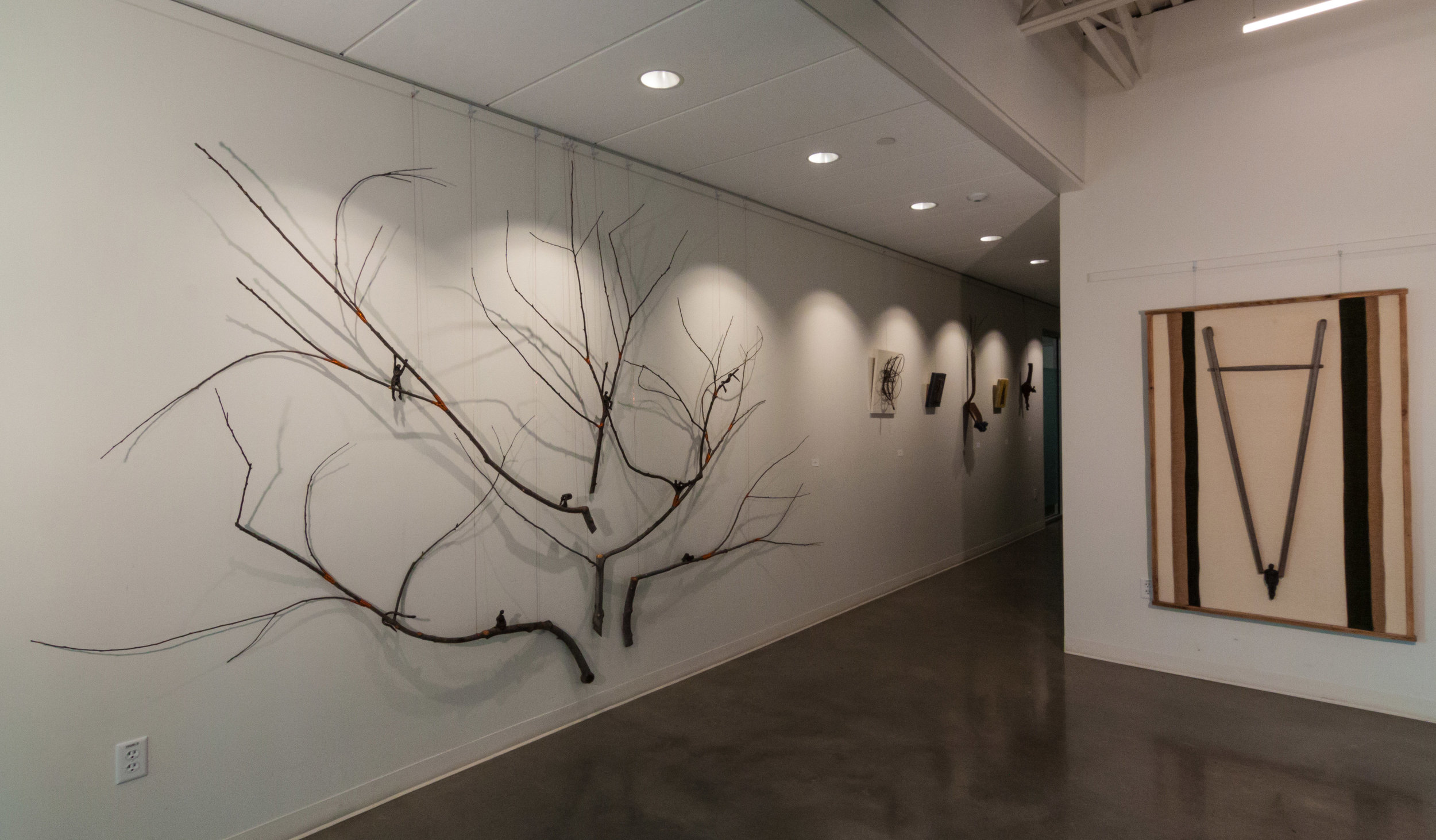
Grafting a Life (Left Wall) Linda Hoffman & Ariel Matisse
Art Prunings
There is a heap of apple prunings outside my studio door. The size of the pile might make you think that it contains all the pruned branches that came out of the orchard this winter, but it’s only a small portion. We burned a two-story tower in an intense bonfire a month ago. All that remained was a circle of charcoal. Would that it were so easy to release the debris and the clutter that accumulates year to year in our lives. As I spread these residues throughout the orchard, I imagine how it will help the soil: carbon, in the form of biochar. The no-longer-useful provides sustenance. What if our own life prunings supported our future growth?
The tangled heap outside my studio door waits because I committed to use apple prunings to make sculpture. There is so much wood that comes off the trees every year; it astonishes me every time. I’ve tried before, a few times, making an 8-foot hanging apple ladder and a few smaller mobiles using branches, string, and bronze figures. They are good sculptures, but the branch is still a branch; I didn’t unfasten it from its normal function.
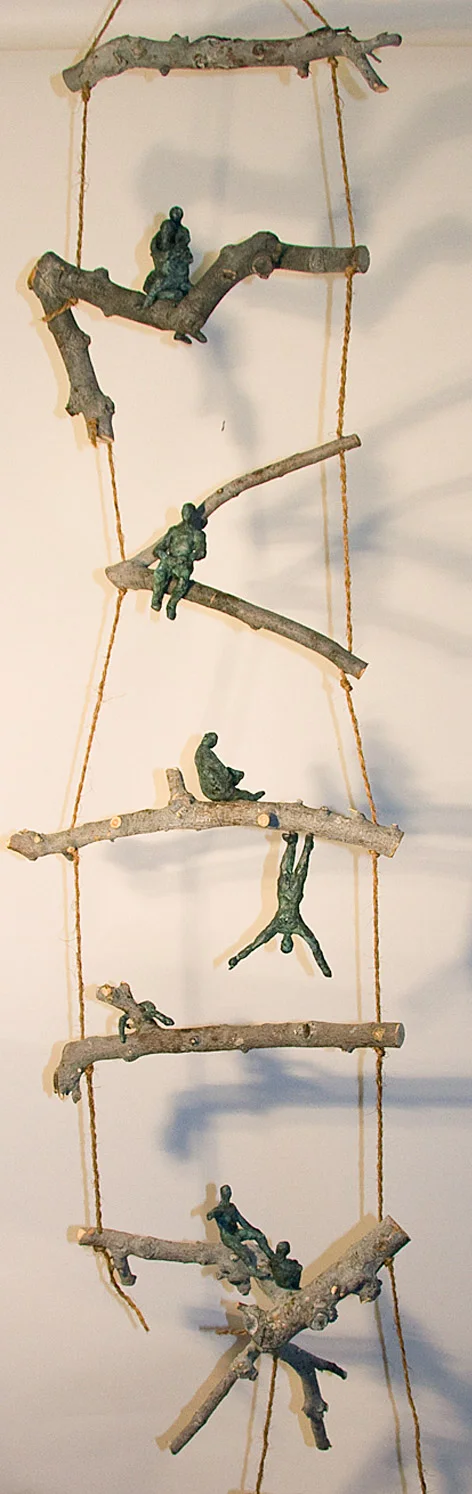
Apple Ladder (LH)
I have in mind something else for all these twigs, but what exactly I am not sure. My own life has become so connected to apples — their seasons and needs, how to grow healthier fruit, the intricacies of bud development — I want my art to also interrelate with the apple tree cycles.
When people ask me, “Are you an artist or an orchardist?” or “What is more important the orchard or your art?” I respond that it is being an artist, because that’s what informs everything I do in the orchard. And so it follows that if my life as an artist is inextricably connected to this orchard, I want to try to use the prunings as a medium. A painter uses paint to create a world of form and space, color and movement, light and dark. I wonder how and if I can do the same with these prunings?
It doesn’t hurt that I am committed to putting up an apple-themed exhibit next January in The Gallery at Villageworks in West Acton. The challenge is that the work has to hang on the walls and not extend out. And I can’t use the floor, because the space serves for movies, concerts, and performances. So I am limited to a slightly bushy two dimensions.
My art is often following a knotted path that leads to something unknown. There is always a challenge, and moments (many) when I don’t think I can do it. I’m not actually sure I can use these prunings. They are delicate, wispy, all irregular with little side shoots, or long side shoots, buds, or tears in the bark. There are some stronger branches, too. We will see . . . but I have begun. I recognize this gnawing feeling as if the rope I am hanging onto is fraying and I have to do it before I fall.
There is that untenable, unknowable truth in all great art, the driving impetus of the artist that the viewer senses. The artist is trying to express something that is unknown, but very real. One of my favorite paintings is by Paul Gauguin and it is on view at the Museum of Fine art in Boston.

Where do we come from? What are we? Where are we going? Paul Gauguin
The entire cycle of human life is in this painting — old age, youth, middle age, the sacred, the animal, the mundane and the mystery. In the center is an androgynous figure reaching for an apple. Art that inspires me asks for a dialogue. It always leaves me with questions. Maybe that is one of its secrets; while art strives to express the unknown, it can only express a brief moment of truth. There are no definitive answers, only more questions. I’m hoping that working with the apple prunings will push me to explore in ways I haven’t done before as an artist and that working with this new challenge will be yet another gift of the orchard.
Search Blog
-
2025
- May 9, 2025 A View from the Tractor Seat
- Apr 11, 2025 Dig
-
2024
- Jan 7, 2024 Winter Wassail
-
2022
- Dec 11, 2022 Keeping Time
- Jun 17, 2022 This Apple-Shaped Earth
- Jan 23, 2022 What is a Jizo?
- Jan 16, 2022 An Invite and Housekeeping Update
- Jan 1, 2022 The Year of the Frog: What Orchardists Do While Apple Trees are Chilling
-
2021
- Oct 24, 2021 Figs
- Oct 3, 2021 The Artist and the Orchard: A Memoir
- Aug 8, 2021 Red-Fleshed Apples
- Jul 25, 2021 When We Were Trees
- Jun 27, 2021 Castor Beans—Who Knew?
- Jun 13, 2021 Spring Training at a Zen Monastery
- May 4, 2021 Our Trees are in Bloom
- Apr 18, 2021 Hooray!
- Jan 24, 2021 Wassailing, virtually!
- Jan 1, 2021 Sitting
-
2020
- Dec 21, 2020 Darkness to Light
- Nov 28, 2020 One Heart
- Sep 18, 2020 Juggling Flowers, Fruit, and Vegetables
- Aug 23, 2020 Refuge
- Aug 9, 2020 Bags of Fertilizer
- Aug 2, 2020 The Sermon of the Blue Heron
- Jul 26, 2020 What's the Buzz?
- Jul 19, 2020 Farm Moments
- Jul 12, 2020 Lost Wax
- Jul 5, 2020 Catalpa: The Hugging Tree
- Jun 28, 2020 Pedaling Peace
- Jun 21, 2020 See Change
- Jun 14, 2020 Lalla Unveiled
- Jun 7, 2020 Pond Alchemy
- May 31, 2020 The Birth of Fruit
- May 24, 2020 An Artist in the Orchard
- May 17, 2020 Walking the Land: Returning Home
- May 10, 2020 Stinging Nettles: Gifts from the Great Mother
- May 3, 2020 The Mystery of Swallow
- Apr 26, 2020 Aerial Bruststrokes
- Apr 19, 2020 Simple Pleasures
- Apr 12, 2020 Weeds and Other Gifts
- Apr 5, 2020 Remembering the Seeds
- Mar 29, 2020 Blow on the Embers
- Mar 22, 2020 Ripples
-
2019
- Nov 16, 2019 Tibet Impressions
- Nov 9, 2019 Forest Tales
- Oct 13, 2019 The Gift
- Aug 4, 2019 The Season is Apples, Berries, and Grandfather Fire
- Jun 8, 2019 Pointers for a Writing Life
- May 12, 2019 Mothers of the Earth
- Apr 6, 2019 The Apple-Shaped Earth
- Mar 23, 2019 You Don’t Know What You Have Till It’s Gone
- Feb 23, 2019 Generations
- Feb 9, 2019 What Are We Doing to the Earth, John Chapman?
-
2018
- Dec 31, 2018 Long Shadows
- Oct 6, 2018 A Pilgrimage to India
- Aug 18, 2018 Scrap Wrenn
- Aug 11, 2018 Off-the-Wall Comments from an Ignorant Farmer
- Jul 28, 2018 Creative Connect
- Jul 14, 2018 How is the Orchard?
- Jun 30, 2018 Which Way?
- Jun 16, 2018 Geese, Herons, Beavers, and the Baby Steps of a Lapsed Blogger
- Feb 24, 2018 Mama's Coupons — Good Forever
- Jan 27, 2018 January Ice
- Jan 13, 2018 The Muse
-
2017
- Dec 30, 2017 A Dream for the New Year
- Dec 23, 2017 A New Year for Apples
- Dec 16, 2017 Intuition
- Nov 22, 2017 Thanksgiving OM
- Nov 4, 2017 East Fork Pottery
- Oct 28, 2017 Putting Down New Roots
- Oct 21, 2017 A is for Art
- Oct 14, 2017 Eve domesticus
- Oct 7, 2017 A String Workshop
- Sep 30, 2017 After Applepicking
- Sep 23, 2017 Two Bad Women and One Good Apple
- Sep 16, 2017 Plein Air Poetry
- Sep 9, 2017 Cutting Off a Leg
- Sep 2, 2017 The Changing Landscape
- Aug 26, 2017 All About Art
- Aug 19, 2017 My First Visit to the Farm
- Aug 12, 2017 The First Food
- Aug 5, 2017 A Teapot, a Woman, and maybe a Boat
- Jul 29, 2017 A Raspberry Dilemma
- Jul 22, 2017 Consider the Miracle
- Jul 15, 2017 Meeting Ekphrasis
- Jul 8, 2017 Ripening Fruit
- Jul 1, 2017 The Voice of The Caterpillar
- Jun 24, 2017 Goumi — An Unusual Fructus
- Jun 17, 2017 Concord, an American Bloomsbury
- Jun 10, 2017 The World Is Bonkers — Shall I Laugh or Cry?
- Jun 3, 2017 Bonkers, a Revolutionary Apple
- May 27, 2017 Guardians of the Swamp
- May 20, 2017 There are Mushrooms and There are Morels
- May 13, 2017 "What's in a Name?"
- May 6, 2017 Bloom Follows Pink: Orchard Pollination
- Apr 29, 2017 The Orchard Is at Pink
- Apr 22, 2017 Natural Farming — Part 2 (continuation from last Sunday's blog)
- Apr 15, 2017 Natural Farming — Part 1
- Apr 8, 2017 Boats, Figures, and Catching Fish
- Apr 1, 2017 A Man with a Mission: The Nuts and Bolts of Bronze Casting
- Mar 25, 2017 A Chalice of Spirit, Art, and Nature
- Mar 18, 2017 Hanami — Blossom Viewing
- Mar 11, 2017 Soil Redemption Song
- Mar 4, 2017 Food is Primary Care
- Feb 25, 2017 Pomme de Terre
- Feb 18, 2017 Organic Certification
- Feb 11, 2017 Tantalizing Fruit
- Feb 4, 2017 The Myths of History
- Jan 28, 2017 The Orchard in Winter
- Jan 21, 2017 The Hi-Line
- Jan 14, 2017 Artistic, Botanical, and Social Diversity
- Jan 7, 2017 Where is Eden?
-
2016
- Dec 31, 2016 The Creative Heart
- Dec 24, 2016 A Christmas Tale
- Dec 17, 2016 Who are the Crones?
- Dec 10, 2016 The Olympic Bell (Part Two)
- Dec 3, 2016 Overheard in the Apple Orchard in Early December
- Nov 26, 2016 The Lessons of a Tortoise
- Nov 19, 2016 In the Studio
- Nov 12, 2016 Even in Darkness
- Nov 5, 2016 Southern Apples, an Elephant, Monkey, Rabbit, and Bird, Two Mango Trees and a Birthday
- Oct 29, 2016 The Tools of Art
- Oct 22, 2016 Labyrinths
- Oct 15, 2016 Repairing the Broken
- Oct 8, 2016 When You Are No More
- Oct 1, 2016 Creation Rain
- Sep 24, 2016 Breaking the Glass
- Sep 17, 2016 String Art
- Sep 10, 2016 Poetry and Photosynthesis: It's all in the Leaves
- Sep 3, 2016 In the Plenty of Time
- Aug 27, 2016 Witch Doctors
- Aug 20, 2016 Listen Coyote
- Aug 13, 2016 Milkweed in the Orchard
- Aug 6, 2016 Some People See a Turtle
- Jul 30, 2016 Arborshaping
- Jul 23, 2016 Joseph Wheelwright: Sculptor of Stones and Trees
- Jul 16, 2016 Asian Pears
- Jul 9, 2016 Gold Leaf, Grief, and the Creative Process
- Jul 2, 2016 The Olympic Bell (Part One)
- Jun 25, 2016 Around the Mulberry Bush
- Jun 18, 2016 Avoiding Apples
- Jun 11, 2016 Fructus
- Jun 4, 2016 Astonishing Apples
- May 28, 2016 Scare the Caterpillars
- May 21, 2016 Join the Club!
- May 14, 2016 The Graft
- May 7, 2016 Rooster, Rhubarb, Rue
- Apr 30, 2016 What do Dolphins and Nettles Have in Common?
- Apr 23, 2016 Art Prunings
- Apr 16, 2016 A Few of the First Arrivals
- Apr 9, 2016 Taste the Spirit of Sustainable Agriculture
- Apr 2, 2016 First Orchard Spray - March 22-24, 2016
- Mar 26, 2016 Hawkeye Apple
- Mar 19, 2016 Desiring the Almata Apple
- Mar 12, 2016 Ugly Fruit
- Mar 5, 2016 Winter Tracks
- Feb 27, 2016 Splash
- Feb 20, 2016 Pruning
- Feb 13, 2016 Orchard Ruminants
- Feb 6, 2016 A Gathering of Seeds
- Jan 30, 2016 Orchard Dragons
- Jan 23, 2016 Tree Rings
- Jan 17, 2016 The Fallen Tree
- Jan 7, 2016 Wassailing the Apple Trees
- Jan 1, 2016 The New Year