LINDA HOFFMAN
Astonishing Apples
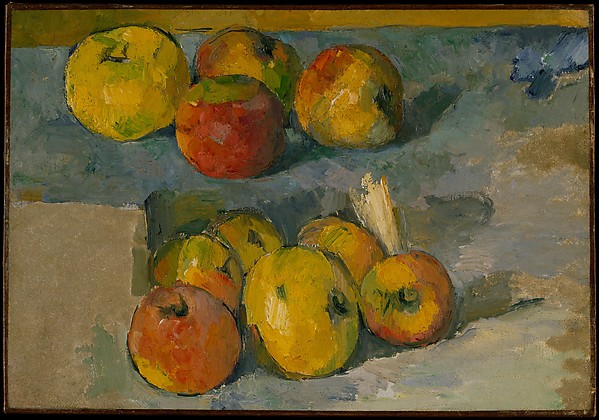
Apples, Paul Cézanne, Metropolitan Museum
The painter Paul Cézanne once said, I will astonish Paris with an apple! He painted the apple over and over — more than 250 still life paintings with apples. Some feel dark and foreboding while others are raucously joyful; but Cézanne wasn’t interested in depicting emotions, he painted light. He painted light that created shape. With small brushstrokes of color, he crafted the landscape he loved near Aix-en-Provence, the nestled houses, Mont Sainte-Victoire, rocks and trees; and back in the studio, his many magnificent still life paintings and portraits.
In the history of art, Cézanne is the beginning of modern painting. He didn’t paint like the Impressionists, with their luminous pictures of an ephemeral moment, but created solidity, the absoluteness of shape — or presence — the reality of an object as it embodies itself.
I was telling my friend, Jody Hojin Kimmel, a Buddhist priest and artist, that I was hoping to write a blog about apples and Cézanne. She told me about a little book, World View of Paul Cézanne: Psychic Interpretation, by Jane Roberts. Roberts wrote that she channeled the book from Cézanne. I found it on Amazon and looked for references to apples. (I also ordered a copy.)
The apple’s color doesn’t stay in the apple, for if you observe carefully, you will notice that the colors bleed outward, escaping the apple’s shape; and that the colors of nearby objects are also contained, however minutely, in the apple . . .
Roberts (or Cézanne) is saying that the apple is not an isolated object, but part of its surroundings. Taking this idea further suggests that the lines we give to objects are not hard and fast boundaries. And extending the idea to ourselves, to our own bodies, means we are not distinct entities. I think Cézanne would agree that there is a continuum between object and ground, between subject and object, between tree, rock, and sky. One of the important realizations of the Buddha was that we are all connected, interdependent, not separate. You might say that Cézanne’s paintings of apples were explorations into the very nature of the spiritual life.
In another reference to Cézanne’s apples, Roberts wrote,
Apples seem to have their own colors made of many combinations, and almost just above these, other colors stain the original ones. And these top colors carry more of light’s shifting characteristics, for they will seem to float above the apple in uneven layers, with peaks and valleys-‑like a colorful sea of surrounding objects, through which we peer to see the objects underneath.
Roberts is describing how Cézanne painted the layers of his perceptions, as he built up the painting of an apple with transparent colors. It’s as if the skin of the apple was multi-dimensional, kaleidoscopic.
Cézanne was completely attentive to his subject. His paintings don’t express any commentary or subtext. The apples are apples; the rocks are rocks — and the painter disappears. When people say, Oh, I can’t paint, they are talking about creating a likeness. If they really want to paint, they must become their subject completely, and the result will be art. It might not be a likeness, and it might not be great art — that takes great skill, patience, and a lifetime of dedicated practice every day. But no matter, others will sense the truth in their work, the truth of the artist’s experience. That’s why I find abstract art can be so powerful; there is a profound merging, beyond meaning, where subject and object cannot be differentiated subject.
This fall we will have an Apple Painting workshop at the farm. We’ll look at some photographs of Cézanne’s paintings and then choose apples from the orchard to arrange and paint. Let me know if you’d like to be on the list to receive information. Cézanne said, Painting from nature is not copying the object . . . it is realizing one’s sensations. We can all do that.
Art Prunings
There is a heap of apple prunings outside my studio door. The size of the pile might make you think that it contains all the pruned branches that came out of the orchard this winter, but it’s only a small portion. We burned a two-story tower in an intense bonfire a month ago. All that remained was a circle of charcoal. Would that it were so easy to release the debris and the clutter that accumulates year to year in our lives. As I spread these residues throughout the orchard, I imagine how it will help the soil: carbon, in the form of biochar. The no-longer-useful provides sustenance. What if our own life prunings supported our future growth?
The tangled heap outside my studio door waits because I committed to use apple prunings to make sculpture. There is so much wood that comes off the trees every year; it astonishes me every time. I’ve tried before, a few times, making an 8-foot hanging apple ladder and a few smaller mobiles using branches, string, and bronze figures. They are good sculptures, but the branch is still a branch; I didn’t unfasten it from its normal function.
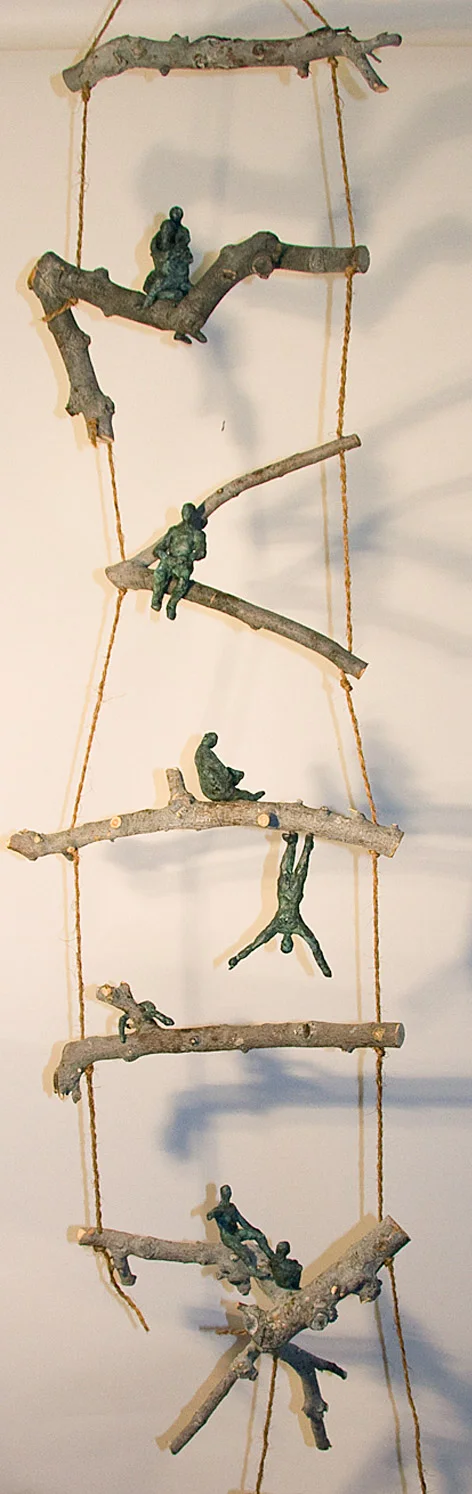
Apple Ladder (LH)
I have in mind something else for all these twigs, but what exactly I am not sure. My own life has become so connected to apples — their seasons and needs, how to grow healthier fruit, the intricacies of bud development — I want my art to also interrelate with the apple tree cycles.
When people ask me, “Are you an artist or an orchardist?” or “What is more important the orchard or your art?” I respond that it is being an artist, because that’s what informs everything I do in the orchard. And so it follows that if my life as an artist is inextricably connected to this orchard, I want to try to use the prunings as a medium. A painter uses paint to create a world of form and space, color and movement, light and dark. I wonder how and if I can do the same with these prunings?
It doesn’t hurt that I am committed to putting up an apple-themed exhibit next January in The Gallery at Villageworks in West Acton. The challenge is that the work has to hang on the walls and not extend out. And I can’t use the floor, because the space serves for movies, concerts, and performances. So I am limited to a slightly bushy two dimensions.
My art is often following a knotted path that leads to something unknown. There is always a challenge, and moments (many) when I don’t think I can do it. I’m not actually sure I can use these prunings. They are delicate, wispy, all irregular with little side shoots, or long side shoots, buds, or tears in the bark. There are some stronger branches, too. We will see . . . but I have begun. I recognize this gnawing feeling as if the rope I am hanging onto is fraying and I have to do it before I fall.
There is that untenable, unknowable truth in all great art, the driving impetus of the artist that the viewer senses. The artist is trying to express something that is unknown, but very real. One of my favorite paintings is by Paul Gauguin and it is on view at the Museum of Fine art in Boston.

Where do we come from? What are we? Where are we going? Paul Gauguin
The entire cycle of human life is in this painting — old age, youth, middle age, the sacred, the animal, the mundane and the mystery. In the center is an androgynous figure reaching for an apple. Art that inspires me asks for a dialogue. It always leaves me with questions. Maybe that is one of its secrets; while art strives to express the unknown, it can only express a brief moment of truth. There are no definitive answers, only more questions. I’m hoping that working with the apple prunings will push me to explore in ways I haven’t done before as an artist and that working with this new challenge will be yet another gift of the orchard.
Winter Tracks
A pack of hungry coyotes visited the orchard. I didn’t know until the next morning when I saw clumps of reddish brown scat — big and fat and filled with seeds and fur and rotten apples — a rich scat bursting with life. Deep holes dotted the rows. The coyotes had smelled the burrowed voles and dug to catch and eat them. I could see their tracks. My neighbor, Ed, asked if I had heard the coyotes. He said they were yipping most of the night. I said regretfully, “No. When temperatures are in the single digits we sleep with the windows closed.”
When I saw Ed the next day he said that he had seen a lone coyote leaping and twirling among the trees. He imagined she was trying to impress his border collie, Sneakers, and invite him for a tryst. Ed brought Sneakers inside the house — there’s a difference between wild and domestic creatures.
A tracker told me that the way to tell the difference between dog and coyote prints is that the coyote’s are straight, economical, and efficient while the dog’s weave back and forth, wandering here and there, as if continuously distracted. Coyote tracks are more like the long lines of an artist who is confident about her drawing. She is determined to get it right. In fact, before making a brush painting, an artist will often gather mind and body into one great ball of concentration. The release is a very decisive yet spontaneous brushstroke.
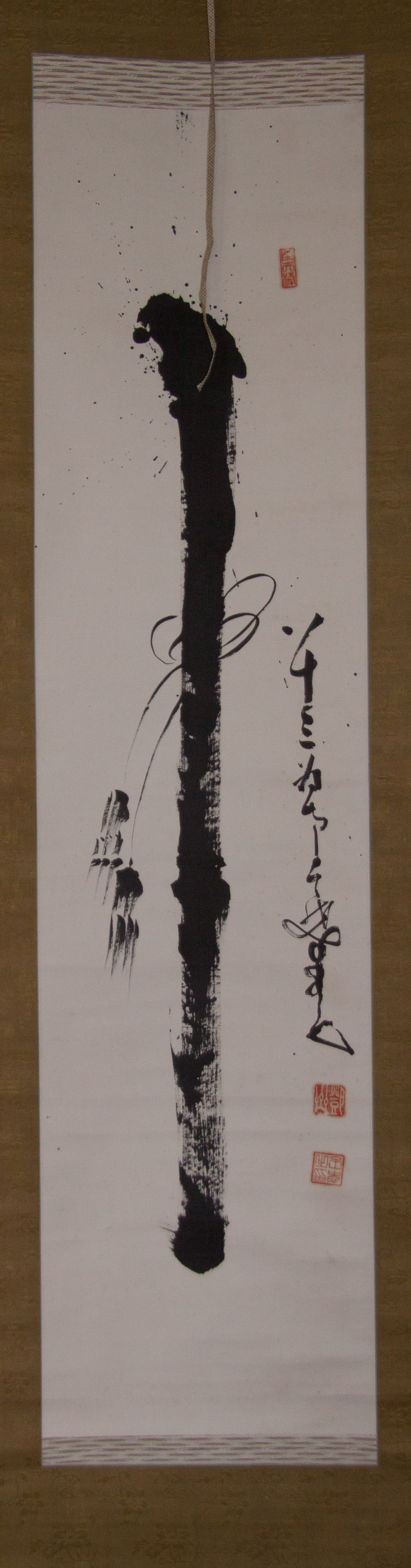
This brush painting by Nantenbo (1839-1925), a Japanese Zen teacher, is of his teaching stick. Whack! The thick black line is in your face. When I first saw the painting I felt the sting of the stick across my back. Looking at the Nantenbo calligraphy now, I think of the coyotes. That’s how hungry one has to be for food — physical as well as spiritual. Like the coyote, one has to be willing to dig deep, to prowl the darkness of lonely nights; to dig and come up empty and not give up.
Then I wondered about the delicate tassels tied around the stick. Perhaps we need to hold this powerful stick of keen determination lightly. Like that lone coyote dancing among the trees, we need light-heartedness and joy along with disciplined work. The coyote finds balance, and so can we.

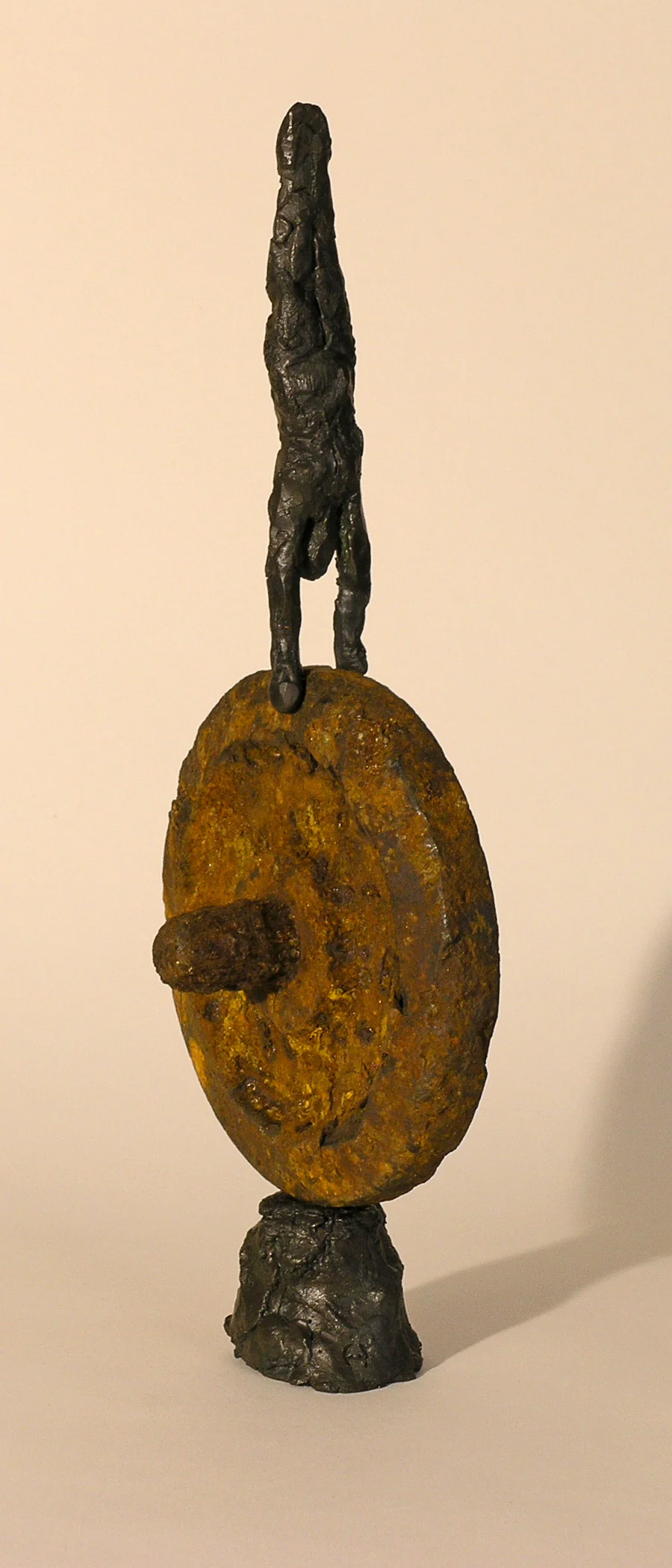
Handstand, bronze figure with found object, LH
Orchard Dragons
In September 1979, I arrived in Kyoto, Japan, to begin a Fellowship year studying the Noh Theater right after graduating college. Wanting to discover the city and its treasures, I would go off walking each day. Finding myself in front of an important looking temple, I walked in and was quickly herded into a large group of Japanese tourists. Led by a white-gloved professional guide, our pod pushed through a narrow opening into a cavernous room. The guide started talking, while gesturing toward the ceiling. I didn’t know a word of Japanese and had no idea what she was saying. There were ‘oohs’ and ‘ahhs’ and ‘ah sos’, but I was baffled.
Straining their necks, everyone was feasting on the ceiling. Swirls of black and white brush strokes covered the dome. It looked like some cosmic orgy of clouds, the Milky Way galaxy with nebulae and star clusters. But thinking was getting me nowhere; I couldn’t make sense of the painting. I felt ridiculous standing there not understanding. The guide would point to one corner and then another, as the group turned in unison to follow her finger. I turned and looked, too, but saw nothing.

Tennryu-ji Temple Ceiling Painting
Then, to my astonishment, a claw appeared, a gnarled dragon’s claw. I followed it back to the powerful leg, the writhing body, the daggered tail, the long-whiskered head. The dragon represents primordial energy and the balance of darkness and light, absence and presence, yin and yang.
My friend, Judith Schutzman, took a photo on New Year’s Day of a few trees in the orchard. A week later she returned with a gift, a painting she had made from her photograph. It took me a few seconds, what was this painting of? Then it was clear, it was the orchard. The apple trees!

Judith brushed heavy black lines to form the trunks, squeezing them in and pushing them out until they sinewed like dragons in the snow. The angular, delicate branches she rendered with smaller strokes of gray, and above, she painted smoky patches of clouds. Then I remembered the Kyoto dragon. Until I studied Judith’s painting I had never considered the big, old apple trees as orchard dragons — great beasts that inspire fear but have to be confronted on the hero’s journey.
It makes me particularly sad to think that someday these old giants will be gone from the New England landscape. Orchardists planting new blocks of trees today plant dwarf trees that are supported by a structure of wires. These small trees are easier to care for, easier to harvest, produce earlier, and overall bring in more money per acre than growing standard size trees.
We often sacrifice wildness for convenience, a new highway through the wilderness. I wonder if that’s what happened to the dragons.
Search Blog
-
2025
- May 9, 2025 A View from the Tractor Seat
- Apr 11, 2025 Dig
-
2024
- Jan 7, 2024 Winter Wassail
-
2022
- Dec 11, 2022 Keeping Time
- Jun 17, 2022 This Apple-Shaped Earth
- Jan 23, 2022 What is a Jizo?
- Jan 16, 2022 An Invite and Housekeeping Update
- Jan 1, 2022 The Year of the Frog: What Orchardists Do While Apple Trees are Chilling
-
2021
- Oct 24, 2021 Figs
- Oct 3, 2021 The Artist and the Orchard: A Memoir
- Aug 8, 2021 Red-Fleshed Apples
- Jul 25, 2021 When We Were Trees
- Jun 27, 2021 Castor Beans—Who Knew?
- Jun 13, 2021 Spring Training at a Zen Monastery
- May 4, 2021 Our Trees are in Bloom
- Apr 18, 2021 Hooray!
- Jan 24, 2021 Wassailing, virtually!
- Jan 1, 2021 Sitting
-
2020
- Dec 21, 2020 Darkness to Light
- Nov 28, 2020 One Heart
- Sep 18, 2020 Juggling Flowers, Fruit, and Vegetables
- Aug 23, 2020 Refuge
- Aug 9, 2020 Bags of Fertilizer
- Aug 2, 2020 The Sermon of the Blue Heron
- Jul 26, 2020 What's the Buzz?
- Jul 19, 2020 Farm Moments
- Jul 12, 2020 Lost Wax
- Jul 5, 2020 Catalpa: The Hugging Tree
- Jun 28, 2020 Pedaling Peace
- Jun 21, 2020 See Change
- Jun 14, 2020 Lalla Unveiled
- Jun 7, 2020 Pond Alchemy
- May 31, 2020 The Birth of Fruit
- May 24, 2020 An Artist in the Orchard
- May 17, 2020 Walking the Land: Returning Home
- May 10, 2020 Stinging Nettles: Gifts from the Great Mother
- May 3, 2020 The Mystery of Swallow
- Apr 26, 2020 Aerial Bruststrokes
- Apr 19, 2020 Simple Pleasures
- Apr 12, 2020 Weeds and Other Gifts
- Apr 5, 2020 Remembering the Seeds
- Mar 29, 2020 Blow on the Embers
- Mar 22, 2020 Ripples
-
2019
- Nov 16, 2019 Tibet Impressions
- Nov 9, 2019 Forest Tales
- Oct 13, 2019 The Gift
- Aug 4, 2019 The Season is Apples, Berries, and Grandfather Fire
- Jun 8, 2019 Pointers for a Writing Life
- May 12, 2019 Mothers of the Earth
- Apr 6, 2019 The Apple-Shaped Earth
- Mar 23, 2019 You Don’t Know What You Have Till It’s Gone
- Feb 23, 2019 Generations
- Feb 9, 2019 What Are We Doing to the Earth, John Chapman?
-
2018
- Dec 31, 2018 Long Shadows
- Oct 6, 2018 A Pilgrimage to India
- Aug 18, 2018 Scrap Wrenn
- Aug 11, 2018 Off-the-Wall Comments from an Ignorant Farmer
- Jul 28, 2018 Creative Connect
- Jul 14, 2018 How is the Orchard?
- Jun 30, 2018 Which Way?
- Jun 16, 2018 Geese, Herons, Beavers, and the Baby Steps of a Lapsed Blogger
- Feb 24, 2018 Mama's Coupons — Good Forever
- Jan 27, 2018 January Ice
- Jan 13, 2018 The Muse
-
2017
- Dec 30, 2017 A Dream for the New Year
- Dec 23, 2017 A New Year for Apples
- Dec 16, 2017 Intuition
- Nov 22, 2017 Thanksgiving OM
- Nov 4, 2017 East Fork Pottery
- Oct 28, 2017 Putting Down New Roots
- Oct 21, 2017 A is for Art
- Oct 14, 2017 Eve domesticus
- Oct 7, 2017 A String Workshop
- Sep 30, 2017 After Applepicking
- Sep 23, 2017 Two Bad Women and One Good Apple
- Sep 16, 2017 Plein Air Poetry
- Sep 9, 2017 Cutting Off a Leg
- Sep 2, 2017 The Changing Landscape
- Aug 26, 2017 All About Art
- Aug 19, 2017 My First Visit to the Farm
- Aug 12, 2017 The First Food
- Aug 5, 2017 A Teapot, a Woman, and maybe a Boat
- Jul 29, 2017 A Raspberry Dilemma
- Jul 22, 2017 Consider the Miracle
- Jul 15, 2017 Meeting Ekphrasis
- Jul 8, 2017 Ripening Fruit
- Jul 1, 2017 The Voice of The Caterpillar
- Jun 24, 2017 Goumi — An Unusual Fructus
- Jun 17, 2017 Concord, an American Bloomsbury
- Jun 10, 2017 The World Is Bonkers — Shall I Laugh or Cry?
- Jun 3, 2017 Bonkers, a Revolutionary Apple
- May 27, 2017 Guardians of the Swamp
- May 20, 2017 There are Mushrooms and There are Morels
- May 13, 2017 "What's in a Name?"
- May 6, 2017 Bloom Follows Pink: Orchard Pollination
- Apr 29, 2017 The Orchard Is at Pink
- Apr 22, 2017 Natural Farming — Part 2 (continuation from last Sunday's blog)
- Apr 15, 2017 Natural Farming — Part 1
- Apr 8, 2017 Boats, Figures, and Catching Fish
- Apr 1, 2017 A Man with a Mission: The Nuts and Bolts of Bronze Casting
- Mar 25, 2017 A Chalice of Spirit, Art, and Nature
- Mar 18, 2017 Hanami — Blossom Viewing
- Mar 11, 2017 Soil Redemption Song
- Mar 4, 2017 Food is Primary Care
- Feb 25, 2017 Pomme de Terre
- Feb 18, 2017 Organic Certification
- Feb 11, 2017 Tantalizing Fruit
- Feb 4, 2017 The Myths of History
- Jan 28, 2017 The Orchard in Winter
- Jan 21, 2017 The Hi-Line
- Jan 14, 2017 Artistic, Botanical, and Social Diversity
- Jan 7, 2017 Where is Eden?
-
2016
- Dec 31, 2016 The Creative Heart
- Dec 24, 2016 A Christmas Tale
- Dec 17, 2016 Who are the Crones?
- Dec 10, 2016 The Olympic Bell (Part Two)
- Dec 3, 2016 Overheard in the Apple Orchard in Early December
- Nov 26, 2016 The Lessons of a Tortoise
- Nov 19, 2016 In the Studio
- Nov 12, 2016 Even in Darkness
- Nov 5, 2016 Southern Apples, an Elephant, Monkey, Rabbit, and Bird, Two Mango Trees and a Birthday
- Oct 29, 2016 The Tools of Art
- Oct 22, 2016 Labyrinths
- Oct 15, 2016 Repairing the Broken
- Oct 8, 2016 When You Are No More
- Oct 1, 2016 Creation Rain
- Sep 24, 2016 Breaking the Glass
- Sep 17, 2016 String Art
- Sep 10, 2016 Poetry and Photosynthesis: It's all in the Leaves
- Sep 3, 2016 In the Plenty of Time
- Aug 27, 2016 Witch Doctors
- Aug 20, 2016 Listen Coyote
- Aug 13, 2016 Milkweed in the Orchard
- Aug 6, 2016 Some People See a Turtle
- Jul 30, 2016 Arborshaping
- Jul 23, 2016 Joseph Wheelwright: Sculptor of Stones and Trees
- Jul 16, 2016 Asian Pears
- Jul 9, 2016 Gold Leaf, Grief, and the Creative Process
- Jul 2, 2016 The Olympic Bell (Part One)
- Jun 25, 2016 Around the Mulberry Bush
- Jun 18, 2016 Avoiding Apples
- Jun 11, 2016 Fructus
- Jun 4, 2016 Astonishing Apples
- May 28, 2016 Scare the Caterpillars
- May 21, 2016 Join the Club!
- May 14, 2016 The Graft
- May 7, 2016 Rooster, Rhubarb, Rue
- Apr 30, 2016 What do Dolphins and Nettles Have in Common?
- Apr 23, 2016 Art Prunings
- Apr 16, 2016 A Few of the First Arrivals
- Apr 9, 2016 Taste the Spirit of Sustainable Agriculture
- Apr 2, 2016 First Orchard Spray - March 22-24, 2016
- Mar 26, 2016 Hawkeye Apple
- Mar 19, 2016 Desiring the Almata Apple
- Mar 12, 2016 Ugly Fruit
- Mar 5, 2016 Winter Tracks
- Feb 27, 2016 Splash
- Feb 20, 2016 Pruning
- Feb 13, 2016 Orchard Ruminants
- Feb 6, 2016 A Gathering of Seeds
- Jan 30, 2016 Orchard Dragons
- Jan 23, 2016 Tree Rings
- Jan 17, 2016 The Fallen Tree
- Jan 7, 2016 Wassailing the Apple Trees
- Jan 1, 2016 The New Year