LINDA HOFFMAN
Plein Air Poetry
Today is for poetry at Old Frog Pond Farm. This afternoon, twenty-four poets will gather and walk the trail around the pond and through the woods, along the orchard, to the meditation hut, with a stop at the rock turtle, and back to the dam. The poets will be reading the poems they began writing earlier in the year inspired by a visit to the farm.
We need poetry to mine the subtle, the tenuous, the painful, the ecstatic, and elegiac feelings of our humanness. We need poetry when we are tired, hurt, hassled, and missing connection to our own heart. “I come to the farm,/having very nearly forgotten myself,” begins Lucinda Bowen. “And here blooms a memory. . . my surprise at improbable sweetness.”
Early in the year, Susan Edwards Richmond, organizer of the event, and I, choose a theme. This year’s subject, Memoir, “invited the poets to dig deeper, to go beyond surfaces, and draw, sometimes unbidden, wells of feeling from the landscape,” wrote Richmond in her introduction to the chapbook of poems.
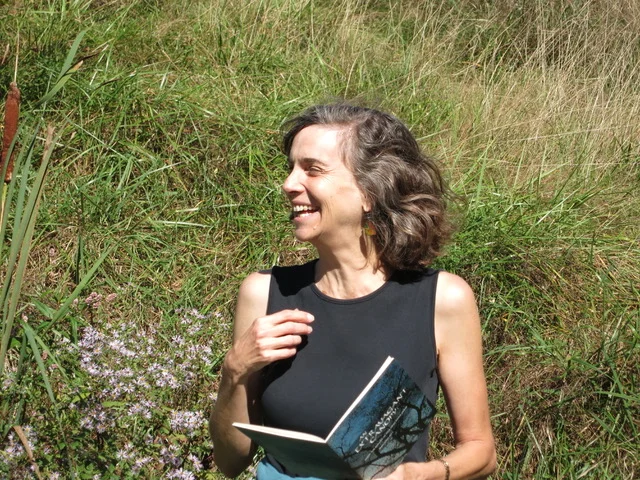
Susan Edwards Richmond, Plein Air Reading, 2013
Poets sign up to participate. Throughout the spring and early summer, they visit the farm and walk the paths. When they come upon a view, a place, a tree, or a sound that awakens their muse, they stop and write. They return home, work on their poems, sometimes visiting again. In mid-summer, they submit their poems to Richmond, editor of the chapbook. For some, Richmond responds with suggestions, working closely with the writer to enhance the poem; others’ work arrives fully fledged. Then Richmond orders the collection, giving shape not only to the book, but to the walking event. Our slow-moving herd of poetry appreciators can’t be running from the dam to the orchard to the bell; then flying to the meditation hut and back again — or the walk would take us far into the evening hours.
Sometimes it is one of the outdoor sculptures at the farm that moves the poet to words. For poet David Davis, the ringing of Paul Matisse’s Olympic Bell brought back memories of Nepal. “Forty years ago in Katmandu/I heard a monk ring a temple bell/That shook my chest and opened my ears.” Polly Brown begins her poem with, “A sculpted figure by the pond,/gathering sky in her round arms,/Is my mother—alive but so lightly tethered/to the place and condition of her body.” She, too, mentions the bell, “hauling on the hammer I sound the bell/in the woods,/ and they [her mother and father] fly to me.”
Some poets invite us to feel the plight of the greater world. Linda Fialkoff writes, “So many refugees/choked into one small boat/fueled by a damp, ragged/body long held hostage.” It is as if she knew that Alicia Dwyer’s Suspended Encampment, a hanging sculpture behind the Medicine Wheel, would be arriving for the sculpture exhibit. Dwyer’s sculpture not only refers to the plight of Monarch butterflies, but to the migrations of people, the refugees throughout Europe, and now, the homeless millions in the aftermath of the recent violent storms and earthquakes.
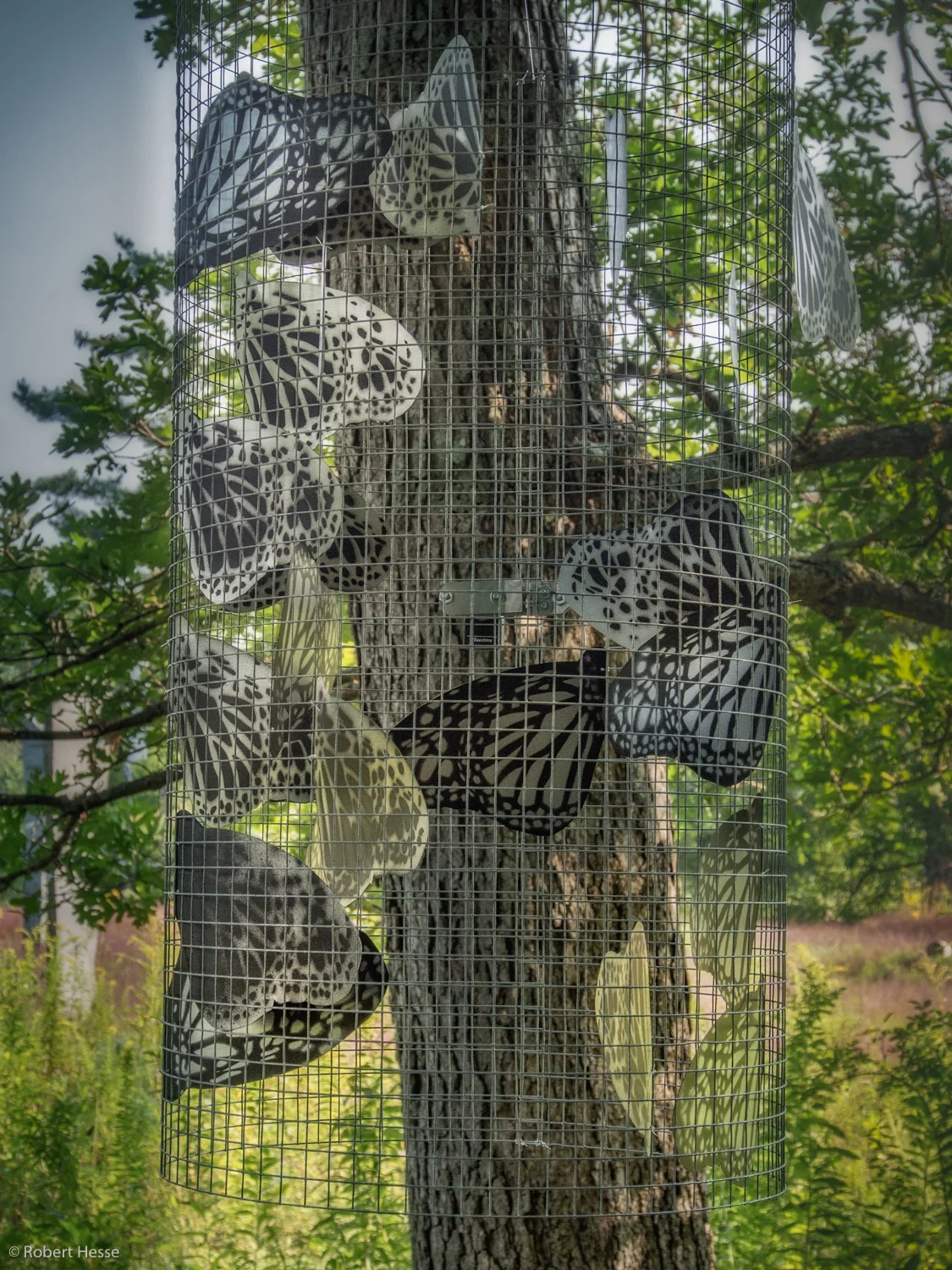
Suspended Encampment, Alicia Dwyer (partial) Photo:Robert Hesse
bg Thurston picks up a stone and hears, “Sometimes sorrow/sits like a stone in your heart/and you are unable to lift it.” For Heather Connelly Bryant, the raspberry patch evokes a strong memory, “Yet I was wrong—now there is new life, new love, new/hope— infidelity no longer hangs in the air, everywhere.” Richmond, also wrote near the raspberries, “each of us now with our own green past, red stained fingers. Only rarely/was there enough/but we were always sated.”
Richmond and her husband brought their children to pick raspberries at this farm years before I moved in, and she was so happy when she learned that I would continue to care for the patch and open it for public picking. Since that time, Richmond and I have collaborated on many projects — Wild Apples, a journal of nature, art, and inquiry, five years of Plein Air Poetry at the farm, and our most recent collaboration, a children’s book, Where’s My Bonkers? about a girl, her mother, and an apple. It’s always about collaboration at the farm. We share, inspire, and co-create together.
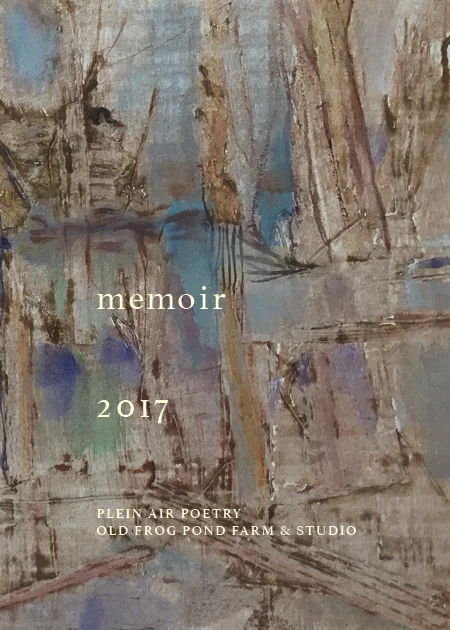
Cover Art & Design: Lynn Horsky
We invite you to join us this afternoon, Sunday, September 17 at 2pm to walk and listen to the poets read their poems. I guarantee you will be sated.
If you can’t make the event, a limited number of chapbooks will be for sale at the farmstand and on the farm’s website. The walk is free and open to the public.
Meeting Ekphrasis
Ekphrasis is a genre of writing about a work of art. Homer’s lengthy and vivid description of Achilles' shield in The Iliad is one of the oldest examples, though Keat’s Ode to a Grecian Urn is more quoted, especially its enigmatic last lines.
Beauty is truth, truth beauty,—that is all
Ye know on earth, and all ye need to know.
The writer, and most often a poet, explores a work of art, responds to it, even adds elements from his or her own life. The Poetry Foundation defines an ekphrastic poem as follows: “Through the imaginative act of narrating and reflecting on the ‘action’ of a painting or sculpture, the poet may amplify and expand its meaning.” I love this description and thought about it when I sat down to write a statement about a new sculpture I am exhibiting at 6 Bridges Gallery in Maynard, Massachusetts (July 11 – August 12).

Meeting in the studio. sculpture, 2017
To write about, Meeting, I started by considering its materials — rope and wood. Rope is used to connect one object to another, a canoe to a tree or a skiff to a dock. A rope hammock connects two trees. What intrigued me when I placed the thick rope into the walnut trunk was that it connected back to itself. There was no connecting of two objects but a unifying of the whole. The ends disappeared as if there were no ends.
This section of a tug-of-war-size rope has been in my studio for six years ago. Back then, I suspended it, tied it, uncoiled part of it, and wove it back into itself. When I hung up the heavy coil, it made me think of a Japanese Enso, the circle that is an expression of enlightenment, the ultimate connection with everything because there is nothing inside or outside, nothing separate or divided, nothing to connect, no beginning and no ending.
I then wrapped a thin white twine around the rope, the way a snake coils around a stick. It reminded me of a painting I saw in a small church in Florence. Christ was nailed to the cross alone up on Calvary Hill. There was a simple white cloth wrapped around his pelvis, the cloth painted as if being blown by a gentle breeze. The body was dead, but life stirred in the simplicity of the white threads. The painter may have been suggesting that life is never completely extinguished.
The wood component of the sculpture, a walnut trunk, sawn twice to reveal its two hollow sections, has also been in my studio for a number of years. A bronze sculpture I made of Kwan Yin, the Goddess of Compassion, sat on it for a while, but I removed her knowing the wood had something else to reveal.
One day I took the tug-of-war rope and threaded it through and around the wood. I was intrigued by what I saw, but also by what I didn’t see. In Meeting, we don’t actually see whether the two ends of the rope meet. It’s a question that is unanswered. The rope, in its serpentine path around and into the trunk reveals only part of itself. It is like happening upon a snake, though the head and tail are hidden.
Meeting is the word for the worship practice of the Quakers. I went to a Quaker elementary school where we had ‘meeting for worship’ on Wednesday mornings. We sat in silence unless someone was moved to speak. In a Quaker Meeting, we meet ourselves, we meet God, we meet each other.
Art is a form of meeting. We meet the work, its materials, colors, and forms, the artist and ourselves. Ekphrasis writing is a form of meeting. When I write about my own work, I discover connections that I had never considered while making the piece. And when I read the writing of others who have been inspired my art, I encounter the work differently.
At another summer exhibit where I have a sculpture, Art on the Trails: Finding Solace in the Woods at the Beal Preserve in Southborough, MA (June 7 – September 24), there will be a reading of ekphrastic poems written about the works of the exhibiting artists. I have a new casting of Tree Harp in the exhibit and hope there will be a poem written about it. I much prefer to hear what others write about my sculpture. An ekphrastic poem that I treasure was written by Joanne Reynolds about my sculpture Ordinary Pine when it was installed at the Jackson Homestead in Newton, Massachusetts.
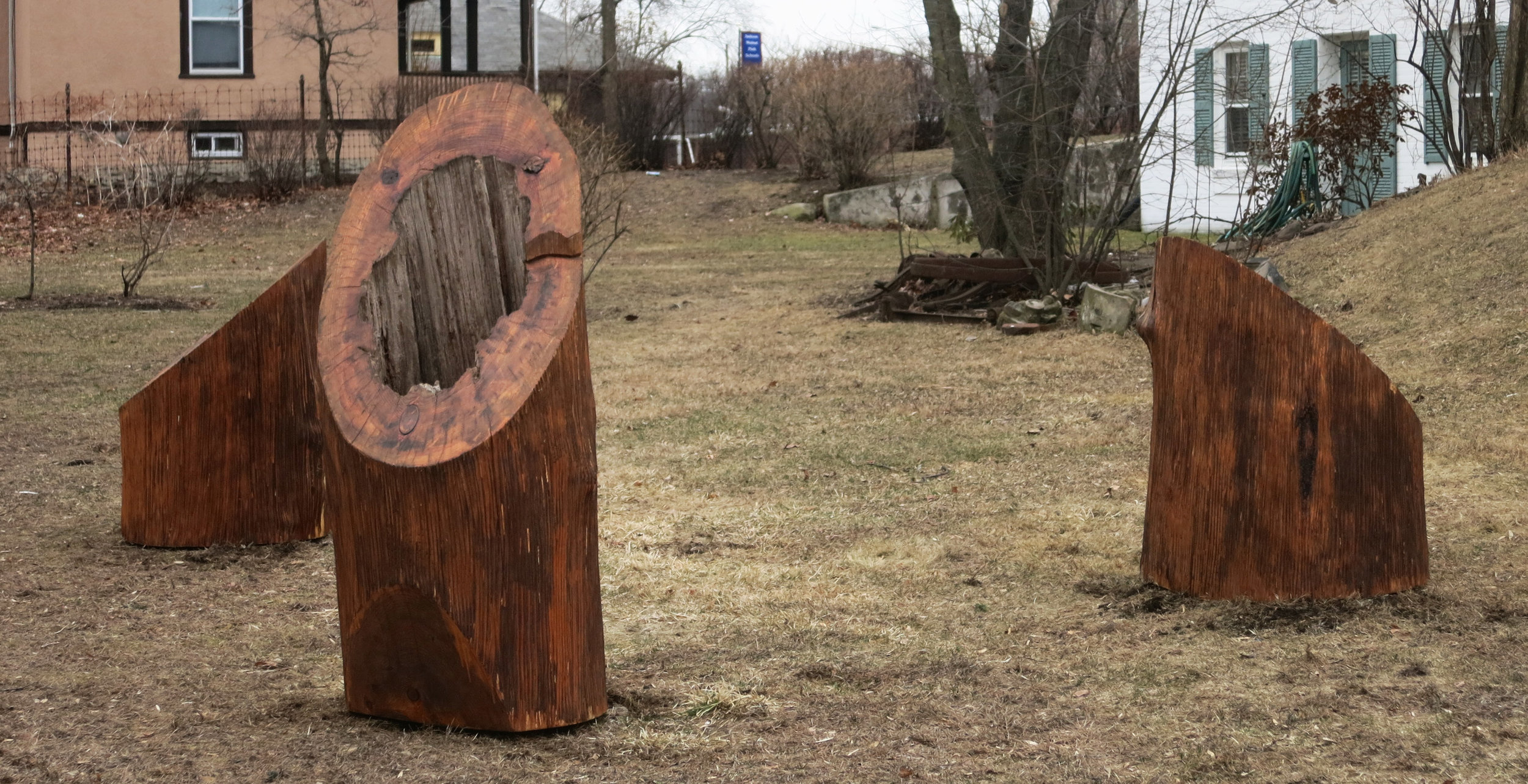
Ordinary Pine, partial view, installed at Jackson Homestead, Newton, MA
Ordinary Pine
What happened? That is to say, what happened
To us? Or between us? What
Will become of us now?
True, you were older. Suffered
The deluge. Cast a shadow
More borrowed than your own.
I came shortly after. Not so much a part
As a go-between - a link.
I remember the way you reached out
To the youngest - your great hands - how well they played!
Facing away from you now, each of us
Cut down, I long to see you.
Both of you.
Such a hole in each of us.
—Joanne Reynolds
Boats, Figures, and Catching Fish
Boats embody our life journey, each of us, adrift, on a vast ocean. We can only surrender to what life presents. We embark, not knowing where the wind will drive our craft. I first started making sculptures of boats in 2007, inspired by teachings of Dogen, a 13th century Japanese Zen master. His writings are short, poetic, beautiful, pithy, and quite challenging to parse. In Genjo Koan, Dogen writes:
When you ride in a boat and watch the shore, you might assume that the shore is moving. But when you keep your eyes closely on the boat, you can see that the boat moves. Similarly, if you examine myriad things with a confused body and mind you might suppose that your mind and nature are permanent. When you practice intimately and return to where you are, it will be clear that nothing at all has unchanging self. Tr. Tanahashi et al.
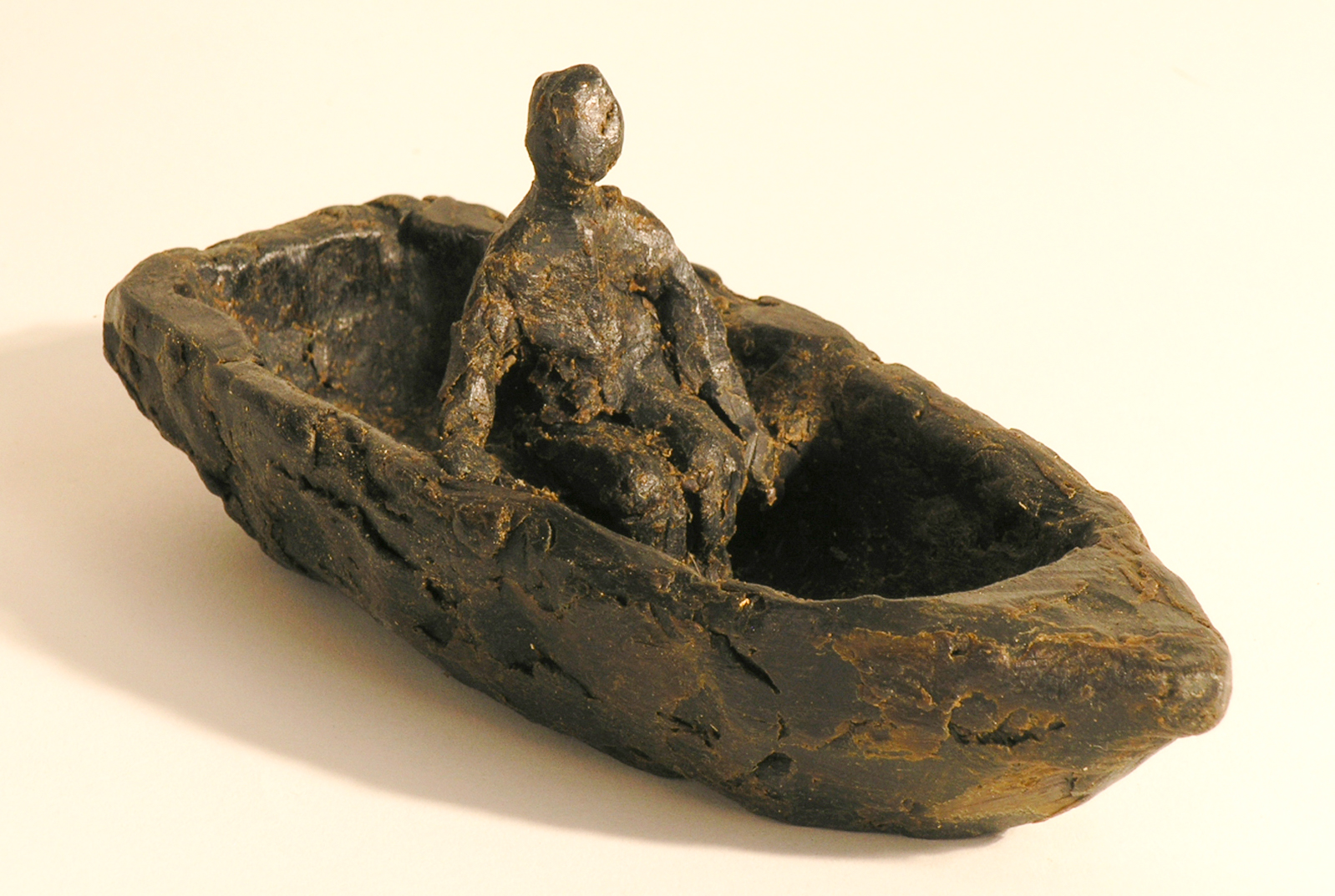
I made boats in wax — boats with one figure, boats with fish, boats with two figures, boats overturned on a beach, a figure emptying water from a boat, a figure birthing a boat. There was nothing fixed in my play with the wax sculptures — only an endless reconfiguring of figures, boats, and fish.

I showed some of these sculptures to friend and poet, Susan Edwards Richmond. She wrote, River Crossings, a poem in five parts based on several of the sculptures. It was originally published in Issue One of Wild Apples, A Journal of Nature, Art, and Inquiry that we founded together with two friends in 2005. [There are back copies still available].
A figure of wax, softened
by pinch of fingers, heel
of a hand . . .
Alone
in the river, bearing
the burden of flood, the stoking
rhythm of oars, molded to that
position, I brace for the sluice
wherever it takes me.
. . .
When I tried to push you
from the boat, a fish leapt
from the river, lodged in my arms.

Richmond’s poem has just been reprinted and is the final section in her first full full-length poetry collection, Before We Were Birds, published last month by Adastra Press. This fine collection begins with the poem sequence Boto, the mysterious freshwater Brazilian dolphin that rises from the Amazon River on full moon nights. A Boto is a shapeshifter who takes human form to catch humans, and even bring them back to live deep in the river.
In Dogen’s, Mountains and Rivers Sutra, he refers to sages who live near water and catch fish, and catch humans.
. . . from ancient times wise people and sages have often lived near water. When they live near water they catch fish, catch human beings, and catch the way. For long these have been genuine activities in water. Furthermore there is catching the self, catching catching, being caught by catching, and being caught by the way. . . Tr. Kotler and Tanahashi
In this same sutra, Dogen uses expressions like riding the clouds and following the wind to describe states of meditative practice and transcendence. The mountains and rivers are none other than our own body and mind. How do we ride the wind and cross each river?
River Crossings ends with:
…reeds
sprout back along the river, edges
grow dense with birds. I am called
neither forward nor back,
out of the water nor into it.
This is the art I practice,
the one that leaves no wake.
Susan Edwards Richmond has published four chapbooks of poetry, Increase, Purgatory Chasm, Birding in Winter, and Boto. A passionate birder, she works at Mass Audubon’s Drumlin Farm Wildlife Sanctuary. Richmond is poet-in-residence at Old Frog Pond Farm & Studio, edits the Plein Air poetry chapbook, and organizes our Plein Air Poetry event every fall. We are also working on a series of children’s books on sustainable agriculture. I am grateful, Susan, for our ever widening collaborations.
Hanami — Blossom Viewing
Blossom viewing is a cultural event in Japan. Hanami, literally “to see flowers,” is the word for this traditional custom that dates back to the 8th century. Hanami takes place as a picnic under the branches, or a stroll among the trees. Sweet treats and sake, colorful kimonos, and an opportunity to compose and share poems are all part of hanami. When I lived in Japan, the evening news announced the opening of the cherry blossoms from Okinawa in the South of Japan to Hokkaido in the North. Families and friends planned their weekends to visit their favorite cherry blossom viewing sites.
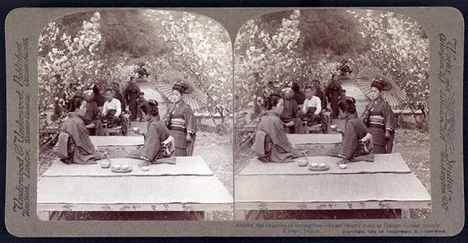
© "Amidst the Beauties of Springtime – Dwarf Cherry Trees at Omuro Gosho Temple" 1904 / Prints and Photographs Division, Library of Congress
Hanami is not only for daytime viewing, but temples and gardens have lanterns to light the cherry trees during special evening hours. In Kyushu, there is a traditional Japanese garden with over 2,000 cherry trees. In Maruyama Park in Kyoto, over 800 trees are illuminated during the short season of the blossoms, and crowds gather. Hanami is big business.
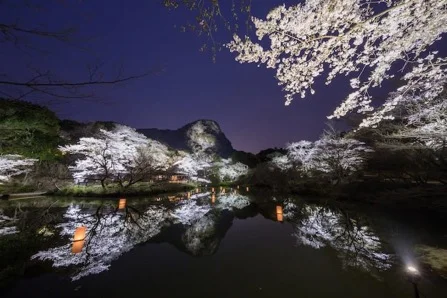
Picture courtesy of Mifuneyama Kankō Hotel, Kyushu
Usually hanami refers to cherry blossoms, but originally it was plum blossoms that were harbingers of spring. In Kyoto, I would see plum trees in bloom in early February, when there was still a dusting of snow on the branches. The striking visual similarity between snowflakes and flower petals has been a favorite subject for Japanese poets. In the earliest Japanese poetry collection, the Manyoshu, this poem was composed at a plum-blossom viewing banquet at the home of Otomo Tabito in 730 CE:
In my garden fall the plum-blossoms—
Are they indeed snow-flakes
Whirling from the sky?
—the Host
And later in the same collection:
Yonder in the plum tree
Fluttering from branch to branch
The warbler sings
And white on his wings falls
Airy snow.
—Author unknown
In Japanese poetry, blossoms evoke the ephemeral nature of life, the fact that everything we love in this world is impermanent — the warbler’s song, the moon’s reflection in water, the touch of a lover. However, in our realization of this transience, we love all the more. For the Japanese, beauty is never very far from melancholy, and one of my favorite books is Beauty and Sadness, by Nobel prize winner Yasunari Kawabata. In the book, the writer Oki Toshio meets a lover from his past, Otoko Ueno. She is now a well-known, but reclusive artist, living with her protégée, who is fiercely jealous of her teacher’s old lover. It’s not the storyline in Kawabata’s books that won him the Nobel prize, but the subtlety of emotions. It’s as if the reader were gazing into the reflection in a drop of sweat on her lover’s neck — we are that close physically to complex emotional states.
In the traditional world of Noh Theater, often one emotion is the focus of a play and, during the performance, that emotion builds to a final delirium of expression. While I was training in the Noh Theater, I danced a role from the Noh play Sakuragawa, Cherry Blossom River, in which a mother, having lost her only son, named Cherry Blossom Boy, roams the countryside to find him. She comes upon the Cherry Blossom River, where, in her crazed grief, and moved by the falling blossoms, she dances. In the dance, she uses a bamboo scoop to lift the fallen blossoms from the river, as if to raise her drowned son’s body. She dances faster and faster, while the deep voices of the chorus, the percussive beat of the drums, and shrill calls of the high-pitched Noh flute come together with intense fervor to express her unimaginable loss. The cherry blossoms signify the transient nature of life, yet a mother’s love for her child never fades.
Now, as an orchardist, I check the daily weather reports during this time of the year. Tender blossoms are susceptible to damage from frost, and the wildly fluctuating temperatures we’ve been having in recent years raise my anxiety. High temperatures cause flower buds to break dormancy and begin to swell. Frigid temperatures can be fatal for these tender buds. Last year, all over New England, farms lost their peach crop, and many orchards lost up to 90 percent of their apple crop. Even if the buds open, the severe cold can affect the fruit set and quality. It’s a big unknown, and we are a long way from fruit set.
Weather can also wreak havoc with cherry blossoms. A rainstorm with wind close to peak blossom time will leave wet petals plastered to the branches, trunk, and ground, and the hanami tourists will change their plans. I’ve seen a rainstorm shred the petals in our orchard; but, by then, the bees had already pollinated, and the tiny applets grew.
Viable blossoms are a cause for celebration both for their beauty and for the fruit we can anticipate. If we have a full blossom set I’m going to host a hanami — kimonos optional—with hot sake, tasty morsels, and poetry!
Search Blog
-
2025
- May 9, 2025 A View from the Tractor Seat
- Apr 11, 2025 Dig
-
2024
- Jan 7, 2024 Winter Wassail
-
2022
- Dec 11, 2022 Keeping Time
- Jun 17, 2022 This Apple-Shaped Earth
- Jan 23, 2022 What is a Jizo?
- Jan 16, 2022 An Invite and Housekeeping Update
- Jan 1, 2022 The Year of the Frog: What Orchardists Do While Apple Trees are Chilling
-
2021
- Oct 24, 2021 Figs
- Oct 3, 2021 The Artist and the Orchard: A Memoir
- Aug 8, 2021 Red-Fleshed Apples
- Jul 25, 2021 When We Were Trees
- Jun 27, 2021 Castor Beans—Who Knew?
- Jun 13, 2021 Spring Training at a Zen Monastery
- May 4, 2021 Our Trees are in Bloom
- Apr 18, 2021 Hooray!
- Jan 24, 2021 Wassailing, virtually!
- Jan 1, 2021 Sitting
-
2020
- Dec 21, 2020 Darkness to Light
- Nov 28, 2020 One Heart
- Sep 18, 2020 Juggling Flowers, Fruit, and Vegetables
- Aug 23, 2020 Refuge
- Aug 9, 2020 Bags of Fertilizer
- Aug 2, 2020 The Sermon of the Blue Heron
- Jul 26, 2020 What's the Buzz?
- Jul 19, 2020 Farm Moments
- Jul 12, 2020 Lost Wax
- Jul 5, 2020 Catalpa: The Hugging Tree
- Jun 28, 2020 Pedaling Peace
- Jun 21, 2020 See Change
- Jun 14, 2020 Lalla Unveiled
- Jun 7, 2020 Pond Alchemy
- May 31, 2020 The Birth of Fruit
- May 24, 2020 An Artist in the Orchard
- May 17, 2020 Walking the Land: Returning Home
- May 10, 2020 Stinging Nettles: Gifts from the Great Mother
- May 3, 2020 The Mystery of Swallow
- Apr 26, 2020 Aerial Bruststrokes
- Apr 19, 2020 Simple Pleasures
- Apr 12, 2020 Weeds and Other Gifts
- Apr 5, 2020 Remembering the Seeds
- Mar 29, 2020 Blow on the Embers
- Mar 22, 2020 Ripples
-
2019
- Nov 16, 2019 Tibet Impressions
- Nov 9, 2019 Forest Tales
- Oct 13, 2019 The Gift
- Aug 4, 2019 The Season is Apples, Berries, and Grandfather Fire
- Jun 8, 2019 Pointers for a Writing Life
- May 12, 2019 Mothers of the Earth
- Apr 6, 2019 The Apple-Shaped Earth
- Mar 23, 2019 You Don’t Know What You Have Till It’s Gone
- Feb 23, 2019 Generations
- Feb 9, 2019 What Are We Doing to the Earth, John Chapman?
-
2018
- Dec 31, 2018 Long Shadows
- Oct 6, 2018 A Pilgrimage to India
- Aug 18, 2018 Scrap Wrenn
- Aug 11, 2018 Off-the-Wall Comments from an Ignorant Farmer
- Jul 28, 2018 Creative Connect
- Jul 14, 2018 How is the Orchard?
- Jun 30, 2018 Which Way?
- Jun 16, 2018 Geese, Herons, Beavers, and the Baby Steps of a Lapsed Blogger
- Feb 24, 2018 Mama's Coupons — Good Forever
- Jan 27, 2018 January Ice
- Jan 13, 2018 The Muse
-
2017
- Dec 30, 2017 A Dream for the New Year
- Dec 23, 2017 A New Year for Apples
- Dec 16, 2017 Intuition
- Nov 22, 2017 Thanksgiving OM
- Nov 4, 2017 East Fork Pottery
- Oct 28, 2017 Putting Down New Roots
- Oct 21, 2017 A is for Art
- Oct 14, 2017 Eve domesticus
- Oct 7, 2017 A String Workshop
- Sep 30, 2017 After Applepicking
- Sep 23, 2017 Two Bad Women and One Good Apple
- Sep 16, 2017 Plein Air Poetry
- Sep 9, 2017 Cutting Off a Leg
- Sep 2, 2017 The Changing Landscape
- Aug 26, 2017 All About Art
- Aug 19, 2017 My First Visit to the Farm
- Aug 12, 2017 The First Food
- Aug 5, 2017 A Teapot, a Woman, and maybe a Boat
- Jul 29, 2017 A Raspberry Dilemma
- Jul 22, 2017 Consider the Miracle
- Jul 15, 2017 Meeting Ekphrasis
- Jul 8, 2017 Ripening Fruit
- Jul 1, 2017 The Voice of The Caterpillar
- Jun 24, 2017 Goumi — An Unusual Fructus
- Jun 17, 2017 Concord, an American Bloomsbury
- Jun 10, 2017 The World Is Bonkers — Shall I Laugh or Cry?
- Jun 3, 2017 Bonkers, a Revolutionary Apple
- May 27, 2017 Guardians of the Swamp
- May 20, 2017 There are Mushrooms and There are Morels
- May 13, 2017 "What's in a Name?"
- May 6, 2017 Bloom Follows Pink: Orchard Pollination
- Apr 29, 2017 The Orchard Is at Pink
- Apr 22, 2017 Natural Farming — Part 2 (continuation from last Sunday's blog)
- Apr 15, 2017 Natural Farming — Part 1
- Apr 8, 2017 Boats, Figures, and Catching Fish
- Apr 1, 2017 A Man with a Mission: The Nuts and Bolts of Bronze Casting
- Mar 25, 2017 A Chalice of Spirit, Art, and Nature
- Mar 18, 2017 Hanami — Blossom Viewing
- Mar 11, 2017 Soil Redemption Song
- Mar 4, 2017 Food is Primary Care
- Feb 25, 2017 Pomme de Terre
- Feb 18, 2017 Organic Certification
- Feb 11, 2017 Tantalizing Fruit
- Feb 4, 2017 The Myths of History
- Jan 28, 2017 The Orchard in Winter
- Jan 21, 2017 The Hi-Line
- Jan 14, 2017 Artistic, Botanical, and Social Diversity
- Jan 7, 2017 Where is Eden?
-
2016
- Dec 31, 2016 The Creative Heart
- Dec 24, 2016 A Christmas Tale
- Dec 17, 2016 Who are the Crones?
- Dec 10, 2016 The Olympic Bell (Part Two)
- Dec 3, 2016 Overheard in the Apple Orchard in Early December
- Nov 26, 2016 The Lessons of a Tortoise
- Nov 19, 2016 In the Studio
- Nov 12, 2016 Even in Darkness
- Nov 5, 2016 Southern Apples, an Elephant, Monkey, Rabbit, and Bird, Two Mango Trees and a Birthday
- Oct 29, 2016 The Tools of Art
- Oct 22, 2016 Labyrinths
- Oct 15, 2016 Repairing the Broken
- Oct 8, 2016 When You Are No More
- Oct 1, 2016 Creation Rain
- Sep 24, 2016 Breaking the Glass
- Sep 17, 2016 String Art
- Sep 10, 2016 Poetry and Photosynthesis: It's all in the Leaves
- Sep 3, 2016 In the Plenty of Time
- Aug 27, 2016 Witch Doctors
- Aug 20, 2016 Listen Coyote
- Aug 13, 2016 Milkweed in the Orchard
- Aug 6, 2016 Some People See a Turtle
- Jul 30, 2016 Arborshaping
- Jul 23, 2016 Joseph Wheelwright: Sculptor of Stones and Trees
- Jul 16, 2016 Asian Pears
- Jul 9, 2016 Gold Leaf, Grief, and the Creative Process
- Jul 2, 2016 The Olympic Bell (Part One)
- Jun 25, 2016 Around the Mulberry Bush
- Jun 18, 2016 Avoiding Apples
- Jun 11, 2016 Fructus
- Jun 4, 2016 Astonishing Apples
- May 28, 2016 Scare the Caterpillars
- May 21, 2016 Join the Club!
- May 14, 2016 The Graft
- May 7, 2016 Rooster, Rhubarb, Rue
- Apr 30, 2016 What do Dolphins and Nettles Have in Common?
- Apr 23, 2016 Art Prunings
- Apr 16, 2016 A Few of the First Arrivals
- Apr 9, 2016 Taste the Spirit of Sustainable Agriculture
- Apr 2, 2016 First Orchard Spray - March 22-24, 2016
- Mar 26, 2016 Hawkeye Apple
- Mar 19, 2016 Desiring the Almata Apple
- Mar 12, 2016 Ugly Fruit
- Mar 5, 2016 Winter Tracks
- Feb 27, 2016 Splash
- Feb 20, 2016 Pruning
- Feb 13, 2016 Orchard Ruminants
- Feb 6, 2016 A Gathering of Seeds
- Jan 30, 2016 Orchard Dragons
- Jan 23, 2016 Tree Rings
- Jan 17, 2016 The Fallen Tree
- Jan 7, 2016 Wassailing the Apple Trees
- Jan 1, 2016 The New Year