LINDA HOFFMAN
Orchard Dragons
In September 1979, I arrived in Kyoto, Japan, to begin a Fellowship year studying the Noh Theater right after graduating college. Wanting to discover the city and its treasures, I would go off walking each day. Finding myself in front of an important looking temple, I walked in and was quickly herded into a large group of Japanese tourists. Led by a white-gloved professional guide, our pod pushed through a narrow opening into a cavernous room. The guide started talking, while gesturing toward the ceiling. I didn’t know a word of Japanese and had no idea what she was saying. There were ‘oohs’ and ‘ahhs’ and ‘ah sos’, but I was baffled.
Straining their necks, everyone was feasting on the ceiling. Swirls of black and white brush strokes covered the dome. It looked like some cosmic orgy of clouds, the Milky Way galaxy with nebulae and star clusters. But thinking was getting me nowhere; I couldn’t make sense of the painting. I felt ridiculous standing there not understanding. The guide would point to one corner and then another, as the group turned in unison to follow her finger. I turned and looked, too, but saw nothing.

Tennryu-ji Temple Ceiling Painting
Then, to my astonishment, a claw appeared, a gnarled dragon’s claw. I followed it back to the powerful leg, the writhing body, the daggered tail, the long-whiskered head. The dragon represents primordial energy and the balance of darkness and light, absence and presence, yin and yang.
My friend, Judith Schutzman, took a photo on New Year’s Day of a few trees in the orchard. A week later she returned with a gift, a painting she had made from her photograph. It took me a few seconds, what was this painting of? Then it was clear, it was the orchard. The apple trees!

Judith brushed heavy black lines to form the trunks, squeezing them in and pushing them out until they sinewed like dragons in the snow. The angular, delicate branches she rendered with smaller strokes of gray, and above, she painted smoky patches of clouds. Then I remembered the Kyoto dragon. Until I studied Judith’s painting I had never considered the big, old apple trees as orchard dragons — great beasts that inspire fear but have to be confronted on the hero’s journey.
It makes me particularly sad to think that someday these old giants will be gone from the New England landscape. Orchardists planting new blocks of trees today plant dwarf trees that are supported by a structure of wires. These small trees are easier to care for, easier to harvest, produce earlier, and overall bring in more money per acre than growing standard size trees.
We often sacrifice wildness for convenience, a new highway through the wilderness. I wonder if that’s what happened to the dragons.
Tree Rings
A cut through a large branch shows the yearly measures of growth. These rings have distinct colors, subtle patterns of orange, gold, and brown, not unlike the colors in the earth. Weather patterns determine this color and thickness. Years of rain and abundant growth produce thicker rings; narrow rings indicate a year of less growth. Colors reflect the changes during one growing season. Light shades indicate spring's rapid growth and darker colors mirror the late season's slowing down.

However, yearly weather patterns and the age of a tree are not the only information that can be found in the rings. When a branch is under stress because too much weight is pressing it towards the ground, the underside will bolster itself, like developing a triceps muscle. When you look at the cross-section of that branch, the rings on the underside are thicker and produce an oval shape. The branch bulked up to support the extra pressure.
Often people ask about the hollows found in old apple trees as well as other hard woods. The trees grow even when the center of the trunk is completely gone. What happened to this center and how does the tree still grow? A forester explained it to me this way. Trees have a two-cell thick cambium layer below the bark. This microscopic layer contains all the growing potential of the tree, generating new bark with the outer cells and new wood with the inner cells. A tree attacked by an invading fungus has to defend itself. The tree can’t move away and it can’t wipe out the fungus. However, when the tree senses this alien presence, the cells that normally produce wood create instead a thin layer as impassable as the Great Wall of China. This new layer separates the fungus from any future growth of the tree. Wood and bark then continue to grow isolated from the diseased center, in effect saying to the fungus, “Take this part of me, I surrender.” For once these walls of demarcation are established, both tree and fungus thrive.
When a tree is bruised from outside like from a car crash, the tree grows a ‘harp’ shape to protect itself from this external injury. From both directions the tree grows inward sealing itself off from the wound. A few years ago, the caretaker of Walden Woods in Concord, who knew about my interest in ‘tree harps’ called and said there was a chunk of wood that he had pulled aside for me. “If you don't want it, it will be chopped for firewood,” he said. I could hear the drama in his voice and I drove over that afternoon. Near a mountain of split oak there sat what I can only describe as a giant set of ram’s horns. I took it back to my studio and carved out all of the rotten wood, eventually making it into the sculpture, Lidian’s Lyre, named after Ralph Waldo Emerson’s wife, Lidian — who rarely gets credited for her part in the Transcendentalists’ activities.

A tree’s wood remains as a testament to its age; its rings are a reminder of the seasons and the passing years. We, humans, unlike trees, don't have to carry all of our wood for our entire lives. Indeed many of the cells in our body renew themselves every few years. We don’t need to carry everything we ever did, thought, or felt; we can let go of ideas and patterns that no longer serve. When I am working on a sculpture it is satisfying to carve out the decayed wood and discover the intact hard wood. Here’s to clearing the mind and uncovering the thick rings of abundance.
The Fallen Tree
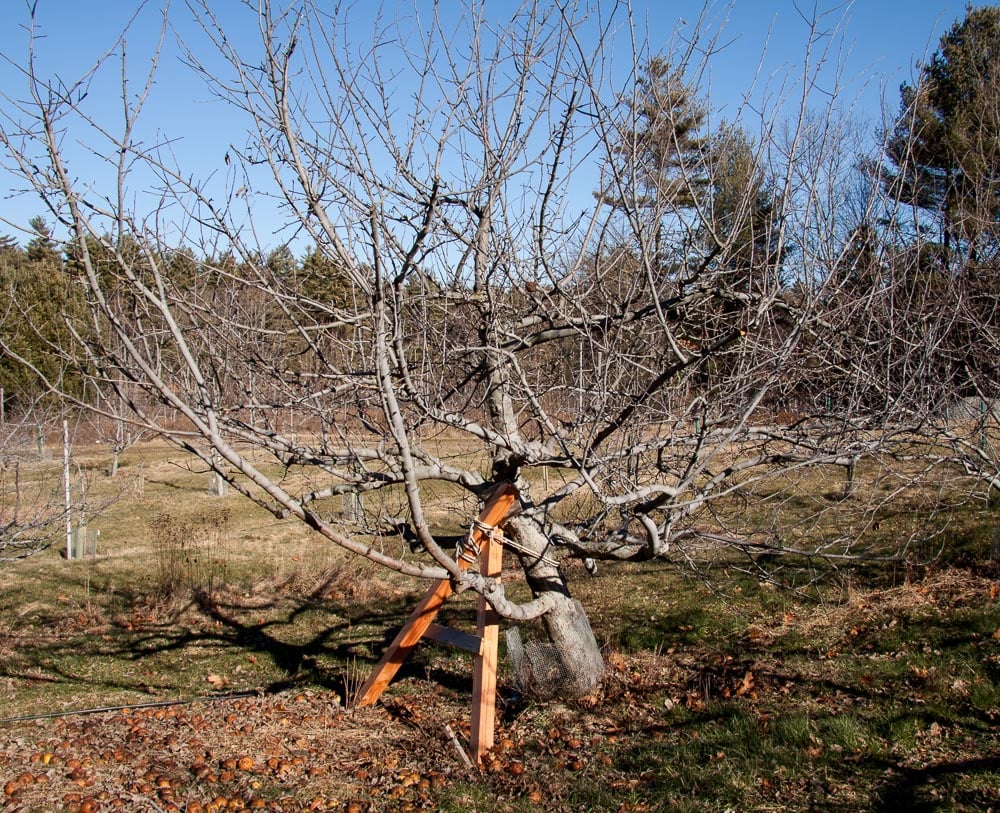
My neighbor, Ed, offered to help me right a fallen apple tree. This tree is large, one of the beauties in the orchard, and three months ago it fell over – onto its knees you might say. The crop of fruit was so heavy it couldn’t support the weight. Leaning heavily to one side now, resting on some smaller limbs it waits. I know the roots must have been shattered, at least some of them, and it needs to be supported or it will fall over completely. But Ed thinks we should lift it back as upright as possible. I worry that we’ll do more damage.

It’s this question that I am always encountering in the orchard. How much do I control? How much in control am I? I tell my neighbor that I hear what he is saying. But I also know that this tree in the three months since it has fallen has done everything in its power to survive. Because nature wants to live. We all want to live. And it’s as much a question of spirit as it is about physical properties.
Rudolph Steiner, the German philosopher, said that plants are intermediaries between the celestial bodies and the earth. This tree is alive. It connects the jays and the squirrels who bicker among the old, hanging fruit. It connects my neighbor and me. We want to save it.
Two days later we meet. I have two wood two-by-fours for the tree’s support and we head to my shop to find bolts and nuts to put them together in an X shape. The fastener department in my shop is a medley of assorted screws, bolts, and other rusty paraphernalia. Ed picks up one bent bolt and says smiling, “Linda, you don’t really want to save this, do you?” Its curve echoes the crescent moon. I see his point but I say, “I wanna keep it.” I keep most things, especially when they are worn, threadbare, or rusty. He puts it back in the drawer with the other straight ones. Then we take our doubled up two-by-fours, ropes, chains, a piece of rug to put between the support and the tree, chainsaw, and loppers.
He drives his tractor and I drive mine. We position ourselves in adjacent rows on either side of the tree and string the ropes. We put our tractors in four-wheel drive lo-gear so the pull will be slow and gentle. I can’t hear Ed over the noise of the engines but see him nod, ‘ok’. We both start backing up and the ropes and chains from the trunk to each of our tractors tighten and stretch. Ever so slowly, this huge towering beast starts to awaken from its slumber. There are no bumps or hesitations; the tree lifts up, a silent resurrection.
We stop pulling, keep the tractors running, and climb down to assess. The tree is still leaning and Ed feels we should take it farther. The rising has been so easy and I don’t feel that we are further stressing the tree so I agree. We pull a little more and then decide it is enough. We install the support. Ed’s rope to his tractor is loose, but my tractor is still tethering the tree. Now is the test. As I drive forward and release the pressure will the tree support itself? I am anticipating that with the release there will be a settling back, but as I inch forward there isn’t the slightest movement of the tree. It is magnificent standing there on its own with arching lower limbs. Fruit still clings to its branches like holiday ornaments.
I think about the moments when I am ‘bent out of shape’, when I am annoyed or frustrated, when there are things I would rather be doing than what I need to do. To what or to whom do I turn to lift me out of this bent state? The meticulous attention required to right that tree and the act of working with my neighbor restored something in me. I remembered the bent nail in my studio fastener department. I decided to give it to Ed.
Wassailing the Apple Trees
On Saturday afternoon we will be wassailing the apple trees in the orchard at Old Frog Pond Farm. We want to thank them for such good harvest in 2015 and encourage their fruiting for 2016. Wassailing is an old English Christmas tradition where farmers would visit the orchards with bowls of cider and gather around one of the largest trees. They would pour libations on the roots and hang bits of bread dipped in cider on the limbs for the robins, the good spirits who would protect the trees. The farmers would of course drink the cider too, and then circling around the tree they would sing
Here's to thee, old apple-tree,
Whence thou mayst bud, and whence thou mayst blow,
And whence thou mayst bear apples enow!
Hats-full! caps-full!
Bushel, bushel, sacks-full!
And my pockets full, too! Hurra!
Wassailing celebrates the gifts from the trees by returning a portion of what we have been given. The ritual acknowledges nature’s generosity and our dependence on her.

Bread and cider are the pagan sacraments for this orchard communion. Bread is food, a symbol for well-being, and physical sustenance. Cider quenches thirst — perhaps physical as well as spiritual. This golden juice is the sun, the rain, and the soil through the living tree.
Thoreau writes about wassailing in his essay, Wild Apples. He also mentions ‘apple howling’ where a group of boys would go out to the orchards and sing while knocking the trunks with sticks
Stand fast, root! bear well, top!
Pray God send us a good howling crop:
Every twig, apples big;
Every bough, apples enow!
This howling feels almost like a wake-up call, like the Zen masters’ use of the keisaku, the hitting stick to wake up their students and call them back to the reality of the present moment. “Don’t slumber too long, trees! We love you. We count on your fruit.”
For our Wassailing celebration at the farm, we’ll toast with our own hot mulled cider and listen to original poems written for the trees. We’ll sing and send out prayers that all creatures will have food, shelter, and bear fruit in 2016 — the microbial population in the soil, sea turtles and polar bears, all people everywhere. If you’d like to join us, bring a little bread for the birds, and we’ll meet at 3 pm in the orchard.
Search Blog
-
2025
- May 9, 2025 A View from the Tractor Seat
- Apr 11, 2025 Dig
-
2024
- Jan 7, 2024 Winter Wassail
-
2022
- Dec 11, 2022 Keeping Time
- Jun 17, 2022 This Apple-Shaped Earth
- Jan 23, 2022 What is a Jizo?
- Jan 16, 2022 An Invite and Housekeeping Update
- Jan 1, 2022 The Year of the Frog: What Orchardists Do While Apple Trees are Chilling
-
2021
- Oct 24, 2021 Figs
- Oct 3, 2021 The Artist and the Orchard: A Memoir
- Aug 8, 2021 Red-Fleshed Apples
- Jul 25, 2021 When We Were Trees
- Jun 27, 2021 Castor Beans—Who Knew?
- Jun 13, 2021 Spring Training at a Zen Monastery
- May 4, 2021 Our Trees are in Bloom
- Apr 18, 2021 Hooray!
- Jan 24, 2021 Wassailing, virtually!
- Jan 1, 2021 Sitting
-
2020
- Dec 21, 2020 Darkness to Light
- Nov 28, 2020 One Heart
- Sep 18, 2020 Juggling Flowers, Fruit, and Vegetables
- Aug 23, 2020 Refuge
- Aug 9, 2020 Bags of Fertilizer
- Aug 2, 2020 The Sermon of the Blue Heron
- Jul 26, 2020 What's the Buzz?
- Jul 19, 2020 Farm Moments
- Jul 12, 2020 Lost Wax
- Jul 5, 2020 Catalpa: The Hugging Tree
- Jun 28, 2020 Pedaling Peace
- Jun 21, 2020 See Change
- Jun 14, 2020 Lalla Unveiled
- Jun 7, 2020 Pond Alchemy
- May 31, 2020 The Birth of Fruit
- May 24, 2020 An Artist in the Orchard
- May 17, 2020 Walking the Land: Returning Home
- May 10, 2020 Stinging Nettles: Gifts from the Great Mother
- May 3, 2020 The Mystery of Swallow
- Apr 26, 2020 Aerial Bruststrokes
- Apr 19, 2020 Simple Pleasures
- Apr 12, 2020 Weeds and Other Gifts
- Apr 5, 2020 Remembering the Seeds
- Mar 29, 2020 Blow on the Embers
- Mar 22, 2020 Ripples
-
2019
- Nov 16, 2019 Tibet Impressions
- Nov 9, 2019 Forest Tales
- Oct 13, 2019 The Gift
- Aug 4, 2019 The Season is Apples, Berries, and Grandfather Fire
- Jun 8, 2019 Pointers for a Writing Life
- May 12, 2019 Mothers of the Earth
- Apr 6, 2019 The Apple-Shaped Earth
- Mar 23, 2019 You Don’t Know What You Have Till It’s Gone
- Feb 23, 2019 Generations
- Feb 9, 2019 What Are We Doing to the Earth, John Chapman?
-
2018
- Dec 31, 2018 Long Shadows
- Oct 6, 2018 A Pilgrimage to India
- Aug 18, 2018 Scrap Wrenn
- Aug 11, 2018 Off-the-Wall Comments from an Ignorant Farmer
- Jul 28, 2018 Creative Connect
- Jul 14, 2018 How is the Orchard?
- Jun 30, 2018 Which Way?
- Jun 16, 2018 Geese, Herons, Beavers, and the Baby Steps of a Lapsed Blogger
- Feb 24, 2018 Mama's Coupons — Good Forever
- Jan 27, 2018 January Ice
- Jan 13, 2018 The Muse
-
2017
- Dec 30, 2017 A Dream for the New Year
- Dec 23, 2017 A New Year for Apples
- Dec 16, 2017 Intuition
- Nov 22, 2017 Thanksgiving OM
- Nov 4, 2017 East Fork Pottery
- Oct 28, 2017 Putting Down New Roots
- Oct 21, 2017 A is for Art
- Oct 14, 2017 Eve domesticus
- Oct 7, 2017 A String Workshop
- Sep 30, 2017 After Applepicking
- Sep 23, 2017 Two Bad Women and One Good Apple
- Sep 16, 2017 Plein Air Poetry
- Sep 9, 2017 Cutting Off a Leg
- Sep 2, 2017 The Changing Landscape
- Aug 26, 2017 All About Art
- Aug 19, 2017 My First Visit to the Farm
- Aug 12, 2017 The First Food
- Aug 5, 2017 A Teapot, a Woman, and maybe a Boat
- Jul 29, 2017 A Raspberry Dilemma
- Jul 22, 2017 Consider the Miracle
- Jul 15, 2017 Meeting Ekphrasis
- Jul 8, 2017 Ripening Fruit
- Jul 1, 2017 The Voice of The Caterpillar
- Jun 24, 2017 Goumi — An Unusual Fructus
- Jun 17, 2017 Concord, an American Bloomsbury
- Jun 10, 2017 The World Is Bonkers — Shall I Laugh or Cry?
- Jun 3, 2017 Bonkers, a Revolutionary Apple
- May 27, 2017 Guardians of the Swamp
- May 20, 2017 There are Mushrooms and There are Morels
- May 13, 2017 "What's in a Name?"
- May 6, 2017 Bloom Follows Pink: Orchard Pollination
- Apr 29, 2017 The Orchard Is at Pink
- Apr 22, 2017 Natural Farming — Part 2 (continuation from last Sunday's blog)
- Apr 15, 2017 Natural Farming — Part 1
- Apr 8, 2017 Boats, Figures, and Catching Fish
- Apr 1, 2017 A Man with a Mission: The Nuts and Bolts of Bronze Casting
- Mar 25, 2017 A Chalice of Spirit, Art, and Nature
- Mar 18, 2017 Hanami — Blossom Viewing
- Mar 11, 2017 Soil Redemption Song
- Mar 4, 2017 Food is Primary Care
- Feb 25, 2017 Pomme de Terre
- Feb 18, 2017 Organic Certification
- Feb 11, 2017 Tantalizing Fruit
- Feb 4, 2017 The Myths of History
- Jan 28, 2017 The Orchard in Winter
- Jan 21, 2017 The Hi-Line
- Jan 14, 2017 Artistic, Botanical, and Social Diversity
- Jan 7, 2017 Where is Eden?
-
2016
- Dec 31, 2016 The Creative Heart
- Dec 24, 2016 A Christmas Tale
- Dec 17, 2016 Who are the Crones?
- Dec 10, 2016 The Olympic Bell (Part Two)
- Dec 3, 2016 Overheard in the Apple Orchard in Early December
- Nov 26, 2016 The Lessons of a Tortoise
- Nov 19, 2016 In the Studio
- Nov 12, 2016 Even in Darkness
- Nov 5, 2016 Southern Apples, an Elephant, Monkey, Rabbit, and Bird, Two Mango Trees and a Birthday
- Oct 29, 2016 The Tools of Art
- Oct 22, 2016 Labyrinths
- Oct 15, 2016 Repairing the Broken
- Oct 8, 2016 When You Are No More
- Oct 1, 2016 Creation Rain
- Sep 24, 2016 Breaking the Glass
- Sep 17, 2016 String Art
- Sep 10, 2016 Poetry and Photosynthesis: It's all in the Leaves
- Sep 3, 2016 In the Plenty of Time
- Aug 27, 2016 Witch Doctors
- Aug 20, 2016 Listen Coyote
- Aug 13, 2016 Milkweed in the Orchard
- Aug 6, 2016 Some People See a Turtle
- Jul 30, 2016 Arborshaping
- Jul 23, 2016 Joseph Wheelwright: Sculptor of Stones and Trees
- Jul 16, 2016 Asian Pears
- Jul 9, 2016 Gold Leaf, Grief, and the Creative Process
- Jul 2, 2016 The Olympic Bell (Part One)
- Jun 25, 2016 Around the Mulberry Bush
- Jun 18, 2016 Avoiding Apples
- Jun 11, 2016 Fructus
- Jun 4, 2016 Astonishing Apples
- May 28, 2016 Scare the Caterpillars
- May 21, 2016 Join the Club!
- May 14, 2016 The Graft
- May 7, 2016 Rooster, Rhubarb, Rue
- Apr 30, 2016 What do Dolphins and Nettles Have in Common?
- Apr 23, 2016 Art Prunings
- Apr 16, 2016 A Few of the First Arrivals
- Apr 9, 2016 Taste the Spirit of Sustainable Agriculture
- Apr 2, 2016 First Orchard Spray - March 22-24, 2016
- Mar 26, 2016 Hawkeye Apple
- Mar 19, 2016 Desiring the Almata Apple
- Mar 12, 2016 Ugly Fruit
- Mar 5, 2016 Winter Tracks
- Feb 27, 2016 Splash
- Feb 20, 2016 Pruning
- Feb 13, 2016 Orchard Ruminants
- Feb 6, 2016 A Gathering of Seeds
- Jan 30, 2016 Orchard Dragons
- Jan 23, 2016 Tree Rings
- Jan 17, 2016 The Fallen Tree
- Jan 7, 2016 Wassailing the Apple Trees
- Jan 1, 2016 The New Year