LINDA HOFFMAN
The First Food
Fill a cooking pot with ripe apples.
(I pick up the fallen ones from under the trees.)
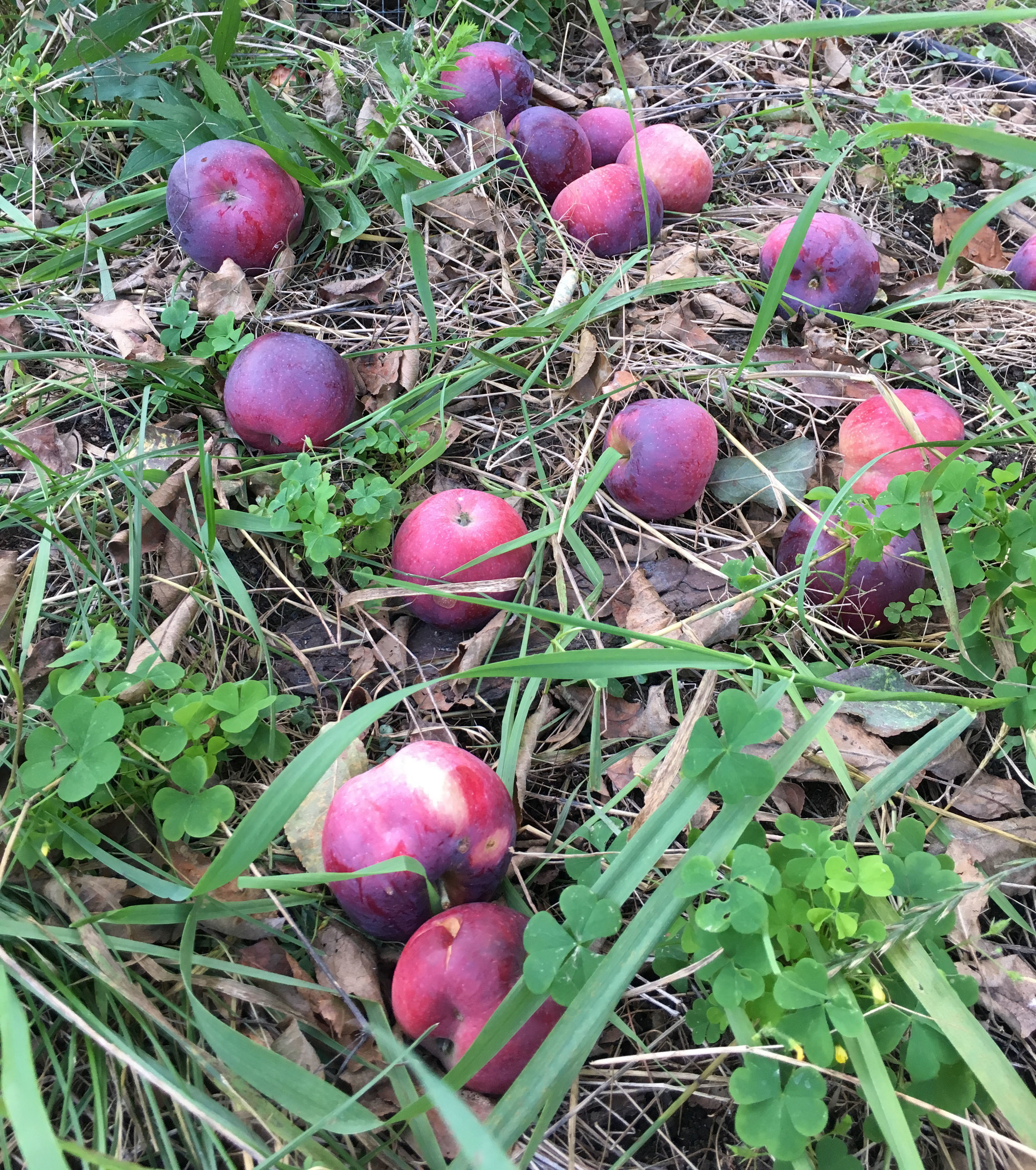
Williams Pride Apple Drops, August 12 — one of our early apples.
Empty the apples into the kitchen sink and rinse them with water.
Take them out and quarter each apple with a sharp knife.
Throw them back into the pot — peel, seeds, core and all.
Add 1 ½ cups of water and begin to cook, covered.
Enjoy the chunk of apple that didn’t make it into the pot.
Ask that all beings enjoy peace, refuge, and healthy food.
Give a stir now and then to move the apples from the top to the bottom.
Keep a cover on the pot so it’s steamy inside.
When the apples are half-cooked, if you are going to use a sweetener, add it now.
(I added ¾ cup of organic sugar to this first batch.)
Ask that all beings find their own sweet spot.
Cock your head like a robin and listen to the kitchen sounds.
Smell the emanation of apple permeating the house.
It there is too much water, take the lid off and release some of the moisture.
Stir a little more.
Cook until all apples are soft.
Turn off the stove and let the pot cool with the lid off.
Pause to absorb the moist scent of cooked apples.
Laugh out loud, though there is nothing funny about a pot of smushy apples.
Offer gratitude to the trees.
After the apple glom cools, ladle large dollops into a food mill.
Rotate the crank around and around.
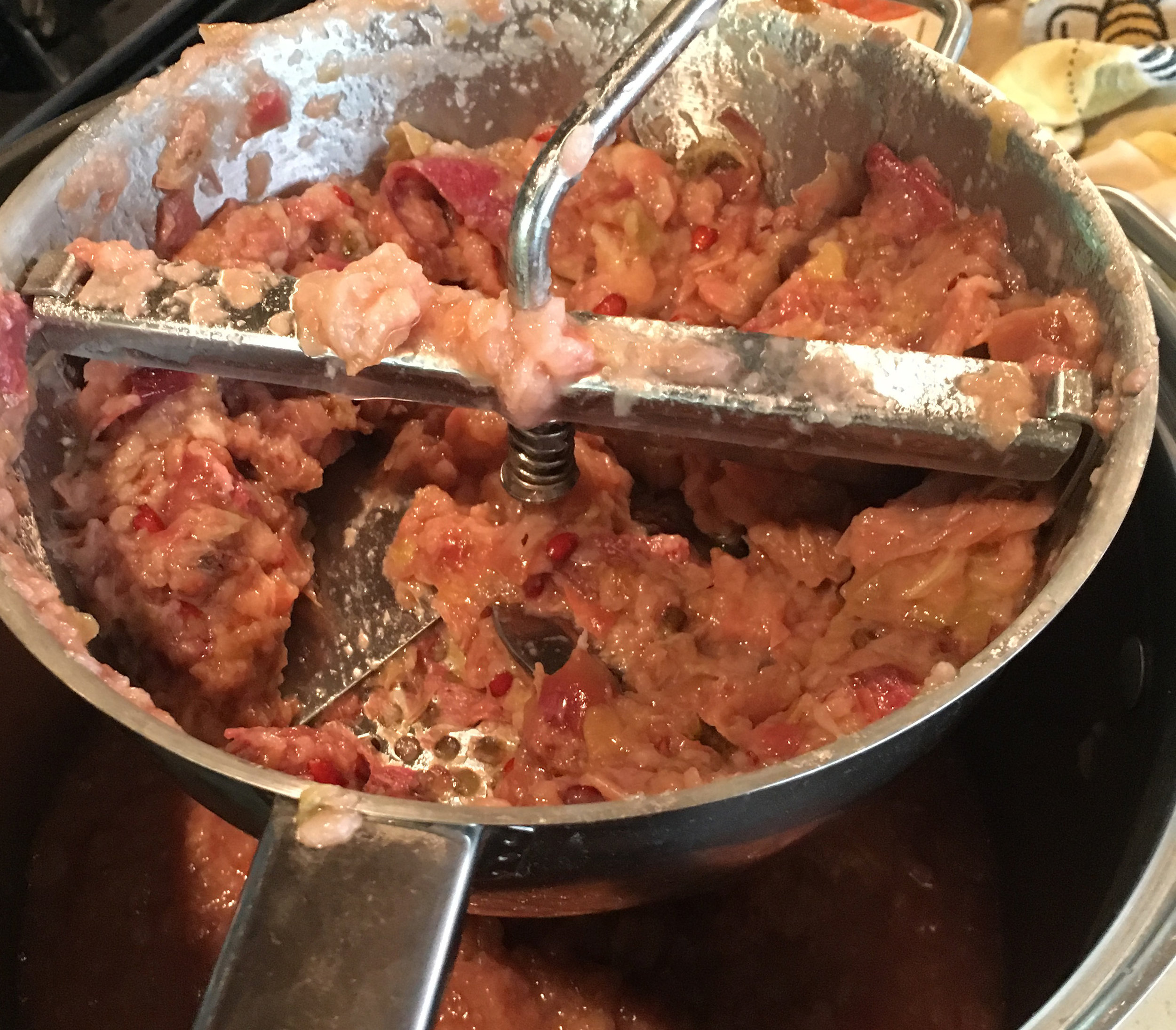
Watch as the strained sauce stained pink (from the peel)
eases its way into the large bowl below.
While it cools do something else.
Have the courage to follow your truth.
Fill a bowl with enough applesauce to eat over the next few days.
Fill containers for freezing.
Stack neatly in the freezer in the basement.
Return to the kitchen and enjoy a taste while the sauce is still warm.
A Teapot, a Woman, and maybe a Boat
One of the problems with making large-scale outdoor sculpture is that you have to store your work when it comes home from an exhibit.

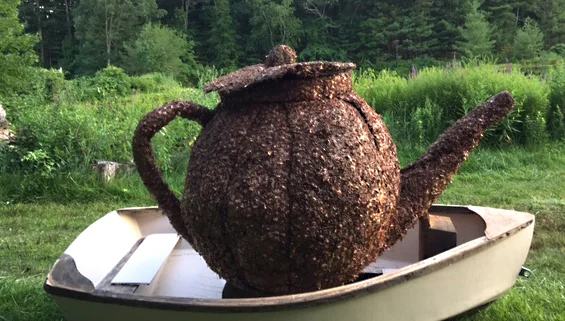
Compost Tea, Linda Hoffman & Gabrielle White, leaves and chickenwire
A few years ago, Gabrielle White and I made Compost Tea. This large teapot was exhibited in two shows and, since then, has been steeping under our back porch. Several weeks ago, we needed to clear this area for washing vegetables. The dilemma — should we dismantle the teapot? I’m one for moving on and getting rid of things. Gabi was reluctant. “Let’s float the teapot,” she suggested. Gabi made a test raft with four five-gallon plastic buckets and a wood pallet. When I returned home that evening I walked on it — and slid into the pond. I later learned that Gabi had fallen in several times. The raft supported our weight — which meant it would support the teapot, but was not very stable.
However, by the next evening the buckets had filled with water and the raft was floating under the surface. Gabi and I stepped into the muck to unstrap the buckets from the pallet and empty them. We searched Craigslist for larger plastic barrels, but southern Connecticut seems to hold the monopoly on used 33-gallon plastic barrels — too far to drive.
Then I thought of the boat. We had been working on a sculpture inspired by the line, The Boat Returned Flooded with Moonlight. I have a little boat that a neighbor gave me years ago. Gabi and I had hauled it out, painted it, and then bought some chicken wire. Gabi is obsessed with the way light shines on and reflects off of chicken wire sculptures. We made a wire figure of a woman seated in the boat with a billowing skirt, a bit like you might imagine Emily Dickinson boating along the Thames. But our Emily kept falling out of the boat, and the sculpture never came together.
Meanwhile, the teapot was now behind my studio awaiting the construction of a raft. At our next session of work, Gabi had the brilliant idea of putting the lady in the teapot. We removed the teapot’s broad-brimmed hat and placed the woman inside. She was visible from the waist up, a jack-in-the-box figure with her own wide-brimmed hat.

The sculpture was intriguing. Then, encouraged to find a solution to our raft difficulties, I said, “Let’s put the teapot in the boat.” I knew we might have to forgo the woman. A boat, a teapot, and a woman was getting a little complicated. Out went Emily. We carried the boat from inside my studio to the teapot and temporarily installed the teapot in the boat with spout pointing towards the bow.
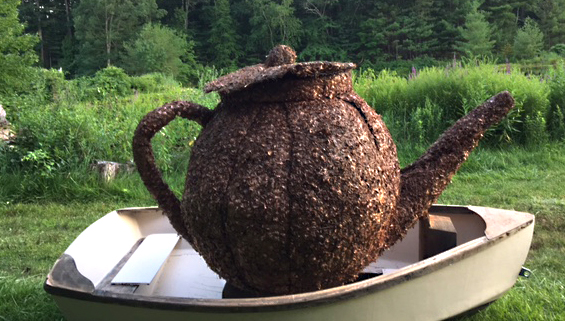
It had a certain presence. They seemed compatibly sized for each other. Then we decided to remove the teapot’s broad-brimmed hat and push Amelia down into the opening. Gabi calls the lady, Amelia, while I prefer Emily. We always enjoy our collaborative way of working even when we disagree. We now had a boat, a teapot, and a lady captain who seemed to be piloting the boat from her teapot quarterdeck. One of her slender arms was resting on the rim of the teapot and the other was gesticulating, as if photographed in mid-sentence. Who was she? Where was she going?
On Friday afternoon, Gabi and I met again to continue work. We wanted to see the sculpture afloat on the pond.
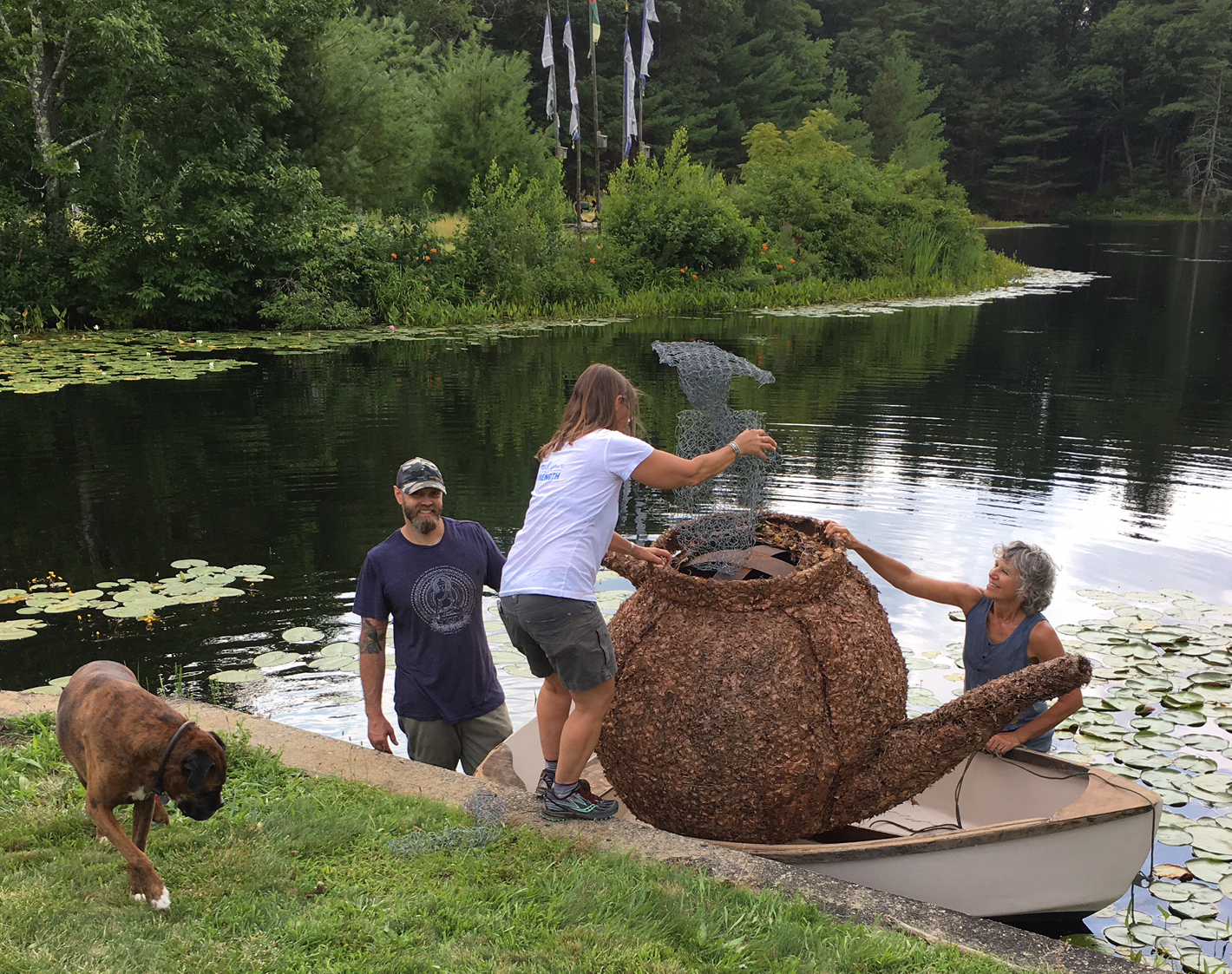
Gabi, Mike Labonte, farm volunteer, Bruschi, farm dog, and I preparing the sculpture for a test voyage. Photo: Farmer Kevin
We don’t yet know what the final piece will be. The woman needs work, the teapot is unsteady in the boat, and Bruschi isn't sure about any of it. You'll have to come to Old Frog Pond Farm’s annual sculpture exhibit, Around the Pond and through the Woods to see for yourself what we decide. This year’s exhibit opens on Friday, September 8 and continues through Columbus Day. The opening reception is on September 10 from 1 - 4 pm. And, as long as the teapot stays afloat, storage will not be an issue!

Gabi in the canoe taking our sculpture for a tour of the pond.
A Raspberry Dilemma
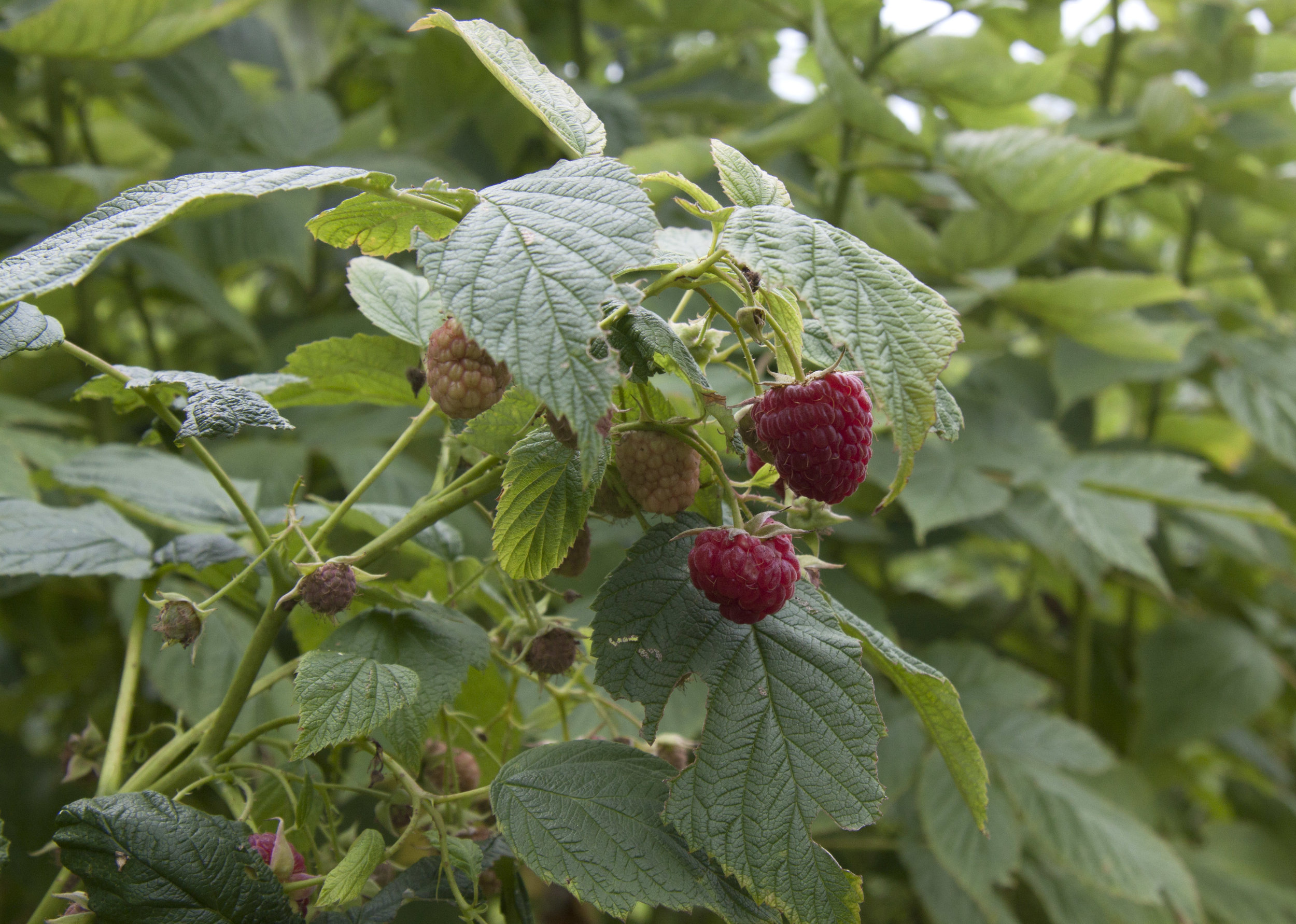
Rogue Ripe Raspberries, July 27, 2017
I came in the other night, kissed Blase, and said, “All I see is raspberries.” I had been picking every last raspberry in the patch, using my deepest concentration to find every single hidden berry that was ripe, or beyond ripe, or too small, or for whatever reason would not ripen into a desirable fruit. It’s not even the beginning of the season for us, but the precocious canes are fruiting. And there are enough berries to attract the Asian Fruit Fly, the Spotted Winged Drosophila (SWD)— the Dragon of small fruit producers!
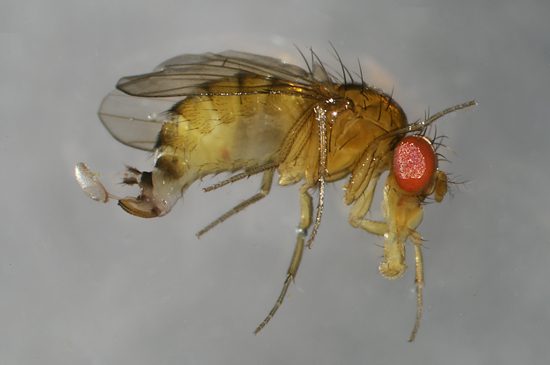
Spotted wing drosophila female (E. Beers, August 2010) Washington State Univeristy
Rotting fruit attracts fruit flies. A bruised pear or peach left on the kitchen counter in summer appears to gather flies from thin air. The SWD, however, is different. The female lays eggs in unripe fruit. She has a curved saw attached to her lower abdomen, which she unfolds and uses to slice into the hard fruit. Therein she deposits one to three eggs. Several females can lay eggs in the same fruit. The larvae hatch in a few days, and the cycle from pupae to egg-laying female is complete in two weeks.
In 2011, midway through the raspberry harvest season, a customer called early on Sunday morning. She had picked twelve pints of raspberries for jam the day before and, while she was cooking them, noticed small white worms floating to the top of the pot. After putting the phone down, I raced out to the patch and picked a few berries. Opening one of the soft berries in the palm of my hand, I peered into the center and saw white larvae squirming inside the soft juicy berry. Disgusting!
The SWD came from Japan to California in 2008 and ravaged fruit growers all along the Pacific coast. The loss for California growers in the first year was over 500 million dollars. In the next two years, SWDs traveled across the country, damaging blueberries in the Midwest and, a year later, arrived on the East coast. It’s still here! Soft-skinned fruit like raspberries and blueberries are at the greatest risk, though SWD will also lay eggs in peaches.
Now, six years later, Old Frog Pond Farm is one of only a few fall raspberry patches in the area. Most everyone else I know has slashed their canes to the ground. If you look up the insect, you will see that university research labs across the country are trying to find a biological way to combat it. Chemical pesticides work, but you need to apply them often and production costs increase for the grower. Organic growers have two choices of sprays – one is a spinosad, a natural bacterium that is used as an organic insecticide, and the other is PyGanic, a natural insecticide derived from chrysanthemum flowers. The latter is labeled as ‘poor’ as far as its effectiveness. A formulation with spinosad works well, but it can’t be sprayed more than six times a season, and it is effective for only five days.
In the last few years, I have been trying to get our canes super healthy so they generate resistance on their own and have experienced some success. Last year, the weather was dry and this kept the SWD numbers down. This year, the SWD arrived two weeks early, and the rains have increased their numbers the way water breeds mosquitoes. I am concerned. We have worked so hard to weed the patch twice, to thin the canes, to give this field all the love and attention possible. For our precocious canes, we now go out every day and pick both ripe and any old fruit. Sanitation is key to keeping SWD in check.
Unlike the old days when the fruit would be on the bushes ripening during the week and the weekend pickers would pick the patch clean, we will need to pick ripe berries every day once the season begins. Silferleaf Farm in Concord, the only other local raspberry grower, started making raspberry vinegar with their daily picked berries. We have not yet developed a secondary market, but I am planning to contact regional ice cream makers. I’m open to suggestions — and volunteer pickers. It’s enjoyable and the ‘take home’ will be berries of course!
Now when I wake in the middle of the night with farm anxiety I see raspberries. Yet this will soon pass — for the next three weeks I will be in the orchard thinning apples, removing blemished fruit and doing summer pruning. We have some beautiful apples, but we also have some serious problem varieties due to the wet season. Soon when I wake in the middle of the night I will be seeing apples — the blemished scabby ones and the cascading, out-of-control trees with branches so loaded with perfect fruit they are in danger of breaking. It is a world of ricocheting extremes even on this small farm.
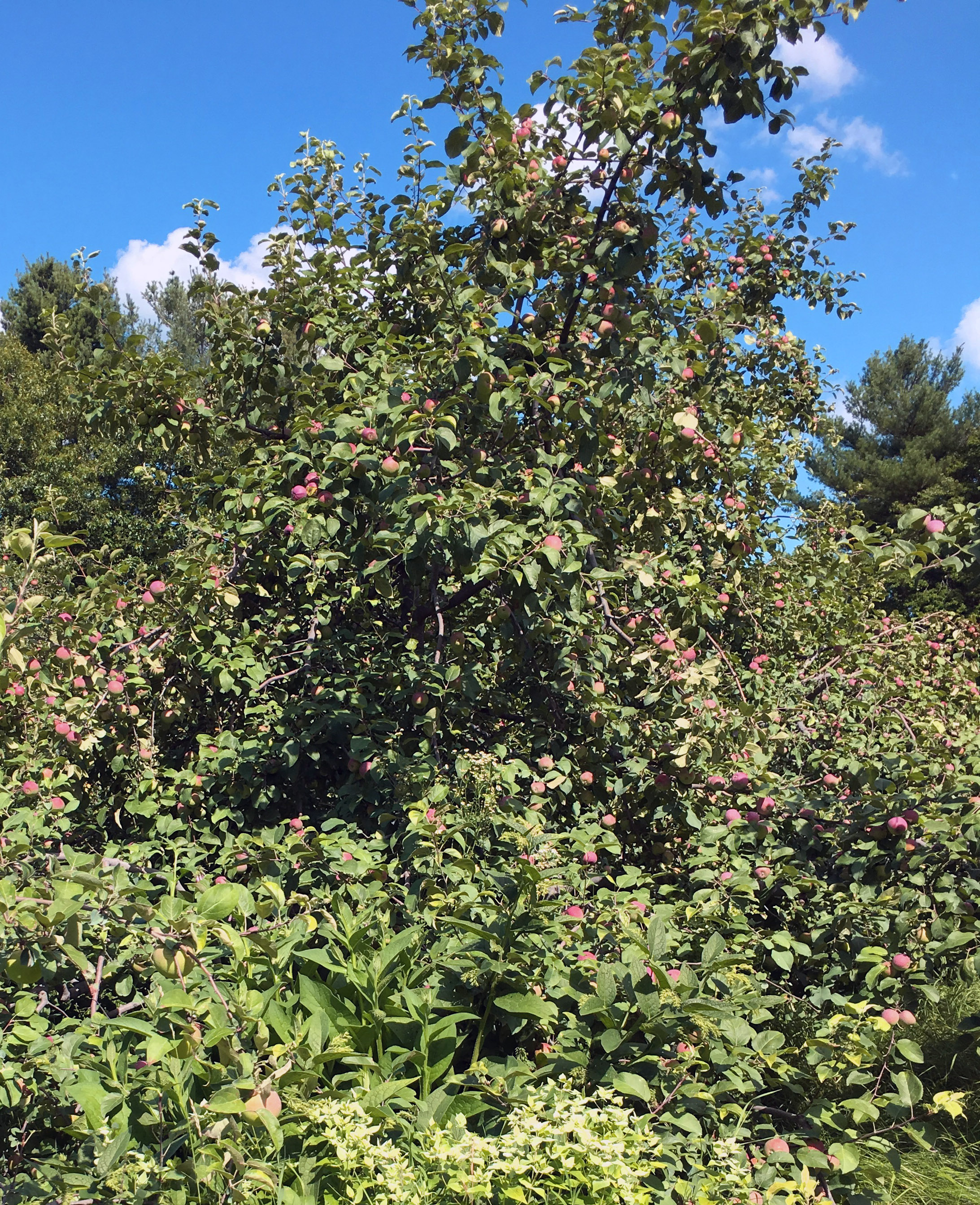
Cascading Freedom Apples with comfrey and mountain mint, July 26, 2017
Consider the Miracle
My son, Alex, sent a family text.
Here she is! Born 7.13.17 6 lbs 5 oz! We are calling her Lui or Lou (short for Lucia). I was a little worried I wouldn’t love her as much as Vita but the heart has this amazing capacity to open wider than you ever thought possible.
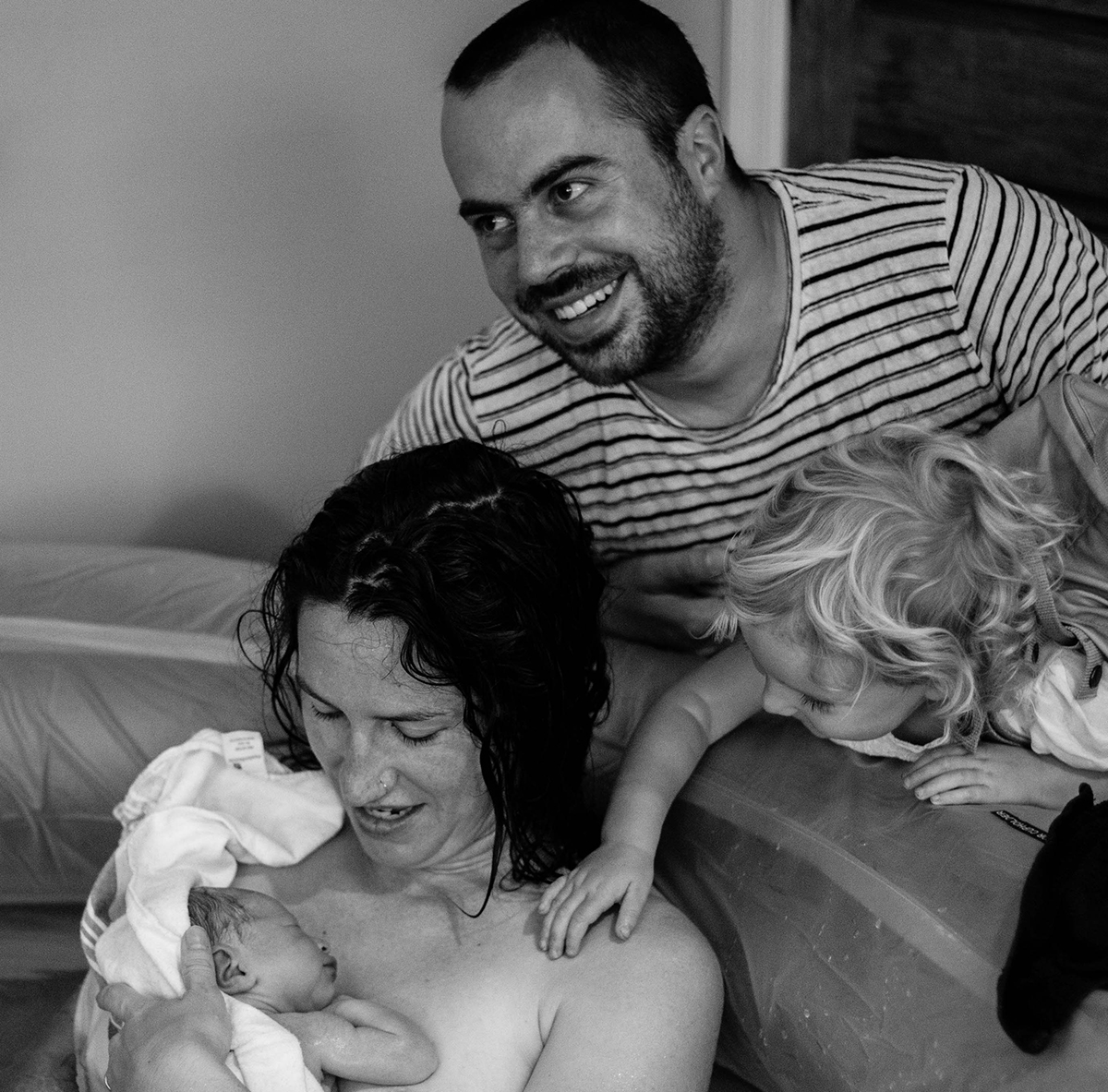
Alex, Connie, Vita, and Lucia Matisse minutes after Lucia's birth.
We have all been waiting for this birth. Connie, Alex’s wife, was certain the baby would arrive early, like her sister Vita two years ago. But no, Lucia was almost a week late!
I know what it is to carry around a baby, well past the due date, in the heat of summer, getting bigger and rounder, the skin stretching tighter around the massive tummy. Then there is only the waiting for the body to begin the birthing process . . . the light contractions, the practice before the hard work, then the pushing with maelstrom force to ease the new being out into the world, the mother directing total allegiance to each hard push until the final slipping out, and the moment of relief and delirious happiness.
Women remember their births. I once spoke with an eighty-three-year-old woman who could distinctly recall each one of her five children’s. There is no other experience that requires such perseverance and fortitude, such complete giving away of one’s self for another. I remember hearing of a woman about to undergo an emergency Caesarian who was asked if she wanted to live, or if she wanted her child to live. It was one or the other, and she had to decide in that instant. She chose the child. “Take Chad out,” she said, making the choice without hesitation.
I am beyond words with gratitude that Connie and Lucia are both doing so well. Lucia already knows the heartbeat and smells of her mother, and she is easily held and comforted by others’ arms. I imagine that Lucia already knows the rhythms of her family’s waking and sleeping and even the sound of words that are repeated often with emphasis, like ‘Alex,’ ‘Connie,’ ‘Vita’; the way in our house, our parrot learned to say ‘Ariel,’ because I called my daughter’s name so loudly each morning urging her to hurry downstairs for school.
I wonder about the sounds one hears in utero. I can remember when I was three or four and already familiar with language, amusing myself with my own made up sounds. I would say nonsensical syllables with intonation, as if I completely understood the content and context. What was so satisfying was not that I had my own language, but that this language was familiar, as if it was the language I had heard in the womb or when I was an infant. It was a comforting language for me to speak. It had emphasis and cadence, but the sounds were always soft and round, nothing harsh, like hearing a conversation among ocean waves.
Now, this little being, Lucia, hears the comforting voice she has heard in utero as she gazes into her mother’s eyes. Connie speaks to her with warmth, love, and kindness. Lucia is learning to connect the language of deep comfort to a face she will come to trust and adore.

Lucia's Birthday!
She hears the deeper voice of her dada and a new heartbeat when she sleeps on his breast. She begins to trust the other. She is learning the voice and antics of her older sister.

Lucia was only 6 pounds 5 ounces at birth, the size of Vita’s favorite doll baby. I look at all the adults around me, and I know that Lucia will grow up to be one of us. But for now she is a miracle, one of those miracles that happens every day, all over the world. One day she will feel her own heart beat. She will discover language and her own voice in the world.
Lucia Marcel Matisse, may you find the courage and wisdom to sow love in this world. For surely, then, the world will reflect only love back to you. Congratulations to your family! We can’t wait to get to know you better!
With love, Ama & Baba
Search Blog
-
2025
- May 9, 2025 A View from the Tractor Seat
- Apr 11, 2025 Dig
-
2024
- Jan 7, 2024 Winter Wassail
-
2022
- Dec 11, 2022 Keeping Time
- Jun 17, 2022 This Apple-Shaped Earth
- Jan 23, 2022 What is a Jizo?
- Jan 16, 2022 An Invite and Housekeeping Update
- Jan 1, 2022 The Year of the Frog: What Orchardists Do While Apple Trees are Chilling
-
2021
- Oct 24, 2021 Figs
- Oct 3, 2021 The Artist and the Orchard: A Memoir
- Aug 8, 2021 Red-Fleshed Apples
- Jul 25, 2021 When We Were Trees
- Jun 27, 2021 Castor Beans—Who Knew?
- Jun 13, 2021 Spring Training at a Zen Monastery
- May 4, 2021 Our Trees are in Bloom
- Apr 18, 2021 Hooray!
- Jan 24, 2021 Wassailing, virtually!
- Jan 1, 2021 Sitting
-
2020
- Dec 21, 2020 Darkness to Light
- Nov 28, 2020 One Heart
- Sep 18, 2020 Juggling Flowers, Fruit, and Vegetables
- Aug 23, 2020 Refuge
- Aug 9, 2020 Bags of Fertilizer
- Aug 2, 2020 The Sermon of the Blue Heron
- Jul 26, 2020 What's the Buzz?
- Jul 19, 2020 Farm Moments
- Jul 12, 2020 Lost Wax
- Jul 5, 2020 Catalpa: The Hugging Tree
- Jun 28, 2020 Pedaling Peace
- Jun 21, 2020 See Change
- Jun 14, 2020 Lalla Unveiled
- Jun 7, 2020 Pond Alchemy
- May 31, 2020 The Birth of Fruit
- May 24, 2020 An Artist in the Orchard
- May 17, 2020 Walking the Land: Returning Home
- May 10, 2020 Stinging Nettles: Gifts from the Great Mother
- May 3, 2020 The Mystery of Swallow
- Apr 26, 2020 Aerial Bruststrokes
- Apr 19, 2020 Simple Pleasures
- Apr 12, 2020 Weeds and Other Gifts
- Apr 5, 2020 Remembering the Seeds
- Mar 29, 2020 Blow on the Embers
- Mar 22, 2020 Ripples
-
2019
- Nov 16, 2019 Tibet Impressions
- Nov 9, 2019 Forest Tales
- Oct 13, 2019 The Gift
- Aug 4, 2019 The Season is Apples, Berries, and Grandfather Fire
- Jun 8, 2019 Pointers for a Writing Life
- May 12, 2019 Mothers of the Earth
- Apr 6, 2019 The Apple-Shaped Earth
- Mar 23, 2019 You Don’t Know What You Have Till It’s Gone
- Feb 23, 2019 Generations
- Feb 9, 2019 What Are We Doing to the Earth, John Chapman?
-
2018
- Dec 31, 2018 Long Shadows
- Oct 6, 2018 A Pilgrimage to India
- Aug 18, 2018 Scrap Wrenn
- Aug 11, 2018 Off-the-Wall Comments from an Ignorant Farmer
- Jul 28, 2018 Creative Connect
- Jul 14, 2018 How is the Orchard?
- Jun 30, 2018 Which Way?
- Jun 16, 2018 Geese, Herons, Beavers, and the Baby Steps of a Lapsed Blogger
- Feb 24, 2018 Mama's Coupons — Good Forever
- Jan 27, 2018 January Ice
- Jan 13, 2018 The Muse
-
2017
- Dec 30, 2017 A Dream for the New Year
- Dec 23, 2017 A New Year for Apples
- Dec 16, 2017 Intuition
- Nov 22, 2017 Thanksgiving OM
- Nov 4, 2017 East Fork Pottery
- Oct 28, 2017 Putting Down New Roots
- Oct 21, 2017 A is for Art
- Oct 14, 2017 Eve domesticus
- Oct 7, 2017 A String Workshop
- Sep 30, 2017 After Applepicking
- Sep 23, 2017 Two Bad Women and One Good Apple
- Sep 16, 2017 Plein Air Poetry
- Sep 9, 2017 Cutting Off a Leg
- Sep 2, 2017 The Changing Landscape
- Aug 26, 2017 All About Art
- Aug 19, 2017 My First Visit to the Farm
- Aug 12, 2017 The First Food
- Aug 5, 2017 A Teapot, a Woman, and maybe a Boat
- Jul 29, 2017 A Raspberry Dilemma
- Jul 22, 2017 Consider the Miracle
- Jul 15, 2017 Meeting Ekphrasis
- Jul 8, 2017 Ripening Fruit
- Jul 1, 2017 The Voice of The Caterpillar
- Jun 24, 2017 Goumi — An Unusual Fructus
- Jun 17, 2017 Concord, an American Bloomsbury
- Jun 10, 2017 The World Is Bonkers — Shall I Laugh or Cry?
- Jun 3, 2017 Bonkers, a Revolutionary Apple
- May 27, 2017 Guardians of the Swamp
- May 20, 2017 There are Mushrooms and There are Morels
- May 13, 2017 "What's in a Name?"
- May 6, 2017 Bloom Follows Pink: Orchard Pollination
- Apr 29, 2017 The Orchard Is at Pink
- Apr 22, 2017 Natural Farming — Part 2 (continuation from last Sunday's blog)
- Apr 15, 2017 Natural Farming — Part 1
- Apr 8, 2017 Boats, Figures, and Catching Fish
- Apr 1, 2017 A Man with a Mission: The Nuts and Bolts of Bronze Casting
- Mar 25, 2017 A Chalice of Spirit, Art, and Nature
- Mar 18, 2017 Hanami — Blossom Viewing
- Mar 11, 2017 Soil Redemption Song
- Mar 4, 2017 Food is Primary Care
- Feb 25, 2017 Pomme de Terre
- Feb 18, 2017 Organic Certification
- Feb 11, 2017 Tantalizing Fruit
- Feb 4, 2017 The Myths of History
- Jan 28, 2017 The Orchard in Winter
- Jan 21, 2017 The Hi-Line
- Jan 14, 2017 Artistic, Botanical, and Social Diversity
- Jan 7, 2017 Where is Eden?
-
2016
- Dec 31, 2016 The Creative Heart
- Dec 24, 2016 A Christmas Tale
- Dec 17, 2016 Who are the Crones?
- Dec 10, 2016 The Olympic Bell (Part Two)
- Dec 3, 2016 Overheard in the Apple Orchard in Early December
- Nov 26, 2016 The Lessons of a Tortoise
- Nov 19, 2016 In the Studio
- Nov 12, 2016 Even in Darkness
- Nov 5, 2016 Southern Apples, an Elephant, Monkey, Rabbit, and Bird, Two Mango Trees and a Birthday
- Oct 29, 2016 The Tools of Art
- Oct 22, 2016 Labyrinths
- Oct 15, 2016 Repairing the Broken
- Oct 8, 2016 When You Are No More
- Oct 1, 2016 Creation Rain
- Sep 24, 2016 Breaking the Glass
- Sep 17, 2016 String Art
- Sep 10, 2016 Poetry and Photosynthesis: It's all in the Leaves
- Sep 3, 2016 In the Plenty of Time
- Aug 27, 2016 Witch Doctors
- Aug 20, 2016 Listen Coyote
- Aug 13, 2016 Milkweed in the Orchard
- Aug 6, 2016 Some People See a Turtle
- Jul 30, 2016 Arborshaping
- Jul 23, 2016 Joseph Wheelwright: Sculptor of Stones and Trees
- Jul 16, 2016 Asian Pears
- Jul 9, 2016 Gold Leaf, Grief, and the Creative Process
- Jul 2, 2016 The Olympic Bell (Part One)
- Jun 25, 2016 Around the Mulberry Bush
- Jun 18, 2016 Avoiding Apples
- Jun 11, 2016 Fructus
- Jun 4, 2016 Astonishing Apples
- May 28, 2016 Scare the Caterpillars
- May 21, 2016 Join the Club!
- May 14, 2016 The Graft
- May 7, 2016 Rooster, Rhubarb, Rue
- Apr 30, 2016 What do Dolphins and Nettles Have in Common?
- Apr 23, 2016 Art Prunings
- Apr 16, 2016 A Few of the First Arrivals
- Apr 9, 2016 Taste the Spirit of Sustainable Agriculture
- Apr 2, 2016 First Orchard Spray - March 22-24, 2016
- Mar 26, 2016 Hawkeye Apple
- Mar 19, 2016 Desiring the Almata Apple
- Mar 12, 2016 Ugly Fruit
- Mar 5, 2016 Winter Tracks
- Feb 27, 2016 Splash
- Feb 20, 2016 Pruning
- Feb 13, 2016 Orchard Ruminants
- Feb 6, 2016 A Gathering of Seeds
- Jan 30, 2016 Orchard Dragons
- Jan 23, 2016 Tree Rings
- Jan 17, 2016 The Fallen Tree
- Jan 7, 2016 Wassailing the Apple Trees
- Jan 1, 2016 The New Year