LINDA HOFFMAN
East Fork Pottery
The canvas tote bag says, “East Fork is a vessel.” But I know East Fork is the little itty bitty stream that moves through the property at the end of Ras Grooms Road, in Marshall, North Carolina. I remember sitting with my oldest son, Alex, on the concrete stoop of a rundown house at the end of rural road, far from anything, a barren bit of land where the sun doesn’t crest the ridge until 11 am. A simple shed, an old tobacco barn, a field plowed by a neighbor, and a mailbox on a crooked post occupied the flatland; the rest of the 40 some acres were steep and covered with gnarly dense rhododendrons and forest trees. Alex was feeling, “What have I done?” I was feeling the same, but didn’t dare say. It was a shocking beginning; the kind that forms a knot in your chest that can take a long time to unravel.
Alex had spent three years as an apprentice with two North Carolina potters, Matt Jones in Big Sandy Mush outside Asheville, and Matt’s teacher, Mark Hewitt in Pittsboro. Then it was time for him to go out on his own. Alex found this little ‘holler’ where the East Fork stream flows and, pressured by a real estate agent who assured him there would never be anything else available for a price he could manage, bought it.
I was visiting with Alex the day after he had signed papers. I would soon leave him alone in his little, dark house. It would take time and effort to set up a rudimentary pottery so he could begin making his own pots. Two men from down the street appeared, carrying a couple of six packs of beer. I feared that they would arrive daily to drink with him. I felt the fragility of my first born son at that moment; still young, not yet a man — finding out how to become one. I reflected that in some way he was doing what I had done when I left our family home, moved to a farm with an abandoned apple orchard, and began a new life. I knew personally the feeling of isolation and fear that comes after plunging into the unknown. But I was older and had more support. The changes at Old Frog Pond Farm took many years. I was worried for him.
Alex built a beautiful wood fire kiln on the site, and then set about making pots. Friends and family helped. It felt like a slow beginning, but two years after we sat on that cracked cement stoop together, East Fork Pottery was born, and hosted its first kiln sale.
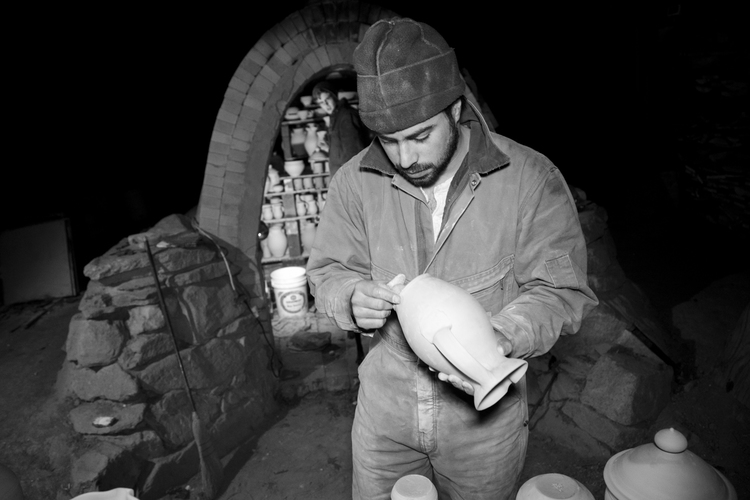
Alex in the Kiln, Photo: Nick Matisse (his brother)
Early on, Alex met a beauty from Los Angeles. What exactly she was doing on a goat farm nearby is hard to know. Connie’s prominent LA lawyer mother visited — trying to understand why her Berkeley grad was now milking goats, and hoping she could delicately move Connie into the next part of her life. Connie and her mom were at the Asheville Farmers Market, when looking around for a friend for her daughter who didn’t say, “Maaa, Maaa,” Connie’s mother pointed to Alex and said: “See that boy, he looks nice. You should go talk with him.” Eight years later, Connie and Alex have two beautiful babies, Vita and Lucia, and Connie is artistic director of East Fork.

Connie and Alex in the Kiln. Photo: Nick Matisse
Alex could have followed in his mentors’ footsteps, opening Alex Matisse Pottery, but, instead, he wanted community. East Fork is a team of great potters, kiln firers, salespeople – and they're all under forty. This youthful group is creating a successful company that makes beauty and brings it to the world. Tall, thin John Viegland, another traditionally trained North Carolina potter, joined Alex early on. He is the financial manager and works at the pottery full time.

John Vigeland in the Pottery
One of their first hires was Amanda Hollomon-Cook. She is now production manager and potter, organizing all the numbers of plates, bowls, and mugs needed, and in what glazes. When she goes home, she works in her own studio on ceramic sculpture. Connie recently did a photo shoot with Amanda and her sculpture — a beautiful collaboration!

Sculpture Amanda Hollomon-Cook Photo: Connie Coady Matisse
I am proud to be Alex’s mother, and Connie's mother-in-law — and I still worry! But take a look at their website – their pottery, the other artisans’ work they promote, and the journal that Connie writes. You will want to be part of this back to the earth and into the marketplace movement! Clay dug from the hills of North Carolina, old world craftsmanship, skill, liberal politics in a not-so-liberal state. “Down with the patriarchy,” says two-year-old Vita. The only difficult family issue is that Connie is a Dodgers fan, and Blase, my husband, is ardently national league, he grew up in Malden outside of Boston. Otherwise, we all eat off plates stamped East Fork.

***While Blase and I are traveling to Florence and Venice for ten days, there will be a two-week pause in the blog.
Putting Down New Roots
My anticipation to re-enter my studio is growing. The studio has been gutted, old electrical wires stream in all directions like seaweed underwater, boards pulled from the walls lay with nails protruding. One part of the ceiling remains as a loft space with a raised roof and new windows. The other side is open to the eaves. There’s no insulation, lights, or finish, but I can taste the new space.

Filled Studio, Empty Studio, New Construction - same view.
I have always loved my studio, even at its most crowded, inefficient, and difficult to work with. It’s been my space. A space I can leave messy, where I can leave tools where I want, and only I need to know where to find them. It has always had its own organization, betraying its chaotic outward appearance. It’s been a shapeshifter — tables appearing and disappearing, floor space growing and shrinking, and hooks on the ceiling filling with nettles and mint drying.
But now all that is changing. Nothing inside hints at what has happened over the last sixteen years. What lies ahead is unknown.
When I moved in, I brought my materials with me — old tools, rusted metal, fabrics, and curious debris. I continued to make sculpture, sometimes exploring new themes, but always following a known path. Two months ago I emptied every iota of matter — the process took weeks. But, in another month or two, construction will be over and I will have an empty space, a blank canvas. I want to do something different, something that arrives not from the materials, but from inside my heart. A close friend who came in to see the progress asked about moving stuff back in, imagining the fun I would have arranging the space. I realized I wasn’t thinking about that. I’m not thinking about arranging anything, or moving anything back in. I’m only anticipating the experience of this new state of emptiness and my own creativity. I want to feel the art coming from my own body — stripped bare, and I am looking forward to sitting and feeling the empty studio in silence.
Yet, I know that this space can never be truly empty. I will carry the daily news will me: the dire situation of the unfathomable numbers of people displaced by frightening natural forces and horrendous human-caused tortures — their isolation, desperation, and need for help.
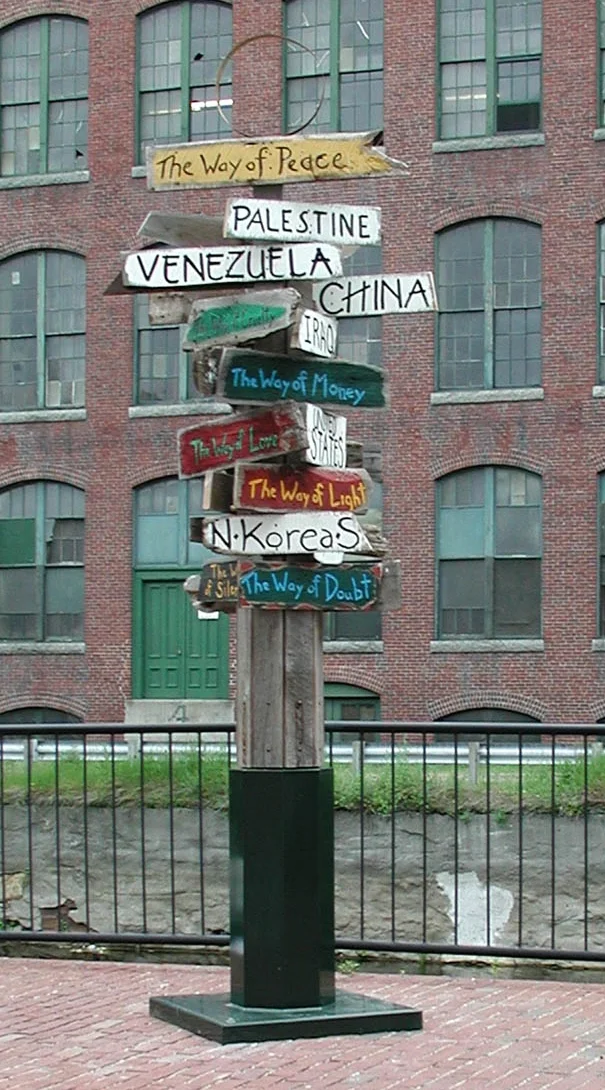
The Way of Peace installed in Lawrence, MA, Linda Hoffman
I am beginning to articulate new questions. What is it that I truly want to add to the world? Does art make the world more comprehensible, tolerable, sharable, beautiful? I’ve lived my life believing this. I am humbled by the enormity of the possibilities and challenges, and at the same time excited to meet this new space, share it, and see how it will influence my art. Planting new seeds in the studio, I'm hoping their tiny root hairs will find fertile ground.
A is for Art
“A work of art is not a piece of fruit lifted from a tree branch: it is a ripening collaboration of artist, receiver, and world.”
—Jane Hirshfield
Outdoor sculpture is always collaborative. The placement of the work, the ripples of water, the sunlight, tree bark, wind, and moss, all interact with the art. One Sunday morning in early August, a few weeks before the farm’s outdoor sculpture exhibit opened, I found myself alone — a rare event. I walked down to the studio. Warmed by the sun I decided I would ‘do some art’ outdoors. Working with dried branches from a Harry Lauder Walking Stick plant, a sculpture came together easily and spontaneously, making me doubt its worth. But as I walked past it in the week that followed, experimenting a little more and making a few changes, I decided there was something to it and included it in our outdoor sculpture exhibit.
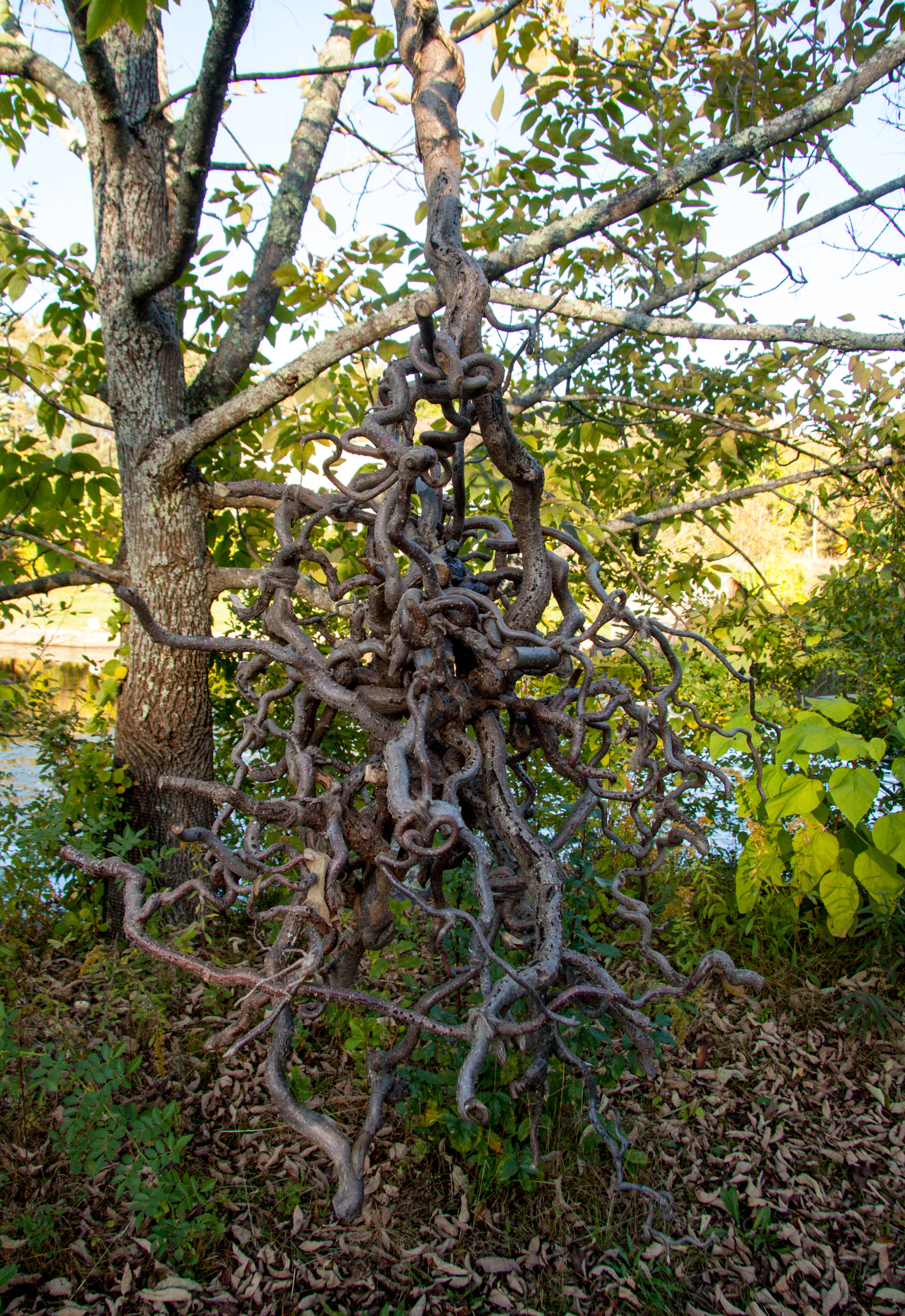
Sitting in Limbo, Linda Hoffman
Last week, a visitor to the exhibit wrote, “My favorite was Sitting in Limbo. I was looking at it, then the wind began turning it around, and I received the beautiful surprise of the meditator sculpture.”
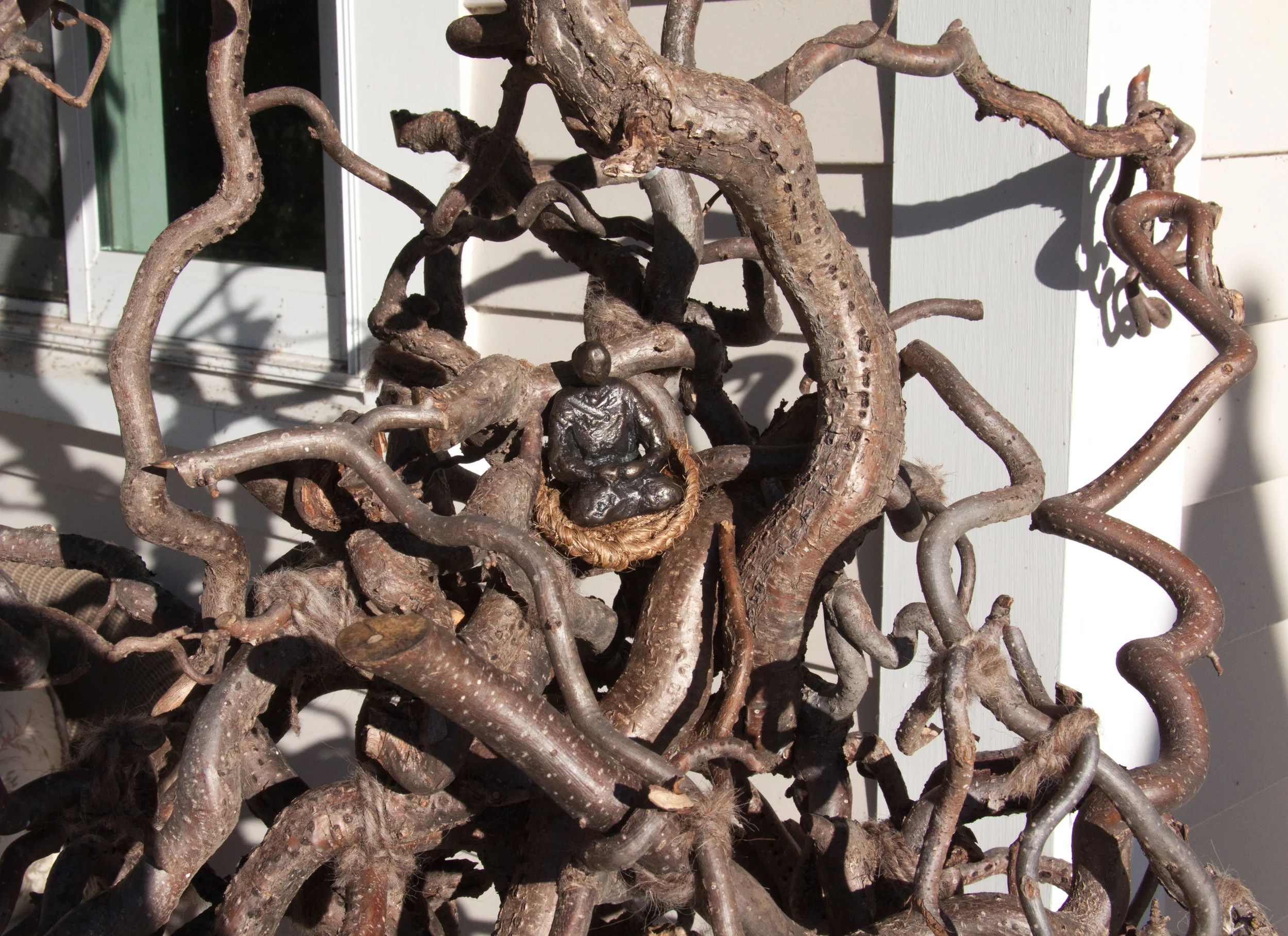
Sitting in Limbo, Detail
Inside, at the very center of this labyrinth of branches, sits a small meditating bronze figure. Inside the cacophony of the world, there is quiet. This viewer had her own collaborative experience with the wind and the sculpture. It surprised her — and we all delight when nature reveals something previously unseen. Her note to me was also a sweet surprise. Often artists don’t have any idea how their work is received.
Growing apples is also a collaborative endeavor. Soil, weather, the unique characteristics of a particular tree and the orchardist are all part of the cooperative effort of growing fruit. But applepicking is different than growing apples, and this is where I get into trouble. People come to the orchard to take home organic apples, not to have a transformational experience. In my truest of hearts, I am not an orchardist, but an artist; and I don’t particularly enjoy when people come to the orchard as if it was a supermarket with a commodity to grab and pay for. In fact, it’s best that I am not at the farmstand greeting and selling bags. Most problematic for me is that people have their own ideas about reality. Apples should look a certain way, and they should not have any blemishes. As an orchardist, I know that I could do better at growing our fruit, and I could focus on the varieties that the public most desires. But the work of artists is to show that there are other realities. Something lives behind appearances that the artist struggles to reveal. There are complex tastes inside apples such as Blue Permain, Caville Blanc, and Lyscom. Not all apples need have the delightful crunch and sweetness of a Honey Crisp, though there is no denying it’s a delicious apple.
As apple season closes, I realize how much I miss the epiphanies of the creative process. I miss the opportunity to be transformed by art. Especially when I look under the trees at all the apples knocked off, or tossed down with disdain because of some blemish, Jane Hirshfield’s words articulating the distinction between the collaborative nature of art and the casual singularity of picking an apple tugs at me. It’s something I have struggled with, yet failed to acknowledge. It is tied up with whether I am an artist or an orchardist — because it is hard to do both well.
Right now, however, as I try to make sense sitting inside my labyrinth of thoughts, I dream of the possibility that our small orchard can become a place where there is a ripening collaboration between the picker, the grower, and fruit — Applepicking as Art.
Eve domesticus
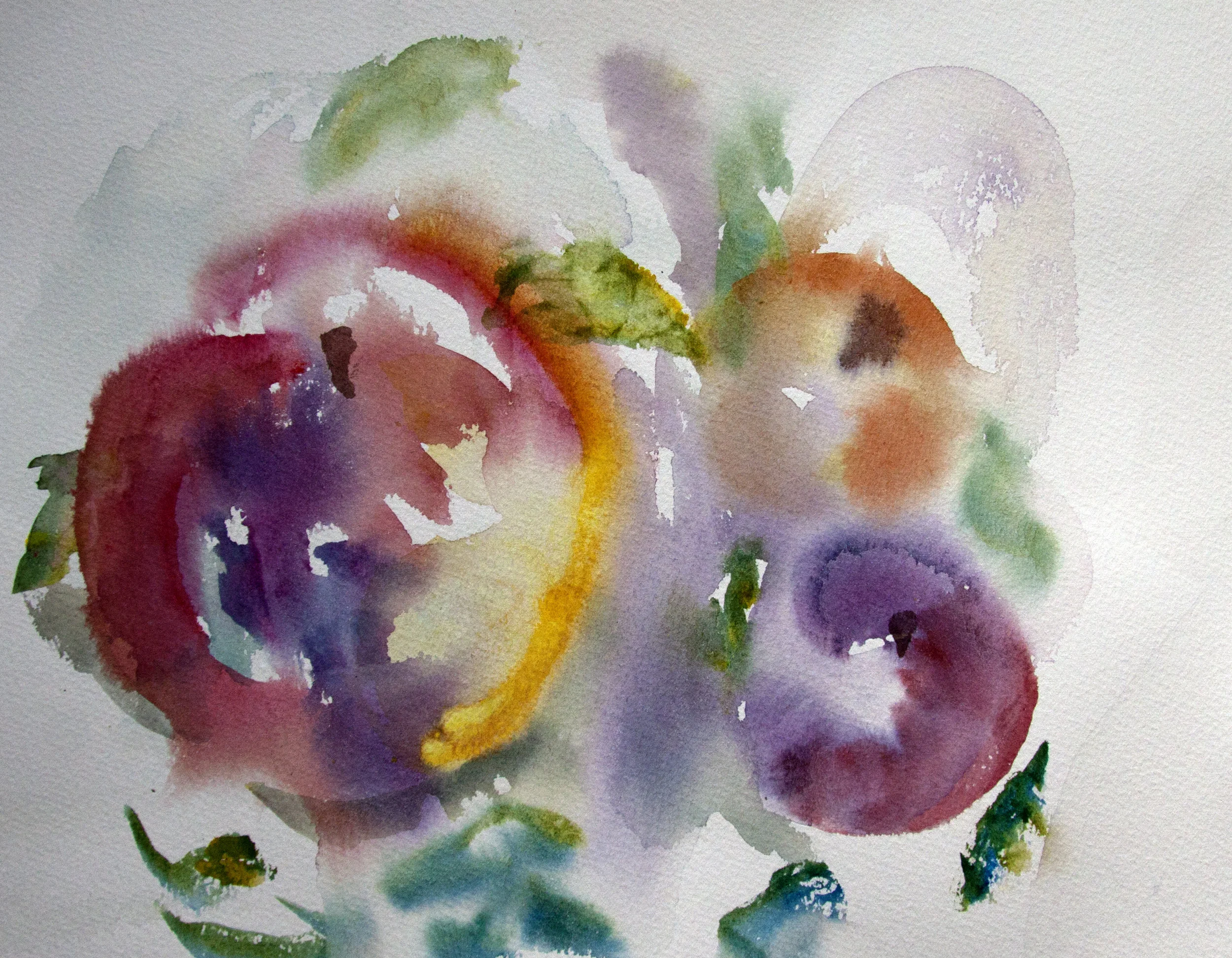
Apple Watercolor, Linda Hoffman
Like many apples throughout history, Eve was discovered by accident. About fifteen years ago, an orchardist at Easton Apples, a large grower in New Zealand, found a tree whose apples were bright red. He considered it to be a promising new cultivar for market. Eve, the apple, has not traveled to this part of the world; she favors the cooler, mountainous regions of Australia and New Zealand. Technically, she is a strain of Braeburn, another New Zealand apple, but there has been some meddling with her DNA, because like some other modern apples, she won’t turn brown when cut.
Eve, the evil one, (or rebel, if you read my blog post Two bad Women and One Good Apple), is now the name of one of the most ordinary apples in the world. Her most distinguishing trait is her bright red skin. In photos, she looks just like a polished Red Delicious apple, the ubiquitous apple of Snow White and the Seven Dwarfs. Following her successful entrance into the apple world, the Heartland Corporation decided to offer a juice made solely of Eve apples. It’s a cloudy, no sugar, pure apple juice, and it had its debut in Malaysia!
This juice is not to be confused with Apple and Eve, the juice from an American family business that started 40 years ago. Apple and Eve was the first juice company to offer organic fruit juice before organics was popular, and the first to offer juice boxes—apple juice stored in a single serving cardboard box, with its own straw and plastic wrap, packaged to travel to the moon.
Artist and inventor, Joe Davis, has been experimenting with ‘apple’ storage in his own unique way. He is using a four-thousand-year old apple variety from Kazakhstan, the birthplace of the apple, Malus sieversii, the parent to our apple, Malus domesticus, to create a new storage system for data. Davis is translating the whole of Wikipedia into the binary code of the four nucleotides of the DNA, then inserting it into an apple using a strain of bacteria that can permeate plant cell walls. He won’t be able to fit all of Wikipedia into one apple, his Tree of Knowledge will be a small orchard. Indeed, If you bite into one of these apples, you might get more than crunch!
Apples are one of our oldest fruits. In part, their success is due to the apple’s inability to produce offspring similar to its parents. The apple, naturally, practices genetic diversity. New apples do exactly the opposite: their gene pool is limited because the best traits are bred over and over again which is one of the reasons modern apples have lost the ability to ward off pests. We’re getting better at breeding, and creating tasty and disease-resistant varieties, though only time will tell if these changes are permanent, or whether the insects and fungi will breed and outfox us. We are sometimes so focused on creating what is desirable to us, that we neglect what nature would do on its own over time.
The ever present debate remains — how much should we interfere? Apple history demonstrates that for several thousand years she’s done quite well on her own — producing apples, locally grown, adapted to particular environments, the Netherlands, France, Asia, Australia, on almost every continent on the planet.
My friend, Patrick Hughes, wrote to me after the blog about Eve saying he ended a sermon on sustainability with the following:
There is one final request I want to leave you with. I believe we need to rewrite the story of Genesis to say that the residents of the Garden of Eden are not cast out of paradise by eating from the tree of knowledge but have it state they gained wisdom and evolved to become the caretakers of the earth by acknowledging this; That apples from that tree of knowledge are locally grown.
We have a few wild apples growing at the farm. After pressing cider, we dispose of the leftover pumice in discreet piles in our wildflower field. Some of the seeds in this leftover mash are hardy enough to send down roots and push up leaves among the wild grasses. Local, sustainable, probably bitter apples, but unique varieties, good for the crows, the bees, and the deer; good for genetic diversity. In my opinion, an apple, better suited for the name, Eve.
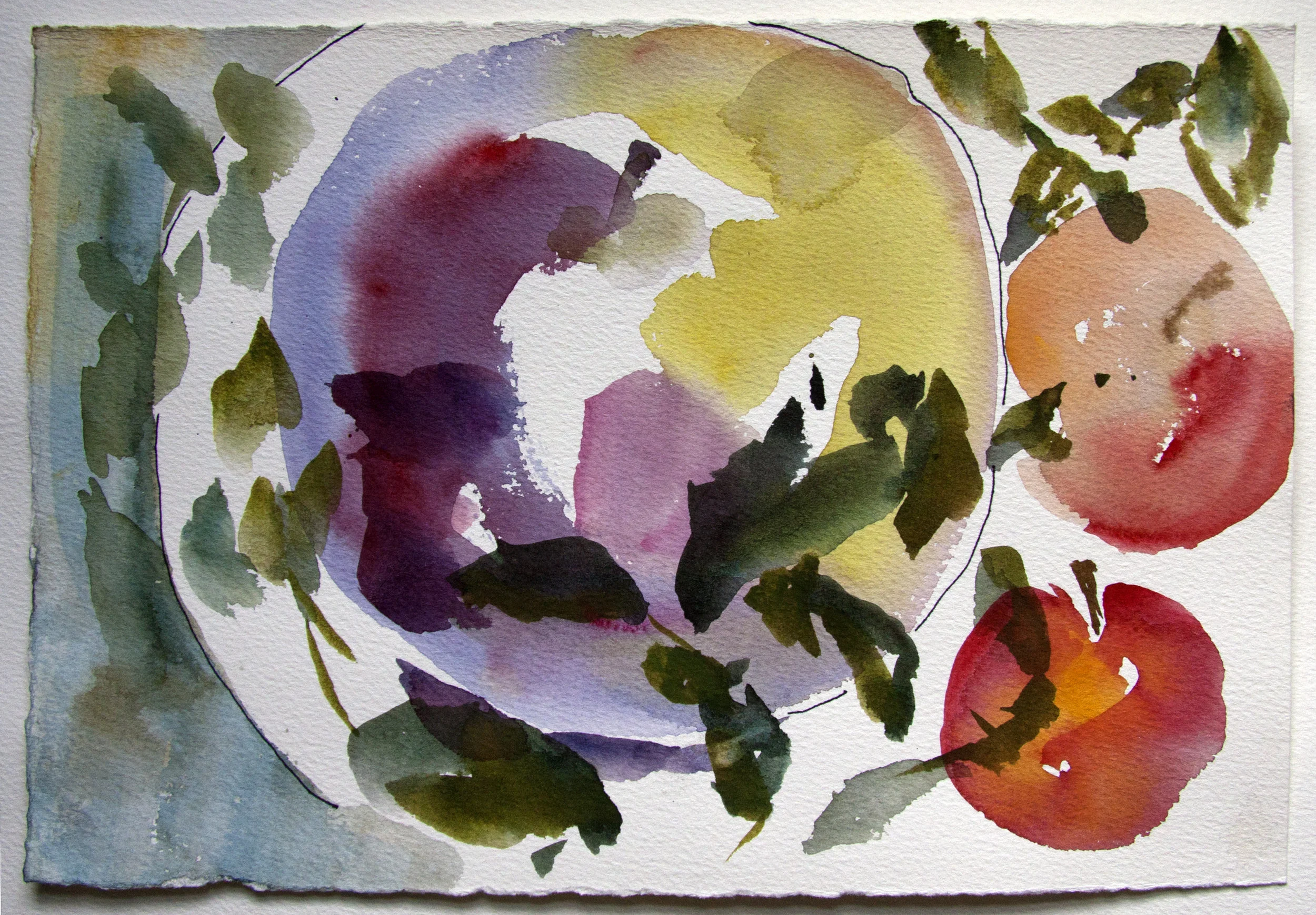
Eve domesticus, Watercolor, Linda Hoffman
Correction: In the blog post After Applepicking I misspelled pomologist, Mike Biltonen's name. His newsletter can be found at http://knowyouroots.com/index.html.
Search Blog
-
2025
- May 9, 2025 A View from the Tractor Seat
- Apr 11, 2025 Dig
-
2024
- Jan 7, 2024 Winter Wassail
-
2022
- Dec 11, 2022 Keeping Time
- Jun 17, 2022 This Apple-Shaped Earth
- Jan 23, 2022 What is a Jizo?
- Jan 16, 2022 An Invite and Housekeeping Update
- Jan 1, 2022 The Year of the Frog: What Orchardists Do While Apple Trees are Chilling
-
2021
- Oct 24, 2021 Figs
- Oct 3, 2021 The Artist and the Orchard: A Memoir
- Aug 8, 2021 Red-Fleshed Apples
- Jul 25, 2021 When We Were Trees
- Jun 27, 2021 Castor Beans—Who Knew?
- Jun 13, 2021 Spring Training at a Zen Monastery
- May 4, 2021 Our Trees are in Bloom
- Apr 18, 2021 Hooray!
- Jan 24, 2021 Wassailing, virtually!
- Jan 1, 2021 Sitting
-
2020
- Dec 21, 2020 Darkness to Light
- Nov 28, 2020 One Heart
- Sep 18, 2020 Juggling Flowers, Fruit, and Vegetables
- Aug 23, 2020 Refuge
- Aug 9, 2020 Bags of Fertilizer
- Aug 2, 2020 The Sermon of the Blue Heron
- Jul 26, 2020 What's the Buzz?
- Jul 19, 2020 Farm Moments
- Jul 12, 2020 Lost Wax
- Jul 5, 2020 Catalpa: The Hugging Tree
- Jun 28, 2020 Pedaling Peace
- Jun 21, 2020 See Change
- Jun 14, 2020 Lalla Unveiled
- Jun 7, 2020 Pond Alchemy
- May 31, 2020 The Birth of Fruit
- May 24, 2020 An Artist in the Orchard
- May 17, 2020 Walking the Land: Returning Home
- May 10, 2020 Stinging Nettles: Gifts from the Great Mother
- May 3, 2020 The Mystery of Swallow
- Apr 26, 2020 Aerial Bruststrokes
- Apr 19, 2020 Simple Pleasures
- Apr 12, 2020 Weeds and Other Gifts
- Apr 5, 2020 Remembering the Seeds
- Mar 29, 2020 Blow on the Embers
- Mar 22, 2020 Ripples
-
2019
- Nov 16, 2019 Tibet Impressions
- Nov 9, 2019 Forest Tales
- Oct 13, 2019 The Gift
- Aug 4, 2019 The Season is Apples, Berries, and Grandfather Fire
- Jun 8, 2019 Pointers for a Writing Life
- May 12, 2019 Mothers of the Earth
- Apr 6, 2019 The Apple-Shaped Earth
- Mar 23, 2019 You Don’t Know What You Have Till It’s Gone
- Feb 23, 2019 Generations
- Feb 9, 2019 What Are We Doing to the Earth, John Chapman?
-
2018
- Dec 31, 2018 Long Shadows
- Oct 6, 2018 A Pilgrimage to India
- Aug 18, 2018 Scrap Wrenn
- Aug 11, 2018 Off-the-Wall Comments from an Ignorant Farmer
- Jul 28, 2018 Creative Connect
- Jul 14, 2018 How is the Orchard?
- Jun 30, 2018 Which Way?
- Jun 16, 2018 Geese, Herons, Beavers, and the Baby Steps of a Lapsed Blogger
- Feb 24, 2018 Mama's Coupons — Good Forever
- Jan 27, 2018 January Ice
- Jan 13, 2018 The Muse
-
2017
- Dec 30, 2017 A Dream for the New Year
- Dec 23, 2017 A New Year for Apples
- Dec 16, 2017 Intuition
- Nov 22, 2017 Thanksgiving OM
- Nov 4, 2017 East Fork Pottery
- Oct 28, 2017 Putting Down New Roots
- Oct 21, 2017 A is for Art
- Oct 14, 2017 Eve domesticus
- Oct 7, 2017 A String Workshop
- Sep 30, 2017 After Applepicking
- Sep 23, 2017 Two Bad Women and One Good Apple
- Sep 16, 2017 Plein Air Poetry
- Sep 9, 2017 Cutting Off a Leg
- Sep 2, 2017 The Changing Landscape
- Aug 26, 2017 All About Art
- Aug 19, 2017 My First Visit to the Farm
- Aug 12, 2017 The First Food
- Aug 5, 2017 A Teapot, a Woman, and maybe a Boat
- Jul 29, 2017 A Raspberry Dilemma
- Jul 22, 2017 Consider the Miracle
- Jul 15, 2017 Meeting Ekphrasis
- Jul 8, 2017 Ripening Fruit
- Jul 1, 2017 The Voice of The Caterpillar
- Jun 24, 2017 Goumi — An Unusual Fructus
- Jun 17, 2017 Concord, an American Bloomsbury
- Jun 10, 2017 The World Is Bonkers — Shall I Laugh or Cry?
- Jun 3, 2017 Bonkers, a Revolutionary Apple
- May 27, 2017 Guardians of the Swamp
- May 20, 2017 There are Mushrooms and There are Morels
- May 13, 2017 "What's in a Name?"
- May 6, 2017 Bloom Follows Pink: Orchard Pollination
- Apr 29, 2017 The Orchard Is at Pink
- Apr 22, 2017 Natural Farming — Part 2 (continuation from last Sunday's blog)
- Apr 15, 2017 Natural Farming — Part 1
- Apr 8, 2017 Boats, Figures, and Catching Fish
- Apr 1, 2017 A Man with a Mission: The Nuts and Bolts of Bronze Casting
- Mar 25, 2017 A Chalice of Spirit, Art, and Nature
- Mar 18, 2017 Hanami — Blossom Viewing
- Mar 11, 2017 Soil Redemption Song
- Mar 4, 2017 Food is Primary Care
- Feb 25, 2017 Pomme de Terre
- Feb 18, 2017 Organic Certification
- Feb 11, 2017 Tantalizing Fruit
- Feb 4, 2017 The Myths of History
- Jan 28, 2017 The Orchard in Winter
- Jan 21, 2017 The Hi-Line
- Jan 14, 2017 Artistic, Botanical, and Social Diversity
- Jan 7, 2017 Where is Eden?
-
2016
- Dec 31, 2016 The Creative Heart
- Dec 24, 2016 A Christmas Tale
- Dec 17, 2016 Who are the Crones?
- Dec 10, 2016 The Olympic Bell (Part Two)
- Dec 3, 2016 Overheard in the Apple Orchard in Early December
- Nov 26, 2016 The Lessons of a Tortoise
- Nov 19, 2016 In the Studio
- Nov 12, 2016 Even in Darkness
- Nov 5, 2016 Southern Apples, an Elephant, Monkey, Rabbit, and Bird, Two Mango Trees and a Birthday
- Oct 29, 2016 The Tools of Art
- Oct 22, 2016 Labyrinths
- Oct 15, 2016 Repairing the Broken
- Oct 8, 2016 When You Are No More
- Oct 1, 2016 Creation Rain
- Sep 24, 2016 Breaking the Glass
- Sep 17, 2016 String Art
- Sep 10, 2016 Poetry and Photosynthesis: It's all in the Leaves
- Sep 3, 2016 In the Plenty of Time
- Aug 27, 2016 Witch Doctors
- Aug 20, 2016 Listen Coyote
- Aug 13, 2016 Milkweed in the Orchard
- Aug 6, 2016 Some People See a Turtle
- Jul 30, 2016 Arborshaping
- Jul 23, 2016 Joseph Wheelwright: Sculptor of Stones and Trees
- Jul 16, 2016 Asian Pears
- Jul 9, 2016 Gold Leaf, Grief, and the Creative Process
- Jul 2, 2016 The Olympic Bell (Part One)
- Jun 25, 2016 Around the Mulberry Bush
- Jun 18, 2016 Avoiding Apples
- Jun 11, 2016 Fructus
- Jun 4, 2016 Astonishing Apples
- May 28, 2016 Scare the Caterpillars
- May 21, 2016 Join the Club!
- May 14, 2016 The Graft
- May 7, 2016 Rooster, Rhubarb, Rue
- Apr 30, 2016 What do Dolphins and Nettles Have in Common?
- Apr 23, 2016 Art Prunings
- Apr 16, 2016 A Few of the First Arrivals
- Apr 9, 2016 Taste the Spirit of Sustainable Agriculture
- Apr 2, 2016 First Orchard Spray - March 22-24, 2016
- Mar 26, 2016 Hawkeye Apple
- Mar 19, 2016 Desiring the Almata Apple
- Mar 12, 2016 Ugly Fruit
- Mar 5, 2016 Winter Tracks
- Feb 27, 2016 Splash
- Feb 20, 2016 Pruning
- Feb 13, 2016 Orchard Ruminants
- Feb 6, 2016 A Gathering of Seeds
- Jan 30, 2016 Orchard Dragons
- Jan 23, 2016 Tree Rings
- Jan 17, 2016 The Fallen Tree
- Jan 7, 2016 Wassailing the Apple Trees
- Jan 1, 2016 The New Year