LINDA HOFFMAN
Walking the Land: Returning Home

This “Man in a Maze” basket by the Akimei O’odham (Pima) people of Arizona is in the Fruitlands Museum collection in Harvard, Massachusetts. Though baskets like this are called, “Man in a Maze,” the design is actually a labyrinth, a teaching tool. Mazes have false turns and dead ends, and the sojourner must often retrace their steps and start over. A labyrinth is a continuous journey, a winding path with no wrong turns, no wrong decisions. The basket’s fine weave expresses stillness and balance, virtues that walking a labyrinth are said to restore.
In 2006, I installed an outdoor labyrinth for Fruitlands Museum inspired by the design of the Pima basket. I remembered this labyrinth while I was writing about our current situation—each of us isolated, walking our individual paths through the pandemic.

Walking the Labyrinth at Fruitlands Museum, 2005
For the Fruitlands’ labyrinth, I used round New England field stones placing them on a flat and grassy hillside. The measured concentric circles follow the contours of the land. Once the installation was completed, I wondered, what should we put in the center? A plant, a flower, a special stone? Nothing felt right, and I left it empty.
A question many people are asking is what the return to normal will look like. Many have discovered a new attentiveness in their daily lives—cooking special recipes, baking bread, taking long walks. And with this attentiveness, gratitude for what we do have naturally arises. The question is will we be able to carry this mindful pace with us as we re-enter the busy marketplace?
When walking a labyrinth, reaching the center is the goal. Perhaps, however, the return is more important. As we walk back out, we have the opportunity to consider what we have noticed along our journey. Quite possibly, we walk back out of the labyrinth with more confidence. We may feel the freedom of not worrying where we are going.
Some of us don’t want to return to normal; for isn’t normal what has polluted our rivers, clearcut our forests, and created social and economic inequality? We aren’t going to change the way international corporations operate—let alone our own government—in a few months, but we can make personal decisions about how we want to walk our labyrinth. Are we walking with attention and with gratitude, or are we hurrying, trying to get somewhere? Are we fully present to the moment of walking? We each have a path to walk, there is no other. We change our lives by what we bring to our walking, and the only thing we truly bring with us is our heartmind.
I see now why it was right to leave the center of the labyrinth at Fruitlands empty. There is a journey, but there is no goal to achieve, no pot of gold, no rainbow, no anything. We may be spiritual beings, but we are on a human path we each have to navigate. Let’s imagine the joy of walking. The labyrinth is no longer at Fruitlands, but I offer you a walk-through Louise Berliner’s poem inspired by it.
Journey
Imagine the wind
Midwife to the basket
Seeds delivered to soil
Subversive act of survival
The seeds take root
Cattail willow devil’s claw
Call to the Pima women
Come gather split soak coil
The basket grows
Tells its story in pattern
Elder Brother in the maze
A journey to the center
The seed becomes artifact
Sold or bartered shipped carried
Arizona story going East
Against the traffic
Imagine the glaciers
Midwives to the landscape
Stones delivered from soil
Subversive act of survival
New England’s best crop
Schist granite fieldstone
Call to the hands of an artist
Come gather map place illuminate
The labyrinth grows
Tells its story in pattern
Any stranger may begin
A journey to the center
Imagine the artist
Midwife to the sculpture
What the hand made
The feet now travel
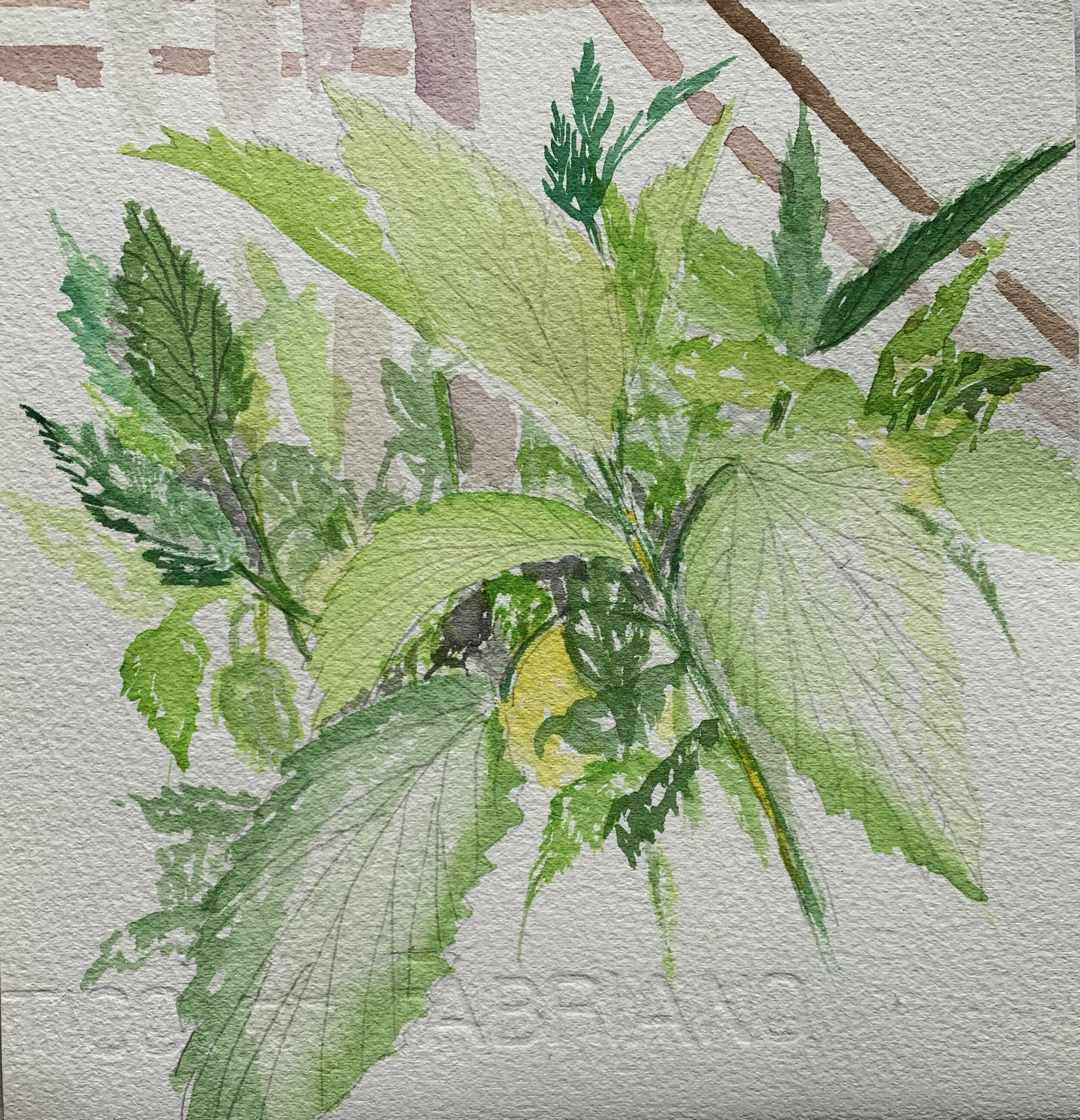
Stinging Nettles: Gifts from the Great Mother

LH, photo: Ariel Matisse
Squatting in a patch of stinging nettles with my foraging basket, and rubber gloves, I was snipping young stalks to sauté for dinner. Some people react with alarm when I mention eating stinging nettles, but the truth is nettles are beloved by wild foragers and herbalists. Mother Earth offers this gift packed with vitamins, minerals, and protein. Richio Cech in his book, Making Plant Medicine, summarizes the uses of nettles: “Practical Uses: Legion.” The Greeks and Romans cultivated fields of nettles more than any other crop.
Nettles sting because they have hairs on the stems and undersides of leaves that break off when touched, exposing the tiniest sharp needles that pierce the skin and inject a toxin that causes a burning rash. Fierce protection! For nettles are so nutritious, animals would devour them before they grew large enough to flower and bear seeds, the driving force in a plant’s life.
An old adage says, “When in doubt, use nettles!” Their beneficial uses include: a natural detoxifier, an anti-inflammatory, a treatment for gout, anemia, joint pain, diabetes, hay fever, urinary tract issues, and prostate issues. Flogging with stinging nettles for arthritis, joint pain, and to increase blood circulation is the one recommendation I am nervous about trying. But when I am without energy and need a dose of friendliness, I reach for the jar of dry nettles and make a cup of tea. It’s magical how this plant restores my balance.
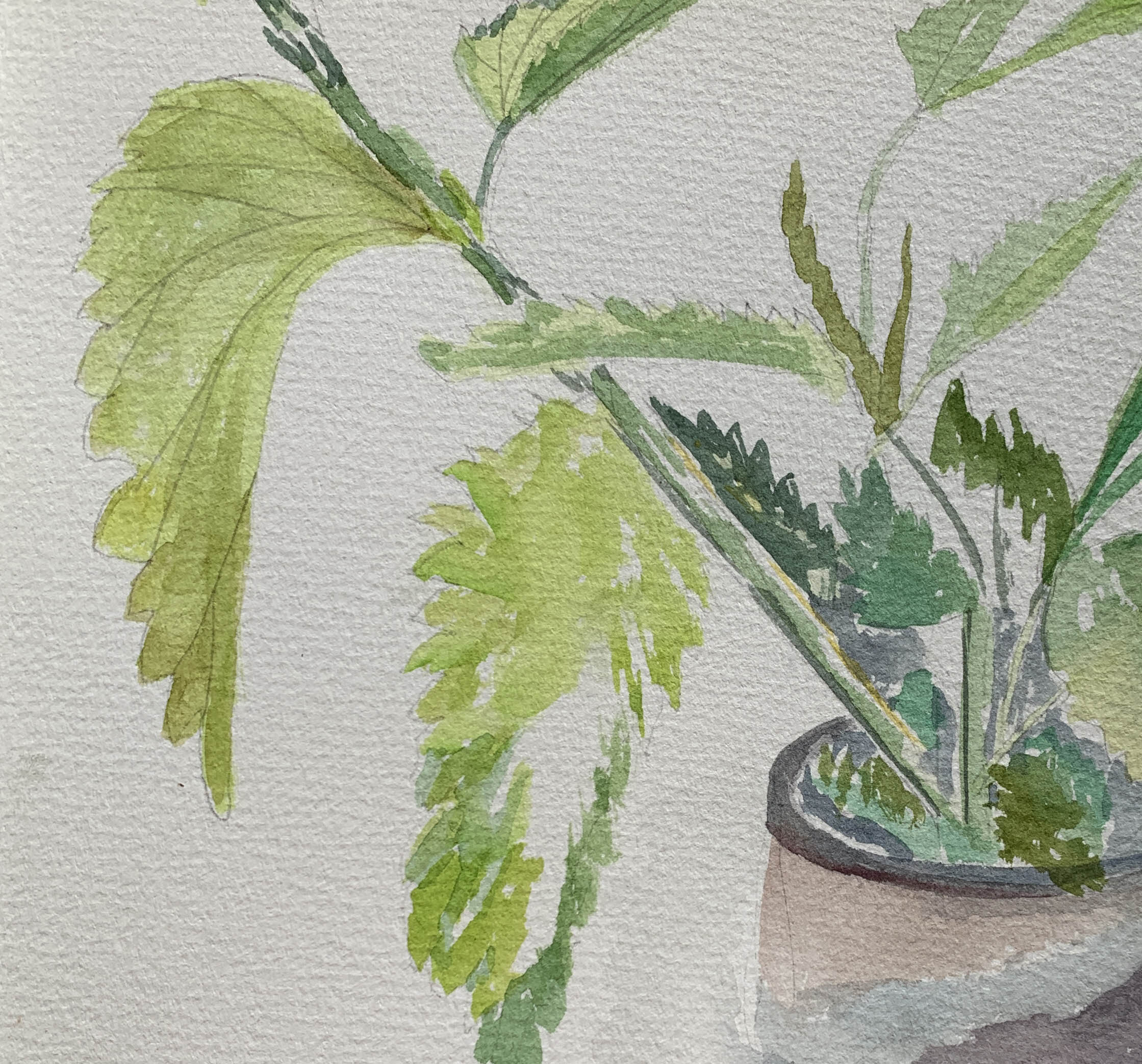
Arrangement with Nettles, watercolor, LH 2020
And, of course, what’s good for me is good for the orchard. Part of being a good orchardist is learning how to take care of the trees with kindness. In late spring, when I want to boost the trees’ immune systems and help provide an extra boost of minerals, I turn towards nettles. When the plants are about eighteen inches tall, I cut a wheelbarrow-full, enough to fill a 50-gallon barrel. Then I add water and let the nettles sit for a few days. Sometimes, I add comfrey leaves for added minerals, horsetail for its silica, and garlicscapes, if I feel the trees need insect protection. After a few hot days, I drain out the liquid and fill my 300-gallon sprayer. The gooey remains of the nettle plants go onto the compost pile, and I set out for my tractor tour of the orchard pulling the airblast sprayer with its peacock’s tail of spray fanning out to touch every leaf.
Nettles reduce heavy metals in soils, in fact I remember hearing that if you plant a rusty agricultural tool, it will attract nettles to grow there. Mostly I find nettles pop up where they choose. At the farm, they don’t seem to care whether it’s a dry berm in full sun, against the peeling paint of the old chicken coop, or in the dappled light of the streambed. When Nettles have finished what they came to do, they pack up and move on. Wild plants are like that.
Now is the season to gather and cook young nettles (they will regrow for fall harvesting.) Try steaming them and adding a little lemon juice and olive oil, and some parmesan or other favorite cheese. Or sauté them with onions or shallots, add some garlic powder, and a bit of cream. For nettle pesto, most people suggest you boil the nettles and dry them with a towel. Then fill your food processor with the nettles, walnuts, pecans or other nut, lemon juice, salt, a couple of peeled garlic cloves, and some hard cheese like asiago or parmesan. Once it becomes the consistency of a paste dribble in olive oil till it is smooth and the consistency you’d like. If you make a lot, freeze some for the middle of next winter to serve over fresh linguine and bring spring back into your life. Don’t be alarmed: nettle pesto is iridescent green.
In midsummer, I cut some of the tall nettles, tie them bundles, and hang them in my studio. Once they are dry, I take a cardboard box or large paper bag, and with gloves on, run my hands along the stem to remove the leaves. The dry leaves can be stored whole, but I put them all through the food processor and store them in a couple of gallon jars. We sell small packs of dried nettles at the farm stand along with bags of freshly picked.
Out of the soil of friendliness grows the beautiful bloom of compassion,
Watered by the tears of joy,
Sheltered beneath the cool shade of the tree of equanimity.
—Longchenpa, 14th century Tibetan Buddhist teacher
Nettles are a curious teacher. They sting! But when we appreciate them, we receive nothing but gifts.
Happy Mother’s Day!

Nettle Bouquet, watercolor and pencil, LH 2020
The Mystery of Swallow

Sky above the Medicine Wheel at Old Frog Pond Farm, Night Photo: Robert Hesse
While in our individual quarantines we hear of mysteries revealed across the globe: In India, people can see the glow of the high Himalayas, fish are swimming again in the dank Venice canals, and above in the night sky, the stars in the milky way glow more brightly. Closer to home, I study tree swallows.
I’ve been watching an iridescent pair who have taken up residence outside my studio window. They perch on the top of a pine nesting box, one of a dozen my husband, Blase, built from scraps in his woodshop. I have yet to see either bird enter the box to lay eggs. Swallows, like most song birds, don’t lay all their clutch at once. The effort is too much; they lay only one egg a day. During this time of egg laying, the parents don’t immediately start incubating, but wait until the clutch is complete. Of course, I thought, how does she know when that last egg is laid? Maybe the way an artist knows when a painting is finished. It’s intuitive, there’s a satisfaction, a completeness. There’s a whisper, it’s done, it’s out of your hands. Release it, and trust.
This swallow pair must be waiting for the last of the eggs to be laid before they start nesting. They sit throughout the day, though occasionally one will fly, leaving the other alone. Rarely, do they both leave.
I have resisted peeking inside the box to see the eggs, I can only assume the eggs are accumulating. Once incubation begins, the parents will take turns sitting on the eggs for a week. Once born, the babies will remain in the nest for 18 to 23 days. Then, they must develop into expert flyers. For their migration from North America to South America will begin in the fall and will travel 200 miles a day at speeds from 17 to 22 miles per hour. However, storms, exhaustion, and starvation are challenges they will face, and it is estimated that only half will survive the journey.
To my surprise, both swallows suddenly take off. I watch for their return when a bluebird lands on their box, perky, though a little uncertain, making me think it is perhaps its first spring to find a partner and mate. The swallows immediately return, flustered at the sight of this interloper. What to do? Cautiously they fly toward the bluebird, wings shaking, approaching, but not getting too close. I think, why aren’t they dive bombing it? They need to protect their nest. The swallows dare to come a little closer, but the bluebird just twitches. The swallows fly out and back, and out and back, but never touch the bluebird. They don’t seem to be aggressive by nature, but they know they have to do something. Meanwhile, the bluebird doesn’t seem to realize it has landed on a box that belongs to others, or it is simply feigning innocence.
I watch more of their wing wagging, and think, this couple is completely ineffective, ridiculously so. Then, amidst more flutters of feathers, the bluebird departs. The swallow couple land on the top of the box, nudge close to each other, feathers touching, sharing the experience they have survived together. Whew! That was difficult! We best just sit here for a while.
Such mysteries of nature belong to us for we belong to nature; we are part of it. How could we be other? We’re made of the same molecules of water, air, and earth’s minerals. When I become demoralized by the problems on the planet, the greed I witness, the suffering brought on by this new pandemic, I remember that I am this earth, not separate from it. I am this morning’s melancholic rain making circles on the pond. I am the swallows anxious flutterings. Argentina may be 10,000 miles away, but the swallows will connect us. They connect me to you. Isn’t that amazing?

First Swallow, LH
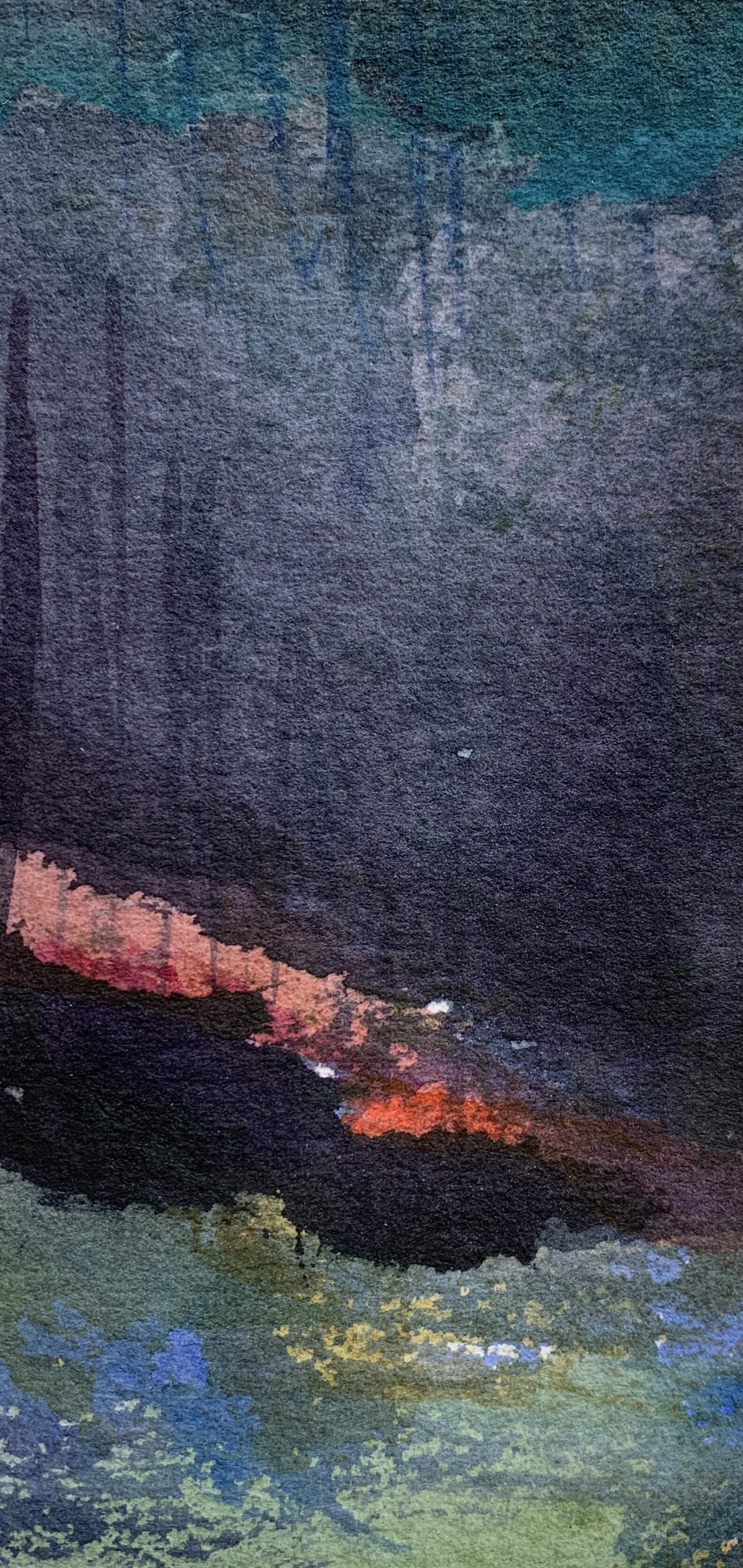
Aerial Bruststrokes
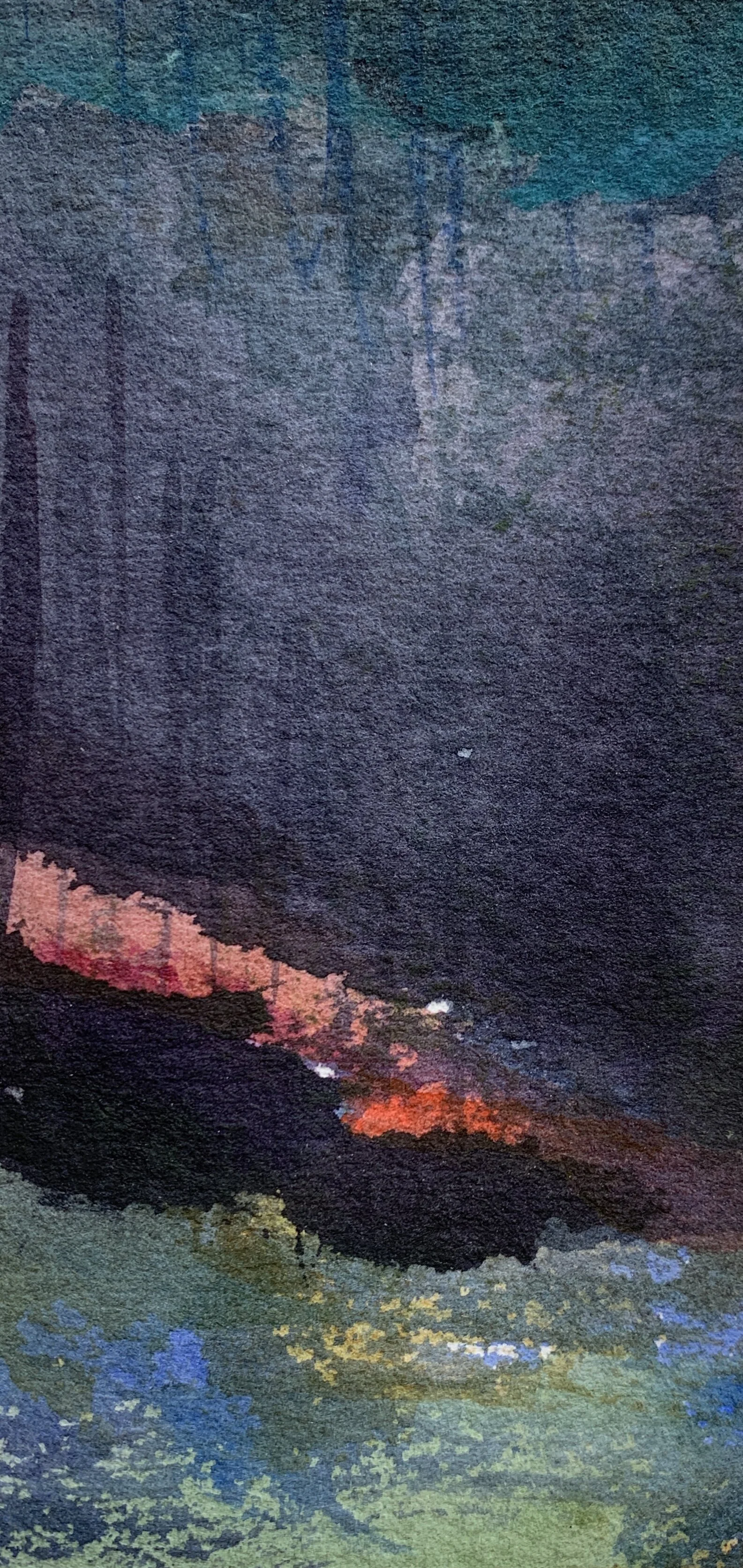
Rain, watercolor, LH
Yet another cold, rainy morning and I sit at my studio window watching tree swallows circle and loop, skim the water, and splash. They could be practicing touch-and-goes as if taking part in some aviation exhibition, but I prefer seeing them as painters dipping their brushes to color the pond and trees.
I first met swallows soon after I met Blase, my husband. We were sitting on the front step of the farmhouse and I asked, “If you were to be reincarnated as an animal, what would it be?”
Blase didn’t pause for very long before he said, “A swallow.”
“A swallow? Why?”
Blase has a deep voice that resonates in his broad chest. He played football during high school and college. He’s physical and strong, so I imagined he would say, a lion, or some impressive creature.
Blase answered my bewildered look, “Because they are so playful.”
I didn't know a swallow from a wren but took in his comment as something significant.
Then he turned to me and asked what animal I would choose.
I replied, “Maybe a lion.” I needed to be strong and able to fight for what I needed not only for myself but for my pride of three children.
I have completely come around to Blase’s point of view. For the swallows, regardless of the lack of warmth and sunshine, do their thing, eat insects, and dazzle us ground walkers. The secret of the swallows’ contentment seems to be their willingness to fly in any weather, to be a complete expression of joy no matter the circumstances. I know how hard that is to do, especially when strong emotions come up, especially when the suffering and grief I feel increases with every bit of news from around the globe.
Navigating the currents of difficulties that arise is our daily practice. The storms will never disappear, but we learn to be better fliers. Like the swallows, we practice our take-offs and landings, until one sunny day, involuntarily we grab a brush, paint the pond pink, the trees purple, and the sky an emerald green, even when it is raining.
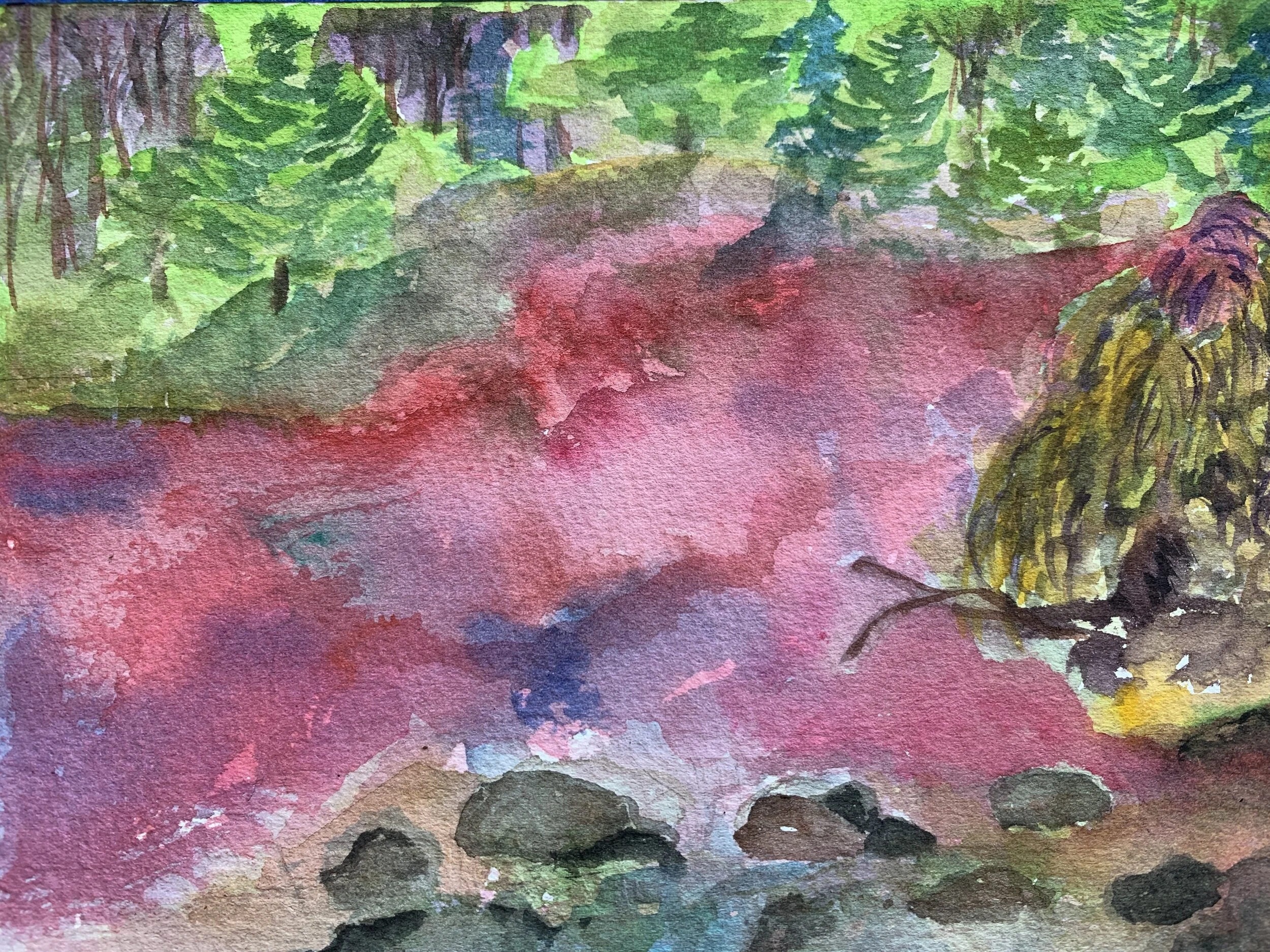
Pink Pond, watercolor, LH
Search Blog
-
2025
- May 9, 2025 A View from the Tractor Seat
- Apr 11, 2025 Dig
-
2024
- Jan 7, 2024 Winter Wassail
-
2022
- Dec 11, 2022 Keeping Time
- Jun 17, 2022 This Apple-Shaped Earth
- Jan 23, 2022 What is a Jizo?
- Jan 16, 2022 An Invite and Housekeeping Update
- Jan 1, 2022 The Year of the Frog: What Orchardists Do While Apple Trees are Chilling
-
2021
- Oct 24, 2021 Figs
- Oct 3, 2021 The Artist and the Orchard: A Memoir
- Aug 8, 2021 Red-Fleshed Apples
- Jul 25, 2021 When We Were Trees
- Jun 27, 2021 Castor Beans—Who Knew?
- Jun 13, 2021 Spring Training at a Zen Monastery
- May 4, 2021 Our Trees are in Bloom
- Apr 18, 2021 Hooray!
- Jan 24, 2021 Wassailing, virtually!
- Jan 1, 2021 Sitting
-
2020
- Dec 21, 2020 Darkness to Light
- Nov 28, 2020 One Heart
- Sep 18, 2020 Juggling Flowers, Fruit, and Vegetables
- Aug 23, 2020 Refuge
- Aug 9, 2020 Bags of Fertilizer
- Aug 2, 2020 The Sermon of the Blue Heron
- Jul 26, 2020 What's the Buzz?
- Jul 19, 2020 Farm Moments
- Jul 12, 2020 Lost Wax
- Jul 5, 2020 Catalpa: The Hugging Tree
- Jun 28, 2020 Pedaling Peace
- Jun 21, 2020 See Change
- Jun 14, 2020 Lalla Unveiled
- Jun 7, 2020 Pond Alchemy
- May 31, 2020 The Birth of Fruit
- May 24, 2020 An Artist in the Orchard
- May 17, 2020 Walking the Land: Returning Home
- May 10, 2020 Stinging Nettles: Gifts from the Great Mother
- May 3, 2020 The Mystery of Swallow
- Apr 26, 2020 Aerial Bruststrokes
- Apr 19, 2020 Simple Pleasures
- Apr 12, 2020 Weeds and Other Gifts
- Apr 5, 2020 Remembering the Seeds
- Mar 29, 2020 Blow on the Embers
- Mar 22, 2020 Ripples
-
2019
- Nov 16, 2019 Tibet Impressions
- Nov 9, 2019 Forest Tales
- Oct 13, 2019 The Gift
- Aug 4, 2019 The Season is Apples, Berries, and Grandfather Fire
- Jun 8, 2019 Pointers for a Writing Life
- May 12, 2019 Mothers of the Earth
- Apr 6, 2019 The Apple-Shaped Earth
- Mar 23, 2019 You Don’t Know What You Have Till It’s Gone
- Feb 23, 2019 Generations
- Feb 9, 2019 What Are We Doing to the Earth, John Chapman?
-
2018
- Dec 31, 2018 Long Shadows
- Oct 6, 2018 A Pilgrimage to India
- Aug 18, 2018 Scrap Wrenn
- Aug 11, 2018 Off-the-Wall Comments from an Ignorant Farmer
- Jul 28, 2018 Creative Connect
- Jul 14, 2018 How is the Orchard?
- Jun 30, 2018 Which Way?
- Jun 16, 2018 Geese, Herons, Beavers, and the Baby Steps of a Lapsed Blogger
- Feb 24, 2018 Mama's Coupons — Good Forever
- Jan 27, 2018 January Ice
- Jan 13, 2018 The Muse
-
2017
- Dec 30, 2017 A Dream for the New Year
- Dec 23, 2017 A New Year for Apples
- Dec 16, 2017 Intuition
- Nov 22, 2017 Thanksgiving OM
- Nov 4, 2017 East Fork Pottery
- Oct 28, 2017 Putting Down New Roots
- Oct 21, 2017 A is for Art
- Oct 14, 2017 Eve domesticus
- Oct 7, 2017 A String Workshop
- Sep 30, 2017 After Applepicking
- Sep 23, 2017 Two Bad Women and One Good Apple
- Sep 16, 2017 Plein Air Poetry
- Sep 9, 2017 Cutting Off a Leg
- Sep 2, 2017 The Changing Landscape
- Aug 26, 2017 All About Art
- Aug 19, 2017 My First Visit to the Farm
- Aug 12, 2017 The First Food
- Aug 5, 2017 A Teapot, a Woman, and maybe a Boat
- Jul 29, 2017 A Raspberry Dilemma
- Jul 22, 2017 Consider the Miracle
- Jul 15, 2017 Meeting Ekphrasis
- Jul 8, 2017 Ripening Fruit
- Jul 1, 2017 The Voice of The Caterpillar
- Jun 24, 2017 Goumi — An Unusual Fructus
- Jun 17, 2017 Concord, an American Bloomsbury
- Jun 10, 2017 The World Is Bonkers — Shall I Laugh or Cry?
- Jun 3, 2017 Bonkers, a Revolutionary Apple
- May 27, 2017 Guardians of the Swamp
- May 20, 2017 There are Mushrooms and There are Morels
- May 13, 2017 "What's in a Name?"
- May 6, 2017 Bloom Follows Pink: Orchard Pollination
- Apr 29, 2017 The Orchard Is at Pink
- Apr 22, 2017 Natural Farming — Part 2 (continuation from last Sunday's blog)
- Apr 15, 2017 Natural Farming — Part 1
- Apr 8, 2017 Boats, Figures, and Catching Fish
- Apr 1, 2017 A Man with a Mission: The Nuts and Bolts of Bronze Casting
- Mar 25, 2017 A Chalice of Spirit, Art, and Nature
- Mar 18, 2017 Hanami — Blossom Viewing
- Mar 11, 2017 Soil Redemption Song
- Mar 4, 2017 Food is Primary Care
- Feb 25, 2017 Pomme de Terre
- Feb 18, 2017 Organic Certification
- Feb 11, 2017 Tantalizing Fruit
- Feb 4, 2017 The Myths of History
- Jan 28, 2017 The Orchard in Winter
- Jan 21, 2017 The Hi-Line
- Jan 14, 2017 Artistic, Botanical, and Social Diversity
- Jan 7, 2017 Where is Eden?
-
2016
- Dec 31, 2016 The Creative Heart
- Dec 24, 2016 A Christmas Tale
- Dec 17, 2016 Who are the Crones?
- Dec 10, 2016 The Olympic Bell (Part Two)
- Dec 3, 2016 Overheard in the Apple Orchard in Early December
- Nov 26, 2016 The Lessons of a Tortoise
- Nov 19, 2016 In the Studio
- Nov 12, 2016 Even in Darkness
- Nov 5, 2016 Southern Apples, an Elephant, Monkey, Rabbit, and Bird, Two Mango Trees and a Birthday
- Oct 29, 2016 The Tools of Art
- Oct 22, 2016 Labyrinths
- Oct 15, 2016 Repairing the Broken
- Oct 8, 2016 When You Are No More
- Oct 1, 2016 Creation Rain
- Sep 24, 2016 Breaking the Glass
- Sep 17, 2016 String Art
- Sep 10, 2016 Poetry and Photosynthesis: It's all in the Leaves
- Sep 3, 2016 In the Plenty of Time
- Aug 27, 2016 Witch Doctors
- Aug 20, 2016 Listen Coyote
- Aug 13, 2016 Milkweed in the Orchard
- Aug 6, 2016 Some People See a Turtle
- Jul 30, 2016 Arborshaping
- Jul 23, 2016 Joseph Wheelwright: Sculptor of Stones and Trees
- Jul 16, 2016 Asian Pears
- Jul 9, 2016 Gold Leaf, Grief, and the Creative Process
- Jul 2, 2016 The Olympic Bell (Part One)
- Jun 25, 2016 Around the Mulberry Bush
- Jun 18, 2016 Avoiding Apples
- Jun 11, 2016 Fructus
- Jun 4, 2016 Astonishing Apples
- May 28, 2016 Scare the Caterpillars
- May 21, 2016 Join the Club!
- May 14, 2016 The Graft
- May 7, 2016 Rooster, Rhubarb, Rue
- Apr 30, 2016 What do Dolphins and Nettles Have in Common?
- Apr 23, 2016 Art Prunings
- Apr 16, 2016 A Few of the First Arrivals
- Apr 9, 2016 Taste the Spirit of Sustainable Agriculture
- Apr 2, 2016 First Orchard Spray - March 22-24, 2016
- Mar 26, 2016 Hawkeye Apple
- Mar 19, 2016 Desiring the Almata Apple
- Mar 12, 2016 Ugly Fruit
- Mar 5, 2016 Winter Tracks
- Feb 27, 2016 Splash
- Feb 20, 2016 Pruning
- Feb 13, 2016 Orchard Ruminants
- Feb 6, 2016 A Gathering of Seeds
- Jan 30, 2016 Orchard Dragons
- Jan 23, 2016 Tree Rings
- Jan 17, 2016 The Fallen Tree
- Jan 7, 2016 Wassailing the Apple Trees
- Jan 1, 2016 The New Year