LINDA HOFFMAN
Castor Beans—Who Knew?
Last fall I saved some seeds in a plastic container in our mud room and promptly forgot about them. A week ago, I remembered. I soaked the seeds for two days before planting them in a large clay pot to see if they would germinate. Then I placed the pot on the porch where I would see them and be sure to remember to give them water twice a day. I didn’t want the sprouting beans to dry out. When I returned later that afternoon to water, the pot was gone. That seemed odd. Where did it go?
For the last few years, we’ve grown a singular plant in the garden outside our kitchen door. It’s odd looking, and almost always unfamiliar to visitors to the farm.
“What’s that growing?” we are asked.
“It’s a castor bean plant, Ricinus Communis.”
While it can grow as a perennial tree in temperate climates, here in New England, we grow it outdoors in a sunny spot as an annual. This red-leafed variety grows quickly, in one season easily touching eight feet, and it isn’t finicky about its soil. The plant has very large leaves—you wouldn’t be wrong to think a child-sized umbrella—shaped like a giant Japanese maple leaf with deep lobes. We have been buying one plant each spring from Applefield Farm in Stow each year.
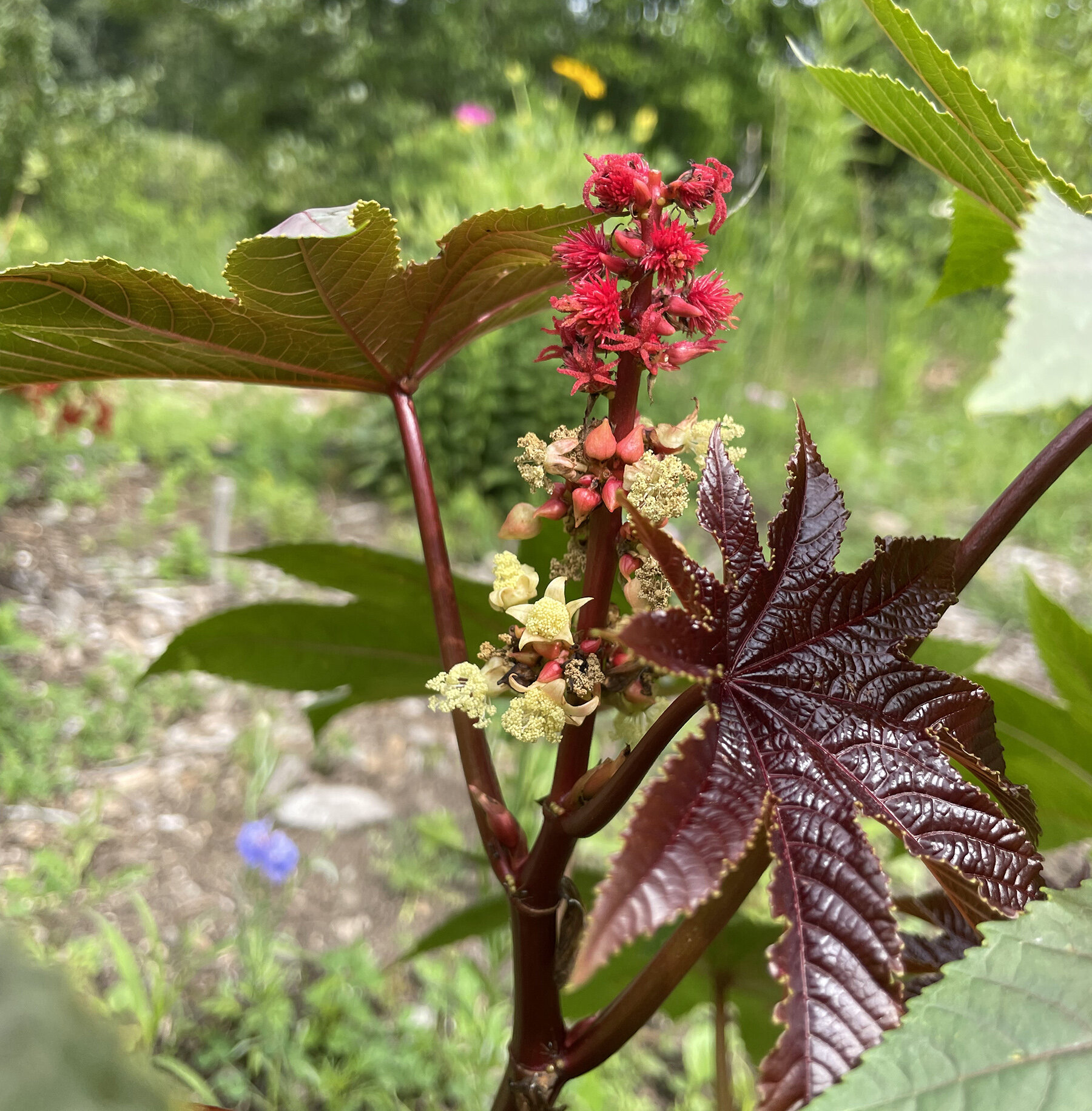
Young Castor Bean Plant with flowers and small seed pods.
The small clusters of pale flowers are barely noticeable, though they have a sweet scent. It’s the seed pods that attract attention. Red clusters of spiky balls, a little smaller than horse chestnuts, vie for room along thick stalks. Then, once the pod dries and the seeds within are mature, the pod splits open, and literarily shoots forth its smooth, oval-shaped, brown-red seeds. I can only guess that since it is self-sowing, the plant doesn’t want too much competition at its roots from its own offspring. And with the seeds protected in their spiky pods, birds aren’t helpful with dispersal. And then, there’s the poison, which I’ll get to soon. But first, let’s solve the mystery of the disappearing pot.
When I saw Blase I asked, “Did you move my pot of castor beans?”
“Oh, I planted a cutting from the Fiddle-leaf Fig in that pot,” he said.
Blase had seen the pot sitting in the corner of the porch, and in need of a pot, he took it, plunging the fig cutting into the center, and setting it on the plant bench in the sun room. He had no way of knowing it was filled with castor beans.
A week later, the castor bean seeds began to germinate. Thick pink bean stalks poked out from the now white lima-bean-size seeds. I dug the seedlings out from around the fig and planted them in individual pots.
And what about the poison? Well, yes. The plant is considered poisonous because the seeds contain ricin, a serious toxin, especially when injected into the body. Eating enough raw seeds will also make you ill with diarrhea and vomiting. The gritty facts about how it is used as a poison can be found here. Earlier this year a man who worked for a biotech company in Massachusetts was arrested for buying 800 castor beans with the intention of extracting the poison. I didn’t know anything about the dark side of castor beans before writing this blog.
And what about the oil? The oil is not poisonous. It is most often sold as a laxative, but it has lots of other uses: lamp oil, soap, candles, plastics, linoleum, paints, inks, ointments and coolants. The seeds contain close to fifty percent of their weight in oil. When I was waiting for the birth of my second child, my midwife told me she was going away so I needed to get this birth moving. She suggested castor oil. It was disgusting. And I don’t think my teaspoonful had any bearing on Nick’s precipitous arrival a day later.
I did learn that in ancient Egypt castor oil was often used for lamps as well as medicinally. Castor bean seeds have been found inside tombs. I can imagine the seeds were buried to keep the lamps lit while the dried apples strung inside the tomb provided food for the deceased’s journey home. I have lots of castor bean plants growing on our side porch. If they do well, I’ll put them out at the farm stand and you too can pick up one of these show-stopping annuals.

Spring Training at a Zen Monastery
Before spring slides into summer, I wanted to share about the last three months which will also explain why there have been so few blog posts. I’ve been on an intense retreat—some of it quarantined in my studio, some of it at Zen Mountain Monastery in the New York Catskills, and some of it, following the spring Old Frog Pond Farm schedule.
I was asked by my Zen teacher to serve as Shuso, or Chief Disciple for the three-month training period, we call Ango. The training period, Ango, dates back to the time of the Buddha. In his time, the year was broken down into three-month periods much like our four seasons. There were two seasons of intensified practice when the community of monks, the Sangha, gathered and practiced together. These periods coincided with the monsoon rains, when it would have been dangerous and difficult for the monks to be wandering the countryside. Instead, they gathered in groves and set up temporary living huts, practicing together and living near their teacher. These intensified three-month periods, called Ango, alternated with the seasons when the Sangha would disperse, going off in the own directions, to beg for food, find shelter, and spend the time in solitary practice.
At Zen Mountain Monastery we practice Ango in the spring and the fall. The Shuso, or chief disciple is chosen by their teacher, and they can be either a lay person or a monk. Their role is to inspire the Sangha with their devotion and commitment to practice. The training period ends with a ceremony where the chief disciple gives their first talk on koan and is then challenged by the Sangha with live questions.

At the end of May, my time as Shuso ended with a talk on the koan, “Dongshan’s Essential Way.” Dongshan was a 9th century Chinese Zen master. The koan is a brief teaching dialogue between a student and their teacher. This koan begins with the student saying, “I cannot see the essential path; I still can’t become free of discriminating consciousness.”
What is this essential path? The student can’t see her way. Is it hidden? Who is hiding it? What is hiding it? And why is this student asking the question right now. Today?
I gave my talk on the last Sunday in May. It was followed by questions from other students, and then congratulatory poems. The ceremony marked the completion of my transition to become a senior student in the order, and the opportunity to now take on a more important role within the Sangha.
Many of you know how much I love Zen practice and specifically, training at Zen Mountain Monastery. A full matrix of activities shape our training: zazen (meditation), liturgy, body practice, art practice, work practice, study of the teachings, and face-to-face encounters with our teacher. Most importantly, it is following the rigorous monastic schedule, putting aside one’s own desires, and joining the community. It is said that being in community is like being in a rock tumbler. We need each other to bump up against, to be polished. However, to put it most simply, Zen training is the study of reality as it really is when we are not confused, when our mind is not obscured by attachments and clinging to that which is not real. We aspire through our practice to move among grasses of this world with equanimity and compassion, to be fully present, to do good and not cause harm.
I haven’t felt that I could write about this rite of passage until it was over. There were moments when I knew for certain my teacher had made a grave mistake. I could not do this. But I also knew there was no way out. Of course I was going to do what I was asked to do. I was going to give it everything I could. And the Sangha was there with their love and their support.
Now that I’ve a little time back home, and have hung up my new white robe and am wearing jeans, t-shirt and work boots, I wanted to share with those of you are curious a little about this rite of passage in the Zen training world. And here is a podcast posted where you can listen to the ceremony or find it on the Zen Mountain Monastery website. If any of you want to talk to me about my experience or about Zen Mountain Monastery, I love talking about it. And if you’d like to join us for morning meditation at the farm, drop me an email and I’ll let you know the details.
I look forward to reconnecting with many of you in person. We’re preparing the grounds for our 15th Annual Outdoor Sculpture Exhibit opening on August 1 with twenty-five sculptors bringing new work on the theme of “Emergence.” We’ve scheduled storytelling events with Fugitive Productions, and Plein Air Poetry returns also on the theme of “Emergence.” The fruit is ripening. It looks like mother nature is providing a bountiful and beautiful crop, and our farmers are working hard to encourage its health and growth.
The verse that accompanied the koan is on the verse board below:
Wet with morning dew
The tips of the ten thousand grasses
All contain the light of day.
Enjoy these last days of spring!
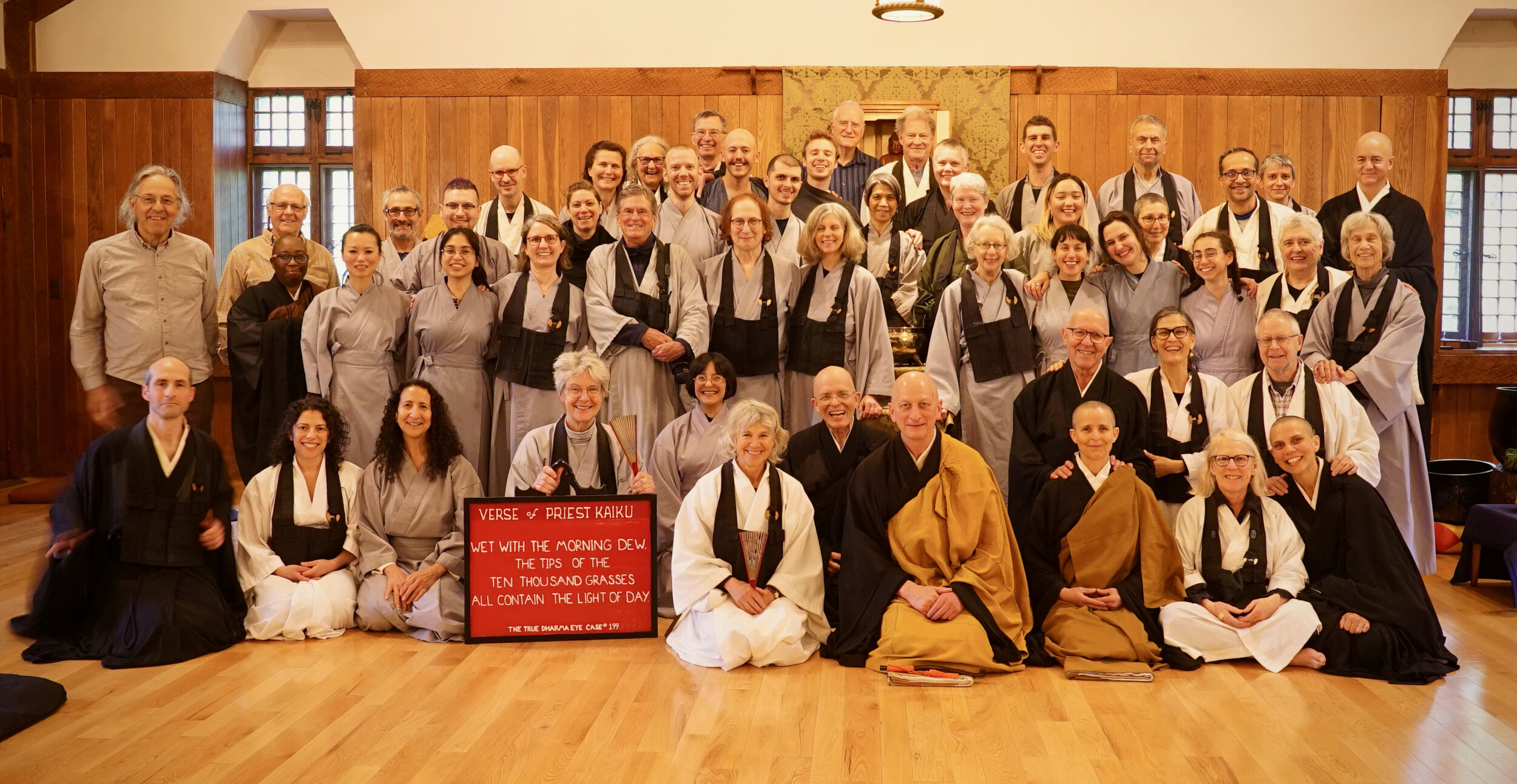
Group Photo after the Ceremony
Our Trees are in Bloom
As an apple orchardist I pay attention to the buds. Will they be strong? Are they healthy? How will I take care of them, because I know—left alone, an orchard in New England will become a massive tangle of brambles, invasive vines, and diseased fruit.
We’ve already sprayed the apple trees with fish fertilizer, seaweed, a little copper, and two different biological fungicides to make sure our buds are protected from the spring diseases. Microscopic fungal spores will rise from the soil beneath the tree in a light rain and land on the leaves. There they find purchase and grow. Once the fruit develops, the fungus jumps to the fruit, ultimately making scab-like forms covering over the developing fruit. Once infection begins, it’s hard to reverse. Spores are released over the four-to-six-week period until we reach 100% release.
Every year I have to be prepared for scab, the nickname orchardists use for the fungus, Venturia inaequalis, one of the early apple diseases and one of the worst problems for organic orchardists in New England. I remember when I first learned to spray. Suited up in protective gear, spray tank filled with 300 gallons of water and the spray materials, the tractor settings in low speed, 3rd gear, at 1700 rpms, I was told that the spray for scab needed to renewed before every wetting period. It seemed an overwhelming proposition. If it rained one day, and then four days later, I needed to spray again because the material would have washed off the trees.
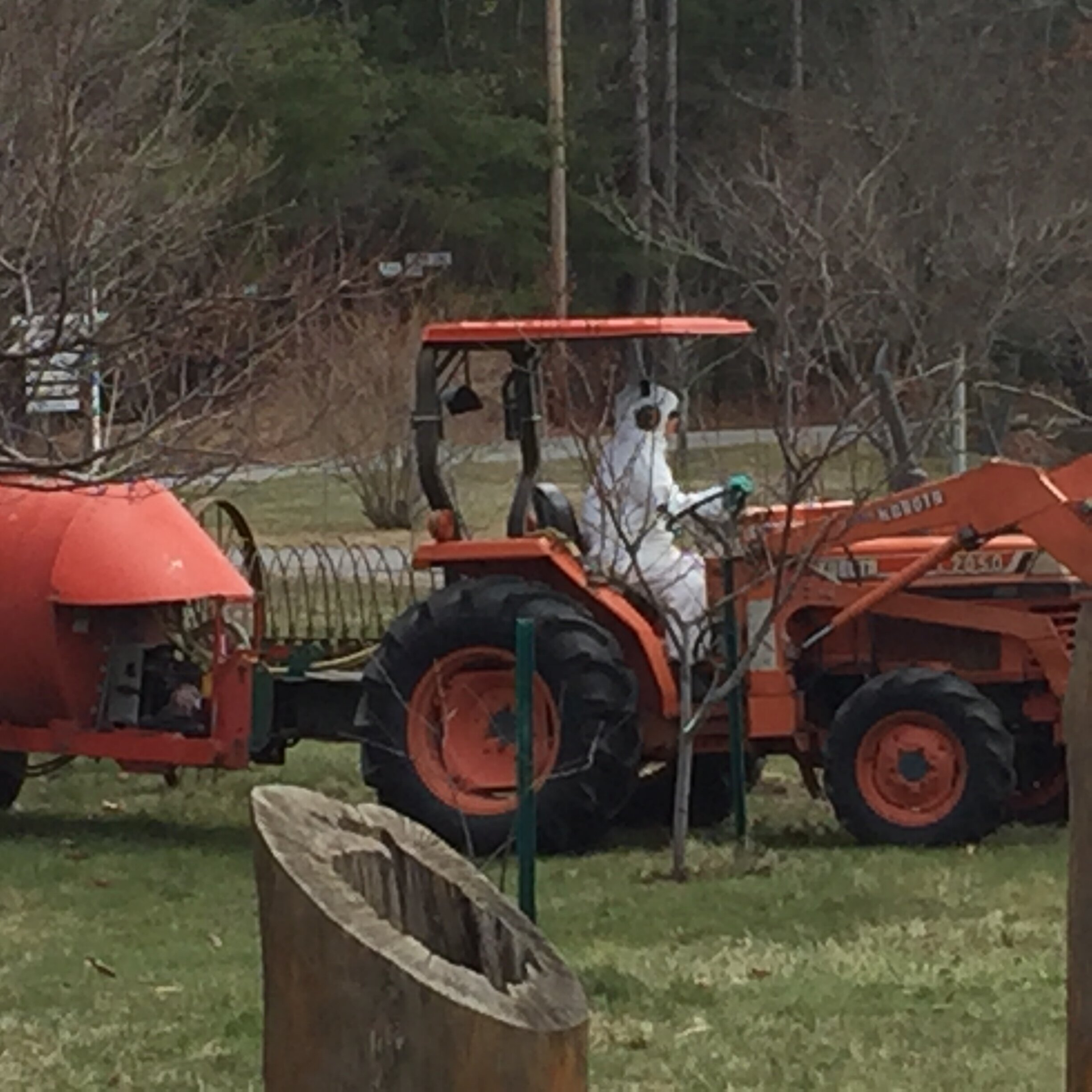
First Spray
Since that time, I’ve learned to time our sprays to most effective for the maximum spore release. I’ve planted many new scab-resistant varieties in our orchard, and removed some of the scab magnet trees like Macintosh. And since 2006 when Old Frog Pond Farm received organic certification, new bio-fungicides are available for organic orchards.
Orchardists have their own language to describe the stages from bud to blossom. Dormant describes the trees in winter, when the buds are gray-brown and tightly closed. They wait for the right combination of temperature and length of daylight to awaken. The outer sheath on the bud is a winter quilt protecting the folded blossom inside. When the apple bud breaks dormancy, the covering of the fruit bud opens slightly to reveal light gray tissue, silver tip.
Then comes green tip. The buds plump in response to warmth and light. The bud opens further to reveal a green plant tissue. The next stage, half-inch green or mouse ears, is an apt description as two tiny oblong-shaped leaves appear. Tight cluster follows with a rosette of green leaves around a tightly packed flower bud. Pink stage is next, as this singular flower bud separates into five or six individual pink-sheathed blossom buds.

This is the most exciting moment in the orchard, for each of these flower buds, if pollinated, will become an apple. In the center the king blossom opens first. It’s the strongest and largest bud. The others follow; reserves for the tree in case something happens to the King. Full bloom is when all blossoms are open. Pollinators arrive from far and wide to drink sweet apple nectar and unknowingly pollinate the trees.
Our trees are in full bloom, and I won’t spray again until the petals fall. Bloom is the time when I walk through the orchard rows and feel overwhelming gratitude to be part of such fragile beauty.
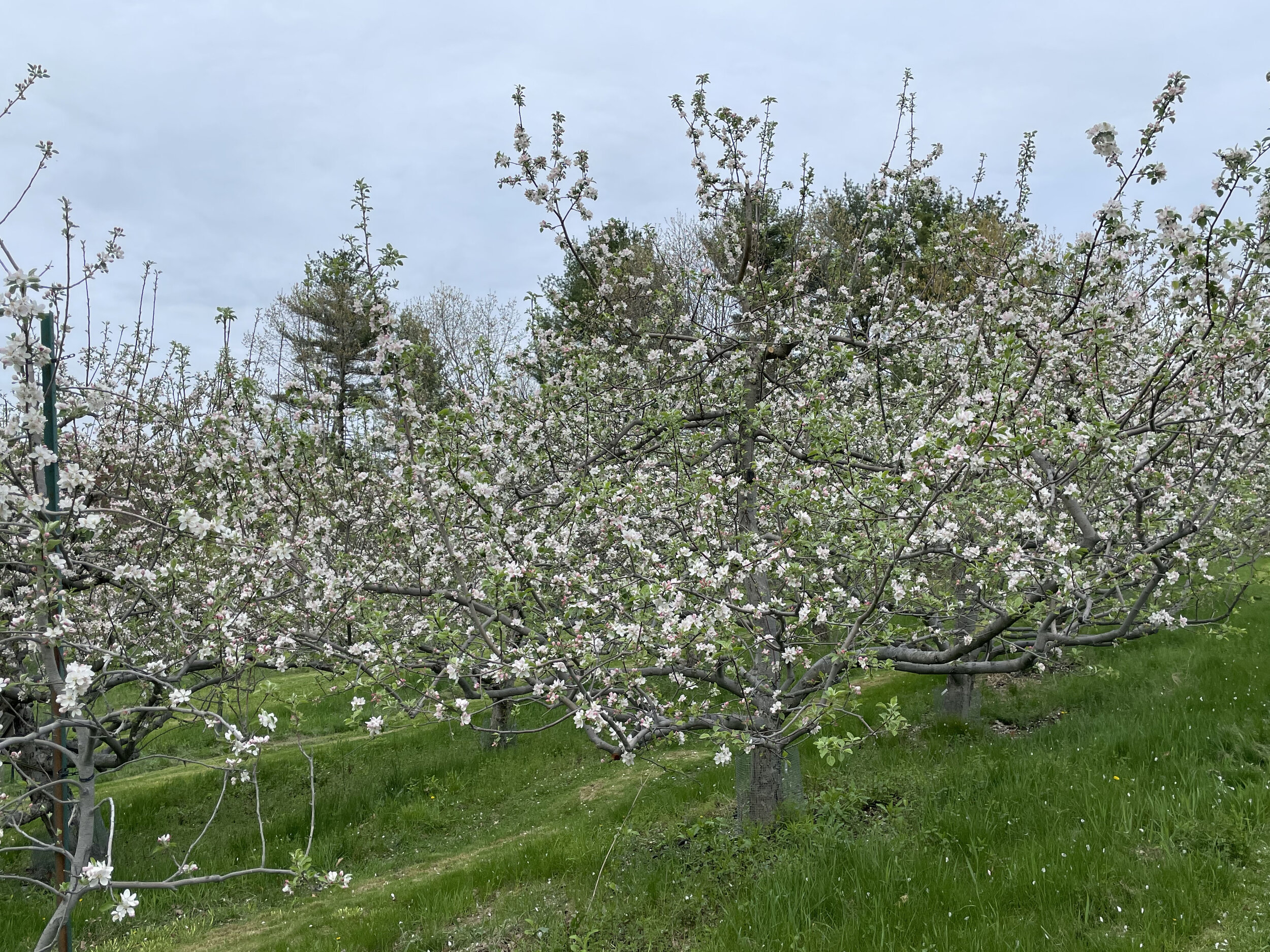
May 4, 2021 Old Frog Pond Farm
Hooray!
I received an email from an apple grower colleague asking if I’d mind if he read a poem I had shared with our holistic apple growers group. He will be speaking at the UU Church in Lincoln, Massachusetts on Sunday, April 25th. I imagine he is speaking for their Earth Day service because of his long history of caring about apples and in particular, the heirloom apples of Maine. John Bunker is not only an apple grower, he is an apple sleuther. He has made it his life’s work to identify as many old apples in Maine as possible. People bring him apples, send him apples, email him photos of apples, and stop him on the street to tell him of old trees they know of and want to identify. John published a book in 2019, Apples and the Art of Detection: Tracking Down, Identifying, and Preserving Rare Apples.
The poem he was referring to in his email was one by the great 14th century Persian poet, Hafez.
An Apple Tree Was Concerned
An apple tree was concerned
about a late frost and losing its gifts
that would help feed a poor family close by.
Can't the clouds be generous with what falls from them?
Can't the sun ration itself with precision?
They can speak, trees,
they can say the sweetest things
but it takes special ears to hear them,
ears that have listened to people
with great care.
Indeed, this poem feels quite timely given wintry weather we experienced here in New England on Friday.
I wrote back to John saying, “Of course! I think Hafez would be delighted.” And I was grateful to be reminded of it, because I, too, will be speaking on that same Sunday at our UU Church in Harvard with good friends, Piali De and her mother-in-law, Marion Stoddart.
Marion Stoddart is well known to many because of her groundbreaking work to inspire and lead the restoration of the Nashua River, at one time one of most polluted rivers in America. Piali De is a brilliant scientist and the CEO of Sensio Systems, an innovative company leading the way to support healthcare at home. We’ll be speaking about lessons learned from restoring the Nashua River, bringing back an abandoned orchard, and raising questions about ownership of land and the importance of ‘common’ land. You can go to the website for the UU Church in the Town of Harvard if you would like to join us next Sunday.
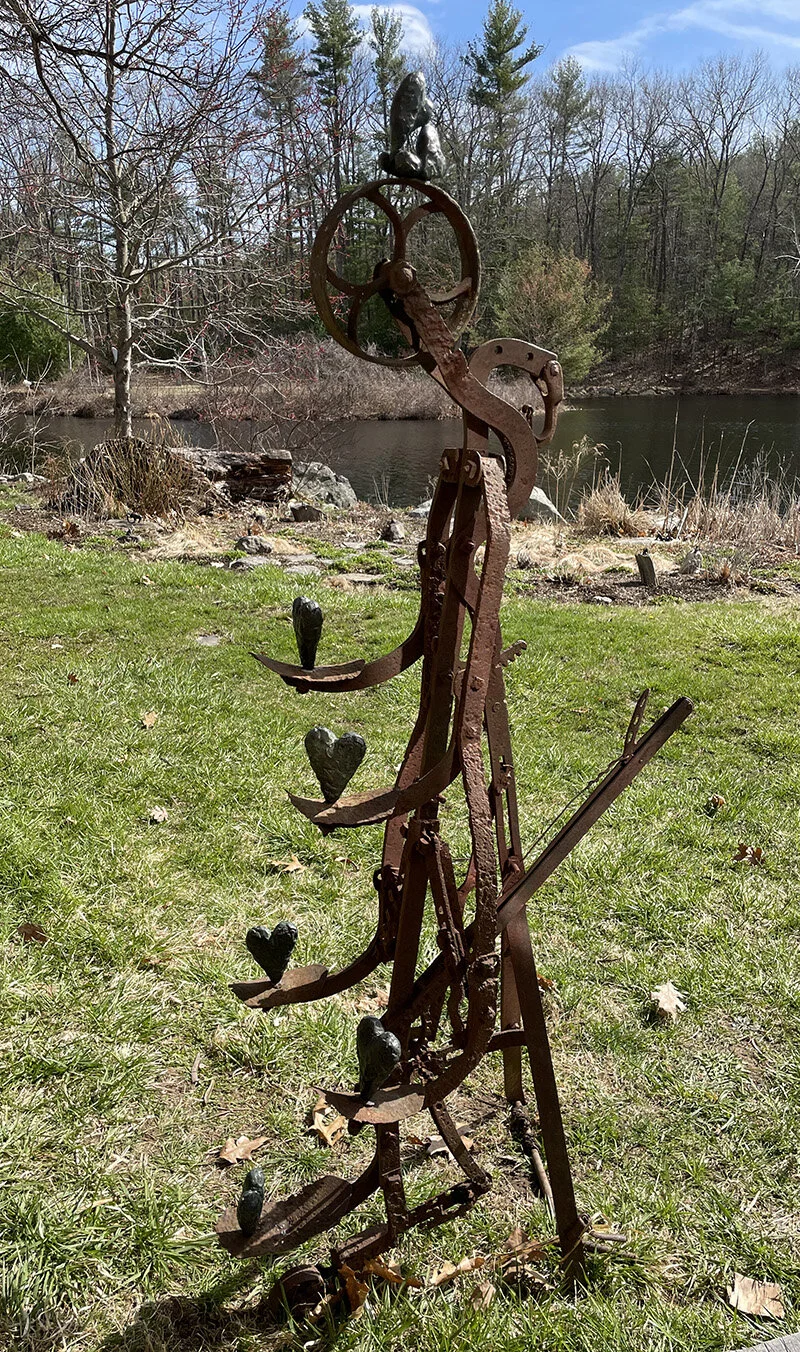
Cultivating Love is part of my new installation for Studios Without Walls exhibit, The Light Gets In, opening on May 28, 2021
Though the Apples, Art, and Spirit blog has been silent in recent months, things are changing. My family has gone through their share of both life and Covid challenges. But we’re coming out on the other side. We’re turning our attention to reopening the farm, taking care of the perennial crops, and planting annual vegetables and flowers.

While weeding the rhubarb I grabbed this fellow. But it did not glide away!
Now we need some cooperation from the weather gods.

Apricots are the earliest blossoming of our fruit trees.
Our apricot tree is in full bloom as are early peaches. It’s likely that we have lost the fruit from these trees. We hope the apples are fine. I’ll be checking on them, and definitely listen to what they have to say.
At the end of my note to John Bunker, I wrote, “Thanks for the reminder. We need each other!”
John quickly wrote back, “Not only do we need each other... we HAVE each other! Hooray!
Yes, we need each other! And we have each other!
Search Blog
-
2025
- May 9, 2025 A View from the Tractor Seat
- Apr 11, 2025 Dig
-
2024
- Jan 7, 2024 Winter Wassail
-
2022
- Dec 11, 2022 Keeping Time
- Jun 17, 2022 This Apple-Shaped Earth
- Jan 23, 2022 What is a Jizo?
- Jan 16, 2022 An Invite and Housekeeping Update
- Jan 1, 2022 The Year of the Frog: What Orchardists Do While Apple Trees are Chilling
-
2021
- Oct 24, 2021 Figs
- Oct 3, 2021 The Artist and the Orchard: A Memoir
- Aug 8, 2021 Red-Fleshed Apples
- Jul 25, 2021 When We Were Trees
- Jun 27, 2021 Castor Beans—Who Knew?
- Jun 13, 2021 Spring Training at a Zen Monastery
- May 4, 2021 Our Trees are in Bloom
- Apr 18, 2021 Hooray!
- Jan 24, 2021 Wassailing, virtually!
- Jan 1, 2021 Sitting
-
2020
- Dec 21, 2020 Darkness to Light
- Nov 28, 2020 One Heart
- Sep 18, 2020 Juggling Flowers, Fruit, and Vegetables
- Aug 23, 2020 Refuge
- Aug 9, 2020 Bags of Fertilizer
- Aug 2, 2020 The Sermon of the Blue Heron
- Jul 26, 2020 What's the Buzz?
- Jul 19, 2020 Farm Moments
- Jul 12, 2020 Lost Wax
- Jul 5, 2020 Catalpa: The Hugging Tree
- Jun 28, 2020 Pedaling Peace
- Jun 21, 2020 See Change
- Jun 14, 2020 Lalla Unveiled
- Jun 7, 2020 Pond Alchemy
- May 31, 2020 The Birth of Fruit
- May 24, 2020 An Artist in the Orchard
- May 17, 2020 Walking the Land: Returning Home
- May 10, 2020 Stinging Nettles: Gifts from the Great Mother
- May 3, 2020 The Mystery of Swallow
- Apr 26, 2020 Aerial Bruststrokes
- Apr 19, 2020 Simple Pleasures
- Apr 12, 2020 Weeds and Other Gifts
- Apr 5, 2020 Remembering the Seeds
- Mar 29, 2020 Blow on the Embers
- Mar 22, 2020 Ripples
-
2019
- Nov 16, 2019 Tibet Impressions
- Nov 9, 2019 Forest Tales
- Oct 13, 2019 The Gift
- Aug 4, 2019 The Season is Apples, Berries, and Grandfather Fire
- Jun 8, 2019 Pointers for a Writing Life
- May 12, 2019 Mothers of the Earth
- Apr 6, 2019 The Apple-Shaped Earth
- Mar 23, 2019 You Don’t Know What You Have Till It’s Gone
- Feb 23, 2019 Generations
- Feb 9, 2019 What Are We Doing to the Earth, John Chapman?
-
2018
- Dec 31, 2018 Long Shadows
- Oct 6, 2018 A Pilgrimage to India
- Aug 18, 2018 Scrap Wrenn
- Aug 11, 2018 Off-the-Wall Comments from an Ignorant Farmer
- Jul 28, 2018 Creative Connect
- Jul 14, 2018 How is the Orchard?
- Jun 30, 2018 Which Way?
- Jun 16, 2018 Geese, Herons, Beavers, and the Baby Steps of a Lapsed Blogger
- Feb 24, 2018 Mama's Coupons — Good Forever
- Jan 27, 2018 January Ice
- Jan 13, 2018 The Muse
-
2017
- Dec 30, 2017 A Dream for the New Year
- Dec 23, 2017 A New Year for Apples
- Dec 16, 2017 Intuition
- Nov 22, 2017 Thanksgiving OM
- Nov 4, 2017 East Fork Pottery
- Oct 28, 2017 Putting Down New Roots
- Oct 21, 2017 A is for Art
- Oct 14, 2017 Eve domesticus
- Oct 7, 2017 A String Workshop
- Sep 30, 2017 After Applepicking
- Sep 23, 2017 Two Bad Women and One Good Apple
- Sep 16, 2017 Plein Air Poetry
- Sep 9, 2017 Cutting Off a Leg
- Sep 2, 2017 The Changing Landscape
- Aug 26, 2017 All About Art
- Aug 19, 2017 My First Visit to the Farm
- Aug 12, 2017 The First Food
- Aug 5, 2017 A Teapot, a Woman, and maybe a Boat
- Jul 29, 2017 A Raspberry Dilemma
- Jul 22, 2017 Consider the Miracle
- Jul 15, 2017 Meeting Ekphrasis
- Jul 8, 2017 Ripening Fruit
- Jul 1, 2017 The Voice of The Caterpillar
- Jun 24, 2017 Goumi — An Unusual Fructus
- Jun 17, 2017 Concord, an American Bloomsbury
- Jun 10, 2017 The World Is Bonkers — Shall I Laugh or Cry?
- Jun 3, 2017 Bonkers, a Revolutionary Apple
- May 27, 2017 Guardians of the Swamp
- May 20, 2017 There are Mushrooms and There are Morels
- May 13, 2017 "What's in a Name?"
- May 6, 2017 Bloom Follows Pink: Orchard Pollination
- Apr 29, 2017 The Orchard Is at Pink
- Apr 22, 2017 Natural Farming — Part 2 (continuation from last Sunday's blog)
- Apr 15, 2017 Natural Farming — Part 1
- Apr 8, 2017 Boats, Figures, and Catching Fish
- Apr 1, 2017 A Man with a Mission: The Nuts and Bolts of Bronze Casting
- Mar 25, 2017 A Chalice of Spirit, Art, and Nature
- Mar 18, 2017 Hanami — Blossom Viewing
- Mar 11, 2017 Soil Redemption Song
- Mar 4, 2017 Food is Primary Care
- Feb 25, 2017 Pomme de Terre
- Feb 18, 2017 Organic Certification
- Feb 11, 2017 Tantalizing Fruit
- Feb 4, 2017 The Myths of History
- Jan 28, 2017 The Orchard in Winter
- Jan 21, 2017 The Hi-Line
- Jan 14, 2017 Artistic, Botanical, and Social Diversity
- Jan 7, 2017 Where is Eden?
-
2016
- Dec 31, 2016 The Creative Heart
- Dec 24, 2016 A Christmas Tale
- Dec 17, 2016 Who are the Crones?
- Dec 10, 2016 The Olympic Bell (Part Two)
- Dec 3, 2016 Overheard in the Apple Orchard in Early December
- Nov 26, 2016 The Lessons of a Tortoise
- Nov 19, 2016 In the Studio
- Nov 12, 2016 Even in Darkness
- Nov 5, 2016 Southern Apples, an Elephant, Monkey, Rabbit, and Bird, Two Mango Trees and a Birthday
- Oct 29, 2016 The Tools of Art
- Oct 22, 2016 Labyrinths
- Oct 15, 2016 Repairing the Broken
- Oct 8, 2016 When You Are No More
- Oct 1, 2016 Creation Rain
- Sep 24, 2016 Breaking the Glass
- Sep 17, 2016 String Art
- Sep 10, 2016 Poetry and Photosynthesis: It's all in the Leaves
- Sep 3, 2016 In the Plenty of Time
- Aug 27, 2016 Witch Doctors
- Aug 20, 2016 Listen Coyote
- Aug 13, 2016 Milkweed in the Orchard
- Aug 6, 2016 Some People See a Turtle
- Jul 30, 2016 Arborshaping
- Jul 23, 2016 Joseph Wheelwright: Sculptor of Stones and Trees
- Jul 16, 2016 Asian Pears
- Jul 9, 2016 Gold Leaf, Grief, and the Creative Process
- Jul 2, 2016 The Olympic Bell (Part One)
- Jun 25, 2016 Around the Mulberry Bush
- Jun 18, 2016 Avoiding Apples
- Jun 11, 2016 Fructus
- Jun 4, 2016 Astonishing Apples
- May 28, 2016 Scare the Caterpillars
- May 21, 2016 Join the Club!
- May 14, 2016 The Graft
- May 7, 2016 Rooster, Rhubarb, Rue
- Apr 30, 2016 What do Dolphins and Nettles Have in Common?
- Apr 23, 2016 Art Prunings
- Apr 16, 2016 A Few of the First Arrivals
- Apr 9, 2016 Taste the Spirit of Sustainable Agriculture
- Apr 2, 2016 First Orchard Spray - March 22-24, 2016
- Mar 26, 2016 Hawkeye Apple
- Mar 19, 2016 Desiring the Almata Apple
- Mar 12, 2016 Ugly Fruit
- Mar 5, 2016 Winter Tracks
- Feb 27, 2016 Splash
- Feb 20, 2016 Pruning
- Feb 13, 2016 Orchard Ruminants
- Feb 6, 2016 A Gathering of Seeds
- Jan 30, 2016 Orchard Dragons
- Jan 23, 2016 Tree Rings
- Jan 17, 2016 The Fallen Tree
- Jan 7, 2016 Wassailing the Apple Trees
- Jan 1, 2016 The New Year