LINDA HOFFMAN
Hooray!
I received an email from an apple grower colleague asking if I’d mind if he read a poem I had shared with our holistic apple growers group. He will be speaking at the UU Church in Lincoln, Massachusetts on Sunday, April 25th. I imagine he is speaking for their Earth Day service because of his long history of caring about apples and in particular, the heirloom apples of Maine. John Bunker is not only an apple grower, he is an apple sleuther. He has made it his life’s work to identify as many old apples in Maine as possible. People bring him apples, send him apples, email him photos of apples, and stop him on the street to tell him of old trees they know of and want to identify. John published a book in 2019, Apples and the Art of Detection: Tracking Down, Identifying, and Preserving Rare Apples.
The poem he was referring to in his email was one by the great 14th century Persian poet, Hafez.
An Apple Tree Was Concerned
An apple tree was concerned
about a late frost and losing its gifts
that would help feed a poor family close by.
Can't the clouds be generous with what falls from them?
Can't the sun ration itself with precision?
They can speak, trees,
they can say the sweetest things
but it takes special ears to hear them,
ears that have listened to people
with great care.
Indeed, this poem feels quite timely given wintry weather we experienced here in New England on Friday.
I wrote back to John saying, “Of course! I think Hafez would be delighted.” And I was grateful to be reminded of it, because I, too, will be speaking on that same Sunday at our UU Church in Harvard with good friends, Piali De and her mother-in-law, Marion Stoddart.
Marion Stoddart is well known to many because of her groundbreaking work to inspire and lead the restoration of the Nashua River, at one time one of most polluted rivers in America. Piali De is a brilliant scientist and the CEO of Sensio Systems, an innovative company leading the way to support healthcare at home. We’ll be speaking about lessons learned from restoring the Nashua River, bringing back an abandoned orchard, and raising questions about ownership of land and the importance of ‘common’ land. You can go to the website for the UU Church in the Town of Harvard if you would like to join us next Sunday.
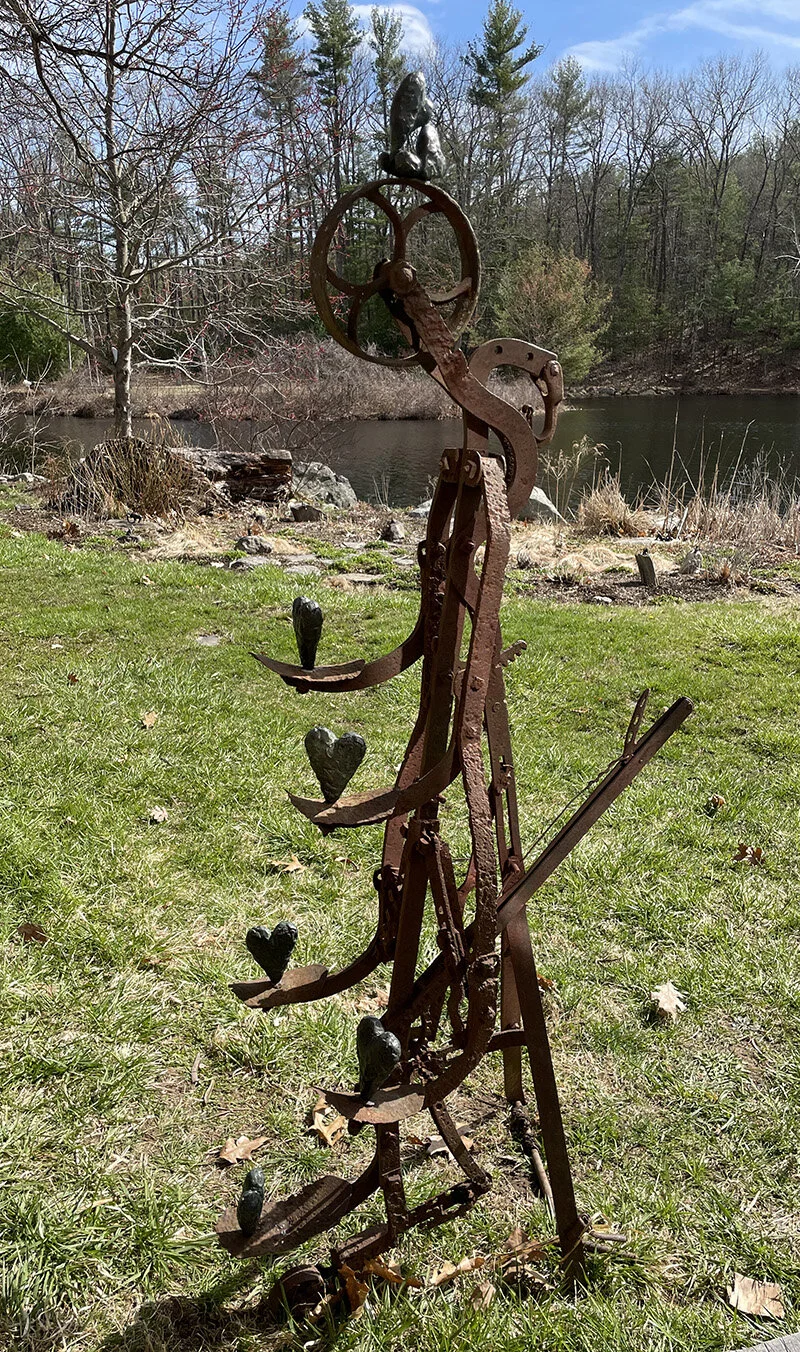
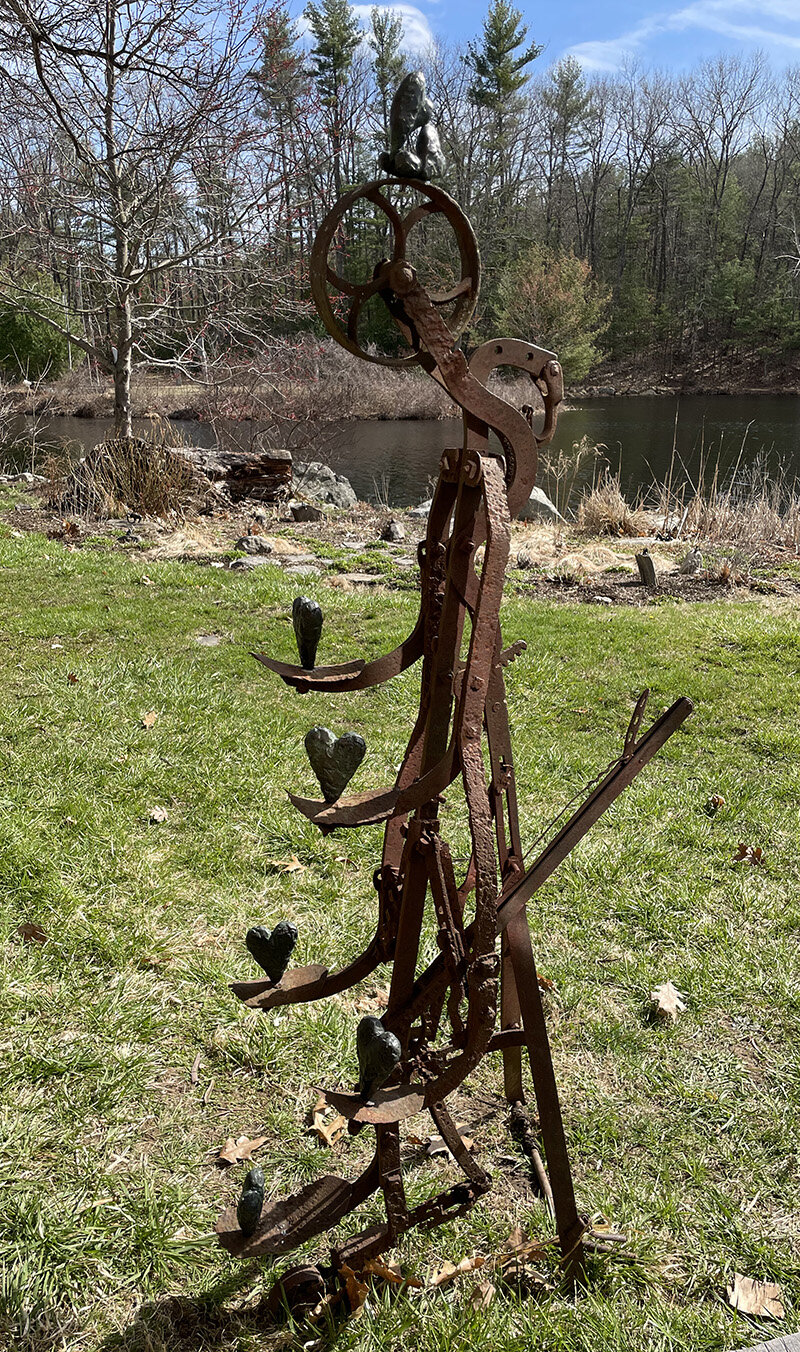
Cultivating Love is part of my new installation for Studios Without Walls exhibit, The Light Gets In, opening on May 28, 2021
Though the Apples, Art, and Spirit blog has been silent in recent months, things are changing. My family has gone through their share of both life and Covid challenges. But we’re coming out on the other side. We’re turning our attention to reopening the farm, taking care of the perennial crops, and planting annual vegetables and flowers.

While weeding the rhubarb I grabbed this fellow. But it did not glide away!
Now we need some cooperation from the weather gods.

Apricots are the earliest blossoming of our fruit trees.
Our apricot tree is in full bloom as are early peaches. It’s likely that we have lost the fruit from these trees. We hope the apples are fine. I’ll be checking on them, and definitely listen to what they have to say.
At the end of my note to John Bunker, I wrote, “Thanks for the reminder. We need each other!”
John quickly wrote back, “Not only do we need each other... we HAVE each other! Hooray!
Yes, we need each other! And we have each other!
Lost Wax
It’s crazy how a nose from one direction can look perfectly fine, and viewed from 180 degrees, it’s too close to the eye. When I work on small wax figures, I turn them continuously around in my hands, making sure, for example, the left elbow doesn’t extend below the hip while I carve the right side of the torso. Working on a larger piece, I circle continuously; this partner dance assures everything works from all perspectives.

Refuge, 2020, in wax in my studio. The endangered sea turtle and giraffe are rescuing the humans.
Our planet faces a ferocious loss of habitat, fifty percent of the species on the earth have disappeared in the last forty to fifty years. We’re a destructive species causing the acidifying of the ocean, the loss of precious topsoil, and the poisoning of the very air we breathe. The animals haven’t caused this harm—we have. But I like to think, despite our recklessness and selfishness, they would choose to save us.
I delivered Refuge to the foundry in early January, needing to cut off the giraffe’s legs to fit in my car.

The turtle arrives at the foundry.
Not a problem for Zach Gabbard, owner and sole fabricator at Mission Foundry in Hyde Park. He will be taking it further apart—flippers, turtle shell, giraffe head, giraffe tail, turtle tail, and each individual person to make rubber molds.
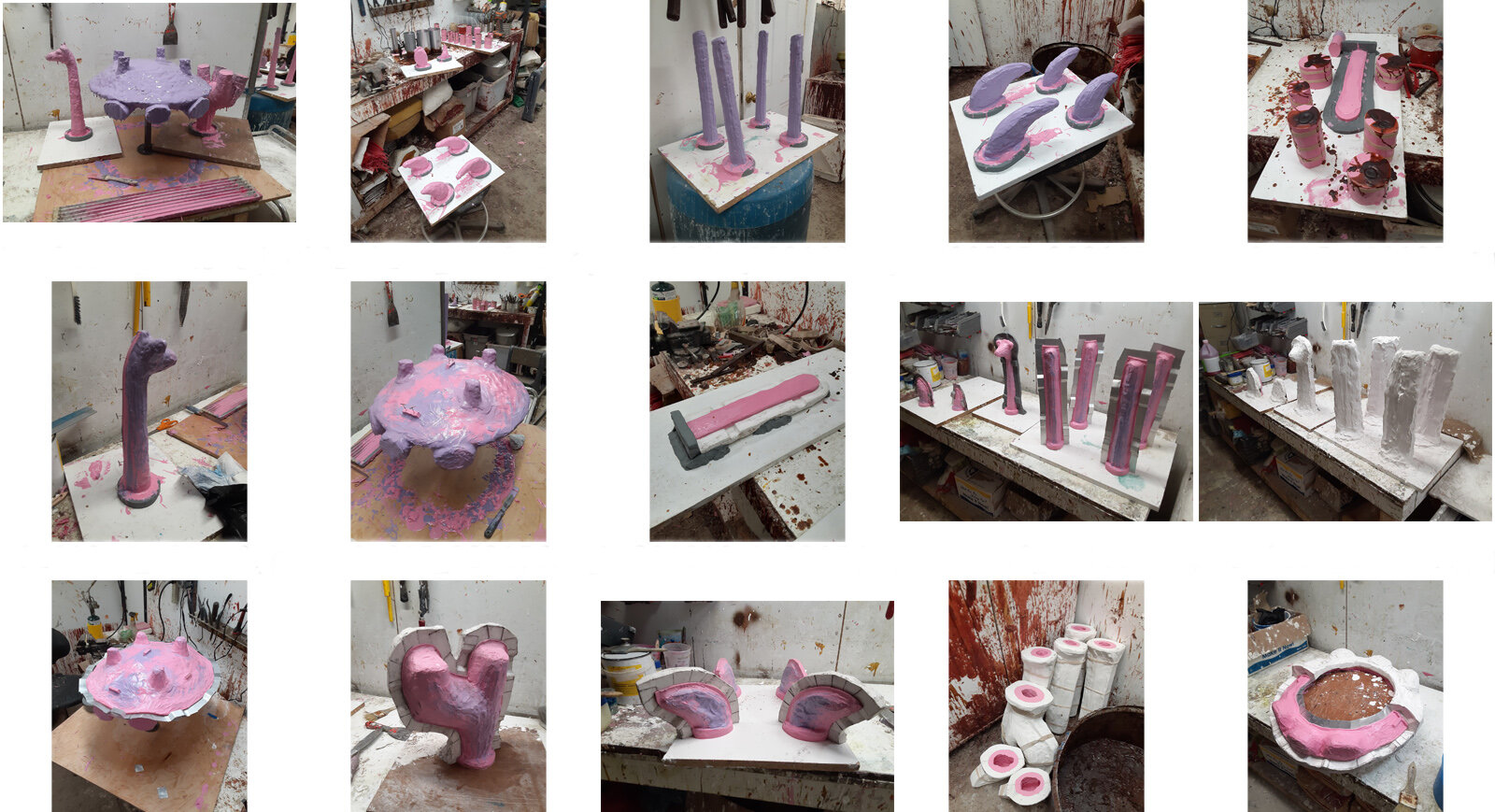
Once he has the rubber molds, he will pour casting wax into them—the small figures solid, the large shapes like the giraffe body receive a thin layer so they can be hollow. When Zach has these wax pieces complete, he will attach the small ones together and build a funnel above each one—the constructions, intriguing modern mobiles.

The next step is to create the molds to receive the molten bronze. Each of these wax mobiles are dipped into a silica slurry nine times to slowly building up the mold. They are dipped, then coated with sand, and hung to dry for at least a day between dips.

At the pour, the funnel on top of each mold receives the liquid bronze, the wax melts out, lost wax, and the bronze hardens. These hard shells are then hammered and broken to free them from the bronze inside.

There are still days of work ahead for Zach. He has to cut off the sprues and funnels. He has to sandblast each piece to get the specks of hard shell out of every crevice. Then the individual pieces will be welded together. Zach has to know how to replicate the textures I sculpt in my wax sculpture, and he has to do it in metal so the welded seams disappear. He has to care about the subtleties of the texture, with the deliberateness of a poet choosing words to describe the grooved furrows of an oak trunk.
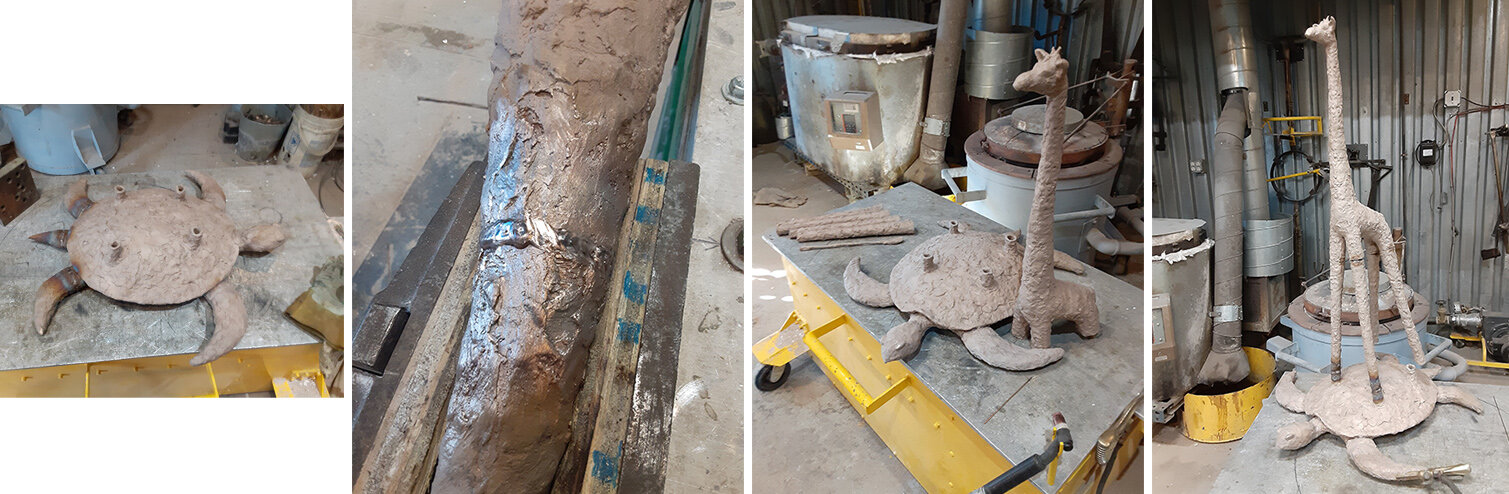
I returned to the foundry a few weeks ago to position each of the the small bronze figures on the backs of the giraffe and turtle. Zach welded each one in place.

Then Refuge received its final patina and wax polish. It’s a long process. This piece is signed and numbered 1/5. Though my original waxes have disappeared, I have the molds to make four more copies. But always, for each one, we have to first make a new wax model, then cast it into bronze. After five copies, we’ll destroy the molds.
Lost wax is an apt metaphor for these times: The only way to create something new is to lose something. While we are collectively facing tremendous loss, it is good to reflect on the space that allows for something new to arise. The loss is real—people’s lives, habitat, species, jobs, freedom. I am alarmed, but I dearly want to believe that we can turn things around. We need humility. We need respect for every living being on the planet. Then the turtle and the giraffe, the heron and the wasp, the oak, the waterlily, and even the gnat will all be helping because we are all interconnected.
Refuge would have been outdoors at the Fuller Museum this summer, but Covid has delayed the opening of the New England Sculptors Exhibit until spring 2021. It sits on a chunk of bedrock outside my studio. I’d love to send more casting work Zach’s way, so if you would be interested in a copy of Refuge for your own garden, let’s talk.
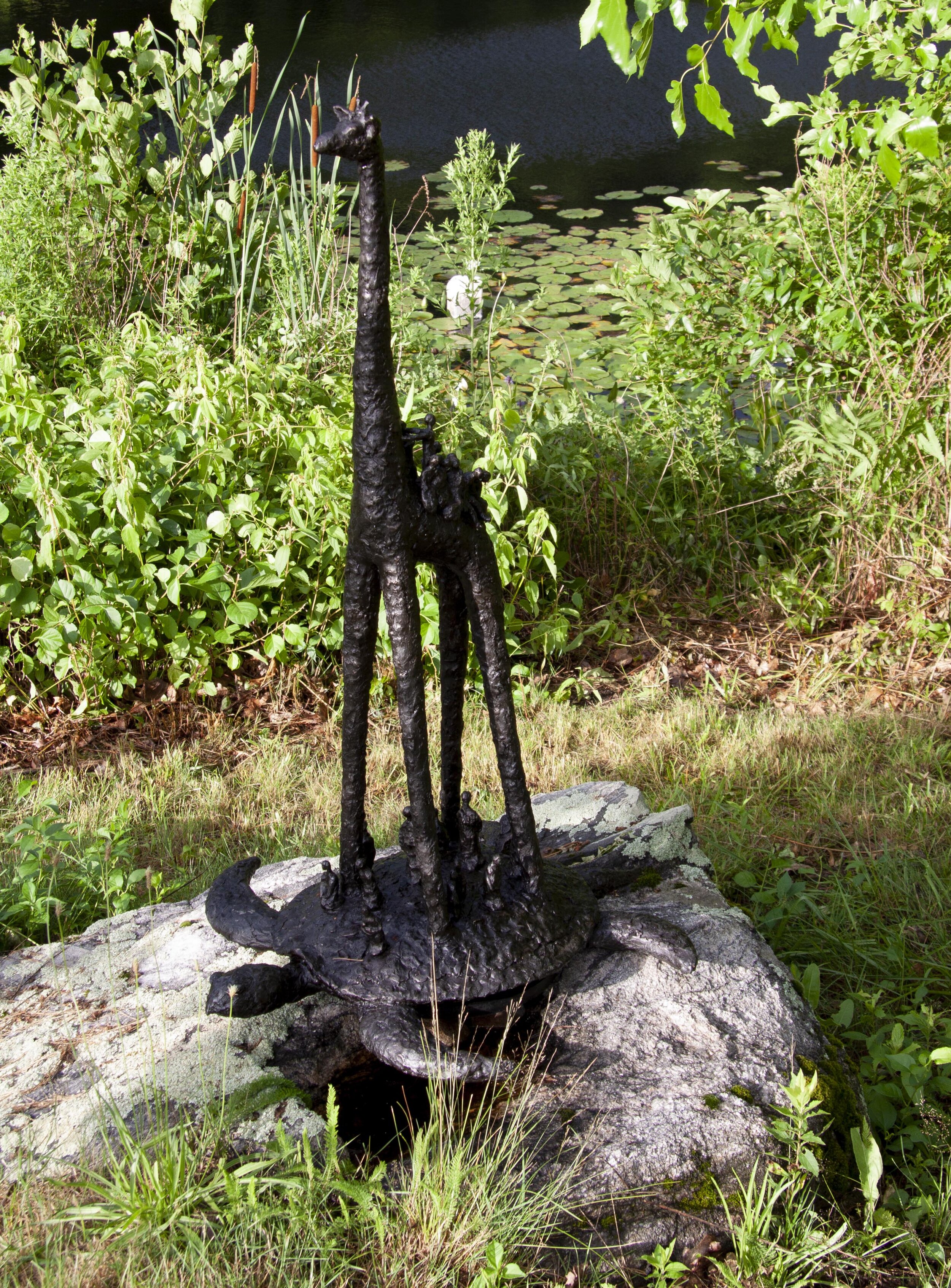
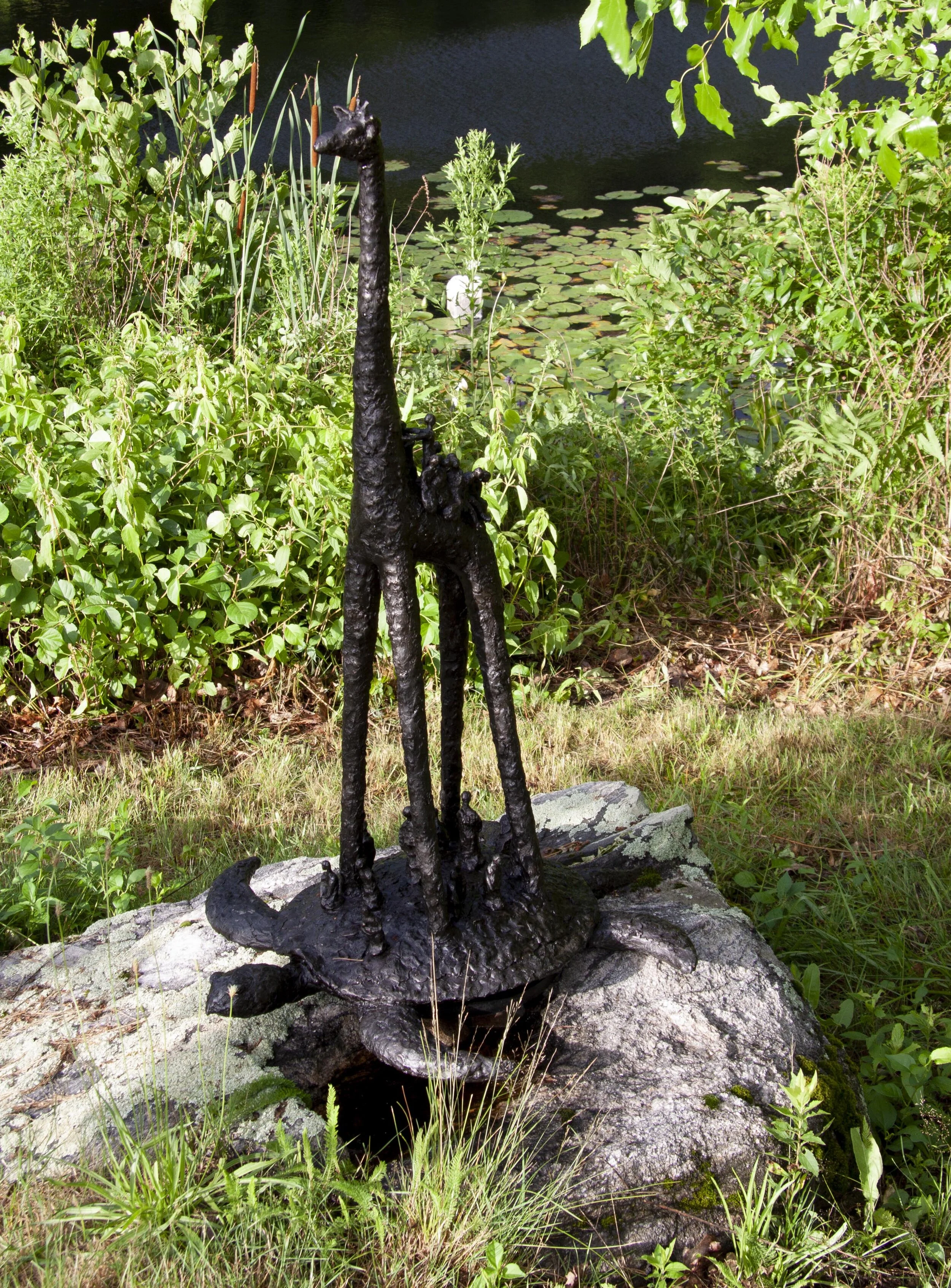
Refuge, bronze, 2020
Refuge is a hopeful piece. The determined, young giraffe and the tireless turtle are unconcerned with the enormity of their mission. They echo the world’s need for us to engage, to bring our gifts, and to offer help in this time of great loss. It’s a collective dance we can’t do alone.
You Don’t Know What You Have Till It’s Gone
Our farmhouse is in Harvard, but many people don’t know that our apple orchard is in Boxborough. We were recently told by a neighbor about a proposed zoning overlay district in Boxborough that would change the zoning of our farm as well as adversely affect our neighbors in Harvard, Boxborough and surrounding towns.
The proposed overlay district comprises 371 acres and will enable the Lincoln Property Company to build four warehouses, 1,020,000 square feet. These four giant ‘cubes’ would cover twenty-three acres of formerly forested land within several thousand feet of our property.
Elizabeth Brook feeds the large wetlands area that flows around our orchard, and into the 500+ acres of Delaney Conservation area. In the last two weeks we have had two sightings of a bald eagle flying over the orchard and Elizabeth Brook wetlands. This proposed development would massively disturb this fragile ecosystem and threaten the aquifer that feeds our wells.

Great Blue Returned on the Spring Equinox
Many of you who have been reading my blog know of the struggle I have faced in growing organic apples over the last few years. Climate change is one factor, but I recently learned of another issue when I attended the Holistic Apple Grower’s Meeting in Western Massachusetts earlier this year. A new fungus, Marssonina Leaf Blotch, causes apple leaf defoliation in apples when a fungicide is not sprayed throughout the growing season. Arriving in this country from Asia, it first appeared in the western part of the country, defoliating thousands of acres of aspens in Utah, but is now in New England. Orchards spray fungicides for scab, the fungal disease most serious for apple growers in New England where the summer weather is often warm and wet. Organic growers have less choice in sprays to control this disease, so I made the hard decision a year ago to remove our Macintosh trees, known to growers as scab magnets. Right after the trees came down, friends joined me to graft one hundred rootstocks with scab resistant apples. These one-year-old saplings grew well in our hoop house for the year and are ready to be planted.
The disappearance of the gnarly Macintosh trees in the first few rows of the orchard caused neighbors to wonder if we were cutting down the entire orchard. I assured people we were not giving up. I have shared my lessons and strivings in growing organic apples, but none-the-less have continued to remain faithful to the trees and the land that have nourished me since I moved here in 2001.
Giving up on the earth, our government, or any issue that is challenging doesn’t solve anything. We have to do the work and stand by our convictions. Liberty Property Company’s build might take ten years, and who is to say that in twenty years, these warehouses won’t be obsolete as everything will be drop-shipped. Tax revenue is an important consideration for all of our communities, but in preserving our towns’ rural nature, its conservation lands, farmland, wildlife, clean water and night sky we make sure that our town remains a desirable place to live and that our property values stay high. Warehouses will not serve the local community, and in fact will cause a serious disruption to our way of life.

Many Boxborough residents heard for the first time about the proposed changes to their bylaw only recently. It seems that there has been a quiet, but legal effort to slip this bylaw change through Town Meeting by highlighting the ‘gifts’ to the town, but not mentioning the warehouses. If you know anyone in Boxborough, please make sure they know about this change in their bylaws coming up for a vote at Town Meeting in May.
I look at the wetlands and the orchard now with a new set of eyes. The runoff into the wetlands might mean we can no longer irrigate. Boxborough neighbors say that with the twenty-acre solar panel array, phase one of Liberty Realty’s development plans, they hear Route 495 in their homes even with the windows closed. More traffic sound reflecting off twenty-three acres of roofs will certainly eclipse the twangs of red-winged blackbirds, chirps of robins and bluebirds, honks of geese, and squawks of herons. And it will be impossible to hear the apple trees. “They can speak, trees . . .” says the 14th century poet, Hafiz in his poem, An Apple Tree Was Concerned.
An apple tree was concerned
about a late frost and losing its gifts
that would help feed a poor family close by.
Can't the clouds be generous with what falls from them?
Can't the sun ration itself with precision?
They can speak, trees,
they can say the sweetest things
but it takes special ears to hear them,
ears that have listened to people
with great care.

My daughter, Ariel, picking Honey Crisp Apples in 2017
We face choices everyday about how we use the earth’s limited resources.
Let us choose wisely.
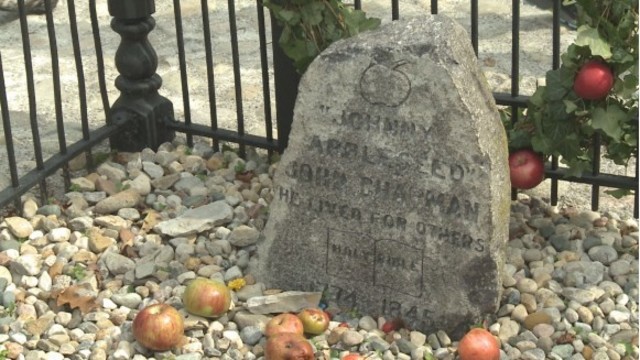
What Are We Doing to the Earth, John Chapman?
John Chapman (1774–1845) is familiar to most grade school students in the United States as Johnny Appleseed, the man who planted apple seeds. The irony is that John Chapman might have been sorely disappointed with this epitaph. John Chapman established nurseries of apple trees in Pennsylvania, Ohio, and as far west as Indiana, but these orchards were not his true raison d’etre. Selling apple trees for his livelihood gave him the possibility of travel where and when he wanted—and the freedom to practice and spread his religion of choice.
John followed the teachings of Emanuel Swedenborg (1688–1772), a Swedish mystic, scientist, and theologian who influenced Harriet Beecher Stowe and was praised by Ralph Waldo Emerson. Swedenborg believed we live in both the world of spirit and the material world, but that our eyes are often closed to the former. He was a Christian who formed a new religious movement, the Swedenborgian denomination, to advance the idea that God revealed himself in the world, in the earth, in all sentient life. Based on his own significant mystical experiences, he wrote that love is the “basic unit of reality.” He seemed determined to show people that there is more than what they see with their eyes and hear with their ears: There is a mystical world that everyone has access to.

Apple Bloom at Old Frog Pond Farm in 2017
John Chapman certainly seemed to want to have, or perhaps did have, his own mystical experiences—we will never know. But he did he carry the words of Swedenborg across the American frontier. Visiting homesteads, he would pull out his Bible and read passages with an ardor that calls to mind the approach of television evangelists today. Sometimes he would tear out a few pages and leave them, only to exchange them for new ones the next time he passed through. He was a vegetarian, wore no leather, and would never even cut down a tree.
Of course, on these journeys, he always had apple trees to sell. Fruit trees, often a requirement for anyone wanting to establish a land claim, provided the fruit to make applejack—hard cider—the drink of choice for the settlers at all three meals. From apple cider, settlers could make apple cider vinegar, a cleaning agent, as well as a preservative and medicinal drink. Even if the apples Chapman’s seedling produced were bitter and hard, ‘spitters’ I’ve heard them called, it didn’t matter, for they all mixed well in the grinder.
Chapman would travel into a new territory ahead of the homesteaders and establish a small nursery with seeds he picked up annually from a cider mill in Pennsylvania. He chose a protected spot near a river or stream, secured it with brambles, and traveled on. The following year he would return, dig up his one-year-old seedlings. Apple seedlings with the right conditions can grow five feet or more in a year.
My friend, Eric Schultz, who generously let me read his chapter on John Chapman in his book, Nation of Entrepreneurs, to be published by Greenleaf Publishing this fall wrote, “John Chapman was the oddest of evangelists, bringing gifts of heaven and alcohol in equal parts to the American frontier and running a business model that supported both.” There are not many followers of the Swedenborg religion today, but Chapman’s apples spread far and wide, and are certainly part of the proliferation of varieties of apples we now grow not only in America but all over the world. It’s interesting how one’s passion does not always create one’s legacy.
I think about John Chapman when I read that we have experienced the five warmest years in history. We will soon be planting Southern apples here in New England, for in not too many years, our older heirloom varieties will not have enough chill hours to produce buds. Much of this heating up of the earth is because of our selfishness and blindness to the interconnection of everything we do, build, use, and desire. Chapman was a minimalist, even during a time when there was not much to spare. His potato sack shirt had armholes cut for sleeves and probably did little to protect him from the elements, but apparently, he never complained. What would we think if we saw this man walking along our streets, barefoot with “horny” toes, wearing a tin can cap, bearded and hairy? We appreciate true iconoclasts often only after the person has died.
I came upon an interesting post, A Theology of Wild Apples, in the blog, American Orchard, Historical perspectives on food, farming and landscape.
Yet well-off travelers in the late 17th and throughout the 18th century frequently cast harsh moral judgments on the subsistence-minded farmer and his wild, disorderly orchards. And by the 1820s, many moralists found another reason to condemn the seedling orchard: most of its apples were destined to be converted to demon alcohol. Temperance societies called for the destruction of wild apple trees as an essential step toward sobering up the nation.
Chapman, born in 1774 in Leominster, Massachusetts, died in 1854 in Fort Wayne, Indiana. Fortunately, a few decades later, his younger compatriot, Henry David Thoreau, born in Concord in 1887, celebrated wilderness, wildness, and, thank goodness, wild apple trees, writing the long essay, Wild Apples, in celebration of them. There is room for both: the domesticated apple and the wild apple.
Which brings me to our orchard of ordered rows. Last Monday, we finished winter pruning, and now the twisting rhythms of branches play the ground between the trees. We pruned on those days of coldest cold stamping our feet to keep warm, and finished last Monday, a 50 degree day with honey bees out flying. Here’s to a bountiful year of apples, those planted by crow and deer, and the straight rows of nursery stock.

Pruned Row February, 2019
And to you, John Chapman, thank you! May we be inspired by your life to care more deeply for every apple, and to appreciate the miracle of every seed.
Search Blog
-
2025
- May 9, 2025 A View from the Tractor Seat
- Apr 11, 2025 Dig
-
2024
- Jan 7, 2024 Winter Wassail
-
2022
- Dec 11, 2022 Keeping Time
- Jun 17, 2022 This Apple-Shaped Earth
- Jan 23, 2022 What is a Jizo?
- Jan 16, 2022 An Invite and Housekeeping Update
- Jan 1, 2022 The Year of the Frog: What Orchardists Do While Apple Trees are Chilling
-
2021
- Oct 24, 2021 Figs
- Oct 3, 2021 The Artist and the Orchard: A Memoir
- Aug 8, 2021 Red-Fleshed Apples
- Jul 25, 2021 When We Were Trees
- Jun 27, 2021 Castor Beans—Who Knew?
- Jun 13, 2021 Spring Training at a Zen Monastery
- May 4, 2021 Our Trees are in Bloom
- Apr 18, 2021 Hooray!
- Jan 24, 2021 Wassailing, virtually!
- Jan 1, 2021 Sitting
-
2020
- Dec 21, 2020 Darkness to Light
- Nov 28, 2020 One Heart
- Sep 18, 2020 Juggling Flowers, Fruit, and Vegetables
- Aug 23, 2020 Refuge
- Aug 9, 2020 Bags of Fertilizer
- Aug 2, 2020 The Sermon of the Blue Heron
- Jul 26, 2020 What's the Buzz?
- Jul 19, 2020 Farm Moments
- Jul 12, 2020 Lost Wax
- Jul 5, 2020 Catalpa: The Hugging Tree
- Jun 28, 2020 Pedaling Peace
- Jun 21, 2020 See Change
- Jun 14, 2020 Lalla Unveiled
- Jun 7, 2020 Pond Alchemy
- May 31, 2020 The Birth of Fruit
- May 24, 2020 An Artist in the Orchard
- May 17, 2020 Walking the Land: Returning Home
- May 10, 2020 Stinging Nettles: Gifts from the Great Mother
- May 3, 2020 The Mystery of Swallow
- Apr 26, 2020 Aerial Bruststrokes
- Apr 19, 2020 Simple Pleasures
- Apr 12, 2020 Weeds and Other Gifts
- Apr 5, 2020 Remembering the Seeds
- Mar 29, 2020 Blow on the Embers
- Mar 22, 2020 Ripples
-
2019
- Nov 16, 2019 Tibet Impressions
- Nov 9, 2019 Forest Tales
- Oct 13, 2019 The Gift
- Aug 4, 2019 The Season is Apples, Berries, and Grandfather Fire
- Jun 8, 2019 Pointers for a Writing Life
- May 12, 2019 Mothers of the Earth
- Apr 6, 2019 The Apple-Shaped Earth
- Mar 23, 2019 You Don’t Know What You Have Till It’s Gone
- Feb 23, 2019 Generations
- Feb 9, 2019 What Are We Doing to the Earth, John Chapman?
-
2018
- Dec 31, 2018 Long Shadows
- Oct 6, 2018 A Pilgrimage to India
- Aug 18, 2018 Scrap Wrenn
- Aug 11, 2018 Off-the-Wall Comments from an Ignorant Farmer
- Jul 28, 2018 Creative Connect
- Jul 14, 2018 How is the Orchard?
- Jun 30, 2018 Which Way?
- Jun 16, 2018 Geese, Herons, Beavers, and the Baby Steps of a Lapsed Blogger
- Feb 24, 2018 Mama's Coupons — Good Forever
- Jan 27, 2018 January Ice
- Jan 13, 2018 The Muse
-
2017
- Dec 30, 2017 A Dream for the New Year
- Dec 23, 2017 A New Year for Apples
- Dec 16, 2017 Intuition
- Nov 22, 2017 Thanksgiving OM
- Nov 4, 2017 East Fork Pottery
- Oct 28, 2017 Putting Down New Roots
- Oct 21, 2017 A is for Art
- Oct 14, 2017 Eve domesticus
- Oct 7, 2017 A String Workshop
- Sep 30, 2017 After Applepicking
- Sep 23, 2017 Two Bad Women and One Good Apple
- Sep 16, 2017 Plein Air Poetry
- Sep 9, 2017 Cutting Off a Leg
- Sep 2, 2017 The Changing Landscape
- Aug 26, 2017 All About Art
- Aug 19, 2017 My First Visit to the Farm
- Aug 12, 2017 The First Food
- Aug 5, 2017 A Teapot, a Woman, and maybe a Boat
- Jul 29, 2017 A Raspberry Dilemma
- Jul 22, 2017 Consider the Miracle
- Jul 15, 2017 Meeting Ekphrasis
- Jul 8, 2017 Ripening Fruit
- Jul 1, 2017 The Voice of The Caterpillar
- Jun 24, 2017 Goumi — An Unusual Fructus
- Jun 17, 2017 Concord, an American Bloomsbury
- Jun 10, 2017 The World Is Bonkers — Shall I Laugh or Cry?
- Jun 3, 2017 Bonkers, a Revolutionary Apple
- May 27, 2017 Guardians of the Swamp
- May 20, 2017 There are Mushrooms and There are Morels
- May 13, 2017 "What's in a Name?"
- May 6, 2017 Bloom Follows Pink: Orchard Pollination
- Apr 29, 2017 The Orchard Is at Pink
- Apr 22, 2017 Natural Farming — Part 2 (continuation from last Sunday's blog)
- Apr 15, 2017 Natural Farming — Part 1
- Apr 8, 2017 Boats, Figures, and Catching Fish
- Apr 1, 2017 A Man with a Mission: The Nuts and Bolts of Bronze Casting
- Mar 25, 2017 A Chalice of Spirit, Art, and Nature
- Mar 18, 2017 Hanami — Blossom Viewing
- Mar 11, 2017 Soil Redemption Song
- Mar 4, 2017 Food is Primary Care
- Feb 25, 2017 Pomme de Terre
- Feb 18, 2017 Organic Certification
- Feb 11, 2017 Tantalizing Fruit
- Feb 4, 2017 The Myths of History
- Jan 28, 2017 The Orchard in Winter
- Jan 21, 2017 The Hi-Line
- Jan 14, 2017 Artistic, Botanical, and Social Diversity
- Jan 7, 2017 Where is Eden?
-
2016
- Dec 31, 2016 The Creative Heart
- Dec 24, 2016 A Christmas Tale
- Dec 17, 2016 Who are the Crones?
- Dec 10, 2016 The Olympic Bell (Part Two)
- Dec 3, 2016 Overheard in the Apple Orchard in Early December
- Nov 26, 2016 The Lessons of a Tortoise
- Nov 19, 2016 In the Studio
- Nov 12, 2016 Even in Darkness
- Nov 5, 2016 Southern Apples, an Elephant, Monkey, Rabbit, and Bird, Two Mango Trees and a Birthday
- Oct 29, 2016 The Tools of Art
- Oct 22, 2016 Labyrinths
- Oct 15, 2016 Repairing the Broken
- Oct 8, 2016 When You Are No More
- Oct 1, 2016 Creation Rain
- Sep 24, 2016 Breaking the Glass
- Sep 17, 2016 String Art
- Sep 10, 2016 Poetry and Photosynthesis: It's all in the Leaves
- Sep 3, 2016 In the Plenty of Time
- Aug 27, 2016 Witch Doctors
- Aug 20, 2016 Listen Coyote
- Aug 13, 2016 Milkweed in the Orchard
- Aug 6, 2016 Some People See a Turtle
- Jul 30, 2016 Arborshaping
- Jul 23, 2016 Joseph Wheelwright: Sculptor of Stones and Trees
- Jul 16, 2016 Asian Pears
- Jul 9, 2016 Gold Leaf, Grief, and the Creative Process
- Jul 2, 2016 The Olympic Bell (Part One)
- Jun 25, 2016 Around the Mulberry Bush
- Jun 18, 2016 Avoiding Apples
- Jun 11, 2016 Fructus
- Jun 4, 2016 Astonishing Apples
- May 28, 2016 Scare the Caterpillars
- May 21, 2016 Join the Club!
- May 14, 2016 The Graft
- May 7, 2016 Rooster, Rhubarb, Rue
- Apr 30, 2016 What do Dolphins and Nettles Have in Common?
- Apr 23, 2016 Art Prunings
- Apr 16, 2016 A Few of the First Arrivals
- Apr 9, 2016 Taste the Spirit of Sustainable Agriculture
- Apr 2, 2016 First Orchard Spray - March 22-24, 2016
- Mar 26, 2016 Hawkeye Apple
- Mar 19, 2016 Desiring the Almata Apple
- Mar 12, 2016 Ugly Fruit
- Mar 5, 2016 Winter Tracks
- Feb 27, 2016 Splash
- Feb 20, 2016 Pruning
- Feb 13, 2016 Orchard Ruminants
- Feb 6, 2016 A Gathering of Seeds
- Jan 30, 2016 Orchard Dragons
- Jan 23, 2016 Tree Rings
- Jan 17, 2016 The Fallen Tree
- Jan 7, 2016 Wassailing the Apple Trees
- Jan 1, 2016 The New Year