LINDA HOFFMAN
Lost Wax
It’s crazy how a nose from one direction can look perfectly fine, and viewed from 180 degrees, it’s too close to the eye. When I work on small wax figures, I turn them continuously around in my hands, making sure, for example, the left elbow doesn’t extend below the hip while I carve the right side of the torso. Working on a larger piece, I circle continuously; this partner dance assures everything works from all perspectives.

Refuge, 2020, in wax in my studio. The endangered sea turtle and giraffe are rescuing the humans.
Our planet faces a ferocious loss of habitat, fifty percent of the species on the earth have disappeared in the last forty to fifty years. We’re a destructive species causing the acidifying of the ocean, the loss of precious topsoil, and the poisoning of the very air we breathe. The animals haven’t caused this harm—we have. But I like to think, despite our recklessness and selfishness, they would choose to save us.
I delivered Refuge to the foundry in early January, needing to cut off the giraffe’s legs to fit in my car.

The turtle arrives at the foundry.
Not a problem for Zach Gabbard, owner and sole fabricator at Mission Foundry in Hyde Park. He will be taking it further apart—flippers, turtle shell, giraffe head, giraffe tail, turtle tail, and each individual person to make rubber molds.
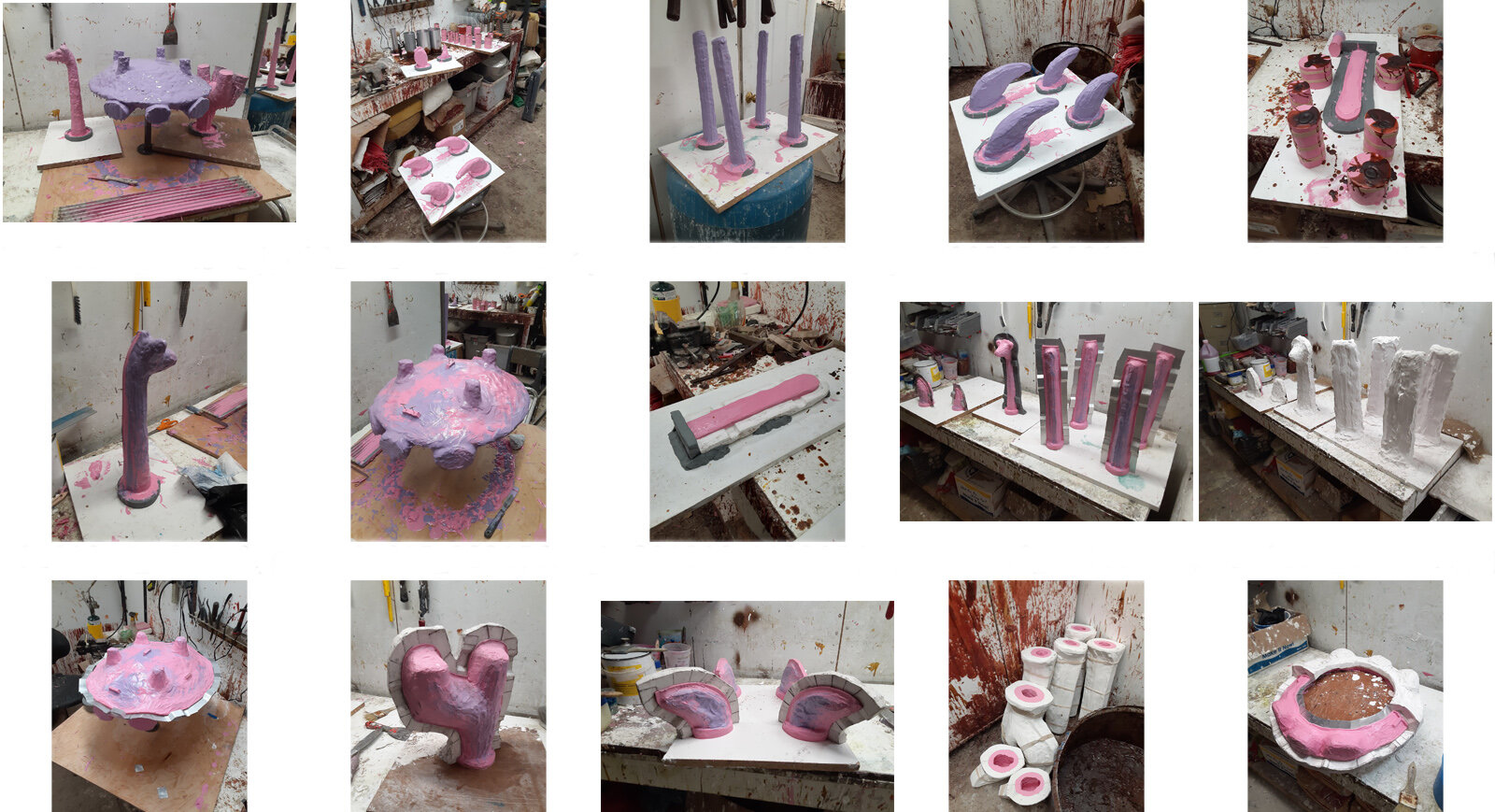
Once he has the rubber molds, he will pour casting wax into them—the small figures solid, the large shapes like the giraffe body receive a thin layer so they can be hollow. When Zach has these wax pieces complete, he will attach the small ones together and build a funnel above each one—the constructions, intriguing modern mobiles.

The next step is to create the molds to receive the molten bronze. Each of these wax mobiles are dipped into a silica slurry nine times to slowly building up the mold. They are dipped, then coated with sand, and hung to dry for at least a day between dips.

At the pour, the funnel on top of each mold receives the liquid bronze, the wax melts out, lost wax, and the bronze hardens. These hard shells are then hammered and broken to free them from the bronze inside.

There are still days of work ahead for Zach. He has to cut off the sprues and funnels. He has to sandblast each piece to get the specks of hard shell out of every crevice. Then the individual pieces will be welded together. Zach has to know how to replicate the textures I sculpt in my wax sculpture, and he has to do it in metal so the welded seams disappear. He has to care about the subtleties of the texture, with the deliberateness of a poet choosing words to describe the grooved furrows of an oak trunk.
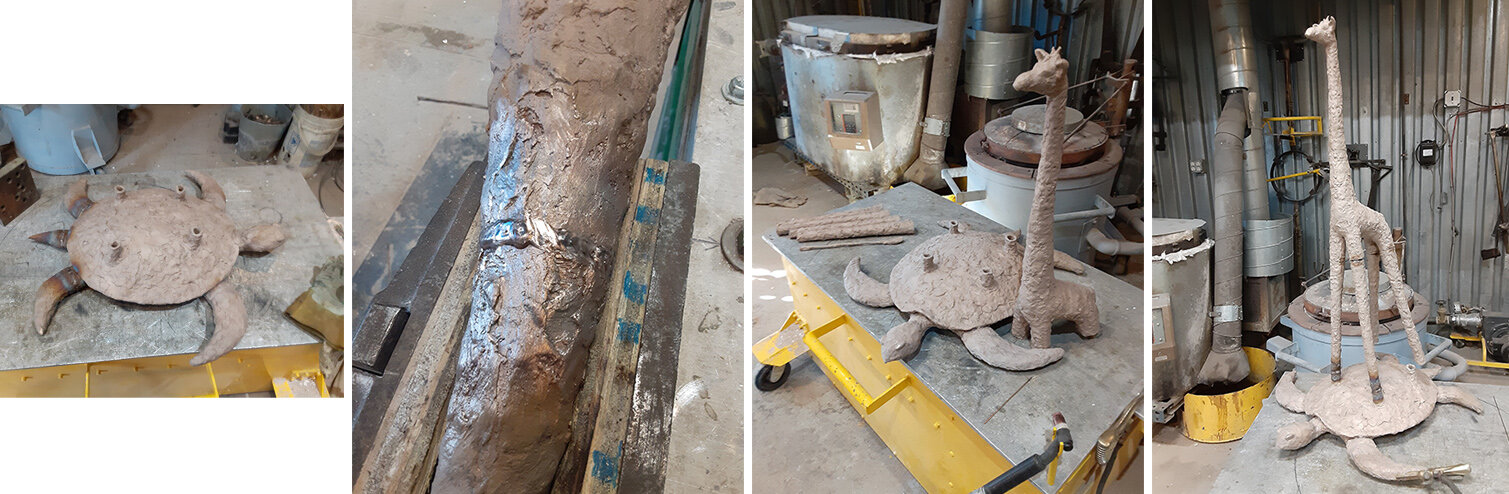
I returned to the foundry a few weeks ago to position each of the the small bronze figures on the backs of the giraffe and turtle. Zach welded each one in place.

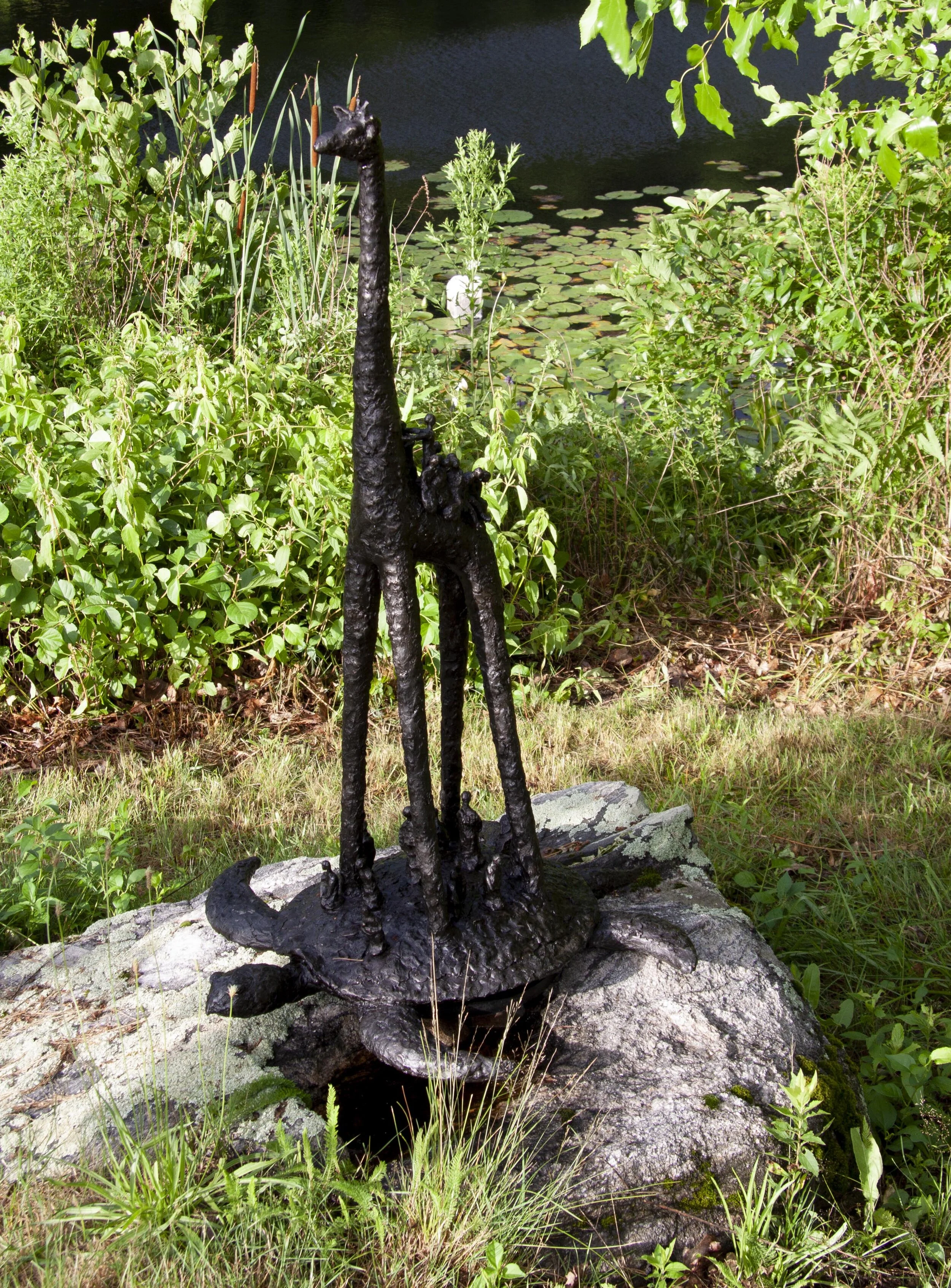
Then Refuge received its final patina and wax polish. It’s a long process. This piece is signed and numbered 1/5. Though my original waxes have disappeared, I have the molds to make four more copies. But always, for each one, we have to first make a new wax model, then cast it into bronze. After five copies, we’ll destroy the molds.
Lost wax is an apt metaphor for these times: The only way to create something new is to lose something. While we are collectively facing tremendous loss, it is good to reflect on the space that allows for something new to arise. The loss is real—people’s lives, habitat, species, jobs, freedom. I am alarmed, but I dearly want to believe that we can turn things around. We need humility. We need respect for every living being on the planet. Then the turtle and the giraffe, the heron and the wasp, the oak, the waterlily, and even the gnat will all be helping because we are all interconnected.
Refuge would have been outdoors at the Fuller Museum this summer, but Covid has delayed the opening of the New England Sculptors Exhibit until spring 2021. It sits on a chunk of bedrock outside my studio. I’d love to send more casting work Zach’s way, so if you would be interested in a copy of Refuge for your own garden, let’s talk.
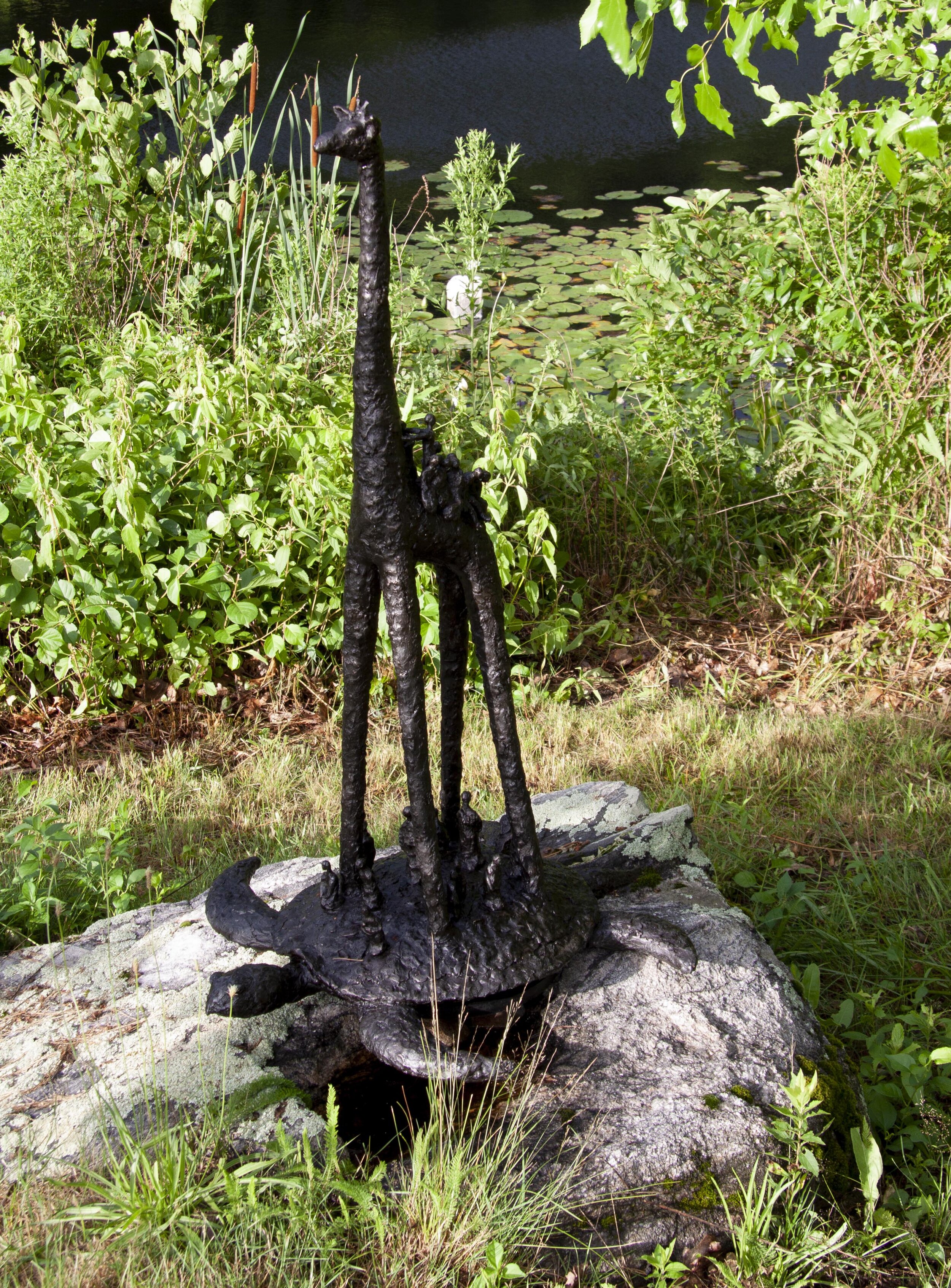
Refuge, bronze, 2020
Refuge is a hopeful piece. The determined, young giraffe and the tireless turtle are unconcerned with the enormity of their mission. They echo the world’s need for us to engage, to bring our gifts, and to offer help in this time of great loss. It’s a collective dance we can’t do alone.
Pointers for a Writing Life
At the farm, for the month of June, on Tuesdays, Wednesdays, and Thursdays, I will concentrate on the tasks in front of me. On the other days of the week, as much as possible, I plan to escape to a rental house on Cape Cod. It’s between Wellfleet and Truro on the ocean side, an area I love and where I have vacationed with my children since they were young. My plan is to work on a book I have been writing off and on for five years and more. I would like to finish it, am feeling the pressure to complete this project—or if it seems not-finish worthy, eject it. Send it over and out into the ethers—delete, delete. After all, it is only electronic bits of information.
But thankfully there is Annie Dillard. In her book, The Writing Life, she says, “Writing a book full-time takes between two and ten years.” She offers me relief. I have not been working full-time on this project. I have two other full-time jobs—art and the farm. She also says:
A work in progress quickly becomes feral. It reverts to a wild state overnight . . . As the work grows, it gets harder to control: it is a lion growing in strength. You must visit it every day and reassert your mastery over it. If you skip a day, you are, quite rightly, afraid to open the door to its room.
I understand this ferocity. At home, I cannot open the book for it might take over, grab hold of a leg and not let go. When I am on the road, or somewhere else, anywhere really, on a train, in a hotel room, and now at the Cape, for some reason the danger is not present and I can turn to it, dive in, and to my astonishment, do the work I love—the search to shape of an event, or an object, with words. And then there is the book itself, becoming an entity of its own, taking over, devising its own life. The two of us now living together.
I am writing about moving to Old Frog Pond Farm, assuming the care of the abandoned orchard, and committing to bringing it back organically. What got me here? Why did my marriage fail? How has my Zen practice braided through the orchard work? And what lessons have I learned that appear in my art?
Annie Dillard again:
The strain, like Giacometti’s penciled search for precision and honesty, enlivens the work and impels it toward is truest end. A pile of decent work behind him, no matter how small, fuels the writer’s hope . . .”
Yes, she is right, I do have hope. And then I fall short, I fail as I judge what I am writing. I hear myself say, I am not a real writer. I read other writers whose work I admire and see how my writing lacks their skill. How does one learn to write? Annie Dillard, thankfully, answers this question.
The page, the page, that eternal blankness, the blankness of eternity which you cover slowly, affirming time’s scrawl as a right and your daring as necessity; the page, which you cover woodenly, ruining it, but asserting your freedom and power to act, acknowledging that you ruin everything you touch but touching it nevertheless, because acting is better than being here in mere opacity; the page, which you cover slowly with the crabbed thread of your gut; the page in the purity of possibilities; the page of your death, against which you pit such flawed excellences as you can muster with all your life’s strength; that page will teach you to write.

Other than write, I take beach walks. On my first one, I stopped when I found a horseshoe crab upside down, it’s little pinchers barely moving. I turned it right side up and watched as it began to move. Its long tail spine pointing to where it had come from, its hulk moving towards the waves. It stopped after about ten feet, and I had this sickening feeling that it was dying, right there, in front of me. I touched its pointer, wriggled it from left to right, and it started up again, slowly, another six feet, scraping its way over the sand, leaving its foot-wide trail. We went through this ritual several more times, my teasing the pointer, the crab starting reluctantly to move, but each time it seemed to be moving more slowly.

When it finally reached the waves, I felt this was its most precarious place to be. It stalled. It waited. The surf poured over its hard shell. It seemed to be waiting for something. Then a large wave carried it into the jumble of surf. I saw was the tail spine, sticking up above the wave, pointing.
Mothers of the Earth
It’s a rainy and cold Mother’s Day morning. I smile though, as I walk to the studio and meet two families of geese shuffling their puff balls away from my threatening presence. The tireless care of these geese parents for their young, the overprotection, their ceaseless devotion strikes me as radical. What if we offered this kind of care to the world?
This morning I have no sculpture installations, no farm workers, visitors, or meditators. I thought about what I wanted to do with my free morning—a yoga class for my body, meditation for the mind, painting for the muse. There has been so much doing in the last month. Good doing, yes. Caring for the trees and the land. Meeting and helping artists. Delicious lists of a new asparagus bed to dig, raspberries to weed, young apple trees to weed and mulch, potatoes to plant, mowers to fix, dead trees to take down, buried rice to feed (we’re growing our own effective microbes to inoculate compost and orchard teas) and so on. But writing this blog is not on my to-do list, it is not something I do and say, now that’s done. It grows from a particular seed of quiet with the shape and color that only comes from being alone. I have to weed the garden of its to-dos in order to uncover what is growing.
Last Sunday we had a Crone Ceremony for the first time at the farm. Thirty-three women gathered to celebrate and bless each other.
An Online Etymology Dictionary defines crone with a lot of negativity:
late 14c., "a feeble and withered old woman," in Middle English a strong term of abuse, from Anglo-French carogne "carrion, carcass; an old ewe . . ."
The defintion ends with:
Since mid-20c. The word has been somewhat reclaimed in feminism and neo-paganism as a symbol of mature female wisdom and power.
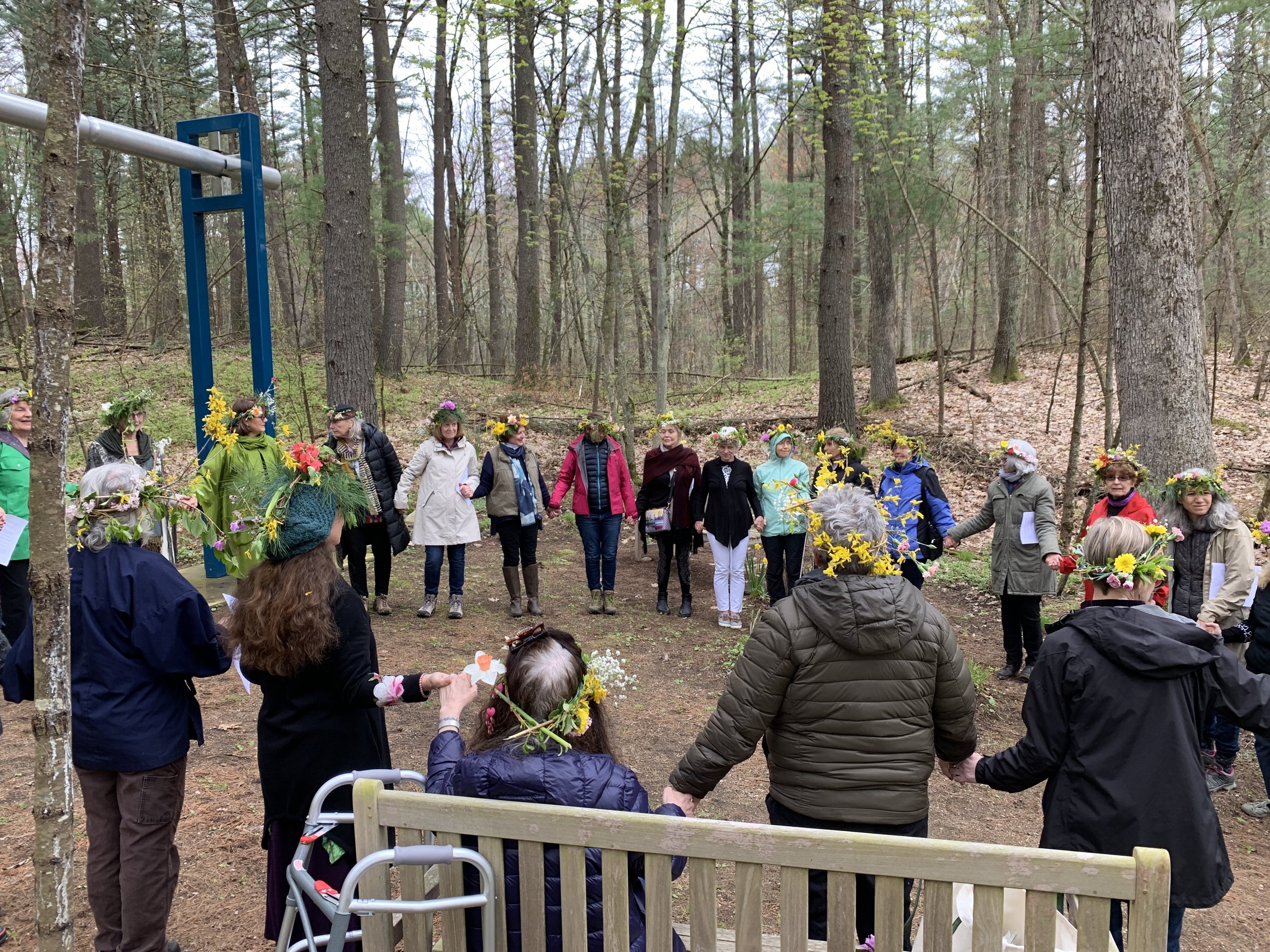
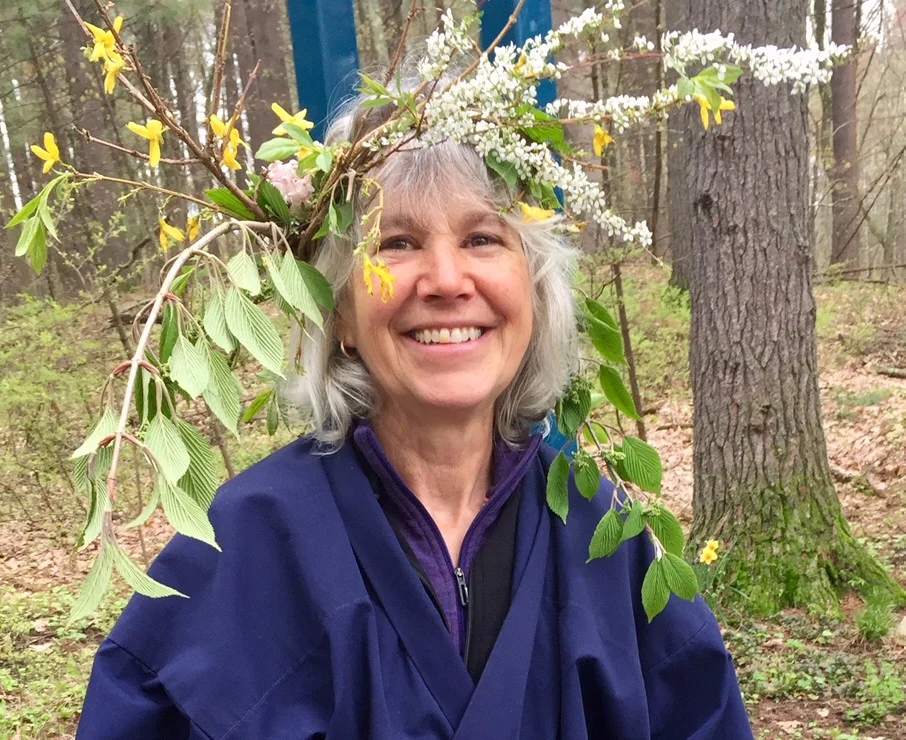
At our gathering, we made ourselves crowns with fresh forsythia branches and flowers. We joined to acknowledge the new shape of our lives as older women, as wise and creative women with enough experience to trust our intuition. We rang The Olympic Bell and listened as its deep note resounded through the grove of pine trees. We let go of habits that no longer serve our lives today by tossing a symbolic twig or stone into the current of the pond. We owned our creativity and freedom as we sang, Amazing Crones to the tune of Amazing Grace, and celebrated that we still have much to offer the world. We ended our ritual in a circle in The Medicine Wheel as each woman asked to be blessed, and the group chorused, We bless you, and spoke her name.

Like the cherry petals that have fallen, the flowers in our crowns faded quickly. I tossed mine into the woodstove the next morning. But, this week, the orchard apples opened their pink cloud hues and row upon row like trackless waves billow on every side. Will the Gods favor us with a good crop? Will the low temperatures forecast for Tuesday night freeze the about-to-open blossoms? Will bloom sustain the wind and rain long enough for the pollinators to do their work on the next sunny day?
Will our bodies trouble us too much so that we can no longer do the things we love? At our gathering we had one women who could no longer walk unsupported because of progressively debilitating Multiple Sclerosis. As she stepped with her walker into the middle of the circle, we felt her bravery and her struggle.
On this Mother’s Day, I offer a prayer for the earth and a blessing for our children and their children. May we do the work to provide good medicine to heal our beloved planet Earth. May we creatively cultivate the opening of all hearts for every sentient being. May we find the seeds of quiet to reconnect with what is important so that future generations will blossom and bear fruit.
We’re all mothers of the earth. Happy Mother’s Day!

The Apple-Shaped Earth
My last blog post was about the threat of one million square feet of warehouses being built not far from our orchard. With the concerned opposition of many citizens of Boxborough, we held back the tidal wave of development — at least for the moment. The planning board pulled their zoning articles from the upcoming town meeting warrant. There will be no vote on re-zoning until the fall. That change will give everyone time for regrouping and envisioning. The property at 1414 Massachusetts Avenue is still owned by Lincoln Properties, and warehouses are the most lucrative way for them to develop their land. The website of the Boxborough community group, Save Our Town Character says, “The potential for Zoning changes to allow warehouses as described below is still very high.” The need to protect the land and the character of the neighborhood is ongoing, but spring has officially arrived, and farm work has begun.
On our first day, Blase, Holly, our new farm worker, John, and I enjoyed the yearly ritual of burning the apple prunings. Ignited by a dry Christmas tree, crumbled newspaper, and kindling, the fire of prunings swayed in the wind. Sparks rose, and apple smoke filled a cloudless sky. Mallards, great blue herons, a woodpecker, and red-winged blackbirds chirped melodies.
I staked for the planting of fifty-three new trees from the apple rootstock we grafted one year ago. Blase attached the back hoe and has begun digging the holes. He is as much devoted to this farm and the orchard as I am.
It will be a marathon of planting. In each hole, the tap root will lead to the north. We’ll mix a little compost and our own bio-char from the burn, a great amendment for the soil, made by dousing the fire before it burns to ash. A cedar stake will go in each hole to support the tree as it grows, and we’ll back fill by hand, removing the large rocks, our most reliable crop. Trees will be watered, blessed, and mulched to suppress the competition with tough orchard grasses. We’d gladly welcome volunteers!
Next the airblast orchard sprayer needs to be tested and calibrated for the season. And oh, the hardest part for me, what are we going to spray? There are more options now for organic growers, and one tendency is to want to try everything. Another approach is to allow the trees to fend for themselves, building up their own immune system like a child must do who goes to preschool. I prefer the middle way, doing what we can to help build the immune system of the trees by improving the soil and spraying nutrients.
Last weekend we visited our grandchildren. Both girls had runny noses, and Blase came home with a nasty cold. As a friend remarked, “Young children are like Petri dishes.” Some might say apple leaves are similar. Every leaf is an incubator where good and bad bacteria and fungi duke it out, and the strongest wins and colonizes the leaf. We want to do what we can to encourage the good guys rather than spraying to get rid of the bad. And, once in a while, we will spray an organic pesticide for a particularly destructive pest, rather than lose the crop.

A mid-June apple hidden behind a leaf with spots of cedar apple rust.
The next two months will be the most crucial for the orchard. Will we have blossoms? Pollinators? Fruit set? A crop? Today, with the added pressures brought on by climate change, these are real questions. Orchards, like lands protected for conservation, keep us alive emotionally, spiritually, and physically. Our country was founded on the promises of agriculture, of self-sufficiency, of everyone growing food and fruit. The fruit orchard was a symbol of this belief in hard work, community, and opportunity for all. We are now far from this ideal as we destroy forests, oceans, and even the air.

Sculpture LH
But the apple remains a fruitful inspiration, as it was in the nineteenth century when Walt Whitman wrote in A Song of Occupations, decades before space ship photographs,
The sun and the stars that float in open air,
the apple-shaped earth and we upon it,
surely the drift of them is something grand.
Search Blog
-
2025
- May 9, 2025 A View from the Tractor Seat
- Apr 11, 2025 Dig
-
2024
- Jan 7, 2024 Winter Wassail
-
2022
- Dec 11, 2022 Keeping Time
- Jun 17, 2022 This Apple-Shaped Earth
- Jan 23, 2022 What is a Jizo?
- Jan 16, 2022 An Invite and Housekeeping Update
- Jan 1, 2022 The Year of the Frog: What Orchardists Do While Apple Trees are Chilling
-
2021
- Oct 24, 2021 Figs
- Oct 3, 2021 The Artist and the Orchard: A Memoir
- Aug 8, 2021 Red-Fleshed Apples
- Jul 25, 2021 When We Were Trees
- Jun 27, 2021 Castor Beans—Who Knew?
- Jun 13, 2021 Spring Training at a Zen Monastery
- May 4, 2021 Our Trees are in Bloom
- Apr 18, 2021 Hooray!
- Jan 24, 2021 Wassailing, virtually!
- Jan 1, 2021 Sitting
-
2020
- Dec 21, 2020 Darkness to Light
- Nov 28, 2020 One Heart
- Sep 18, 2020 Juggling Flowers, Fruit, and Vegetables
- Aug 23, 2020 Refuge
- Aug 9, 2020 Bags of Fertilizer
- Aug 2, 2020 The Sermon of the Blue Heron
- Jul 26, 2020 What's the Buzz?
- Jul 19, 2020 Farm Moments
- Jul 12, 2020 Lost Wax
- Jul 5, 2020 Catalpa: The Hugging Tree
- Jun 28, 2020 Pedaling Peace
- Jun 21, 2020 See Change
- Jun 14, 2020 Lalla Unveiled
- Jun 7, 2020 Pond Alchemy
- May 31, 2020 The Birth of Fruit
- May 24, 2020 An Artist in the Orchard
- May 17, 2020 Walking the Land: Returning Home
- May 10, 2020 Stinging Nettles: Gifts from the Great Mother
- May 3, 2020 The Mystery of Swallow
- Apr 26, 2020 Aerial Bruststrokes
- Apr 19, 2020 Simple Pleasures
- Apr 12, 2020 Weeds and Other Gifts
- Apr 5, 2020 Remembering the Seeds
- Mar 29, 2020 Blow on the Embers
- Mar 22, 2020 Ripples
-
2019
- Nov 16, 2019 Tibet Impressions
- Nov 9, 2019 Forest Tales
- Oct 13, 2019 The Gift
- Aug 4, 2019 The Season is Apples, Berries, and Grandfather Fire
- Jun 8, 2019 Pointers for a Writing Life
- May 12, 2019 Mothers of the Earth
- Apr 6, 2019 The Apple-Shaped Earth
- Mar 23, 2019 You Don’t Know What You Have Till It’s Gone
- Feb 23, 2019 Generations
- Feb 9, 2019 What Are We Doing to the Earth, John Chapman?
-
2018
- Dec 31, 2018 Long Shadows
- Oct 6, 2018 A Pilgrimage to India
- Aug 18, 2018 Scrap Wrenn
- Aug 11, 2018 Off-the-Wall Comments from an Ignorant Farmer
- Jul 28, 2018 Creative Connect
- Jul 14, 2018 How is the Orchard?
- Jun 30, 2018 Which Way?
- Jun 16, 2018 Geese, Herons, Beavers, and the Baby Steps of a Lapsed Blogger
- Feb 24, 2018 Mama's Coupons — Good Forever
- Jan 27, 2018 January Ice
- Jan 13, 2018 The Muse
-
2017
- Dec 30, 2017 A Dream for the New Year
- Dec 23, 2017 A New Year for Apples
- Dec 16, 2017 Intuition
- Nov 22, 2017 Thanksgiving OM
- Nov 4, 2017 East Fork Pottery
- Oct 28, 2017 Putting Down New Roots
- Oct 21, 2017 A is for Art
- Oct 14, 2017 Eve domesticus
- Oct 7, 2017 A String Workshop
- Sep 30, 2017 After Applepicking
- Sep 23, 2017 Two Bad Women and One Good Apple
- Sep 16, 2017 Plein Air Poetry
- Sep 9, 2017 Cutting Off a Leg
- Sep 2, 2017 The Changing Landscape
- Aug 26, 2017 All About Art
- Aug 19, 2017 My First Visit to the Farm
- Aug 12, 2017 The First Food
- Aug 5, 2017 A Teapot, a Woman, and maybe a Boat
- Jul 29, 2017 A Raspberry Dilemma
- Jul 22, 2017 Consider the Miracle
- Jul 15, 2017 Meeting Ekphrasis
- Jul 8, 2017 Ripening Fruit
- Jul 1, 2017 The Voice of The Caterpillar
- Jun 24, 2017 Goumi — An Unusual Fructus
- Jun 17, 2017 Concord, an American Bloomsbury
- Jun 10, 2017 The World Is Bonkers — Shall I Laugh or Cry?
- Jun 3, 2017 Bonkers, a Revolutionary Apple
- May 27, 2017 Guardians of the Swamp
- May 20, 2017 There are Mushrooms and There are Morels
- May 13, 2017 "What's in a Name?"
- May 6, 2017 Bloom Follows Pink: Orchard Pollination
- Apr 29, 2017 The Orchard Is at Pink
- Apr 22, 2017 Natural Farming — Part 2 (continuation from last Sunday's blog)
- Apr 15, 2017 Natural Farming — Part 1
- Apr 8, 2017 Boats, Figures, and Catching Fish
- Apr 1, 2017 A Man with a Mission: The Nuts and Bolts of Bronze Casting
- Mar 25, 2017 A Chalice of Spirit, Art, and Nature
- Mar 18, 2017 Hanami — Blossom Viewing
- Mar 11, 2017 Soil Redemption Song
- Mar 4, 2017 Food is Primary Care
- Feb 25, 2017 Pomme de Terre
- Feb 18, 2017 Organic Certification
- Feb 11, 2017 Tantalizing Fruit
- Feb 4, 2017 The Myths of History
- Jan 28, 2017 The Orchard in Winter
- Jan 21, 2017 The Hi-Line
- Jan 14, 2017 Artistic, Botanical, and Social Diversity
- Jan 7, 2017 Where is Eden?
-
2016
- Dec 31, 2016 The Creative Heart
- Dec 24, 2016 A Christmas Tale
- Dec 17, 2016 Who are the Crones?
- Dec 10, 2016 The Olympic Bell (Part Two)
- Dec 3, 2016 Overheard in the Apple Orchard in Early December
- Nov 26, 2016 The Lessons of a Tortoise
- Nov 19, 2016 In the Studio
- Nov 12, 2016 Even in Darkness
- Nov 5, 2016 Southern Apples, an Elephant, Monkey, Rabbit, and Bird, Two Mango Trees and a Birthday
- Oct 29, 2016 The Tools of Art
- Oct 22, 2016 Labyrinths
- Oct 15, 2016 Repairing the Broken
- Oct 8, 2016 When You Are No More
- Oct 1, 2016 Creation Rain
- Sep 24, 2016 Breaking the Glass
- Sep 17, 2016 String Art
- Sep 10, 2016 Poetry and Photosynthesis: It's all in the Leaves
- Sep 3, 2016 In the Plenty of Time
- Aug 27, 2016 Witch Doctors
- Aug 20, 2016 Listen Coyote
- Aug 13, 2016 Milkweed in the Orchard
- Aug 6, 2016 Some People See a Turtle
- Jul 30, 2016 Arborshaping
- Jul 23, 2016 Joseph Wheelwright: Sculptor of Stones and Trees
- Jul 16, 2016 Asian Pears
- Jul 9, 2016 Gold Leaf, Grief, and the Creative Process
- Jul 2, 2016 The Olympic Bell (Part One)
- Jun 25, 2016 Around the Mulberry Bush
- Jun 18, 2016 Avoiding Apples
- Jun 11, 2016 Fructus
- Jun 4, 2016 Astonishing Apples
- May 28, 2016 Scare the Caterpillars
- May 21, 2016 Join the Club!
- May 14, 2016 The Graft
- May 7, 2016 Rooster, Rhubarb, Rue
- Apr 30, 2016 What do Dolphins and Nettles Have in Common?
- Apr 23, 2016 Art Prunings
- Apr 16, 2016 A Few of the First Arrivals
- Apr 9, 2016 Taste the Spirit of Sustainable Agriculture
- Apr 2, 2016 First Orchard Spray - March 22-24, 2016
- Mar 26, 2016 Hawkeye Apple
- Mar 19, 2016 Desiring the Almata Apple
- Mar 12, 2016 Ugly Fruit
- Mar 5, 2016 Winter Tracks
- Feb 27, 2016 Splash
- Feb 20, 2016 Pruning
- Feb 13, 2016 Orchard Ruminants
- Feb 6, 2016 A Gathering of Seeds
- Jan 30, 2016 Orchard Dragons
- Jan 23, 2016 Tree Rings
- Jan 17, 2016 The Fallen Tree
- Jan 7, 2016 Wassailing the Apple Trees
- Jan 1, 2016 The New Year