LINDA HOFFMAN
Our Trees are in Bloom
As an apple orchardist I pay attention to the buds. Will they be strong? Are they healthy? How will I take care of them, because I know—left alone, an orchard in New England will become a massive tangle of brambles, invasive vines, and diseased fruit.
We’ve already sprayed the apple trees with fish fertilizer, seaweed, a little copper, and two different biological fungicides to make sure our buds are protected from the spring diseases. Microscopic fungal spores will rise from the soil beneath the tree in a light rain and land on the leaves. There they find purchase and grow. Once the fruit develops, the fungus jumps to the fruit, ultimately making scab-like forms covering over the developing fruit. Once infection begins, it’s hard to reverse. Spores are released over the four-to-six-week period until we reach 100% release.
Every year I have to be prepared for scab, the nickname orchardists use for the fungus, Venturia inaequalis, one of the early apple diseases and one of the worst problems for organic orchardists in New England. I remember when I first learned to spray. Suited up in protective gear, spray tank filled with 300 gallons of water and the spray materials, the tractor settings in low speed, 3rd gear, at 1700 rpms, I was told that the spray for scab needed to renewed before every wetting period. It seemed an overwhelming proposition. If it rained one day, and then four days later, I needed to spray again because the material would have washed off the trees.
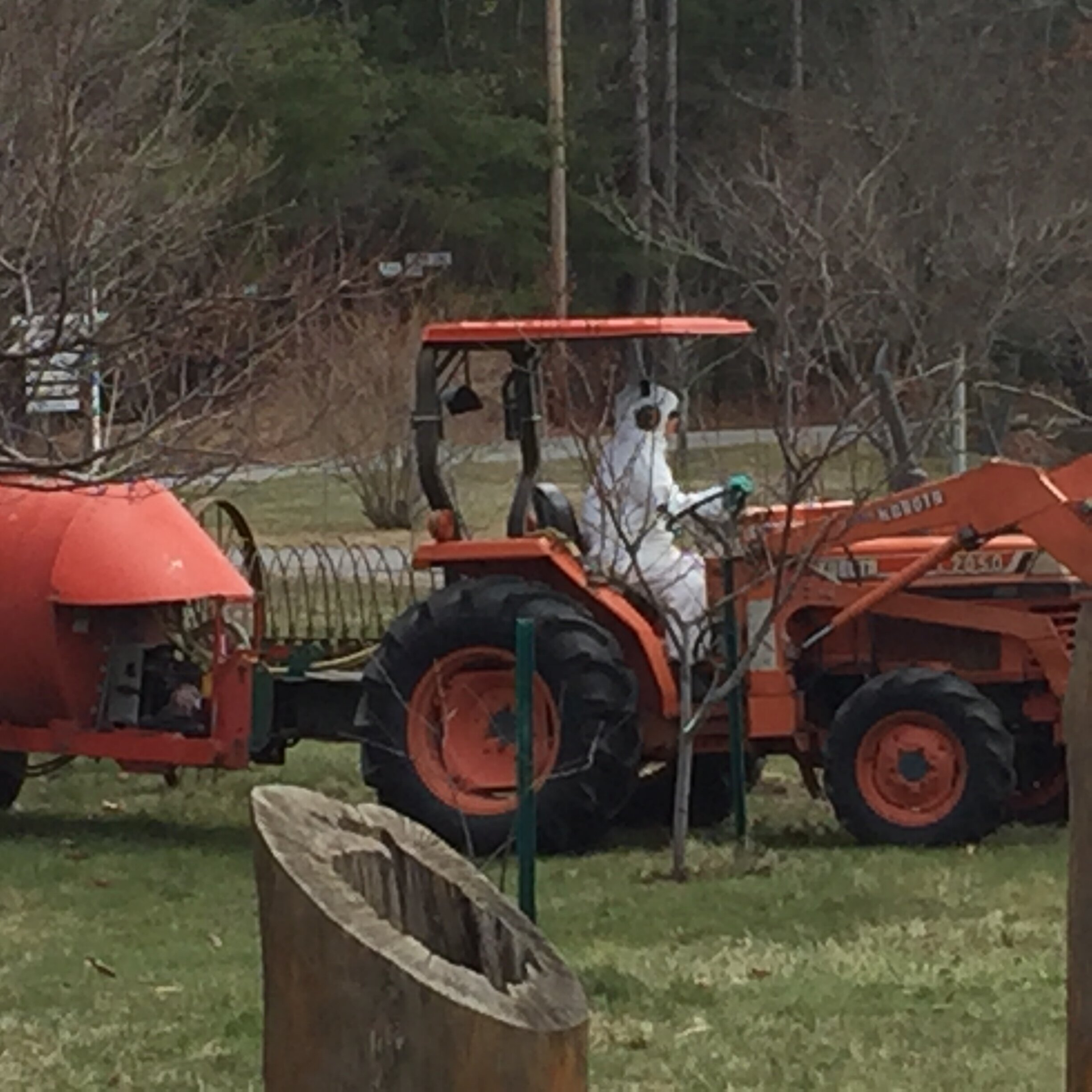
First Spray
Since that time, I’ve learned to time our sprays to most effective for the maximum spore release. I’ve planted many new scab-resistant varieties in our orchard, and removed some of the scab magnet trees like Macintosh. And since 2006 when Old Frog Pond Farm received organic certification, new bio-fungicides are available for organic orchards.
Orchardists have their own language to describe the stages from bud to blossom. Dormant describes the trees in winter, when the buds are gray-brown and tightly closed. They wait for the right combination of temperature and length of daylight to awaken. The outer sheath on the bud is a winter quilt protecting the folded blossom inside. When the apple bud breaks dormancy, the covering of the fruit bud opens slightly to reveal light gray tissue, silver tip.
Then comes green tip. The buds plump in response to warmth and light. The bud opens further to reveal a green plant tissue. The next stage, half-inch green or mouse ears, is an apt description as two tiny oblong-shaped leaves appear. Tight cluster follows with a rosette of green leaves around a tightly packed flower bud. Pink stage is next, as this singular flower bud separates into five or six individual pink-sheathed blossom buds.

This is the most exciting moment in the orchard, for each of these flower buds, if pollinated, will become an apple. In the center the king blossom opens first. It’s the strongest and largest bud. The others follow; reserves for the tree in case something happens to the King. Full bloom is when all blossoms are open. Pollinators arrive from far and wide to drink sweet apple nectar and unknowingly pollinate the trees.
Our trees are in full bloom, and I won’t spray again until the petals fall. Bloom is the time when I walk through the orchard rows and feel overwhelming gratitude to be part of such fragile beauty.
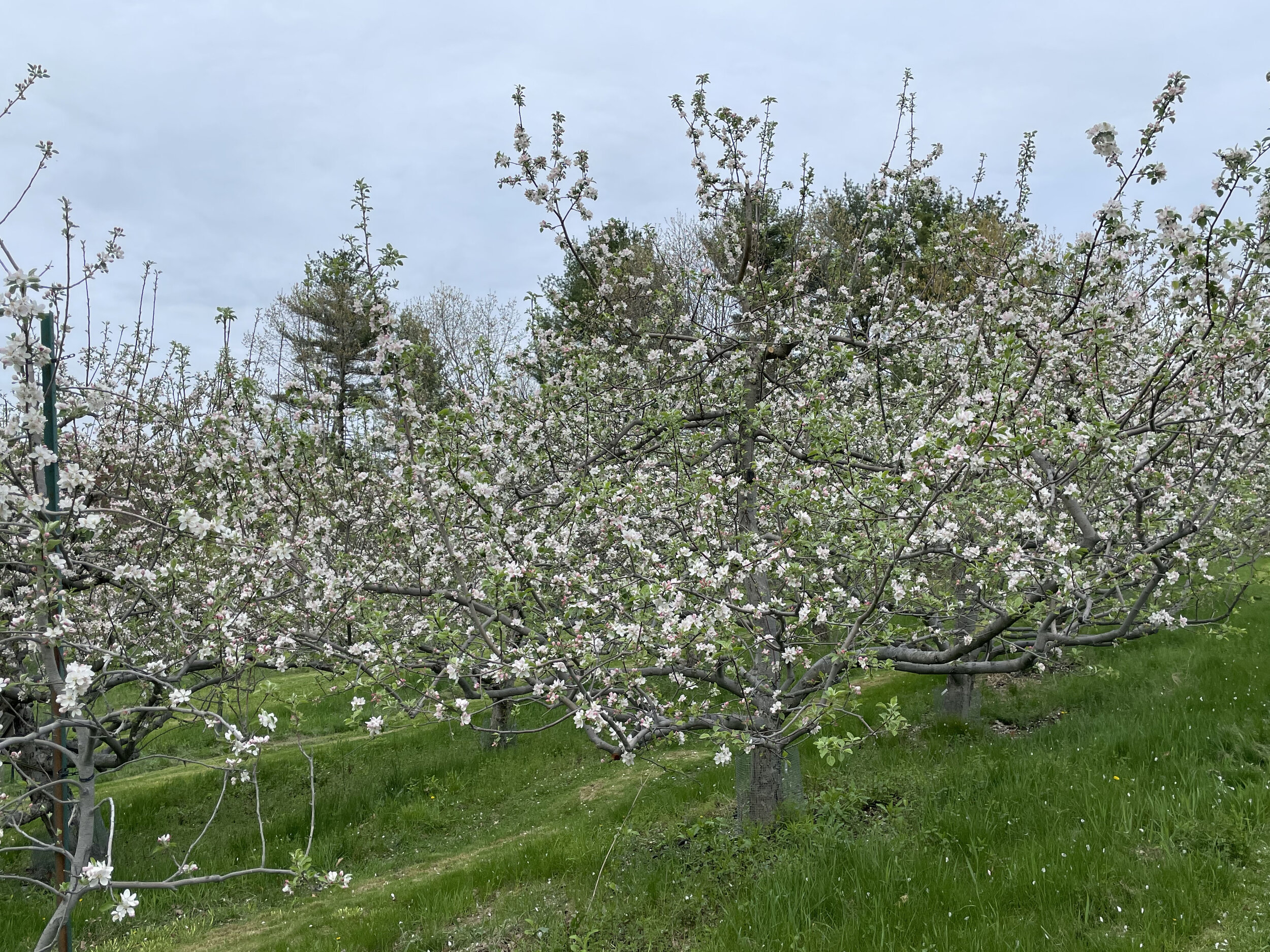
May 4, 2021 Old Frog Pond Farm
An Artist in the Orchard
Usually I carry a spade, loppers, clippers, a weeding tool, a basket with rubber ties, and wire into the orchard. But like a plein air painter who leaves the studio and brings paints and brushes to the subject, I bring a notebook and pen, and sit in a patch of purple violets under a Golden Delicious apple tree.

Along with the violets, two varieties of clover are growing—mammoth red and white Dutch. I love clover under my apple trees—and daffodils and dandelions, mountain mint and comfrey, iron weed, valerian, St. John’s wort, bee balm, even stinging nettles. The more companion plants, the richer the soil.

Notebook page 5/16/20
Most people don’t realize that one apple bud opens to become a cluster of five or six flower buds. The king blossom is in the center; it’s the first to grow and the first to open. It’s surrounded by the harem waiting to take over if anything should happen to the king.
In a stellar pollination year, most of the secondary blossoms will be pollinated and the tree becomes a cloud of delicate wings. The downside is too many children. The apples will be small, with more disease and pest pressure, and less air circulation and sunlight, not beneficial for the crop.
On this particular Golden Delicious tree, I see only a few blossoms. Golden Delicious have a propensity to be biennial—a riot of blossoms one year, and the next only a scattering. Orchardists can control this tendency by “thinning” the trees, removing a portion of the young fruit. As an organic grower, I don’t have an array of chemical thinners to choose from, but I can hand thin. On our youngest trees, we pluck off all the blossoms, discouraging such precocious behavior; these trees need to focus on growth, not reproduction! On the younger trees, we remove some of the fruitlets, leaving a few inches between apples. But on the mature trees, when the fruit set is crazy-good, our feeble efforts to thin hardly make a difference. One tree alone could occupy an afternoon, and we don't have a month to devote to thinning. I leave the Golden Delicious to do as they are inclined. Other trees, like the newer varieties of Liberty and Honey Crisp, are bred to discourage this trait.
The upside of this off-year is all energy goes into growing large and shiny leaves—optimal photosynthesis. A time of repose, a sabbatical to recharge. As I sit in its shade, I think about what the tree offers other than fruit. Maybe nutritive support to other trees and to the soil around its roots? Maybe sequestering more carbon? Maybe that strange notion, self-care?
This Golden Delicious tree is over 45 years old, and some orchard experts say it should be replaced because it’s old and leaning too far south. But I’m enthralled by its wayward slant, its zig-zag desire to find equipoise. In the photo below you can see the young branch I’m training to become a new central leader if necessary.

Being both orchardist and artist is at times contradictory. Should I spray a particularly nasty, but approved organic material like lime sulfur to thin the Golden Delicious so they don’t fall into biennial production? After all, we have 28 mature Golden Delicious trees with no fruit, and that’s a lot of real estate in a small orchard. The truth is I appreciate the gnarly old trees and the young slender spindles, the trees with no apples and the trees loaded with fruit.
I finish taking notes and gather violets to put in a jar of olive oil for next fall when we will make salves and balms. A pair of cedar waxwings are courting in one of the Gala trees, and two orioles sing from high in a Summer Sweet. The woodchuck peeks out of a nearby hole, and upon seeing me, ducks back down. The geese hiss. On my walk back to the house, I snap off two fat purple asparagus no doubt planted by some robin scratching for worms near the trunk of a Cortland in the first row. Today I’m an artist in the orchard. Tomorrow I’ll return with other tools.

Apple Tree, Watercolor and Pencil, 2020, Linda Hoffman
Bloom Follows Pink: Orchard Pollination

Bloom is the stage when the closed pink flower buds open to pale, white papery blossoms. This is when the party in the orchard really gets going. You can hear the swoosh of long dresses, the honeybees’ buzz; and follow the flight of the bumblebees, recklessly circling, then landing, the honeybees alighting on flowers, drinking in sweet nectar.
Bees visit a lot of flowers to gather this ambrosia, logging between several hundred and fifteen hundred flower visits on each trip through the orchard. They suck in the sweetness with their long proboscis, then store these sugars in their nectar stomach. Upon returning to the hive with a full belly, another bee will withdraw the nectar, process it, and transfer it into individual cells.

When the bees gather nectar from inside the apple blossoms, they brush across the pollen sitting on small pillows supported by stamens. The pollen grains attach to Velcro-like hairs on the bees’ bodies. When the bee visits another tree, the pollen from one tree is brushed from the bee onto the sticky female stigmas in the center of the blossom of another tree. The pollen grains travel down tubes to reach the ovary. There, sperm in the pollen grain meets the ovules in the ovary. These fertilized ovules become seeds, and the apple grows to protect the growing pips. We find this flesh delicious!
Honeybees need pollen and water, as well as nectar. The bees will divide up these responsibilities for the hive – some gathering pollen, their main source of protein; while others gather nectar for the sugars, and still others water. Some bees including honeybees have ‘pollen baskets’ on their hind legs formed by woven hairs. The bees also have hairs on the inside of their legs that they use like combs to gather the pollen sticking all over their bodies and push it into the basket, mixing in a little sticky nectar, so the pollen packs tightly. You can see the bees sporting bright yellow Turkish pants if you wander through the orchard when they are flying.
This year I am worried about pollination. I can’t remember a bigger bloom in the orchard — or this much spring rain! The bees don’t fly until the temperature reaches fifty-five degrees. In the last week, we’ve only had about five hours of honeybee pollinating temperatures without rain. Fortunately, the native pollinators, like the bumble bees, will fly in cooler temperatures. Only about five percent of apple blossoms need to be pollinated for a good harvest; the tree produces that many ‘extra’ flowers. But, maybe we should not consider them ‘extra.’ These flowers feed the many pollinators. The tree practices generosity. Giving and receiving are one.
If the apples practiced self-pollination, that is one flower on a tree pollinating other flowers on the same tree, it would require less flying. Peanuts, peas, tomatoes, and sunflowers are examples of self-pollinating plants. However, many plants, like most apples, have evolved to require cross-pollination to ensure genetic diversity. In scientific terms, this type of pollination is referred to as self-incompatible, or “unable to survive without another.” These plants all need another plant or tree in their life to bear fruit.
Cross-pollination is critical to a life cycle that ensures the continuity of the species. Maybe human beings aren’t so different. We are not self-compatible either. We need to interact with people different from ourselves to learn and grow. The cross-pollination of cultures, experiences, and ideas may be the ambrosia we need for a healthy, peace-filled world.

A Baltimore Oriole enjoying sweet nectar from a Macintosh tree.
Search Blog
-
2025
- May 9, 2025 A View from the Tractor Seat
- Apr 11, 2025 Dig
-
2024
- Jan 7, 2024 Winter Wassail
-
2022
- Dec 11, 2022 Keeping Time
- Jun 17, 2022 This Apple-Shaped Earth
- Jan 23, 2022 What is a Jizo?
- Jan 16, 2022 An Invite and Housekeeping Update
- Jan 1, 2022 The Year of the Frog: What Orchardists Do While Apple Trees are Chilling
-
2021
- Oct 24, 2021 Figs
- Oct 3, 2021 The Artist and the Orchard: A Memoir
- Aug 8, 2021 Red-Fleshed Apples
- Jul 25, 2021 When We Were Trees
- Jun 27, 2021 Castor Beans—Who Knew?
- Jun 13, 2021 Spring Training at a Zen Monastery
- May 4, 2021 Our Trees are in Bloom
- Apr 18, 2021 Hooray!
- Jan 24, 2021 Wassailing, virtually!
- Jan 1, 2021 Sitting
-
2020
- Dec 21, 2020 Darkness to Light
- Nov 28, 2020 One Heart
- Sep 18, 2020 Juggling Flowers, Fruit, and Vegetables
- Aug 23, 2020 Refuge
- Aug 9, 2020 Bags of Fertilizer
- Aug 2, 2020 The Sermon of the Blue Heron
- Jul 26, 2020 What's the Buzz?
- Jul 19, 2020 Farm Moments
- Jul 12, 2020 Lost Wax
- Jul 5, 2020 Catalpa: The Hugging Tree
- Jun 28, 2020 Pedaling Peace
- Jun 21, 2020 See Change
- Jun 14, 2020 Lalla Unveiled
- Jun 7, 2020 Pond Alchemy
- May 31, 2020 The Birth of Fruit
- May 24, 2020 An Artist in the Orchard
- May 17, 2020 Walking the Land: Returning Home
- May 10, 2020 Stinging Nettles: Gifts from the Great Mother
- May 3, 2020 The Mystery of Swallow
- Apr 26, 2020 Aerial Bruststrokes
- Apr 19, 2020 Simple Pleasures
- Apr 12, 2020 Weeds and Other Gifts
- Apr 5, 2020 Remembering the Seeds
- Mar 29, 2020 Blow on the Embers
- Mar 22, 2020 Ripples
-
2019
- Nov 16, 2019 Tibet Impressions
- Nov 9, 2019 Forest Tales
- Oct 13, 2019 The Gift
- Aug 4, 2019 The Season is Apples, Berries, and Grandfather Fire
- Jun 8, 2019 Pointers for a Writing Life
- May 12, 2019 Mothers of the Earth
- Apr 6, 2019 The Apple-Shaped Earth
- Mar 23, 2019 You Don’t Know What You Have Till It’s Gone
- Feb 23, 2019 Generations
- Feb 9, 2019 What Are We Doing to the Earth, John Chapman?
-
2018
- Dec 31, 2018 Long Shadows
- Oct 6, 2018 A Pilgrimage to India
- Aug 18, 2018 Scrap Wrenn
- Aug 11, 2018 Off-the-Wall Comments from an Ignorant Farmer
- Jul 28, 2018 Creative Connect
- Jul 14, 2018 How is the Orchard?
- Jun 30, 2018 Which Way?
- Jun 16, 2018 Geese, Herons, Beavers, and the Baby Steps of a Lapsed Blogger
- Feb 24, 2018 Mama's Coupons — Good Forever
- Jan 27, 2018 January Ice
- Jan 13, 2018 The Muse
-
2017
- Dec 30, 2017 A Dream for the New Year
- Dec 23, 2017 A New Year for Apples
- Dec 16, 2017 Intuition
- Nov 22, 2017 Thanksgiving OM
- Nov 4, 2017 East Fork Pottery
- Oct 28, 2017 Putting Down New Roots
- Oct 21, 2017 A is for Art
- Oct 14, 2017 Eve domesticus
- Oct 7, 2017 A String Workshop
- Sep 30, 2017 After Applepicking
- Sep 23, 2017 Two Bad Women and One Good Apple
- Sep 16, 2017 Plein Air Poetry
- Sep 9, 2017 Cutting Off a Leg
- Sep 2, 2017 The Changing Landscape
- Aug 26, 2017 All About Art
- Aug 19, 2017 My First Visit to the Farm
- Aug 12, 2017 The First Food
- Aug 5, 2017 A Teapot, a Woman, and maybe a Boat
- Jul 29, 2017 A Raspberry Dilemma
- Jul 22, 2017 Consider the Miracle
- Jul 15, 2017 Meeting Ekphrasis
- Jul 8, 2017 Ripening Fruit
- Jul 1, 2017 The Voice of The Caterpillar
- Jun 24, 2017 Goumi — An Unusual Fructus
- Jun 17, 2017 Concord, an American Bloomsbury
- Jun 10, 2017 The World Is Bonkers — Shall I Laugh or Cry?
- Jun 3, 2017 Bonkers, a Revolutionary Apple
- May 27, 2017 Guardians of the Swamp
- May 20, 2017 There are Mushrooms and There are Morels
- May 13, 2017 "What's in a Name?"
- May 6, 2017 Bloom Follows Pink: Orchard Pollination
- Apr 29, 2017 The Orchard Is at Pink
- Apr 22, 2017 Natural Farming — Part 2 (continuation from last Sunday's blog)
- Apr 15, 2017 Natural Farming — Part 1
- Apr 8, 2017 Boats, Figures, and Catching Fish
- Apr 1, 2017 A Man with a Mission: The Nuts and Bolts of Bronze Casting
- Mar 25, 2017 A Chalice of Spirit, Art, and Nature
- Mar 18, 2017 Hanami — Blossom Viewing
- Mar 11, 2017 Soil Redemption Song
- Mar 4, 2017 Food is Primary Care
- Feb 25, 2017 Pomme de Terre
- Feb 18, 2017 Organic Certification
- Feb 11, 2017 Tantalizing Fruit
- Feb 4, 2017 The Myths of History
- Jan 28, 2017 The Orchard in Winter
- Jan 21, 2017 The Hi-Line
- Jan 14, 2017 Artistic, Botanical, and Social Diversity
- Jan 7, 2017 Where is Eden?
-
2016
- Dec 31, 2016 The Creative Heart
- Dec 24, 2016 A Christmas Tale
- Dec 17, 2016 Who are the Crones?
- Dec 10, 2016 The Olympic Bell (Part Two)
- Dec 3, 2016 Overheard in the Apple Orchard in Early December
- Nov 26, 2016 The Lessons of a Tortoise
- Nov 19, 2016 In the Studio
- Nov 12, 2016 Even in Darkness
- Nov 5, 2016 Southern Apples, an Elephant, Monkey, Rabbit, and Bird, Two Mango Trees and a Birthday
- Oct 29, 2016 The Tools of Art
- Oct 22, 2016 Labyrinths
- Oct 15, 2016 Repairing the Broken
- Oct 8, 2016 When You Are No More
- Oct 1, 2016 Creation Rain
- Sep 24, 2016 Breaking the Glass
- Sep 17, 2016 String Art
- Sep 10, 2016 Poetry and Photosynthesis: It's all in the Leaves
- Sep 3, 2016 In the Plenty of Time
- Aug 27, 2016 Witch Doctors
- Aug 20, 2016 Listen Coyote
- Aug 13, 2016 Milkweed in the Orchard
- Aug 6, 2016 Some People See a Turtle
- Jul 30, 2016 Arborshaping
- Jul 23, 2016 Joseph Wheelwright: Sculptor of Stones and Trees
- Jul 16, 2016 Asian Pears
- Jul 9, 2016 Gold Leaf, Grief, and the Creative Process
- Jul 2, 2016 The Olympic Bell (Part One)
- Jun 25, 2016 Around the Mulberry Bush
- Jun 18, 2016 Avoiding Apples
- Jun 11, 2016 Fructus
- Jun 4, 2016 Astonishing Apples
- May 28, 2016 Scare the Caterpillars
- May 21, 2016 Join the Club!
- May 14, 2016 The Graft
- May 7, 2016 Rooster, Rhubarb, Rue
- Apr 30, 2016 What do Dolphins and Nettles Have in Common?
- Apr 23, 2016 Art Prunings
- Apr 16, 2016 A Few of the First Arrivals
- Apr 9, 2016 Taste the Spirit of Sustainable Agriculture
- Apr 2, 2016 First Orchard Spray - March 22-24, 2016
- Mar 26, 2016 Hawkeye Apple
- Mar 19, 2016 Desiring the Almata Apple
- Mar 12, 2016 Ugly Fruit
- Mar 5, 2016 Winter Tracks
- Feb 27, 2016 Splash
- Feb 20, 2016 Pruning
- Feb 13, 2016 Orchard Ruminants
- Feb 6, 2016 A Gathering of Seeds
- Jan 30, 2016 Orchard Dragons
- Jan 23, 2016 Tree Rings
- Jan 17, 2016 The Fallen Tree
- Jan 7, 2016 Wassailing the Apple Trees
- Jan 1, 2016 The New Year