LINDA HOFFMAN
The Year of the Frog: What Orchardists Do While Apple Trees are Chilling
I’m working in the studio on a sculpture of a frog. I talk to it while I sculpt it. I ask questions. I stroke it and I pat it. You might say I have fallen in love with this frog—though I’m not intending to kiss it, and definitely not desiring to meet a prince. This is not a frog of fairytales, but the frog who is the subject of a haiku by Matsuo Basho, Japan’s most influential 17th century haiku master.
Haiku was originally a seventeen-syllable introductory verse to a longer series of linked poems. Then in the middle of the 15th century, people began to write these short poems as a separate form. They sent them to each other, shared them. They were often playful. Basho, a maverick, was keen to use this form of poetry to express something more serious. For almost all of his life he explored the writing of haiku. Haiku became an evocation of an experience, of a moment. As an art form, it aligned with the development of Zen Buddhism in Japan, and became an instantaneous presentation of the whole without intellectual commentary.
How much could be expressed in few words? How to express an emotion like loneliness without using the word?
In 2001, when I first visited this rundown farm with its old apple orchard, I was awed by its large pond. Years earlier I had lived in Japan and been influenced by the Zen poets and traditional Japanese arts. This pond reminded me of one of Basho’s haiku and I named the farm Old Frog Pond. There are at least a hundred translations of the poem—some quite strange—but literarily it is:
Furu ike ya/ old pond (‘ya’ is a word of emphasis but without specific meaning)
Kawazu tobikomu/ frog jumps
Mizu no oto/water’s sound
In a traditional haiku, the first line often sets the scene. In this poem, we are introduced to the view of the old pond. This ageless pond might make us think about the beauty of the moon’s reflection in water, or how an old willow’s branches coax ripples on its surface. The pond may hold in its depth old carp, ancient beings.
In the second line, our gaze narrows as we see a frog. In traditional haiku writing, “Frog” was considered a season word to indicate spring. In Basho’s poem this little frog appears, a small creature, perhaps just coming out of the mud on an early spring day. Our mind holds the fragility of the frog within the expansive pond. We hold the singular among the universal.
Then, all of sudden, we are woken from our musings with a ‘splash’—the sound caused by the frog’s jump breaking the surface of the water.
Suddenly, everything disappears—our thoughts about this old pond, about the frog, the season, the setting. Only the sound exists. We are no longer thinking or making up a story. No frog and princess here. For a moment we even forget ourselves—just splash!
What does it take to be absorbed in the moment? Why is this significant?
How do we absorb ourselves in an experience? How do we have an experience?
Who is this ‘we’ that experiences?
Basho trained for several years as a Zen monk. He continued to wear the robes of a monk as his daily garb. His writing of haiku was the practice of a Zen art. His language was always simple yet conveyed the complexity of our heart/mind. In Japanese the character for kokoro, carries the meaning of ‘heart’ and ‘mind’, unlike in English where these two words are distinct.
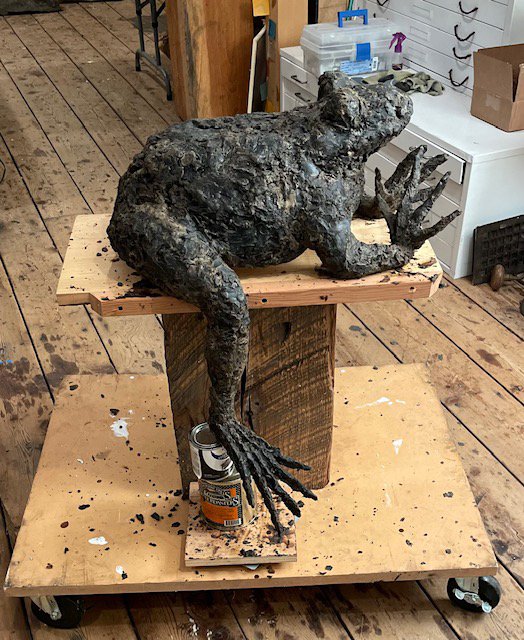
Working on sculpture is different from writing. I form the muscles of the leg with melted wax. I press and shape the thick and sinuous body parts. I carve into hard wax the lines of the nail ridges on its webbed feet. Wax sticks to my finger tips and palms, and hardened wax packs behind my nails. When I work on the frog, I touch only frog. When I gaze at the frog, I see only frog. This frog does not jump. It is sitting. Contemplative you might say. Prayerful even. There is no splash.
A concrete pillar stands in the water between the lower pond and the small stone bridge before the pond water flows into the vast Delaney wetlands. It’s been calling for a sculpture since I moved here. Once this frog is cast into bronze, it will live on the post and gaze east towards the rising sun. Its feet will dangle and tease the water.
While working on the sculpture, I wondered if the frog should be carrying anything on its back or holding anything in its hands. But the frog was adamant. I’m just a frog. I’m a frog that is completely myself. Not going anywhere, not doing anything. Maybe that’s why I love it. Maybe that’s what love is—not needing something or someone or ourselves to be any more than just what and who we are. Not needing to do anything, only experiencing this moment fully.
Next spring I hope you will come to see this Frog in its new home.
May we all find the stillness and wakefulness of Basho’s Frog in the New Year!

The Artist and the Orchard: A Memoir
I now hold the book in my hands. I’m surprised by its slight weight, it’s smooth surface. The cover painting is a detail from a watercolor of the orchard and inside are the rows of trees: training in the Noh Theater in Kyoto, raising my children in the old Baptist church in Groton, Massachusetts, moving to Old Frog Pond Farm in nearby Harvard, restoring an abandoned orchard, Zen Buddhist training, and the important personal relationships that have shaped my life.

The book leaning against the wall sculpture, Repetition of Days, from “The Agricultural Tool Series.”
Like a sapling, this writing has taken years to bear fruit. I have written mostly in winter. However, soon after settling into a writing schedule, the first warmth fills the air and the farming season begins. The doing takes over—the weeding, the planting, the tending. I’ve had to learn patience. While the apple trees have had to withstand a freak October ice storm, vole attacks, and the confusion of spring coming far too early, I’ve also lived through challenging events. The hope, of course, is that I am a little stronger. After all, like the trees, we can learn to be resilient and generous despite the inevitable setbacks the wild beasts leave at our door.
Now the published book is here and I hope many of you will celebrate with me on Saturday, October 30th at 2 pm. We’ll meet at Sanctuary, a recently restored large church in the center of Maynard, Massachusetts. In keeping with the community of individuals of who have contributed to the becoming of the book, a few musicians and poets will share the stage with me. Seating will be around small tables and make it possible to maintain social distances. We’ll wear masks and vaccination certificates will be checked at the door (or a PCR test within three days.)
Copies of The Artist the Orchard: A Memoir will be for sale. If you have already bought one, come anyway and I’ll sign your book. If you live far away, the memoir is now available from the publisher, Loom Press, local bookstores as well as at bookstore.org and other online sites.
Enjoy the new season, and I look forward to sharing this event with you.

An Artist in the Orchard
Usually I carry a spade, loppers, clippers, a weeding tool, a basket with rubber ties, and wire into the orchard. But like a plein air painter who leaves the studio and brings paints and brushes to the subject, I bring a notebook and pen, and sit in a patch of purple violets under a Golden Delicious apple tree.

Along with the violets, two varieties of clover are growing—mammoth red and white Dutch. I love clover under my apple trees—and daffodils and dandelions, mountain mint and comfrey, iron weed, valerian, St. John’s wort, bee balm, even stinging nettles. The more companion plants, the richer the soil.

Notebook page 5/16/20
Most people don’t realize that one apple bud opens to become a cluster of five or six flower buds. The king blossom is in the center; it’s the first to grow and the first to open. It’s surrounded by the harem waiting to take over if anything should happen to the king.
In a stellar pollination year, most of the secondary blossoms will be pollinated and the tree becomes a cloud of delicate wings. The downside is too many children. The apples will be small, with more disease and pest pressure, and less air circulation and sunlight, not beneficial for the crop.
On this particular Golden Delicious tree, I see only a few blossoms. Golden Delicious have a propensity to be biennial—a riot of blossoms one year, and the next only a scattering. Orchardists can control this tendency by “thinning” the trees, removing a portion of the young fruit. As an organic grower, I don’t have an array of chemical thinners to choose from, but I can hand thin. On our youngest trees, we pluck off all the blossoms, discouraging such precocious behavior; these trees need to focus on growth, not reproduction! On the younger trees, we remove some of the fruitlets, leaving a few inches between apples. But on the mature trees, when the fruit set is crazy-good, our feeble efforts to thin hardly make a difference. One tree alone could occupy an afternoon, and we don't have a month to devote to thinning. I leave the Golden Delicious to do as they are inclined. Other trees, like the newer varieties of Liberty and Honey Crisp, are bred to discourage this trait.
The upside of this off-year is all energy goes into growing large and shiny leaves—optimal photosynthesis. A time of repose, a sabbatical to recharge. As I sit in its shade, I think about what the tree offers other than fruit. Maybe nutritive support to other trees and to the soil around its roots? Maybe sequestering more carbon? Maybe that strange notion, self-care?
This Golden Delicious tree is over 45 years old, and some orchard experts say it should be replaced because it’s old and leaning too far south. But I’m enthralled by its wayward slant, its zig-zag desire to find equipoise. In the photo below you can see the young branch I’m training to become a new central leader if necessary.

Being both orchardist and artist is at times contradictory. Should I spray a particularly nasty, but approved organic material like lime sulfur to thin the Golden Delicious so they don’t fall into biennial production? After all, we have 28 mature Golden Delicious trees with no fruit, and that’s a lot of real estate in a small orchard. The truth is I appreciate the gnarly old trees and the young slender spindles, the trees with no apples and the trees loaded with fruit.
I finish taking notes and gather violets to put in a jar of olive oil for next fall when we will make salves and balms. A pair of cedar waxwings are courting in one of the Gala trees, and two orioles sing from high in a Summer Sweet. The woodchuck peeks out of a nearby hole, and upon seeing me, ducks back down. The geese hiss. On my walk back to the house, I snap off two fat purple asparagus no doubt planted by some robin scratching for worms near the trunk of a Cortland in the first row. Today I’m an artist in the orchard. Tomorrow I’ll return with other tools.

Apple Tree, Watercolor and Pencil, 2020, Linda Hoffman
The Gift
On Christmas last year my stepfather gave me a gift, but before I started to open it, he said, “Wait. There’s baggage that comes with this gift, Linda.” I know about gifts—after all I am the daughter and step-daughter of anthropologists.
“All right,” I said, and started opening the wrapping paper.

It was a coffee table book on Tibet, one that in all likelihood he had picked up from his living room side table. Bill has been fascinated with Tibet since a brief visit there five years ago.
“I want you and Blase to take me to Tibet,” he said.
I love this man. He married my mother when I was myself a young bride, and they had a glorious and passionate life until she died in 1997. Bill is now ninety-two—I would do anything for him. He is the one person I often speak to about my mother, a courageous woman who remains a constant inspiration to me. Bill always sends me a note on her birthday.
Bill wanted me to organize our trip, not travel with an organized tour like his previous visit. But Tibet is not easy to enter. You have to travel either from Kathmandu or China. Outsiders cannot visit Tibet as one would a western European country, France for example—climbing the Eiffel Tower, visiting Notre Dame, or taking the train to Versailles. Any person visiting Tibet needs not only a Chinese visa, but a Tibetan visa, and a guide to go anywhere outside of the capital, Lhasa. I made contact with a Tibetan guide service, determined that our trip would benefit the Tibetan people.
I asked my daughter, Ariel, if she wanted to join the three of us, and she jumped at the opportunity. We talked about what painting supplies we would take with us and began looking forward to painting together. Meanwhile, well-meaning friends warned me it would be dangerous to take Bill from sea-level to over 12,000 feet.” They had a point, but when I mentioned this to Bill, he waved it off. “I’ll take Diamox and be fine.”
Obtaining our Chinese visas was the first hurdle. For various bureaucratic reasons Bill’s application was rejected twice, while ours went through after some artful arranging. Several weeks passed and the timing was getting down to the wire. Without Bill’s Chinese visa, we couldn’t apply for the Tibetan visas, and if we didn’t do that shortly, it would be too late. I called Bill.
“Bill, what do you think?”
“Maybe I’m just not meant to go,” he said.
“Well, if you’re not going, we’re not going.”
“Oh, no!” he said. You must go! The three of you must go without me.”
Getting our visas was arduous, but the re-applications, hotel reservations, letters, documents, and day by day plans had worn me out. I’d spent so much time organizing this trip, arranging, choosing accommodations, and so forth, that I was ready to let it go. Bill was the impetus; without him I was no longer sure about going.
I called Ariel and told her it didn’t seem Bill would get his visa in time and we needed to decide if we would go without him. Blase was on the fence because his mother’s health was failing. I didn’t know what Blase would decide. I hoped he’d come with us, but wanted her to know it might be just the two of us.
“It’s fine just the two of us.” she said.
“We’ll have to be courageous,” I replied.
“We can do it.”
She wanted to go no matter what. It was decided. Ariel and I would go with or without the men.

Detail from Journey, Outdoor Installation by Tristan Govignon at Old frog Pond Farm & Studio. Photo: Robert Hesse
Blase visited his mother and after speaking with her and his brothers, he felt more at ease about being away and said he wanted to join us. On Monday, I wrote to Samdup, the person arranging our Tibetan itinerary, wired payment for the trip, and gave the ok to apply for our three Tibetan visas. These were being processed when on Thursday afternoon Bill received his Chinese visa from the embassy.
I wrote again to Samdup:
Bill has his visa. I have attached the copy below. Please add him to our trip.
I didn’t know if there was time to re-apply as a quartet, but I was determined to do everything possible to have Bill go with us. Samdup replied that they needed to resubmit everything, but he would see what he could do to expedite the process. We still have not heard definitively, and our flight to Beijing leaves on Thursday, but we are planning to board our China Air airplane, fly to Beijing, and hopefully to Lhasa.
I still wonder a little, especially in the middle of the night, if we are we supposed to go. But I trust that without knowing the reason, there is something important for us to experience. Ariel and I are excited to share this opportunity with Blase and Bill, to visit a country surviving despite the trauma of its recent history, a country rich in spiritual teachings, one that has already brought so much wisdom to the West.
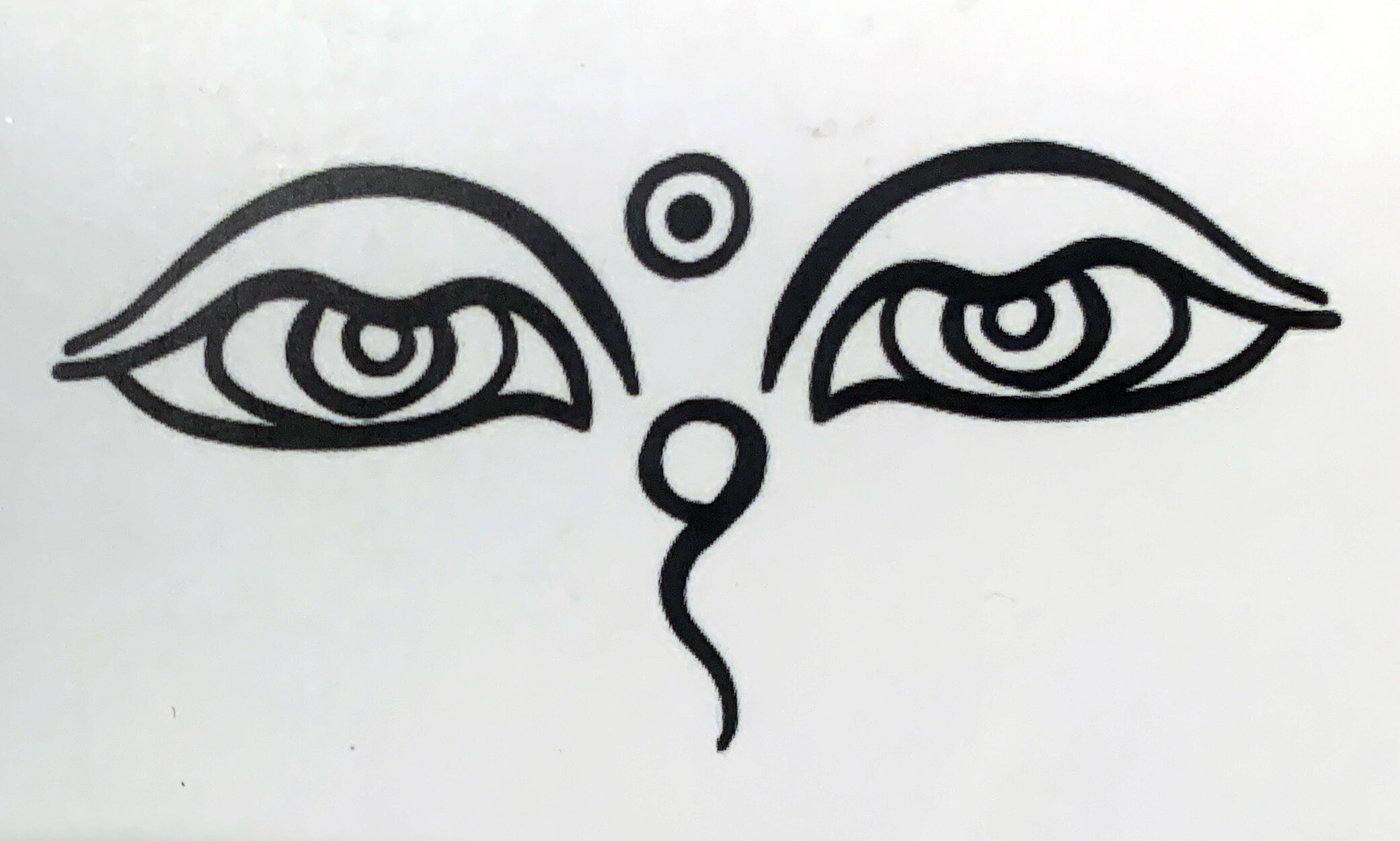
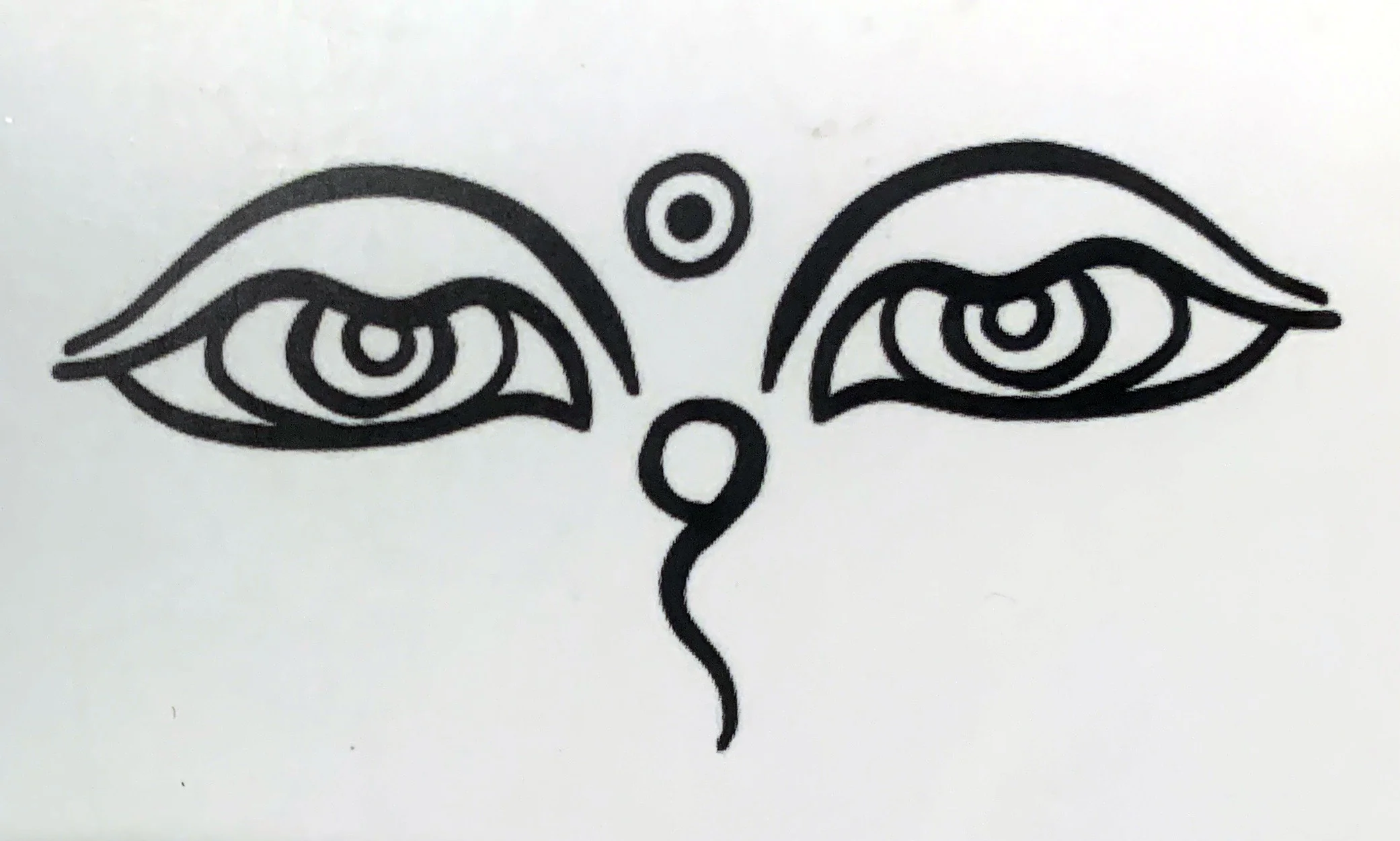
Cover Drawing by Robert Spellman for The Wisdom of Tibetan Buddhism, edited by Reginald Ray, Shambhala Pocket Library.
Search Blog
-
2025
- May 9, 2025 A View from the Tractor Seat
- Apr 11, 2025 Dig
-
2024
- Jan 7, 2024 Winter Wassail
-
2022
- Dec 11, 2022 Keeping Time
- Jun 17, 2022 This Apple-Shaped Earth
- Jan 23, 2022 What is a Jizo?
- Jan 16, 2022 An Invite and Housekeeping Update
- Jan 1, 2022 The Year of the Frog: What Orchardists Do While Apple Trees are Chilling
-
2021
- Oct 24, 2021 Figs
- Oct 3, 2021 The Artist and the Orchard: A Memoir
- Aug 8, 2021 Red-Fleshed Apples
- Jul 25, 2021 When We Were Trees
- Jun 27, 2021 Castor Beans—Who Knew?
- Jun 13, 2021 Spring Training at a Zen Monastery
- May 4, 2021 Our Trees are in Bloom
- Apr 18, 2021 Hooray!
- Jan 24, 2021 Wassailing, virtually!
- Jan 1, 2021 Sitting
-
2020
- Dec 21, 2020 Darkness to Light
- Nov 28, 2020 One Heart
- Sep 18, 2020 Juggling Flowers, Fruit, and Vegetables
- Aug 23, 2020 Refuge
- Aug 9, 2020 Bags of Fertilizer
- Aug 2, 2020 The Sermon of the Blue Heron
- Jul 26, 2020 What's the Buzz?
- Jul 19, 2020 Farm Moments
- Jul 12, 2020 Lost Wax
- Jul 5, 2020 Catalpa: The Hugging Tree
- Jun 28, 2020 Pedaling Peace
- Jun 21, 2020 See Change
- Jun 14, 2020 Lalla Unveiled
- Jun 7, 2020 Pond Alchemy
- May 31, 2020 The Birth of Fruit
- May 24, 2020 An Artist in the Orchard
- May 17, 2020 Walking the Land: Returning Home
- May 10, 2020 Stinging Nettles: Gifts from the Great Mother
- May 3, 2020 The Mystery of Swallow
- Apr 26, 2020 Aerial Bruststrokes
- Apr 19, 2020 Simple Pleasures
- Apr 12, 2020 Weeds and Other Gifts
- Apr 5, 2020 Remembering the Seeds
- Mar 29, 2020 Blow on the Embers
- Mar 22, 2020 Ripples
-
2019
- Nov 16, 2019 Tibet Impressions
- Nov 9, 2019 Forest Tales
- Oct 13, 2019 The Gift
- Aug 4, 2019 The Season is Apples, Berries, and Grandfather Fire
- Jun 8, 2019 Pointers for a Writing Life
- May 12, 2019 Mothers of the Earth
- Apr 6, 2019 The Apple-Shaped Earth
- Mar 23, 2019 You Don’t Know What You Have Till It’s Gone
- Feb 23, 2019 Generations
- Feb 9, 2019 What Are We Doing to the Earth, John Chapman?
-
2018
- Dec 31, 2018 Long Shadows
- Oct 6, 2018 A Pilgrimage to India
- Aug 18, 2018 Scrap Wrenn
- Aug 11, 2018 Off-the-Wall Comments from an Ignorant Farmer
- Jul 28, 2018 Creative Connect
- Jul 14, 2018 How is the Orchard?
- Jun 30, 2018 Which Way?
- Jun 16, 2018 Geese, Herons, Beavers, and the Baby Steps of a Lapsed Blogger
- Feb 24, 2018 Mama's Coupons — Good Forever
- Jan 27, 2018 January Ice
- Jan 13, 2018 The Muse
-
2017
- Dec 30, 2017 A Dream for the New Year
- Dec 23, 2017 A New Year for Apples
- Dec 16, 2017 Intuition
- Nov 22, 2017 Thanksgiving OM
- Nov 4, 2017 East Fork Pottery
- Oct 28, 2017 Putting Down New Roots
- Oct 21, 2017 A is for Art
- Oct 14, 2017 Eve domesticus
- Oct 7, 2017 A String Workshop
- Sep 30, 2017 After Applepicking
- Sep 23, 2017 Two Bad Women and One Good Apple
- Sep 16, 2017 Plein Air Poetry
- Sep 9, 2017 Cutting Off a Leg
- Sep 2, 2017 The Changing Landscape
- Aug 26, 2017 All About Art
- Aug 19, 2017 My First Visit to the Farm
- Aug 12, 2017 The First Food
- Aug 5, 2017 A Teapot, a Woman, and maybe a Boat
- Jul 29, 2017 A Raspberry Dilemma
- Jul 22, 2017 Consider the Miracle
- Jul 15, 2017 Meeting Ekphrasis
- Jul 8, 2017 Ripening Fruit
- Jul 1, 2017 The Voice of The Caterpillar
- Jun 24, 2017 Goumi — An Unusual Fructus
- Jun 17, 2017 Concord, an American Bloomsbury
- Jun 10, 2017 The World Is Bonkers — Shall I Laugh or Cry?
- Jun 3, 2017 Bonkers, a Revolutionary Apple
- May 27, 2017 Guardians of the Swamp
- May 20, 2017 There are Mushrooms and There are Morels
- May 13, 2017 "What's in a Name?"
- May 6, 2017 Bloom Follows Pink: Orchard Pollination
- Apr 29, 2017 The Orchard Is at Pink
- Apr 22, 2017 Natural Farming — Part 2 (continuation from last Sunday's blog)
- Apr 15, 2017 Natural Farming — Part 1
- Apr 8, 2017 Boats, Figures, and Catching Fish
- Apr 1, 2017 A Man with a Mission: The Nuts and Bolts of Bronze Casting
- Mar 25, 2017 A Chalice of Spirit, Art, and Nature
- Mar 18, 2017 Hanami — Blossom Viewing
- Mar 11, 2017 Soil Redemption Song
- Mar 4, 2017 Food is Primary Care
- Feb 25, 2017 Pomme de Terre
- Feb 18, 2017 Organic Certification
- Feb 11, 2017 Tantalizing Fruit
- Feb 4, 2017 The Myths of History
- Jan 28, 2017 The Orchard in Winter
- Jan 21, 2017 The Hi-Line
- Jan 14, 2017 Artistic, Botanical, and Social Diversity
- Jan 7, 2017 Where is Eden?
-
2016
- Dec 31, 2016 The Creative Heart
- Dec 24, 2016 A Christmas Tale
- Dec 17, 2016 Who are the Crones?
- Dec 10, 2016 The Olympic Bell (Part Two)
- Dec 3, 2016 Overheard in the Apple Orchard in Early December
- Nov 26, 2016 The Lessons of a Tortoise
- Nov 19, 2016 In the Studio
- Nov 12, 2016 Even in Darkness
- Nov 5, 2016 Southern Apples, an Elephant, Monkey, Rabbit, and Bird, Two Mango Trees and a Birthday
- Oct 29, 2016 The Tools of Art
- Oct 22, 2016 Labyrinths
- Oct 15, 2016 Repairing the Broken
- Oct 8, 2016 When You Are No More
- Oct 1, 2016 Creation Rain
- Sep 24, 2016 Breaking the Glass
- Sep 17, 2016 String Art
- Sep 10, 2016 Poetry and Photosynthesis: It's all in the Leaves
- Sep 3, 2016 In the Plenty of Time
- Aug 27, 2016 Witch Doctors
- Aug 20, 2016 Listen Coyote
- Aug 13, 2016 Milkweed in the Orchard
- Aug 6, 2016 Some People See a Turtle
- Jul 30, 2016 Arborshaping
- Jul 23, 2016 Joseph Wheelwright: Sculptor of Stones and Trees
- Jul 16, 2016 Asian Pears
- Jul 9, 2016 Gold Leaf, Grief, and the Creative Process
- Jul 2, 2016 The Olympic Bell (Part One)
- Jun 25, 2016 Around the Mulberry Bush
- Jun 18, 2016 Avoiding Apples
- Jun 11, 2016 Fructus
- Jun 4, 2016 Astonishing Apples
- May 28, 2016 Scare the Caterpillars
- May 21, 2016 Join the Club!
- May 14, 2016 The Graft
- May 7, 2016 Rooster, Rhubarb, Rue
- Apr 30, 2016 What do Dolphins and Nettles Have in Common?
- Apr 23, 2016 Art Prunings
- Apr 16, 2016 A Few of the First Arrivals
- Apr 9, 2016 Taste the Spirit of Sustainable Agriculture
- Apr 2, 2016 First Orchard Spray - March 22-24, 2016
- Mar 26, 2016 Hawkeye Apple
- Mar 19, 2016 Desiring the Almata Apple
- Mar 12, 2016 Ugly Fruit
- Mar 5, 2016 Winter Tracks
- Feb 27, 2016 Splash
- Feb 20, 2016 Pruning
- Feb 13, 2016 Orchard Ruminants
- Feb 6, 2016 A Gathering of Seeds
- Jan 30, 2016 Orchard Dragons
- Jan 23, 2016 Tree Rings
- Jan 17, 2016 The Fallen Tree
- Jan 7, 2016 Wassailing the Apple Trees
- Jan 1, 2016 The New Year