LINDA HOFFMAN
Two Bad Women and One Good Apple
The Apple Was a Northern Invention
When she ate the pomegranate,
it was as if the seed
with its wet red shining coat
of sweet flesh clinging to the dark core
was one of nature’s eyes. Afterward,
it was nature that was blind,
and she who was wild
with vision, condemned
to see what was before her, and behind.
The poet Eleanor Rand Wilner has a different view on this most well-known ‘apple’ story. I’m not referring to the pomegranate versus apple question — that debate we may never resolve, but to Wilner's portrayal of Eve as ‘wild with vision,’ a seer and a mystic. The poet completely uproots the traditional portrayal of Eve as a fallen women unable to resist the tantalizing offer of the serpent.
The story of Adam and Eve is a collective, cultural invention. However, in my personal version, our sister Eve has been condemned for two thousand years because she satisfied her desire to taste the fruit from the Tree of Knowledge of Good and Evil, because she wanted to know the deep truth about who she was and the meaning of life.
Our Eve had much in common with Lalla or Lal Ded, the 14th century Hindi mystic poet, who also experienced her own expulsion. Married at twelve, starved, beaten, and abused by her husband and in-laws, Lalla was finally able to leave that household when she was in her twenties. She found spiritual teachers and eventually, her own divine wisdom.
I Lalla set forth blooming as a cotton flower
Then the carder and the cleaner kicked me again and again
Next a woman spun me and lifted me from her wheel as gossamer
And in the weaver's room they hung me as warp on the loom
~ Lalla 102
Then the washermen beat and dashed me on the stone
And rubbed me with clay and soap to whiten me
Then the tailor cut me piece by piece
Now, as finished cloth, I have found my way at last to Freedom
~ Lalla 103
Tr. Jennifer Sundeen
Lalla had to tear off the cloth of the society in which she was born and, piece by piece, remake herself from within. She danced naked through the streets, uttering verses that were remembered and passed down, adn then finally recorded 400 years later. A rebel, a seeker, she gave up the comforts of hearth and home to wander, always loving and always teaching. She didn’t follow a prescribed path or religious dogma, but discovered her own truths from within her own body.
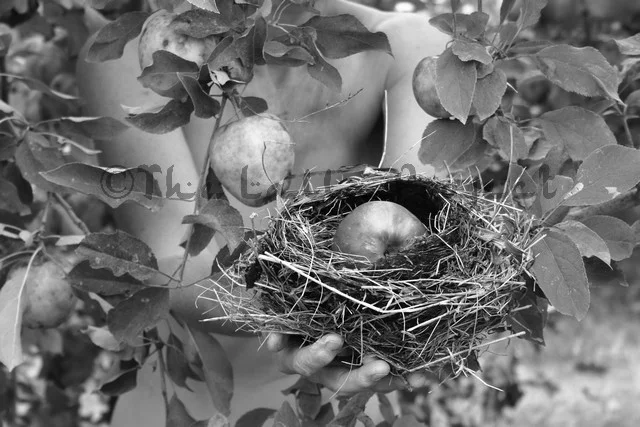
Photo: Carol J. Hicks
Then there is Reinette Clochard, an old French variety, an apple we grow in the orchard. Reinette means ‘little Queen’ in French, and a clochard is a bum, a vagabond, a homeless person. Not only is this a strange name for an apple, but it is an odd juxtaposition of social classes. And why the queen and not the king? The apple is small in size, giving meaning to ‘little’ queen; but her mottled yellow color of skin is more like a wild apple found in the woods, an apple without regal color, one that Thoreau would have grabbed, bitten into, found to be hard, and delighted in its ordinariness. Reinette Clochard’s flesh is pale and soft, creamy, the opposite of the crunchy sweet apples preferred by many today. She can be kept easily at room temperature for several months. That’s why she used to be loaded onto ships for sailors to eat, their only fresh food.
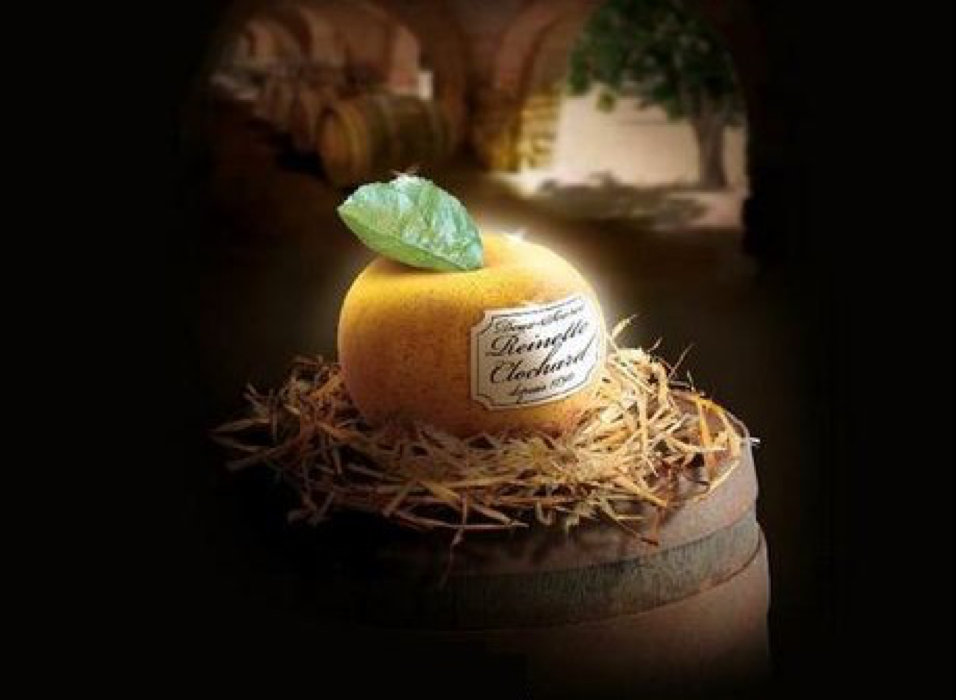
In France, Reinette Clochard is making a comeback. She comes packaged in wooden boxes and is sold as a specialty apple. In our orchard, people disdain her. They don’t know what to make of the name or her appearance.
The apple season at Old Frog Pond Farm has reached its fullest expression. Pickers have been walking the orchard rows, counting the color-coded blocks on their maps to find the Honey Crisp and Crimson Crisp. Once these were picked out, they began picking Liberty and Freedom. Reinette Clochard remained on the tree, her ripe fruit finally falling to the ground, until I went out and rescued her.
And now, you may be wanting to ask, what does Eve, the mystic poet Lalla, and this old French apple have in common?
Apples originated in the forests of Kazakhstan, traveled along the Silk Road in horses’ bellies, and in the pockets of Roman soldiers through Europe and to England, and eventually to America. The apple carries within its skin poetic, mythological, geographic, social, and scientific history. As women, we belong to the lineage of expulsed women seers. We carry the seeds from these early destroyers of social conventions. We need to clamor loudly for what we want. Can you imagine being named little homeless queen? Surely no woman named this apple. We should reject the labels that society assigns us.
When I think of Eve, I see her as a nonconformist, a woman with the strength to go against convention. The same is true for the wild mystic Lalla. Sometimes I forget the lessons they both exemplify. I don’t allow myself to do what matters most to me, what connects me to my deepest roots, or speak my truth. And Reinette Clochard? We shouldn’t forget the girls and women all over the world who are without education, who are demeaned, abused, or locked into confining roles, who still need our help.
Two of the newer apples we grow in the orchard are named Liberty and Freedom. Odd names for a fruit, you might think, but these are disease-resistant varieties. The suggestion is that the orchardist is free from the concern of scab, liberated from the fungal disease that makes growing apples in new England so challenging. These names reflect the significant changes in plant breeding in the last century. If only changing the human heart was as simple.
Today is our last day for apple picking. There are only a few Liberty and Freedom apples on the trees. We need more of both in this world. We need to remember the Eves, the Lallas, and the Reinette Clochards. We need to remember all those, both men and women, who sought knowledge and freedom and did not settle for less.
Search Blog
-
2025
- May 9, 2025 A View from the Tractor Seat
- Apr 11, 2025 Dig
-
2024
- Jan 7, 2024 Winter Wassail
-
2022
- Dec 11, 2022 Keeping Time
- Jun 17, 2022 This Apple-Shaped Earth
- Jan 23, 2022 What is a Jizo?
- Jan 16, 2022 An Invite and Housekeeping Update
- Jan 1, 2022 The Year of the Frog: What Orchardists Do While Apple Trees are Chilling
-
2021
- Oct 24, 2021 Figs
- Oct 3, 2021 The Artist and the Orchard: A Memoir
- Aug 8, 2021 Red-Fleshed Apples
- Jul 25, 2021 When We Were Trees
- Jun 27, 2021 Castor Beans—Who Knew?
- Jun 13, 2021 Spring Training at a Zen Monastery
- May 4, 2021 Our Trees are in Bloom
- Apr 18, 2021 Hooray!
- Jan 24, 2021 Wassailing, virtually!
- Jan 1, 2021 Sitting
-
2020
- Dec 21, 2020 Darkness to Light
- Nov 28, 2020 One Heart
- Sep 18, 2020 Juggling Flowers, Fruit, and Vegetables
- Aug 23, 2020 Refuge
- Aug 9, 2020 Bags of Fertilizer
- Aug 2, 2020 The Sermon of the Blue Heron
- Jul 26, 2020 What's the Buzz?
- Jul 19, 2020 Farm Moments
- Jul 12, 2020 Lost Wax
- Jul 5, 2020 Catalpa: The Hugging Tree
- Jun 28, 2020 Pedaling Peace
- Jun 21, 2020 See Change
- Jun 14, 2020 Lalla Unveiled
- Jun 7, 2020 Pond Alchemy
- May 31, 2020 The Birth of Fruit
- May 24, 2020 An Artist in the Orchard
- May 17, 2020 Walking the Land: Returning Home
- May 10, 2020 Stinging Nettles: Gifts from the Great Mother
- May 3, 2020 The Mystery of Swallow
- Apr 26, 2020 Aerial Bruststrokes
- Apr 19, 2020 Simple Pleasures
- Apr 12, 2020 Weeds and Other Gifts
- Apr 5, 2020 Remembering the Seeds
- Mar 29, 2020 Blow on the Embers
- Mar 22, 2020 Ripples
-
2019
- Nov 16, 2019 Tibet Impressions
- Nov 9, 2019 Forest Tales
- Oct 13, 2019 The Gift
- Aug 4, 2019 The Season is Apples, Berries, and Grandfather Fire
- Jun 8, 2019 Pointers for a Writing Life
- May 12, 2019 Mothers of the Earth
- Apr 6, 2019 The Apple-Shaped Earth
- Mar 23, 2019 You Don’t Know What You Have Till It’s Gone
- Feb 23, 2019 Generations
- Feb 9, 2019 What Are We Doing to the Earth, John Chapman?
-
2018
- Dec 31, 2018 Long Shadows
- Oct 6, 2018 A Pilgrimage to India
- Aug 18, 2018 Scrap Wrenn
- Aug 11, 2018 Off-the-Wall Comments from an Ignorant Farmer
- Jul 28, 2018 Creative Connect
- Jul 14, 2018 How is the Orchard?
- Jun 30, 2018 Which Way?
- Jun 16, 2018 Geese, Herons, Beavers, and the Baby Steps of a Lapsed Blogger
- Feb 24, 2018 Mama's Coupons — Good Forever
- Jan 27, 2018 January Ice
- Jan 13, 2018 The Muse
-
2017
- Dec 30, 2017 A Dream for the New Year
- Dec 23, 2017 A New Year for Apples
- Dec 16, 2017 Intuition
- Nov 22, 2017 Thanksgiving OM
- Nov 4, 2017 East Fork Pottery
- Oct 28, 2017 Putting Down New Roots
- Oct 21, 2017 A is for Art
- Oct 14, 2017 Eve domesticus
- Oct 7, 2017 A String Workshop
- Sep 30, 2017 After Applepicking
- Sep 23, 2017 Two Bad Women and One Good Apple
- Sep 16, 2017 Plein Air Poetry
- Sep 9, 2017 Cutting Off a Leg
- Sep 2, 2017 The Changing Landscape
- Aug 26, 2017 All About Art
- Aug 19, 2017 My First Visit to the Farm
- Aug 12, 2017 The First Food
- Aug 5, 2017 A Teapot, a Woman, and maybe a Boat
- Jul 29, 2017 A Raspberry Dilemma
- Jul 22, 2017 Consider the Miracle
- Jul 15, 2017 Meeting Ekphrasis
- Jul 8, 2017 Ripening Fruit
- Jul 1, 2017 The Voice of The Caterpillar
- Jun 24, 2017 Goumi — An Unusual Fructus
- Jun 17, 2017 Concord, an American Bloomsbury
- Jun 10, 2017 The World Is Bonkers — Shall I Laugh or Cry?
- Jun 3, 2017 Bonkers, a Revolutionary Apple
- May 27, 2017 Guardians of the Swamp
- May 20, 2017 There are Mushrooms and There are Morels
- May 13, 2017 "What's in a Name?"
- May 6, 2017 Bloom Follows Pink: Orchard Pollination
- Apr 29, 2017 The Orchard Is at Pink
- Apr 22, 2017 Natural Farming — Part 2 (continuation from last Sunday's blog)
- Apr 15, 2017 Natural Farming — Part 1
- Apr 8, 2017 Boats, Figures, and Catching Fish
- Apr 1, 2017 A Man with a Mission: The Nuts and Bolts of Bronze Casting
- Mar 25, 2017 A Chalice of Spirit, Art, and Nature
- Mar 18, 2017 Hanami — Blossom Viewing
- Mar 11, 2017 Soil Redemption Song
- Mar 4, 2017 Food is Primary Care
- Feb 25, 2017 Pomme de Terre
- Feb 18, 2017 Organic Certification
- Feb 11, 2017 Tantalizing Fruit
- Feb 4, 2017 The Myths of History
- Jan 28, 2017 The Orchard in Winter
- Jan 21, 2017 The Hi-Line
- Jan 14, 2017 Artistic, Botanical, and Social Diversity
- Jan 7, 2017 Where is Eden?
-
2016
- Dec 31, 2016 The Creative Heart
- Dec 24, 2016 A Christmas Tale
- Dec 17, 2016 Who are the Crones?
- Dec 10, 2016 The Olympic Bell (Part Two)
- Dec 3, 2016 Overheard in the Apple Orchard in Early December
- Nov 26, 2016 The Lessons of a Tortoise
- Nov 19, 2016 In the Studio
- Nov 12, 2016 Even in Darkness
- Nov 5, 2016 Southern Apples, an Elephant, Monkey, Rabbit, and Bird, Two Mango Trees and a Birthday
- Oct 29, 2016 The Tools of Art
- Oct 22, 2016 Labyrinths
- Oct 15, 2016 Repairing the Broken
- Oct 8, 2016 When You Are No More
- Oct 1, 2016 Creation Rain
- Sep 24, 2016 Breaking the Glass
- Sep 17, 2016 String Art
- Sep 10, 2016 Poetry and Photosynthesis: It's all in the Leaves
- Sep 3, 2016 In the Plenty of Time
- Aug 27, 2016 Witch Doctors
- Aug 20, 2016 Listen Coyote
- Aug 13, 2016 Milkweed in the Orchard
- Aug 6, 2016 Some People See a Turtle
- Jul 30, 2016 Arborshaping
- Jul 23, 2016 Joseph Wheelwright: Sculptor of Stones and Trees
- Jul 16, 2016 Asian Pears
- Jul 9, 2016 Gold Leaf, Grief, and the Creative Process
- Jul 2, 2016 The Olympic Bell (Part One)
- Jun 25, 2016 Around the Mulberry Bush
- Jun 18, 2016 Avoiding Apples
- Jun 11, 2016 Fructus
- Jun 4, 2016 Astonishing Apples
- May 28, 2016 Scare the Caterpillars
- May 21, 2016 Join the Club!
- May 14, 2016 The Graft
- May 7, 2016 Rooster, Rhubarb, Rue
- Apr 30, 2016 What do Dolphins and Nettles Have in Common?
- Apr 23, 2016 Art Prunings
- Apr 16, 2016 A Few of the First Arrivals
- Apr 9, 2016 Taste the Spirit of Sustainable Agriculture
- Apr 2, 2016 First Orchard Spray - March 22-24, 2016
- Mar 26, 2016 Hawkeye Apple
- Mar 19, 2016 Desiring the Almata Apple
- Mar 12, 2016 Ugly Fruit
- Mar 5, 2016 Winter Tracks
- Feb 27, 2016 Splash
- Feb 20, 2016 Pruning
- Feb 13, 2016 Orchard Ruminants
- Feb 6, 2016 A Gathering of Seeds
- Jan 30, 2016 Orchard Dragons
- Jan 23, 2016 Tree Rings
- Jan 17, 2016 The Fallen Tree
- Jan 7, 2016 Wassailing the Apple Trees
- Jan 1, 2016 The New Year