LINDA HOFFMAN
The Creative Heart
I watched as my son, Alex, carefully undid the wrapping, opened the wooden box, and lifted a corner of the quilted cloth. On his face, I saw a strange look of disbelief. “It’s broken,” he said. Now it was my turn to be stunned. The beautiful ceramic bowl sat in broken shards on its rose-colored cloth. I was crushed and horrified. It felt like a betrayal.
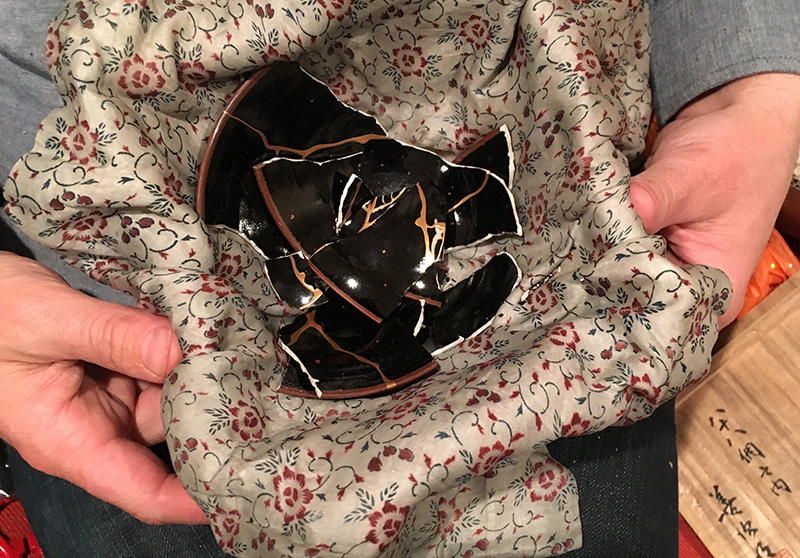
A few months ago, I wrote a blog about Kintsugi — the Japanese art of repairing a broken bowl with gold. For Christmas, I offered a Japanese tea bowl that had been repaired using this method, to Alex and my daughter-in-law, Connie. I felt it would be a meaningful gift as they embarked on married life together. With baby Vita now a hear and half, a new baby on the way, and the opening of a store in Asheville, North Carolina, East Fork Pottery, their life is full. I thought of the Kintsugi bowl with its veins of gold as a symbol of creatively and beautifully overcoming challenges.
A week later, I was still feeling badly about how my gift turned out. I thought to myself, I should make something with these shards — a sculpture — and give it to them. I mentioned my idea to Alex and he seemed a little put off — then he said, “Yes, um, we should do a repair.” And I understood that he wanted to repair the bowl himself. I had kept it anticipating that I would return the broken shards to the gallery, but they graciously refunded the price I had paid. We decided to talk about it in early January when we will next be together.
Everything in our world is impermanent. Wood turns to ash and fallen leaves to compost. The broken pot shards can become something else. Accepting change is about no longer being stuck in what was, but moving on. This moving on is the awakening of our creative heart.
I know that my well-being depends on feeling that I have connected to that place of creativity inside my heart. With days of less meaningful doing, I begin to fall into this dark abyss of my own mind. I become disjointed, my body altogether not my body, my limbs connected like a puppet. I don’t act with spontaneity and wholeness. I can be in the most beautiful place and if I don’t feel connected to it, I can’t appreciate it because I block the beauty from entering my bones. I can be in the most loving relationship and not allow this love to enter.
Each creative act makes use of something that is unresolved in our hearts. Each creative act makes the world whole. In this new year, let’s make whatever is broken whole again. We don’t, in fact, can’t know what it will look like. Who would ever imagine that a river carved a canyon that enthralls millions of people thousands of years later. I can’t imagine what will possibly come out of this box of pot shards, but this is precisely the process that heals broken places and turns them into art.
In this new year, I’d like to remember that broken bowl when I find myself slipping away from my creative heart, when I feel alone and cut off. For I know that in doing the work I will find my way back. We all share this longing that is deeply human, that beseeches us to be fully our own life, to belong completely to the entirety. Our longing is the gift we can offer.
When I started this weekly blog, Apples, Art, and Spirit, one year ago, I thought it would be a one-year project and I would be using the orchard as a springboard to write. With 2016 being a year of no apples, they have been a very silent partner. I’ve decided to commit to another year, and hopefully with some good winter chill, we will have an apple crop and there will be more apple-inspired writing. Please join me, share the blog with your friends, and together let’s lift the corner of the new year, white, and pure, and unknown. It’s ours to create for the very first time.

Milkweed in the Orchard
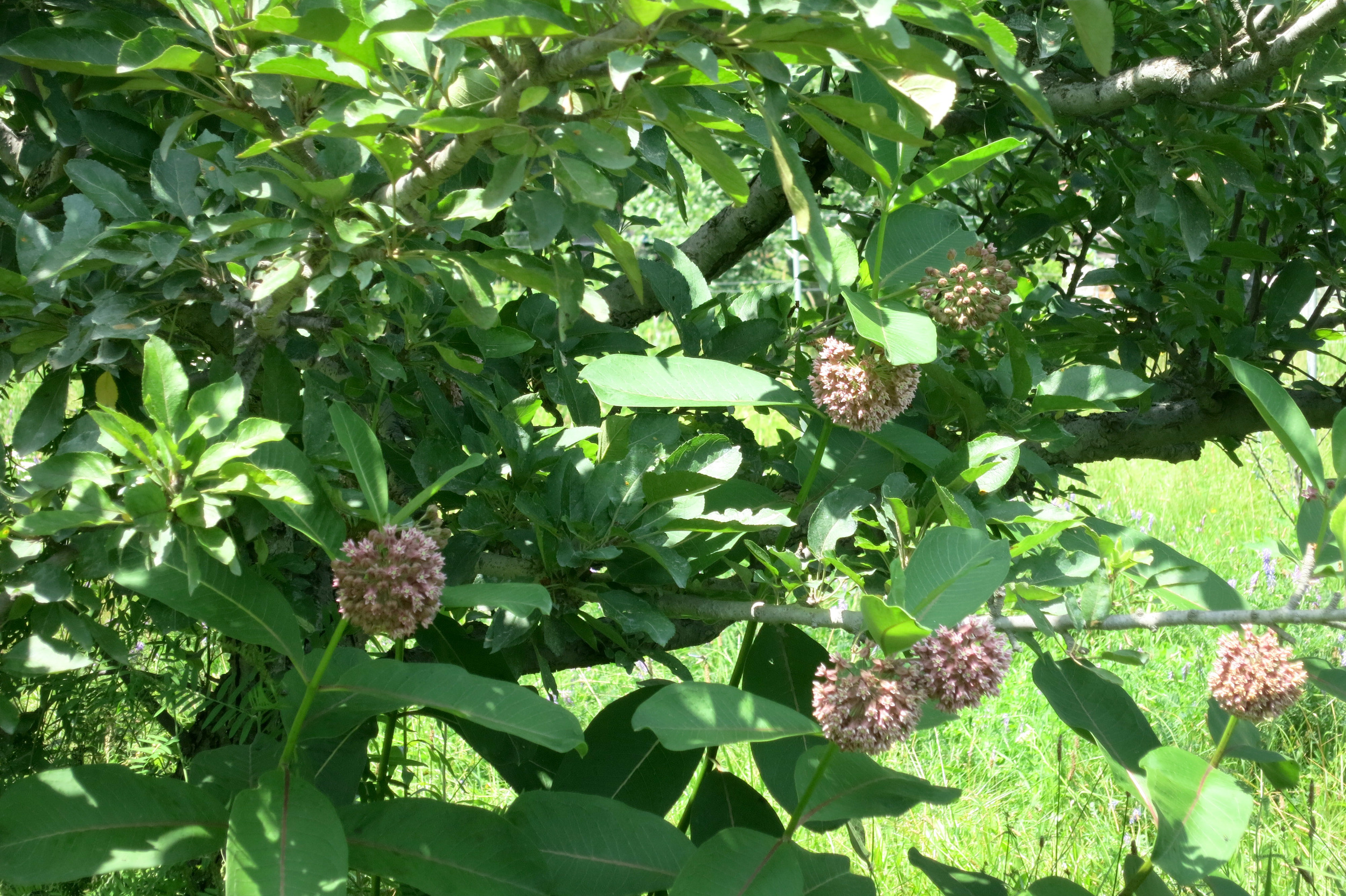
Milkweed under an Apple Tree
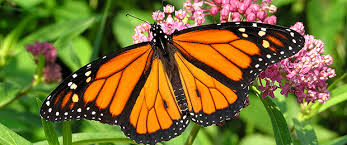
In the last few years, milkweed has spread exponentially throughout the orchard. We don’t mow it down, but we don’t plant it either. It is as if the earth herself has decided that we need more of it; that nature wants to help the monarch butterflies who depend on this plant for their survival. Every summer, monarchs lay their eggs on milkweed. The emerging black-, white-, and yellow-striped caterpillars begin eating around the edges of the leaves, and even absorb a substance from their host that provides a defense against predators.
But where are the monarchs? Their numbers have been decreasing steadily for the last twenty years. In fact, the Endangered Species Coalition reports that North American monarchs have declined by ninety percent since the mid 90’s. During the first few years of tending the orchard, I would see monarchs daily when the milkweed was in bloom. This year I have yet to see one.
One reason for their decline is the loss of milkweed habitat. Much of this acreage is now planted with corn and soybeans, and the fields are sprayed with Monsanto’s Roundup. (In 1995, 10 million pounds of Roundup was used on corn and soybeans, and, by 2013, the total pounds rose to 204 million.) Roundup destroys all weeds – including milkweed! I’ve known about the horrors of Roundup, but I didn’t realize that genetically modified corn seed, like Bt corn, produces pollen that kills monarch caterpillars and other insects. I am familiar with Bacillus thuringiensis, Bt, a bacteria-based organic pesticide that is approved for use in organic production. An organic grower uses it sparingly and for target pests. But in the case of Bt corn, the plant itself sends out this pesticide to all insects, pollinators as well as pests such as the corn borer.
When the first findings came out that Bt corn was killing off the monarchs, the agricultural giants who control the fate of millions of acres of farmland (as well as the U.S. Environmental Protection Agency and the U.S. Department of Agriculture) denied them. If you want to read further, Orion Magazine published a great article aptly titled, The Canary in the Cornfield.
In recent years, monarch butterfly decline also correlates with unprecedented fluctuations of temperatures caused by global warming. For example, in 2013, a cold period in May delayed the Monarch departure from their wintering grounds, so they arrived late and didn’t breed as well. Their numbers upon their return the following winter were the lowest ever. In early March this year, a sleet storm with high winds at their wintering ground in Mexico felled trees and buried large numbers of monarchs under sheets of ice.
It’s good we have milkweed growing throughout our orchard, and it is wonderful to read about all of the projects to encourage the survival of the monarch, like the Fresh Pond Monarch Watch in Cambridge, MA, who are planting milkweed, pulling out the invasive black swallow-wort vines, and breeding and releasing caterpillars. However, it will ultimately be the millions of acres in the Midwest that will make the most difference in monarch numbers.
Milkweed belongs to the Asclepiadaceae family, derived from Asclepius, the Greek god (actually demi-god because his father was Apollo but his mother was mortal) of medicine and healing. Athena gave Asclepius the gift to save mortals and even bring them back from the dead. Zeus was jealous when he saw his foes coming back from Hades and supposedly killed Asclepius with a thunderbolt. No one knows for sure since Asclepius became a living god. In ancient Greece there were 320 Asclepions, healing sanctuaries, actually the first hospitals in the world. Last year a 2,400-year-old temple dedicated to him was excavated. I hope he continues to use his healing powers through the proliferation of milkweed and helps to insure the survival of the Monarch butterfly.

Asclepius and his daughter Hygieia, goddess of health.
.
Search Blog
-
2025
- May 9, 2025 A View from the Tractor Seat
- Apr 11, 2025 Dig
-
2024
- Jan 7, 2024 Winter Wassail
-
2022
- Dec 11, 2022 Keeping Time
- Jun 17, 2022 This Apple-Shaped Earth
- Jan 23, 2022 What is a Jizo?
- Jan 16, 2022 An Invite and Housekeeping Update
- Jan 1, 2022 The Year of the Frog: What Orchardists Do While Apple Trees are Chilling
-
2021
- Oct 24, 2021 Figs
- Oct 3, 2021 The Artist and the Orchard: A Memoir
- Aug 8, 2021 Red-Fleshed Apples
- Jul 25, 2021 When We Were Trees
- Jun 27, 2021 Castor Beans—Who Knew?
- Jun 13, 2021 Spring Training at a Zen Monastery
- May 4, 2021 Our Trees are in Bloom
- Apr 18, 2021 Hooray!
- Jan 24, 2021 Wassailing, virtually!
- Jan 1, 2021 Sitting
-
2020
- Dec 21, 2020 Darkness to Light
- Nov 28, 2020 One Heart
- Sep 18, 2020 Juggling Flowers, Fruit, and Vegetables
- Aug 23, 2020 Refuge
- Aug 9, 2020 Bags of Fertilizer
- Aug 2, 2020 The Sermon of the Blue Heron
- Jul 26, 2020 What's the Buzz?
- Jul 19, 2020 Farm Moments
- Jul 12, 2020 Lost Wax
- Jul 5, 2020 Catalpa: The Hugging Tree
- Jun 28, 2020 Pedaling Peace
- Jun 21, 2020 See Change
- Jun 14, 2020 Lalla Unveiled
- Jun 7, 2020 Pond Alchemy
- May 31, 2020 The Birth of Fruit
- May 24, 2020 An Artist in the Orchard
- May 17, 2020 Walking the Land: Returning Home
- May 10, 2020 Stinging Nettles: Gifts from the Great Mother
- May 3, 2020 The Mystery of Swallow
- Apr 26, 2020 Aerial Bruststrokes
- Apr 19, 2020 Simple Pleasures
- Apr 12, 2020 Weeds and Other Gifts
- Apr 5, 2020 Remembering the Seeds
- Mar 29, 2020 Blow on the Embers
- Mar 22, 2020 Ripples
-
2019
- Nov 16, 2019 Tibet Impressions
- Nov 9, 2019 Forest Tales
- Oct 13, 2019 The Gift
- Aug 4, 2019 The Season is Apples, Berries, and Grandfather Fire
- Jun 8, 2019 Pointers for a Writing Life
- May 12, 2019 Mothers of the Earth
- Apr 6, 2019 The Apple-Shaped Earth
- Mar 23, 2019 You Don’t Know What You Have Till It’s Gone
- Feb 23, 2019 Generations
- Feb 9, 2019 What Are We Doing to the Earth, John Chapman?
-
2018
- Dec 31, 2018 Long Shadows
- Oct 6, 2018 A Pilgrimage to India
- Aug 18, 2018 Scrap Wrenn
- Aug 11, 2018 Off-the-Wall Comments from an Ignorant Farmer
- Jul 28, 2018 Creative Connect
- Jul 14, 2018 How is the Orchard?
- Jun 30, 2018 Which Way?
- Jun 16, 2018 Geese, Herons, Beavers, and the Baby Steps of a Lapsed Blogger
- Feb 24, 2018 Mama's Coupons — Good Forever
- Jan 27, 2018 January Ice
- Jan 13, 2018 The Muse
-
2017
- Dec 30, 2017 A Dream for the New Year
- Dec 23, 2017 A New Year for Apples
- Dec 16, 2017 Intuition
- Nov 22, 2017 Thanksgiving OM
- Nov 4, 2017 East Fork Pottery
- Oct 28, 2017 Putting Down New Roots
- Oct 21, 2017 A is for Art
- Oct 14, 2017 Eve domesticus
- Oct 7, 2017 A String Workshop
- Sep 30, 2017 After Applepicking
- Sep 23, 2017 Two Bad Women and One Good Apple
- Sep 16, 2017 Plein Air Poetry
- Sep 9, 2017 Cutting Off a Leg
- Sep 2, 2017 The Changing Landscape
- Aug 26, 2017 All About Art
- Aug 19, 2017 My First Visit to the Farm
- Aug 12, 2017 The First Food
- Aug 5, 2017 A Teapot, a Woman, and maybe a Boat
- Jul 29, 2017 A Raspberry Dilemma
- Jul 22, 2017 Consider the Miracle
- Jul 15, 2017 Meeting Ekphrasis
- Jul 8, 2017 Ripening Fruit
- Jul 1, 2017 The Voice of The Caterpillar
- Jun 24, 2017 Goumi — An Unusual Fructus
- Jun 17, 2017 Concord, an American Bloomsbury
- Jun 10, 2017 The World Is Bonkers — Shall I Laugh or Cry?
- Jun 3, 2017 Bonkers, a Revolutionary Apple
- May 27, 2017 Guardians of the Swamp
- May 20, 2017 There are Mushrooms and There are Morels
- May 13, 2017 "What's in a Name?"
- May 6, 2017 Bloom Follows Pink: Orchard Pollination
- Apr 29, 2017 The Orchard Is at Pink
- Apr 22, 2017 Natural Farming — Part 2 (continuation from last Sunday's blog)
- Apr 15, 2017 Natural Farming — Part 1
- Apr 8, 2017 Boats, Figures, and Catching Fish
- Apr 1, 2017 A Man with a Mission: The Nuts and Bolts of Bronze Casting
- Mar 25, 2017 A Chalice of Spirit, Art, and Nature
- Mar 18, 2017 Hanami — Blossom Viewing
- Mar 11, 2017 Soil Redemption Song
- Mar 4, 2017 Food is Primary Care
- Feb 25, 2017 Pomme de Terre
- Feb 18, 2017 Organic Certification
- Feb 11, 2017 Tantalizing Fruit
- Feb 4, 2017 The Myths of History
- Jan 28, 2017 The Orchard in Winter
- Jan 21, 2017 The Hi-Line
- Jan 14, 2017 Artistic, Botanical, and Social Diversity
- Jan 7, 2017 Where is Eden?
-
2016
- Dec 31, 2016 The Creative Heart
- Dec 24, 2016 A Christmas Tale
- Dec 17, 2016 Who are the Crones?
- Dec 10, 2016 The Olympic Bell (Part Two)
- Dec 3, 2016 Overheard in the Apple Orchard in Early December
- Nov 26, 2016 The Lessons of a Tortoise
- Nov 19, 2016 In the Studio
- Nov 12, 2016 Even in Darkness
- Nov 5, 2016 Southern Apples, an Elephant, Monkey, Rabbit, and Bird, Two Mango Trees and a Birthday
- Oct 29, 2016 The Tools of Art
- Oct 22, 2016 Labyrinths
- Oct 15, 2016 Repairing the Broken
- Oct 8, 2016 When You Are No More
- Oct 1, 2016 Creation Rain
- Sep 24, 2016 Breaking the Glass
- Sep 17, 2016 String Art
- Sep 10, 2016 Poetry and Photosynthesis: It's all in the Leaves
- Sep 3, 2016 In the Plenty of Time
- Aug 27, 2016 Witch Doctors
- Aug 20, 2016 Listen Coyote
- Aug 13, 2016 Milkweed in the Orchard
- Aug 6, 2016 Some People See a Turtle
- Jul 30, 2016 Arborshaping
- Jul 23, 2016 Joseph Wheelwright: Sculptor of Stones and Trees
- Jul 16, 2016 Asian Pears
- Jul 9, 2016 Gold Leaf, Grief, and the Creative Process
- Jul 2, 2016 The Olympic Bell (Part One)
- Jun 25, 2016 Around the Mulberry Bush
- Jun 18, 2016 Avoiding Apples
- Jun 11, 2016 Fructus
- Jun 4, 2016 Astonishing Apples
- May 28, 2016 Scare the Caterpillars
- May 21, 2016 Join the Club!
- May 14, 2016 The Graft
- May 7, 2016 Rooster, Rhubarb, Rue
- Apr 30, 2016 What do Dolphins and Nettles Have in Common?
- Apr 23, 2016 Art Prunings
- Apr 16, 2016 A Few of the First Arrivals
- Apr 9, 2016 Taste the Spirit of Sustainable Agriculture
- Apr 2, 2016 First Orchard Spray - March 22-24, 2016
- Mar 26, 2016 Hawkeye Apple
- Mar 19, 2016 Desiring the Almata Apple
- Mar 12, 2016 Ugly Fruit
- Mar 5, 2016 Winter Tracks
- Feb 27, 2016 Splash
- Feb 20, 2016 Pruning
- Feb 13, 2016 Orchard Ruminants
- Feb 6, 2016 A Gathering of Seeds
- Jan 30, 2016 Orchard Dragons
- Jan 23, 2016 Tree Rings
- Jan 17, 2016 The Fallen Tree
- Jan 7, 2016 Wassailing the Apple Trees
- Jan 1, 2016 The New Year