LINDA HOFFMAN
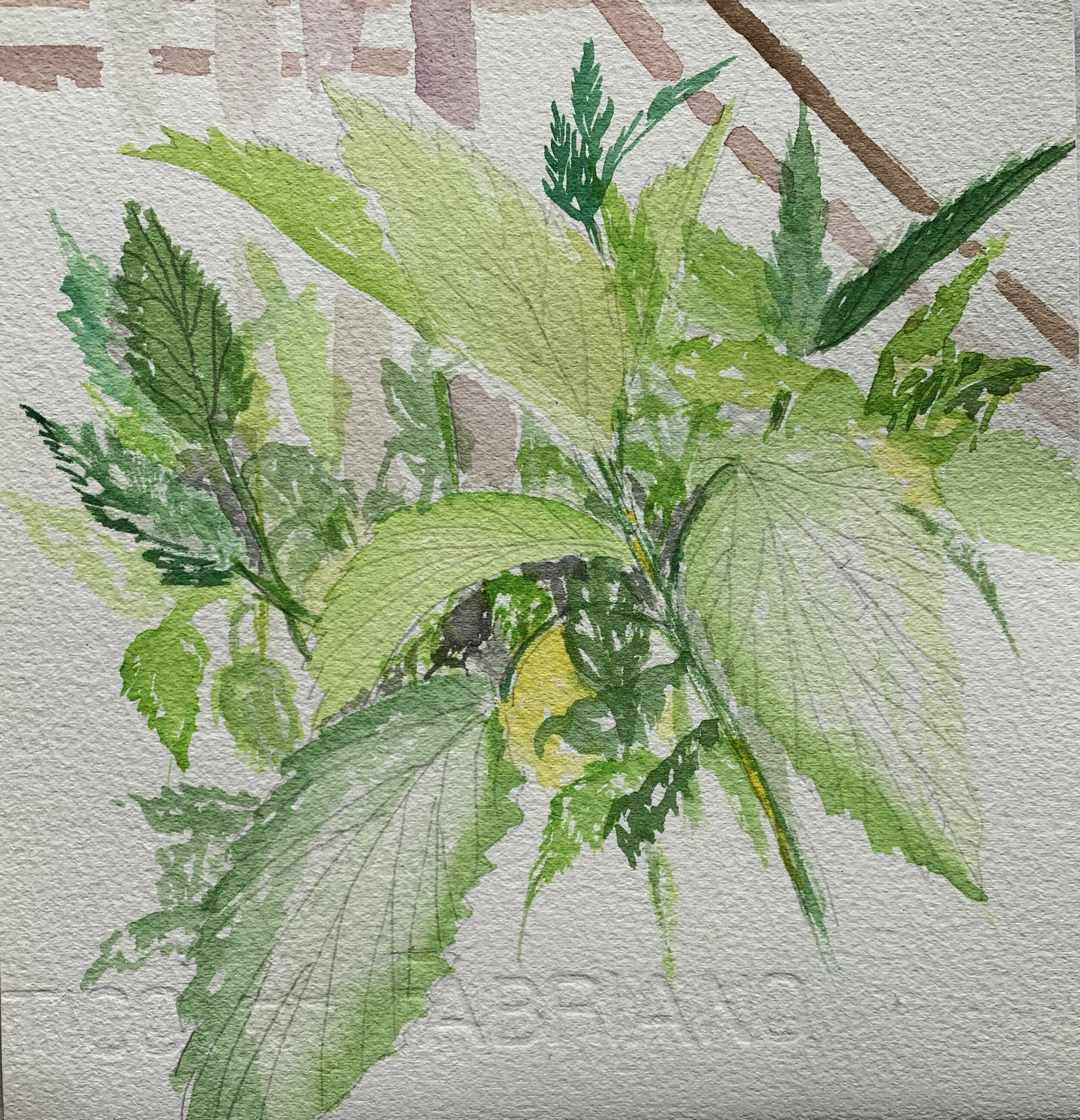
Stinging Nettles: Gifts from the Great Mother

LH, photo: Ariel Matisse
Squatting in a patch of stinging nettles with my foraging basket, and rubber gloves, I was snipping young stalks to sauté for dinner. Some people react with alarm when I mention eating stinging nettles, but the truth is nettles are beloved by wild foragers and herbalists. Mother Earth offers this gift packed with vitamins, minerals, and protein. Richio Cech in his book, Making Plant Medicine, summarizes the uses of nettles: “Practical Uses: Legion.” The Greeks and Romans cultivated fields of nettles more than any other crop.
Nettles sting because they have hairs on the stems and undersides of leaves that break off when touched, exposing the tiniest sharp needles that pierce the skin and inject a toxin that causes a burning rash. Fierce protection! For nettles are so nutritious, animals would devour them before they grew large enough to flower and bear seeds, the driving force in a plant’s life.
An old adage says, “When in doubt, use nettles!” Their beneficial uses include: a natural detoxifier, an anti-inflammatory, a treatment for gout, anemia, joint pain, diabetes, hay fever, urinary tract issues, and prostate issues. Flogging with stinging nettles for arthritis, joint pain, and to increase blood circulation is the one recommendation I am nervous about trying. But when I am without energy and need a dose of friendliness, I reach for the jar of dry nettles and make a cup of tea. It’s magical how this plant restores my balance.
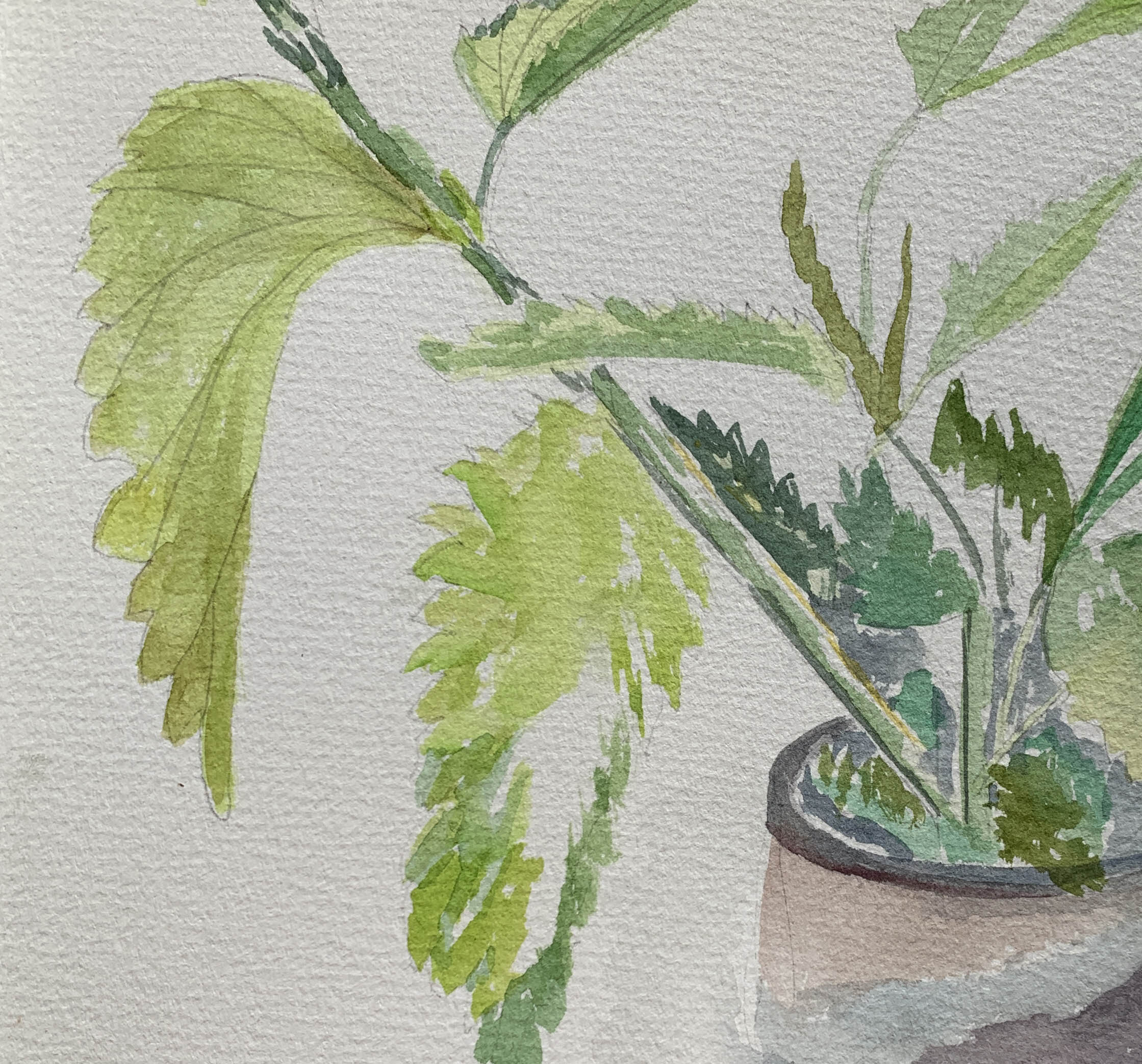
Arrangement with Nettles, watercolor, LH 2020
And, of course, what’s good for me is good for the orchard. Part of being a good orchardist is learning how to take care of the trees with kindness. In late spring, when I want to boost the trees’ immune systems and help provide an extra boost of minerals, I turn towards nettles. When the plants are about eighteen inches tall, I cut a wheelbarrow-full, enough to fill a 50-gallon barrel. Then I add water and let the nettles sit for a few days. Sometimes, I add comfrey leaves for added minerals, horsetail for its silica, and garlicscapes, if I feel the trees need insect protection. After a few hot days, I drain out the liquid and fill my 300-gallon sprayer. The gooey remains of the nettle plants go onto the compost pile, and I set out for my tractor tour of the orchard pulling the airblast sprayer with its peacock’s tail of spray fanning out to touch every leaf.
Nettles reduce heavy metals in soils, in fact I remember hearing that if you plant a rusty agricultural tool, it will attract nettles to grow there. Mostly I find nettles pop up where they choose. At the farm, they don’t seem to care whether it’s a dry berm in full sun, against the peeling paint of the old chicken coop, or in the dappled light of the streambed. When Nettles have finished what they came to do, they pack up and move on. Wild plants are like that.
Now is the season to gather and cook young nettles (they will regrow for fall harvesting.) Try steaming them and adding a little lemon juice and olive oil, and some parmesan or other favorite cheese. Or sauté them with onions or shallots, add some garlic powder, and a bit of cream. For nettle pesto, most people suggest you boil the nettles and dry them with a towel. Then fill your food processor with the nettles, walnuts, pecans or other nut, lemon juice, salt, a couple of peeled garlic cloves, and some hard cheese like asiago or parmesan. Once it becomes the consistency of a paste dribble in olive oil till it is smooth and the consistency you’d like. If you make a lot, freeze some for the middle of next winter to serve over fresh linguine and bring spring back into your life. Don’t be alarmed: nettle pesto is iridescent green.
In midsummer, I cut some of the tall nettles, tie them bundles, and hang them in my studio. Once they are dry, I take a cardboard box or large paper bag, and with gloves on, run my hands along the stem to remove the leaves. The dry leaves can be stored whole, but I put them all through the food processor and store them in a couple of gallon jars. We sell small packs of dried nettles at the farm stand along with bags of freshly picked.
Out of the soil of friendliness grows the beautiful bloom of compassion,
Watered by the tears of joy,
Sheltered beneath the cool shade of the tree of equanimity.
—Longchenpa, 14th century Tibetan Buddhist teacher
Nettles are a curious teacher. They sting! But when we appreciate them, we receive nothing but gifts.
Happy Mother’s Day!

Nettle Bouquet, watercolor and pencil, LH 2020
Witch Doctors
To return to my dying Asian pear tree that I wrote about a month ago: I finally did call the nursery. The horticulturalist assured me that the tree was certainly a Hosui variety – because Hosui get fire blight very easily – and he was certain it was fire blight.
“Pull it right out!” he commanded. “Fire blight will spread to the other trees.” He added that you have to be super vigilant with Hosui, which essentially means spraying Streptomycin in the spring when fire blight is a possibility. He said many people plant Kosui instead of the Hosui, but even that variety isn’t all that resistant. Not like Olympic, for example. “Orchardists are always pulling the Hosui and replanting with more resistant varieties.
I didn’t ask, “Why then, are you selling them?”
It turns out that my tree isn’t a Hosui or a Kosui – it’s a Niitaka. And even though every leaf blackened and fell, I decided to try and save the tree using a poultice of carbonatite, clay, and aloe, and some rubbing and mumblings. After a week, I was excited to see that a few of the buds were plumping and showing some green tissue. Now a witch doctor is an interesting phenomenon.
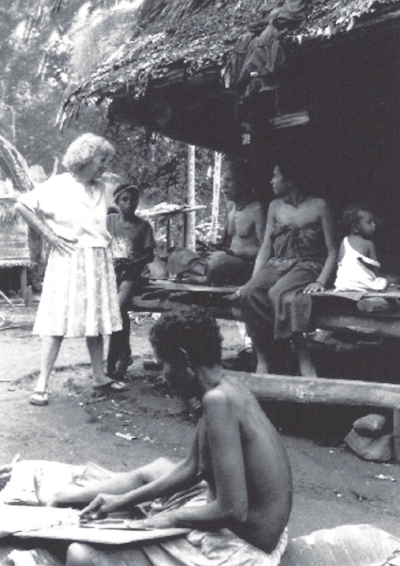
Dr. Annette Weiner, Kwaibwaga Village, Trobriand Islands, 1989
I had an experience firsthand when I lived with my anthropologist mother on a small coral atoll in New Guinea. Ours was an inland village, but one day some of my mother’s informants (the anthropological jargon for those who provide answers to the anthropologist’s questions) said, let’s go visit a coastal village. We walked a few miles over sharp coral to the far side of the island. As we neared the coastal village, I was struck by the trees we walked by. Their roots were above ground, tall intertwining webs formed tent-like structures that I could imagine hiding inside of.
When we entered the village, we felt oddly unwelcomed. The men were out fishing and the women were wary. That’s when I got something in one of my eyes. A piece of dirt or an insect. My eye stung, but no one could see anything in it. After hanging out for only a short while, we turned around to make the trip home. The suspicious looks from the villagers didn’t feel good, and we didn’t want to cause trouble.
We traveled back through the forest of amazing trees, back along the rough coral trails, and finally entered our village towards nightfall. By the time we were back, I was feverish and dizzy. Word buzzed around the village. Questions were asked. Had anyone said magic to protect me against flying witches. Flying witches inhabit the buttressed roots of those mysterious trees. Of course, the witches are jealous of young girls. They were certain that I had been attacked by a flying witch.
My mother was nervous. Even though she had aspirin and antibiotics to give me, and we were both taking quinine for malaria, she wondered what it could be. She was also fascinated to know what the villagers would do. They told her they had called a witch doctor from another village who specializes in flying witches. A skinny old man came in carrying his satchel of herbs. He checked me over, bending my limbs, looking into my eyes. He rubbed herbs into my skin and mumbled prayers. He was paid. And when my mother looked at him expectantly, he said, “The witch is only playing with your daughter; it won’t kill her.”

LH in Kwaibwaga Village in 1971 (fully recovered)
Norman Cousins, one of the early proponents of the mind-body connection, relates how when he visited the Schweitzer Hospital in Gabon, Africa, he commented to Dr. Schweitzer, “The local people are lucky to have access to the Schweitzer clinic and not have to depend on witch-doctor supernaturalism.” One look at Dr. Schweitzer and Cousins recognized his ignorance. The next day, Dr. Schweitzer took him to observe native African medicine. The witch doctor gave herbs in a brown paper bag to some patients and incantations in a brown paper bag to others, while still others he directed towards the Western doctor.
Dr. Schweitzer explained the three groups. The first had what he called functional issues; these would go away easily and the herbs would help. The next group had what he called psychogenic problems, and they were treated with African psychotherapy. The third had physical problems, like a tumor or broken bone, and these he sent to the Western doctor. When Cousins pushed for an explanation, Schweitzer said,
The witch doctor succeeds for the same reason all the rest of us succeed. Each patient carries his own doctor inside him. They come to us knowing the truth. We are at our best when we give the doctor who resides inside within each patient a chance to go to work.
—From The Mysterious Placebo, Norman Cousins
I believe plants aren’t so different from us. There is a doctor inside the trees that I hope I can motivate. I don't know if it has fire blight or a fungal disease. But rather than pull it, I will wait and see if its own wisdom along with my herbs will help.
Search Blog
-
2025
- May 9, 2025 A View from the Tractor Seat
- Apr 11, 2025 Dig
-
2024
- Jan 7, 2024 Winter Wassail
-
2022
- Dec 11, 2022 Keeping Time
- Jun 17, 2022 This Apple-Shaped Earth
- Jan 23, 2022 What is a Jizo?
- Jan 16, 2022 An Invite and Housekeeping Update
- Jan 1, 2022 The Year of the Frog: What Orchardists Do While Apple Trees are Chilling
-
2021
- Oct 24, 2021 Figs
- Oct 3, 2021 The Artist and the Orchard: A Memoir
- Aug 8, 2021 Red-Fleshed Apples
- Jul 25, 2021 When We Were Trees
- Jun 27, 2021 Castor Beans—Who Knew?
- Jun 13, 2021 Spring Training at a Zen Monastery
- May 4, 2021 Our Trees are in Bloom
- Apr 18, 2021 Hooray!
- Jan 24, 2021 Wassailing, virtually!
- Jan 1, 2021 Sitting
-
2020
- Dec 21, 2020 Darkness to Light
- Nov 28, 2020 One Heart
- Sep 18, 2020 Juggling Flowers, Fruit, and Vegetables
- Aug 23, 2020 Refuge
- Aug 9, 2020 Bags of Fertilizer
- Aug 2, 2020 The Sermon of the Blue Heron
- Jul 26, 2020 What's the Buzz?
- Jul 19, 2020 Farm Moments
- Jul 12, 2020 Lost Wax
- Jul 5, 2020 Catalpa: The Hugging Tree
- Jun 28, 2020 Pedaling Peace
- Jun 21, 2020 See Change
- Jun 14, 2020 Lalla Unveiled
- Jun 7, 2020 Pond Alchemy
- May 31, 2020 The Birth of Fruit
- May 24, 2020 An Artist in the Orchard
- May 17, 2020 Walking the Land: Returning Home
- May 10, 2020 Stinging Nettles: Gifts from the Great Mother
- May 3, 2020 The Mystery of Swallow
- Apr 26, 2020 Aerial Bruststrokes
- Apr 19, 2020 Simple Pleasures
- Apr 12, 2020 Weeds and Other Gifts
- Apr 5, 2020 Remembering the Seeds
- Mar 29, 2020 Blow on the Embers
- Mar 22, 2020 Ripples
-
2019
- Nov 16, 2019 Tibet Impressions
- Nov 9, 2019 Forest Tales
- Oct 13, 2019 The Gift
- Aug 4, 2019 The Season is Apples, Berries, and Grandfather Fire
- Jun 8, 2019 Pointers for a Writing Life
- May 12, 2019 Mothers of the Earth
- Apr 6, 2019 The Apple-Shaped Earth
- Mar 23, 2019 You Don’t Know What You Have Till It’s Gone
- Feb 23, 2019 Generations
- Feb 9, 2019 What Are We Doing to the Earth, John Chapman?
-
2018
- Dec 31, 2018 Long Shadows
- Oct 6, 2018 A Pilgrimage to India
- Aug 18, 2018 Scrap Wrenn
- Aug 11, 2018 Off-the-Wall Comments from an Ignorant Farmer
- Jul 28, 2018 Creative Connect
- Jul 14, 2018 How is the Orchard?
- Jun 30, 2018 Which Way?
- Jun 16, 2018 Geese, Herons, Beavers, and the Baby Steps of a Lapsed Blogger
- Feb 24, 2018 Mama's Coupons — Good Forever
- Jan 27, 2018 January Ice
- Jan 13, 2018 The Muse
-
2017
- Dec 30, 2017 A Dream for the New Year
- Dec 23, 2017 A New Year for Apples
- Dec 16, 2017 Intuition
- Nov 22, 2017 Thanksgiving OM
- Nov 4, 2017 East Fork Pottery
- Oct 28, 2017 Putting Down New Roots
- Oct 21, 2017 A is for Art
- Oct 14, 2017 Eve domesticus
- Oct 7, 2017 A String Workshop
- Sep 30, 2017 After Applepicking
- Sep 23, 2017 Two Bad Women and One Good Apple
- Sep 16, 2017 Plein Air Poetry
- Sep 9, 2017 Cutting Off a Leg
- Sep 2, 2017 The Changing Landscape
- Aug 26, 2017 All About Art
- Aug 19, 2017 My First Visit to the Farm
- Aug 12, 2017 The First Food
- Aug 5, 2017 A Teapot, a Woman, and maybe a Boat
- Jul 29, 2017 A Raspberry Dilemma
- Jul 22, 2017 Consider the Miracle
- Jul 15, 2017 Meeting Ekphrasis
- Jul 8, 2017 Ripening Fruit
- Jul 1, 2017 The Voice of The Caterpillar
- Jun 24, 2017 Goumi — An Unusual Fructus
- Jun 17, 2017 Concord, an American Bloomsbury
- Jun 10, 2017 The World Is Bonkers — Shall I Laugh or Cry?
- Jun 3, 2017 Bonkers, a Revolutionary Apple
- May 27, 2017 Guardians of the Swamp
- May 20, 2017 There are Mushrooms and There are Morels
- May 13, 2017 "What's in a Name?"
- May 6, 2017 Bloom Follows Pink: Orchard Pollination
- Apr 29, 2017 The Orchard Is at Pink
- Apr 22, 2017 Natural Farming — Part 2 (continuation from last Sunday's blog)
- Apr 15, 2017 Natural Farming — Part 1
- Apr 8, 2017 Boats, Figures, and Catching Fish
- Apr 1, 2017 A Man with a Mission: The Nuts and Bolts of Bronze Casting
- Mar 25, 2017 A Chalice of Spirit, Art, and Nature
- Mar 18, 2017 Hanami — Blossom Viewing
- Mar 11, 2017 Soil Redemption Song
- Mar 4, 2017 Food is Primary Care
- Feb 25, 2017 Pomme de Terre
- Feb 18, 2017 Organic Certification
- Feb 11, 2017 Tantalizing Fruit
- Feb 4, 2017 The Myths of History
- Jan 28, 2017 The Orchard in Winter
- Jan 21, 2017 The Hi-Line
- Jan 14, 2017 Artistic, Botanical, and Social Diversity
- Jan 7, 2017 Where is Eden?
-
2016
- Dec 31, 2016 The Creative Heart
- Dec 24, 2016 A Christmas Tale
- Dec 17, 2016 Who are the Crones?
- Dec 10, 2016 The Olympic Bell (Part Two)
- Dec 3, 2016 Overheard in the Apple Orchard in Early December
- Nov 26, 2016 The Lessons of a Tortoise
- Nov 19, 2016 In the Studio
- Nov 12, 2016 Even in Darkness
- Nov 5, 2016 Southern Apples, an Elephant, Monkey, Rabbit, and Bird, Two Mango Trees and a Birthday
- Oct 29, 2016 The Tools of Art
- Oct 22, 2016 Labyrinths
- Oct 15, 2016 Repairing the Broken
- Oct 8, 2016 When You Are No More
- Oct 1, 2016 Creation Rain
- Sep 24, 2016 Breaking the Glass
- Sep 17, 2016 String Art
- Sep 10, 2016 Poetry and Photosynthesis: It's all in the Leaves
- Sep 3, 2016 In the Plenty of Time
- Aug 27, 2016 Witch Doctors
- Aug 20, 2016 Listen Coyote
- Aug 13, 2016 Milkweed in the Orchard
- Aug 6, 2016 Some People See a Turtle
- Jul 30, 2016 Arborshaping
- Jul 23, 2016 Joseph Wheelwright: Sculptor of Stones and Trees
- Jul 16, 2016 Asian Pears
- Jul 9, 2016 Gold Leaf, Grief, and the Creative Process
- Jul 2, 2016 The Olympic Bell (Part One)
- Jun 25, 2016 Around the Mulberry Bush
- Jun 18, 2016 Avoiding Apples
- Jun 11, 2016 Fructus
- Jun 4, 2016 Astonishing Apples
- May 28, 2016 Scare the Caterpillars
- May 21, 2016 Join the Club!
- May 14, 2016 The Graft
- May 7, 2016 Rooster, Rhubarb, Rue
- Apr 30, 2016 What do Dolphins and Nettles Have in Common?
- Apr 23, 2016 Art Prunings
- Apr 16, 2016 A Few of the First Arrivals
- Apr 9, 2016 Taste the Spirit of Sustainable Agriculture
- Apr 2, 2016 First Orchard Spray - March 22-24, 2016
- Mar 26, 2016 Hawkeye Apple
- Mar 19, 2016 Desiring the Almata Apple
- Mar 12, 2016 Ugly Fruit
- Mar 5, 2016 Winter Tracks
- Feb 27, 2016 Splash
- Feb 20, 2016 Pruning
- Feb 13, 2016 Orchard Ruminants
- Feb 6, 2016 A Gathering of Seeds
- Jan 30, 2016 Orchard Dragons
- Jan 23, 2016 Tree Rings
- Jan 17, 2016 The Fallen Tree
- Jan 7, 2016 Wassailing the Apple Trees
- Jan 1, 2016 The New Year