LINDA HOFFMAN
The Orchard Is at Pink
apple buds fling
pink sweetness
spring frenzy
Apple growers, as well as beekeepers, fruit researchers, and orchard advisory consultants, all casually announce, “The orchard is at pink.” It’s their scientific way of saying, “The festivities are soon to begin.” Pink is one of the growth stages in fruit trees — when each tightly clustered fruit bud opens, and anywhere from five to seven individual flower buds, each enrobed in pink, magenta, or red petals, rise from a whorl of tender green leaves.

The King Bloom is encircled by buds.
Each one of these pink-robed buds is prepared to produce an apple. Before finding myself the owner of a small orchard, I assumed that one fruit bud would create one apple. But the apple tree wants to ensure its own longevity: each fruit bud opens to a cluster of blossoms, with each blossom capable of producing fruit. In the center is the King Bloom, the strongest and largest. All the others are in reserve, princes and princesses waiting to take over the throne should something happen to the King. The King Bloom opens first, and the others follow soon after. It’s possible that each of these pink buds will produce an apple with the King Bloom in the center.
Pink is the time when the banquet table is set. The scurrying and preparation is done. The orchard grasses have greened, the daffodils and dandelions are in bloom, and we have planted out our new trees. The first loud guests arrive. Robins and mourning doves hop from ground to tree; bluebirds flit through the branches. The herons are back and fly their pattern from Delaney wetlands to beyond the orchard and back again, necks stretching, wings flapping, achingly beautiful. Geese honk incessantly defending their nesting areas, and a pair of swans antagonizes any creature not respectful of their water rights.
Last Sunday I saw my first bumblebee, and on Monday, Melissa Ljosa brought two hives of honeybees who will live here all year. I had to take a sculpture to the Design Center in Boston that morning and when I returned, I heard the bees as I walked among our Asian pear trees. I didn't have to look; I could feel their buzzing energy.
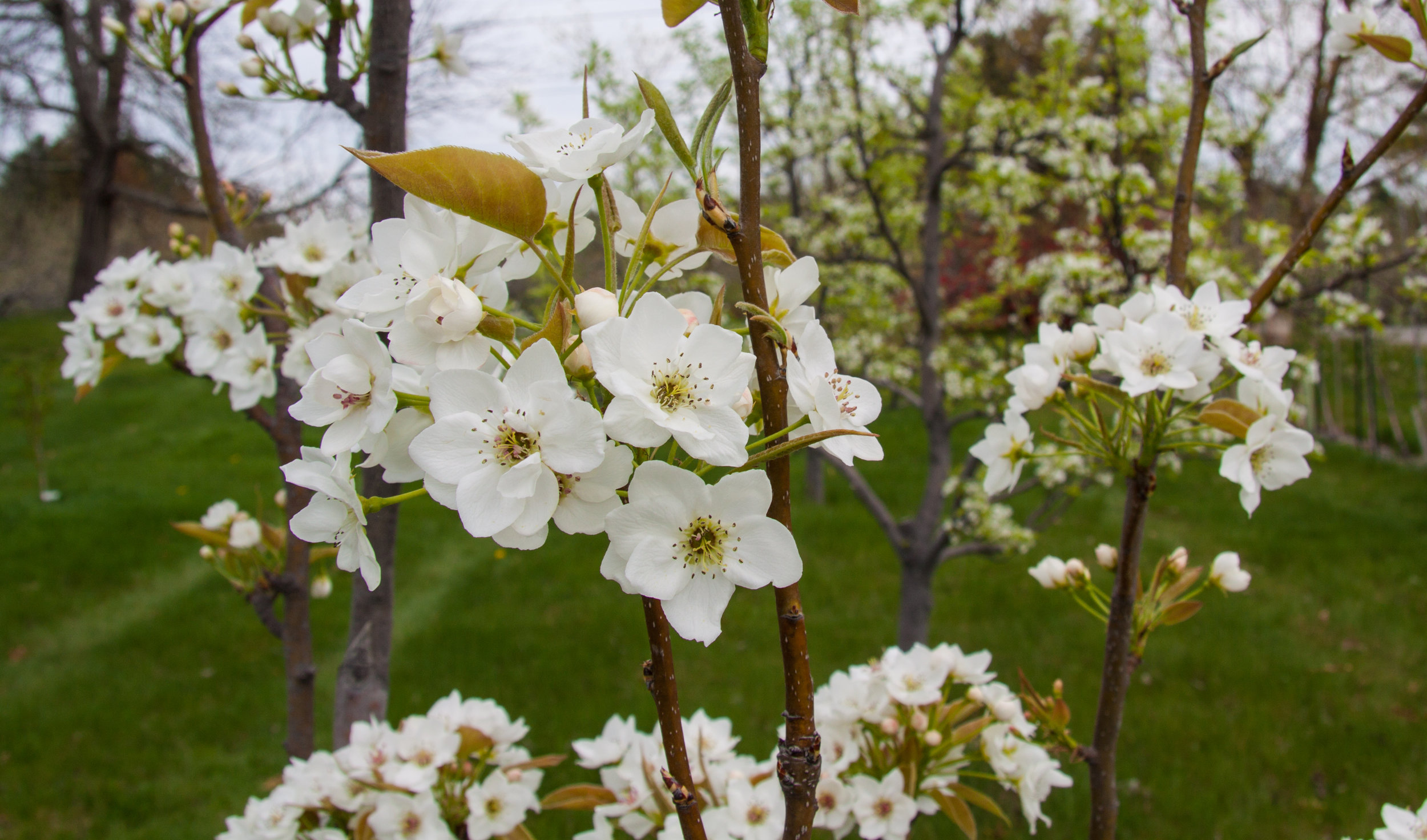
Asian pear white buds.
Our Asian pears are in full bloom, always one stage ahead of the apples. I smelled the trees’ sour scent. Asian pears, so delicious and sweet to eat, give off an unappealing odor, old cheese, (at least judged by this human). Pears, as well as plums and cherries, have white fruit buds, thus, orchardists don’t use the designation pink, but white bud. These clusters of white buds are beautiful, but only apples have a rosette of green leaves with pink rising. This contrast of color makes apple blossoms magical.
When the apple orchard was at pink, I used to call Gus Skamarycz, our beekeeper for many years before he retired. My call at pink would let him know the blossoms had donned their lipstick and were almost ready to greet the bees. He would wait a few days, and then arrive before sunup with two hives. I would meet him in the orchard, his bees still asleep.
“Why so early?” I asked the first year.
“I want the bees to open their eyes in a new place, see the blossoms, and go to work,” he replied.
When I asked, “How long does it take a hive to pollinate an orchard?” Looking around, Gus said, “A strong hive can pollinate this orchard in a few hours, but you have different varieties.”
Not all of our trees will bloom at the same time. The Macintosh apples are the first to open and the earliest to ripen; the Golden Blushing apples reach full blossom two weeks later—their ripening peaks in early October. Gus’s bees would stay for two weeks to provide pollination for all the trees. With Melissa’s two hives now in residence, we don’t worry about pollination and she doesn’t worry about food for her bees.
Next week we will be at bloom in the apple orchard, the stage when the pink buds open. Join us next Saturday, May 6 for Blossom Viewing. We’ll be in the orchard from 3 to 5 if the day is sunny. Bring paints, pen and paper or a poem to share; we’ll listen to the bees and toast the trees, our own free-form, apple blossom viewing.
Natural Farming — Part 2 (continuation from last Sunday's blog)
The comfrey I planted throughout the orchard did not spread as I had been warned. We experienced our area’s driest summer in history. We don’t have clay soil like the Japanese farmer, Fukuoka, but quite the opposite; our orchard soil is classified as Hinckley, an exceedingly rocky, fast-draining soil. It is definitely not choice soil for an orchard. The young trees struggled just like the comfrey. Only the older trees, with deep roots, tapped into water. I realized that if I wanted to plant more herbs and wildflowers, and create a natural environment like Fukuoka, I would need to have some way of delivering water to all the trees.
We applied to the Natural Resources Conservation Services (NRCS) for a grant to put in an irrigation system, and our grant was accepted. They knew that with our Hinckley soils, the apple trees would surely benefit from irrigation. We installed the system ourselves, pumping the water from the surrounding wetlands. Now I could plant all kinds of beneficial and medicinal plants in the orchard—plants that would be good for our soil, and that might help with pest management.
The beauty of the orchard delighted me as the summer progressed. Sunflowers, rudbeckia, mountain mint, asters, goldenrod, bee balm, and echinacea flowered and fed the pollinators. When Blase asked if he should mow in the orchard, I replied, “Not yet, no.” The Jerusalem artichoke flowers were six feet tall, and the valerian stalks were covered with delicate white flowers. A few weeks later, he said, “I really should mow the orchard.” Again, I said, “No mowing. Not yet.”

The orchard was beginning to feel like a natural woodland. The trees were loaded with fruit, and it seemed like an abundant crop. I finally asked Blase to mow between the apple tree rows to accommodate the pickers, but we left all the wildflowers and natural growth between and under the trees. We had a great harvest season, the farm quieted, and Blase and I turned to other pursuits.
Heavy snow fell during the month of January. The drifts were over three feet high, burying the lowest apple limbs. In early February, warmer temperatures brought a thaw, and I went for a walk among the trees. Snow melts first around the trunks, and my eye caught sight of gnawed wood close to the ground. It glowed a bright orange color. Shocked, I reached down and brushed more snow away. The gnawed wood went deeper.
Voles! They had scampered across the crust of the deep snow, climbed over the 18-inch high hardware cloth fence that encircles every trunk, and dropped down between the trunk and the protective screen. There they made soft, grassy nests, and ate and lived in the safety of their cozy burrows with a pantry of food close by. In tree after tree, especially in the back of the orchard, these rodents had eaten the bark, chewing their way around the base of the trees and down to the roots. Many trees were completely girdled. Girdling, when it is complete, kills the tree by cutting off the sap flow between the roots and the crown.

Voles girdled this tree.

Voles even ate the lower branches because of the height of the hard packed snow!
I panicked and called in reinforcements. With a couple of friends, we started shoveling the snow away from every trunk.
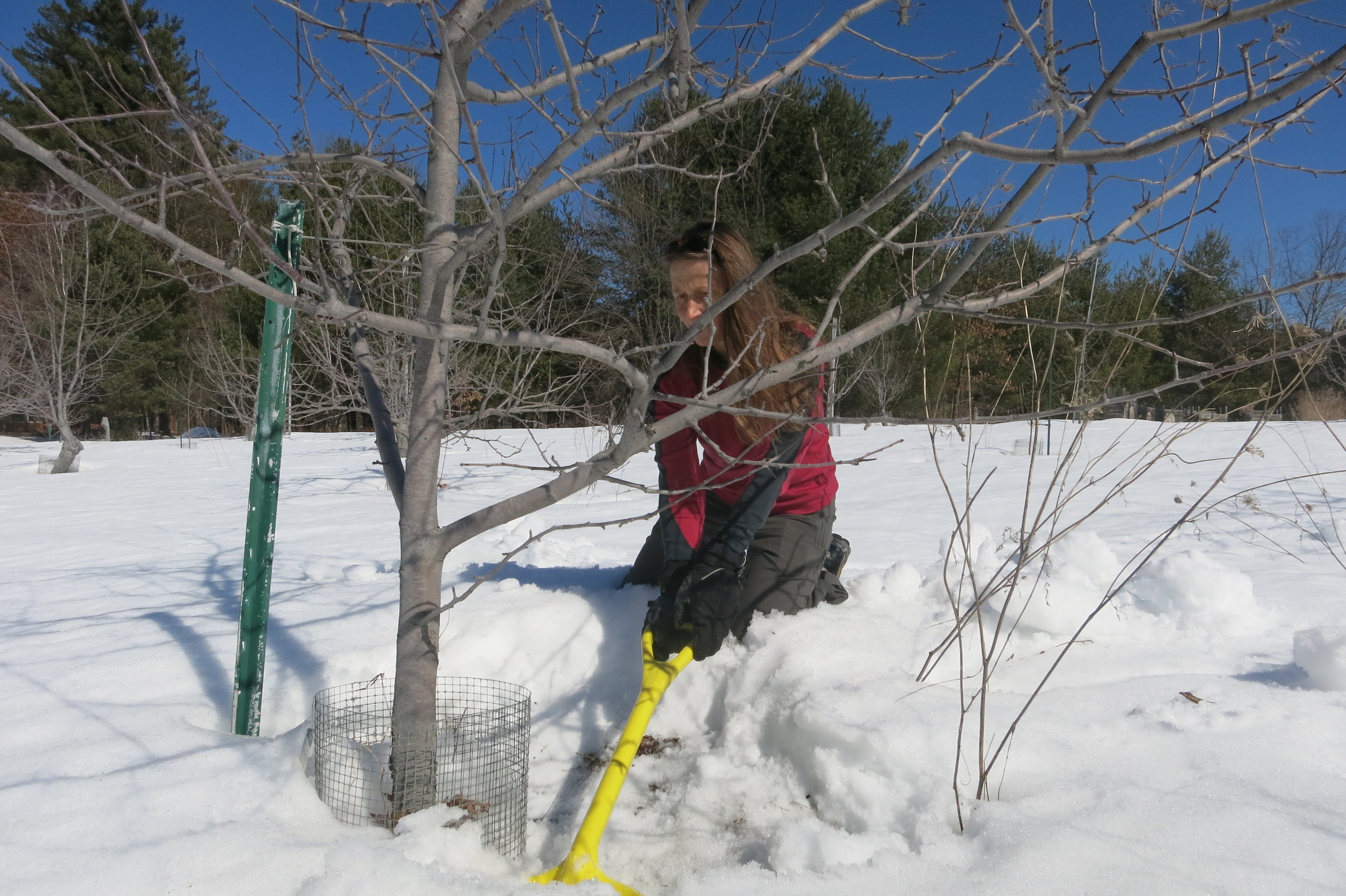
Gabi White tirelessly shoveling snow.
It was exhausting work. There was no way we could remove that much snow from around every tree. When we were too tired to shovel, we stomped the snow down with snowshoes. It felt like a war zone. Our hats, coats, shirts, and gloves were scattered everywhere.
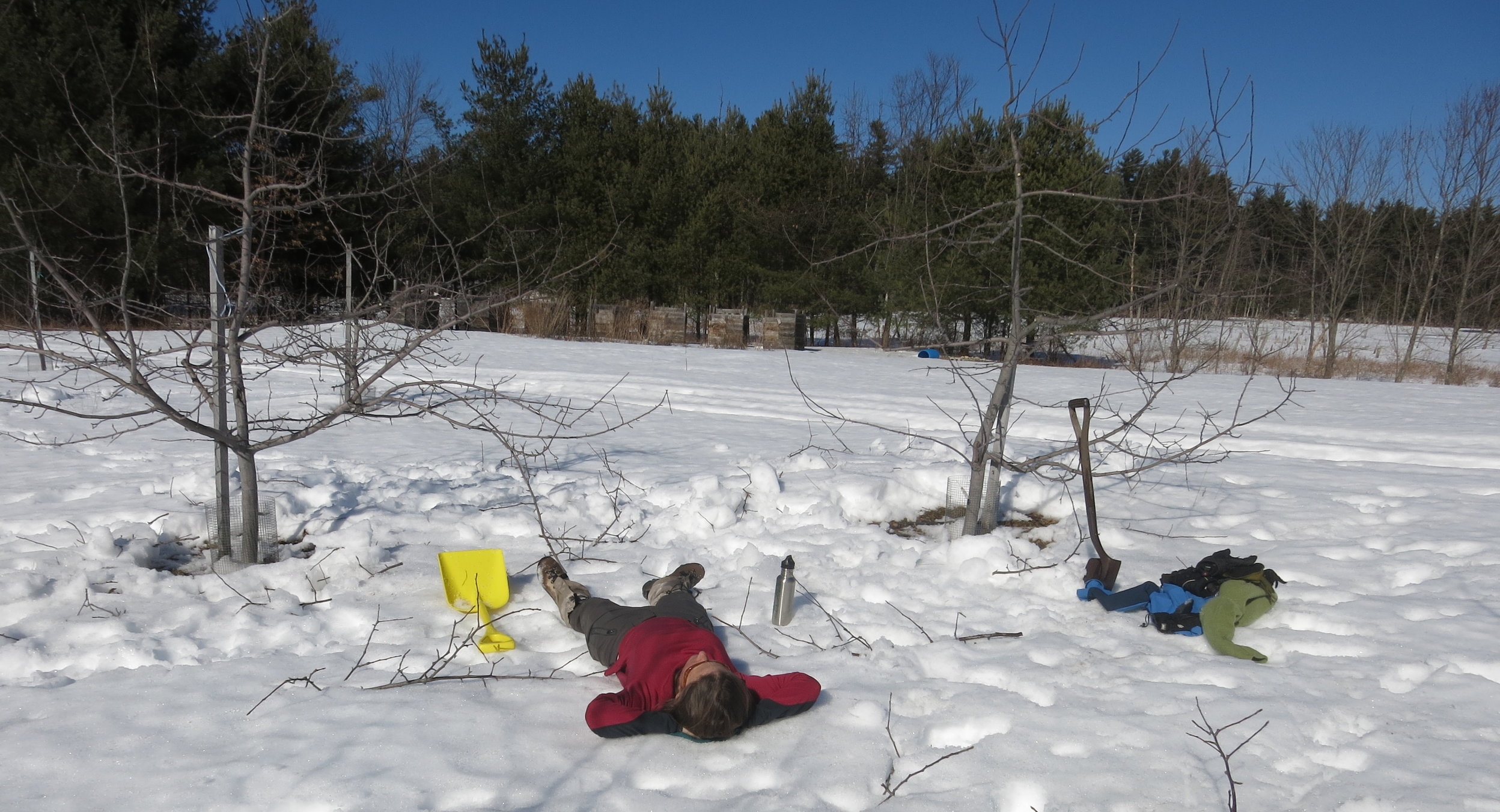
Gabi White — resting!
After a short break, we got back to work, shoveled more snow, heated up and stripped to tank tops, but it was too late. The damage was done.
Paige O’Brien, one of our farm workers, made a detailed map of all the injured trees and numbered them on a scale of one to four. One was one-quarter girdled, two was halfway, three was three-quarters, and four was completely girdled. We cut down the threes and fours, because they would either die or struggle mightily. A weak tree would attract more disease and pests. In all, fifty trees out of three hundred needed to be cut down. A saw blade to each trunk, and the task was done. Such quick work compared to years of cultivating growth.
Later, I learned it had been a bumper year for voles. Nature is like that—a bumper year for acorns, for apples, and now, for voles. Commercial growers knock down the vole population every fall with pellet poison. I had done the opposite. I had created a perfect vole habitat by growing delicious herbaceous perennials and cultivating long grasses and flowering plants. Following the irrigation drip lines, the voles had scampered freely from tree to tree.
So much for a wild orchard. I would have to rethink my approach and mow down all the perennials in the fall. Now, we mow several times throughout the season to dissuade the vole population from even considering making the orchard their home, but we leave patches of herbs and wildflowers growing between the trees. In preparation for winter, even these plants get mowed down to the ground. We also pull the drip lines away from the trees. In the spring, the hardy plants come back. I can already see the healing herbs like comfrey, valerian, and mountain mint unfolding their leaves. The orchard is not wild, but it’s not a monoculture either. We are trying to live peaceably with the other creatures who make their home nearby — definitely not offering them apples trees to chew — but encouraging a diversity and abundance of nature.
The challenge remains, however. I check on trees that aren't growing as well as I would expect and discover they are partially girdled, and two days ago I cut down a Crimson Crisp, a three-year-old ready to take off, but completely eaten around the graft. I'm discouraged. Then I smile at a dove sitting on a young tree as a blue heron flies by. I see pink buds on almost every branch of some eighty varieties of apples. I am blessed.
Natural Farming — Part 1
It may be that when we no longer know what to do,
we have come to our real work
and when we no longer know which way to go,
we have begun our real journey.
—Wendell Berry, Farmer, Poet, and Writer
In 2006, the once abandoned orchard at Old Frog Pond Farm received organic certification. But that didn’t mean I understood what I was doing as an orchardist. An experienced farmer tends the earth for years, season after season, noticing, altering her approach, and trying new ideas. I was following an instruction sheet that I only partially understood. In my search to improve my orchard practices, I came upon the writings of Masanobu Fukuoka (1913-2008), a Japanese rice and citrus grower, who discovered a way to farm that was in harmony with nature. His book, One Straw Revolution, published in English in 1978, became an underground manifesto for a new approach to agriculture: one that did no harm, that did not depend on chemical fertilizers, pesticides, or mountains of compost — one that emphasized ease.

As a young man, Fukuoka worked for the Customs Bureau’s Plant Inspection Division, having studied plant pathology at the university. His long hours led to a bout of acute pneumonia and hospitalization. He lay for days in his hospital room where a broken window let in cold and snow. He recounts that a nurse checked his temperature from time to time, but that was all. In the midst of this icy solitude, he started to fear death approaching. When he was finally released from the hospital, he fell into a terrible depression. The work that had fascinated him seemed useless. He could not sleep or focus on anything. One night on a hill overlooking the harbor, he collapsed with exhaustion. He woke the next morning at dawn, gazing over the water. “Everything I had held in firm conviction,” he wrote, “everything upon which I had ordinarily relied, was swept away with the wind. I felt that I understood nothing.” The next day he handed in his resignation and began wandering, trying to explain to people he met what he had experienced. “I challenged a lot of people with my conviction that everything is meaningless and of no value, that everything returns to nothingness. But this was too much, or too little, for the everyday world to conceive.” He returned to his father’s farm resolved to live a simple life.
I settled myself on the mountain and everything went well up until the time my father entrusted me with the richly bearing trees in the orchard. . . . My conviction was that crops grow themselves and should not have to be grown. I had acted in the belief that everything should be left to take its natural course, but I found that if you apply that way of thinking all at once, before long things do not go so well.
Fukuoka ruined the citrus crop and his father insisted that he leave and get a job and come back when his mind was right. Fukuoka left, and found a job as Head Researcher at a nearby agricultural research center. It was just when Japan was preparing for war and for the next eight years Fukuoka did research devoted to increasing the wartime food supply. Throughout this time, he was always pondering the idea of a natural approach to farming.
Fukuoka returned to his father’s farm, convinced that a grower could trust nature and not use any chemicals. On a clay hillside above the farm, he decided he would grow an orchard of mikan, a Japanese clementine. “The red clay was so hard you could not stick a shovel into it,” he wrote. People had previously grown potatoes there, exhausted the soil, and abandoned the fields. His father thought he was crazy.
To improve the soil, Fukuoka first tried digging holes in the compacted soil and adding organic matter, a physically demanding effort that led nowhere. Then he tried burying straw and ferns that he had carried on his back from higher up on the mountain. But hauling ninety pound loads and digging trenches was exhausting. The trenches eventually caved in, and there was barely any organic matter. He thought of building organic matter in the soil with decomposed wood, but it wasn’t available nearby. This was his “aha” moment — he could grow the wood himself.
Among his citrus trees, he planted pine, cedar, pear, loquats, cherries, and other native trees. On the bare ground under them, he sowed white clover and alfalfa. After several years, the clover grew and blanketed the hillside. He planted daikon, the large white Japanese radish. With its deep taproot, the daikon opened the way for water and air to circulate through the dense clay. The radish reseeded, softening the hard clay soil, and, after a few seasons, Fukuoka could plant root crops like potatoes and eventually more tender vegetables. He continued to sow clover, a nitrogen-fixing plant that returned more nitrogen to the soil than it used. The orchard soil became rich and dark, and the tall trees provided a windbreak protecting the smaller citrus trees. With the ground cover of nitrogen-producing plants, the orchard naturally had all the fertilizer necessary. With the diversity of plants and trees, insect pressure decreased, and he had no need for pesticides.
In Japan, after World War II, there was a great rush to emulate the West and use modern methods, specifically chemicals for farming. At first these new introductions from the West meant less work for the farmers, but it took only one generation before the minerals in the soil were depleted and the crops became dependent on chemical nutrients. Fukuoka knew intuitively that there must be another way.
Over the over the next decades, Fukuoka refined his approach to agriculture and called it natural farming (different from 'do-nothing' farming that had destroyed his father's citrus crop). He believed that farming should be pleasurable and in harmony with nature, not such oppressively hard work that the farmer is left with no time for other pursuits. “There is no time in modern agriculture for a farmer to write a poem or compose a song,” he would grumble. Fukuoka always sold his crops for less than chemically treated produce, because he felt natural food should be less expensive. “After all, natural food [is] easier to grow, even though it [is] more nutritious and tasty.” When Fukuoka learned that a distributor in Tokyo was selling his mikan for a high price, he immediately stopped selling to him.
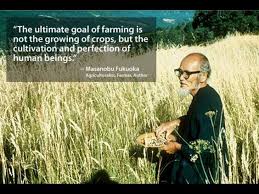
The ultimate goal of farming is not the growing of crops, but the cultivation and perfection of human beings.
—Masanobu Fukuoka
I aspired to Fukuoka’s ease and trust of nature. Having no idea what I would do, for several weeks, I carried around his book, as if the spirit contained within it would infuse the farm. My first real step was to plant comfrey throughout the orchard, a plant that also has a long taproot. People told me that I was really foolish, because comfrey spreads its seeds and will take over gardens, fields, and even orchards. The comfrey didn’t turn out to be a problem, because the deer kept it in check. But what happened next in my desire to create a natural orchard in the spirit of Fukuoka was devastating.
Natural Farming: Part 2 will follow next Sunday.
Organic Certification
Last week I filled out our annual organic certification paperwork due February 15th. It’s one of those items on my To Do list that I often put off. When a farmer wants to be an organic grower and label her produce organic, each crop on the farm must be certified by a regional certifying agency. First, the applicant needs to demonstrate that for three years the land has been free from contaminating chemicals. Then, the crops must be grown according to organic standards; specifically, any material used on the crop must be on the Organic Materials Review Institute’s (OMRI) list of approved materials or individually approved by a certifying agency. If a farmer chooses not to become certified, yet still follows all the regulations, she can tell customers that the crop is grown according to organic standards, but cannot label it organic. The standards are stringent, and the United States Department of Agriculture can slap on a fine of up to $10,000 for each infraction.
Now that I am filling out the certification papers for the 11th year in a row it doesn’t take me as long as it used to. But I remember the first year I nervously submitted our thirty-page application, including maps of the land, a soil report, a list of materials I had used or planned to use, and harvest, selling, and storage plans. The certifier wanted to be sure that there was no possibility of contamination at any step in the process of delivering the crop to the consumer. The final requirement before receiving certification was the annual onsite inspector visit.
I knew that being certified would create our market. Our certifier had told me that there were no other pick-your-own certified organic orchards in Massachusetts. Without it, why would anyone be attracted to our little farm, when we were surrounded by so many commercial orchards that not only offered apples, but cider donuts, farmstands, mazes, petting zoos, and hay rides — big time agri-tainment?
On the day of our appointment, the inspector arrived with copies of our application and a clipboard of questions. He wanted to see the shed where we stored all of our materials, the tractor, the sprayer and other tools, our spray log, and receipts for all materials purchased—in short, everything related to the farm operation. It was a bit like having a nosy mother-in-law inspect your domestic abilities. I thought I’d done everything correctly, but the inspector noted some inconsistencies that needed to be addressed before the orchard could receive organic certification.
The most difficult issue to resolve was my early season copper spray for fire blight, a standard in the orchard arsenal. Copper is a mined material; I never imagined that it wouldn’t be organic. The product label said it contained copper sulfate and copper oxychloride, both Greek to me (I never took chemistry), and other inert materials. The inspector told me he was not worried about the first two materials, but that I would need to find out about the inert ingredients, which companies are hesitant to reveal because of trade secrets. Those inert ingredients could make us ineligible for certification for three years. With my friend Kavita’s help, we discovered that our product was on an older OMRI list. We were ecstatic and called the organic certifier. He said, “This is good news,” but he cautioned us. “The product might have changed—otherwise, why wasn’t it on the current list? If the material is the same as on the older list, you need to get the company to state that in writing.”
We called the company numerous times and sent beseeching emails. Fortunately, we reached a sympathetic person who explained that the product was changed to a different label due to a “consolidation of product line.” Neither the active nor inert ingredients had changed. He said the company didn’t list it because the paperwork was so arduous. We were very appreciative and the farm officially received organic certification a few weeks later. Now, I get approval for every product before I use it in the orchard. And because we are one of two organic pick-your-own orchards in the state, and still the only one in eastern MA, we are picked out every fall before Columbus Day.
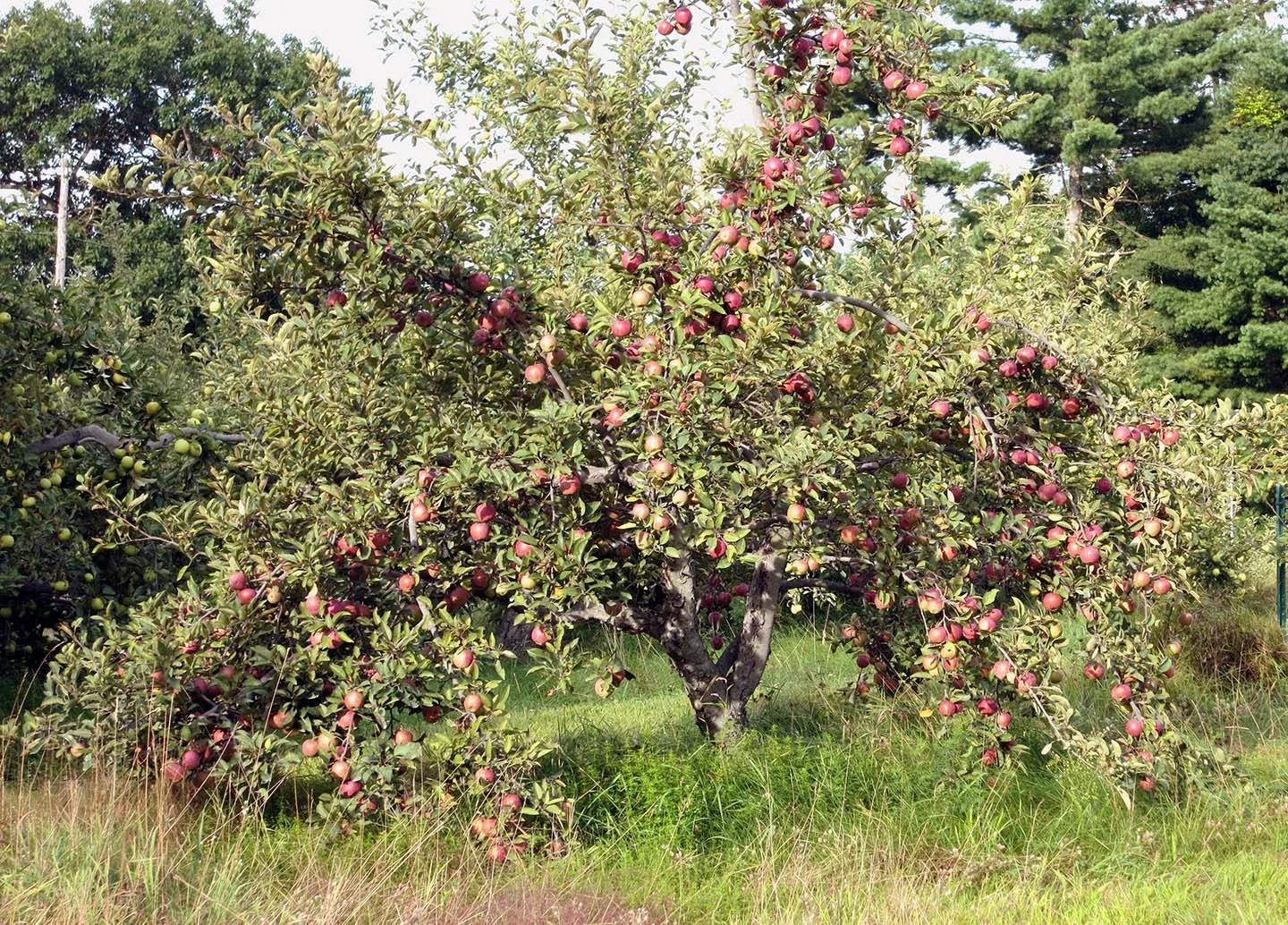
Apple Tree at Old Frog Pond Farm, 2013 Photo Credit: Linda Hoffman
Today, I wouldn't consider spraying a harsh chemical on our trees or herbicide under the trees, but I continue to apply for certification. Organic certification creates the market for our small farm. But I know that organic is only a minimum requirement for healthy food. The nutritional content of our food makes the big difference in human health and it’s the biological activity in the soil that feeds the plants that feed us. I’ll be writing about nutrient dense growing in a future blog. But that’s why it’s important to know your farm and know your farmer!
Search Blog
-
2025
- May 9, 2025 A View from the Tractor Seat
- Apr 11, 2025 Dig
-
2024
- Jan 7, 2024 Winter Wassail
-
2022
- Dec 11, 2022 Keeping Time
- Jun 17, 2022 This Apple-Shaped Earth
- Jan 23, 2022 What is a Jizo?
- Jan 16, 2022 An Invite and Housekeeping Update
- Jan 1, 2022 The Year of the Frog: What Orchardists Do While Apple Trees are Chilling
-
2021
- Oct 24, 2021 Figs
- Oct 3, 2021 The Artist and the Orchard: A Memoir
- Aug 8, 2021 Red-Fleshed Apples
- Jul 25, 2021 When We Were Trees
- Jun 27, 2021 Castor Beans—Who Knew?
- Jun 13, 2021 Spring Training at a Zen Monastery
- May 4, 2021 Our Trees are in Bloom
- Apr 18, 2021 Hooray!
- Jan 24, 2021 Wassailing, virtually!
- Jan 1, 2021 Sitting
-
2020
- Dec 21, 2020 Darkness to Light
- Nov 28, 2020 One Heart
- Sep 18, 2020 Juggling Flowers, Fruit, and Vegetables
- Aug 23, 2020 Refuge
- Aug 9, 2020 Bags of Fertilizer
- Aug 2, 2020 The Sermon of the Blue Heron
- Jul 26, 2020 What's the Buzz?
- Jul 19, 2020 Farm Moments
- Jul 12, 2020 Lost Wax
- Jul 5, 2020 Catalpa: The Hugging Tree
- Jun 28, 2020 Pedaling Peace
- Jun 21, 2020 See Change
- Jun 14, 2020 Lalla Unveiled
- Jun 7, 2020 Pond Alchemy
- May 31, 2020 The Birth of Fruit
- May 24, 2020 An Artist in the Orchard
- May 17, 2020 Walking the Land: Returning Home
- May 10, 2020 Stinging Nettles: Gifts from the Great Mother
- May 3, 2020 The Mystery of Swallow
- Apr 26, 2020 Aerial Bruststrokes
- Apr 19, 2020 Simple Pleasures
- Apr 12, 2020 Weeds and Other Gifts
- Apr 5, 2020 Remembering the Seeds
- Mar 29, 2020 Blow on the Embers
- Mar 22, 2020 Ripples
-
2019
- Nov 16, 2019 Tibet Impressions
- Nov 9, 2019 Forest Tales
- Oct 13, 2019 The Gift
- Aug 4, 2019 The Season is Apples, Berries, and Grandfather Fire
- Jun 8, 2019 Pointers for a Writing Life
- May 12, 2019 Mothers of the Earth
- Apr 6, 2019 The Apple-Shaped Earth
- Mar 23, 2019 You Don’t Know What You Have Till It’s Gone
- Feb 23, 2019 Generations
- Feb 9, 2019 What Are We Doing to the Earth, John Chapman?
-
2018
- Dec 31, 2018 Long Shadows
- Oct 6, 2018 A Pilgrimage to India
- Aug 18, 2018 Scrap Wrenn
- Aug 11, 2018 Off-the-Wall Comments from an Ignorant Farmer
- Jul 28, 2018 Creative Connect
- Jul 14, 2018 How is the Orchard?
- Jun 30, 2018 Which Way?
- Jun 16, 2018 Geese, Herons, Beavers, and the Baby Steps of a Lapsed Blogger
- Feb 24, 2018 Mama's Coupons — Good Forever
- Jan 27, 2018 January Ice
- Jan 13, 2018 The Muse
-
2017
- Dec 30, 2017 A Dream for the New Year
- Dec 23, 2017 A New Year for Apples
- Dec 16, 2017 Intuition
- Nov 22, 2017 Thanksgiving OM
- Nov 4, 2017 East Fork Pottery
- Oct 28, 2017 Putting Down New Roots
- Oct 21, 2017 A is for Art
- Oct 14, 2017 Eve domesticus
- Oct 7, 2017 A String Workshop
- Sep 30, 2017 After Applepicking
- Sep 23, 2017 Two Bad Women and One Good Apple
- Sep 16, 2017 Plein Air Poetry
- Sep 9, 2017 Cutting Off a Leg
- Sep 2, 2017 The Changing Landscape
- Aug 26, 2017 All About Art
- Aug 19, 2017 My First Visit to the Farm
- Aug 12, 2017 The First Food
- Aug 5, 2017 A Teapot, a Woman, and maybe a Boat
- Jul 29, 2017 A Raspberry Dilemma
- Jul 22, 2017 Consider the Miracle
- Jul 15, 2017 Meeting Ekphrasis
- Jul 8, 2017 Ripening Fruit
- Jul 1, 2017 The Voice of The Caterpillar
- Jun 24, 2017 Goumi — An Unusual Fructus
- Jun 17, 2017 Concord, an American Bloomsbury
- Jun 10, 2017 The World Is Bonkers — Shall I Laugh or Cry?
- Jun 3, 2017 Bonkers, a Revolutionary Apple
- May 27, 2017 Guardians of the Swamp
- May 20, 2017 There are Mushrooms and There are Morels
- May 13, 2017 "What's in a Name?"
- May 6, 2017 Bloom Follows Pink: Orchard Pollination
- Apr 29, 2017 The Orchard Is at Pink
- Apr 22, 2017 Natural Farming — Part 2 (continuation from last Sunday's blog)
- Apr 15, 2017 Natural Farming — Part 1
- Apr 8, 2017 Boats, Figures, and Catching Fish
- Apr 1, 2017 A Man with a Mission: The Nuts and Bolts of Bronze Casting
- Mar 25, 2017 A Chalice of Spirit, Art, and Nature
- Mar 18, 2017 Hanami — Blossom Viewing
- Mar 11, 2017 Soil Redemption Song
- Mar 4, 2017 Food is Primary Care
- Feb 25, 2017 Pomme de Terre
- Feb 18, 2017 Organic Certification
- Feb 11, 2017 Tantalizing Fruit
- Feb 4, 2017 The Myths of History
- Jan 28, 2017 The Orchard in Winter
- Jan 21, 2017 The Hi-Line
- Jan 14, 2017 Artistic, Botanical, and Social Diversity
- Jan 7, 2017 Where is Eden?
-
2016
- Dec 31, 2016 The Creative Heart
- Dec 24, 2016 A Christmas Tale
- Dec 17, 2016 Who are the Crones?
- Dec 10, 2016 The Olympic Bell (Part Two)
- Dec 3, 2016 Overheard in the Apple Orchard in Early December
- Nov 26, 2016 The Lessons of a Tortoise
- Nov 19, 2016 In the Studio
- Nov 12, 2016 Even in Darkness
- Nov 5, 2016 Southern Apples, an Elephant, Monkey, Rabbit, and Bird, Two Mango Trees and a Birthday
- Oct 29, 2016 The Tools of Art
- Oct 22, 2016 Labyrinths
- Oct 15, 2016 Repairing the Broken
- Oct 8, 2016 When You Are No More
- Oct 1, 2016 Creation Rain
- Sep 24, 2016 Breaking the Glass
- Sep 17, 2016 String Art
- Sep 10, 2016 Poetry and Photosynthesis: It's all in the Leaves
- Sep 3, 2016 In the Plenty of Time
- Aug 27, 2016 Witch Doctors
- Aug 20, 2016 Listen Coyote
- Aug 13, 2016 Milkweed in the Orchard
- Aug 6, 2016 Some People See a Turtle
- Jul 30, 2016 Arborshaping
- Jul 23, 2016 Joseph Wheelwright: Sculptor of Stones and Trees
- Jul 16, 2016 Asian Pears
- Jul 9, 2016 Gold Leaf, Grief, and the Creative Process
- Jul 2, 2016 The Olympic Bell (Part One)
- Jun 25, 2016 Around the Mulberry Bush
- Jun 18, 2016 Avoiding Apples
- Jun 11, 2016 Fructus
- Jun 4, 2016 Astonishing Apples
- May 28, 2016 Scare the Caterpillars
- May 21, 2016 Join the Club!
- May 14, 2016 The Graft
- May 7, 2016 Rooster, Rhubarb, Rue
- Apr 30, 2016 What do Dolphins and Nettles Have in Common?
- Apr 23, 2016 Art Prunings
- Apr 16, 2016 A Few of the First Arrivals
- Apr 9, 2016 Taste the Spirit of Sustainable Agriculture
- Apr 2, 2016 First Orchard Spray - March 22-24, 2016
- Mar 26, 2016 Hawkeye Apple
- Mar 19, 2016 Desiring the Almata Apple
- Mar 12, 2016 Ugly Fruit
- Mar 5, 2016 Winter Tracks
- Feb 27, 2016 Splash
- Feb 20, 2016 Pruning
- Feb 13, 2016 Orchard Ruminants
- Feb 6, 2016 A Gathering of Seeds
- Jan 30, 2016 Orchard Dragons
- Jan 23, 2016 Tree Rings
- Jan 17, 2016 The Fallen Tree
- Jan 7, 2016 Wassailing the Apple Trees
- Jan 1, 2016 The New Year