LINDA HOFFMAN
Creative Connect
Sheets of rain slice across the pond, while our thirty-eight resident Canada geese poke at their feathers or calmly stare. Human wellbeing often depends on being dry, out of the rain, but in those moments when I enjoy the geese, I also enjoy getting wet.
You might call such a moment being alive, but as an artist I call it being creative. For by creativity I mean the potential to connect with the world outside oneself, whether near to home—the geese in the rain, a field of wildflowers, or far from home—the terror of immigrant children separated from their parents.
When I experience long periods without this creative energy rising, I don’t feel connected. I fall into an abyss of my own mind, a morass of thinking about myself. Creativity makes me feel connected to the world. We all share this experience; it is inherently human.
The opposite is also true. We can be in the most beautiful place and not appreciate it; we block the beauty from entering our marrow. We can be in the most loving relationship and not allow the love to enter. When we don’t connect, we don't belong. Caught in the rain, we fear our clothing is getting wet or ruined, and we make it a problem. We hurry, frown, hunch up, forget the larger picture.
This longing to be connected with a big 220 amp plug drives my art. Even when I am grieving or burdened, when the world appears deeply troubled and dysfunctional, I try to keep this connective amperage flowing. For I know life will continue to change like wood to ash or leaves to compost, and human creativity is recognizing and living with these transitions and using them. A friend sent me a link to an article about an artist's painting exhibit. The artist, Kelly Thorndike, is an Iraqi vet who was stationed at the horrific Abu Ghraib prison when a bomb went off. In the second before shrapnel hit and seriously wounded him, Thorndike saw a nearby inmate blown to pieces. It’s worth a read. Creative work can help us process events and feelings we store in our minds.
A few nights ago, I was finishing a new sculpture, a mandala of sorts, with a great hollow tree in the center, and small meditating figures surrounding it.

Sculpture in process leaning on the wall.
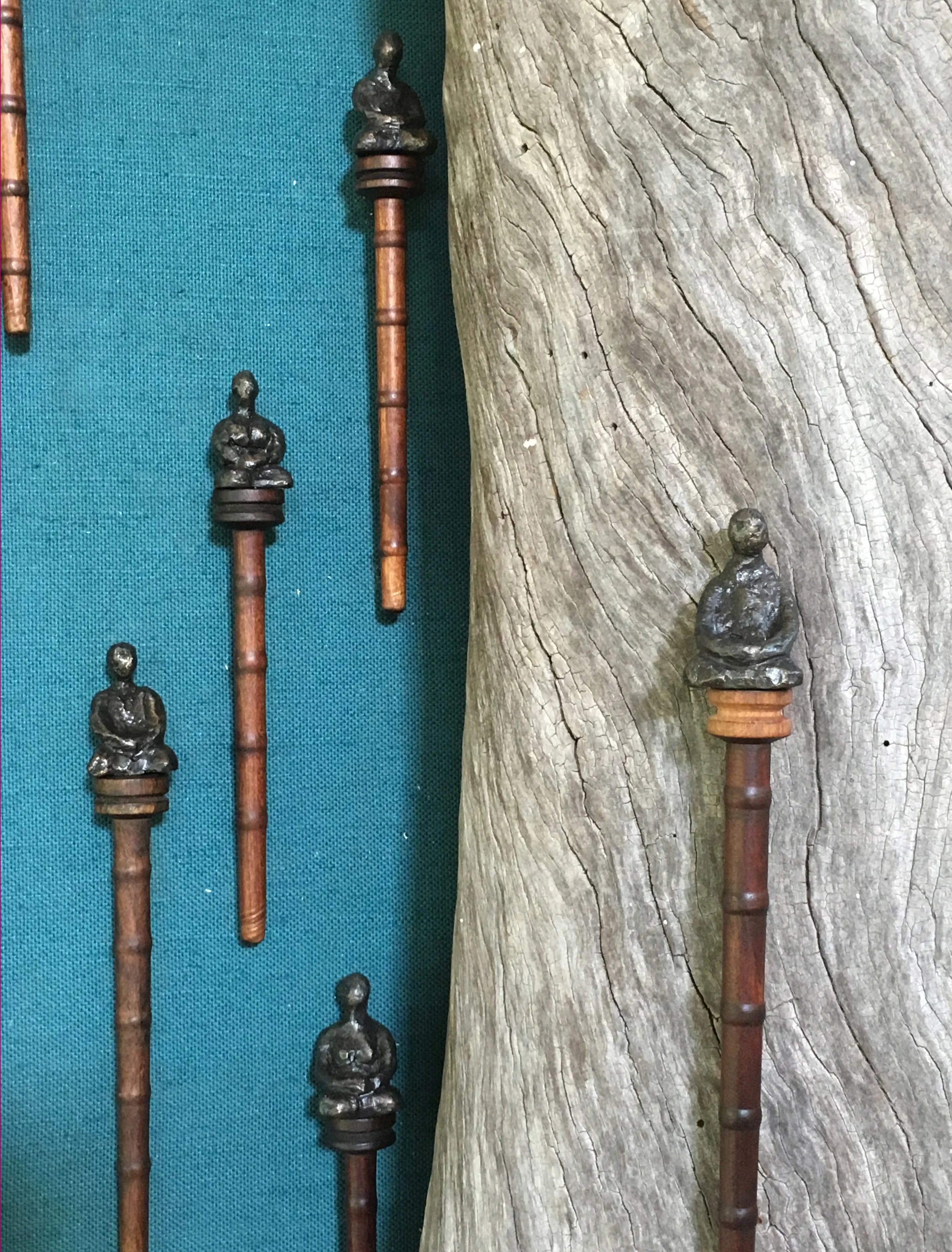
I think the outer work is complete, but I have one part yet to finish. The Buddhas are sitting on wooden dowels, bobbins from an old textile mill in Lowell.
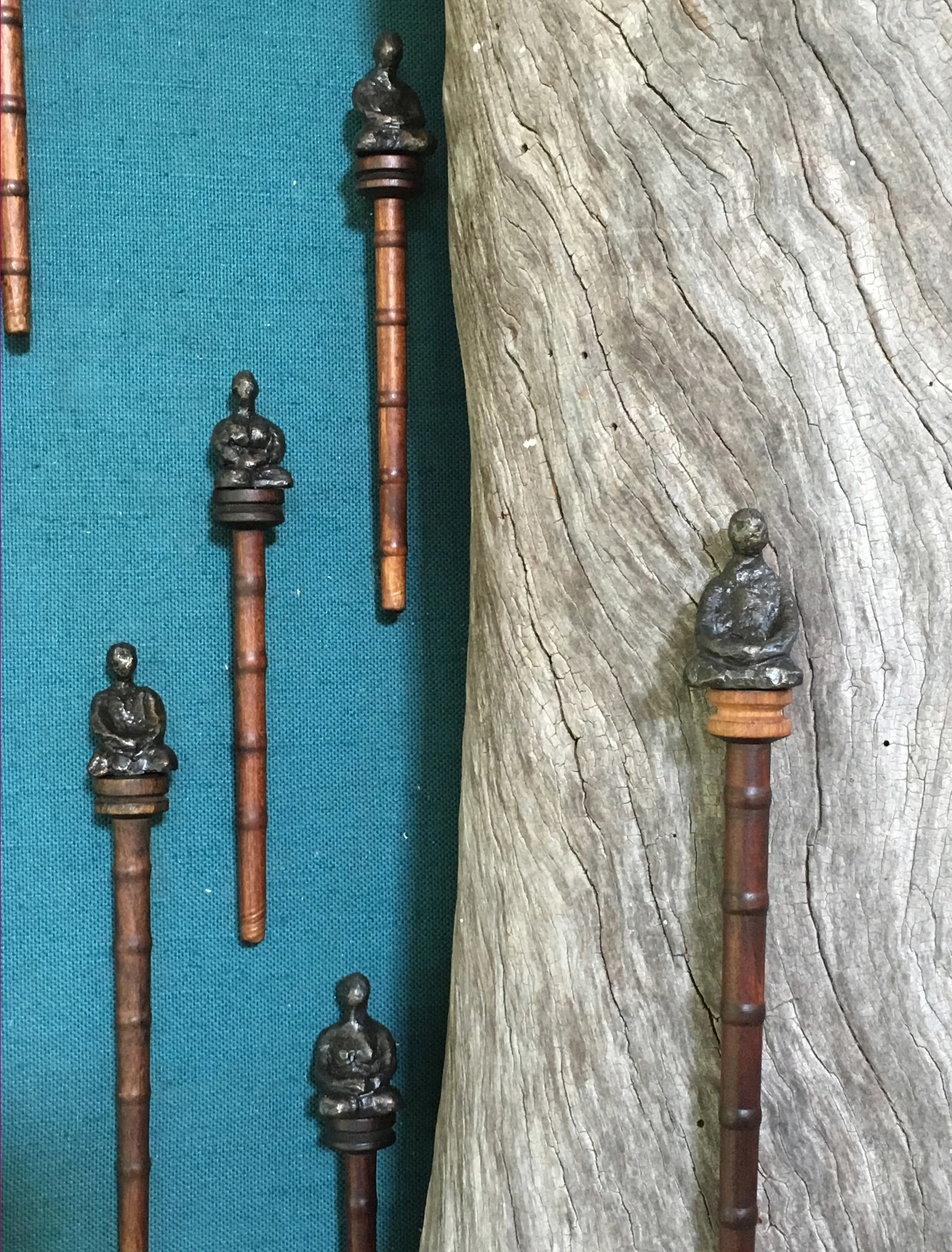
Sculpture detail, LH
They are hollow. I want to place a word, a prayer, a meditation for the world inside each of these wooden tubes. I cut up a watercolor and wrote single words on each one—compassion, wisdom, suffering . . . but then didn’t feel this was exactly right. As I was putting tools away, I noticed a bag of leftover National Geographic maps from making the sculpture, The Teapot Explorer.
I pulled out one, ‘Peoples of the Mideast’, a map of Libya, Saudi Arabia, Egypt, Iran, Turkey, and Afghanistan, with pictures of all the different ethnic groups from these areas—Bedouin, Qashqai, Armenian, Turk, Lur, Kurd among others. In one corner of the map there is a box describing the ethno-linguistic groups titled, An Awesome Human Mosaic. I thought of adding the names of indigenous people inside each bobbin in recognition of the depth of so much human diversity.

Copyright 1972 National Geographic Society
Then I opened a second map, ‘Great Migrations’, depicting eighteen migration patterns around the globe—birds, mammals, insects, reptiles, amphibians, crustaceans, micro-organisms, and fish. I traced the Monarch’s multi-generational migration of 4000 miles. I followed the equally miraculous journey of the Loggerhead turtle 9000 miles from beginning to end, back to the very beach where it was born. Each of these creatures as unique as the indigenous people I admire.
I left the studio filled with awe.
Early the next morning on my way to the studio, I stopped to visit the geese. Some of the them were on the dam wetting their feet, others stood in the lawn alongside it. I appreciated so much life right outside the door. Then I continued to my studio determined to write this blog. I’m not sure the blog is quite finished, and I don’t know how or when I will finish the sculpture, but as I look up from my page, startled at the sound of flapping wings, I see the geese practicing. It's flying-lesson time for the young.
Soil Redemption Song
Michael Phillips, author of The Apple Grower and The Holistic Orchard, now has a new book, Mycorrhizal Planet, just published by Chelsea Green Publishing. There was some disagreement between Phillips and the publisher about the title for the book, so he conducted a poll asking friends for input. A cattle rancher, a regional publisher, a permaculture guru, a biodynamic herbalist, an academic, and an orchardist/artist, among others, all weighed in on which of three titles they preferred. I voted without hesitation for Mycorrhizal Alchemy, but Chelsea Green decided to go with Mycorrhizal Planet (Mycorrhizal Pathways was the other choice). Alchemy suggests transformation, mystery, and ancient practices, all of which I am drawn towards. It’s a little like taking old found objects and making them into art.
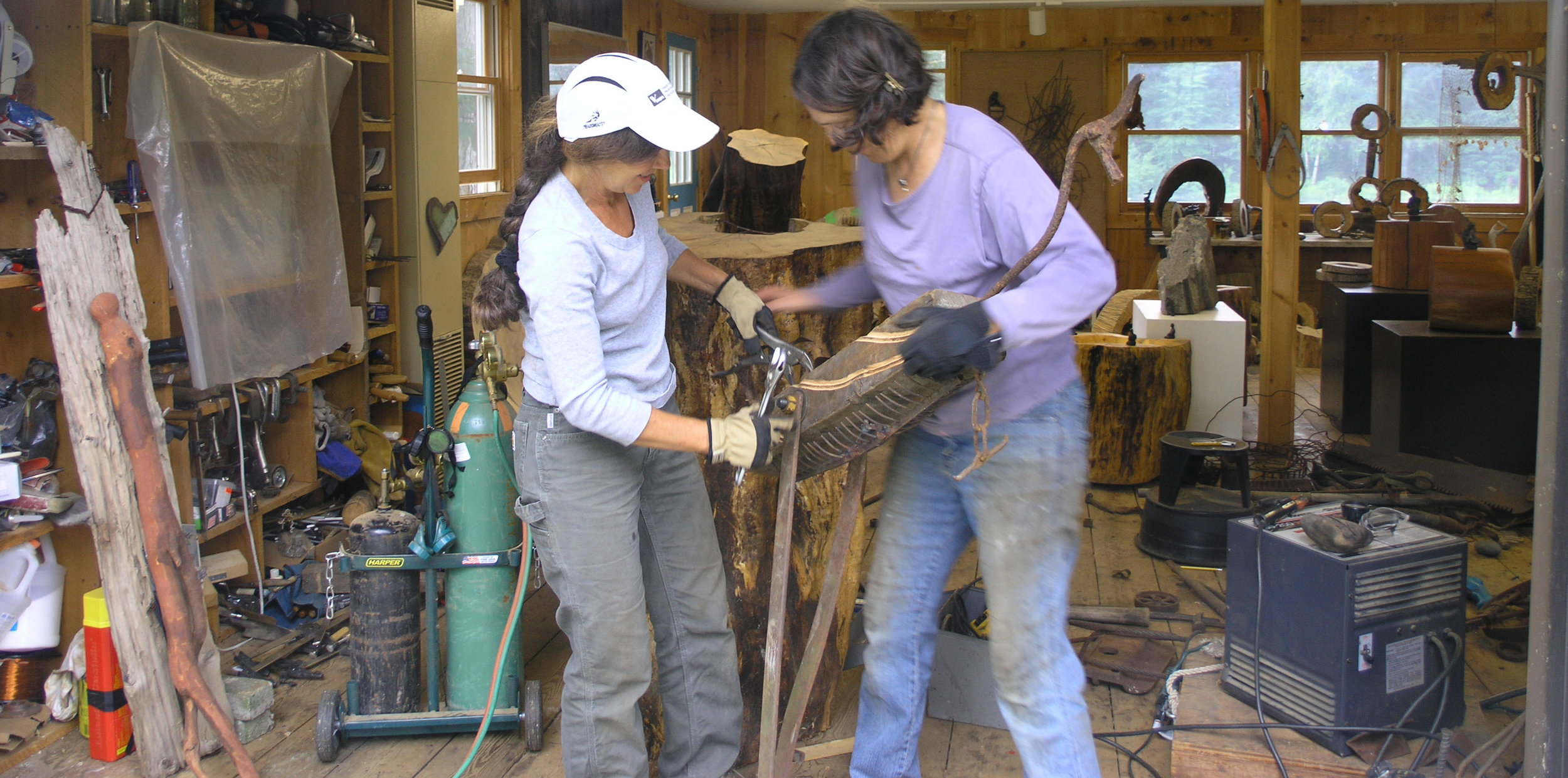
Linda Hoffman (left) and Madeleine Lord working on Belle the Bird in Hoffman's Studio, 2009
In the painting, The Alchemist by Cornelis Bega, a hunched figure sits in a cave-like room, intent on what is happening inside a glass jar. Books, notebooks, and earthenware pots surround him, suggesting a lifetime of mixing substances and studying their reactions. The alchemist is grounded and humble in Bega’s depiction. It’s a lonely art, much maligned as a materialistic quest to turn ore into gold; when, in fact, alchemists made considerable contributions to early science.
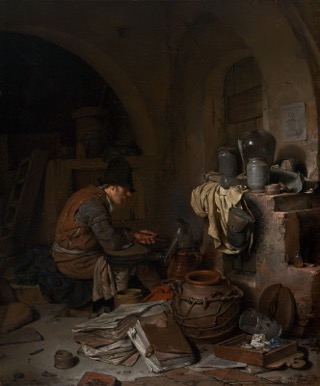
The Alchemist, Cornelis Bega
I think of Michael Phillips like this alchemist, studying the threads of life in the soil, appreciating them, and sharing their magic. Mycorrhizal fungi form a fibrous network stretching throughout the soil, attaching to roots, and connecting plant roots to each other. These fungi process minerals and feed them up to the plants, sending up just what is required. They will even provide storage for a plant’s bounty until leaner times, or pass on needed nutrients to other plants. It's a hidden world that scientists are only beginning to explore.

Photo courtesy of Larry Petersen, University of Guelph
“Each and every Mycorrhizal pulsating with nutrient flow, [is] making our lives possible,” Phillips writes. I consider Phillip’s passion to understand soil devotional.
Interestingly, Buddhism conceives of our world as one in which everything is interrelated and interdependent; nothing is separate in all of existence (or non-existence). Buddhism uses the analogy of the jeweled Net of Indra to describe this global interconnectedness. Imagine a vast net spreading out infinitely in all directions. At every crossing point in the net is a reflective jewel, and each jewel contains the reflection of every other jewel. If I were to put a mark on one gemstone, it would appear on every other one. How we treat one person ripples across the entire world.
The world under our feet is no different. Trees even share nutrients through Mycorrhizal fungi attached to their roots with trees of different species. It’s a little mind blowing — this network of fungi in the soil supporting the cosmic connection between all beings throughout space and time.
Phillips told me that he actually wanted the title to be Soil Redemption Song, inspired by Bob Marley’s haunting Redemption Song.
[…]
Won't you help to sing
These songs of freedom?
'Cause all I ever have
Redemption songs
Redemption songs
Emancipate yourselves from mental slavery
None but ourselves can free our minds
Have no fear for atomic energy
'Cause none of them can stop the time
How long shall they kill our prophets
While we stand aside and look? Ooh
Some say it's just a part of it
We've got to fulfill the Book
Won't you help to sing
These songs of freedom?
'Cause all I ever have
Redemption songs
Redemption songs
Redemption songs
Michael told me that as he pondered the lyrics of this song, he wrote, “Healthy plant metabolism begins with a molecule of water, a breath of carbon, and light energy from our nearest star. The tangible science behind all this unlocks the righteous way to farm and garden, give honor to trees, and plain do right by this earth. Nothing has ever excited me more.”
Mycorrhizal Planet provides practical information for the farmer, gardener, orchardist, and forester, as well as inspiration for all of us who have temporarily lost heart from following the daily news. If you’d like to order the book please go to Phillips’ website. He’ll sign a copy and send it to you.
Listen closely when you next walk among the trees. You might just hear the great alchemist Bob Marley singing — transforming our pain with his courage. Listen!
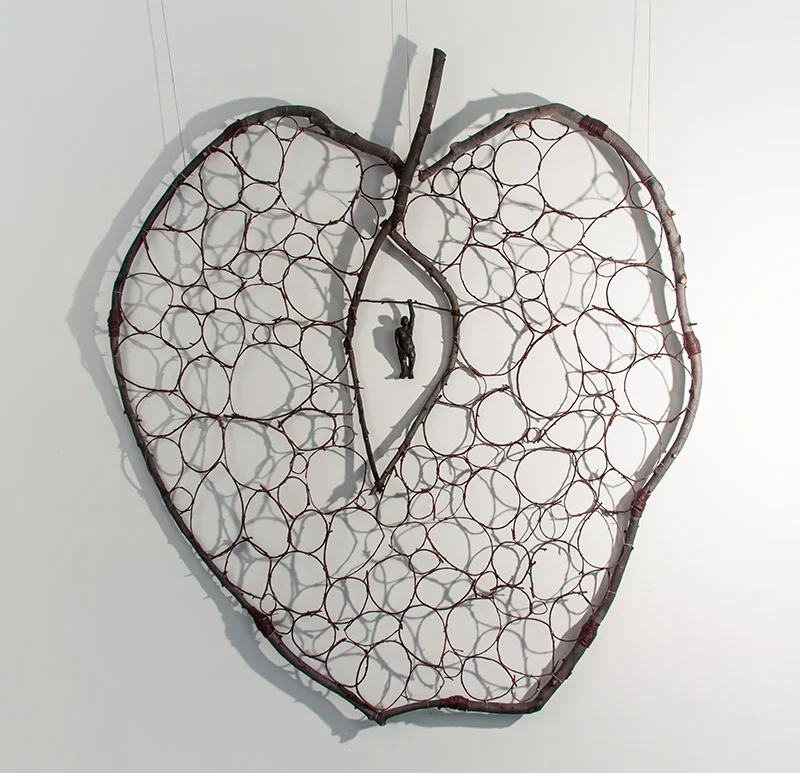
Where is Eden?
“Way to the East, at the source of four rivers” it says in the Bible. But this description doesn’t really help. The Tigris and the Euphrates are two locator rivers for Eden, but they have different sources, and there is no confluence of four rivers nearby. Medieval cartographers placed Eden on the far edge of their maps, beyond Asia, as if in unexplored territory. They often drew a walled garden and a naked little man and woman to mark the location.

Beatus Map, locating Garden of Eden (1109)
For centuries, Eden was considered a real place and it belonged on any map of the world, but no one quite knew exactly where to locate it. When coordinate mapping began in the 15th century, Eden was placed at 0 degrees latitude and 180 degrees longitude — until it became apparent that the coordinates pointed to an area in the middle of the Pacific Ocean. Today, we don’t try to put Eden on the map — but that doesn’t mean we don’t try to find it.
What is Eden, after all, but getting what we want, when we want it? That’s what the Buddha understood 2500 years and built the foundation of his teaching from his understanding that we all suffer because of our desires. When things go our way, we are happy, and when they don’t, we suffer. Eden is that lovely place where every desire is satisfied: the world is our oyster. The Buddha taught that the way out from this suffering was to understand that satisfying our cravings will never bring happiness, because all of life is impermanent. When we think we have it — whatever it is — something shifts — and once again we are looking for the next rosy apple.
Eden and Paradise are often used synonymously. To the Persians, Paradise meant a walled garden, while to the Hebrews it was an orchard. Indeed, I would agree that an orchard is as close as it comes to Eden. Trees that grow and produce sweet fruit year after year are really quite miraculous. There is so much about fruit trees that is astonishing — even simple apple branches — those irregular shaped, pruned and grafted, sculpted limbs, bewitching with their freedom and artistry.
Thus we have the genesis of the exhibit, After Apple Pruning. Using apple branches pruned from dormant trees and a few grafted roots from young trees that died, and with the help of good friends, Lynn Horsky and Gabrielle White, and my daughter, Ariel Matisse, we have created an Eden of apple orchard related sculpture for The Gallery at Villageworks in Acton, Massachusetts. We populated many of the branches with bronze figures that I first sculpted in wax — Adam and Eve, serpents, people sitting, bending, kneeling, reading, mediating, resting, as well as hanging from trees, tempting a snake, or embracing.
A few days ago, in anticipation of the installation, I became almost hysterical with worry. Two large wall panels took most of one day to figure out how to hang, including three trips to the hardware store and two consultations with my neighbor, a retired engineer (No nails in the walls was a gallery restriction). I didn’t want to rent and drive a 15’ truck and the forecast was solid rain for installation day. Moving so many very delicate branches was frightening, because one never knows when reassembling a piece if it will come together the way it did before. I watched as my mind went into a tail spin. I was struggling outside the garden walls.
The installation was smoother than expected; though one small, but important branch broke and caused a small panic. Blase, my partner, helped enormously. Clearly my prior distress was for naught. Today, we no longer look for Eden on a map, but I would place it for the next three months, a little to the east, in Acton. I simply love to be in the gallery space among all of the art. My Eden has been the pleasure of working with Lynn and Gabi, and seeing my daughter fully engage a challenging project. Eden is inside the mind, always nearby, no farther than our next thought.
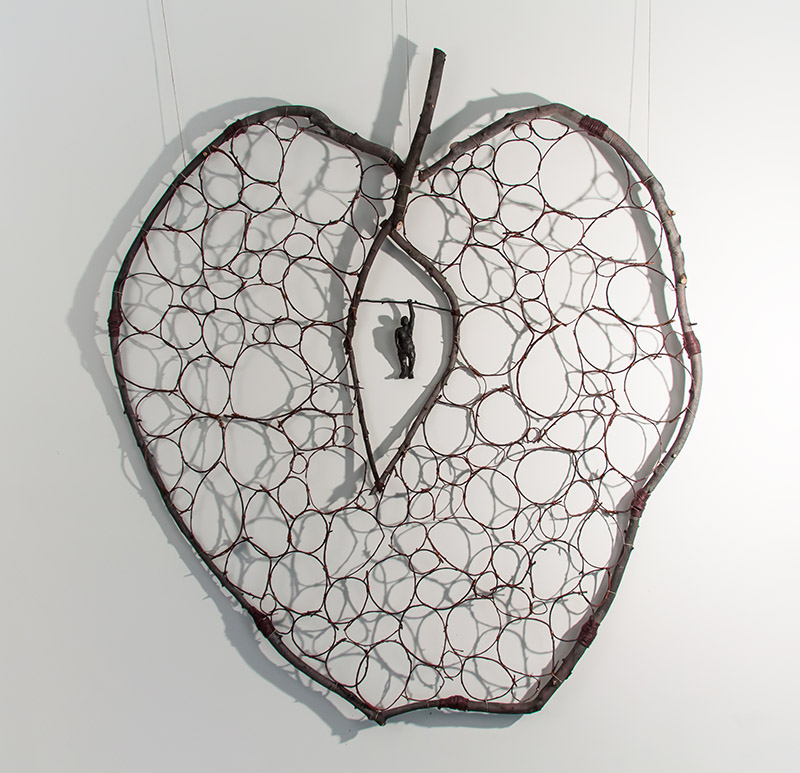
From One Seed, Linda Hoffman & Gabrielle White
Please join us!
Opening Reception for the Artists
Sunday, January 15 from 3-5 pm at 525 Massachusetts Ave, Acton, MA.
Exhibition dates: January 6 – March 30, 2017
Gallery hours: M-F 9-5.
Artist Hours in the Gallery
Fridays, Feb 3, 10, 24; March 10, 24; noon to 2pm
Poetry Reading in the Gallery
Celebrating the publication of "Before We Were Birds"
By Susan Edwards Richmond
Sunday, March 12 at 3pm
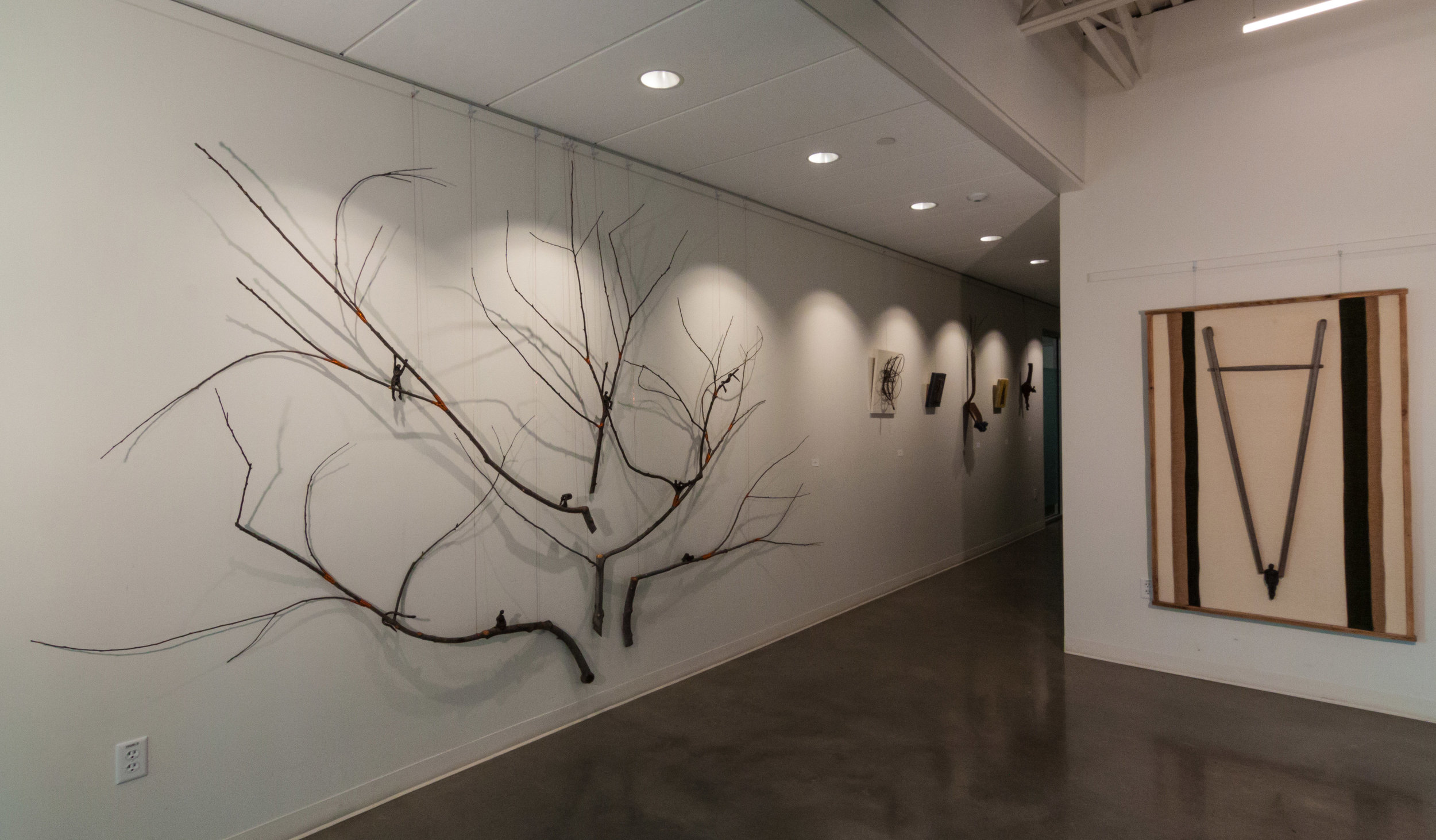
Grafting a Life (Left Wall) Linda Hoffman & Ariel Matisse
Search Blog
-
2025
- May 9, 2025 A View from the Tractor Seat
- Apr 11, 2025 Dig
-
2024
- Jan 7, 2024 Winter Wassail
-
2022
- Dec 11, 2022 Keeping Time
- Jun 17, 2022 This Apple-Shaped Earth
- Jan 23, 2022 What is a Jizo?
- Jan 16, 2022 An Invite and Housekeeping Update
- Jan 1, 2022 The Year of the Frog: What Orchardists Do While Apple Trees are Chilling
-
2021
- Oct 24, 2021 Figs
- Oct 3, 2021 The Artist and the Orchard: A Memoir
- Aug 8, 2021 Red-Fleshed Apples
- Jul 25, 2021 When We Were Trees
- Jun 27, 2021 Castor Beans—Who Knew?
- Jun 13, 2021 Spring Training at a Zen Monastery
- May 4, 2021 Our Trees are in Bloom
- Apr 18, 2021 Hooray!
- Jan 24, 2021 Wassailing, virtually!
- Jan 1, 2021 Sitting
-
2020
- Dec 21, 2020 Darkness to Light
- Nov 28, 2020 One Heart
- Sep 18, 2020 Juggling Flowers, Fruit, and Vegetables
- Aug 23, 2020 Refuge
- Aug 9, 2020 Bags of Fertilizer
- Aug 2, 2020 The Sermon of the Blue Heron
- Jul 26, 2020 What's the Buzz?
- Jul 19, 2020 Farm Moments
- Jul 12, 2020 Lost Wax
- Jul 5, 2020 Catalpa: The Hugging Tree
- Jun 28, 2020 Pedaling Peace
- Jun 21, 2020 See Change
- Jun 14, 2020 Lalla Unveiled
- Jun 7, 2020 Pond Alchemy
- May 31, 2020 The Birth of Fruit
- May 24, 2020 An Artist in the Orchard
- May 17, 2020 Walking the Land: Returning Home
- May 10, 2020 Stinging Nettles: Gifts from the Great Mother
- May 3, 2020 The Mystery of Swallow
- Apr 26, 2020 Aerial Bruststrokes
- Apr 19, 2020 Simple Pleasures
- Apr 12, 2020 Weeds and Other Gifts
- Apr 5, 2020 Remembering the Seeds
- Mar 29, 2020 Blow on the Embers
- Mar 22, 2020 Ripples
-
2019
- Nov 16, 2019 Tibet Impressions
- Nov 9, 2019 Forest Tales
- Oct 13, 2019 The Gift
- Aug 4, 2019 The Season is Apples, Berries, and Grandfather Fire
- Jun 8, 2019 Pointers for a Writing Life
- May 12, 2019 Mothers of the Earth
- Apr 6, 2019 The Apple-Shaped Earth
- Mar 23, 2019 You Don’t Know What You Have Till It’s Gone
- Feb 23, 2019 Generations
- Feb 9, 2019 What Are We Doing to the Earth, John Chapman?
-
2018
- Dec 31, 2018 Long Shadows
- Oct 6, 2018 A Pilgrimage to India
- Aug 18, 2018 Scrap Wrenn
- Aug 11, 2018 Off-the-Wall Comments from an Ignorant Farmer
- Jul 28, 2018 Creative Connect
- Jul 14, 2018 How is the Orchard?
- Jun 30, 2018 Which Way?
- Jun 16, 2018 Geese, Herons, Beavers, and the Baby Steps of a Lapsed Blogger
- Feb 24, 2018 Mama's Coupons — Good Forever
- Jan 27, 2018 January Ice
- Jan 13, 2018 The Muse
-
2017
- Dec 30, 2017 A Dream for the New Year
- Dec 23, 2017 A New Year for Apples
- Dec 16, 2017 Intuition
- Nov 22, 2017 Thanksgiving OM
- Nov 4, 2017 East Fork Pottery
- Oct 28, 2017 Putting Down New Roots
- Oct 21, 2017 A is for Art
- Oct 14, 2017 Eve domesticus
- Oct 7, 2017 A String Workshop
- Sep 30, 2017 After Applepicking
- Sep 23, 2017 Two Bad Women and One Good Apple
- Sep 16, 2017 Plein Air Poetry
- Sep 9, 2017 Cutting Off a Leg
- Sep 2, 2017 The Changing Landscape
- Aug 26, 2017 All About Art
- Aug 19, 2017 My First Visit to the Farm
- Aug 12, 2017 The First Food
- Aug 5, 2017 A Teapot, a Woman, and maybe a Boat
- Jul 29, 2017 A Raspberry Dilemma
- Jul 22, 2017 Consider the Miracle
- Jul 15, 2017 Meeting Ekphrasis
- Jul 8, 2017 Ripening Fruit
- Jul 1, 2017 The Voice of The Caterpillar
- Jun 24, 2017 Goumi — An Unusual Fructus
- Jun 17, 2017 Concord, an American Bloomsbury
- Jun 10, 2017 The World Is Bonkers — Shall I Laugh or Cry?
- Jun 3, 2017 Bonkers, a Revolutionary Apple
- May 27, 2017 Guardians of the Swamp
- May 20, 2017 There are Mushrooms and There are Morels
- May 13, 2017 "What's in a Name?"
- May 6, 2017 Bloom Follows Pink: Orchard Pollination
- Apr 29, 2017 The Orchard Is at Pink
- Apr 22, 2017 Natural Farming — Part 2 (continuation from last Sunday's blog)
- Apr 15, 2017 Natural Farming — Part 1
- Apr 8, 2017 Boats, Figures, and Catching Fish
- Apr 1, 2017 A Man with a Mission: The Nuts and Bolts of Bronze Casting
- Mar 25, 2017 A Chalice of Spirit, Art, and Nature
- Mar 18, 2017 Hanami — Blossom Viewing
- Mar 11, 2017 Soil Redemption Song
- Mar 4, 2017 Food is Primary Care
- Feb 25, 2017 Pomme de Terre
- Feb 18, 2017 Organic Certification
- Feb 11, 2017 Tantalizing Fruit
- Feb 4, 2017 The Myths of History
- Jan 28, 2017 The Orchard in Winter
- Jan 21, 2017 The Hi-Line
- Jan 14, 2017 Artistic, Botanical, and Social Diversity
- Jan 7, 2017 Where is Eden?
-
2016
- Dec 31, 2016 The Creative Heart
- Dec 24, 2016 A Christmas Tale
- Dec 17, 2016 Who are the Crones?
- Dec 10, 2016 The Olympic Bell (Part Two)
- Dec 3, 2016 Overheard in the Apple Orchard in Early December
- Nov 26, 2016 The Lessons of a Tortoise
- Nov 19, 2016 In the Studio
- Nov 12, 2016 Even in Darkness
- Nov 5, 2016 Southern Apples, an Elephant, Monkey, Rabbit, and Bird, Two Mango Trees and a Birthday
- Oct 29, 2016 The Tools of Art
- Oct 22, 2016 Labyrinths
- Oct 15, 2016 Repairing the Broken
- Oct 8, 2016 When You Are No More
- Oct 1, 2016 Creation Rain
- Sep 24, 2016 Breaking the Glass
- Sep 17, 2016 String Art
- Sep 10, 2016 Poetry and Photosynthesis: It's all in the Leaves
- Sep 3, 2016 In the Plenty of Time
- Aug 27, 2016 Witch Doctors
- Aug 20, 2016 Listen Coyote
- Aug 13, 2016 Milkweed in the Orchard
- Aug 6, 2016 Some People See a Turtle
- Jul 30, 2016 Arborshaping
- Jul 23, 2016 Joseph Wheelwright: Sculptor of Stones and Trees
- Jul 16, 2016 Asian Pears
- Jul 9, 2016 Gold Leaf, Grief, and the Creative Process
- Jul 2, 2016 The Olympic Bell (Part One)
- Jun 25, 2016 Around the Mulberry Bush
- Jun 18, 2016 Avoiding Apples
- Jun 11, 2016 Fructus
- Jun 4, 2016 Astonishing Apples
- May 28, 2016 Scare the Caterpillars
- May 21, 2016 Join the Club!
- May 14, 2016 The Graft
- May 7, 2016 Rooster, Rhubarb, Rue
- Apr 30, 2016 What do Dolphins and Nettles Have in Common?
- Apr 23, 2016 Art Prunings
- Apr 16, 2016 A Few of the First Arrivals
- Apr 9, 2016 Taste the Spirit of Sustainable Agriculture
- Apr 2, 2016 First Orchard Spray - March 22-24, 2016
- Mar 26, 2016 Hawkeye Apple
- Mar 19, 2016 Desiring the Almata Apple
- Mar 12, 2016 Ugly Fruit
- Mar 5, 2016 Winter Tracks
- Feb 27, 2016 Splash
- Feb 20, 2016 Pruning
- Feb 13, 2016 Orchard Ruminants
- Feb 6, 2016 A Gathering of Seeds
- Jan 30, 2016 Orchard Dragons
- Jan 23, 2016 Tree Rings
- Jan 17, 2016 The Fallen Tree
- Jan 7, 2016 Wassailing the Apple Trees
- Jan 1, 2016 The New Year