LINDA HOFFMAN
Simple Pleasures
“I nurture simplicity among the gardens and fields”
—Chinese farmer and poet, T’ao Chien, 365-427 C.E.
These days, many of us have no choice but to bring simplicity into our lives. Many of our favorite activities have been taken away whether this means no gym workouts, no visiting with friends and family, or no shopping at a favorite store. We scrounge through the pantry shelves for something to cook, making do with what is on hand. Or go outside like I did the other night to gather parsley and a bit of coriander that overwintered, new shoots of spearmint, and a large bowl of stinging nettles, to add to some sad looking basil leaves in the back of the fridge. The greens, smushed into the Cuisinart, along with oil, garlic, lemon juice, and pecans made a hearty pesto. Our creative meals can bring us great delight.
Simplicity can also mean living more intentionally, with more discipline and purpose. It can be unburdening our lives as well as decluttering our minds. Usually our minds flit from one thought to the next, from one sensation to another, moving quickly and erratically, but there is the silence when all distractions and desires fade. In many spiritual traditions, one sits in meditation to calm thoughts in order to experience deep silence. Sitting still, not moving, is the aid to find the stability of simplicity that allows for an opening to that great Silence.
For me, the concentration required by sculpting, painting, and writing creates the fertile ground for merging with the work, and within that merging, I find stillness. A musical score gives structure to mark periods of sounds and rests. The German-born pianist, Artur Schnabel (1882–1951) wrote,
“The notes I handle no better than many pianists. But the pauses between the notes—ah, that is where the art resides.”
The great jazz musician Miles Davis said it this way:
“Don’t play what’s there; play what’s not there.”
Lao Tzu, the Chinese sage advises, “Become empty of yourself and realize inner silence.” It sounds straightforward, but who knows how to empty themselves. I can’t sit myself down on a meditation cushion and say, I’m going to find silence: I only find myself in the midst of a great amount of activity. That’s why cultivating the earth always feels like cheating, the back door: the simple act of weeding as the antidote for the anxiety of our present times. But even weeding can be a challenge. I was talking to a friend yesterday and said,
“You know, weeding is not always that easy. It’s not just pulling the long white weed thread. Some weeds like vetch are impossible, impenetrable. It’s exhausting to dig through their density of roots. And when it’s that difficult, there’s no quieting the mind.”
Meister Eckhart, the Christian contemplative wrote,
“It’s not what we do that makes us holy, but we should make holy what we do.”
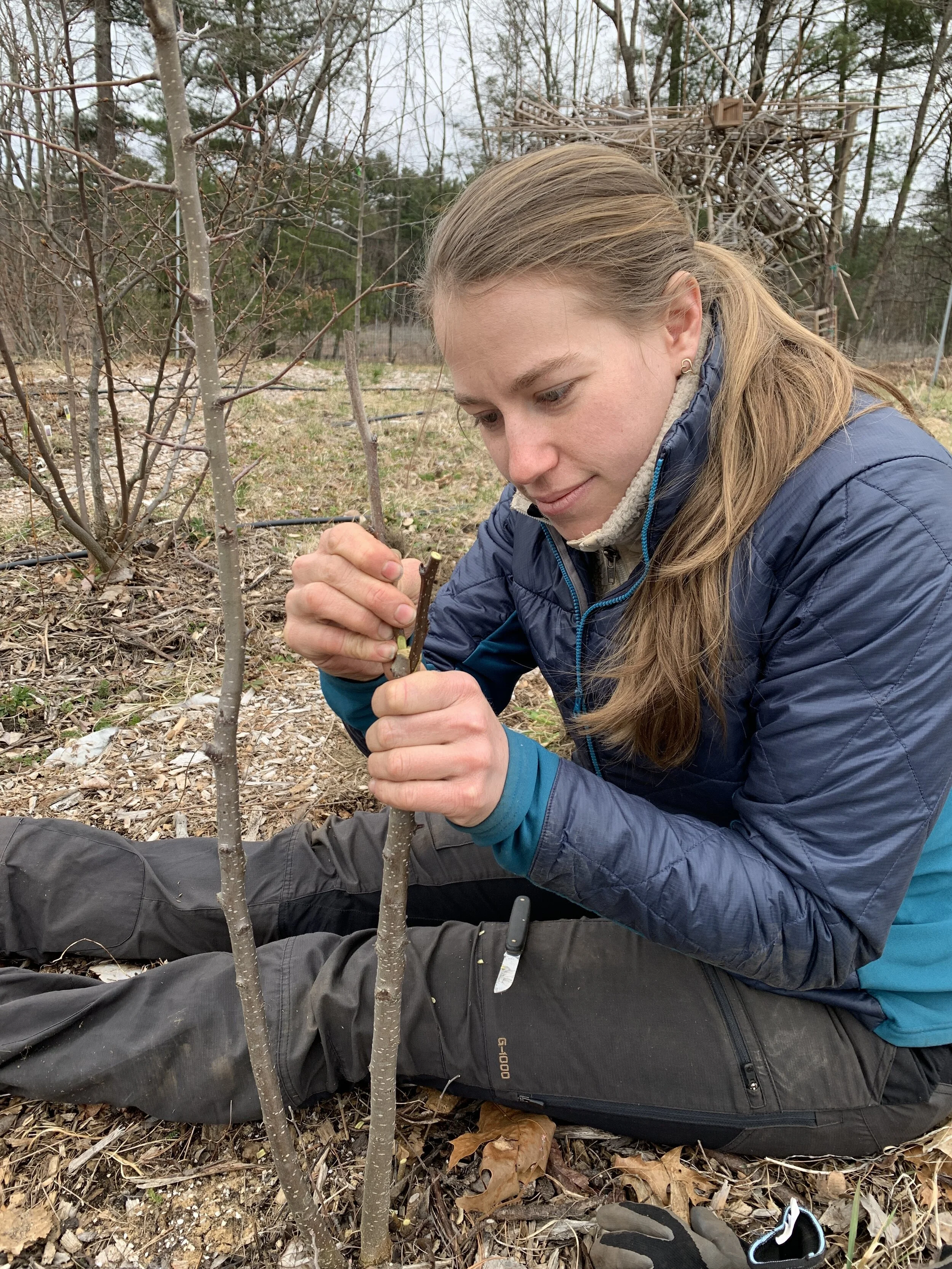
Ariel, grafting Olympic Asian pear scion wood onto rootstock in the Asian pear orchard.
So I return to the words of T’ao Chien: “I nurture simplicity among the gardens and fields.” I remind myself that he is surely weeding the gardens and plowing the fields, and he is nurturing simplicity. When I only concern myself with getting the work finished, checked off the to-do list, I take no pleasure in it. When I forget the to-do list, then the merging that I so love takes place. We can make holy everything we do. We can nurture simplicity everywhere.
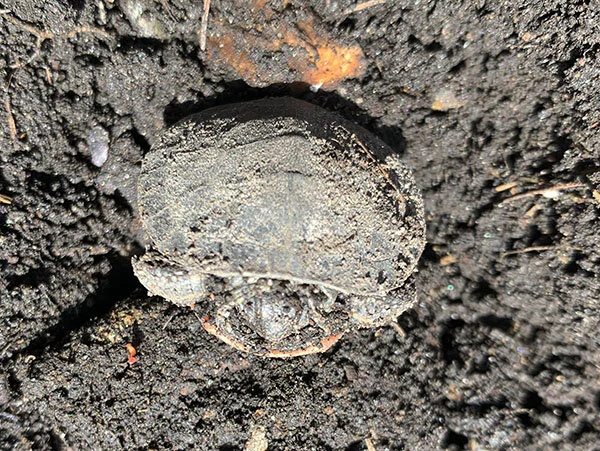
Baby snapper turtle Ariel found when we were moving a pear tree to plant new peaches. The turtle stretched and then we quickly dug it back into the soil.
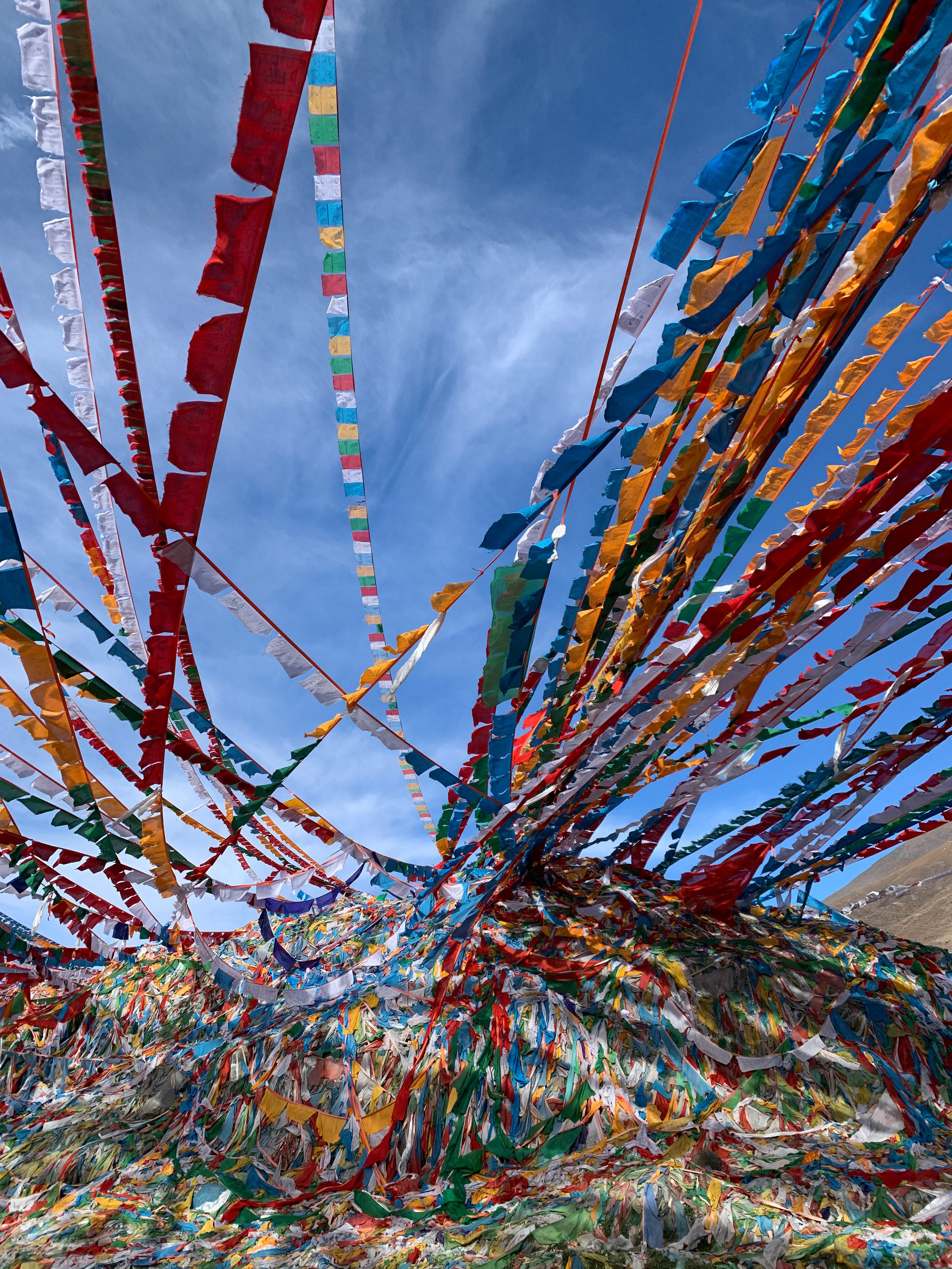
Tibet Impressions

Our three-generational quartet, aged twenty-nine to ninety-two, received four visas for Tibet at our airport Beijing hotel less than twenty-four hours before our scheduled flight to Lhasa. We could hardly believe it, we were going to Tibet after so many hurdles.
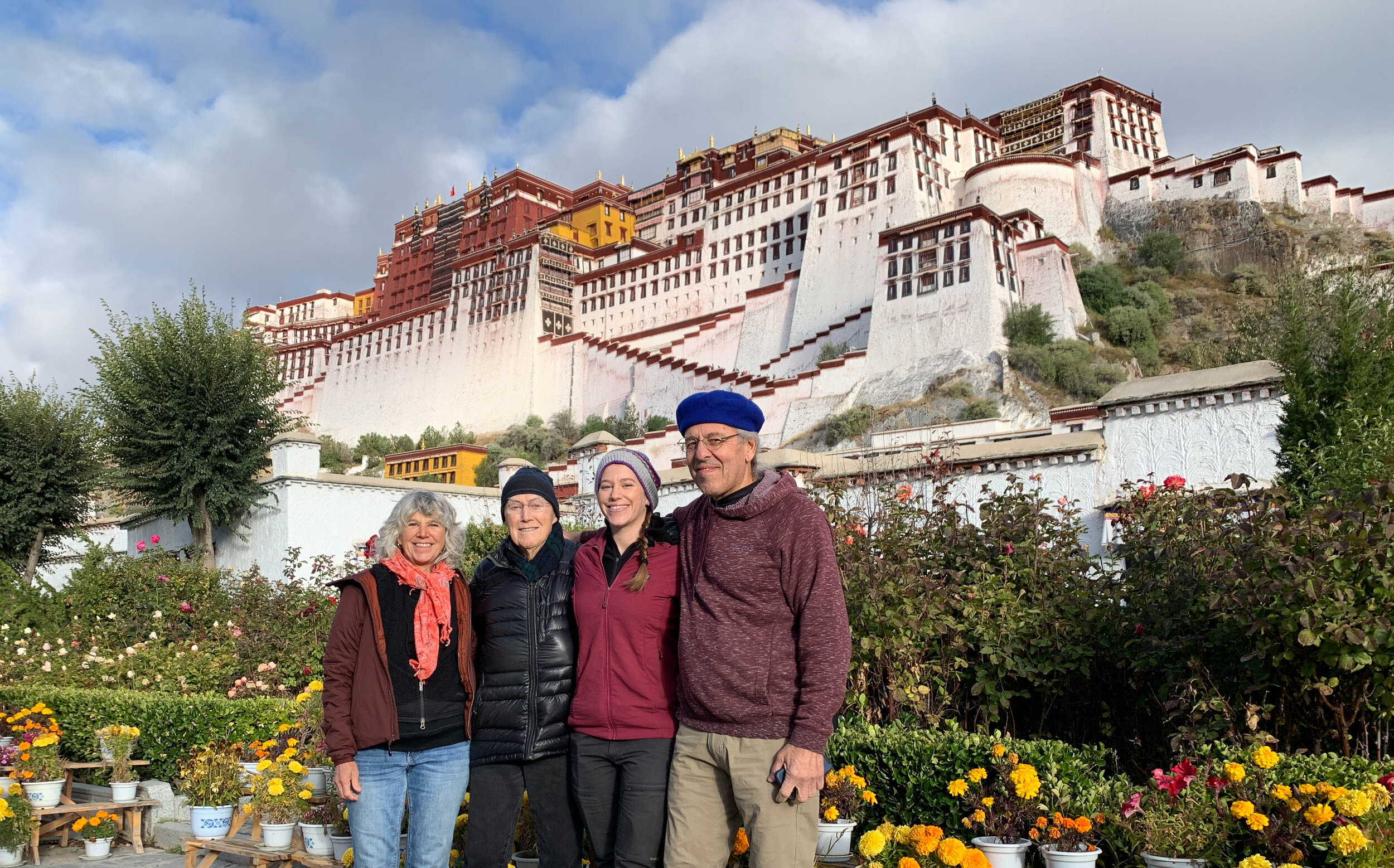
In front of the Potala Palace, built in the 7th century and then rebuilt in the 17th century, this masterpiece of Tibetan architecture, was home to the Dalai Lamas and Tibetan government from the 17th century until 1959 when the present Dalai Lama escaped to India.

Bill, my stepfather, and my daughter, Ariel, walking down the wet and slippery slope on the backside of the Potala Palace.
Our travels through Tibet climbed up and down—stairs and mountains, from thrilling sights to chilling realities. The first three shocks upon arrival:
Three fighter jets sat near the terminal at the Lhasa airport. Military presence we would learn is everywhere.
Our guide pointed to the two recording devices on the dashboard of the vehicle we would be traveling in for the next ten days. We needed to always be aware that what we were saying, not only in the car, but anywhere, might be overheard and reported.
Tibetans cannot have passports. No Tibetan person can leave the country.

Blase, my partner, and I send prayers by way of the smoke from burning juniper at a high pass above Lhasa.
Lhasa is seemingly undergoing more construction than any other city in the world. In downtown Lhasa, the snowcapped mountains are partially obscured by high-rise apartment buildings. The construction is primarily for the Chinese who are moving into Tibet. The population is changing. Tibet now has an estimated population of about 6 million Tibetans and 7.5 million Chinese settlers. The apartments are affordable only if you have a government job.
For five days, we stayed in the old part of Lhasa from where we could walk to monasteries, temples, nunneries, noodle shops, teahouses, and explore the narrow streets of old Tibet. We joined the devoted pilgrims walking clockwise around the Barkhor Circuit, Lhasa’s most important pilgrimage Kora.
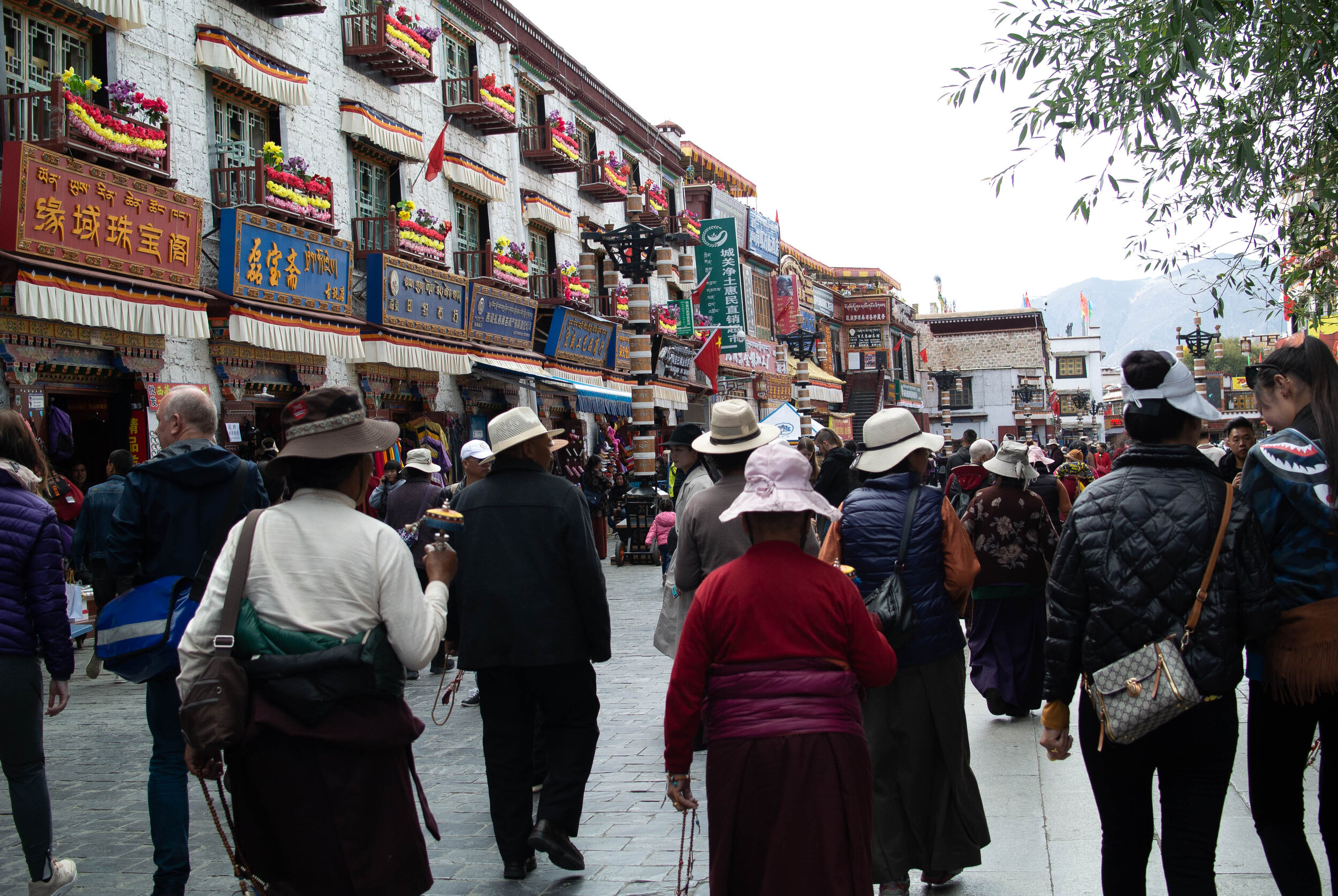
The Barkhor Kora, an everyday happening.
This walk takes you around the Jokhang, one of Tibet’s oldest temples. Pilgrims make the circuit multiple times, some walk, some do full body bows. Others stop at the plaza in front of the Jokhang, roll out their prostration mat, and do a hundred, or a thousand full prostrations, sliding out on their gloved hands or using wooden blocks strapped to their hands, to extend their arms fully out beyond their head, belly flat on the ground.

Before sunrise prostrations.
Inside the darkness of the old Jokhang pilgrims are moving always in a clockwise direction, making offerings to colorful thangkas and sculptures of Buddhas, deities, demons, and kings. Butter lamps burn, silver bowls of water glisten, cans of beer (some protectors favor beer) along with fruit, money, and yak butter decorations are packed into every nook and cranny. Gongs and drums, wood and cloth, bright colors, meditation cushions piled with burgundy meditation robes, people jostling, hurrying, determined to complete their rounds, Tibetan Buddhism is practiced here by Tibetans everyday.
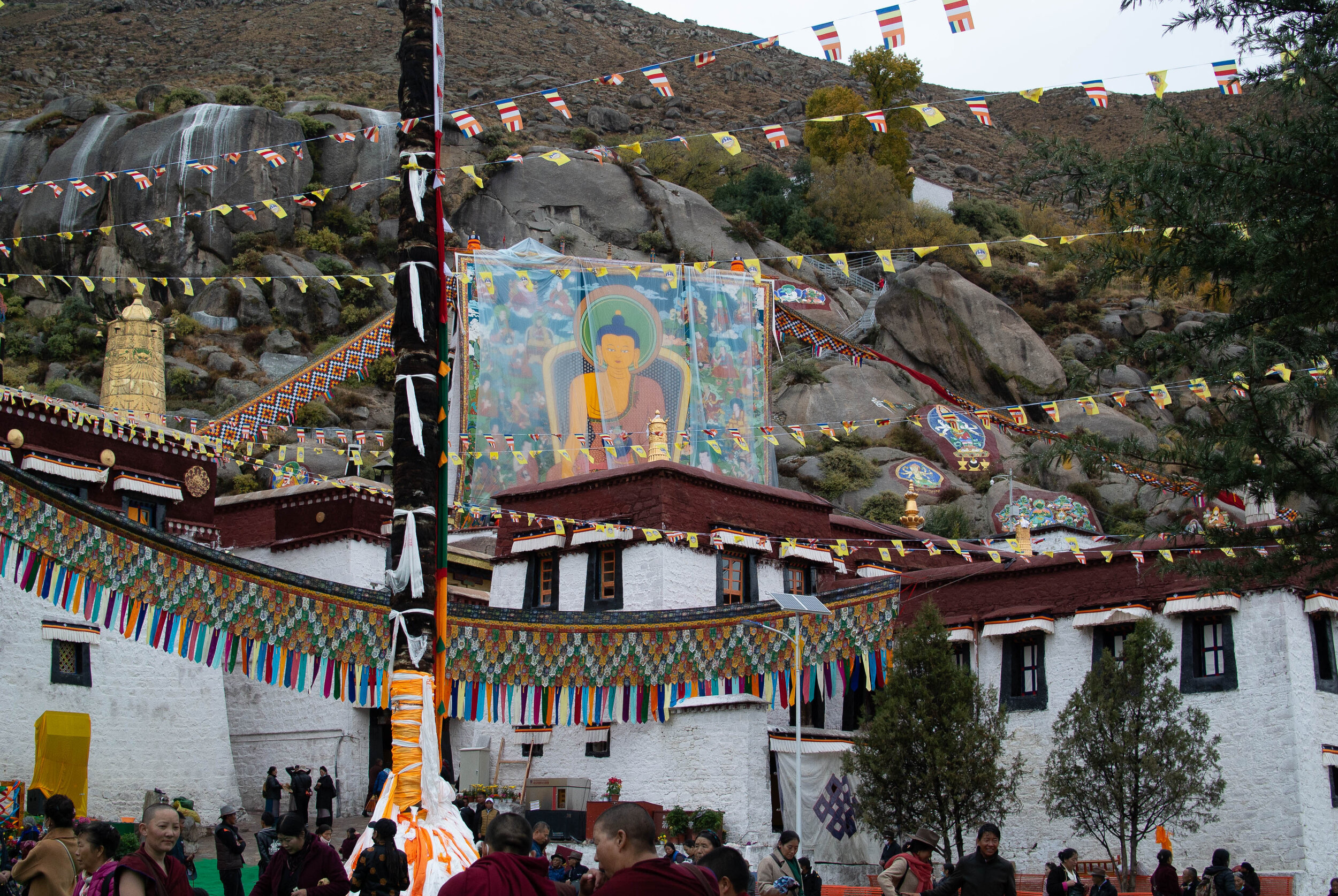
We arrived at Sera monastery during celebrations for their six-hundred year anniversary. The road was closed. The Police were limiting the number of people. Following our guide, we started walking to see if there was another way to enter and saw people slipping through a hole in a fence and running across a yak field. We followed at the fastest clip we could manage on day one at 12,000 feet, avoiding the entrance road and entering further up towards the monastery. Our timing worked. Another ten minutes and this alternate route would have been closed. The monastery was filled with pilgrims from all over Tibet in colorful traditional clothing, mala beads in hand, making offerings and chanting, We followed a group of people to see the Thangka unveiled for the occasion, about three hundred feet in length and hanging over a slap of flat rock, covered in plastic because of the rain.
Monasteries are traditionally built into the hillsides, and above many of them are rocky paths leading to caves where monks, and Dalai Lamas, and yogis like Milarepa and Guru Rinpoche once meditated for years at a time.

During the cultural revolution ninety-five percent of the monasteries were destroyed, but now the Central Government is rebuilding them, though limiting the number of monks who can live at each one. Tibetan families historically sent at least one son to become a monk, but today, you need to be approved by the Central Government. Monasteries were the principal sites of resistance—the government wants to make sure that this doesn’t happen again. The Police have a convincing presence at the large monasteries, the head Abbot is appointed by the Central Government. I imagine even in a monastery one must be careful with one’s opinions.
After visiting Gangden Monastery, a complex with some fifty buildings that was first destroyed during the 1959 Tibetan Uprising and then reduced to rubble during the 1966-67 Cultural Revolution, the brutality of the deaths kept me awake all night weeping. Throughout the trip I worried that we could be arrested for our sympathy for the Tibetans or that we would put our guide at risk.
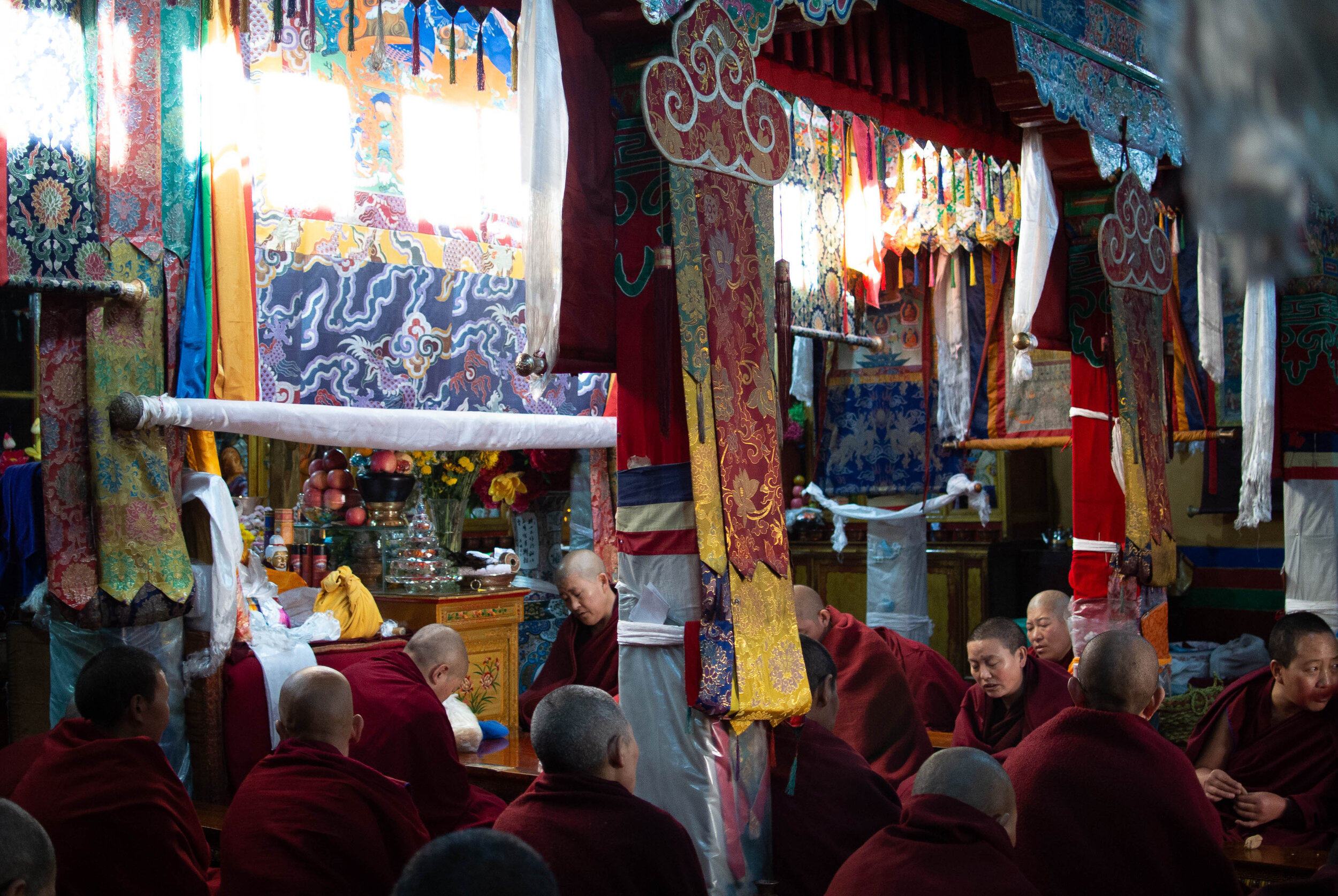
Nuns at morning service in the main assembly hall at the Nunnery in Chimpuk.
In spite of decades of persecution, the Tibetan people are among the most spiritually devoted people I have encountered. There was never a monastery, nunnery, or temple without pilgrims. In the streets, it seemed like everyone carried their mala beads, even while shopping. I wondered if it was prayer or a devotional peaceful resistance? We visited a small monastery in Lhasa that was completely packed with worshipers. People covered every inch of the courtyard and chapels.

We visited Samye, the first Buddhist monastery in Tibet, climbing the hill nearby to have a view of its mandala pattern and take in the fields and bare mountains.
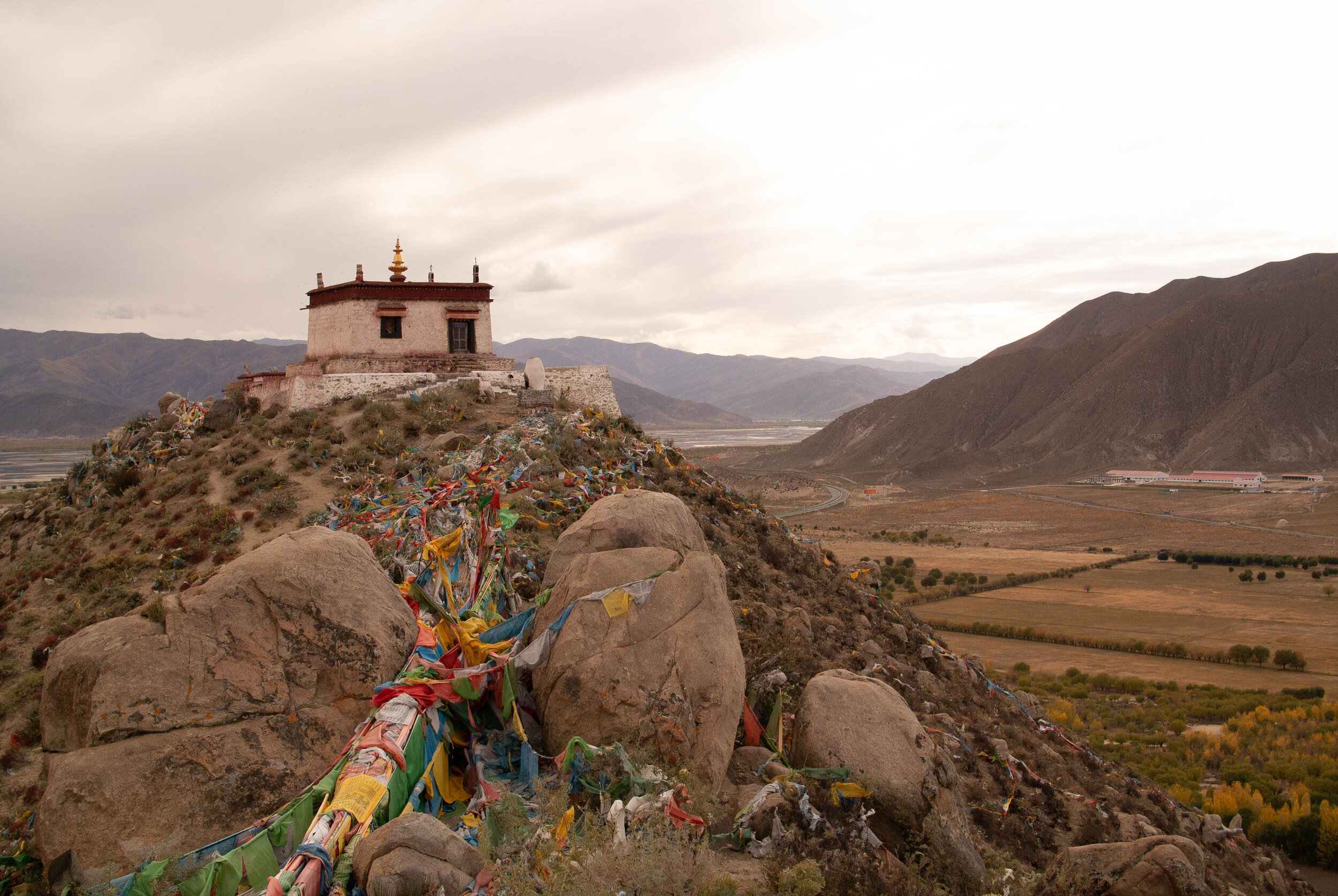
The hill above Samye Monastery.
We learned the local houses around Samye will soon be razed to the ground to clean up the area around the monastery. These local people will be given housing in several apartment buildings. How will they remain farmers and herders? Where will the cows return to at night?

An ancient world is changing. Roads are being built throughout the country. In the river valleys the Central Government has planted hundreds of thousands of trees. Power comes from gigantic solar arrays and large hydro dams that India and other countries downstream are concerned will affect their water supply. The Chinese say that Tibet has been part of China for centuries—the Tibetans and much of the Western world disagree. Tibet is rich in natural resources and strategically important to China: its square footage is larger than the United States. But our questions of why the Chinese are so determined to control Tibet, what are they really doing there, and what are their intentions for the Tibetan people remained unanswered.

“Are there Tibetan poets and writers today?” I asked our guide. He didn’t answer.
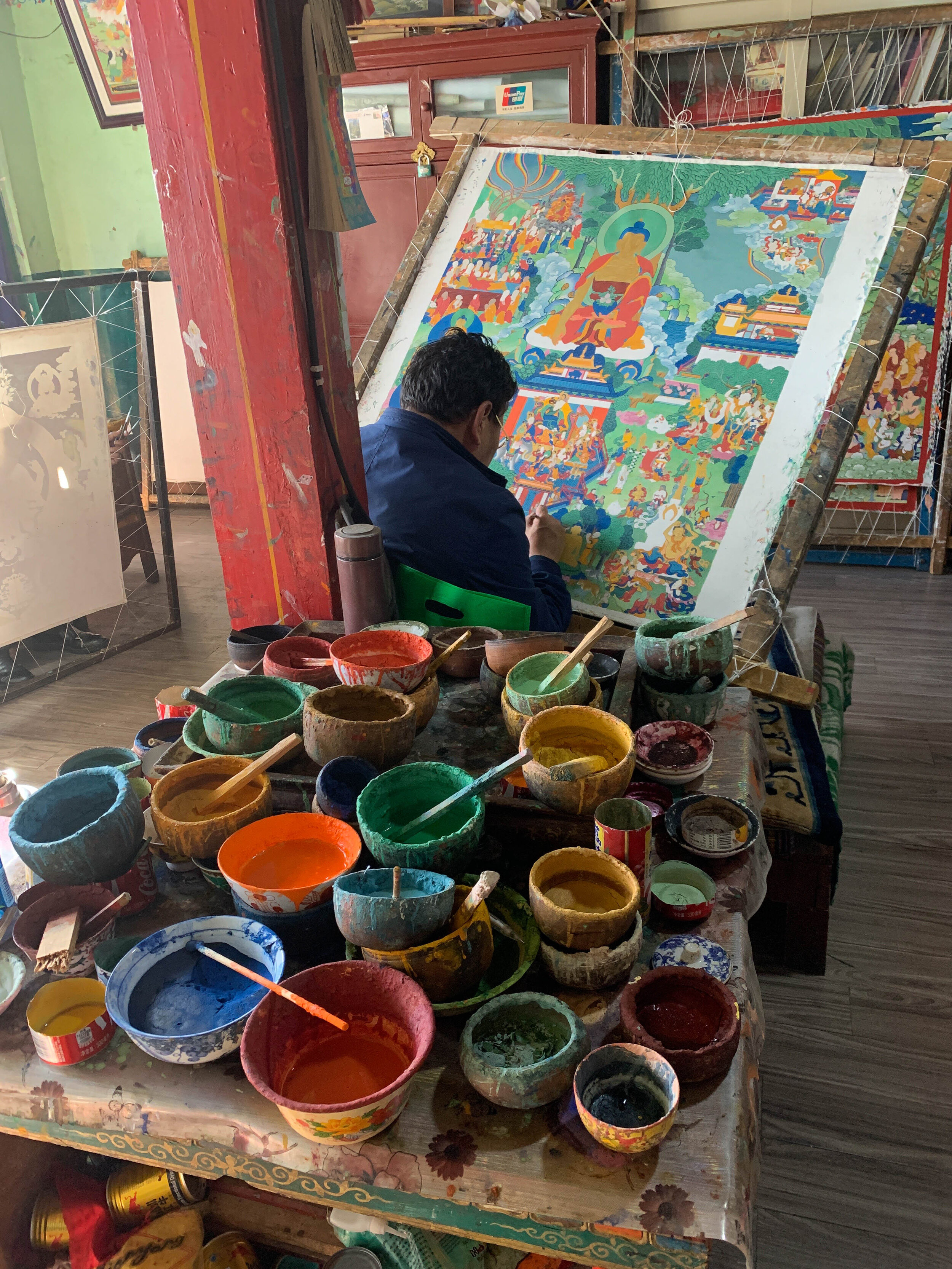
A visit to a painting workshop.
Monks still yak butter offerings as well as talk on their cell phones.

A view inside the monastery kitchen.
It was a trip that will take more time for me to realize how I have been affected. It was a trip to a third-world country with its close-to-the-earth living, inside a first-world-country with its money and high-rise bureaucracy. A trip made special because I shared it with my daughter, husband, and step-father.

Our wonderful guide with Blase and Ariel.
The memory of family members who died during and after the Chinese invasion is still very much alive for the present generation of Tibetans. They consider Tibet their country, though their language is no longer taught in the public schools. Many Tibetans are concerned about passing their culture onto their children.
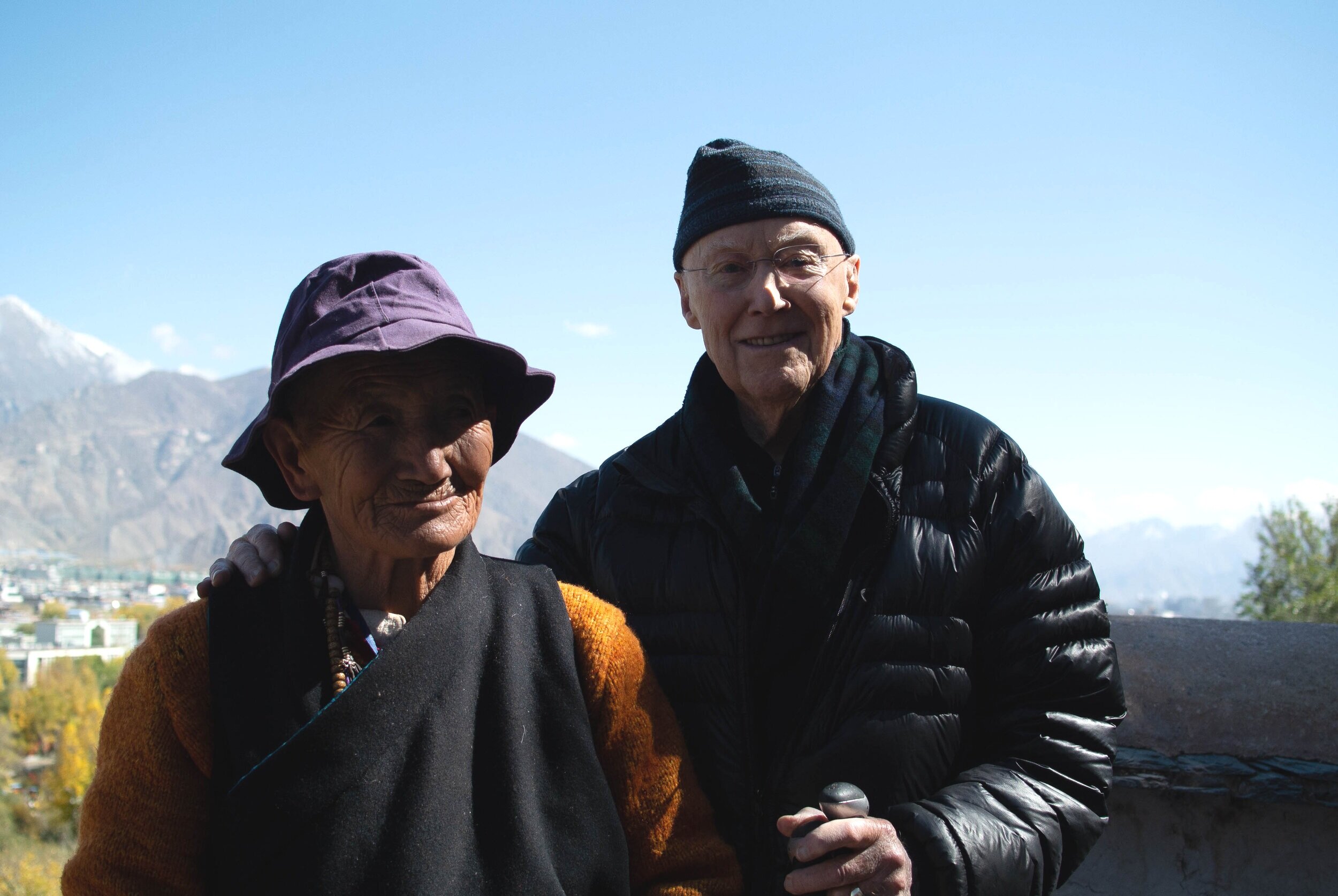
The Tibetans we met were honored that Bill would make such an arduous journey at his age.
The trip was an electrical jolt reminding us how fortunate we are to live with so much personal freedom.
How do we offer care to this country whose people have been sending prayers for peace from their once remote kingdom to the entire world for centuries? One thing we can do is learn what is happening today—Free Tibet has up-to-date information.
And send our love to all those in the world who are not free, who are living under totalitarian regimes or imprisoned for their views or choices. Let the prayers fly!

Generations
Dedicated to Annette Barbara Weiner (1933–1997)
I was recently prompted to read “Once More to the Lake,” the essay E. B. White wrote about returning to his childhood summer home, this time with his eleven-year-old son. For White, then 43, memories flooded back as he gazed at his son’s hands on the fishing rod. White no longer knew who he was—the son of his father or the father of his son. Disturbed by this unsettling dichotomy he wrote:
I looked at the boy, who was silently watching his fly, and it was my hands that held his rod, my eyes watching. I felt dizzy and didn't know which rod I was at the end of.
What is passed between parent and child, and how does this happen?
Generations is the title of the current exhibit at Hopkinton Center for the Arts, and the title refers to the relationship of the two exhibiting artists, my daughter, Ariel Matisse, and myself. Less than two years ago, Ariel decided to make an outdoor sculpture for our annual sculpture exhibit at the farm. This was the summer after she helped with the exhibit, After Apple Pruning . Taken with using wire while working on a collaborative sculpture for that exhibit, Ariel wanted to make a wire tree and asked to use a hollow log I had in the studio. I’m always fascinated with hollow logs—the form and the emptiness. The heart sutra, chanted daily in all Buddhists monasteries, says, Form is emptiness, emptiness is form. Ariel wanted to gold leaf the saw cut, the way I have done since making the six-part Inside the Ordinary Maple in 1998.

Inside the Ordinary Maple, wood and gold leaf, LH
“Of course, I will show you.” First you sand it smooth, gradually using finer sand paper. Then it needs to be urethaned to seal the wood. Moisture seeping up into the gold leaf will lift it. Then you need to apply the sizing and wait for it to be the perfect tackiness to receive the leaf.
Gold leaf is between .1 and .125 millionths of a meter or micrometers. One thousand sheets will equal an ordinary piece of paper. It’s not something you can grasp with your fingers. To pick up a small fragment, you will find a soft watercolor brush is useful, rubbing it first in your hair to create some static electricity. For large areas, I use a rolled leaf that comes with a thin backing material. Once the leaf is placed down on the sizing and pressed in gently, you lift off the backing.
Ariel and I sat around the log each on our stool, our hands moving together. I watched her fingers. They knew how to hold the tools, to feel the smooth surface of wood, to lift the backing. I showed her how to shine the gold, to burnish it with a cotton ball.
Then the project was all hers. Cutting wire to length, hanging this Medusa head of tangled wires from a hook on the ceiling, bending, shaping, counting the complex pattern. Twisting the roots and drilling the ends into the trunk. Where did she learn all of this? When? What is transferred between mother and daughter? Or, father and daughter ? Ariel’s father is a gifted ‘maker of things’, as he likes to say.
When the director of the Center, Kris Waldman, needed a show to fill the slot from January 25 to March 15, my name was suggested. She came to the studio on December 24th and took photos. As she was leaving, I said I’d like to do the exhibit with my daughter. She was surprised at first, but then I pointed out two of Ariel’s pieces, Spiral, on the wall, and Willow, her first tree, the one we had gold leafed together. Ariel then sent Kris photos of her newer work.

Tempo V, Ariel Matisse
Kris chose sculptures from each of us and suggested the title for the exhibit. One of my pieces is, Filling the Vessel, a large five-panel sculpture I made in memory of mother. In the gallery, it faces the wall of Ariel’s sculptures. I feel I am in between the two of them. I relate to E.B. White’s uncertain feeling of no longer knowing who he is.
I seemed to be living a dual existence. I would be in the middle of some simple act, I would be picking up a bait box or laying down a table fork, or I would be saying something, and suddenly it would be not I but my father who was saying the words or making the gesture.
Recently, my art no longer feels like something I own; it belongs to something more fluid, a stream, a flooding of creativity across generations. I’m playing my part, doing what is in front of me, inhabiting my life as fully as I can, yet letting it flow. E.B. White describes how, while in the boat with his son, “A school of minnows swam by, each minnow with its small, individual shadow, doubling the attendance, so clear and sharp in the sunlight.” He seems to be seeing himself as one of these minnows, insignificant, one of the schooling fish. It’s points to the conundrum of form and emptiness. The shadow and the real are inseparable. White is not father and not son; and both father and son—a beautiful rising and falling of creation. The living and the dying, and the what never dies.
We hope you will see the exhibit at the Hopkinton Center for the Arts, Hopkinton, MA, and perhaps join us at our reception on Friday, March 1; 6–7:30 p.m. The gallery is open Monday–Saturday, 9–5 p.m. and during the center’s evening events. The exhibit is up through March 15.

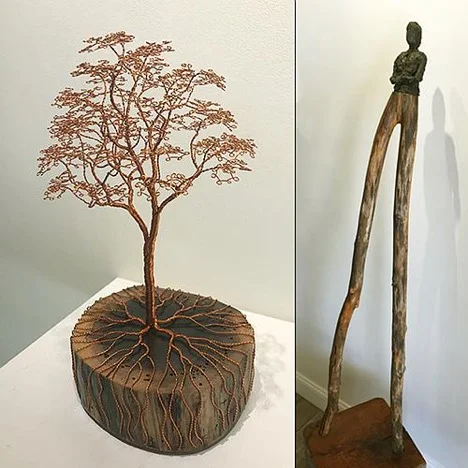
Left: Ariel Matisse, In the Garden, 2019, copper wire, walnut, 11" x 6" x 5½". Right: Linda Hoffman, Long-Legged Man, 2006, bronze, branch, wood block, 65" x 16" x 16".
My mother, Annette Weiner, would be so happy to see the exhibit. If I had thought of it earlier, I would have suggested we exhibit one of her paintings along with our sculpture.

Tree, Annette Weiner
When my mother went to college, she already had two children ages six and nine. Starting out as a Fine Arts major at the University of Pennsylvania, she then changed to anthropology and went on to earn a PhD the year I graduated from high school. As in the orchard, the cycle continues from seed, to blossom, to fruit. This poem by Dawna Markova says it well.
I Will Not Die an Unlived Life
I will not die an unlived life
I will not live in fear
of falling or catching fire.
I choose to inhabit my days,
to allow my living to open me,
to make me less afraid,
more accessible,
to loosen my heart
until it becomes a wing,
a torch, a promise.
I choose to risk my significance;
to live so that which came to me as seed
goes to the next as blossom
and that which came to me as blossom,
goes on as fruit.
Long Shadows
Dear Blog Readers,
Happy New Year!
The last blog I wrote was before I left for a Buddhist pilgrimage to India in early October. When people ask how was the journey, I usually begin to talk about painting. Uncharacteristically, I journaled throughout the trip not with words, but with small watercolor paintings of important sites and experiences. Now, as this year ends, I am turning towards words as a way to understand how I was changed by the trip and to share it with you. It’s been a curious enfolding.
Caw caw caw crows shriek in the white sun over grave stones . . . —Allen Ginsberg’s Kaddish
When I was a young child, a large Arborvitae grew outside our small row house in Chester, Pennsylvania, an industrial city with streets of row houses and screen doors that banged. We were among the few Jewish families, and we drove to Center City Philadelphia to celebrate holy days in the city’s oldest synagogue, Rodeph Shalom. The recitation of the Kaddish was my favorite part of the service because the grownups rose while the children remained seated, and the endless rhythmic chanting of V-im-ru ah-mein in the mourner’s prayer made me feel I belonged to a great sadness. However, when I was fourteen, I became disillusioned with Judaism and became interested in Eastern religions, eventually taking Buddhist vows.
The pilgrimage to India was a journey to the roots of Buddhist spirituality. Our group of sixteen Zen practitioners meditated under the Bodhi Tree where the Buddha attained enlightenment, and listened to the Abbot of our monastery give a talk on Vulture Peak where the Buddha gave many sermons to his followers 2500 years ago. We visited the sites of the Buddha’s birth and of his death, a cave where he meditated, and stupas built to honor his most faithful disciples and his mother. I painted it all.

The Bodhi Tree, India sketchbook, LH

Painting from the bus window, India sketchbook, LH
On the last day of our trip, I saw the headlines, “Eleven Jews killed in the Tree of Life Congregation Synagogue.” I remember thinking something like, ‘it never ends’, but my reaction was shallow.
When I returned home from India all I wanted to do was to paint. The Catalpa Tree was waiting for me outside my studio—this giant of a tree that I had been drawing and painting over the last six months.

Catalpa Tree at Old Frog Pond Farm
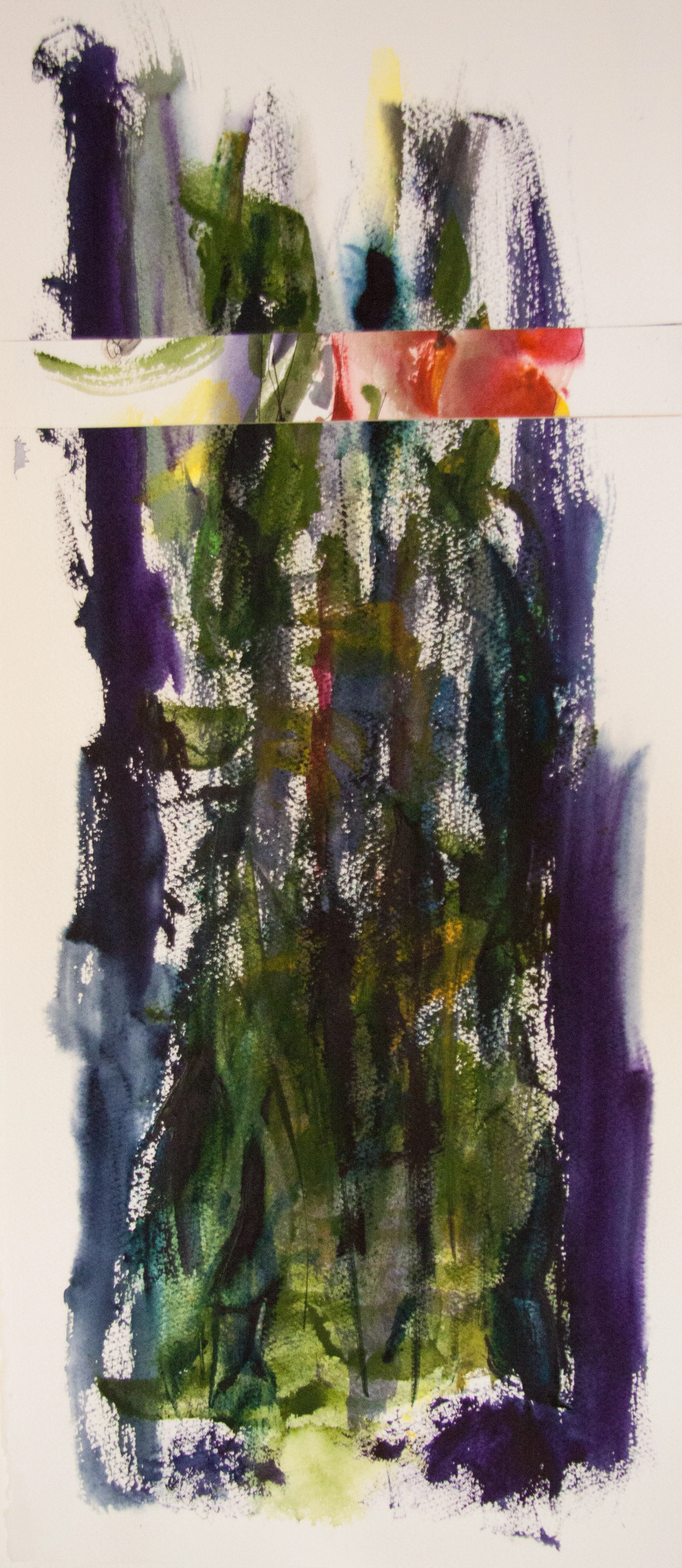
Dissatisfied with my prior efforts to capture its strength, I decided to paint the energy of its massive trunks, not the outer form of the tree. I painted one painting, tacked it to the wall, and started another, sometimes going back to work on an earlier one after it had dried. Around painting number five, this great sadness welled up inside me. What was I doing? Where was it coming from?

Some of the paintings had fire and flame; not just trunk and furrowed bark. I listened closely, and from my heart rose up the words, “On October 27, 2018 eleven Jews were killed at the Tree of Life Temple in Pittsburgh.” I knew I had to paint eleven paintings to honor each person who died. Their names were familiar—Rabinowitz, Rosenthal, Stein. I come from a long line of Steins on my mother’s side.
A few weeks of seeing the paintings on my studio wall, I decided to do something to make the deaths more visible. I cut each painting across at the height to mark each person’s age at the time of the shooting. I added a new section and then restored the painting to wholeness by reattaching the cut-off section.

The Arborvitae of my childhood, the Tree of Life Synagogue in Pittsburgh, the Bodhi Tree in India, and the Catalpa outside my studio at Old Frog Pond Farm in Harvard all blended, each tree unique and yet all sharing the same roots. My journey to India connected me not only to Buddhism’s beginnings, but to my natal tribe.
In creating art we can transcend tragedy. We can also integrate the parts of ourselves that we have kept hidden. When asked about my trip to India, I still begin with, “I painted.”
May all beings have abundant peace in the New Year.
May we always see the perfection in the other.
May we care for the earth with great love.
May we not forget those who came before us and gave us life.
V-im-ru ah-mein (and we say, Amen.)
Note: This series of paintings will be on exhibit in the Camilla Blackman Concert Hall at Indian Hill Music in Littleton, MA beginning March 1 with a closing reception on April 26th. And if you would like to hear a transcendent instrumental piece I recommend listening to Maurice Ravel’s (1875-1937) Kaddish. for violin and piano.
Search Blog
-
2025
- May 9, 2025 A View from the Tractor Seat
- Apr 11, 2025 Dig
-
2024
- Jan 7, 2024 Winter Wassail
-
2022
- Dec 11, 2022 Keeping Time
- Jun 17, 2022 This Apple-Shaped Earth
- Jan 23, 2022 What is a Jizo?
- Jan 16, 2022 An Invite and Housekeeping Update
- Jan 1, 2022 The Year of the Frog: What Orchardists Do While Apple Trees are Chilling
-
2021
- Oct 24, 2021 Figs
- Oct 3, 2021 The Artist and the Orchard: A Memoir
- Aug 8, 2021 Red-Fleshed Apples
- Jul 25, 2021 When We Were Trees
- Jun 27, 2021 Castor Beans—Who Knew?
- Jun 13, 2021 Spring Training at a Zen Monastery
- May 4, 2021 Our Trees are in Bloom
- Apr 18, 2021 Hooray!
- Jan 24, 2021 Wassailing, virtually!
- Jan 1, 2021 Sitting
-
2020
- Dec 21, 2020 Darkness to Light
- Nov 28, 2020 One Heart
- Sep 18, 2020 Juggling Flowers, Fruit, and Vegetables
- Aug 23, 2020 Refuge
- Aug 9, 2020 Bags of Fertilizer
- Aug 2, 2020 The Sermon of the Blue Heron
- Jul 26, 2020 What's the Buzz?
- Jul 19, 2020 Farm Moments
- Jul 12, 2020 Lost Wax
- Jul 5, 2020 Catalpa: The Hugging Tree
- Jun 28, 2020 Pedaling Peace
- Jun 21, 2020 See Change
- Jun 14, 2020 Lalla Unveiled
- Jun 7, 2020 Pond Alchemy
- May 31, 2020 The Birth of Fruit
- May 24, 2020 An Artist in the Orchard
- May 17, 2020 Walking the Land: Returning Home
- May 10, 2020 Stinging Nettles: Gifts from the Great Mother
- May 3, 2020 The Mystery of Swallow
- Apr 26, 2020 Aerial Bruststrokes
- Apr 19, 2020 Simple Pleasures
- Apr 12, 2020 Weeds and Other Gifts
- Apr 5, 2020 Remembering the Seeds
- Mar 29, 2020 Blow on the Embers
- Mar 22, 2020 Ripples
-
2019
- Nov 16, 2019 Tibet Impressions
- Nov 9, 2019 Forest Tales
- Oct 13, 2019 The Gift
- Aug 4, 2019 The Season is Apples, Berries, and Grandfather Fire
- Jun 8, 2019 Pointers for a Writing Life
- May 12, 2019 Mothers of the Earth
- Apr 6, 2019 The Apple-Shaped Earth
- Mar 23, 2019 You Don’t Know What You Have Till It’s Gone
- Feb 23, 2019 Generations
- Feb 9, 2019 What Are We Doing to the Earth, John Chapman?
-
2018
- Dec 31, 2018 Long Shadows
- Oct 6, 2018 A Pilgrimage to India
- Aug 18, 2018 Scrap Wrenn
- Aug 11, 2018 Off-the-Wall Comments from an Ignorant Farmer
- Jul 28, 2018 Creative Connect
- Jul 14, 2018 How is the Orchard?
- Jun 30, 2018 Which Way?
- Jun 16, 2018 Geese, Herons, Beavers, and the Baby Steps of a Lapsed Blogger
- Feb 24, 2018 Mama's Coupons — Good Forever
- Jan 27, 2018 January Ice
- Jan 13, 2018 The Muse
-
2017
- Dec 30, 2017 A Dream for the New Year
- Dec 23, 2017 A New Year for Apples
- Dec 16, 2017 Intuition
- Nov 22, 2017 Thanksgiving OM
- Nov 4, 2017 East Fork Pottery
- Oct 28, 2017 Putting Down New Roots
- Oct 21, 2017 A is for Art
- Oct 14, 2017 Eve domesticus
- Oct 7, 2017 A String Workshop
- Sep 30, 2017 After Applepicking
- Sep 23, 2017 Two Bad Women and One Good Apple
- Sep 16, 2017 Plein Air Poetry
- Sep 9, 2017 Cutting Off a Leg
- Sep 2, 2017 The Changing Landscape
- Aug 26, 2017 All About Art
- Aug 19, 2017 My First Visit to the Farm
- Aug 12, 2017 The First Food
- Aug 5, 2017 A Teapot, a Woman, and maybe a Boat
- Jul 29, 2017 A Raspberry Dilemma
- Jul 22, 2017 Consider the Miracle
- Jul 15, 2017 Meeting Ekphrasis
- Jul 8, 2017 Ripening Fruit
- Jul 1, 2017 The Voice of The Caterpillar
- Jun 24, 2017 Goumi — An Unusual Fructus
- Jun 17, 2017 Concord, an American Bloomsbury
- Jun 10, 2017 The World Is Bonkers — Shall I Laugh or Cry?
- Jun 3, 2017 Bonkers, a Revolutionary Apple
- May 27, 2017 Guardians of the Swamp
- May 20, 2017 There are Mushrooms and There are Morels
- May 13, 2017 "What's in a Name?"
- May 6, 2017 Bloom Follows Pink: Orchard Pollination
- Apr 29, 2017 The Orchard Is at Pink
- Apr 22, 2017 Natural Farming — Part 2 (continuation from last Sunday's blog)
- Apr 15, 2017 Natural Farming — Part 1
- Apr 8, 2017 Boats, Figures, and Catching Fish
- Apr 1, 2017 A Man with a Mission: The Nuts and Bolts of Bronze Casting
- Mar 25, 2017 A Chalice of Spirit, Art, and Nature
- Mar 18, 2017 Hanami — Blossom Viewing
- Mar 11, 2017 Soil Redemption Song
- Mar 4, 2017 Food is Primary Care
- Feb 25, 2017 Pomme de Terre
- Feb 18, 2017 Organic Certification
- Feb 11, 2017 Tantalizing Fruit
- Feb 4, 2017 The Myths of History
- Jan 28, 2017 The Orchard in Winter
- Jan 21, 2017 The Hi-Line
- Jan 14, 2017 Artistic, Botanical, and Social Diversity
- Jan 7, 2017 Where is Eden?
-
2016
- Dec 31, 2016 The Creative Heart
- Dec 24, 2016 A Christmas Tale
- Dec 17, 2016 Who are the Crones?
- Dec 10, 2016 The Olympic Bell (Part Two)
- Dec 3, 2016 Overheard in the Apple Orchard in Early December
- Nov 26, 2016 The Lessons of a Tortoise
- Nov 19, 2016 In the Studio
- Nov 12, 2016 Even in Darkness
- Nov 5, 2016 Southern Apples, an Elephant, Monkey, Rabbit, and Bird, Two Mango Trees and a Birthday
- Oct 29, 2016 The Tools of Art
- Oct 22, 2016 Labyrinths
- Oct 15, 2016 Repairing the Broken
- Oct 8, 2016 When You Are No More
- Oct 1, 2016 Creation Rain
- Sep 24, 2016 Breaking the Glass
- Sep 17, 2016 String Art
- Sep 10, 2016 Poetry and Photosynthesis: It's all in the Leaves
- Sep 3, 2016 In the Plenty of Time
- Aug 27, 2016 Witch Doctors
- Aug 20, 2016 Listen Coyote
- Aug 13, 2016 Milkweed in the Orchard
- Aug 6, 2016 Some People See a Turtle
- Jul 30, 2016 Arborshaping
- Jul 23, 2016 Joseph Wheelwright: Sculptor of Stones and Trees
- Jul 16, 2016 Asian Pears
- Jul 9, 2016 Gold Leaf, Grief, and the Creative Process
- Jul 2, 2016 The Olympic Bell (Part One)
- Jun 25, 2016 Around the Mulberry Bush
- Jun 18, 2016 Avoiding Apples
- Jun 11, 2016 Fructus
- Jun 4, 2016 Astonishing Apples
- May 28, 2016 Scare the Caterpillars
- May 21, 2016 Join the Club!
- May 14, 2016 The Graft
- May 7, 2016 Rooster, Rhubarb, Rue
- Apr 30, 2016 What do Dolphins and Nettles Have in Common?
- Apr 23, 2016 Art Prunings
- Apr 16, 2016 A Few of the First Arrivals
- Apr 9, 2016 Taste the Spirit of Sustainable Agriculture
- Apr 2, 2016 First Orchard Spray - March 22-24, 2016
- Mar 26, 2016 Hawkeye Apple
- Mar 19, 2016 Desiring the Almata Apple
- Mar 12, 2016 Ugly Fruit
- Mar 5, 2016 Winter Tracks
- Feb 27, 2016 Splash
- Feb 20, 2016 Pruning
- Feb 13, 2016 Orchard Ruminants
- Feb 6, 2016 A Gathering of Seeds
- Jan 30, 2016 Orchard Dragons
- Jan 23, 2016 Tree Rings
- Jan 17, 2016 The Fallen Tree
- Jan 7, 2016 Wassailing the Apple Trees
- Jan 1, 2016 The New Year