LINDA HOFFMAN
Pedaling Peace
A dear friend of ours, Sam Gloyd, age 74, is on the road—solo biking cross-country. After Sam’s send-off at the Family Promise Metrowest center in Natick, Massachusetts, a national organization that assists homeless families, Sam biked to Old Frog Pond Farm. Blase and I chatted with him about his trip until Sam said, “Don’t you guys eat lunch around here?”
A few years ago, Sam gave up his therapeutic practice, moved out of the room he rented in a shared house, sold or gave away his possessions, and began a series of volunteer jobs at retreat centers across America and in Europe. He returned from Spain and Portugal to Natick, staying with his ex-wife, Karen, to spend the holidays with their three children and two grandsons.
While in the area, he approached Family Promise Metrowest about volunteering, and they asked if he’d like a paying job driving their van instead. They needed a driver for the 6–8 am morning shift to take families to work and children to school. Then Covid hit, his driving services were no longer needed, and the retreat centers all over the world closed indefinitely.
I asked Sam why pedaling.
“I love biking and can keep social distance on a bike, and I have some work to do with my sisters in Indiana. Collectively we’ve all mistreated mother earth. And I’m pedaling for my own penance and how I’ve caused hurt and injury to my sisters.”
Pedaling for Peace and Penance was born.

Blase Provitola and Sam Gloyd with the flag that took a farm to make. Blase bought the material, Ariel Matisse sewed it, and Holly Cyganiewicz painted it.
Sam and his sisters seem to represent the great American divide. Sam explained, “When Trump was elected president one of my sisters said, ‘Finally our country can return to our moral values.’” They couldn’t openly accept that Sam is a gay man.
I asked if they knew he was on the way to see them. Sam replied, “My brother told me, ‘Be aware, the closer you get to Fort Wayne, Indiana, the weaker the bridges are.’”
When Sam shared his plans for this bike trip with the “incredible group of women” who run Family Promise Metrowest, they got excited and wanted to be part of it. The organization not only offered him a generous donation but reached out to Family Promise centers in every city he would be biking through, requesting them to offer Sam a meal, a tent site, and a shower.
After Indiana he’ll take inventory and see if he has the energy to go on. But on his mind is a visit to a retired Methodist Minister in Michigan who was a spiritual mentor and married Sam and his wife. He’d also like to bike across Wisconsin, visit the Twin Cities, and is drawn to visit Standing Rock. And everywhere he goes, he shares the compassionate work of Family Promise’s 200 centers.
“I love seeing how providence will support me and open doors,” he said.
I hold Sam’s journey like a fan that is narrow at the bottom and widens out in both directions. He’ll be making new friends and reuniting with old ones. Especially significant will be the meeting with his sisters in Indiana. When we spoke, he seemed a little worried. He shared that he wasn’t always willing to understand their side. But Sam is a man with a big heart, and he truly desires to create peaceful ground with his sisters.
He told us he had just reread the slim book by Paul Coehlo, The Alchemist, popular in the early 80s. The protagonist crosses the desert and encounters many challenges seeking his legend. I think Sam is creating his own legend. He is inspiring people to get out of the box, think wider and larger, and take up that freedom that belongs inherently to each of us. His creative energy is bringing more peace into our divided world.
At a pause in our conversation Sam said, “Don’t you guys eat lunch around here?” When both Blase and I shrugged sometimes, he said, “Well, I’m hungry.” We scurried off to make a send-off lunch, delighting him with a large, fresh salad, bread, and cheese. Sam had already picked four pints of strawberries. These we put in a plastic container and strapped the box between his saddle bags.
Peddle your Love, Sam! You have so much to give!

Sam Gloyd and Linda Hoffman socially distancing.
Follow Cycling with Sam on Family Promise’s website.
Watch an ABC Channel 5 interview!
Donate to his campaign here.
Weeds and Other Gifts

A Small Piece of Land, Watercolor LH, 2020
“The greatest fine art of the future will be the making of a comfortable living from a small piece of land.” —Abraham Lincoln
When I am anxious or out of balance, which is often these days, I turn to weeding. I can always find weeds on the farm. The weeds are tenacious; they want to grow. One definition of a weed is a plant growing in the wrong place. We have lots of plants growing in the wrong places. Most of them need to be dug up. On the farm ‘to do’ list, weeding sits in almost every category: blueberries, raspberries, rhubarb, asparagus, around the apples, pears, and peach trees, the hoop house, and the kitchen garden.
Sitting on the ground, along the rows of blueberries, as if at a banquet table, each of us brings our favorite utensil. Ariel’s preference is the triangular Korean hoe, Holly prefers a claw, and I use a pink-handled small trowel.

Holly weeding young blueberry bushes on a cold and windy day.
We yank, we pull, we dig, leveraging our tools into thick mats of grasses, and tug some more. Grass clumps lift out—these get a hearty shake sending the worms and the soil attached to the roots back into the row, while whatever is left finds new life in the compost pile.

Frederic G. Cooper, 1917, U.S. Food Administration
My mind is occupied by thoughts of farms and food. The largest apple grower in our town depends on two migrant workers, but he has yet to hear from the embassy about their arrival. The commercial vegetable market in California doesn’t know how they will manage not only because of their dependence on migrant workers, but the chain of supply, the connective system, the trucks, the transport, the weigh stations, the middle places where all the packaging happens, are facing their own challenges. Farmers in Florida are plowing under vegetables, and in the Midwest, dairies are dumping fresh milk, though stores limit the amount customers can buy. Small farms feel the pressure, too. The restaurant that bought fifty pounds of greens a week is now closed, and many farmer’s markets have been canceled.
Abraham Lincoln promoted the cultivation of land after the bloodshed of the Civil War. During and at the end of World War II, the American Victory Garden movement created sustainability and health. England had their own movement, Dig for Victory. Maybe the restoration of the world’s psyche after times of great suffering was in part due to the return of our connection to the soil, to food. Maybe, it is a time to build more resiliency into our communities. Food is basic to our needs along with water, clean air, and shelter. We need to return to the basics and provide this for all people on the planet. Let’s give up fighting for causes and beliefs that only divide us. Let’s rally around what truly supports us.
I think about these things, and obviously oversimplify them, while I grab a small clump of grass, and ease out its long root system, pure white and thick, from among the blueberry’s dark, thin roots. Pull too hard and the root snaps. Only by teasing gently but firmly, can I coax out a foot-length root, with grass nodules every few inches, to release its hold. Of course, some weeds will quickly regrow, we don’t get them all, but if we don’t weed, the mass of growth under the blueberry plants will rob the bushes of nutrients. We weed in order to ease the competition for resources, to encourage a bountiful crop.
Weeding is not glamorous work and It doesn’t save lives, but it offers a connection to something trustworthy that helps keep me balanced. I know not everyone has access to weeds, but even in a city, we can break for a moment, see a bit of earth or touch a tree, and know this is all part of us. Amid slicing an apple, or washing salad greens, we can pause within our anxiety, and connect to this gift from the earth, the ground that sustains us.

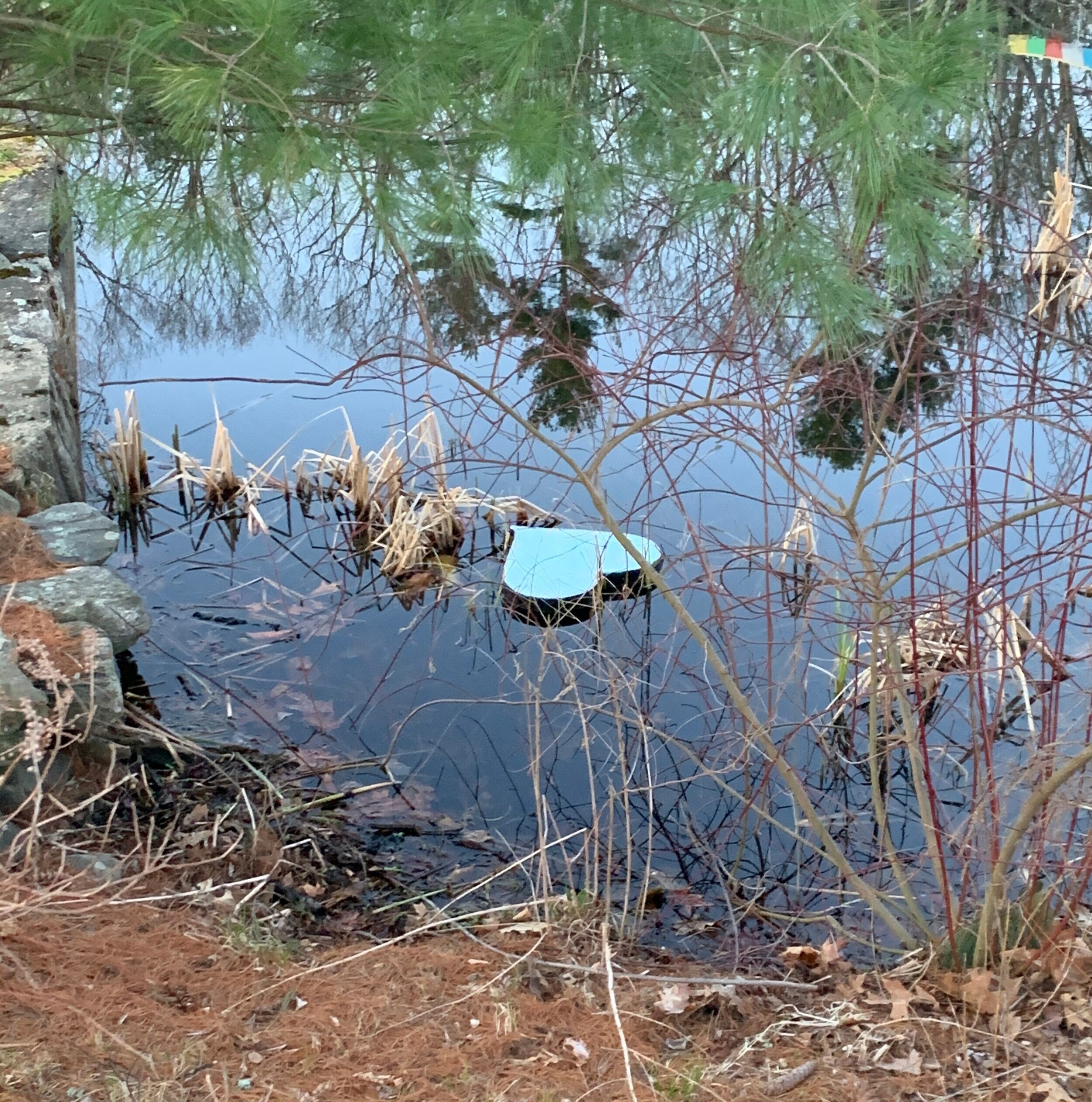
This morning’s surprise: blown by the wind from a pile of old materials outside my studio.
.
Tibet Impressions

Our three-generational quartet, aged twenty-nine to ninety-two, received four visas for Tibet at our airport Beijing hotel less than twenty-four hours before our scheduled flight to Lhasa. We could hardly believe it, we were going to Tibet after so many hurdles.
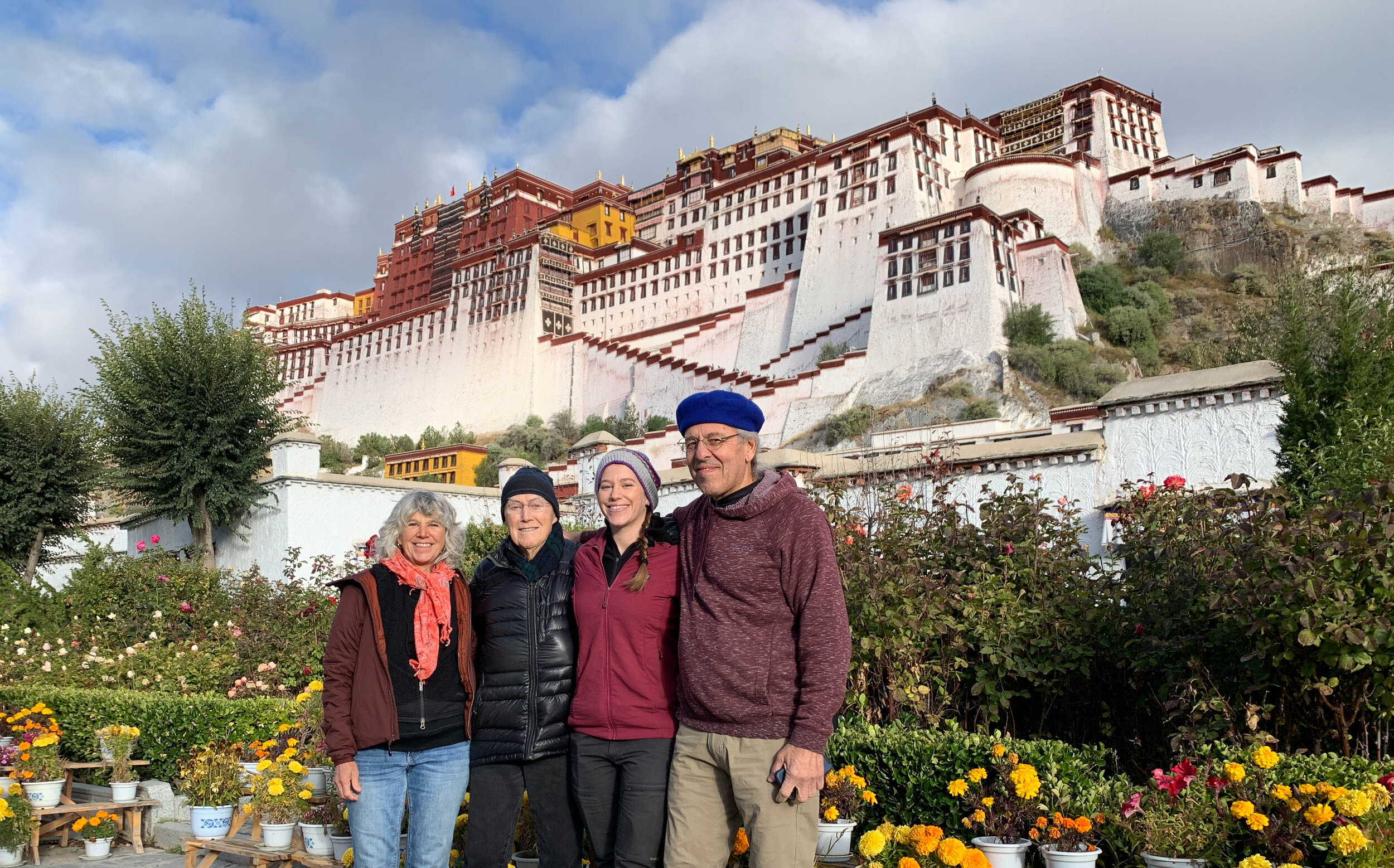
In front of the Potala Palace, built in the 7th century and then rebuilt in the 17th century, this masterpiece of Tibetan architecture, was home to the Dalai Lamas and Tibetan government from the 17th century until 1959 when the present Dalai Lama escaped to India.

Bill, my stepfather, and my daughter, Ariel, walking down the wet and slippery slope on the backside of the Potala Palace.
Our travels through Tibet climbed up and down—stairs and mountains, from thrilling sights to chilling realities. The first three shocks upon arrival:
Three fighter jets sat near the terminal at the Lhasa airport. Military presence we would learn is everywhere.
Our guide pointed to the two recording devices on the dashboard of the vehicle we would be traveling in for the next ten days. We needed to always be aware that what we were saying, not only in the car, but anywhere, might be overheard and reported.
Tibetans cannot have passports. No Tibetan person can leave the country.

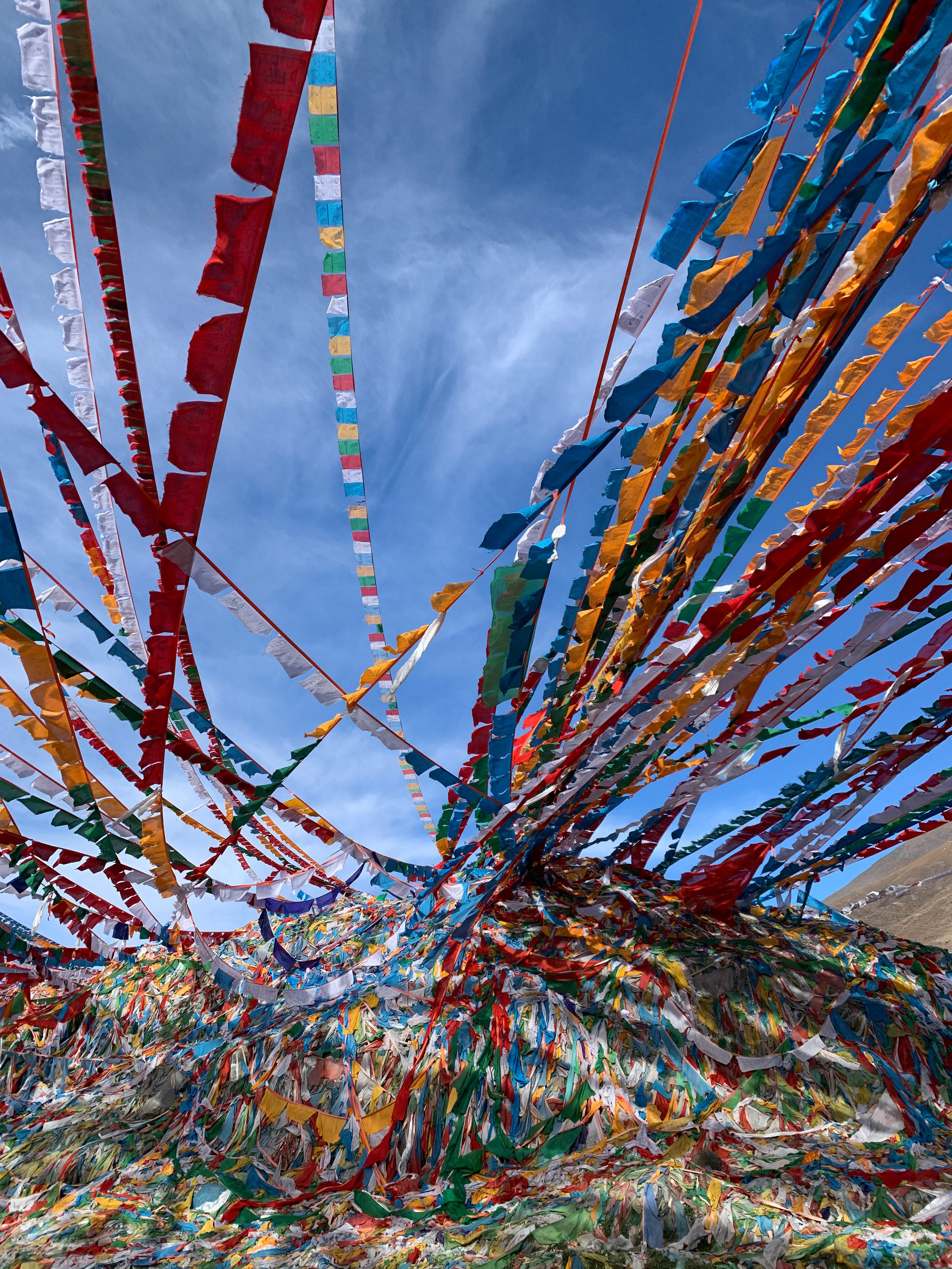
Blase, my partner, and I send prayers by way of the smoke from burning juniper at a high pass above Lhasa.
Lhasa is seemingly undergoing more construction than any other city in the world. In downtown Lhasa, the snowcapped mountains are partially obscured by high-rise apartment buildings. The construction is primarily for the Chinese who are moving into Tibet. The population is changing. Tibet now has an estimated population of about 6 million Tibetans and 7.5 million Chinese settlers. The apartments are affordable only if you have a government job.
For five days, we stayed in the old part of Lhasa from where we could walk to monasteries, temples, nunneries, noodle shops, teahouses, and explore the narrow streets of old Tibet. We joined the devoted pilgrims walking clockwise around the Barkhor Circuit, Lhasa’s most important pilgrimage Kora.
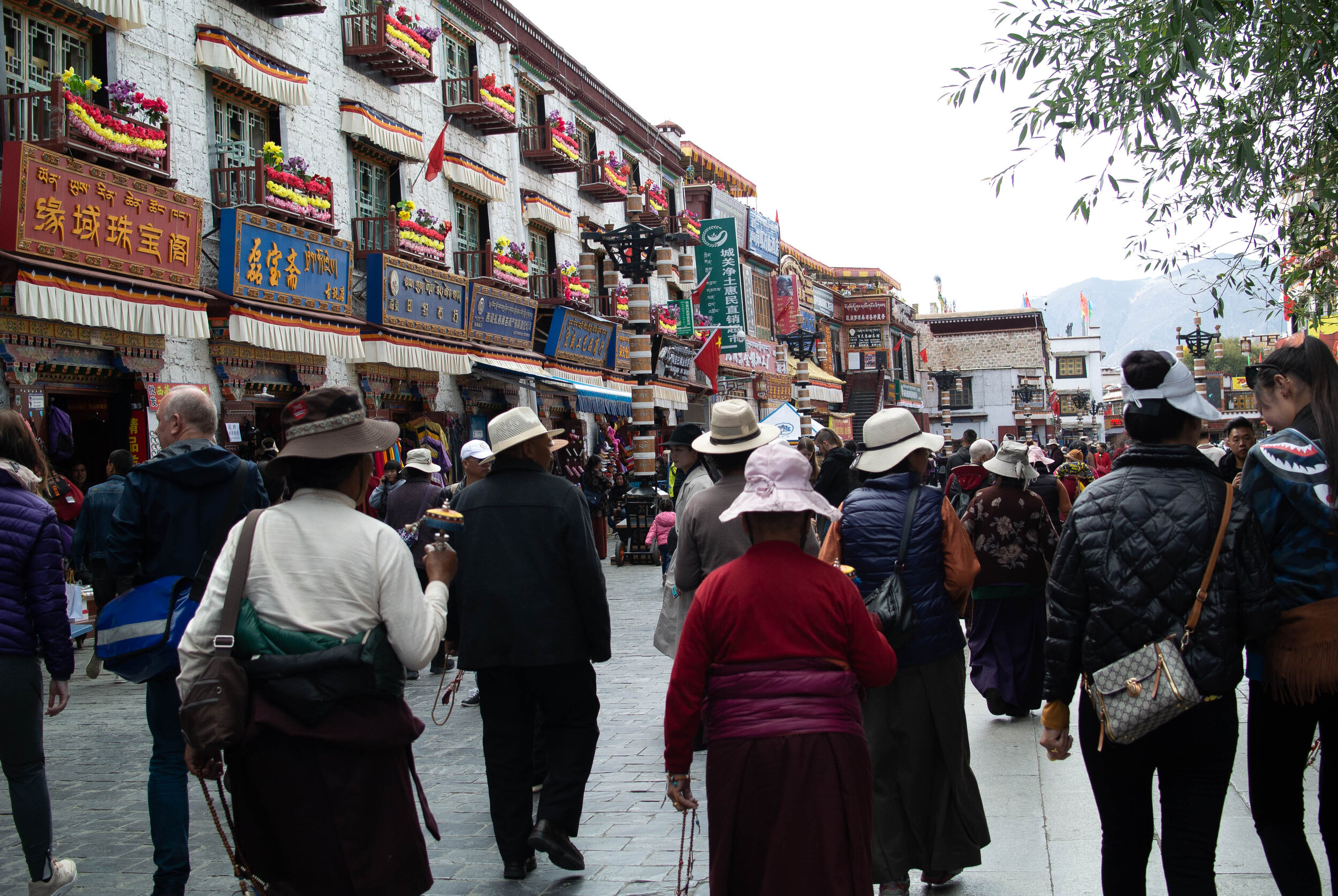
The Barkhor Kora, an everyday happening.
This walk takes you around the Jokhang, one of Tibet’s oldest temples. Pilgrims make the circuit multiple times, some walk, some do full body bows. Others stop at the plaza in front of the Jokhang, roll out their prostration mat, and do a hundred, or a thousand full prostrations, sliding out on their gloved hands or using wooden blocks strapped to their hands, to extend their arms fully out beyond their head, belly flat on the ground.

Before sunrise prostrations.
Inside the darkness of the old Jokhang pilgrims are moving always in a clockwise direction, making offerings to colorful thangkas and sculptures of Buddhas, deities, demons, and kings. Butter lamps burn, silver bowls of water glisten, cans of beer (some protectors favor beer) along with fruit, money, and yak butter decorations are packed into every nook and cranny. Gongs and drums, wood and cloth, bright colors, meditation cushions piled with burgundy meditation robes, people jostling, hurrying, determined to complete their rounds, Tibetan Buddhism is practiced here by Tibetans everyday.
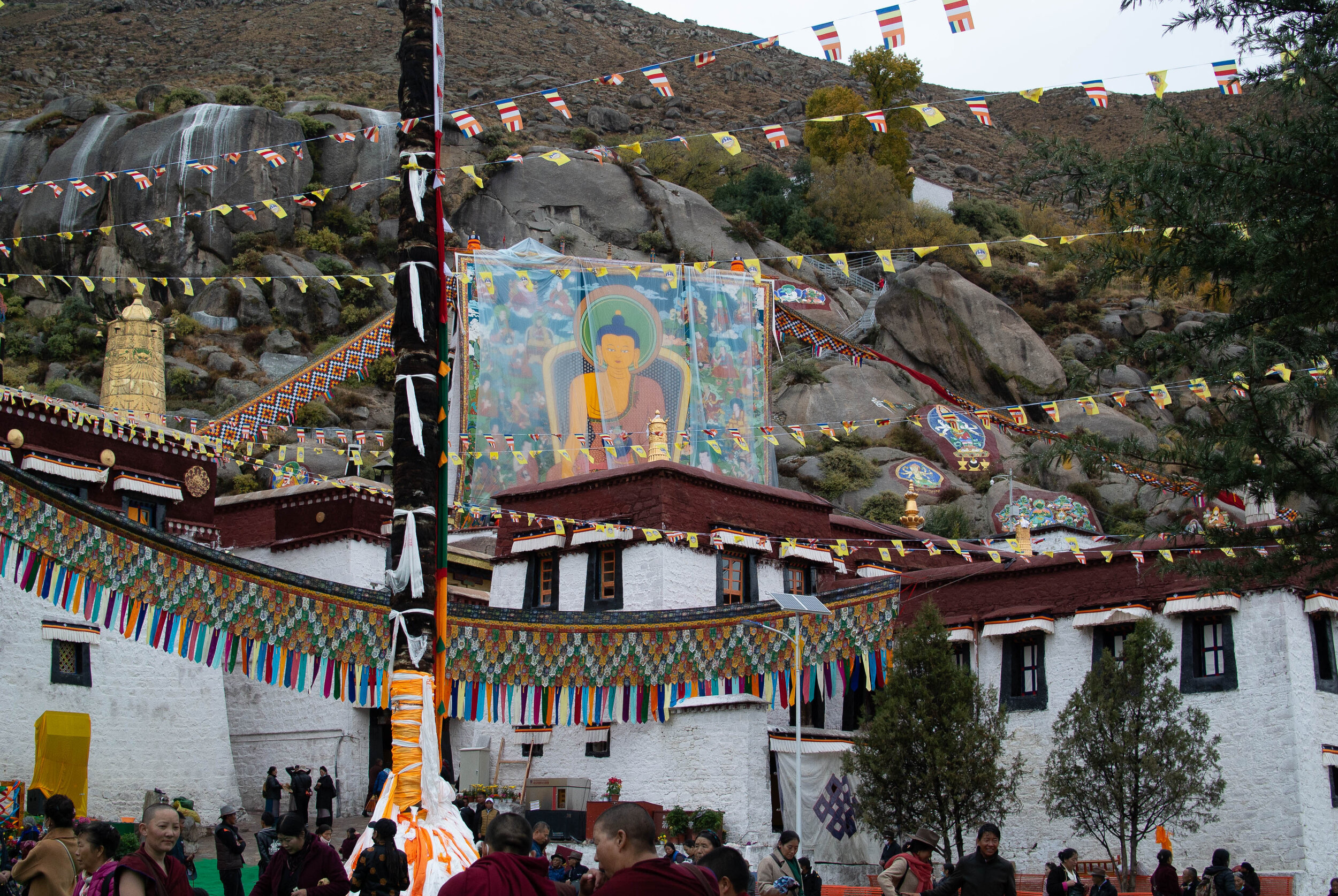
We arrived at Sera monastery during celebrations for their six-hundred year anniversary. The road was closed. The Police were limiting the number of people. Following our guide, we started walking to see if there was another way to enter and saw people slipping through a hole in a fence and running across a yak field. We followed at the fastest clip we could manage on day one at 12,000 feet, avoiding the entrance road and entering further up towards the monastery. Our timing worked. Another ten minutes and this alternate route would have been closed. The monastery was filled with pilgrims from all over Tibet in colorful traditional clothing, mala beads in hand, making offerings and chanting, We followed a group of people to see the Thangka unveiled for the occasion, about three hundred feet in length and hanging over a slap of flat rock, covered in plastic because of the rain.
Monasteries are traditionally built into the hillsides, and above many of them are rocky paths leading to caves where monks, and Dalai Lamas, and yogis like Milarepa and Guru Rinpoche once meditated for years at a time.

During the cultural revolution ninety-five percent of the monasteries were destroyed, but now the Central Government is rebuilding them, though limiting the number of monks who can live at each one. Tibetan families historically sent at least one son to become a monk, but today, you need to be approved by the Central Government. Monasteries were the principal sites of resistance—the government wants to make sure that this doesn’t happen again. The Police have a convincing presence at the large monasteries, the head Abbot is appointed by the Central Government. I imagine even in a monastery one must be careful with one’s opinions.
After visiting Gangden Monastery, a complex with some fifty buildings that was first destroyed during the 1959 Tibetan Uprising and then reduced to rubble during the 1966-67 Cultural Revolution, the brutality of the deaths kept me awake all night weeping. Throughout the trip I worried that we could be arrested for our sympathy for the Tibetans or that we would put our guide at risk.
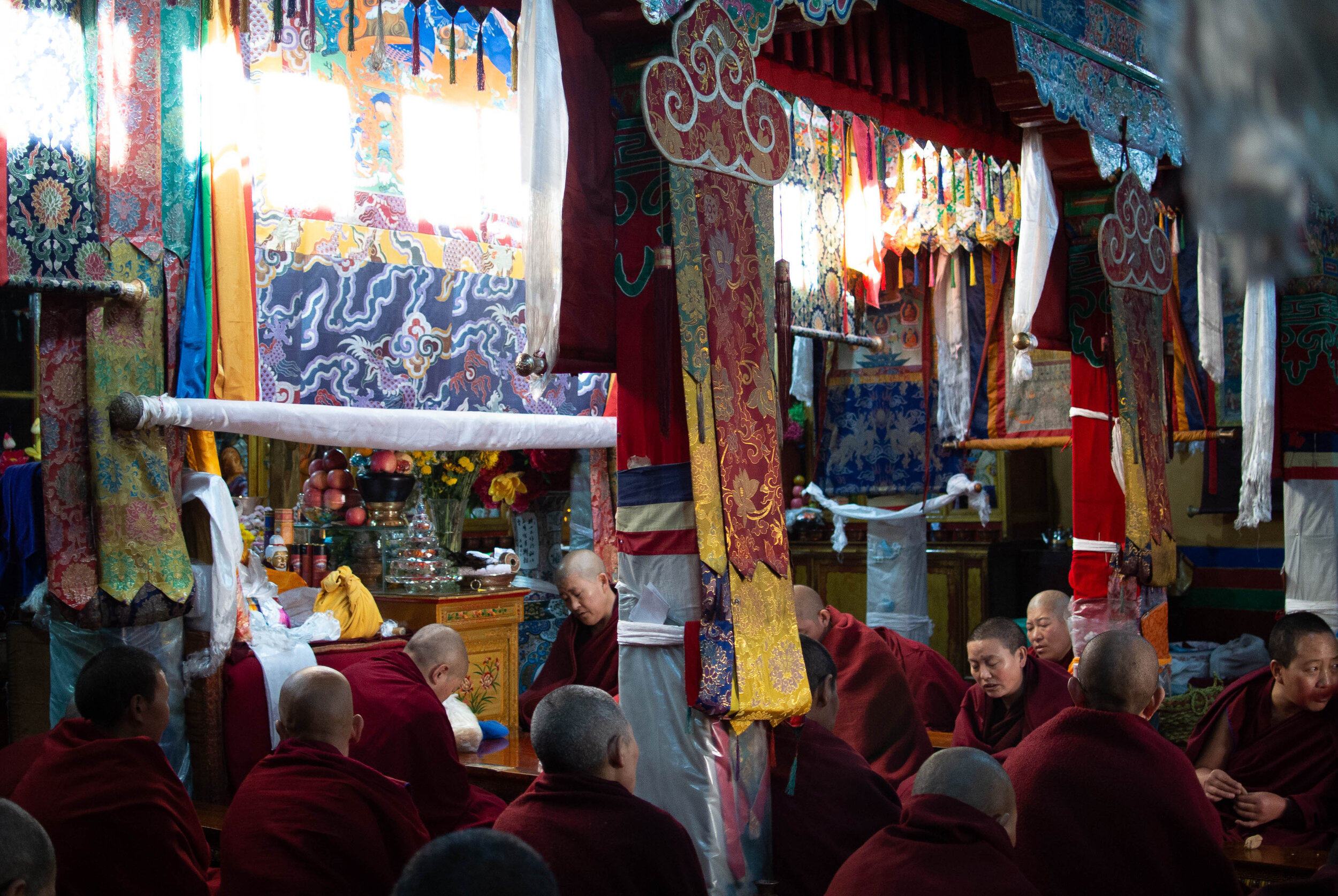
Nuns at morning service in the main assembly hall at the Nunnery in Chimpuk.
In spite of decades of persecution, the Tibetan people are among the most spiritually devoted people I have encountered. There was never a monastery, nunnery, or temple without pilgrims. In the streets, it seemed like everyone carried their mala beads, even while shopping. I wondered if it was prayer or a devotional peaceful resistance? We visited a small monastery in Lhasa that was completely packed with worshipers. People covered every inch of the courtyard and chapels.

We visited Samye, the first Buddhist monastery in Tibet, climbing the hill nearby to have a view of its mandala pattern and take in the fields and bare mountains.
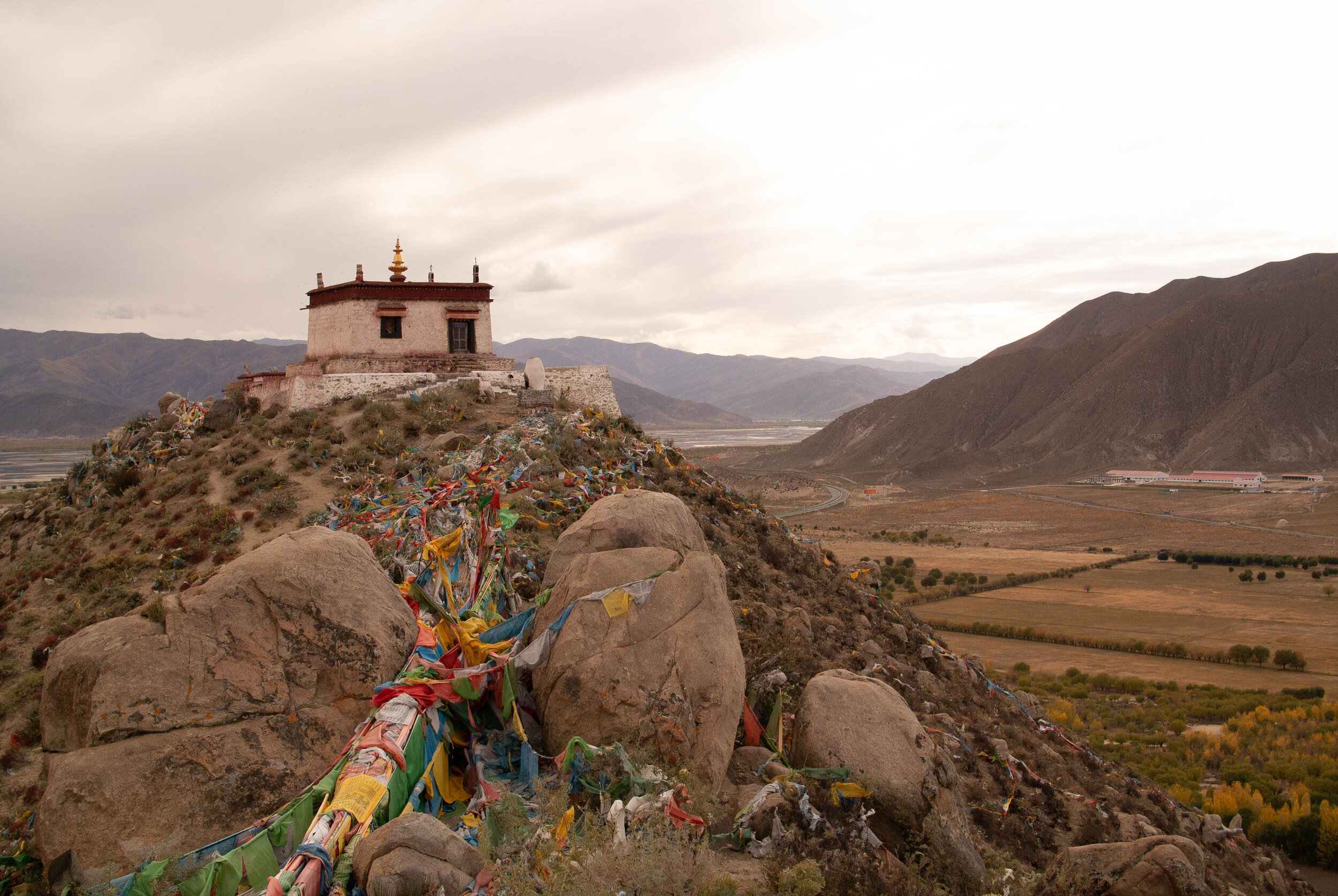
The hill above Samye Monastery.
We learned the local houses around Samye will soon be razed to the ground to clean up the area around the monastery. These local people will be given housing in several apartment buildings. How will they remain farmers and herders? Where will the cows return to at night?

An ancient world is changing. Roads are being built throughout the country. In the river valleys the Central Government has planted hundreds of thousands of trees. Power comes from gigantic solar arrays and large hydro dams that India and other countries downstream are concerned will affect their water supply. The Chinese say that Tibet has been part of China for centuries—the Tibetans and much of the Western world disagree. Tibet is rich in natural resources and strategically important to China: its square footage is larger than the United States. But our questions of why the Chinese are so determined to control Tibet, what are they really doing there, and what are their intentions for the Tibetan people remained unanswered.

“Are there Tibetan poets and writers today?” I asked our guide. He didn’t answer.
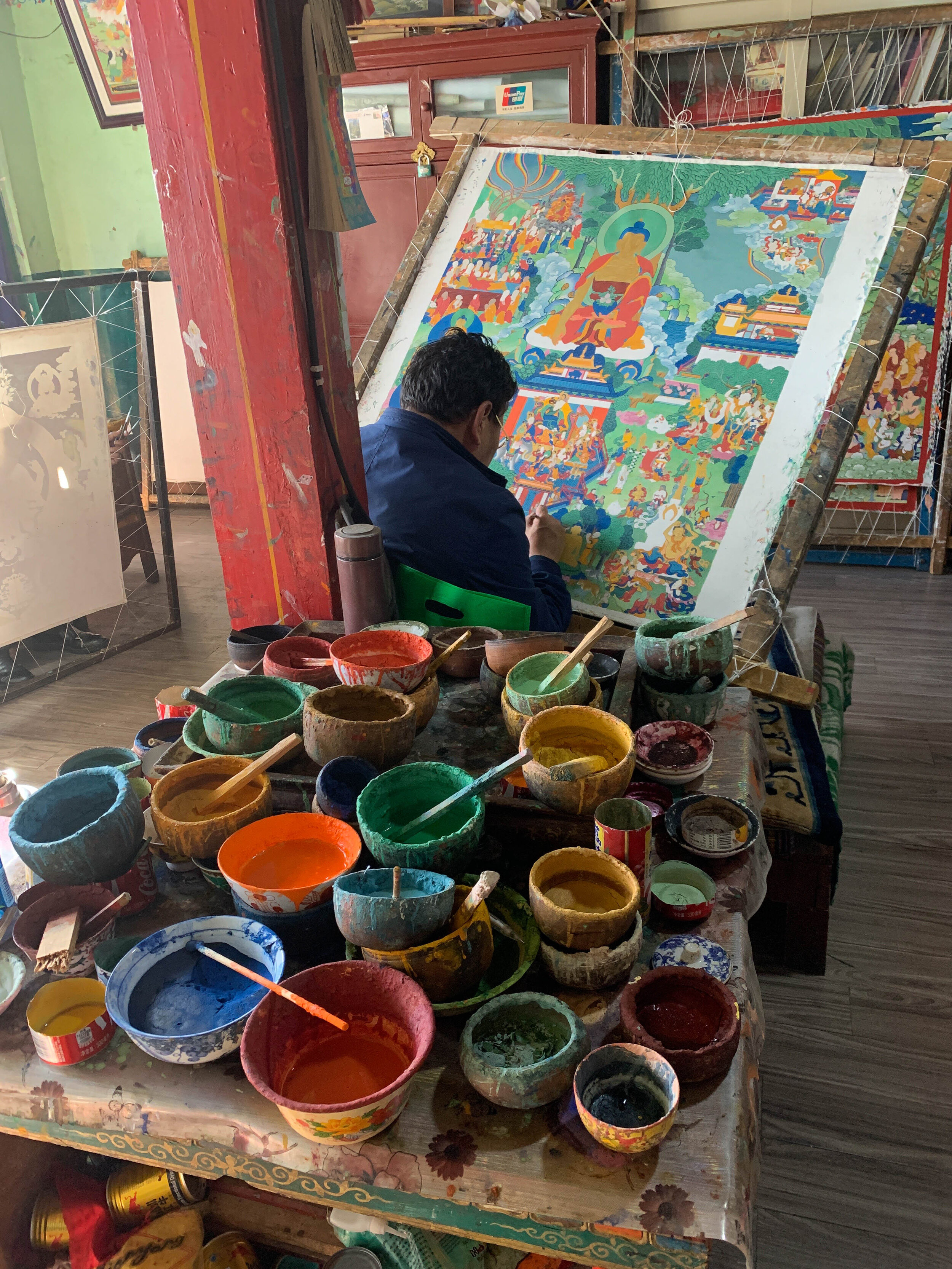
A visit to a painting workshop.
Monks still yak butter offerings as well as talk on their cell phones.

A view inside the monastery kitchen.
It was a trip that will take more time for me to realize how I have been affected. It was a trip to a third-world country with its close-to-the-earth living, inside a first-world-country with its money and high-rise bureaucracy. A trip made special because I shared it with my daughter, husband, and step-father.

Our wonderful guide with Blase and Ariel.
The memory of family members who died during and after the Chinese invasion is still very much alive for the present generation of Tibetans. They consider Tibet their country, though their language is no longer taught in the public schools. Many Tibetans are concerned about passing their culture onto their children.
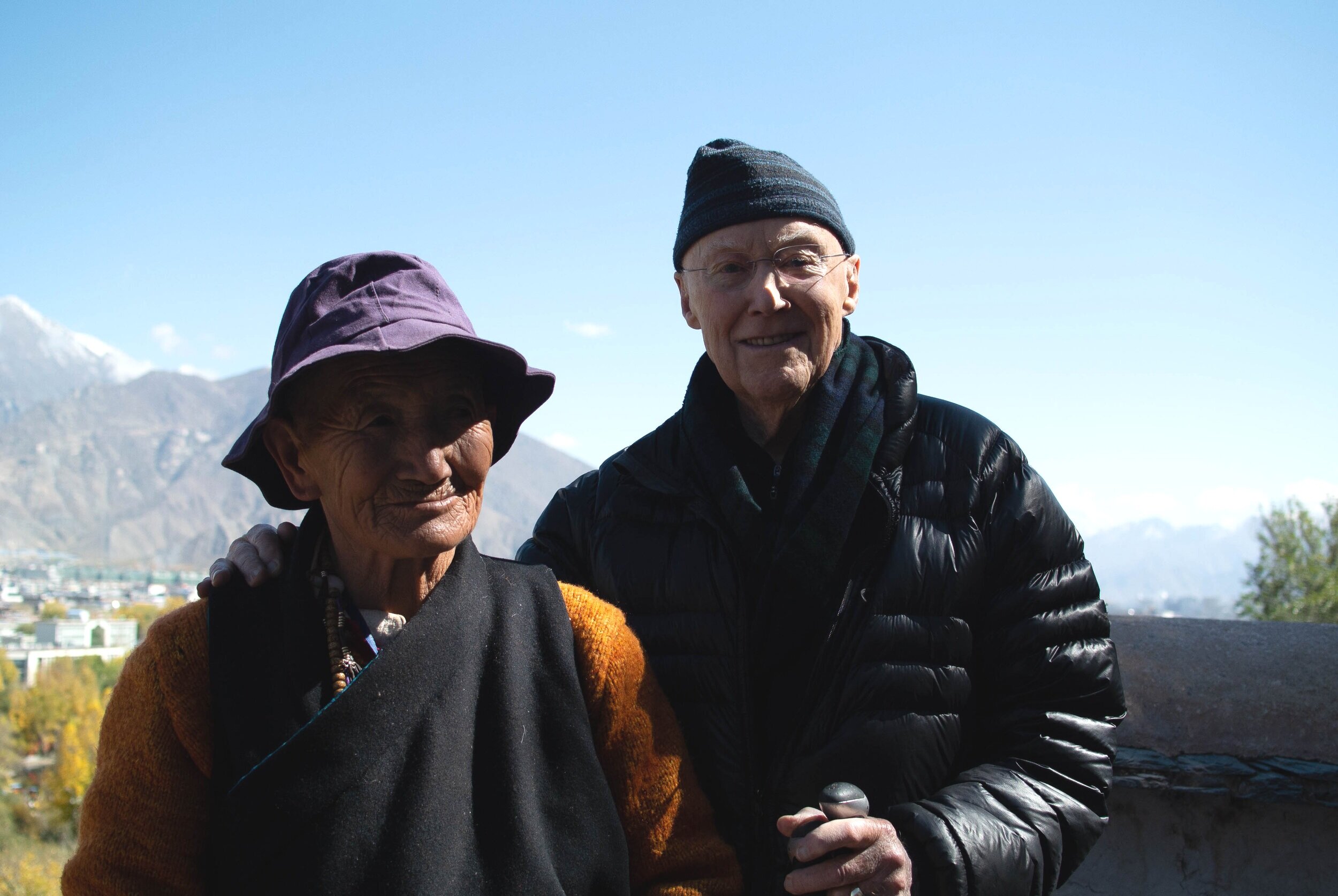
The Tibetans we met were honored that Bill would make such an arduous journey at his age.
The trip was an electrical jolt reminding us how fortunate we are to live with so much personal freedom.
How do we offer care to this country whose people have been sending prayers for peace from their once remote kingdom to the entire world for centuries? One thing we can do is learn what is happening today—Free Tibet has up-to-date information.
And send our love to all those in the world who are not free, who are living under totalitarian regimes or imprisoned for their views or choices. Let the prayers fly!

The Gift
On Christmas last year my stepfather gave me a gift, but before I started to open it, he said, “Wait. There’s baggage that comes with this gift, Linda.” I know about gifts—after all I am the daughter and step-daughter of anthropologists.
“All right,” I said, and started opening the wrapping paper.
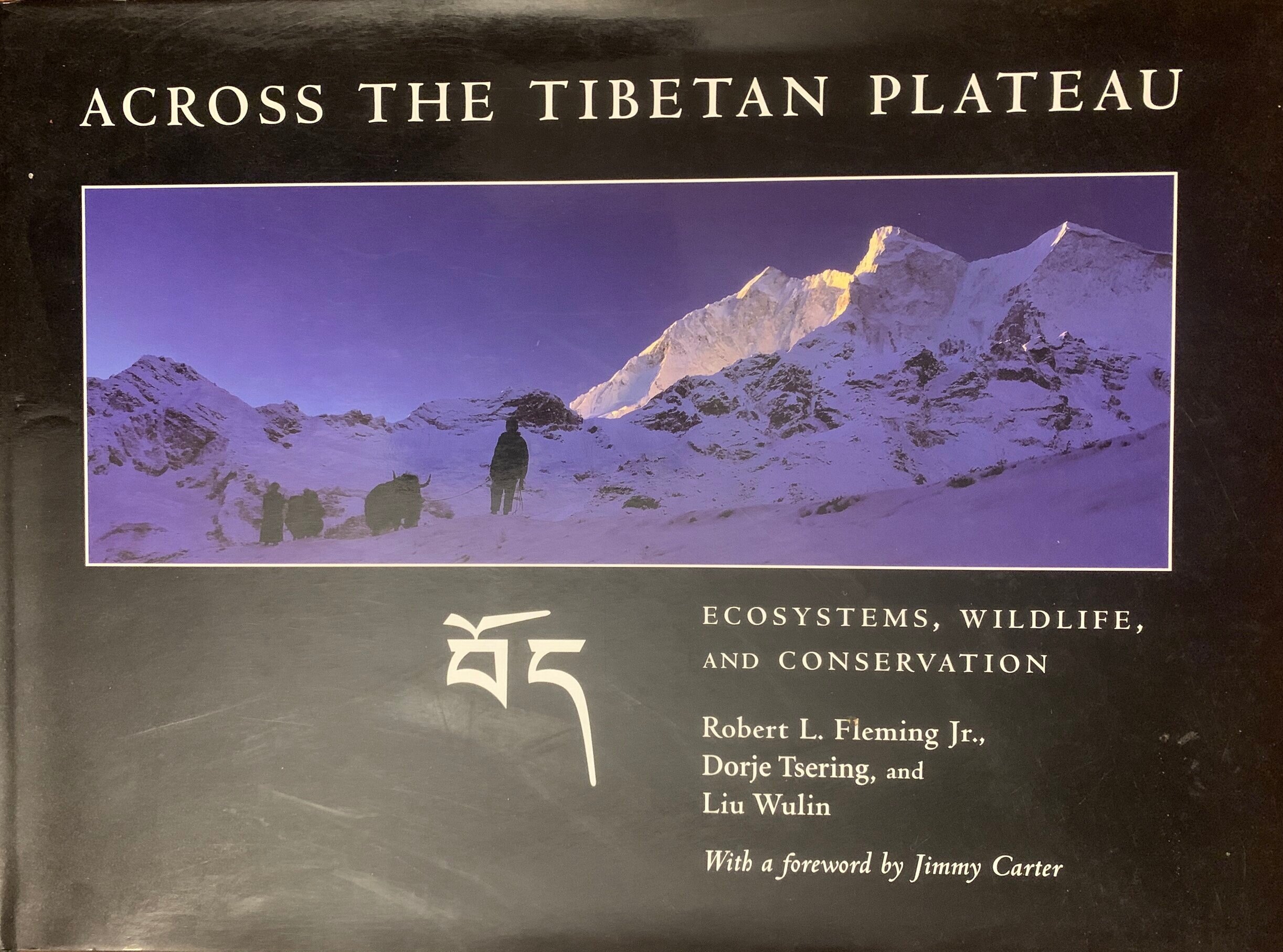
It was a coffee table book on Tibet, one that in all likelihood he had picked up from his living room side table. Bill has been fascinated with Tibet since a brief visit there five years ago.
“I want you and Blase to take me to Tibet,” he said.
I love this man. He married my mother when I was myself a young bride, and they had a glorious and passionate life until she died in 1997. Bill is now ninety-two—I would do anything for him. He is the one person I often speak to about my mother, a courageous woman who remains a constant inspiration to me. Bill always sends me a note on her birthday.
Bill wanted me to organize our trip, not travel with an organized tour like his previous visit. But Tibet is not easy to enter. You have to travel either from Kathmandu or China. Outsiders cannot visit Tibet as one would a western European country, France for example—climbing the Eiffel Tower, visiting Notre Dame, or taking the train to Versailles. Any person visiting Tibet needs not only a Chinese visa, but a Tibetan visa, and a guide to go anywhere outside of the capital, Lhasa. I made contact with a Tibetan guide service, determined that our trip would benefit the Tibetan people.
I asked my daughter, Ariel, if she wanted to join the three of us, and she jumped at the opportunity. We talked about what painting supplies we would take with us and began looking forward to painting together. Meanwhile, well-meaning friends warned me it would be dangerous to take Bill from sea-level to over 12,000 feet.” They had a point, but when I mentioned this to Bill, he waved it off. “I’ll take Diamox and be fine.”
Obtaining our Chinese visas was the first hurdle. For various bureaucratic reasons Bill’s application was rejected twice, while ours went through after some artful arranging. Several weeks passed and the timing was getting down to the wire. Without Bill’s Chinese visa, we couldn’t apply for the Tibetan visas, and if we didn’t do that shortly, it would be too late. I called Bill.
“Bill, what do you think?”
“Maybe I’m just not meant to go,” he said.
“Well, if you’re not going, we’re not going.”
“Oh, no!” he said. You must go! The three of you must go without me.”
Getting our visas was arduous, but the re-applications, hotel reservations, letters, documents, and day by day plans had worn me out. I’d spent so much time organizing this trip, arranging, choosing accommodations, and so forth, that I was ready to let it go. Bill was the impetus; without him I was no longer sure about going.
I called Ariel and told her it didn’t seem Bill would get his visa in time and we needed to decide if we would go without him. Blase was on the fence because his mother’s health was failing. I didn’t know what Blase would decide. I hoped he’d come with us, but wanted her to know it might be just the two of us.
“It’s fine just the two of us.” she said.
“We’ll have to be courageous,” I replied.
“We can do it.”
She wanted to go no matter what. It was decided. Ariel and I would go with or without the men.

Detail from Journey, Outdoor Installation by Tristan Govignon at Old frog Pond Farm & Studio. Photo: Robert Hesse
Blase visited his mother and after speaking with her and his brothers, he felt more at ease about being away and said he wanted to join us. On Monday, I wrote to Samdup, the person arranging our Tibetan itinerary, wired payment for the trip, and gave the ok to apply for our three Tibetan visas. These were being processed when on Thursday afternoon Bill received his Chinese visa from the embassy.
I wrote again to Samdup:
Bill has his visa. I have attached the copy below. Please add him to our trip.
I didn’t know if there was time to re-apply as a quartet, but I was determined to do everything possible to have Bill go with us. Samdup replied that they needed to resubmit everything, but he would see what he could do to expedite the process. We still have not heard definitively, and our flight to Beijing leaves on Thursday, but we are planning to board our China Air airplane, fly to Beijing, and hopefully to Lhasa.
I still wonder a little, especially in the middle of the night, if we are we supposed to go. But I trust that without knowing the reason, there is something important for us to experience. Ariel and I are excited to share this opportunity with Blase and Bill, to visit a country surviving despite the trauma of its recent history, a country rich in spiritual teachings, one that has already brought so much wisdom to the West.
Cover Drawing by Robert Spellman for The Wisdom of Tibetan Buddhism, edited by Reginald Ray, Shambhala Pocket Library.
Search Blog
-
2025
- May 9, 2025 A View from the Tractor Seat
- Apr 11, 2025 Dig
-
2024
- Jan 7, 2024 Winter Wassail
-
2022
- Dec 11, 2022 Keeping Time
- Jun 17, 2022 This Apple-Shaped Earth
- Jan 23, 2022 What is a Jizo?
- Jan 16, 2022 An Invite and Housekeeping Update
- Jan 1, 2022 The Year of the Frog: What Orchardists Do While Apple Trees are Chilling
-
2021
- Oct 24, 2021 Figs
- Oct 3, 2021 The Artist and the Orchard: A Memoir
- Aug 8, 2021 Red-Fleshed Apples
- Jul 25, 2021 When We Were Trees
- Jun 27, 2021 Castor Beans—Who Knew?
- Jun 13, 2021 Spring Training at a Zen Monastery
- May 4, 2021 Our Trees are in Bloom
- Apr 18, 2021 Hooray!
- Jan 24, 2021 Wassailing, virtually!
- Jan 1, 2021 Sitting
-
2020
- Dec 21, 2020 Darkness to Light
- Nov 28, 2020 One Heart
- Sep 18, 2020 Juggling Flowers, Fruit, and Vegetables
- Aug 23, 2020 Refuge
- Aug 9, 2020 Bags of Fertilizer
- Aug 2, 2020 The Sermon of the Blue Heron
- Jul 26, 2020 What's the Buzz?
- Jul 19, 2020 Farm Moments
- Jul 12, 2020 Lost Wax
- Jul 5, 2020 Catalpa: The Hugging Tree
- Jun 28, 2020 Pedaling Peace
- Jun 21, 2020 See Change
- Jun 14, 2020 Lalla Unveiled
- Jun 7, 2020 Pond Alchemy
- May 31, 2020 The Birth of Fruit
- May 24, 2020 An Artist in the Orchard
- May 17, 2020 Walking the Land: Returning Home
- May 10, 2020 Stinging Nettles: Gifts from the Great Mother
- May 3, 2020 The Mystery of Swallow
- Apr 26, 2020 Aerial Bruststrokes
- Apr 19, 2020 Simple Pleasures
- Apr 12, 2020 Weeds and Other Gifts
- Apr 5, 2020 Remembering the Seeds
- Mar 29, 2020 Blow on the Embers
- Mar 22, 2020 Ripples
-
2019
- Nov 16, 2019 Tibet Impressions
- Nov 9, 2019 Forest Tales
- Oct 13, 2019 The Gift
- Aug 4, 2019 The Season is Apples, Berries, and Grandfather Fire
- Jun 8, 2019 Pointers for a Writing Life
- May 12, 2019 Mothers of the Earth
- Apr 6, 2019 The Apple-Shaped Earth
- Mar 23, 2019 You Don’t Know What You Have Till It’s Gone
- Feb 23, 2019 Generations
- Feb 9, 2019 What Are We Doing to the Earth, John Chapman?
-
2018
- Dec 31, 2018 Long Shadows
- Oct 6, 2018 A Pilgrimage to India
- Aug 18, 2018 Scrap Wrenn
- Aug 11, 2018 Off-the-Wall Comments from an Ignorant Farmer
- Jul 28, 2018 Creative Connect
- Jul 14, 2018 How is the Orchard?
- Jun 30, 2018 Which Way?
- Jun 16, 2018 Geese, Herons, Beavers, and the Baby Steps of a Lapsed Blogger
- Feb 24, 2018 Mama's Coupons — Good Forever
- Jan 27, 2018 January Ice
- Jan 13, 2018 The Muse
-
2017
- Dec 30, 2017 A Dream for the New Year
- Dec 23, 2017 A New Year for Apples
- Dec 16, 2017 Intuition
- Nov 22, 2017 Thanksgiving OM
- Nov 4, 2017 East Fork Pottery
- Oct 28, 2017 Putting Down New Roots
- Oct 21, 2017 A is for Art
- Oct 14, 2017 Eve domesticus
- Oct 7, 2017 A String Workshop
- Sep 30, 2017 After Applepicking
- Sep 23, 2017 Two Bad Women and One Good Apple
- Sep 16, 2017 Plein Air Poetry
- Sep 9, 2017 Cutting Off a Leg
- Sep 2, 2017 The Changing Landscape
- Aug 26, 2017 All About Art
- Aug 19, 2017 My First Visit to the Farm
- Aug 12, 2017 The First Food
- Aug 5, 2017 A Teapot, a Woman, and maybe a Boat
- Jul 29, 2017 A Raspberry Dilemma
- Jul 22, 2017 Consider the Miracle
- Jul 15, 2017 Meeting Ekphrasis
- Jul 8, 2017 Ripening Fruit
- Jul 1, 2017 The Voice of The Caterpillar
- Jun 24, 2017 Goumi — An Unusual Fructus
- Jun 17, 2017 Concord, an American Bloomsbury
- Jun 10, 2017 The World Is Bonkers — Shall I Laugh or Cry?
- Jun 3, 2017 Bonkers, a Revolutionary Apple
- May 27, 2017 Guardians of the Swamp
- May 20, 2017 There are Mushrooms and There are Morels
- May 13, 2017 "What's in a Name?"
- May 6, 2017 Bloom Follows Pink: Orchard Pollination
- Apr 29, 2017 The Orchard Is at Pink
- Apr 22, 2017 Natural Farming — Part 2 (continuation from last Sunday's blog)
- Apr 15, 2017 Natural Farming — Part 1
- Apr 8, 2017 Boats, Figures, and Catching Fish
- Apr 1, 2017 A Man with a Mission: The Nuts and Bolts of Bronze Casting
- Mar 25, 2017 A Chalice of Spirit, Art, and Nature
- Mar 18, 2017 Hanami — Blossom Viewing
- Mar 11, 2017 Soil Redemption Song
- Mar 4, 2017 Food is Primary Care
- Feb 25, 2017 Pomme de Terre
- Feb 18, 2017 Organic Certification
- Feb 11, 2017 Tantalizing Fruit
- Feb 4, 2017 The Myths of History
- Jan 28, 2017 The Orchard in Winter
- Jan 21, 2017 The Hi-Line
- Jan 14, 2017 Artistic, Botanical, and Social Diversity
- Jan 7, 2017 Where is Eden?
-
2016
- Dec 31, 2016 The Creative Heart
- Dec 24, 2016 A Christmas Tale
- Dec 17, 2016 Who are the Crones?
- Dec 10, 2016 The Olympic Bell (Part Two)
- Dec 3, 2016 Overheard in the Apple Orchard in Early December
- Nov 26, 2016 The Lessons of a Tortoise
- Nov 19, 2016 In the Studio
- Nov 12, 2016 Even in Darkness
- Nov 5, 2016 Southern Apples, an Elephant, Monkey, Rabbit, and Bird, Two Mango Trees and a Birthday
- Oct 29, 2016 The Tools of Art
- Oct 22, 2016 Labyrinths
- Oct 15, 2016 Repairing the Broken
- Oct 8, 2016 When You Are No More
- Oct 1, 2016 Creation Rain
- Sep 24, 2016 Breaking the Glass
- Sep 17, 2016 String Art
- Sep 10, 2016 Poetry and Photosynthesis: It's all in the Leaves
- Sep 3, 2016 In the Plenty of Time
- Aug 27, 2016 Witch Doctors
- Aug 20, 2016 Listen Coyote
- Aug 13, 2016 Milkweed in the Orchard
- Aug 6, 2016 Some People See a Turtle
- Jul 30, 2016 Arborshaping
- Jul 23, 2016 Joseph Wheelwright: Sculptor of Stones and Trees
- Jul 16, 2016 Asian Pears
- Jul 9, 2016 Gold Leaf, Grief, and the Creative Process
- Jul 2, 2016 The Olympic Bell (Part One)
- Jun 25, 2016 Around the Mulberry Bush
- Jun 18, 2016 Avoiding Apples
- Jun 11, 2016 Fructus
- Jun 4, 2016 Astonishing Apples
- May 28, 2016 Scare the Caterpillars
- May 21, 2016 Join the Club!
- May 14, 2016 The Graft
- May 7, 2016 Rooster, Rhubarb, Rue
- Apr 30, 2016 What do Dolphins and Nettles Have in Common?
- Apr 23, 2016 Art Prunings
- Apr 16, 2016 A Few of the First Arrivals
- Apr 9, 2016 Taste the Spirit of Sustainable Agriculture
- Apr 2, 2016 First Orchard Spray - March 22-24, 2016
- Mar 26, 2016 Hawkeye Apple
- Mar 19, 2016 Desiring the Almata Apple
- Mar 12, 2016 Ugly Fruit
- Mar 5, 2016 Winter Tracks
- Feb 27, 2016 Splash
- Feb 20, 2016 Pruning
- Feb 13, 2016 Orchard Ruminants
- Feb 6, 2016 A Gathering of Seeds
- Jan 30, 2016 Orchard Dragons
- Jan 23, 2016 Tree Rings
- Jan 17, 2016 The Fallen Tree
- Jan 7, 2016 Wassailing the Apple Trees
- Jan 1, 2016 The New Year