LINDA HOFFMAN
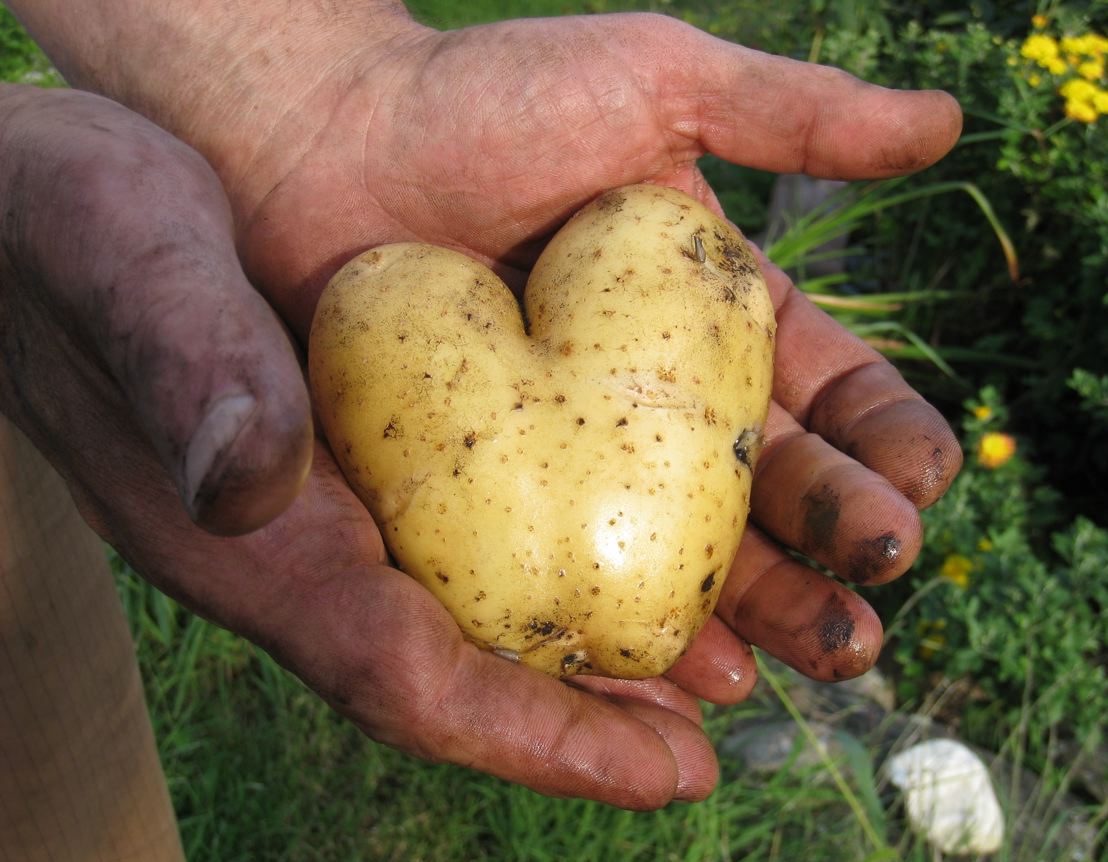
Pomme de Terre
To peel a boiled potato is a rare treat. —François Ponge
Pomme de terre in French means apple of the earth. Like apples, les pommes de terre have been on the planet for thousands of years and have been cultivated on all every continent except Antarctica. They sprout easily from the tuber itself: a rarity among plants, unlike a seed that is often surrounded by fleshy material or a hard pit.

A forgotten bag of potatoes!
The potato had its start in the soil of South America between 8000 and 5000 BCE. Today in the Andes about four hundred varieties of potatoes are grown. A single farmer in Peru might plant thirty to fifty different potatoes. Some of these potatoes she knows are resistant to drought or disease, others keep longer once they are dug, some crop early, some late. Peruvian potatoes, like heirloom apples, have many-shapes: round, oblong, conical, to name only a few, with hues of red, brown, yellow, purple, and blue that are marbled, speckled, streaked, striped, and mottled. Twenty-five or so varieties are sold in supermarkets and it seems that Peruvian shoppers are familiar with each potato’s unique characteristic.
Near Cuzco, Peru, six thousand families live in the world's first "Potato Park." Here residents and scientists test the tolerance of different potatoes to changing temperatures in a 22,700 acre living laboratory. Climate change has affected potato growing in Peru as it has crops across the globe. Potatoes that grew at 3000 feet now must be grown closer to 4000 feet because of the rise in average temperatures at these altitudes. And in low altitudes, it is now too warm to plant them. I am worried about our unseasonably warm local temperatures taking our fruit trees out of dormancy too early.
In his book, Potato: a history of the propitious esculent, John Reader writes that Juan, a Peruvian potato grower, told him that it had been a bad year for potatoes because an early frost had harmed the young plants. But his crop did all right. He had some plants that were frost tolerant, “and also tall enough to lean over and protect their weaker brothers.”
Farmers learn from their plants; being a farmer is being a nurturer. Humans need to eat, and if we are going to eat, we need to be kind to our crops. Today, so many people exchange money for food that we have moved far away from the mentality of being a nurturer towards plants. Money doesn’t grow on trees, and we don’t have to cultivate money with any sort of empathy. Is it any wonder that we have President Trump in the White House? His product, wealth, requires little compassion to grow, only aggressive boasting to propagate the Trump brand.
There is pressure on the Andean farmers to sell their land for profit. But it is organizations like the International Potato Center partnering with the “Potato Park” to support the Andean farmers so that their native knowledge will not be lost. Trialing the adaptive properties of hundreds of potatoes will hopefully insure that their children will eat food grown in the Andean soil, food will sustain them and their culture, as it has for millennia.
The French poet, Francis Ponge, wrote prose poems about single objects like the potato. Let’s not forget in these days of too much bad news to marvel at the simple potato.
La Pomme de Terre
To peel a boiled potato is a rare treat.
Between the cushion and the thumb and the point of the knife held by the other fingers, one seizes — after piercing— one of those lips of rough, thin parchment and pulls it towards one to detach it from the appetizing flesh of the tuber. […]
—François Ponge, in Selected Poems, edited and translated by Margaret Guiton
There are some potatoes with such papery thin skin that there is no need to peel away the parchment. And some are too beautiful to eat.
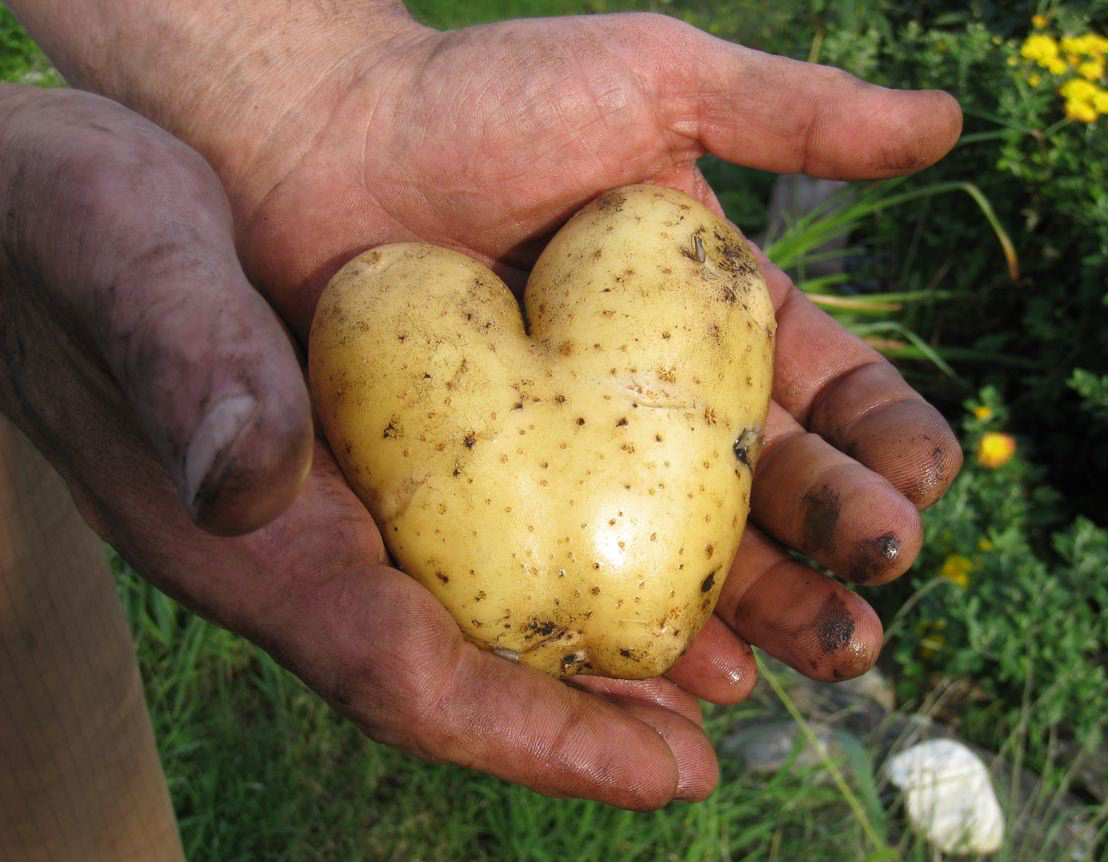
Freshly Dug Love!
Artistic, Botanical, and Social Diversity
In 1887, the United States Department of Agriculture in Washington, D.C. hired an immigrant artist to be on its staff. Born in Germany, Wilhem Heinrich Prestele’s parents emigrated to the United States with their family in 1843 when Wilhelm was five years old. His father, Joseph Presetele, had been a head gardener for King Ludwig I of Bavaria and a painter of fruits and flowers.
In his mid-twenties, William Henry Prestele, as he was now called, was a struggling artist living on Ninth Avenue in New York City with a wife and three children to support. William had inherited his father’s abilities, and when the opportunity to make a series of nurseryman’s plates for a Bloomington, Indiana, nursery came up, he packed up his young family, moved from New York to Indiana, and started his career as a botanical illustrator. None of the plates from this time exist, but an 1869 edition of Gardener's Monthly wrote:
We have now before us a fruit piece...prepared by W. H. Prestele. We are in the habit of admiring European art in this line, and have often wished Americans could successfully compete with it. We now have it here. We never saw anything of the kind better executed from any part of the world.
Prestele’s next position was in the USDA’s new pomological division. He painted watercolors for the National Agricultural Library’s collection, which grew to hold 7,584 watercolors of different varieties of fruits and nuts, including 3,802 paintings of apples. There were 21 artists who contributed to the collection, and nine of them were women.

Dolls Autumn Apple painted by William Henry Prestele, U.S. Department of Agriculture Pomological Watercolor Collection. Rare and Special Collections, National Agricultural Library, Beltsville, Maryland
The watercolors and drawings of fruit by these artists are among the most beautiful of early American art, no less amazing than the landscape paintings of the same era by the likes of Thomas Cole and his student Frederic Church. Though these artists had widely divergent subjects—towering mountains and flowing water on the one hand, versus seedpods, blossoms, and fruit on the other — they shared a desire for scientific accuracy and transcendent awe for their subjects. Americans’ appreciation for wilderness seemed to have paralleled their enjoyment of the apple.
The consumer knew that some apples were better for dessert, and some for pies, while others needed to be stored for several months to develop their flavors. The public appreciated the details of their differences — one licorice, another bitter, some with hints of orange, others lemony, nutty, or cinnamon-ny. The Nomenclature of the Apple by W. H. Ragan, printed in 1905, listed the unique apples offered by nursery catalogues from 1804 to 1904 — there were 6,654! The 19th century was a heyday for apples.
In the 1920s and 30s, with more people living in cities, the industrialization of food production advanced. Longer shelf life and ease of shipping became more important than taste. It was far easier to focus on a few varieties for mass production. It was all about commerce, all about looks; and the appreciation of the unique tastes of locally picked apples vanished. By the time my mother shopped for apples in Philadelphia in the 1950s and 60s, there were only a handful of apple varieties available in the supermarket. I remember liking the tart Winesap, while my brother preferred the sweeter Red Delicious.
I love the fact that the USDA hired artists to create extravagantly detailed renderings of fruits and nuts. We have lost a quality that comes with hand-painting, handwriting, and drawing. Sharing is a button on Facebook, and a catalogue is a collection of photographs. But more importantly, as these few varieties were crossed and re-crossed, their good taste and their health diminished. Red Delicious stayed a lovely red on the outside, but inside became mealy and boring. Unlike in a diverse orchard, where one variety might suffer insect pressure, while other varieties are ignored by pests; the insects prepared thorough, full-on attacks and feasted in these monocultures. As a result, pesticide use greatly increased. As any biological grower knows, diversity is key for healthy agriculture.
Diversity is also key to responding to climate change. A Northern apple grower might soon need to plant some Southern apples that don't require as many chill hours. Apple trees start to grow only after they receive a certain number of chill hours followed by heat. Each variety has its own ‘chill’ requirement. To read more about chill requirements for both apples and people read The New Year 2016 blog.
Diversity is key in every aspect our lives — the food we eat, the people we interact with, the news we read. We don’t always realize how we insulate ourselves and build walls around many aspects of our lives. We need healthy ecosystems just as much as we need healthy societal systems. And we need imagination! My friend, Vico Fabris, paints beautiful imaginary botanicals.
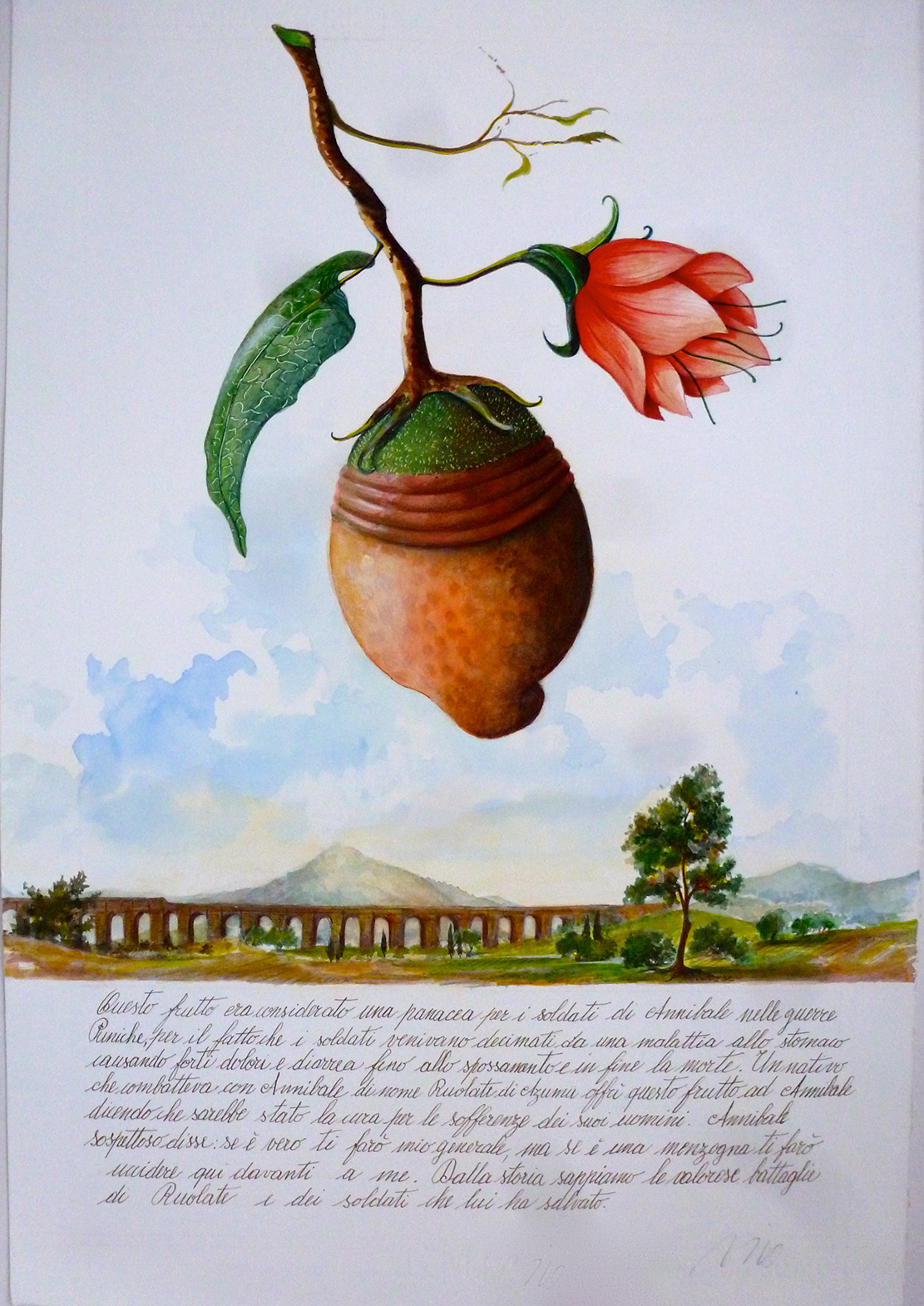
Azumacea, Vico Fabbris
Written in Vico’s native Italian under this painting is local legend about the plant, its medicinal properties, fragrance, and source. Vico celebrates diversity in every one of his paintings.
I doubt either of us could find support as artists in this United States government. When our President Elect asked Warhol to do a portrait of Trump Tower, Trump was “very upset that [the series] wasn’t color-coordinated,” and the deal fell through. We’ll all just have to take down that wall brick by brick., and keep America as artistically, botanically, and socially diverse as possible.
Search Blog
-
2025
- May 9, 2025 A View from the Tractor Seat
- Apr 11, 2025 Dig
-
2024
- Jan 7, 2024 Winter Wassail
-
2022
- Dec 11, 2022 Keeping Time
- Jun 17, 2022 This Apple-Shaped Earth
- Jan 23, 2022 What is a Jizo?
- Jan 16, 2022 An Invite and Housekeeping Update
- Jan 1, 2022 The Year of the Frog: What Orchardists Do While Apple Trees are Chilling
-
2021
- Oct 24, 2021 Figs
- Oct 3, 2021 The Artist and the Orchard: A Memoir
- Aug 8, 2021 Red-Fleshed Apples
- Jul 25, 2021 When We Were Trees
- Jun 27, 2021 Castor Beans—Who Knew?
- Jun 13, 2021 Spring Training at a Zen Monastery
- May 4, 2021 Our Trees are in Bloom
- Apr 18, 2021 Hooray!
- Jan 24, 2021 Wassailing, virtually!
- Jan 1, 2021 Sitting
-
2020
- Dec 21, 2020 Darkness to Light
- Nov 28, 2020 One Heart
- Sep 18, 2020 Juggling Flowers, Fruit, and Vegetables
- Aug 23, 2020 Refuge
- Aug 9, 2020 Bags of Fertilizer
- Aug 2, 2020 The Sermon of the Blue Heron
- Jul 26, 2020 What's the Buzz?
- Jul 19, 2020 Farm Moments
- Jul 12, 2020 Lost Wax
- Jul 5, 2020 Catalpa: The Hugging Tree
- Jun 28, 2020 Pedaling Peace
- Jun 21, 2020 See Change
- Jun 14, 2020 Lalla Unveiled
- Jun 7, 2020 Pond Alchemy
- May 31, 2020 The Birth of Fruit
- May 24, 2020 An Artist in the Orchard
- May 17, 2020 Walking the Land: Returning Home
- May 10, 2020 Stinging Nettles: Gifts from the Great Mother
- May 3, 2020 The Mystery of Swallow
- Apr 26, 2020 Aerial Bruststrokes
- Apr 19, 2020 Simple Pleasures
- Apr 12, 2020 Weeds and Other Gifts
- Apr 5, 2020 Remembering the Seeds
- Mar 29, 2020 Blow on the Embers
- Mar 22, 2020 Ripples
-
2019
- Nov 16, 2019 Tibet Impressions
- Nov 9, 2019 Forest Tales
- Oct 13, 2019 The Gift
- Aug 4, 2019 The Season is Apples, Berries, and Grandfather Fire
- Jun 8, 2019 Pointers for a Writing Life
- May 12, 2019 Mothers of the Earth
- Apr 6, 2019 The Apple-Shaped Earth
- Mar 23, 2019 You Don’t Know What You Have Till It’s Gone
- Feb 23, 2019 Generations
- Feb 9, 2019 What Are We Doing to the Earth, John Chapman?
-
2018
- Dec 31, 2018 Long Shadows
- Oct 6, 2018 A Pilgrimage to India
- Aug 18, 2018 Scrap Wrenn
- Aug 11, 2018 Off-the-Wall Comments from an Ignorant Farmer
- Jul 28, 2018 Creative Connect
- Jul 14, 2018 How is the Orchard?
- Jun 30, 2018 Which Way?
- Jun 16, 2018 Geese, Herons, Beavers, and the Baby Steps of a Lapsed Blogger
- Feb 24, 2018 Mama's Coupons — Good Forever
- Jan 27, 2018 January Ice
- Jan 13, 2018 The Muse
-
2017
- Dec 30, 2017 A Dream for the New Year
- Dec 23, 2017 A New Year for Apples
- Dec 16, 2017 Intuition
- Nov 22, 2017 Thanksgiving OM
- Nov 4, 2017 East Fork Pottery
- Oct 28, 2017 Putting Down New Roots
- Oct 21, 2017 A is for Art
- Oct 14, 2017 Eve domesticus
- Oct 7, 2017 A String Workshop
- Sep 30, 2017 After Applepicking
- Sep 23, 2017 Two Bad Women and One Good Apple
- Sep 16, 2017 Plein Air Poetry
- Sep 9, 2017 Cutting Off a Leg
- Sep 2, 2017 The Changing Landscape
- Aug 26, 2017 All About Art
- Aug 19, 2017 My First Visit to the Farm
- Aug 12, 2017 The First Food
- Aug 5, 2017 A Teapot, a Woman, and maybe a Boat
- Jul 29, 2017 A Raspberry Dilemma
- Jul 22, 2017 Consider the Miracle
- Jul 15, 2017 Meeting Ekphrasis
- Jul 8, 2017 Ripening Fruit
- Jul 1, 2017 The Voice of The Caterpillar
- Jun 24, 2017 Goumi — An Unusual Fructus
- Jun 17, 2017 Concord, an American Bloomsbury
- Jun 10, 2017 The World Is Bonkers — Shall I Laugh or Cry?
- Jun 3, 2017 Bonkers, a Revolutionary Apple
- May 27, 2017 Guardians of the Swamp
- May 20, 2017 There are Mushrooms and There are Morels
- May 13, 2017 "What's in a Name?"
- May 6, 2017 Bloom Follows Pink: Orchard Pollination
- Apr 29, 2017 The Orchard Is at Pink
- Apr 22, 2017 Natural Farming — Part 2 (continuation from last Sunday's blog)
- Apr 15, 2017 Natural Farming — Part 1
- Apr 8, 2017 Boats, Figures, and Catching Fish
- Apr 1, 2017 A Man with a Mission: The Nuts and Bolts of Bronze Casting
- Mar 25, 2017 A Chalice of Spirit, Art, and Nature
- Mar 18, 2017 Hanami — Blossom Viewing
- Mar 11, 2017 Soil Redemption Song
- Mar 4, 2017 Food is Primary Care
- Feb 25, 2017 Pomme de Terre
- Feb 18, 2017 Organic Certification
- Feb 11, 2017 Tantalizing Fruit
- Feb 4, 2017 The Myths of History
- Jan 28, 2017 The Orchard in Winter
- Jan 21, 2017 The Hi-Line
- Jan 14, 2017 Artistic, Botanical, and Social Diversity
- Jan 7, 2017 Where is Eden?
-
2016
- Dec 31, 2016 The Creative Heart
- Dec 24, 2016 A Christmas Tale
- Dec 17, 2016 Who are the Crones?
- Dec 10, 2016 The Olympic Bell (Part Two)
- Dec 3, 2016 Overheard in the Apple Orchard in Early December
- Nov 26, 2016 The Lessons of a Tortoise
- Nov 19, 2016 In the Studio
- Nov 12, 2016 Even in Darkness
- Nov 5, 2016 Southern Apples, an Elephant, Monkey, Rabbit, and Bird, Two Mango Trees and a Birthday
- Oct 29, 2016 The Tools of Art
- Oct 22, 2016 Labyrinths
- Oct 15, 2016 Repairing the Broken
- Oct 8, 2016 When You Are No More
- Oct 1, 2016 Creation Rain
- Sep 24, 2016 Breaking the Glass
- Sep 17, 2016 String Art
- Sep 10, 2016 Poetry and Photosynthesis: It's all in the Leaves
- Sep 3, 2016 In the Plenty of Time
- Aug 27, 2016 Witch Doctors
- Aug 20, 2016 Listen Coyote
- Aug 13, 2016 Milkweed in the Orchard
- Aug 6, 2016 Some People See a Turtle
- Jul 30, 2016 Arborshaping
- Jul 23, 2016 Joseph Wheelwright: Sculptor of Stones and Trees
- Jul 16, 2016 Asian Pears
- Jul 9, 2016 Gold Leaf, Grief, and the Creative Process
- Jul 2, 2016 The Olympic Bell (Part One)
- Jun 25, 2016 Around the Mulberry Bush
- Jun 18, 2016 Avoiding Apples
- Jun 11, 2016 Fructus
- Jun 4, 2016 Astonishing Apples
- May 28, 2016 Scare the Caterpillars
- May 21, 2016 Join the Club!
- May 14, 2016 The Graft
- May 7, 2016 Rooster, Rhubarb, Rue
- Apr 30, 2016 What do Dolphins and Nettles Have in Common?
- Apr 23, 2016 Art Prunings
- Apr 16, 2016 A Few of the First Arrivals
- Apr 9, 2016 Taste the Spirit of Sustainable Agriculture
- Apr 2, 2016 First Orchard Spray - March 22-24, 2016
- Mar 26, 2016 Hawkeye Apple
- Mar 19, 2016 Desiring the Almata Apple
- Mar 12, 2016 Ugly Fruit
- Mar 5, 2016 Winter Tracks
- Feb 27, 2016 Splash
- Feb 20, 2016 Pruning
- Feb 13, 2016 Orchard Ruminants
- Feb 6, 2016 A Gathering of Seeds
- Jan 30, 2016 Orchard Dragons
- Jan 23, 2016 Tree Rings
- Jan 17, 2016 The Fallen Tree
- Jan 7, 2016 Wassailing the Apple Trees
- Jan 1, 2016 The New Year