LINDA HOFFMAN
An Artist in the Orchard
Usually I carry a spade, loppers, clippers, a weeding tool, a basket with rubber ties, and wire into the orchard. But like a plein air painter who leaves the studio and brings paints and brushes to the subject, I bring a notebook and pen, and sit in a patch of purple violets under a Golden Delicious apple tree.

Along with the violets, two varieties of clover are growing—mammoth red and white Dutch. I love clover under my apple trees—and daffodils and dandelions, mountain mint and comfrey, iron weed, valerian, St. John’s wort, bee balm, even stinging nettles. The more companion plants, the richer the soil.

Notebook page 5/16/20
Most people don’t realize that one apple bud opens to become a cluster of five or six flower buds. The king blossom is in the center; it’s the first to grow and the first to open. It’s surrounded by the harem waiting to take over if anything should happen to the king.
In a stellar pollination year, most of the secondary blossoms will be pollinated and the tree becomes a cloud of delicate wings. The downside is too many children. The apples will be small, with more disease and pest pressure, and less air circulation and sunlight, not beneficial for the crop.
On this particular Golden Delicious tree, I see only a few blossoms. Golden Delicious have a propensity to be biennial—a riot of blossoms one year, and the next only a scattering. Orchardists can control this tendency by “thinning” the trees, removing a portion of the young fruit. As an organic grower, I don’t have an array of chemical thinners to choose from, but I can hand thin. On our youngest trees, we pluck off all the blossoms, discouraging such precocious behavior; these trees need to focus on growth, not reproduction! On the younger trees, we remove some of the fruitlets, leaving a few inches between apples. But on the mature trees, when the fruit set is crazy-good, our feeble efforts to thin hardly make a difference. One tree alone could occupy an afternoon, and we don't have a month to devote to thinning. I leave the Golden Delicious to do as they are inclined. Other trees, like the newer varieties of Liberty and Honey Crisp, are bred to discourage this trait.
The upside of this off-year is all energy goes into growing large and shiny leaves—optimal photosynthesis. A time of repose, a sabbatical to recharge. As I sit in its shade, I think about what the tree offers other than fruit. Maybe nutritive support to other trees and to the soil around its roots? Maybe sequestering more carbon? Maybe that strange notion, self-care?
This Golden Delicious tree is over 45 years old, and some orchard experts say it should be replaced because it’s old and leaning too far south. But I’m enthralled by its wayward slant, its zig-zag desire to find equipoise. In the photo below you can see the young branch I’m training to become a new central leader if necessary.

Being both orchardist and artist is at times contradictory. Should I spray a particularly nasty, but approved organic material like lime sulfur to thin the Golden Delicious so they don’t fall into biennial production? After all, we have 28 mature Golden Delicious trees with no fruit, and that’s a lot of real estate in a small orchard. The truth is I appreciate the gnarly old trees and the young slender spindles, the trees with no apples and the trees loaded with fruit.
I finish taking notes and gather violets to put in a jar of olive oil for next fall when we will make salves and balms. A pair of cedar waxwings are courting in one of the Gala trees, and two orioles sing from high in a Summer Sweet. The woodchuck peeks out of a nearby hole, and upon seeing me, ducks back down. The geese hiss. On my walk back to the house, I snap off two fat purple asparagus no doubt planted by some robin scratching for worms near the trunk of a Cortland in the first row. Today I’m an artist in the orchard. Tomorrow I’ll return with other tools.

Apple Tree, Watercolor and Pencil, 2020, Linda Hoffman
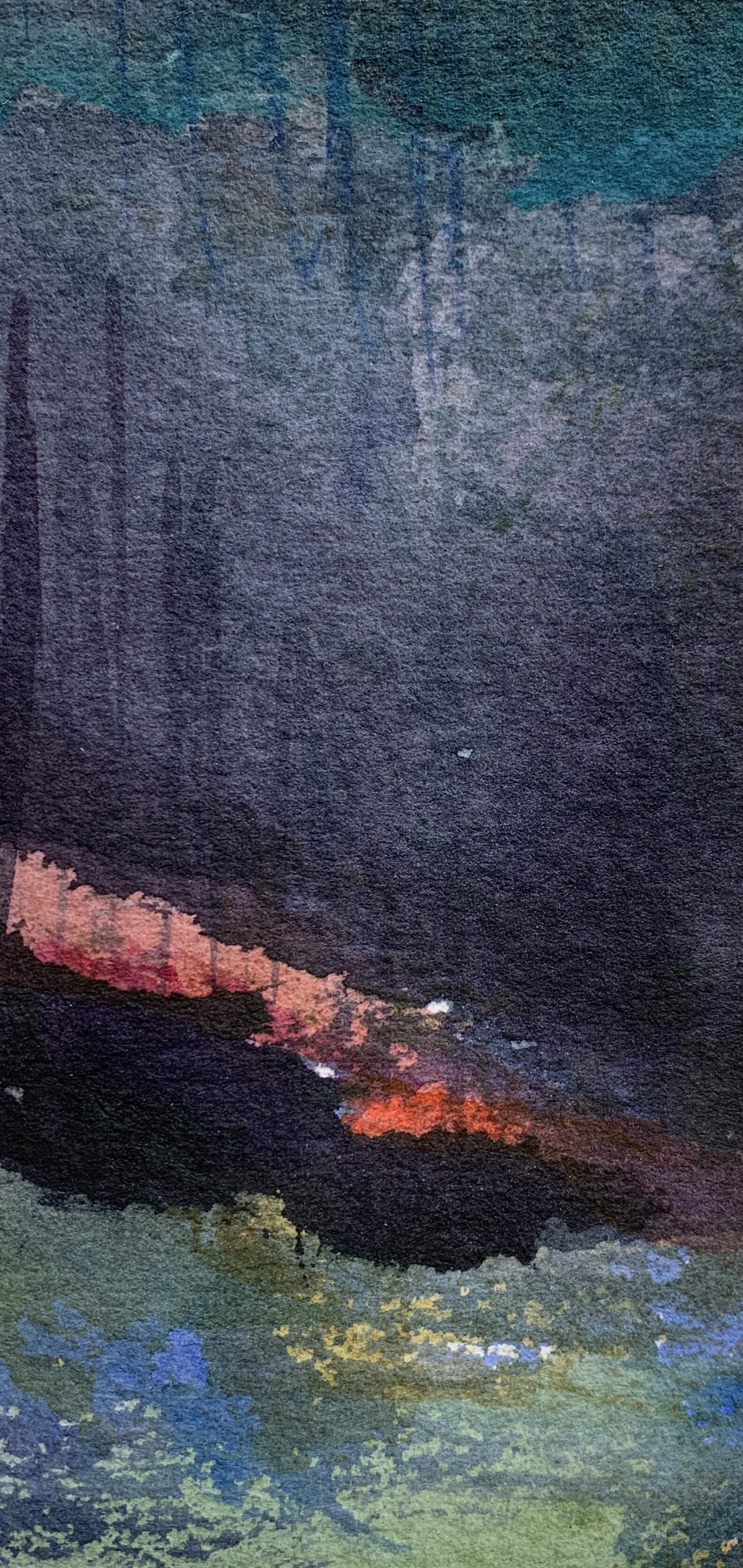
Aerial Bruststrokes
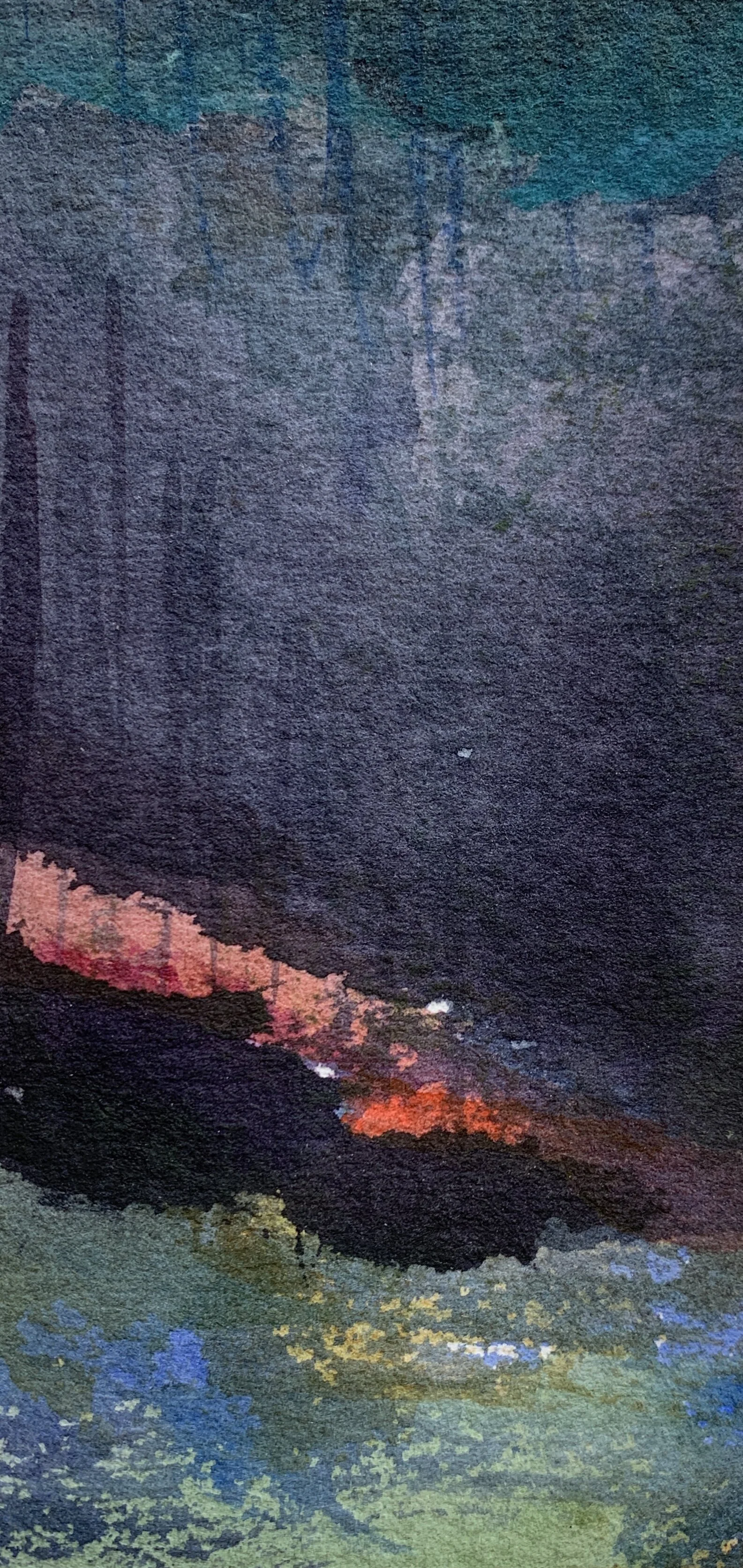
Rain, watercolor, LH
Yet another cold, rainy morning and I sit at my studio window watching tree swallows circle and loop, skim the water, and splash. They could be practicing touch-and-goes as if taking part in some aviation exhibition, but I prefer seeing them as painters dipping their brushes to color the pond and trees.
I first met swallows soon after I met Blase, my husband. We were sitting on the front step of the farmhouse and I asked, “If you were to be reincarnated as an animal, what would it be?”
Blase didn’t pause for very long before he said, “A swallow.”
“A swallow? Why?”
Blase has a deep voice that resonates in his broad chest. He played football during high school and college. He’s physical and strong, so I imagined he would say, a lion, or some impressive creature.
Blase answered my bewildered look, “Because they are so playful.”
I didn't know a swallow from a wren but took in his comment as something significant.
Then he turned to me and asked what animal I would choose.
I replied, “Maybe a lion.” I needed to be strong and able to fight for what I needed not only for myself but for my pride of three children.
I have completely come around to Blase’s point of view. For the swallows, regardless of the lack of warmth and sunshine, do their thing, eat insects, and dazzle us ground walkers. The secret of the swallows’ contentment seems to be their willingness to fly in any weather, to be a complete expression of joy no matter the circumstances. I know how hard that is to do, especially when strong emotions come up, especially when the suffering and grief I feel increases with every bit of news from around the globe.
Navigating the currents of difficulties that arise is our daily practice. The storms will never disappear, but we learn to be better fliers. Like the swallows, we practice our take-offs and landings, until one sunny day, involuntarily we grab a brush, paint the pond pink, the trees purple, and the sky an emerald green, even when it is raining.
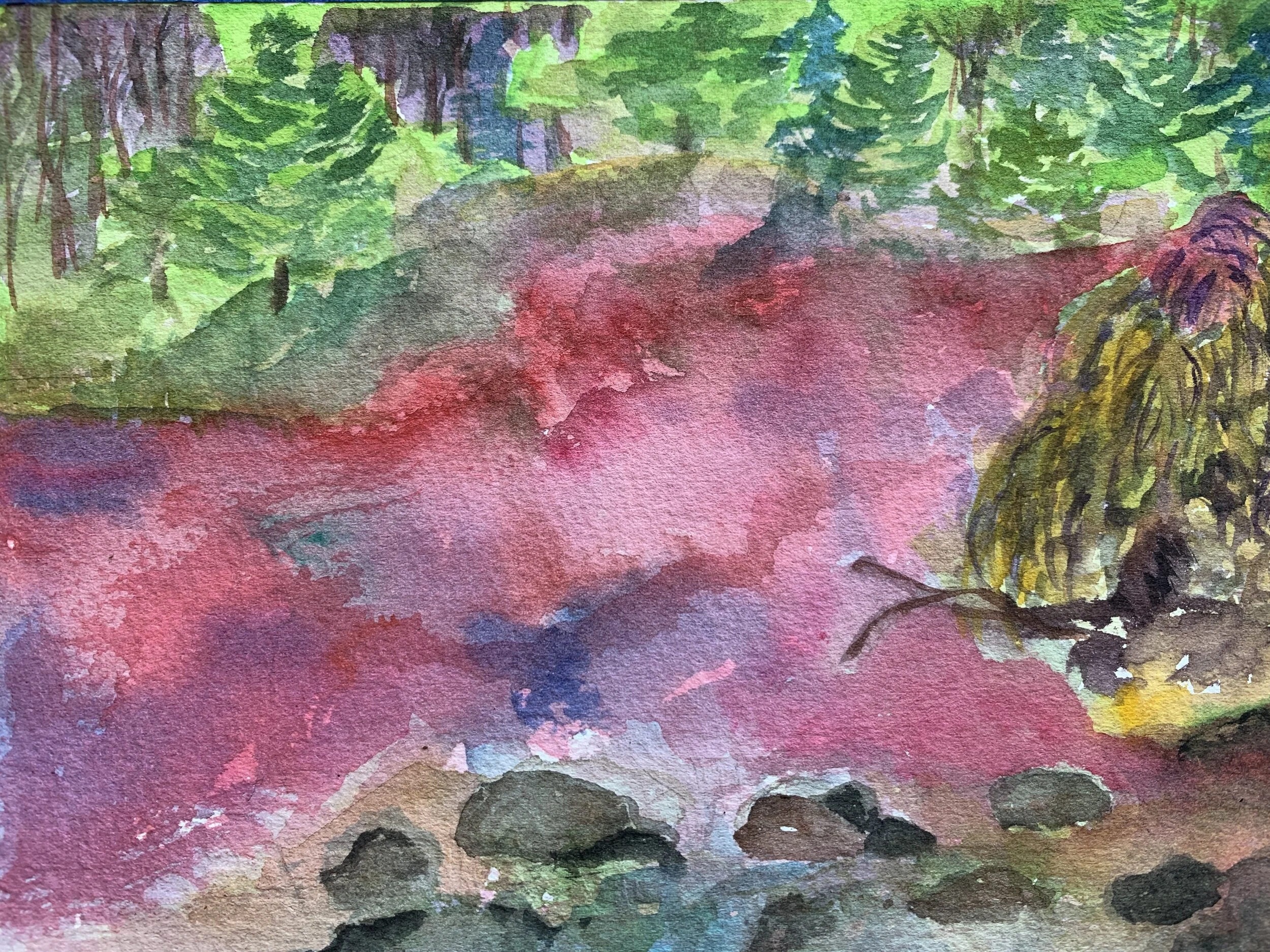
Pink Pond, watercolor, LH
Simple Pleasures
“I nurture simplicity among the gardens and fields”
—Chinese farmer and poet, T’ao Chien, 365-427 C.E.
These days, many of us have no choice but to bring simplicity into our lives. Many of our favorite activities have been taken away whether this means no gym workouts, no visiting with friends and family, or no shopping at a favorite store. We scrounge through the pantry shelves for something to cook, making do with what is on hand. Or go outside like I did the other night to gather parsley and a bit of coriander that overwintered, new shoots of spearmint, and a large bowl of stinging nettles, to add to some sad looking basil leaves in the back of the fridge. The greens, smushed into the Cuisinart, along with oil, garlic, lemon juice, and pecans made a hearty pesto. Our creative meals can bring us great delight.
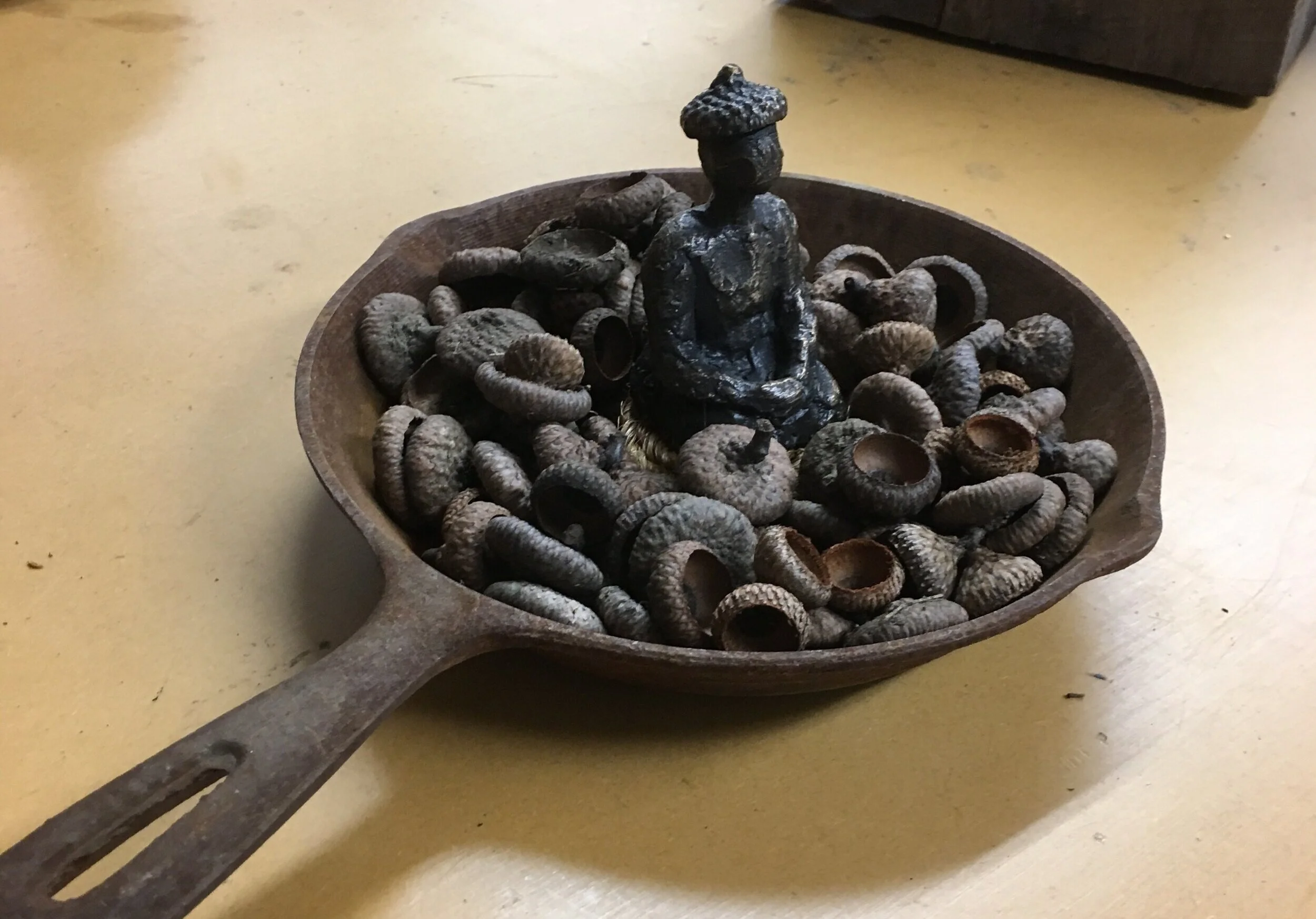
Simplicity can also mean living more intentionally, with more discipline and purpose. It can be unburdening our lives as well as decluttering our minds. Usually our minds flit from one thought to the next, from one sensation to another, moving quickly and erratically, but there is the silence when all distractions and desires fade. In many spiritual traditions, one sits in meditation to calm thoughts in order to experience deep silence. Sitting still, not moving, is the aid to find the stability of simplicity that allows for an opening to that great Silence.
For me, the concentration required by sculpting, painting, and writing creates the fertile ground for merging with the work, and within that merging, I find stillness. A musical score gives structure to mark periods of sounds and rests. The German-born pianist, Artur Schnabel (1882–1951) wrote,
“The notes I handle no better than many pianists. But the pauses between the notes—ah, that is where the art resides.”
The great jazz musician Miles Davis said it this way:
“Don’t play what’s there; play what’s not there.”
Lao Tzu, the Chinese sage advises, “Become empty of yourself and realize inner silence.” It sounds straightforward, but who knows how to empty themselves. I can’t sit myself down on a meditation cushion and say, I’m going to find silence: I only find myself in the midst of a great amount of activity. That’s why cultivating the earth always feels like cheating, the back door: the simple act of weeding as the antidote for the anxiety of our present times. But even weeding can be a challenge. I was talking to a friend yesterday and said,
“You know, weeding is not always that easy. It’s not just pulling the long white weed thread. Some weeds like vetch are impossible, impenetrable. It’s exhausting to dig through their density of roots. And when it’s that difficult, there’s no quieting the mind.”
Meister Eckhart, the Christian contemplative wrote,
“It’s not what we do that makes us holy, but we should make holy what we do.”
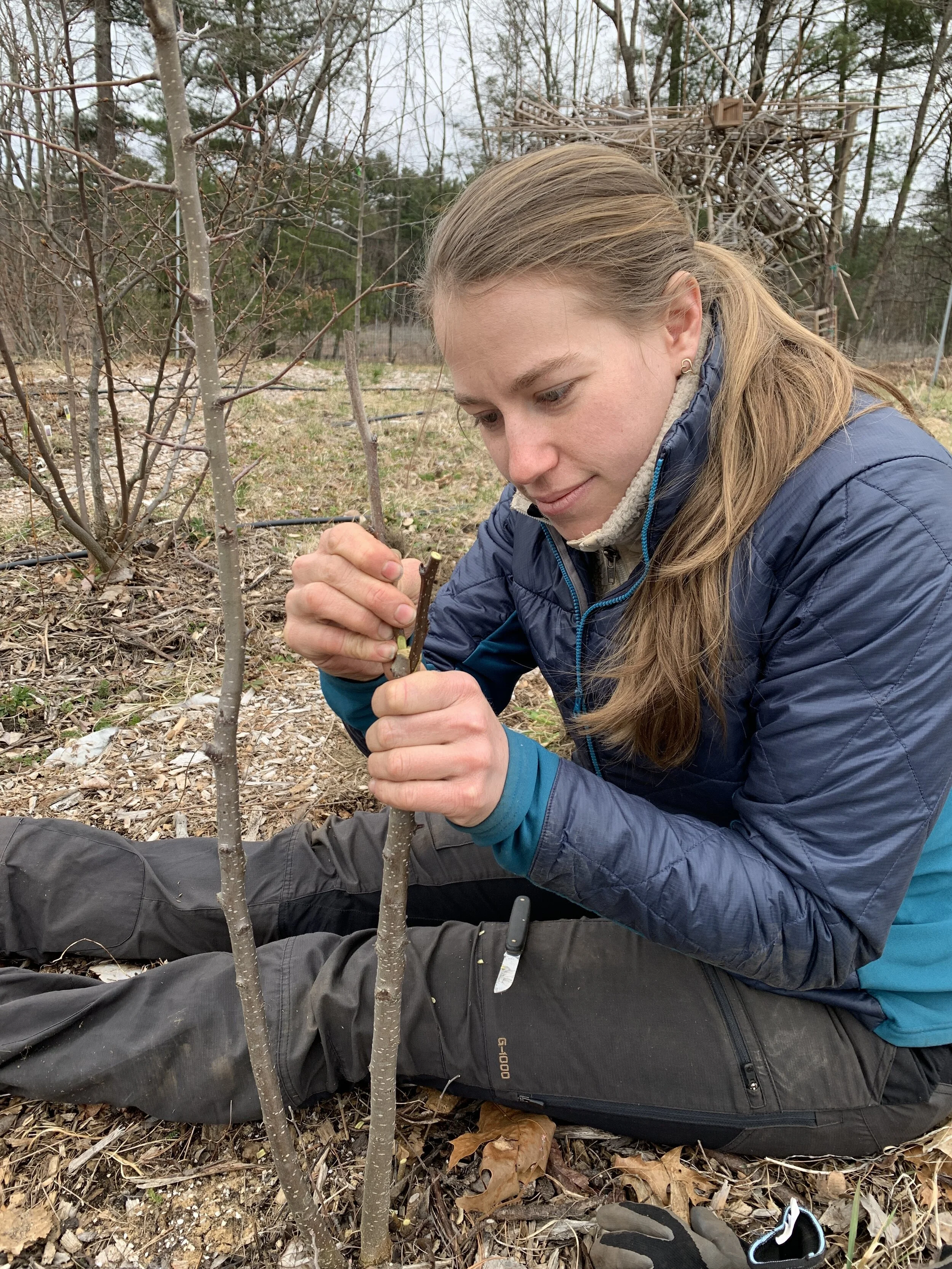
Ariel, grafting Olympic Asian pear scion wood onto rootstock in the Asian pear orchard.
So I return to the words of T’ao Chien: “I nurture simplicity among the gardens and fields.” I remind myself that he is surely weeding the gardens and plowing the fields, and he is nurturing simplicity. When I only concern myself with getting the work finished, checked off the to-do list, I take no pleasure in it. When I forget the to-do list, then the merging that I so love takes place. We can make holy everything we do. We can nurture simplicity everywhere.
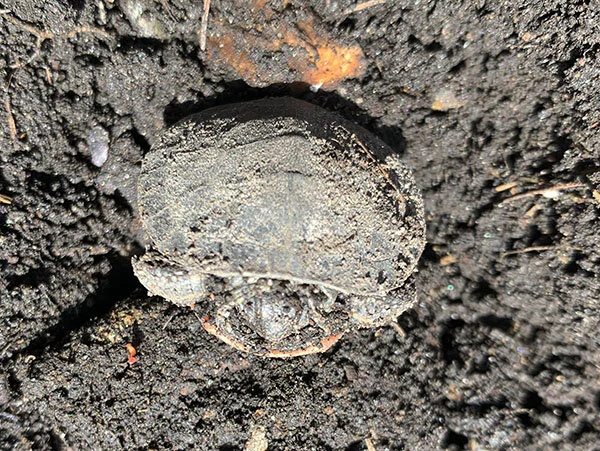
Baby snapper turtle Ariel found when we were moving a pear tree to plant new peaches. The turtle stretched and then we quickly dug it back into the soil.
Forest Tales
Our quartet, my stepfather Bill, daughter Ariel, and partner Blase, returned one week ago from our trip to Tibet. However, condensing two intense weeks of pilgrimage into a brief blog, like making a few jugs of sweet juice from bushels of ripe apples, takes time. The apples need to sweat, I need to distill the experience.
Meanwhile the Catalpa tree with its large heart-shaped leaves outside my studio window is no longer green and leafy, but is sending brown flying carpets everywhere. And in the woods, the sight-lines are clear as tree branches lay bare the sky, and the spiced air welcomes the forest walker.
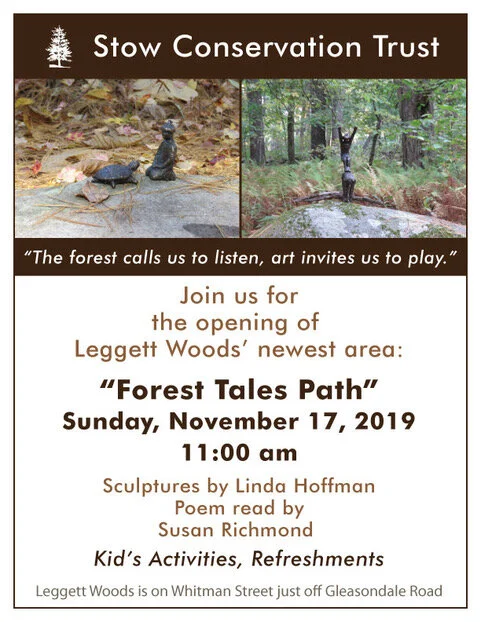
Next Sunday morning, November 17th at 11 am, I invite you to join me for a forest walk in one of Stow, Massachusetts’ conservation areas, The Leggett Woods. Here along a meandering trail, I installed thirteen sculptures, a world of acorn-capped acrobatics, a mother and child, a boy and a turtle, a frog, each one fixed onto a forest stone. The storyteller sits near the beginning reading to three acorn-capped children.
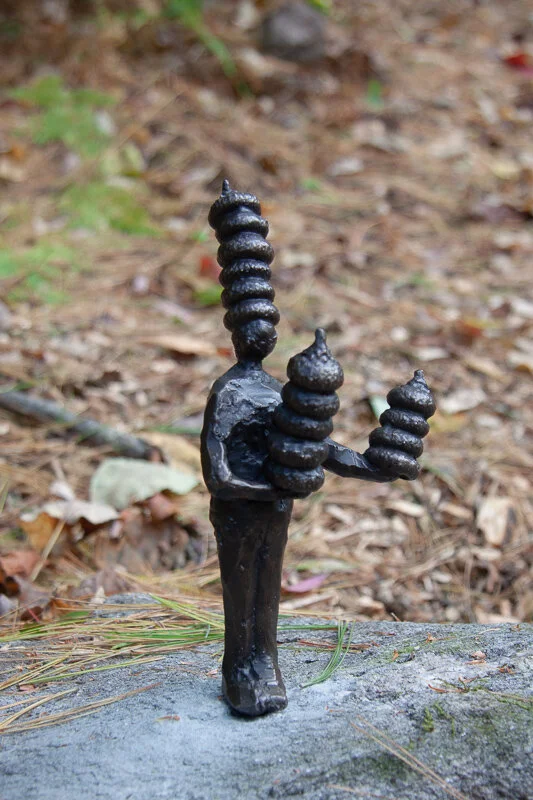
Caps for Sale
The paths are cleared and covered with wood chips so discovering each one is not difficult. The Stow Conservation Trust, the private land preservation organization in Stow, hopes to attract more families to explore their trails by creating special places to visit and enjoy.
The genesis of this project began along Old Frog Pond Farm’s woods trails where a series of bronze meditating figures are permanently installed. They are small, and you would think go unnoticed, and perhaps do for some people, but most others notice one sculpture, and then another, and another, and are delighted by the shift in scale, the quietness, and simplicity of these bronze figures on rocks.
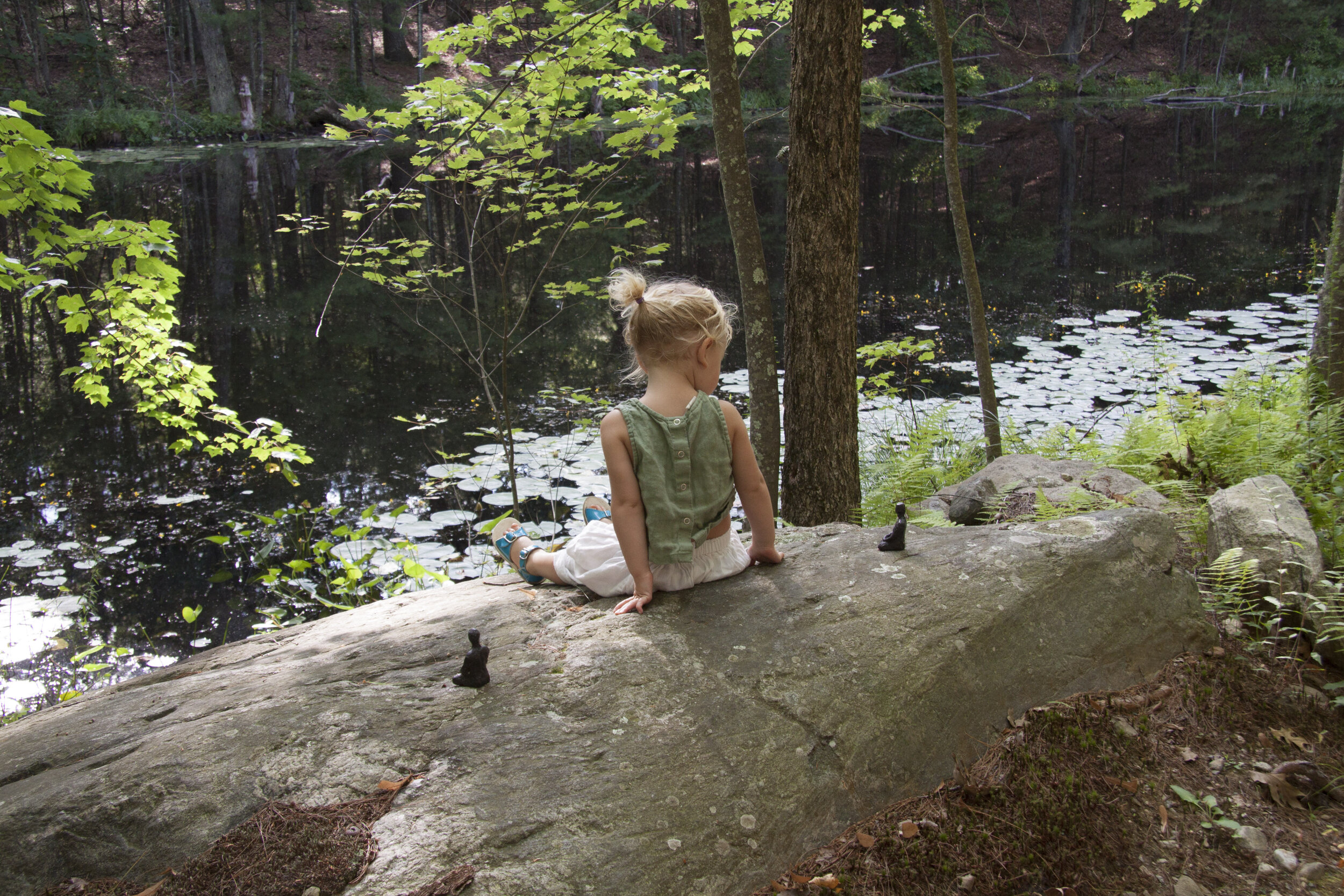
Vita Matisse sitting with sculptures.
My granddaughter enjoys sitting on the large rock among them. Other children add acorn caps, a perfect fit for the bowed bronze heads. We don’t encourage interaction with the sculpture on exhibit at the farm, but I thought these acorns caps were a charming addition and have since cast a few figures topped with them. The wood burns out in the lost wax process.
When I was considering a possible sculpture for the Leggett Woods, I thought about a village of sculptures that might encourage children to get down on their hands and knees, and play. Perhaps add some more acorn caps, or build a little house of twigs, or add stones and leaves—an artwork to encourage interaction with the forest life.
The Stow Conservation Trust worked hard to find volunteers to help with the land clearing and creation of the trails. I am especially grateful to the committee I worked with directly, Janet Kresi Moffat, Ann Carley, and Carol Gumbart, and to the Alice Eaton Grant Funds for supporting the commission.
Another person I have worked with for many years is poet, Susan Edwards Richmond. In the first issue of Wild Apples, the journal of nature, art, and inquiry we founded and edited with two other friends in 2006, Susan wrote poetry for a series of my bronze boat sculptures. When I told her about this commission, I hesitantly asked if she might like to write a poem—I knew her creative focus was now on children’s books (Bird Count published by Peachtree Publishing Company came out last month!). As the date for installation got closer, Susan wrote, “Where are you installing the sculptures in Stow? Could you use another hand? I can meet on the 11th as long as it's after 1:45 pm.”
It was a kind offer, but among Susan’s many talents is not operating a hammer drill or epoxy gun. I didn’t reply. She wrote again a few days later, “What time? Would you like some local help? :)”. This time I answered, “Sure! Maybe around 11? You follow the trail then take the left fork. Can’t miss.”
Susan arrived when John Lowe, my assistant, and I were well into the installation. We’d been there since 9 am. Of course, Susan and I both knew she wasn’t coming to help with the install, but with notebook in hand she immediately knelt down in front of a sculpture.
Susan will be reading the Forest Tales poems at the opening next Sunday. There will be kids’ activities, refreshments, art, nature, and poetry. Hope to see some of you on Sunday, November 17 at 11 am. And I promise a Tibet blog soon!
Directions: Leggett Woods is on Whitman Street just off of Gleasondale Road (Route 62). If you are driving South on Route 62 from the intersection of Route 117 in Stow, go about a mile, turn left at the fork with signs for Honey Pot Orchards , and the Leggett Woods parking area is on your right.
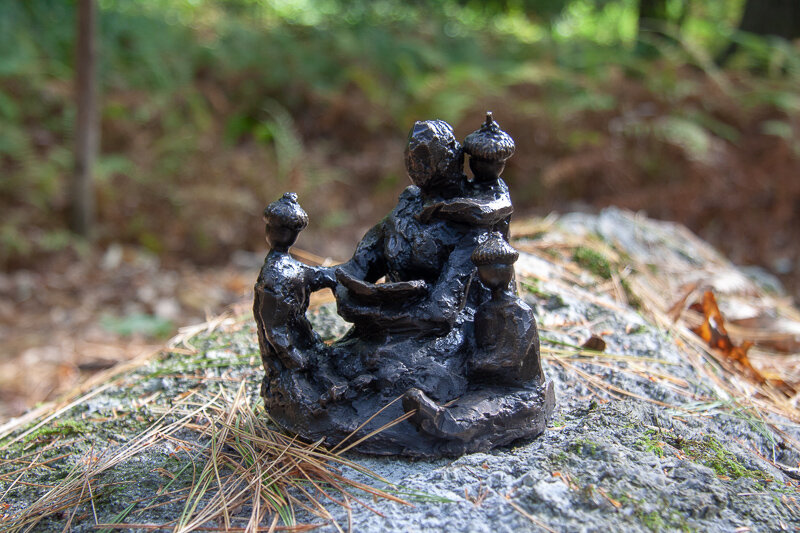
The Storyteller
Search Blog
-
2025
- May 9, 2025 A View from the Tractor Seat
- Apr 11, 2025 Dig
-
2024
- Jan 7, 2024 Winter Wassail
-
2022
- Dec 11, 2022 Keeping Time
- Jun 17, 2022 This Apple-Shaped Earth
- Jan 23, 2022 What is a Jizo?
- Jan 16, 2022 An Invite and Housekeeping Update
- Jan 1, 2022 The Year of the Frog: What Orchardists Do While Apple Trees are Chilling
-
2021
- Oct 24, 2021 Figs
- Oct 3, 2021 The Artist and the Orchard: A Memoir
- Aug 8, 2021 Red-Fleshed Apples
- Jul 25, 2021 When We Were Trees
- Jun 27, 2021 Castor Beans—Who Knew?
- Jun 13, 2021 Spring Training at a Zen Monastery
- May 4, 2021 Our Trees are in Bloom
- Apr 18, 2021 Hooray!
- Jan 24, 2021 Wassailing, virtually!
- Jan 1, 2021 Sitting
-
2020
- Dec 21, 2020 Darkness to Light
- Nov 28, 2020 One Heart
- Sep 18, 2020 Juggling Flowers, Fruit, and Vegetables
- Aug 23, 2020 Refuge
- Aug 9, 2020 Bags of Fertilizer
- Aug 2, 2020 The Sermon of the Blue Heron
- Jul 26, 2020 What's the Buzz?
- Jul 19, 2020 Farm Moments
- Jul 12, 2020 Lost Wax
- Jul 5, 2020 Catalpa: The Hugging Tree
- Jun 28, 2020 Pedaling Peace
- Jun 21, 2020 See Change
- Jun 14, 2020 Lalla Unveiled
- Jun 7, 2020 Pond Alchemy
- May 31, 2020 The Birth of Fruit
- May 24, 2020 An Artist in the Orchard
- May 17, 2020 Walking the Land: Returning Home
- May 10, 2020 Stinging Nettles: Gifts from the Great Mother
- May 3, 2020 The Mystery of Swallow
- Apr 26, 2020 Aerial Bruststrokes
- Apr 19, 2020 Simple Pleasures
- Apr 12, 2020 Weeds and Other Gifts
- Apr 5, 2020 Remembering the Seeds
- Mar 29, 2020 Blow on the Embers
- Mar 22, 2020 Ripples
-
2019
- Nov 16, 2019 Tibet Impressions
- Nov 9, 2019 Forest Tales
- Oct 13, 2019 The Gift
- Aug 4, 2019 The Season is Apples, Berries, and Grandfather Fire
- Jun 8, 2019 Pointers for a Writing Life
- May 12, 2019 Mothers of the Earth
- Apr 6, 2019 The Apple-Shaped Earth
- Mar 23, 2019 You Don’t Know What You Have Till It’s Gone
- Feb 23, 2019 Generations
- Feb 9, 2019 What Are We Doing to the Earth, John Chapman?
-
2018
- Dec 31, 2018 Long Shadows
- Oct 6, 2018 A Pilgrimage to India
- Aug 18, 2018 Scrap Wrenn
- Aug 11, 2018 Off-the-Wall Comments from an Ignorant Farmer
- Jul 28, 2018 Creative Connect
- Jul 14, 2018 How is the Orchard?
- Jun 30, 2018 Which Way?
- Jun 16, 2018 Geese, Herons, Beavers, and the Baby Steps of a Lapsed Blogger
- Feb 24, 2018 Mama's Coupons — Good Forever
- Jan 27, 2018 January Ice
- Jan 13, 2018 The Muse
-
2017
- Dec 30, 2017 A Dream for the New Year
- Dec 23, 2017 A New Year for Apples
- Dec 16, 2017 Intuition
- Nov 22, 2017 Thanksgiving OM
- Nov 4, 2017 East Fork Pottery
- Oct 28, 2017 Putting Down New Roots
- Oct 21, 2017 A is for Art
- Oct 14, 2017 Eve domesticus
- Oct 7, 2017 A String Workshop
- Sep 30, 2017 After Applepicking
- Sep 23, 2017 Two Bad Women and One Good Apple
- Sep 16, 2017 Plein Air Poetry
- Sep 9, 2017 Cutting Off a Leg
- Sep 2, 2017 The Changing Landscape
- Aug 26, 2017 All About Art
- Aug 19, 2017 My First Visit to the Farm
- Aug 12, 2017 The First Food
- Aug 5, 2017 A Teapot, a Woman, and maybe a Boat
- Jul 29, 2017 A Raspberry Dilemma
- Jul 22, 2017 Consider the Miracle
- Jul 15, 2017 Meeting Ekphrasis
- Jul 8, 2017 Ripening Fruit
- Jul 1, 2017 The Voice of The Caterpillar
- Jun 24, 2017 Goumi — An Unusual Fructus
- Jun 17, 2017 Concord, an American Bloomsbury
- Jun 10, 2017 The World Is Bonkers — Shall I Laugh or Cry?
- Jun 3, 2017 Bonkers, a Revolutionary Apple
- May 27, 2017 Guardians of the Swamp
- May 20, 2017 There are Mushrooms and There are Morels
- May 13, 2017 "What's in a Name?"
- May 6, 2017 Bloom Follows Pink: Orchard Pollination
- Apr 29, 2017 The Orchard Is at Pink
- Apr 22, 2017 Natural Farming — Part 2 (continuation from last Sunday's blog)
- Apr 15, 2017 Natural Farming — Part 1
- Apr 8, 2017 Boats, Figures, and Catching Fish
- Apr 1, 2017 A Man with a Mission: The Nuts and Bolts of Bronze Casting
- Mar 25, 2017 A Chalice of Spirit, Art, and Nature
- Mar 18, 2017 Hanami — Blossom Viewing
- Mar 11, 2017 Soil Redemption Song
- Mar 4, 2017 Food is Primary Care
- Feb 25, 2017 Pomme de Terre
- Feb 18, 2017 Organic Certification
- Feb 11, 2017 Tantalizing Fruit
- Feb 4, 2017 The Myths of History
- Jan 28, 2017 The Orchard in Winter
- Jan 21, 2017 The Hi-Line
- Jan 14, 2017 Artistic, Botanical, and Social Diversity
- Jan 7, 2017 Where is Eden?
-
2016
- Dec 31, 2016 The Creative Heart
- Dec 24, 2016 A Christmas Tale
- Dec 17, 2016 Who are the Crones?
- Dec 10, 2016 The Olympic Bell (Part Two)
- Dec 3, 2016 Overheard in the Apple Orchard in Early December
- Nov 26, 2016 The Lessons of a Tortoise
- Nov 19, 2016 In the Studio
- Nov 12, 2016 Even in Darkness
- Nov 5, 2016 Southern Apples, an Elephant, Monkey, Rabbit, and Bird, Two Mango Trees and a Birthday
- Oct 29, 2016 The Tools of Art
- Oct 22, 2016 Labyrinths
- Oct 15, 2016 Repairing the Broken
- Oct 8, 2016 When You Are No More
- Oct 1, 2016 Creation Rain
- Sep 24, 2016 Breaking the Glass
- Sep 17, 2016 String Art
- Sep 10, 2016 Poetry and Photosynthesis: It's all in the Leaves
- Sep 3, 2016 In the Plenty of Time
- Aug 27, 2016 Witch Doctors
- Aug 20, 2016 Listen Coyote
- Aug 13, 2016 Milkweed in the Orchard
- Aug 6, 2016 Some People See a Turtle
- Jul 30, 2016 Arborshaping
- Jul 23, 2016 Joseph Wheelwright: Sculptor of Stones and Trees
- Jul 16, 2016 Asian Pears
- Jul 9, 2016 Gold Leaf, Grief, and the Creative Process
- Jul 2, 2016 The Olympic Bell (Part One)
- Jun 25, 2016 Around the Mulberry Bush
- Jun 18, 2016 Avoiding Apples
- Jun 11, 2016 Fructus
- Jun 4, 2016 Astonishing Apples
- May 28, 2016 Scare the Caterpillars
- May 21, 2016 Join the Club!
- May 14, 2016 The Graft
- May 7, 2016 Rooster, Rhubarb, Rue
- Apr 30, 2016 What do Dolphins and Nettles Have in Common?
- Apr 23, 2016 Art Prunings
- Apr 16, 2016 A Few of the First Arrivals
- Apr 9, 2016 Taste the Spirit of Sustainable Agriculture
- Apr 2, 2016 First Orchard Spray - March 22-24, 2016
- Mar 26, 2016 Hawkeye Apple
- Mar 19, 2016 Desiring the Almata Apple
- Mar 12, 2016 Ugly Fruit
- Mar 5, 2016 Winter Tracks
- Feb 27, 2016 Splash
- Feb 20, 2016 Pruning
- Feb 13, 2016 Orchard Ruminants
- Feb 6, 2016 A Gathering of Seeds
- Jan 30, 2016 Orchard Dragons
- Jan 23, 2016 Tree Rings
- Jan 17, 2016 The Fallen Tree
- Jan 7, 2016 Wassailing the Apple Trees
- Jan 1, 2016 The New Year