LINDA HOFFMAN
Bags of Fertilizer
I wonder how many bags of fertilizer are spread on a single field to grow corn. In the United States alone we grow corn on 90 million acres. How many 50-pound bags of synthetic fertilizers are emptied out and fed to the soil?
I’m obsessed with this thinking, it’s formed a loop in my mind, like a morning dream that repeats over and over. And while one detail changes, nothing significant enough shifts to allow an escape. The parking ticket can’t be found, the man is still in the bar drinking, how to get out of the parking lot and to safety.
After World War II ended, the companies who made nerve gas and poisons reprogrammed their products, calling them fertilizers. Then, they persuasively changed the way of farming all over the world, poisoning the earth instead of the enemy, while in the long term, harming both humans, insects, and soil. How did we arrive at this idea that we need to manufacture synthetic materials to help the earth grow plants? The microorganisms in the soil are all part of a complex soil web: the bacteria, the fungal populations, the earthworms, the nematodes, the mycelia are the real farmers.

Sketchbook page, Julia Tricca
In Beirut this week, thousands of tons of fertilizer exploded and took the lives of 150 people, injured thousands, destroying the homes of hundreds of thousands of others. A country that was already suffering from oppression, injustice, war and corruption is in chaos. Bags of fertilizer, or shall I say explosives, from Batumi, Georgia destined for Mozambique, one of the ten poorest countries on the planet, has shaken this country to its core.
Fertilizer bags are usually cheap paper just thick enough to hold the weight. But if they lay around and attract moisture, the paper decays, the bags leak, and moving them becomes a huge mess. Hazardous waste. Human trash needing to be gotten rid of. We’re good at manufacturing materials that harm the planet, that have a long shelf life, that don’t disappear even after hundreds of years.
We are caught in a loop of our own creation. How are we going to get out of our destructive cycle? Surely the farmers in Mozambique know how to grow food naturally. Buying expensive synthetic fertilizers is not going to solve their country’s many problems. It’s not solving the problems in our country. For example, in Kansas, where 90 percent of the state is agricultural land, one in five people go hungry. Kansas isn’t growing food, it grows feed for cattle, ethanol for fuel, and high fructose corn syrup, while a large percent of its population starves.
We have to envision a new model. We have to collectively re-envision the world we want to pass on to the unborn. We live on the planet, we need to eat food grown in its soil, and drink water from its underground rivers. Here is where we need to begin.
We need to believe that nature works and there is a natural way to live in accord with nature. The system is designed to work. We need to trust. And we need to make changes. Almost 70% of agricultural land on the earth is used to grow feed for animals we eat. And this meat provides a much smaller percent of calories to the world’s population than plant-based crops. If we are to provide food for the growing number of people on the planet, farming needs to be a journey in which we relate to the land and all its creatures.

Sketchbook page, Julia Tricca
The good news is that a United Nations report in 2014 stated that 80% of the world’s food is still produced by family farms. The future is not in industrial agriculture, but in intelligent small-scale farming. I heard a surprising statistic while listening to a podcast between John Kempf and Zach Bush, two modern agronomists—70% of our food comes from farms that are five acres or less. This statistic gives me hope. But for the people suffering in Lebanon, an outpouring of aid is what is needed. A few of the organizations you can donate to are:
The United Nation’s World Food Program
Unicef
Impact Lebanon
Project Hope
And remember to support your local farms!

Sketchbook page, Julia Tricca
Note: Artist Julia Tricca was a farmer at Old Frog Pond Farm during her high school and two college summers. She graduated this spring and shared her final art project with me. Julia will be installing a new sculpture at the farm this fall. We’re all proud of you, Julia!
What's the Buzz?
Our bees had a productive spring, and our beekeeper, Don Rota, presented us with seven pounds of ravishing, golden, lucid, liquid gold. On Thursday afternoon, we bottled the honey in six- and twelve-ounce glass jars in the farmhouse kitchen.

But what exactly is honey? When bees gather nectar from the flowers, they receive a jolt of energy in the form of carbohydrates (sugars) to keep them going in the hot sun from flower to flower, but the excess is stored in their nectar stomachs. When they return to the hive, they regurgitate the nectar and offer it to another bee. As this nectar is passed from bee to bee, an enzyme in the bees’ stomachs begins the process of turning it into honey. Then the consolidated nectar is put into cells in the hive. Fanning completes the water evaporation process and what’s left is honey. Bees make honey so they can survive the winter.

Bees have been on the planet for 120,000,000 years. A bee was found preserved in amber from Myanmar dating back 100,000,000 years. Despite the longevity of the species, individual worker bees, all female, only live a month in the summer. It’s hard work to be a worker bee, but then they do have the glory of visiting flower after flower, and gorging on lovely nectar. In winter, however, their physiology changes and worker bees live up to three months.
Drones, the male bees, live longer, do no work, just laze around the hive waiting for a queen to be born. After her birth, the virgin makes a maiden voyage outside the hive, sending out a pheromone to attract the opposite sex. The drones mate with the nubile queen and then die soon after, completely spent after such their lovemaking. She stores this lifetime supply of sperm to use as needed, controlling fertilization of her eggs by releasing sperm as the egg passes through her oviduct. Come fall, any drones still hanging around are booted out of the hive, and left to starve to death.
Queens can live for five years. If the hive’s queen is old or ill, the new queen may fight her and possibly take over. Sometimes worker bees bring a new queen into a hive because it is large and needs a queen so part of the hive can swarm. It’s the decision of the workers to feed royal jelly to larvae bees to make new queens. The worker bees democratically decide about everything that happens in the hive. Depending on the size of the cells the worker bees create, the queen lays unfertilized eggs to become drones (male) or fertilized ones to become worker bees (female).
Some people consider bees to be mammals. They view the hive as an animal without its ‘skin bag.’ The different kinds of bees are like cells in a body with different functions. The ‘swarm’ is the offspring. I like this notion because the hive becomes a larger system, one creature, one body, one ecosystem.
In summer the hive may grow to over 30,000 bees, but in the winter they drop down to a thousand bees as they conserve resources to survive the winter. The life of the honey bee is one deep and abiding concern for their food supply. Surely this is why they have survived on the planet for so long. In comparison, our ancestors have occupied the planet for only six million years, and we have become dangerously complacent about our food supply.
Humans have a long desired honey. A drawing on a rock face in Spain dating back to 6000 BCE shows two people climbing a rope ladder to get to a hive high up on a flat rock wall. Another drawing found in Zimbabwe from 8000 BCE shows the wavy lines of natural honeycomb with a person approaching it holding some kind of smoker. People in remote areas of Nepal and Macedonia still ‘hunt’ for hives, sometimes climbing steep rock faces to gather prized honey. In Romania, bee hive trucks follow the flowering from the South to the North, parking for a few weeks off highways, giving their bees lots of wild forage. I imagine the colors and shapes help the bees return to their own hives.

Bee hive truck near Vitri, Romania, 2016
The Egyptians described keeping bees for the medicinal properties of the honey in paintings and writing. They used honey for all sorts of sicknesses from diabetes to contraception. There are even paintings depicting ritual circumcisions with the wound being dressed with honey. Today we know there are high levels of antimicrobial activity in raw honey.
Beekeepers are dedicated to their hives. They also are enthusiastic to share information and help each other. Melissa Ljosa used to keep two top bar hives here until she moved to Vermont a few months ago.

Don Rota is the one without the bee suit. Melissa (left), is checking a top bar hive. We miss her!
Don now takes care of ten hives at Old Frog Pond Farm. He loves to keep them here because we are committed to organic practices, and the farm grows healthy forage all season long for the bees. Don told me one spoon of honey takes twelve bees their entire lives to gather. I think of them each morning with my dollop of honey in my morning tea.
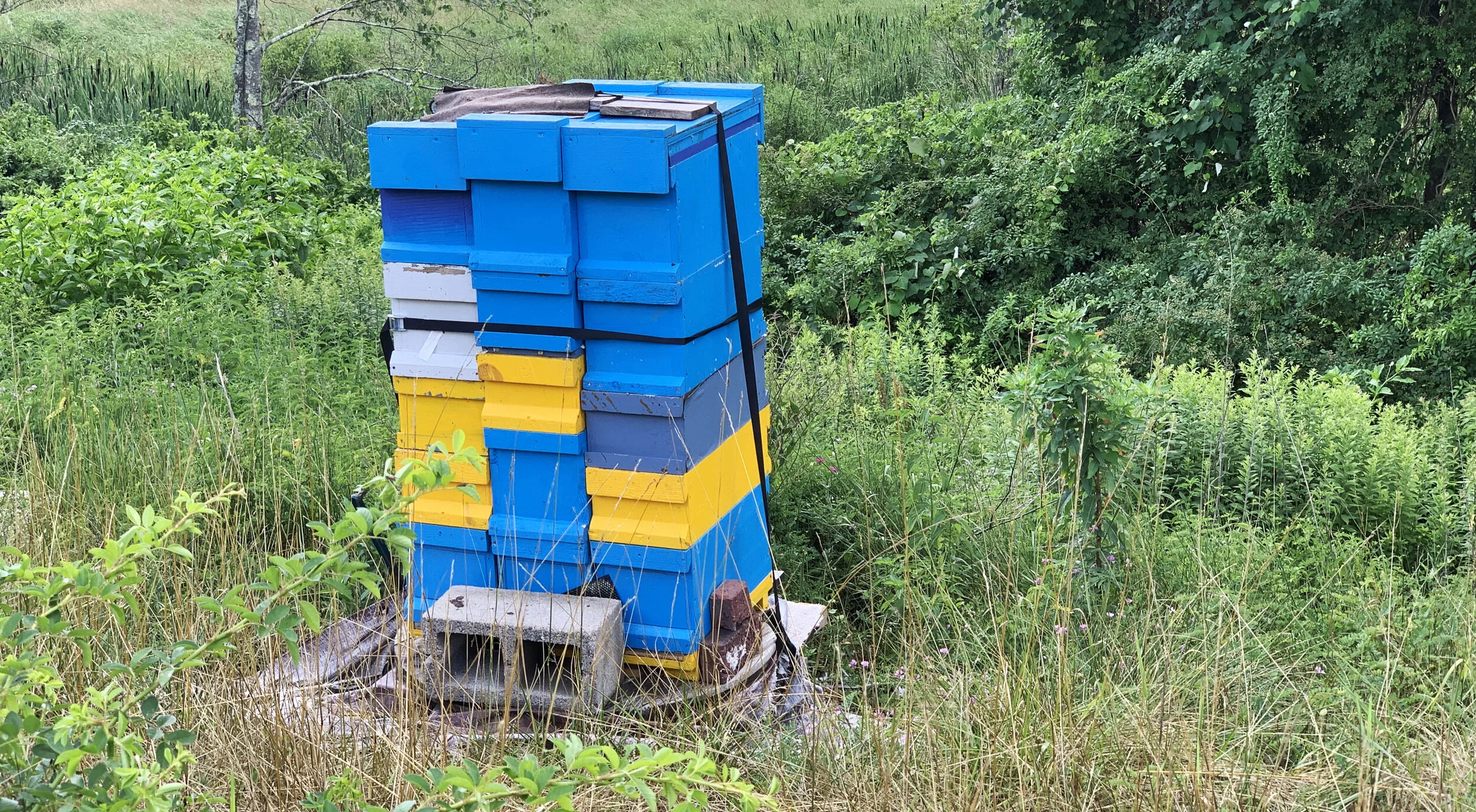
A few of Don’s more colorful hives at the farm. Yellow for the sun and blue for the dome above.
And what’s the buzz? As the bee beats its wings, we hear the vibration as buzzing. But the flower feels the buzzing as movement. Pollen may fall off the flower and onto the bee’s body. Some is carried to the next flower the bee visits; the rest is stashed in the bee’s pollen baskets on its hind legs. It will travel back to the hive for the nurse workers who stay in the hive to feed the young.
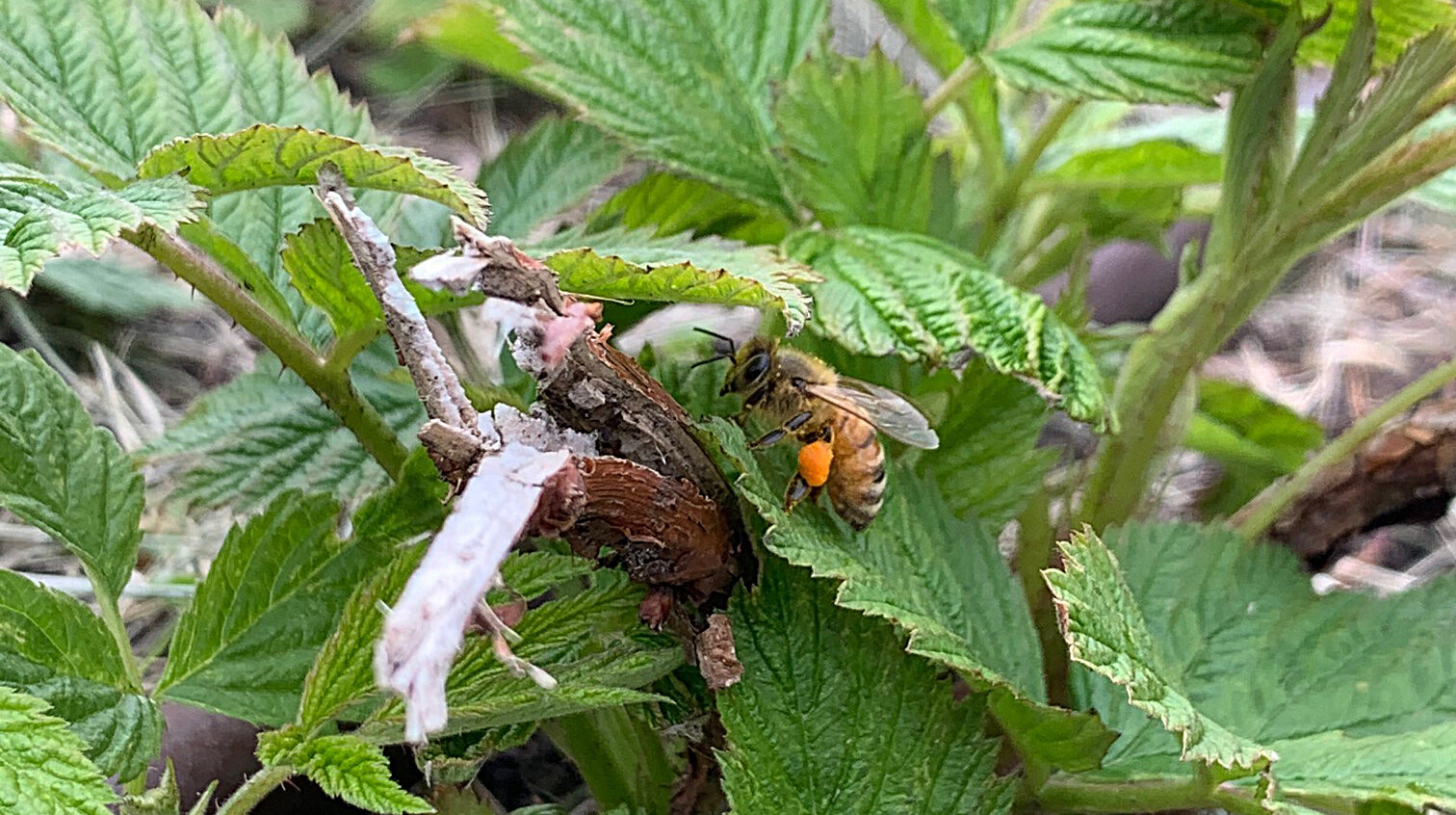
Pollen Baskets are Full
There’s so much more I could write about bees—but perhaps best to stop here and invite you to stop by our farm stand for a taste of local, raw honey. Its truest secrets are only conveyed by the spoonful on the tongue.
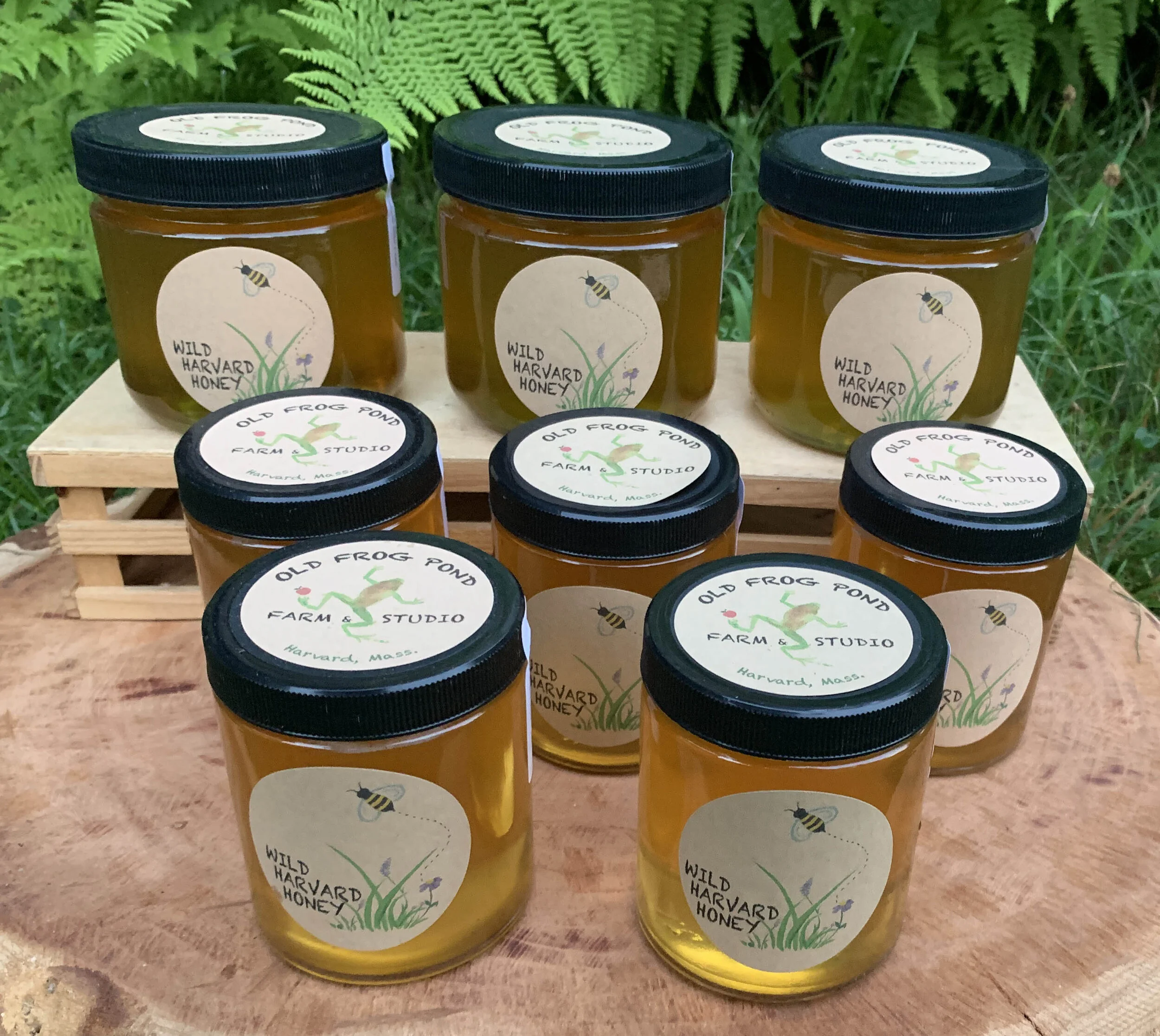
Raw honey for sale at our self-serve farm stand.
Stinging Nettles: Gifts from the Great Mother

LH, photo: Ariel Matisse
Squatting in a patch of stinging nettles with my foraging basket, and rubber gloves, I was snipping young stalks to sauté for dinner. Some people react with alarm when I mention eating stinging nettles, but the truth is nettles are beloved by wild foragers and herbalists. Mother Earth offers this gift packed with vitamins, minerals, and protein. Richio Cech in his book, Making Plant Medicine, summarizes the uses of nettles: “Practical Uses: Legion.” The Greeks and Romans cultivated fields of nettles more than any other crop.
Nettles sting because they have hairs on the stems and undersides of leaves that break off when touched, exposing the tiniest sharp needles that pierce the skin and inject a toxin that causes a burning rash. Fierce protection! For nettles are so nutritious, animals would devour them before they grew large enough to flower and bear seeds, the driving force in a plant’s life.
An old adage says, “When in doubt, use nettles!” Their beneficial uses include: a natural detoxifier, an anti-inflammatory, a treatment for gout, anemia, joint pain, diabetes, hay fever, urinary tract issues, and prostate issues. Flogging with stinging nettles for arthritis, joint pain, and to increase blood circulation is the one recommendation I am nervous about trying. But when I am without energy and need a dose of friendliness, I reach for the jar of dry nettles and make a cup of tea. It’s magical how this plant restores my balance.
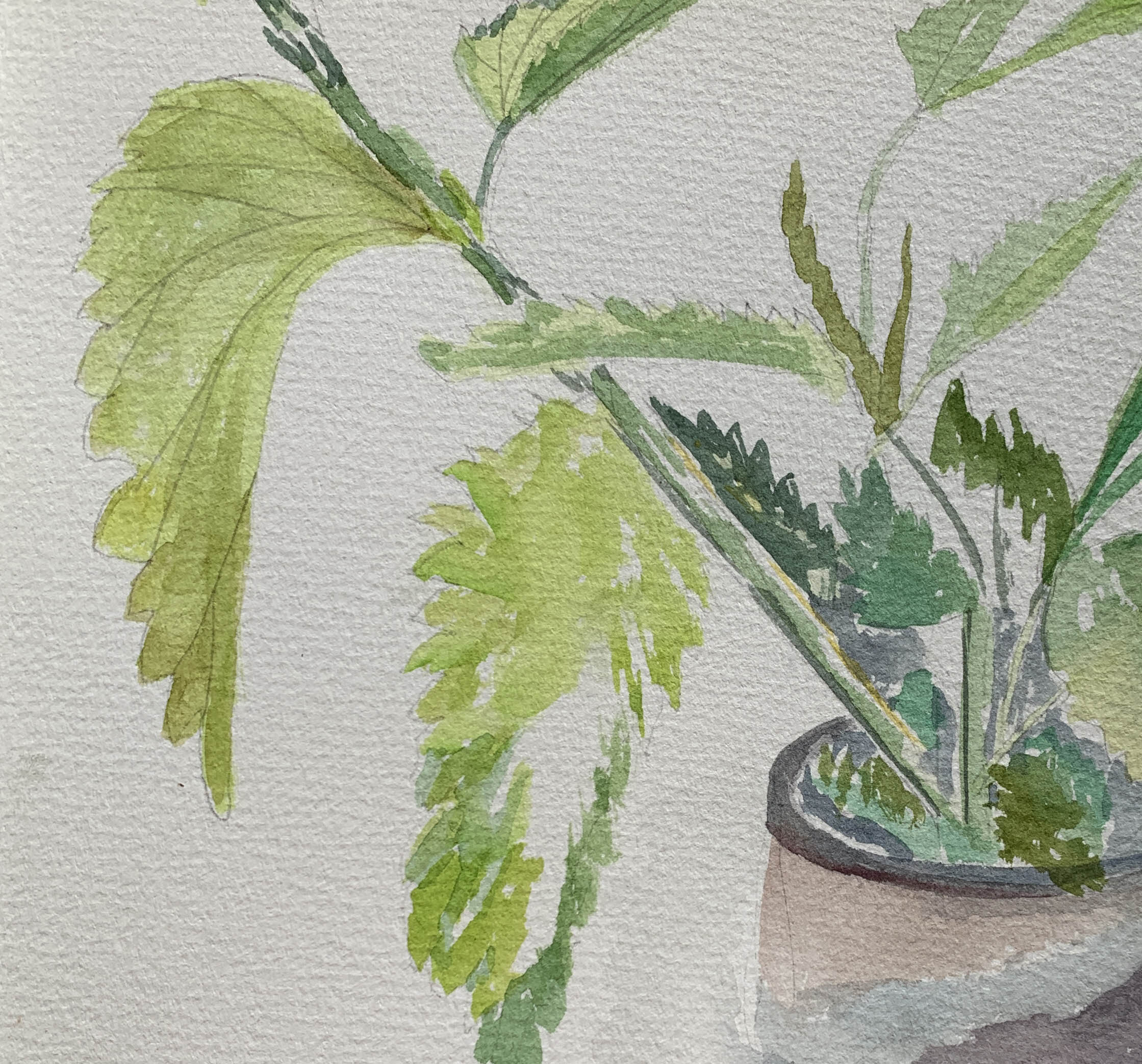
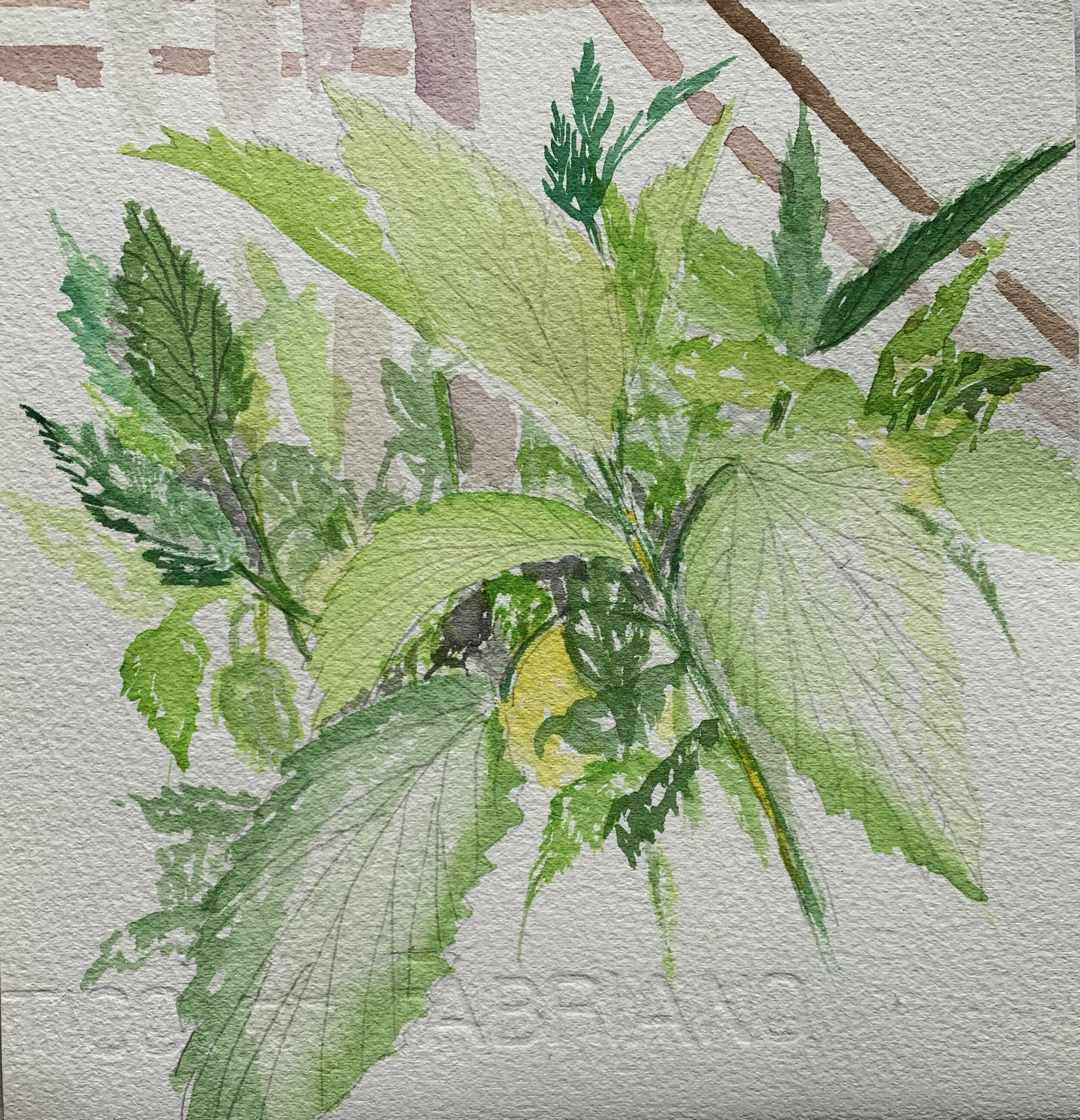
Arrangement with Nettles, watercolor, LH 2020
And, of course, what’s good for me is good for the orchard. Part of being a good orchardist is learning how to take care of the trees with kindness. In late spring, when I want to boost the trees’ immune systems and help provide an extra boost of minerals, I turn towards nettles. When the plants are about eighteen inches tall, I cut a wheelbarrow-full, enough to fill a 50-gallon barrel. Then I add water and let the nettles sit for a few days. Sometimes, I add comfrey leaves for added minerals, horsetail for its silica, and garlicscapes, if I feel the trees need insect protection. After a few hot days, I drain out the liquid and fill my 300-gallon sprayer. The gooey remains of the nettle plants go onto the compost pile, and I set out for my tractor tour of the orchard pulling the airblast sprayer with its peacock’s tail of spray fanning out to touch every leaf.
Nettles reduce heavy metals in soils, in fact I remember hearing that if you plant a rusty agricultural tool, it will attract nettles to grow there. Mostly I find nettles pop up where they choose. At the farm, they don’t seem to care whether it’s a dry berm in full sun, against the peeling paint of the old chicken coop, or in the dappled light of the streambed. When Nettles have finished what they came to do, they pack up and move on. Wild plants are like that.
Now is the season to gather and cook young nettles (they will regrow for fall harvesting.) Try steaming them and adding a little lemon juice and olive oil, and some parmesan or other favorite cheese. Or sauté them with onions or shallots, add some garlic powder, and a bit of cream. For nettle pesto, most people suggest you boil the nettles and dry them with a towel. Then fill your food processor with the nettles, walnuts, pecans or other nut, lemon juice, salt, a couple of peeled garlic cloves, and some hard cheese like asiago or parmesan. Once it becomes the consistency of a paste dribble in olive oil till it is smooth and the consistency you’d like. If you make a lot, freeze some for the middle of next winter to serve over fresh linguine and bring spring back into your life. Don’t be alarmed: nettle pesto is iridescent green.
In midsummer, I cut some of the tall nettles, tie them bundles, and hang them in my studio. Once they are dry, I take a cardboard box or large paper bag, and with gloves on, run my hands along the stem to remove the leaves. The dry leaves can be stored whole, but I put them all through the food processor and store them in a couple of gallon jars. We sell small packs of dried nettles at the farm stand along with bags of freshly picked.
Out of the soil of friendliness grows the beautiful bloom of compassion,
Watered by the tears of joy,
Sheltered beneath the cool shade of the tree of equanimity.
—Longchenpa, 14th century Tibetan Buddhist teacher
Nettles are a curious teacher. They sting! But when we appreciate them, we receive nothing but gifts.
Happy Mother’s Day!

Nettle Bouquet, watercolor and pencil, LH 2020
Simple Pleasures
“I nurture simplicity among the gardens and fields”
—Chinese farmer and poet, T’ao Chien, 365-427 C.E.
These days, many of us have no choice but to bring simplicity into our lives. Many of our favorite activities have been taken away whether this means no gym workouts, no visiting with friends and family, or no shopping at a favorite store. We scrounge through the pantry shelves for something to cook, making do with what is on hand. Or go outside like I did the other night to gather parsley and a bit of coriander that overwintered, new shoots of spearmint, and a large bowl of stinging nettles, to add to some sad looking basil leaves in the back of the fridge. The greens, smushed into the Cuisinart, along with oil, garlic, lemon juice, and pecans made a hearty pesto. Our creative meals can bring us great delight.
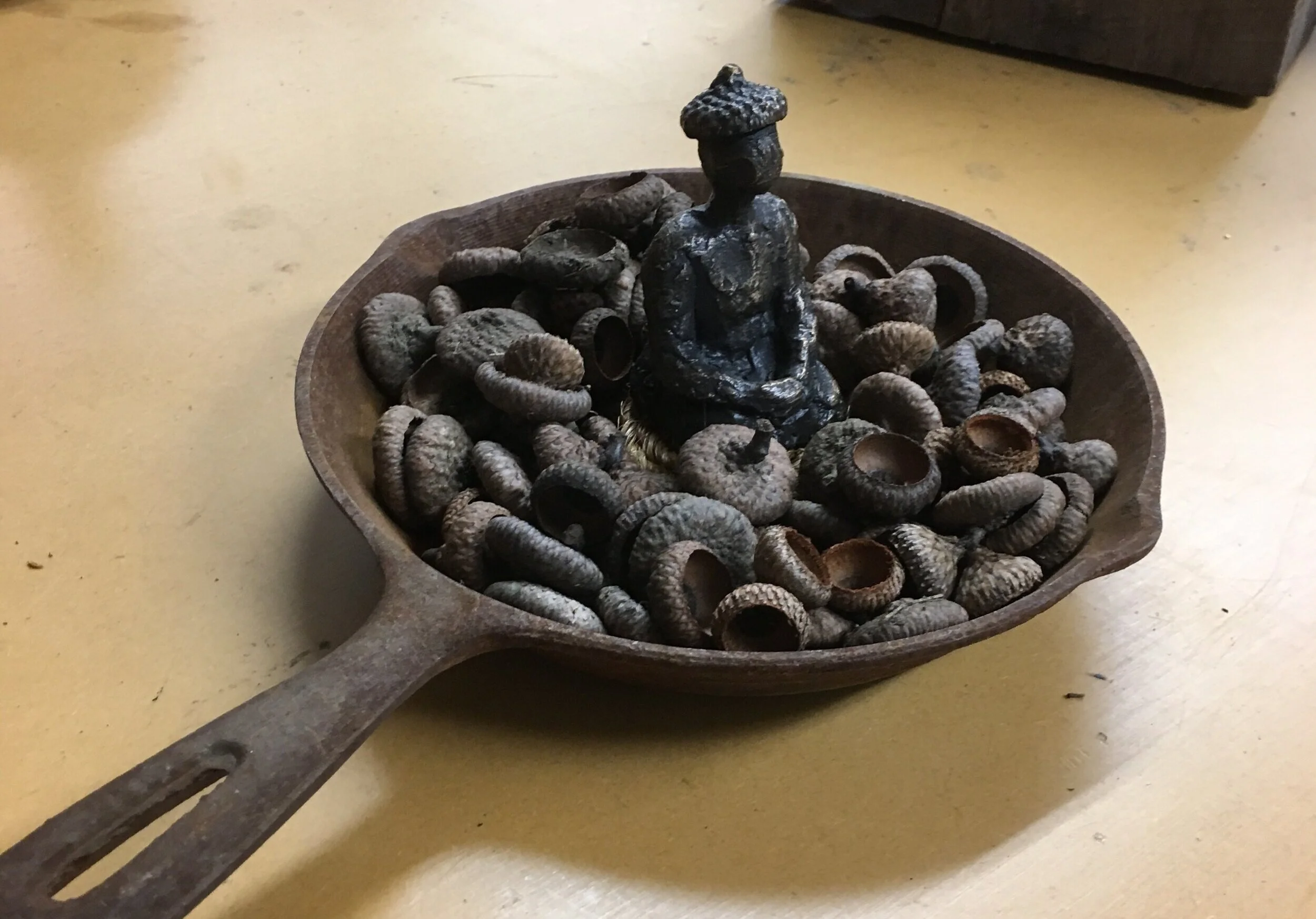
Simplicity can also mean living more intentionally, with more discipline and purpose. It can be unburdening our lives as well as decluttering our minds. Usually our minds flit from one thought to the next, from one sensation to another, moving quickly and erratically, but there is the silence when all distractions and desires fade. In many spiritual traditions, one sits in meditation to calm thoughts in order to experience deep silence. Sitting still, not moving, is the aid to find the stability of simplicity that allows for an opening to that great Silence.
For me, the concentration required by sculpting, painting, and writing creates the fertile ground for merging with the work, and within that merging, I find stillness. A musical score gives structure to mark periods of sounds and rests. The German-born pianist, Artur Schnabel (1882–1951) wrote,
“The notes I handle no better than many pianists. But the pauses between the notes—ah, that is where the art resides.”
The great jazz musician Miles Davis said it this way:
“Don’t play what’s there; play what’s not there.”
Lao Tzu, the Chinese sage advises, “Become empty of yourself and realize inner silence.” It sounds straightforward, but who knows how to empty themselves. I can’t sit myself down on a meditation cushion and say, I’m going to find silence: I only find myself in the midst of a great amount of activity. That’s why cultivating the earth always feels like cheating, the back door: the simple act of weeding as the antidote for the anxiety of our present times. But even weeding can be a challenge. I was talking to a friend yesterday and said,
“You know, weeding is not always that easy. It’s not just pulling the long white weed thread. Some weeds like vetch are impossible, impenetrable. It’s exhausting to dig through their density of roots. And when it’s that difficult, there’s no quieting the mind.”
Meister Eckhart, the Christian contemplative wrote,
“It’s not what we do that makes us holy, but we should make holy what we do.”
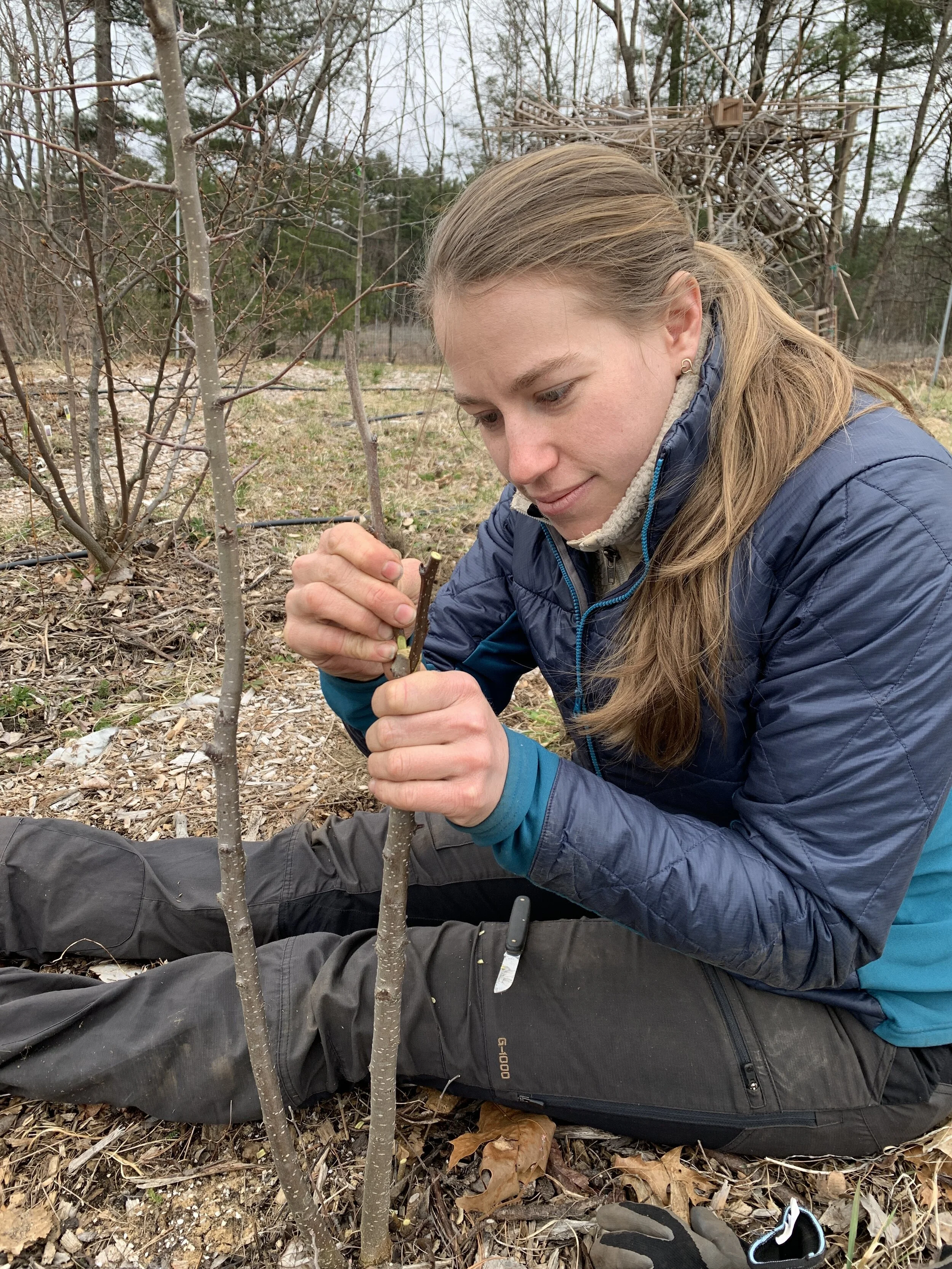
Ariel, grafting Olympic Asian pear scion wood onto rootstock in the Asian pear orchard.
So I return to the words of T’ao Chien: “I nurture simplicity among the gardens and fields.” I remind myself that he is surely weeding the gardens and plowing the fields, and he is nurturing simplicity. When I only concern myself with getting the work finished, checked off the to-do list, I take no pleasure in it. When I forget the to-do list, then the merging that I so love takes place. We can make holy everything we do. We can nurture simplicity everywhere.
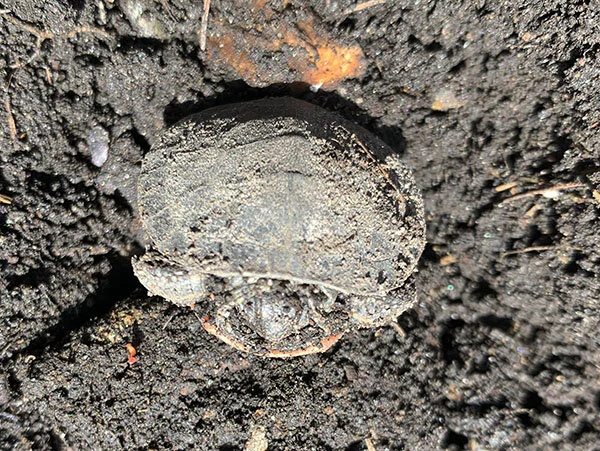
Baby snapper turtle Ariel found when we were moving a pear tree to plant new peaches. The turtle stretched and then we quickly dug it back into the soil.
Search Blog
-
2025
- May 9, 2025 A View from the Tractor Seat
- Apr 11, 2025 Dig
-
2024
- Jan 7, 2024 Winter Wassail
-
2022
- Dec 11, 2022 Keeping Time
- Jun 17, 2022 This Apple-Shaped Earth
- Jan 23, 2022 What is a Jizo?
- Jan 16, 2022 An Invite and Housekeeping Update
- Jan 1, 2022 The Year of the Frog: What Orchardists Do While Apple Trees are Chilling
-
2021
- Oct 24, 2021 Figs
- Oct 3, 2021 The Artist and the Orchard: A Memoir
- Aug 8, 2021 Red-Fleshed Apples
- Jul 25, 2021 When We Were Trees
- Jun 27, 2021 Castor Beans—Who Knew?
- Jun 13, 2021 Spring Training at a Zen Monastery
- May 4, 2021 Our Trees are in Bloom
- Apr 18, 2021 Hooray!
- Jan 24, 2021 Wassailing, virtually!
- Jan 1, 2021 Sitting
-
2020
- Dec 21, 2020 Darkness to Light
- Nov 28, 2020 One Heart
- Sep 18, 2020 Juggling Flowers, Fruit, and Vegetables
- Aug 23, 2020 Refuge
- Aug 9, 2020 Bags of Fertilizer
- Aug 2, 2020 The Sermon of the Blue Heron
- Jul 26, 2020 What's the Buzz?
- Jul 19, 2020 Farm Moments
- Jul 12, 2020 Lost Wax
- Jul 5, 2020 Catalpa: The Hugging Tree
- Jun 28, 2020 Pedaling Peace
- Jun 21, 2020 See Change
- Jun 14, 2020 Lalla Unveiled
- Jun 7, 2020 Pond Alchemy
- May 31, 2020 The Birth of Fruit
- May 24, 2020 An Artist in the Orchard
- May 17, 2020 Walking the Land: Returning Home
- May 10, 2020 Stinging Nettles: Gifts from the Great Mother
- May 3, 2020 The Mystery of Swallow
- Apr 26, 2020 Aerial Bruststrokes
- Apr 19, 2020 Simple Pleasures
- Apr 12, 2020 Weeds and Other Gifts
- Apr 5, 2020 Remembering the Seeds
- Mar 29, 2020 Blow on the Embers
- Mar 22, 2020 Ripples
-
2019
- Nov 16, 2019 Tibet Impressions
- Nov 9, 2019 Forest Tales
- Oct 13, 2019 The Gift
- Aug 4, 2019 The Season is Apples, Berries, and Grandfather Fire
- Jun 8, 2019 Pointers for a Writing Life
- May 12, 2019 Mothers of the Earth
- Apr 6, 2019 The Apple-Shaped Earth
- Mar 23, 2019 You Don’t Know What You Have Till It’s Gone
- Feb 23, 2019 Generations
- Feb 9, 2019 What Are We Doing to the Earth, John Chapman?
-
2018
- Dec 31, 2018 Long Shadows
- Oct 6, 2018 A Pilgrimage to India
- Aug 18, 2018 Scrap Wrenn
- Aug 11, 2018 Off-the-Wall Comments from an Ignorant Farmer
- Jul 28, 2018 Creative Connect
- Jul 14, 2018 How is the Orchard?
- Jun 30, 2018 Which Way?
- Jun 16, 2018 Geese, Herons, Beavers, and the Baby Steps of a Lapsed Blogger
- Feb 24, 2018 Mama's Coupons — Good Forever
- Jan 27, 2018 January Ice
- Jan 13, 2018 The Muse
-
2017
- Dec 30, 2017 A Dream for the New Year
- Dec 23, 2017 A New Year for Apples
- Dec 16, 2017 Intuition
- Nov 22, 2017 Thanksgiving OM
- Nov 4, 2017 East Fork Pottery
- Oct 28, 2017 Putting Down New Roots
- Oct 21, 2017 A is for Art
- Oct 14, 2017 Eve domesticus
- Oct 7, 2017 A String Workshop
- Sep 30, 2017 After Applepicking
- Sep 23, 2017 Two Bad Women and One Good Apple
- Sep 16, 2017 Plein Air Poetry
- Sep 9, 2017 Cutting Off a Leg
- Sep 2, 2017 The Changing Landscape
- Aug 26, 2017 All About Art
- Aug 19, 2017 My First Visit to the Farm
- Aug 12, 2017 The First Food
- Aug 5, 2017 A Teapot, a Woman, and maybe a Boat
- Jul 29, 2017 A Raspberry Dilemma
- Jul 22, 2017 Consider the Miracle
- Jul 15, 2017 Meeting Ekphrasis
- Jul 8, 2017 Ripening Fruit
- Jul 1, 2017 The Voice of The Caterpillar
- Jun 24, 2017 Goumi — An Unusual Fructus
- Jun 17, 2017 Concord, an American Bloomsbury
- Jun 10, 2017 The World Is Bonkers — Shall I Laugh or Cry?
- Jun 3, 2017 Bonkers, a Revolutionary Apple
- May 27, 2017 Guardians of the Swamp
- May 20, 2017 There are Mushrooms and There are Morels
- May 13, 2017 "What's in a Name?"
- May 6, 2017 Bloom Follows Pink: Orchard Pollination
- Apr 29, 2017 The Orchard Is at Pink
- Apr 22, 2017 Natural Farming — Part 2 (continuation from last Sunday's blog)
- Apr 15, 2017 Natural Farming — Part 1
- Apr 8, 2017 Boats, Figures, and Catching Fish
- Apr 1, 2017 A Man with a Mission: The Nuts and Bolts of Bronze Casting
- Mar 25, 2017 A Chalice of Spirit, Art, and Nature
- Mar 18, 2017 Hanami — Blossom Viewing
- Mar 11, 2017 Soil Redemption Song
- Mar 4, 2017 Food is Primary Care
- Feb 25, 2017 Pomme de Terre
- Feb 18, 2017 Organic Certification
- Feb 11, 2017 Tantalizing Fruit
- Feb 4, 2017 The Myths of History
- Jan 28, 2017 The Orchard in Winter
- Jan 21, 2017 The Hi-Line
- Jan 14, 2017 Artistic, Botanical, and Social Diversity
- Jan 7, 2017 Where is Eden?
-
2016
- Dec 31, 2016 The Creative Heart
- Dec 24, 2016 A Christmas Tale
- Dec 17, 2016 Who are the Crones?
- Dec 10, 2016 The Olympic Bell (Part Two)
- Dec 3, 2016 Overheard in the Apple Orchard in Early December
- Nov 26, 2016 The Lessons of a Tortoise
- Nov 19, 2016 In the Studio
- Nov 12, 2016 Even in Darkness
- Nov 5, 2016 Southern Apples, an Elephant, Monkey, Rabbit, and Bird, Two Mango Trees and a Birthday
- Oct 29, 2016 The Tools of Art
- Oct 22, 2016 Labyrinths
- Oct 15, 2016 Repairing the Broken
- Oct 8, 2016 When You Are No More
- Oct 1, 2016 Creation Rain
- Sep 24, 2016 Breaking the Glass
- Sep 17, 2016 String Art
- Sep 10, 2016 Poetry and Photosynthesis: It's all in the Leaves
- Sep 3, 2016 In the Plenty of Time
- Aug 27, 2016 Witch Doctors
- Aug 20, 2016 Listen Coyote
- Aug 13, 2016 Milkweed in the Orchard
- Aug 6, 2016 Some People See a Turtle
- Jul 30, 2016 Arborshaping
- Jul 23, 2016 Joseph Wheelwright: Sculptor of Stones and Trees
- Jul 16, 2016 Asian Pears
- Jul 9, 2016 Gold Leaf, Grief, and the Creative Process
- Jul 2, 2016 The Olympic Bell (Part One)
- Jun 25, 2016 Around the Mulberry Bush
- Jun 18, 2016 Avoiding Apples
- Jun 11, 2016 Fructus
- Jun 4, 2016 Astonishing Apples
- May 28, 2016 Scare the Caterpillars
- May 21, 2016 Join the Club!
- May 14, 2016 The Graft
- May 7, 2016 Rooster, Rhubarb, Rue
- Apr 30, 2016 What do Dolphins and Nettles Have in Common?
- Apr 23, 2016 Art Prunings
- Apr 16, 2016 A Few of the First Arrivals
- Apr 9, 2016 Taste the Spirit of Sustainable Agriculture
- Apr 2, 2016 First Orchard Spray - March 22-24, 2016
- Mar 26, 2016 Hawkeye Apple
- Mar 19, 2016 Desiring the Almata Apple
- Mar 12, 2016 Ugly Fruit
- Mar 5, 2016 Winter Tracks
- Feb 27, 2016 Splash
- Feb 20, 2016 Pruning
- Feb 13, 2016 Orchard Ruminants
- Feb 6, 2016 A Gathering of Seeds
- Jan 30, 2016 Orchard Dragons
- Jan 23, 2016 Tree Rings
- Jan 17, 2016 The Fallen Tree
- Jan 7, 2016 Wassailing the Apple Trees
- Jan 1, 2016 The New Year