LINDA HOFFMAN
The Birth of Fruit
May we spread the seeds of true justice across our nation.
May we water them with our grief, and tend them with great love.
Spring’s robe swishes as she walks through the rows of apple trees, the small fruit now covered with white clay to protect it from the egg-laying stings of the plum curculio beetle.

On the high-bush blueberries, the white bell-like corollas dry, then fall, exposing small green fruit.

The mulberries pop out from smooth branches like furry caterpillars,

and the husks of the peaches fall to the ground revealing first fuzz.

Fruits are ovaries, designed to protect the all important seeds. Peppers, tomatoes, as well as squash are technically fruits, but we think of them as vegetables. Asparagus aren’t fruits, but because they are a perennial crop, we give them two long rows in the berry patch. The stalks shoot up overnight.

Rhubarb is technically a vegetable, but it’s most often cooked in pies or with sugar to sweeten its tart taste, and therefore, is often thought to be a fruit. Our favorite recipe for rhubarb is stewed with strawberries and a bit of honey or maple syrup.

Not far away, the blackberry buds entice as if there weren’t hiding sharp thorns.

Blackberries ripen well before the red raspberries whose canes are mowed to the ground in early spring. Fall raspberries grow four to five feet high, bud, flower, and bear fruit all in one season.

Seedless table grapes are a new crop for the farm, the vines are only beginning their long climb to maturity.

Finally, spring embraces summer, and the strawberry ripening begins.

Photos: Linda Hoffman and Ariel Matisse
An Artist in the Orchard
Usually I carry a spade, loppers, clippers, a weeding tool, a basket with rubber ties, and wire into the orchard. But like a plein air painter who leaves the studio and brings paints and brushes to the subject, I bring a notebook and pen, and sit in a patch of purple violets under a Golden Delicious apple tree.

Along with the violets, two varieties of clover are growing—mammoth red and white Dutch. I love clover under my apple trees—and daffodils and dandelions, mountain mint and comfrey, iron weed, valerian, St. John’s wort, bee balm, even stinging nettles. The more companion plants, the richer the soil.

Notebook page 5/16/20
Most people don’t realize that one apple bud opens to become a cluster of five or six flower buds. The king blossom is in the center; it’s the first to grow and the first to open. It’s surrounded by the harem waiting to take over if anything should happen to the king.
In a stellar pollination year, most of the secondary blossoms will be pollinated and the tree becomes a cloud of delicate wings. The downside is too many children. The apples will be small, with more disease and pest pressure, and less air circulation and sunlight, not beneficial for the crop.
On this particular Golden Delicious tree, I see only a few blossoms. Golden Delicious have a propensity to be biennial—a riot of blossoms one year, and the next only a scattering. Orchardists can control this tendency by “thinning” the trees, removing a portion of the young fruit. As an organic grower, I don’t have an array of chemical thinners to choose from, but I can hand thin. On our youngest trees, we pluck off all the blossoms, discouraging such precocious behavior; these trees need to focus on growth, not reproduction! On the younger trees, we remove some of the fruitlets, leaving a few inches between apples. But on the mature trees, when the fruit set is crazy-good, our feeble efforts to thin hardly make a difference. One tree alone could occupy an afternoon, and we don't have a month to devote to thinning. I leave the Golden Delicious to do as they are inclined. Other trees, like the newer varieties of Liberty and Honey Crisp, are bred to discourage this trait.
The upside of this off-year is all energy goes into growing large and shiny leaves—optimal photosynthesis. A time of repose, a sabbatical to recharge. As I sit in its shade, I think about what the tree offers other than fruit. Maybe nutritive support to other trees and to the soil around its roots? Maybe sequestering more carbon? Maybe that strange notion, self-care?
This Golden Delicious tree is over 45 years old, and some orchard experts say it should be replaced because it’s old and leaning too far south. But I’m enthralled by its wayward slant, its zig-zag desire to find equipoise. In the photo below you can see the young branch I’m training to become a new central leader if necessary.

Being both orchardist and artist is at times contradictory. Should I spray a particularly nasty, but approved organic material like lime sulfur to thin the Golden Delicious so they don’t fall into biennial production? After all, we have 28 mature Golden Delicious trees with no fruit, and that’s a lot of real estate in a small orchard. The truth is I appreciate the gnarly old trees and the young slender spindles, the trees with no apples and the trees loaded with fruit.
I finish taking notes and gather violets to put in a jar of olive oil for next fall when we will make salves and balms. A pair of cedar waxwings are courting in one of the Gala trees, and two orioles sing from high in a Summer Sweet. The woodchuck peeks out of a nearby hole, and upon seeing me, ducks back down. The geese hiss. On my walk back to the house, I snap off two fat purple asparagus no doubt planted by some robin scratching for worms near the trunk of a Cortland in the first row. Today I’m an artist in the orchard. Tomorrow I’ll return with other tools.

Apple Tree, Watercolor and Pencil, 2020, Linda Hoffman
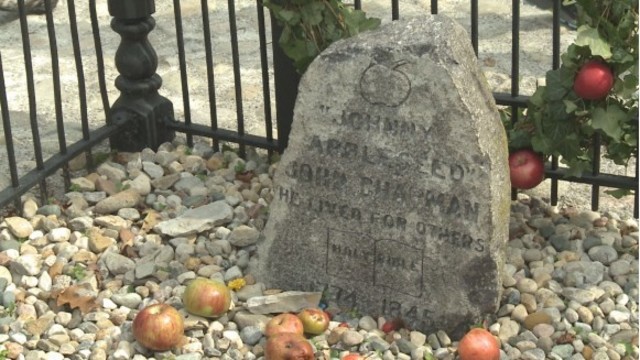
What Are We Doing to the Earth, John Chapman?
John Chapman (1774–1845) is familiar to most grade school students in the United States as Johnny Appleseed, the man who planted apple seeds. The irony is that John Chapman might have been sorely disappointed with this epitaph. John Chapman established nurseries of apple trees in Pennsylvania, Ohio, and as far west as Indiana, but these orchards were not his true raison d’etre. Selling apple trees for his livelihood gave him the possibility of travel where and when he wanted—and the freedom to practice and spread his religion of choice.
John followed the teachings of Emanuel Swedenborg (1688–1772), a Swedish mystic, scientist, and theologian who influenced Harriet Beecher Stowe and was praised by Ralph Waldo Emerson. Swedenborg believed we live in both the world of spirit and the material world, but that our eyes are often closed to the former. He was a Christian who formed a new religious movement, the Swedenborgian denomination, to advance the idea that God revealed himself in the world, in the earth, in all sentient life. Based on his own significant mystical experiences, he wrote that love is the “basic unit of reality.” He seemed determined to show people that there is more than what they see with their eyes and hear with their ears: There is a mystical world that everyone has access to.

Apple Bloom at Old Frog Pond Farm in 2017
John Chapman certainly seemed to want to have, or perhaps did have, his own mystical experiences—we will never know. But he did he carry the words of Swedenborg across the American frontier. Visiting homesteads, he would pull out his Bible and read passages with an ardor that calls to mind the approach of television evangelists today. Sometimes he would tear out a few pages and leave them, only to exchange them for new ones the next time he passed through. He was a vegetarian, wore no leather, and would never even cut down a tree.
Of course, on these journeys, he always had apple trees to sell. Fruit trees, often a requirement for anyone wanting to establish a land claim, provided the fruit to make applejack—hard cider—the drink of choice for the settlers at all three meals. From apple cider, settlers could make apple cider vinegar, a cleaning agent, as well as a preservative and medicinal drink. Even if the apples Chapman’s seedling produced were bitter and hard, ‘spitters’ I’ve heard them called, it didn’t matter, for they all mixed well in the grinder.
Chapman would travel into a new territory ahead of the homesteaders and establish a small nursery with seeds he picked up annually from a cider mill in Pennsylvania. He chose a protected spot near a river or stream, secured it with brambles, and traveled on. The following year he would return, dig up his one-year-old seedlings. Apple seedlings with the right conditions can grow five feet or more in a year.
My friend, Eric Schultz, who generously let me read his chapter on John Chapman in his book, Nation of Entrepreneurs, to be published by Greenleaf Publishing this fall wrote, “John Chapman was the oddest of evangelists, bringing gifts of heaven and alcohol in equal parts to the American frontier and running a business model that supported both.” There are not many followers of the Swedenborg religion today, but Chapman’s apples spread far and wide, and are certainly part of the proliferation of varieties of apples we now grow not only in America but all over the world. It’s interesting how one’s passion does not always create one’s legacy.
I think about John Chapman when I read that we have experienced the five warmest years in history. We will soon be planting Southern apples here in New England, for in not too many years, our older heirloom varieties will not have enough chill hours to produce buds. Much of this heating up of the earth is because of our selfishness and blindness to the interconnection of everything we do, build, use, and desire. Chapman was a minimalist, even during a time when there was not much to spare. His potato sack shirt had armholes cut for sleeves and probably did little to protect him from the elements, but apparently, he never complained. What would we think if we saw this man walking along our streets, barefoot with “horny” toes, wearing a tin can cap, bearded and hairy? We appreciate true iconoclasts often only after the person has died.
I came upon an interesting post, A Theology of Wild Apples, in the blog, American Orchard, Historical perspectives on food, farming and landscape.
Yet well-off travelers in the late 17th and throughout the 18th century frequently cast harsh moral judgments on the subsistence-minded farmer and his wild, disorderly orchards. And by the 1820s, many moralists found another reason to condemn the seedling orchard: most of its apples were destined to be converted to demon alcohol. Temperance societies called for the destruction of wild apple trees as an essential step toward sobering up the nation.
Chapman, born in 1774 in Leominster, Massachusetts, died in 1854 in Fort Wayne, Indiana. Fortunately, a few decades later, his younger compatriot, Henry David Thoreau, born in Concord in 1887, celebrated wilderness, wildness, and, thank goodness, wild apple trees, writing the long essay, Wild Apples, in celebration of them. There is room for both: the domesticated apple and the wild apple.
Which brings me to our orchard of ordered rows. Last Monday, we finished winter pruning, and now the twisting rhythms of branches play the ground between the trees. We pruned on those days of coldest cold stamping our feet to keep warm, and finished last Monday, a 50 degree day with honey bees out flying. Here’s to a bountiful year of apples, those planted by crow and deer, and the straight rows of nursery stock.

Pruned Row February, 2019
And to you, John Chapman, thank you! May we be inspired by your life to care more deeply for every apple, and to appreciate the miracle of every seed.
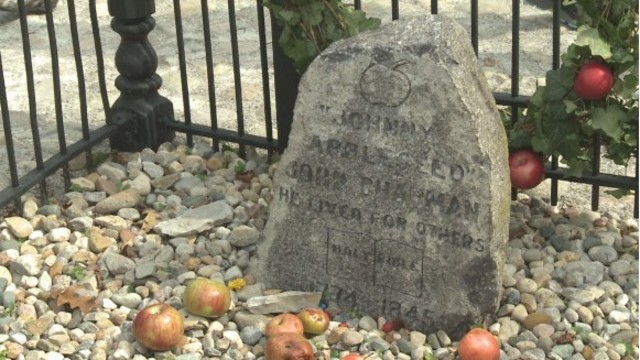
Goumi — An Unusual Fructus
A few days ago I had the pleasure of tasting my first farm-grown fructus of the season, goumi berries, a new fruit for the orchard. I knew the berries were ripe from their red-orange translucent color and the ease of release from the stem. Goumi berries have an astringent tartness with the first bite (I briefly wondered whether I should be eating them), but once through the skin, the inner flesh holds a citrusy sweetness. I lingered over the oblong seed, turning it in my mouth, and sanding off the last bit of fruit with my tongue before spitting it to the ground. Goumis remind me of mulberries, and I imagine, like mulberries, goumis would be delicious in pies, sauces, and jellies.
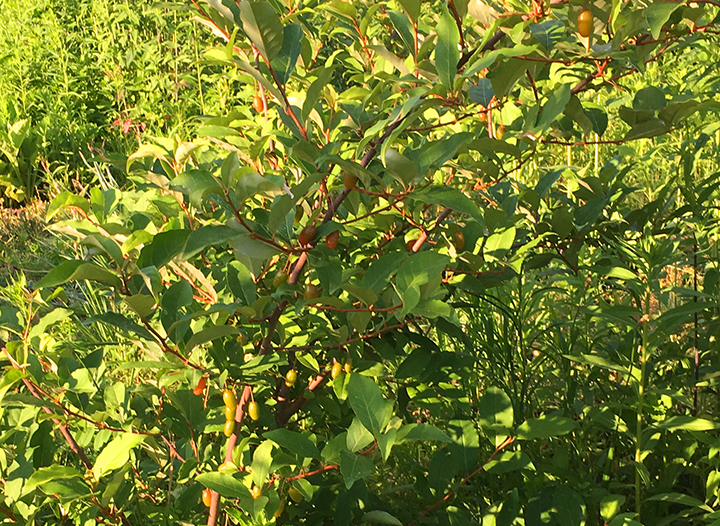
The goumi, Elaeagnus multiflora, comes from China. Its leaves are silvery below and glossy green above, similar to its sister plant, Elaeagnus umbellate, an invasive in America which grows up to twenty inches high and thirty inches wide, outcompeting native plants for sun and nutrients. Goumis have an Old World look that suggests they’ve been around a long time. No tender hybrid, but a strong matriarch who grows wide around the middle and rules her household.
I can attest that the plant grows on its own without much attention. The Asian pear orchard completely got away from me last year. When my daughter, Ariel, and I finally hacked our way through it last fall to liberate the young pear trees, the purple asters, bee balms, and other wildflowers were over six feet tall. (Some of you may recall the blog in which I described experimenting, once again, with creating a natural orchard.) By design, there is no access for the riding mower, and I didn’t get myself back there with a scythe or sickle. The goumis came through this neglect, strong as ever, growing three feet and flowering this spring with sweet scented delicate white blossoms for the first time. Many of the pears, on the other hand, suffered from so much competition — I promised them I would to do better this year.
I first heard about goumis though the permaculture world. Goumis are considered good companion plants for an orchard because they are nitrogen fixers. That is, like clover and vetch, they work with bacteria in the soil to make nitrogen accessible for themselves as well as nearby roots. I planted four goumi bushes in our Asian pear orchard with the hopes that the pears would then not need any additional outsourced nitrogen. Goumis are also touted for being an “insectory,” meaning they attract beneficial insects who might ward off orchard pests. Goumis make a hardy hedge and provide great bird watching early in the season. However, if you are hoping to harvest goumi fructus, you will need to cover them before the birds enjoy them all. Our English word fruit is derived from fructus, one of the verb forms of the Latin, fruor ("have the benefit of, use, enjoy"). Eating fructus we enjoy the miraculous bounty of nature
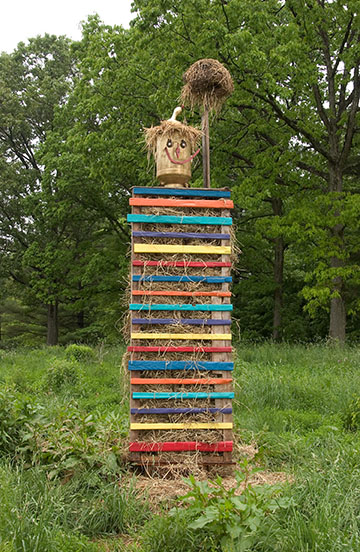
Sweet Hay the Clown, Sculpture LH
Search Blog
-
2025
- May 9, 2025 A View from the Tractor Seat
- Apr 11, 2025 Dig
-
2024
- Jan 7, 2024 Winter Wassail
-
2022
- Dec 11, 2022 Keeping Time
- Jun 17, 2022 This Apple-Shaped Earth
- Jan 23, 2022 What is a Jizo?
- Jan 16, 2022 An Invite and Housekeeping Update
- Jan 1, 2022 The Year of the Frog: What Orchardists Do While Apple Trees are Chilling
-
2021
- Oct 24, 2021 Figs
- Oct 3, 2021 The Artist and the Orchard: A Memoir
- Aug 8, 2021 Red-Fleshed Apples
- Jul 25, 2021 When We Were Trees
- Jun 27, 2021 Castor Beans—Who Knew?
- Jun 13, 2021 Spring Training at a Zen Monastery
- May 4, 2021 Our Trees are in Bloom
- Apr 18, 2021 Hooray!
- Jan 24, 2021 Wassailing, virtually!
- Jan 1, 2021 Sitting
-
2020
- Dec 21, 2020 Darkness to Light
- Nov 28, 2020 One Heart
- Sep 18, 2020 Juggling Flowers, Fruit, and Vegetables
- Aug 23, 2020 Refuge
- Aug 9, 2020 Bags of Fertilizer
- Aug 2, 2020 The Sermon of the Blue Heron
- Jul 26, 2020 What's the Buzz?
- Jul 19, 2020 Farm Moments
- Jul 12, 2020 Lost Wax
- Jul 5, 2020 Catalpa: The Hugging Tree
- Jun 28, 2020 Pedaling Peace
- Jun 21, 2020 See Change
- Jun 14, 2020 Lalla Unveiled
- Jun 7, 2020 Pond Alchemy
- May 31, 2020 The Birth of Fruit
- May 24, 2020 An Artist in the Orchard
- May 17, 2020 Walking the Land: Returning Home
- May 10, 2020 Stinging Nettles: Gifts from the Great Mother
- May 3, 2020 The Mystery of Swallow
- Apr 26, 2020 Aerial Bruststrokes
- Apr 19, 2020 Simple Pleasures
- Apr 12, 2020 Weeds and Other Gifts
- Apr 5, 2020 Remembering the Seeds
- Mar 29, 2020 Blow on the Embers
- Mar 22, 2020 Ripples
-
2019
- Nov 16, 2019 Tibet Impressions
- Nov 9, 2019 Forest Tales
- Oct 13, 2019 The Gift
- Aug 4, 2019 The Season is Apples, Berries, and Grandfather Fire
- Jun 8, 2019 Pointers for a Writing Life
- May 12, 2019 Mothers of the Earth
- Apr 6, 2019 The Apple-Shaped Earth
- Mar 23, 2019 You Don’t Know What You Have Till It’s Gone
- Feb 23, 2019 Generations
- Feb 9, 2019 What Are We Doing to the Earth, John Chapman?
-
2018
- Dec 31, 2018 Long Shadows
- Oct 6, 2018 A Pilgrimage to India
- Aug 18, 2018 Scrap Wrenn
- Aug 11, 2018 Off-the-Wall Comments from an Ignorant Farmer
- Jul 28, 2018 Creative Connect
- Jul 14, 2018 How is the Orchard?
- Jun 30, 2018 Which Way?
- Jun 16, 2018 Geese, Herons, Beavers, and the Baby Steps of a Lapsed Blogger
- Feb 24, 2018 Mama's Coupons — Good Forever
- Jan 27, 2018 January Ice
- Jan 13, 2018 The Muse
-
2017
- Dec 30, 2017 A Dream for the New Year
- Dec 23, 2017 A New Year for Apples
- Dec 16, 2017 Intuition
- Nov 22, 2017 Thanksgiving OM
- Nov 4, 2017 East Fork Pottery
- Oct 28, 2017 Putting Down New Roots
- Oct 21, 2017 A is for Art
- Oct 14, 2017 Eve domesticus
- Oct 7, 2017 A String Workshop
- Sep 30, 2017 After Applepicking
- Sep 23, 2017 Two Bad Women and One Good Apple
- Sep 16, 2017 Plein Air Poetry
- Sep 9, 2017 Cutting Off a Leg
- Sep 2, 2017 The Changing Landscape
- Aug 26, 2017 All About Art
- Aug 19, 2017 My First Visit to the Farm
- Aug 12, 2017 The First Food
- Aug 5, 2017 A Teapot, a Woman, and maybe a Boat
- Jul 29, 2017 A Raspberry Dilemma
- Jul 22, 2017 Consider the Miracle
- Jul 15, 2017 Meeting Ekphrasis
- Jul 8, 2017 Ripening Fruit
- Jul 1, 2017 The Voice of The Caterpillar
- Jun 24, 2017 Goumi — An Unusual Fructus
- Jun 17, 2017 Concord, an American Bloomsbury
- Jun 10, 2017 The World Is Bonkers — Shall I Laugh or Cry?
- Jun 3, 2017 Bonkers, a Revolutionary Apple
- May 27, 2017 Guardians of the Swamp
- May 20, 2017 There are Mushrooms and There are Morels
- May 13, 2017 "What's in a Name?"
- May 6, 2017 Bloom Follows Pink: Orchard Pollination
- Apr 29, 2017 The Orchard Is at Pink
- Apr 22, 2017 Natural Farming — Part 2 (continuation from last Sunday's blog)
- Apr 15, 2017 Natural Farming — Part 1
- Apr 8, 2017 Boats, Figures, and Catching Fish
- Apr 1, 2017 A Man with a Mission: The Nuts and Bolts of Bronze Casting
- Mar 25, 2017 A Chalice of Spirit, Art, and Nature
- Mar 18, 2017 Hanami — Blossom Viewing
- Mar 11, 2017 Soil Redemption Song
- Mar 4, 2017 Food is Primary Care
- Feb 25, 2017 Pomme de Terre
- Feb 18, 2017 Organic Certification
- Feb 11, 2017 Tantalizing Fruit
- Feb 4, 2017 The Myths of History
- Jan 28, 2017 The Orchard in Winter
- Jan 21, 2017 The Hi-Line
- Jan 14, 2017 Artistic, Botanical, and Social Diversity
- Jan 7, 2017 Where is Eden?
-
2016
- Dec 31, 2016 The Creative Heart
- Dec 24, 2016 A Christmas Tale
- Dec 17, 2016 Who are the Crones?
- Dec 10, 2016 The Olympic Bell (Part Two)
- Dec 3, 2016 Overheard in the Apple Orchard in Early December
- Nov 26, 2016 The Lessons of a Tortoise
- Nov 19, 2016 In the Studio
- Nov 12, 2016 Even in Darkness
- Nov 5, 2016 Southern Apples, an Elephant, Monkey, Rabbit, and Bird, Two Mango Trees and a Birthday
- Oct 29, 2016 The Tools of Art
- Oct 22, 2016 Labyrinths
- Oct 15, 2016 Repairing the Broken
- Oct 8, 2016 When You Are No More
- Oct 1, 2016 Creation Rain
- Sep 24, 2016 Breaking the Glass
- Sep 17, 2016 String Art
- Sep 10, 2016 Poetry and Photosynthesis: It's all in the Leaves
- Sep 3, 2016 In the Plenty of Time
- Aug 27, 2016 Witch Doctors
- Aug 20, 2016 Listen Coyote
- Aug 13, 2016 Milkweed in the Orchard
- Aug 6, 2016 Some People See a Turtle
- Jul 30, 2016 Arborshaping
- Jul 23, 2016 Joseph Wheelwright: Sculptor of Stones and Trees
- Jul 16, 2016 Asian Pears
- Jul 9, 2016 Gold Leaf, Grief, and the Creative Process
- Jul 2, 2016 The Olympic Bell (Part One)
- Jun 25, 2016 Around the Mulberry Bush
- Jun 18, 2016 Avoiding Apples
- Jun 11, 2016 Fructus
- Jun 4, 2016 Astonishing Apples
- May 28, 2016 Scare the Caterpillars
- May 21, 2016 Join the Club!
- May 14, 2016 The Graft
- May 7, 2016 Rooster, Rhubarb, Rue
- Apr 30, 2016 What do Dolphins and Nettles Have in Common?
- Apr 23, 2016 Art Prunings
- Apr 16, 2016 A Few of the First Arrivals
- Apr 9, 2016 Taste the Spirit of Sustainable Agriculture
- Apr 2, 2016 First Orchard Spray - March 22-24, 2016
- Mar 26, 2016 Hawkeye Apple
- Mar 19, 2016 Desiring the Almata Apple
- Mar 12, 2016 Ugly Fruit
- Mar 5, 2016 Winter Tracks
- Feb 27, 2016 Splash
- Feb 20, 2016 Pruning
- Feb 13, 2016 Orchard Ruminants
- Feb 6, 2016 A Gathering of Seeds
- Jan 30, 2016 Orchard Dragons
- Jan 23, 2016 Tree Rings
- Jan 17, 2016 The Fallen Tree
- Jan 7, 2016 Wassailing the Apple Trees
- Jan 1, 2016 The New Year