LINDA HOFFMAN
Food is Primary Care
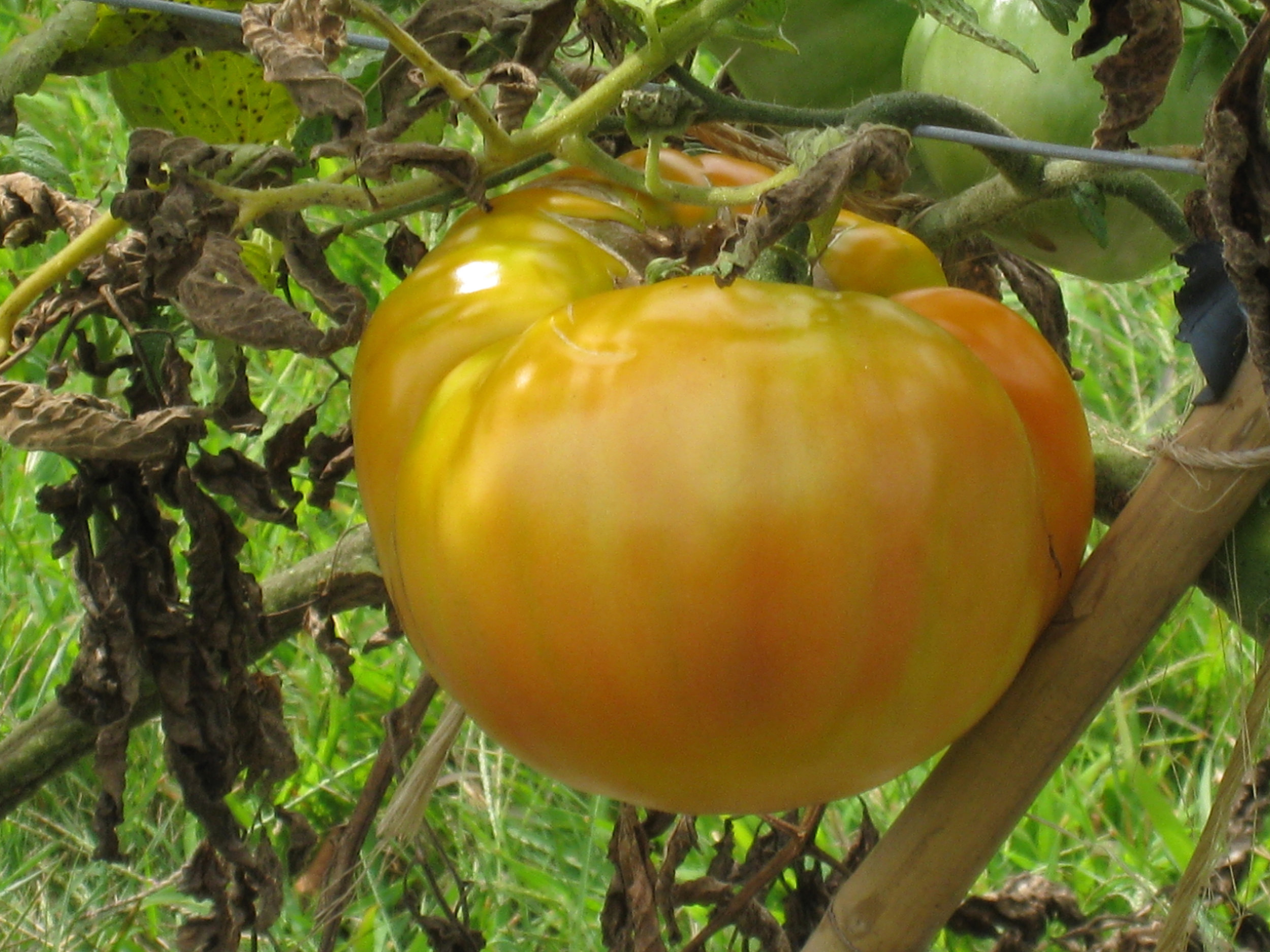
Sometimes I will buy a big peach, a bright red tomato, or even an apple only to be disappointed when I bite into a mealy peach, a watery tomato, and a tasteless apple. I don’t like to throw out food, so I often eat it anyway. But sometimes, it’s just so bad that I guiltily toss the entire beautiful glob into the compost pile, burying it under some faded tulips or tough cabbage leaves.
Nutritionists say that we’re not getting the nutrients our bodies need from our food. Considering the obesity epidemic and the debilitating diseases in America, it’s hard not to agree. Soil health, crop health, and human health are interrelated. Since the 1950s, however, crop yield has gone up, but nutritional value has gone down. The great monocultures of agricultural production have focused on yield, pest resistance, appearance, and shelf life; not taste or nutrition.
Many of our food systems provide food that is low on both flavor and nutrition — for example, food served in hospitals to those who are ill, people who need healthy food. Turkey with corn might sound appealing when ticked off the menu, but when it arrives the next day, it’s a different story. Pre-frozen turkey rounds and corn niblets grown with chemical pesticides and herbicides, not to mention jiggles of artificially dyed red and orange Jello for dessert, is neither appealing nor nutritious.
The good news is that Marydale Debor, founder of the organization Fresh Advantage (their wonderful tagline is Food is Primary Care), works to put fresh and nutritious food back into hospitals, schools, and other institutions. It’s not easy – the old guard must be removed and new chefs who want to buy and cook with local ingredients need to be hired. Debor knows that buying food from a small local farm is the best way to get tasty and nutritious food.
A healthy diet contains a diversity of foods, but how to encourage diverse and nourishing meals when much of our food no longer has taste — especially when junk food has so much flavor? I heard a presentation by Mark Schatzker, author of The Dorito Effect: The Surprising New Truth about Food and Flavor. He explained that not only have our foods lost their flavor, but food is now separate from taste. He gave the example of the Frito-Lay Company that makes Dorito chips. In that product, for the first time, taste was manufactured; and flavor was added separately such that taste had no relation to the product’s food ingredients. Frito-Lay, Inc. (a subsidiary of PepsiCo) perfected the taste of their chip to be appealing to a wide group of people. This original manufactured taste opened the door to all kinds of manufactured food, in particular, the enormous category of junk food.
Humans can have associations with food taste from childhood like the sweetness of mother’s milk. If a manufactured food is high is corn fructose, it will satisfy this associative sugar craving, but, and here’s the catch, it will not satisfy the belly’s nutritive need because it’s only flavor. We don’t stop eating, because the craving doesn’t go away. We are caught like Tantalus reaching for the apples that are forever out of reach.
I love potato chips and eat more than I like to admit. But if that peach I had grabbed was warm, sweet, and juicy, or there was a basket of cherry tomatoes on the kitchen counter, I would eat a bellyful, be sated, and nutritionally fed. Healthy food needs to be the norm for people everywhere. Everyone should have access to nourishing and delicious food at a price that is affordable.
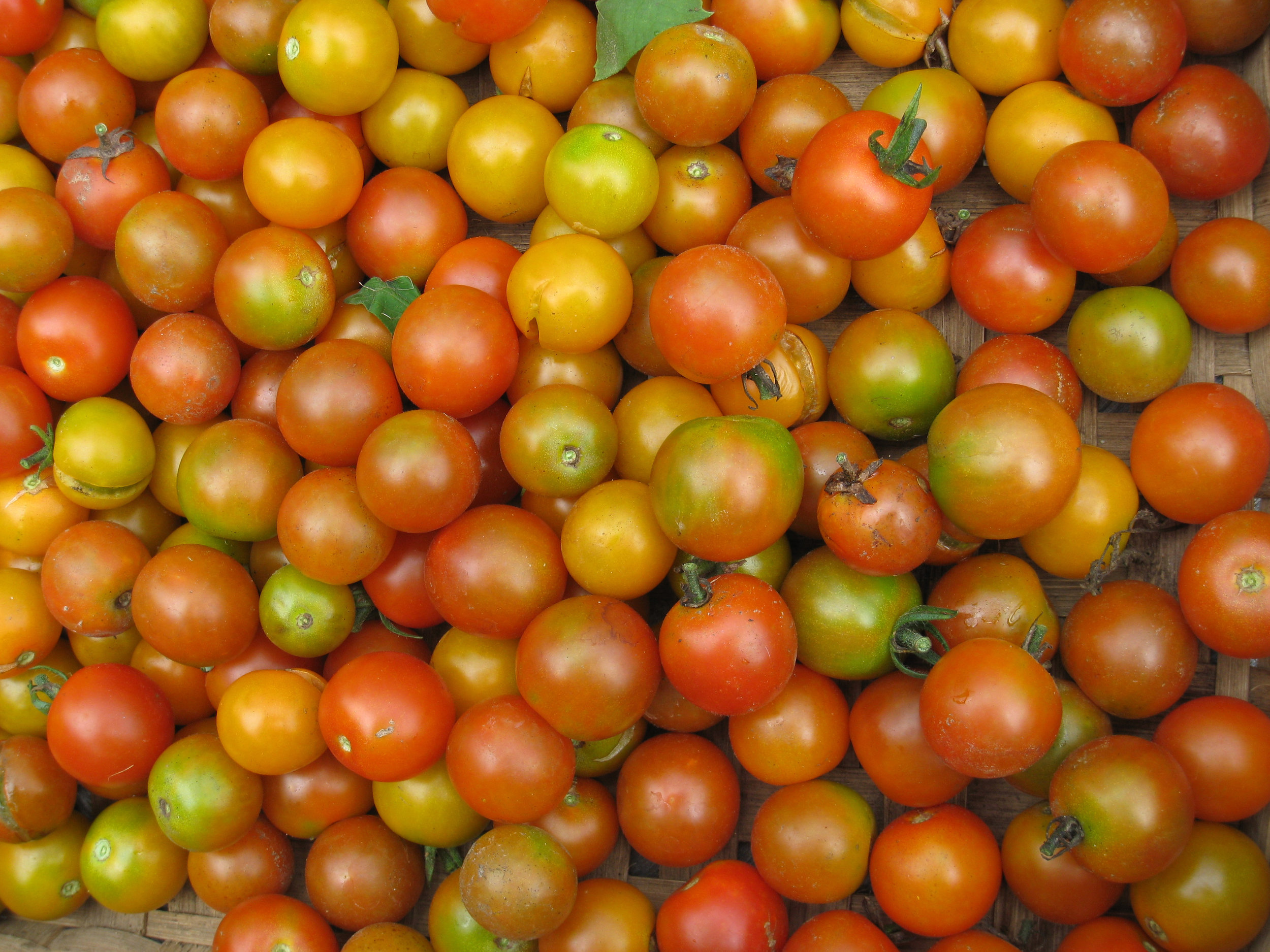
A Late Harvest of Cherry Tomatoes from Old Frog Pond Farm
Some people believe that our bodies can sense food grown with love and compassion; it feeds the spirit as well as the body, and sadly the opposite is also true. Food made by an angry cook can make a food unappealing or even repellent. ‘Food is primary care’ — and real food inspires wonderful poetry!
Ode to The Tomato
by Pablo Neruda
The street
filled with tomatoes,
midday,
summer,
light is
halved
like
a
tomato,
its juice
runs
through the streets.
In December,
unabated,
the tomato
invades
the kitchen,
it enters at lunchtime,
takes
its ease
on countertops,
among glasses,
butter dishes,
blue saltcellars.
It sheds
its own light,
benign majesty.
Unfortunately,
we must murder it:
the knife
sinks
into living flesh,
red
viscera
a cool
sun,
profound,
inexhaustible,
populates the salads
of Chile,
happily, it is wed
to the clear onion,
and to celebrate the union
we
pour
oil,
essential
child of the olive,
onto its halved hemispheres,
pepper
adds
its fragrance,
salt, its magnetism;
it is the wedding
of the day,
parsley
hoists
its flag,
potatoes
bubble vigorously,
the aroma
of the roast
knocks
at the door,
it's time!
come on!
and, on
the table, at the midpoint
of summer,
the tomato,
star of earth, recurrent
and fertile
star,
displays
its convolutions,
its canals,
its remarkable amplitude
and abundance,
no pit,
no husk,
no leaves or thorns,
the tomato offers
its gift
of fiery color
and cool completeness.
Repairing the Broken
“The world breaks everyone, then some become strong in the broken places.”
—Ernest Hemmingway
In the Japanese pottery world there is an old tradition, Kintsugi (golden joinery), of repairing a broken pot with gold. The pot might have been a prized tea ceremony bowl, revered with the eye and treasured with the hand. Instead of tossing the pot broken by some mishap into the rubbish pile, the pieces would be fitted back together and held by lacquer mixed with gold powder. Kintsugi became an art form. A newly repaired bowl with threads of gold has more appeal than the unbroken one.
Teabowl, Yamamoto Gempo (1866-1961) photo courtesy of Backmann Eckenstein Newsletter
Kintsugi is connected to the Japanese philosophy of wabi-sabi. Wabi might translate as loneliness or solitariness —the sight of a lone crow on a crooked branch or a plum blossom peeking through light snow. Sabi refers to objects that exude the well-worn, rustic patina of age. Wabi-sabi informs the aesthetics of the traditional Japanese arts. An object doesn’t need to be discarded because it is worn and old. On the contrary, we treasure it even more.
I lived in Japan in my early twenties, and I consider wabi-sabi to be a strong influence on my own aesthetics. I love using old tools, worn objects, and wood in my art. Wood, its knots, rings, and branch collars, carries the history of the life of the tree. Similarly, pottery carries its past; the clay was created in the earth hundreds of years ago. We have an intuitive attraction to that which is old and from the earth. We trust its wisdom. Without knowing about Kintsugi, when I made my first large-scale outdoor sculpture using tree logs from a hundred-year-old maple that fell in a winter storm, I gold leafed its sawn surfaces to highlight its beauty and give it new life.
The repairs of Kintsugi draw our attention to the impermanence of life. In fact, it is emphasized and celebrated. The repairs to the bowl add to its beauty. How is it that our culture wants to deny this reality? From blemish-free apples to wrinkle-free faces to the ideal relationship, we are directed to strive for perfection as if it was attainable and permanent.
In the third stanza of Jane Hirshfield’s poem, For What Binds Us, she writes:
And see how the flesh grows back
across a wound, with a great vehemence,
more strong
than the simple, untested surface before.
There's a name for it on horses,
when it comes back darker and raised: proud flesh,
I can recall as a child sitting with friends as we showed off our scars and shared our battle stories.
I have a tea mug I use every day. It’s one that my son, Alex, a potter and the founder of East Fork Pottery, made over ten years ago when he was a freshman at Guilford College. It’s the only piece of pottery that still exists from that time. At home, we keep all of our mugs on two open shelves in the kitchen. When my beloved Alex mug is on the shelf and a houseguest decides to choose a cup, they infallibly choose this one. There is little about it that would make you prefer it from among the two shelves of mugs. Yet there must be something that communicates, whether it is our intuitive attraction to the patina of age or the subtle power of something treasured. No one seems to be concerned with the hairline crack down the inside of it. I care for this mug tenderly.

Mug, Alex Matisse, fourth from right on bottom shelf
Eventually, my Alex mug will likely break. I will need to learn how to make a Kintsugi repair in preparation for that day.
The gold we need for each repair is available in many forms — a hot bowl of soup, a knitted scarf, a poem, acts of courage, love and compassion — we can see them all as gold threads we offer to heal this earth and each other.
Wassailing the Apple Trees
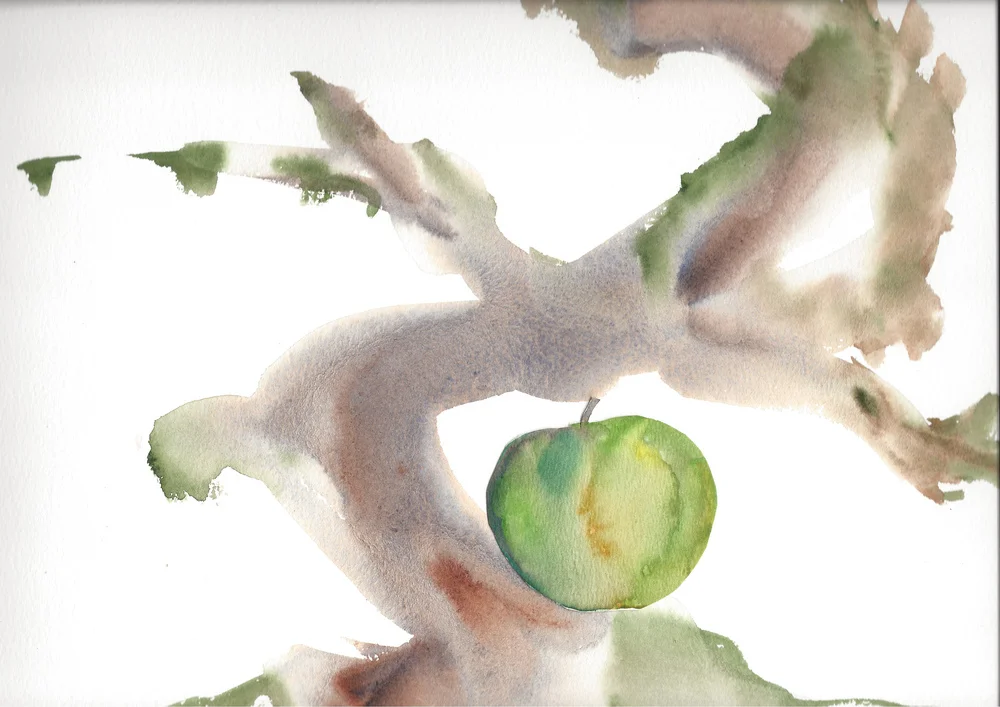
On Saturday afternoon we will be wassailing the apple trees in the orchard at Old Frog Pond Farm. We want to thank them for such good harvest in 2015 and encourage their fruiting for 2016. Wassailing is an old English Christmas tradition where farmers would visit the orchards with bowls of cider and gather around one of the largest trees. They would pour libations on the roots and hang bits of bread dipped in cider on the limbs for the robins, the good spirits who would protect the trees. The farmers would of course drink the cider too, and then circling around the tree they would sing
Here's to thee, old apple-tree,
Whence thou mayst bud, and whence thou mayst blow,
And whence thou mayst bear apples enow!
Hats-full! caps-full!
Bushel, bushel, sacks-full!
And my pockets full, too! Hurra!
Wassailing celebrates the gifts from the trees by returning a portion of what we have been given. The ritual acknowledges nature’s generosity and our dependence on her.

Bread and cider are the pagan sacraments for this orchard communion. Bread is food, a symbol for well-being, and physical sustenance. Cider quenches thirst — perhaps physical as well as spiritual. This golden juice is the sun, the rain, and the soil through the living tree.
Thoreau writes about wassailing in his essay, Wild Apples. He also mentions ‘apple howling’ where a group of boys would go out to the orchards and sing while knocking the trunks with sticks
Stand fast, root! bear well, top!
Pray God send us a good howling crop:
Every twig, apples big;
Every bough, apples enow!
This howling feels almost like a wake-up call, like the Zen masters’ use of the keisaku, the hitting stick to wake up their students and call them back to the reality of the present moment. “Don’t slumber too long, trees! We love you. We count on your fruit.”
For our Wassailing celebration at the farm, we’ll toast with our own hot mulled cider and listen to original poems written for the trees. We’ll sing and send out prayers that all creatures will have food, shelter, and bear fruit in 2016 — the microbial population in the soil, sea turtles and polar bears, all people everywhere. If you’d like to join us, bring a little bread for the birds, and we’ll meet at 3 pm in the orchard.
Search Blog
-
2025
- May 9, 2025 A View from the Tractor Seat
- Apr 11, 2025 Dig
-
2024
- Jan 7, 2024 Winter Wassail
-
2022
- Dec 11, 2022 Keeping Time
- Jun 17, 2022 This Apple-Shaped Earth
- Jan 23, 2022 What is a Jizo?
- Jan 16, 2022 An Invite and Housekeeping Update
- Jan 1, 2022 The Year of the Frog: What Orchardists Do While Apple Trees are Chilling
-
2021
- Oct 24, 2021 Figs
- Oct 3, 2021 The Artist and the Orchard: A Memoir
- Aug 8, 2021 Red-Fleshed Apples
- Jul 25, 2021 When We Were Trees
- Jun 27, 2021 Castor Beans—Who Knew?
- Jun 13, 2021 Spring Training at a Zen Monastery
- May 4, 2021 Our Trees are in Bloom
- Apr 18, 2021 Hooray!
- Jan 24, 2021 Wassailing, virtually!
- Jan 1, 2021 Sitting
-
2020
- Dec 21, 2020 Darkness to Light
- Nov 28, 2020 One Heart
- Sep 18, 2020 Juggling Flowers, Fruit, and Vegetables
- Aug 23, 2020 Refuge
- Aug 9, 2020 Bags of Fertilizer
- Aug 2, 2020 The Sermon of the Blue Heron
- Jul 26, 2020 What's the Buzz?
- Jul 19, 2020 Farm Moments
- Jul 12, 2020 Lost Wax
- Jul 5, 2020 Catalpa: The Hugging Tree
- Jun 28, 2020 Pedaling Peace
- Jun 21, 2020 See Change
- Jun 14, 2020 Lalla Unveiled
- Jun 7, 2020 Pond Alchemy
- May 31, 2020 The Birth of Fruit
- May 24, 2020 An Artist in the Orchard
- May 17, 2020 Walking the Land: Returning Home
- May 10, 2020 Stinging Nettles: Gifts from the Great Mother
- May 3, 2020 The Mystery of Swallow
- Apr 26, 2020 Aerial Bruststrokes
- Apr 19, 2020 Simple Pleasures
- Apr 12, 2020 Weeds and Other Gifts
- Apr 5, 2020 Remembering the Seeds
- Mar 29, 2020 Blow on the Embers
- Mar 22, 2020 Ripples
-
2019
- Nov 16, 2019 Tibet Impressions
- Nov 9, 2019 Forest Tales
- Oct 13, 2019 The Gift
- Aug 4, 2019 The Season is Apples, Berries, and Grandfather Fire
- Jun 8, 2019 Pointers for a Writing Life
- May 12, 2019 Mothers of the Earth
- Apr 6, 2019 The Apple-Shaped Earth
- Mar 23, 2019 You Don’t Know What You Have Till It’s Gone
- Feb 23, 2019 Generations
- Feb 9, 2019 What Are We Doing to the Earth, John Chapman?
-
2018
- Dec 31, 2018 Long Shadows
- Oct 6, 2018 A Pilgrimage to India
- Aug 18, 2018 Scrap Wrenn
- Aug 11, 2018 Off-the-Wall Comments from an Ignorant Farmer
- Jul 28, 2018 Creative Connect
- Jul 14, 2018 How is the Orchard?
- Jun 30, 2018 Which Way?
- Jun 16, 2018 Geese, Herons, Beavers, and the Baby Steps of a Lapsed Blogger
- Feb 24, 2018 Mama's Coupons — Good Forever
- Jan 27, 2018 January Ice
- Jan 13, 2018 The Muse
-
2017
- Dec 30, 2017 A Dream for the New Year
- Dec 23, 2017 A New Year for Apples
- Dec 16, 2017 Intuition
- Nov 22, 2017 Thanksgiving OM
- Nov 4, 2017 East Fork Pottery
- Oct 28, 2017 Putting Down New Roots
- Oct 21, 2017 A is for Art
- Oct 14, 2017 Eve domesticus
- Oct 7, 2017 A String Workshop
- Sep 30, 2017 After Applepicking
- Sep 23, 2017 Two Bad Women and One Good Apple
- Sep 16, 2017 Plein Air Poetry
- Sep 9, 2017 Cutting Off a Leg
- Sep 2, 2017 The Changing Landscape
- Aug 26, 2017 All About Art
- Aug 19, 2017 My First Visit to the Farm
- Aug 12, 2017 The First Food
- Aug 5, 2017 A Teapot, a Woman, and maybe a Boat
- Jul 29, 2017 A Raspberry Dilemma
- Jul 22, 2017 Consider the Miracle
- Jul 15, 2017 Meeting Ekphrasis
- Jul 8, 2017 Ripening Fruit
- Jul 1, 2017 The Voice of The Caterpillar
- Jun 24, 2017 Goumi — An Unusual Fructus
- Jun 17, 2017 Concord, an American Bloomsbury
- Jun 10, 2017 The World Is Bonkers — Shall I Laugh or Cry?
- Jun 3, 2017 Bonkers, a Revolutionary Apple
- May 27, 2017 Guardians of the Swamp
- May 20, 2017 There are Mushrooms and There are Morels
- May 13, 2017 "What's in a Name?"
- May 6, 2017 Bloom Follows Pink: Orchard Pollination
- Apr 29, 2017 The Orchard Is at Pink
- Apr 22, 2017 Natural Farming — Part 2 (continuation from last Sunday's blog)
- Apr 15, 2017 Natural Farming — Part 1
- Apr 8, 2017 Boats, Figures, and Catching Fish
- Apr 1, 2017 A Man with a Mission: The Nuts and Bolts of Bronze Casting
- Mar 25, 2017 A Chalice of Spirit, Art, and Nature
- Mar 18, 2017 Hanami — Blossom Viewing
- Mar 11, 2017 Soil Redemption Song
- Mar 4, 2017 Food is Primary Care
- Feb 25, 2017 Pomme de Terre
- Feb 18, 2017 Organic Certification
- Feb 11, 2017 Tantalizing Fruit
- Feb 4, 2017 The Myths of History
- Jan 28, 2017 The Orchard in Winter
- Jan 21, 2017 The Hi-Line
- Jan 14, 2017 Artistic, Botanical, and Social Diversity
- Jan 7, 2017 Where is Eden?
-
2016
- Dec 31, 2016 The Creative Heart
- Dec 24, 2016 A Christmas Tale
- Dec 17, 2016 Who are the Crones?
- Dec 10, 2016 The Olympic Bell (Part Two)
- Dec 3, 2016 Overheard in the Apple Orchard in Early December
- Nov 26, 2016 The Lessons of a Tortoise
- Nov 19, 2016 In the Studio
- Nov 12, 2016 Even in Darkness
- Nov 5, 2016 Southern Apples, an Elephant, Monkey, Rabbit, and Bird, Two Mango Trees and a Birthday
- Oct 29, 2016 The Tools of Art
- Oct 22, 2016 Labyrinths
- Oct 15, 2016 Repairing the Broken
- Oct 8, 2016 When You Are No More
- Oct 1, 2016 Creation Rain
- Sep 24, 2016 Breaking the Glass
- Sep 17, 2016 String Art
- Sep 10, 2016 Poetry and Photosynthesis: It's all in the Leaves
- Sep 3, 2016 In the Plenty of Time
- Aug 27, 2016 Witch Doctors
- Aug 20, 2016 Listen Coyote
- Aug 13, 2016 Milkweed in the Orchard
- Aug 6, 2016 Some People See a Turtle
- Jul 30, 2016 Arborshaping
- Jul 23, 2016 Joseph Wheelwright: Sculptor of Stones and Trees
- Jul 16, 2016 Asian Pears
- Jul 9, 2016 Gold Leaf, Grief, and the Creative Process
- Jul 2, 2016 The Olympic Bell (Part One)
- Jun 25, 2016 Around the Mulberry Bush
- Jun 18, 2016 Avoiding Apples
- Jun 11, 2016 Fructus
- Jun 4, 2016 Astonishing Apples
- May 28, 2016 Scare the Caterpillars
- May 21, 2016 Join the Club!
- May 14, 2016 The Graft
- May 7, 2016 Rooster, Rhubarb, Rue
- Apr 30, 2016 What do Dolphins and Nettles Have in Common?
- Apr 23, 2016 Art Prunings
- Apr 16, 2016 A Few of the First Arrivals
- Apr 9, 2016 Taste the Spirit of Sustainable Agriculture
- Apr 2, 2016 First Orchard Spray - March 22-24, 2016
- Mar 26, 2016 Hawkeye Apple
- Mar 19, 2016 Desiring the Almata Apple
- Mar 12, 2016 Ugly Fruit
- Mar 5, 2016 Winter Tracks
- Feb 27, 2016 Splash
- Feb 20, 2016 Pruning
- Feb 13, 2016 Orchard Ruminants
- Feb 6, 2016 A Gathering of Seeds
- Jan 30, 2016 Orchard Dragons
- Jan 23, 2016 Tree Rings
- Jan 17, 2016 The Fallen Tree
- Jan 7, 2016 Wassailing the Apple Trees
- Jan 1, 2016 The New Year