LINDA HOFFMAN
Lost Wax
It’s crazy how a nose from one direction can look perfectly fine, and viewed from 180 degrees, it’s too close to the eye. When I work on small wax figures, I turn them continuously around in my hands, making sure, for example, the left elbow doesn’t extend below the hip while I carve the right side of the torso. Working on a larger piece, I circle continuously; this partner dance assures everything works from all perspectives.

Refuge, 2020, in wax in my studio. The endangered sea turtle and giraffe are rescuing the humans.
Our planet faces a ferocious loss of habitat, fifty percent of the species on the earth have disappeared in the last forty to fifty years. We’re a destructive species causing the acidifying of the ocean, the loss of precious topsoil, and the poisoning of the very air we breathe. The animals haven’t caused this harm—we have. But I like to think, despite our recklessness and selfishness, they would choose to save us.
I delivered Refuge to the foundry in early January, needing to cut off the giraffe’s legs to fit in my car.

The turtle arrives at the foundry.
Not a problem for Zach Gabbard, owner and sole fabricator at Mission Foundry in Hyde Park. He will be taking it further apart—flippers, turtle shell, giraffe head, giraffe tail, turtle tail, and each individual person to make rubber molds.
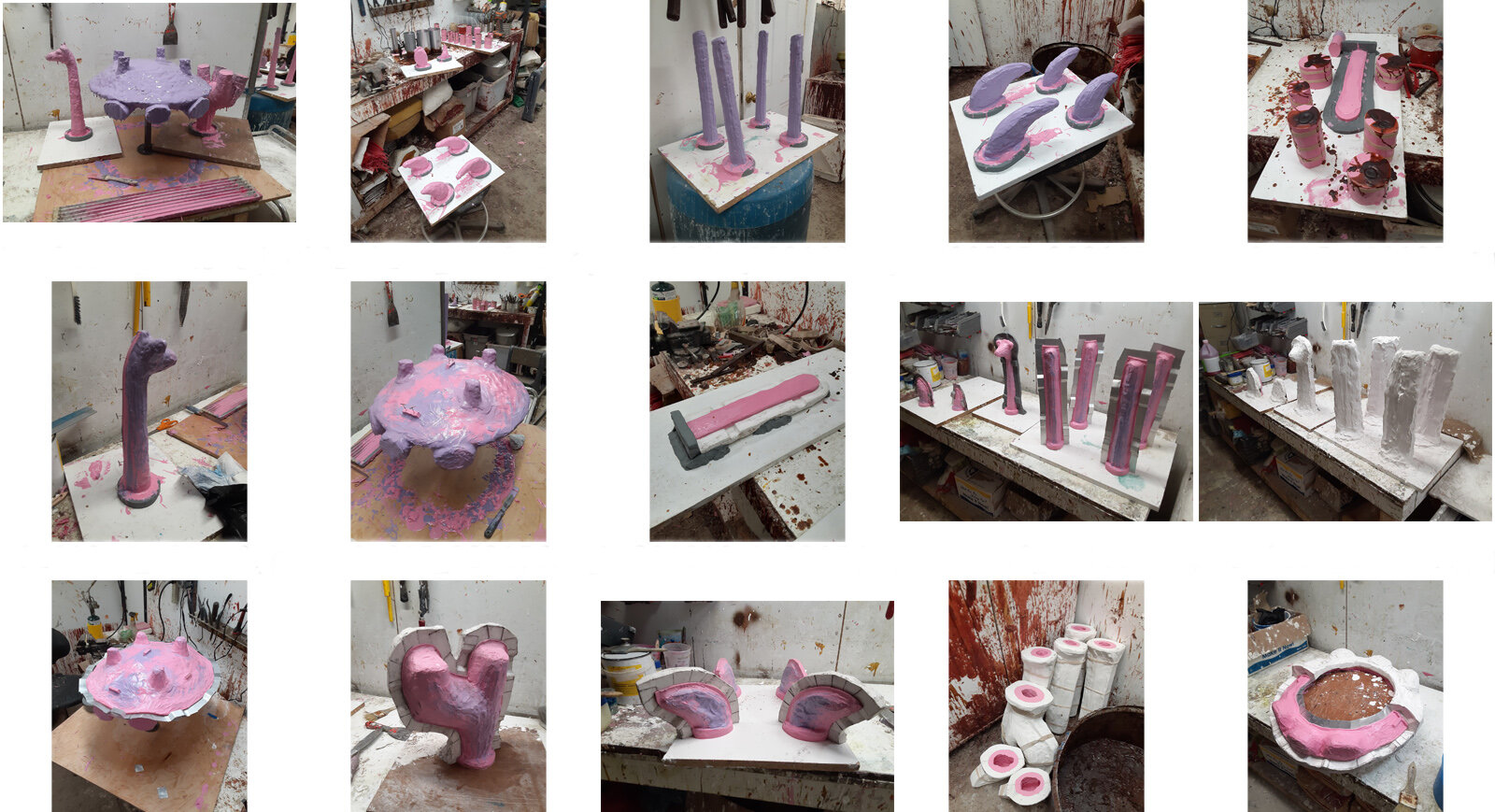
Once he has the rubber molds, he will pour casting wax into them—the small figures solid, the large shapes like the giraffe body receive a thin layer so they can be hollow. When Zach has these wax pieces complete, he will attach the small ones together and build a funnel above each one—the constructions, intriguing modern mobiles.

The next step is to create the molds to receive the molten bronze. Each of these wax mobiles are dipped into a silica slurry nine times to slowly building up the mold. They are dipped, then coated with sand, and hung to dry for at least a day between dips.

At the pour, the funnel on top of each mold receives the liquid bronze, the wax melts out, lost wax, and the bronze hardens. These hard shells are then hammered and broken to free them from the bronze inside.

There are still days of work ahead for Zach. He has to cut off the sprues and funnels. He has to sandblast each piece to get the specks of hard shell out of every crevice. Then the individual pieces will be welded together. Zach has to know how to replicate the textures I sculpt in my wax sculpture, and he has to do it in metal so the welded seams disappear. He has to care about the subtleties of the texture, with the deliberateness of a poet choosing words to describe the grooved furrows of an oak trunk.
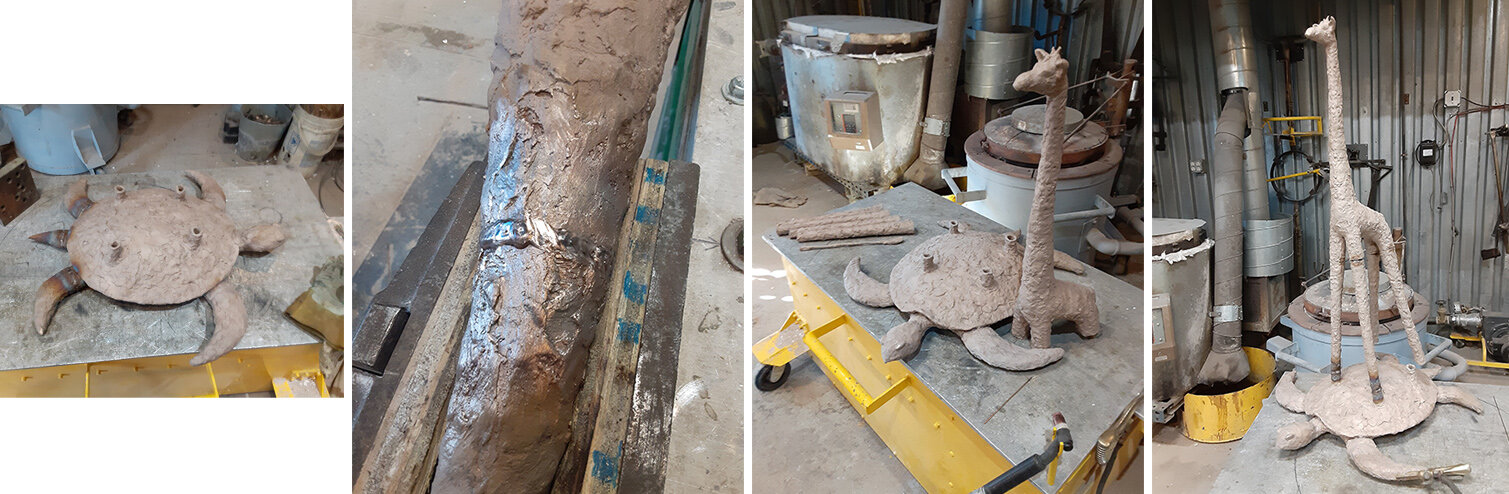
I returned to the foundry a few weeks ago to position each of the the small bronze figures on the backs of the giraffe and turtle. Zach welded each one in place.

Then Refuge received its final patina and wax polish. It’s a long process. This piece is signed and numbered 1/5. Though my original waxes have disappeared, I have the molds to make four more copies. But always, for each one, we have to first make a new wax model, then cast it into bronze. After five copies, we’ll destroy the molds.
Lost wax is an apt metaphor for these times: The only way to create something new is to lose something. While we are collectively facing tremendous loss, it is good to reflect on the space that allows for something new to arise. The loss is real—people’s lives, habitat, species, jobs, freedom. I am alarmed, but I dearly want to believe that we can turn things around. We need humility. We need respect for every living being on the planet. Then the turtle and the giraffe, the heron and the wasp, the oak, the waterlily, and even the gnat will all be helping because we are all interconnected.
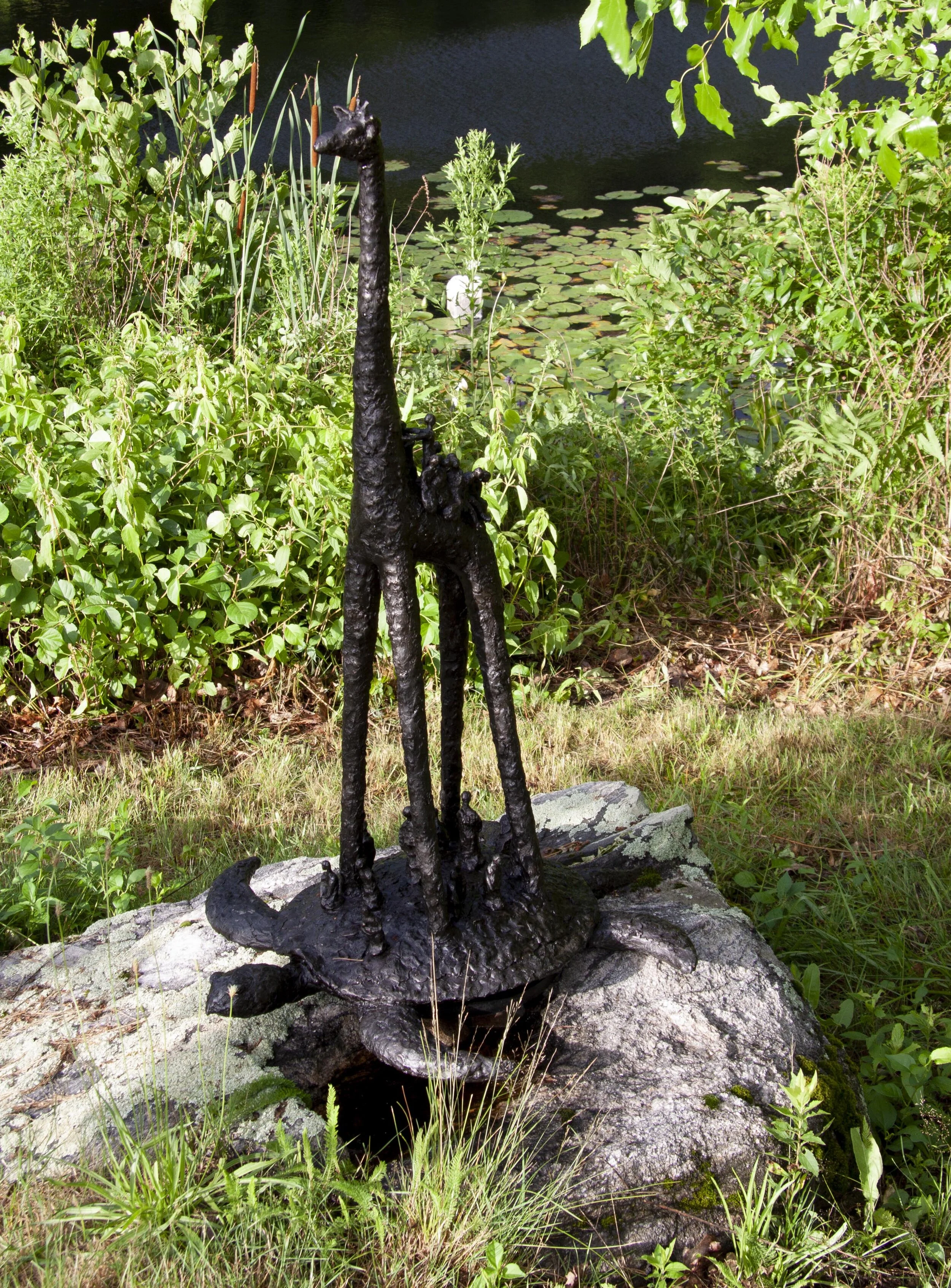
Refuge would have been outdoors at the Fuller Museum this summer, but Covid has delayed the opening of the New England Sculptors Exhibit until spring 2021. It sits on a chunk of bedrock outside my studio. I’d love to send more casting work Zach’s way, so if you would be interested in a copy of Refuge for your own garden, let’s talk.
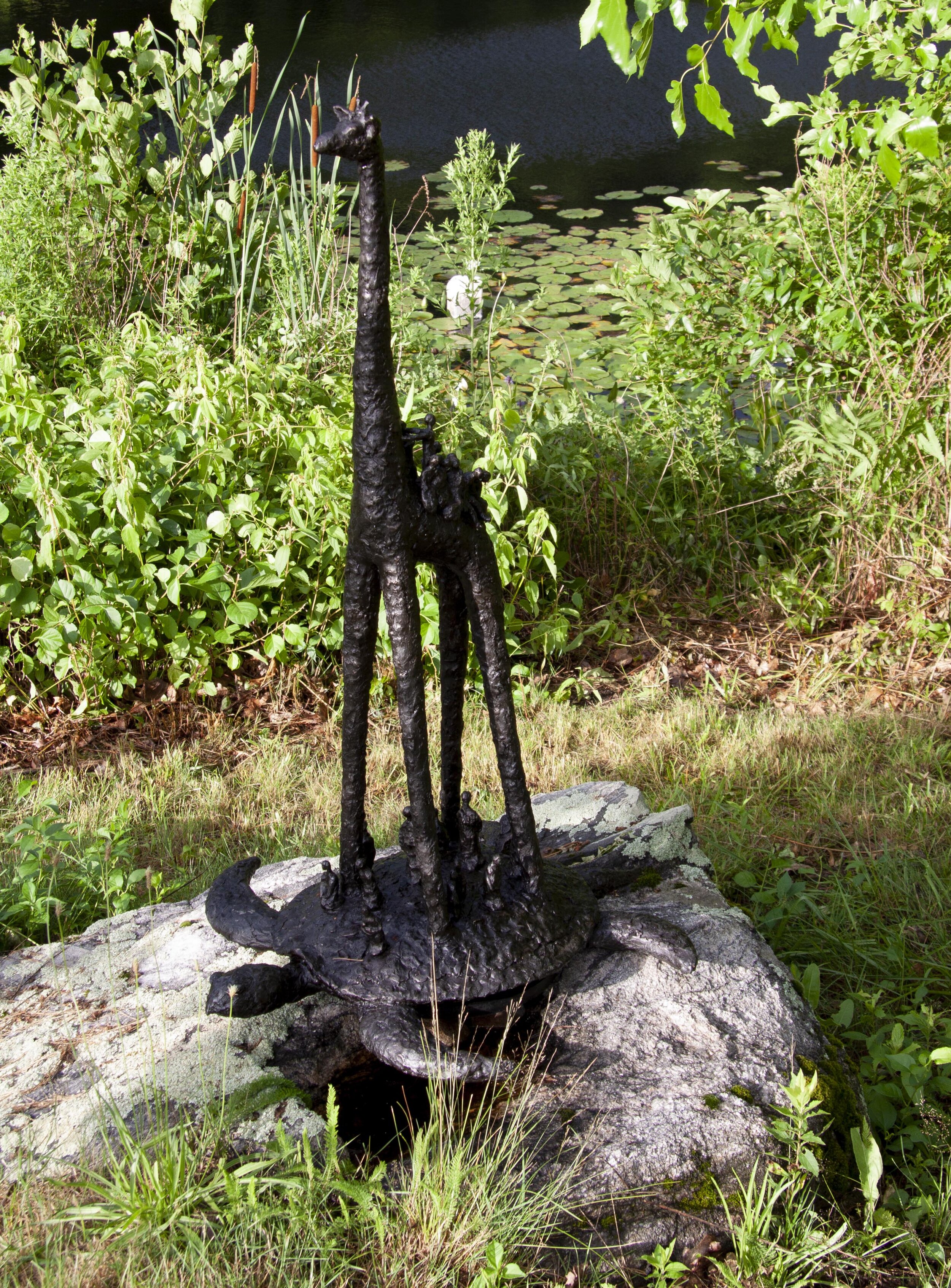
Refuge, bronze, 2020
Refuge is a hopeful piece. The determined, young giraffe and the tireless turtle are unconcerned with the enormity of their mission. They echo the world’s need for us to engage, to bring our gifts, and to offer help in this time of great loss. It’s a collective dance we can’t do alone.
See Change
For those of you who live in the Greater Boston area, here’s something wonderful to see! See Change is Studio Without Walls’ new exhibit of site-responsive sculpture along the Riverway Park in Brookline. The exhibit was to have opened in April but was postponed indefinitely because of Covid. Now, through the downright doggedness of its founder, Bette Ann Libby, and the willingness of the Brookline Parks and Open Spaces Department, it’s open to the public, free—and a pure delight! When Holly Cyganiewicz and I were installing our sculpture, A Tree Grows in Brookline, two fathers, both with children under three years old, stopped to chat. They walk this lovely oasis every day while on childcare duty. We’ll be back, they each said.

A Tree Grows in Brookline, Linda Hoffman and Holly Cyganiewicz; tree trunk with burl, painted curly willow branches
I was delighted to see Bob Shannahan’s life-size Mastodon and its Mother, made with alder and sumac branches, a sculpture exhibited at Old Frog Pond Farm last fall. And to find,Julie Lupien Nussbaum’s Alien Fishery, where she’s augmented the lone fish accompanying her sculpture Vodnik with Cruel Shoes also exhibited at the farm, and created a school of fish hanging from a high oak branch. If there’s a slight breeze, when you pause to watch, they turn as one body. Some sculptures in this family-friendly exhibit respond to the devastation of our planet, others to the need for justice and equality, and some captivate and offer hope for the future with their colors and shapes.
Studios Without Walls is a Brookline-based collaborative group of sculptors and conceptual artists who produce exhibitions of art in outdoor and public settings. Their commitment is to bring art to their community and educate audiences to appreciate and participate with outdoor sculpture. Photographs of this year’s installations, site maps, as well as treasure hunt clues are online at Studios Without Walls. Globe Correspondent Karen Campbell wrote in her glowing review, “With sculptures tailored to nestle in and around the trees, a leisurely amble offers a surprising visual treat of clever, substantive, thought-provoking art.”

Bllnkah II Liz Helfer; broken windshield glass
Brookline’s Parks and Open Space director said, “Brookline’s Studios Without Walls affirms the power of art to change your perspective.” The thirteen participating artists are Gail Jerauld Bos, Grey Held, Liz Helfer, Linda Hoffman and Holly Cyganiewicz, Janet Kawada, Bette Ann Libby, Julie Lupien Nussbaum, Madeleine Lord, Maria Ritz, Bob Shannahan, Marnie Sinclair, Allen M. Spivack, and Delanie Wise.
The exhibit is open through September 7, 2020. Wear your masks, stay six feet apart, and take a stroll along the Muddy River. The Longmont T stop will take you there and free parking is available on nearby streets.
Thank you Brookline Parks and Open Spaces, sponsors and supporters of Studios Without Walls, and especially the artists. We all want to “See Change”!!
Walking the Land: Returning Home

This “Man in a Maze” basket by the Akimei O’odham (Pima) people of Arizona is in the Fruitlands Museum collection in Harvard, Massachusetts. Though baskets like this are called, “Man in a Maze,” the design is actually a labyrinth, a teaching tool. Mazes have false turns and dead ends, and the sojourner must often retrace their steps and start over. A labyrinth is a continuous journey, a winding path with no wrong turns, no wrong decisions. The basket’s fine weave expresses stillness and balance, virtues that walking a labyrinth are said to restore.
In 2006, I installed an outdoor labyrinth for Fruitlands Museum inspired by the design of the Pima basket. I remembered this labyrinth while I was writing about our current situation—each of us isolated, walking our individual paths through the pandemic.

Walking the Labyrinth at Fruitlands Museum, 2005
For the Fruitlands’ labyrinth, I used round New England field stones placing them on a flat and grassy hillside. The measured concentric circles follow the contours of the land. Once the installation was completed, I wondered, what should we put in the center? A plant, a flower, a special stone? Nothing felt right, and I left it empty.
A question many people are asking is what the return to normal will look like. Many have discovered a new attentiveness in their daily lives—cooking special recipes, baking bread, taking long walks. And with this attentiveness, gratitude for what we do have naturally arises. The question is will we be able to carry this mindful pace with us as we re-enter the busy marketplace?
When walking a labyrinth, reaching the center is the goal. Perhaps, however, the return is more important. As we walk back out, we have the opportunity to consider what we have noticed along our journey. Quite possibly, we walk back out of the labyrinth with more confidence. We may feel the freedom of not worrying where we are going.
Some of us don’t want to return to normal; for isn’t normal what has polluted our rivers, clearcut our forests, and created social and economic inequality? We aren’t going to change the way international corporations operate—let alone our own government—in a few months, but we can make personal decisions about how we want to walk our labyrinth. Are we walking with attention and with gratitude, or are we hurrying, trying to get somewhere? Are we fully present to the moment of walking? We each have a path to walk, there is no other. We change our lives by what we bring to our walking, and the only thing we truly bring with us is our heartmind.
I see now why it was right to leave the center of the labyrinth at Fruitlands empty. There is a journey, but there is no goal to achieve, no pot of gold, no rainbow, no anything. We may be spiritual beings, but we are on a human path we each have to navigate. Let’s imagine the joy of walking. The labyrinth is no longer at Fruitlands, but I offer you a walk-through Louise Berliner’s poem inspired by it.
Journey
Imagine the wind
Midwife to the basket
Seeds delivered to soil
Subversive act of survival
The seeds take root
Cattail willow devil’s claw
Call to the Pima women
Come gather split soak coil
The basket grows
Tells its story in pattern
Elder Brother in the maze
A journey to the center
The seed becomes artifact
Sold or bartered shipped carried
Arizona story going East
Against the traffic
Imagine the glaciers
Midwives to the landscape
Stones delivered from soil
Subversive act of survival
New England’s best crop
Schist granite fieldstone
Call to the hands of an artist
Come gather map place illuminate
The labyrinth grows
Tells its story in pattern
Any stranger may begin
A journey to the center
Imagine the artist
Midwife to the sculpture
What the hand made
The feet now travel
Scrap Wrenn
Artist Scrap Wrenn and her partner, Jo, arrived at the farm in time for a late dinner on Tuesday in a U-Haul truck from upstate New York. I was introduced to Scrap at Zen Mountain Monastery, where I am known by my Buddhist name, Shinji. I wrote to her shortly after our introduction,
Hi Scrap,
We have an outdoor sculpture exhibit at the farm every fall . . . I know you are about to move into the monastery, but just thought I’d ask if you had a piece you might install here.
You can see the prior year’s work at oldfrogpondfarm.com under the tab for art.
Loved your stormy Instagram post!
Shinji
Scrap posts on Instagram almost every day. Some posts become images she includes in large photographic collages of people and place—magnificent landscapes with hundreds of photographic moments in which we immerse ourselves and journey through. Scrap’s visual language is quick-moving and incantatory. It is like listening to a medieval chant where the polyphony of different voices weaves a tapestry of individual melodies as well as harmonizing together. We engage with the leaps and turnings as questions about the nature of reality and meanings seep into our consciousness. She recently installed an exhibit of these photo collages at the John Davis Gallery in Hudson, New York.

John Davis Gallery, Hudson, New York, (Scrap Wrenn far left)
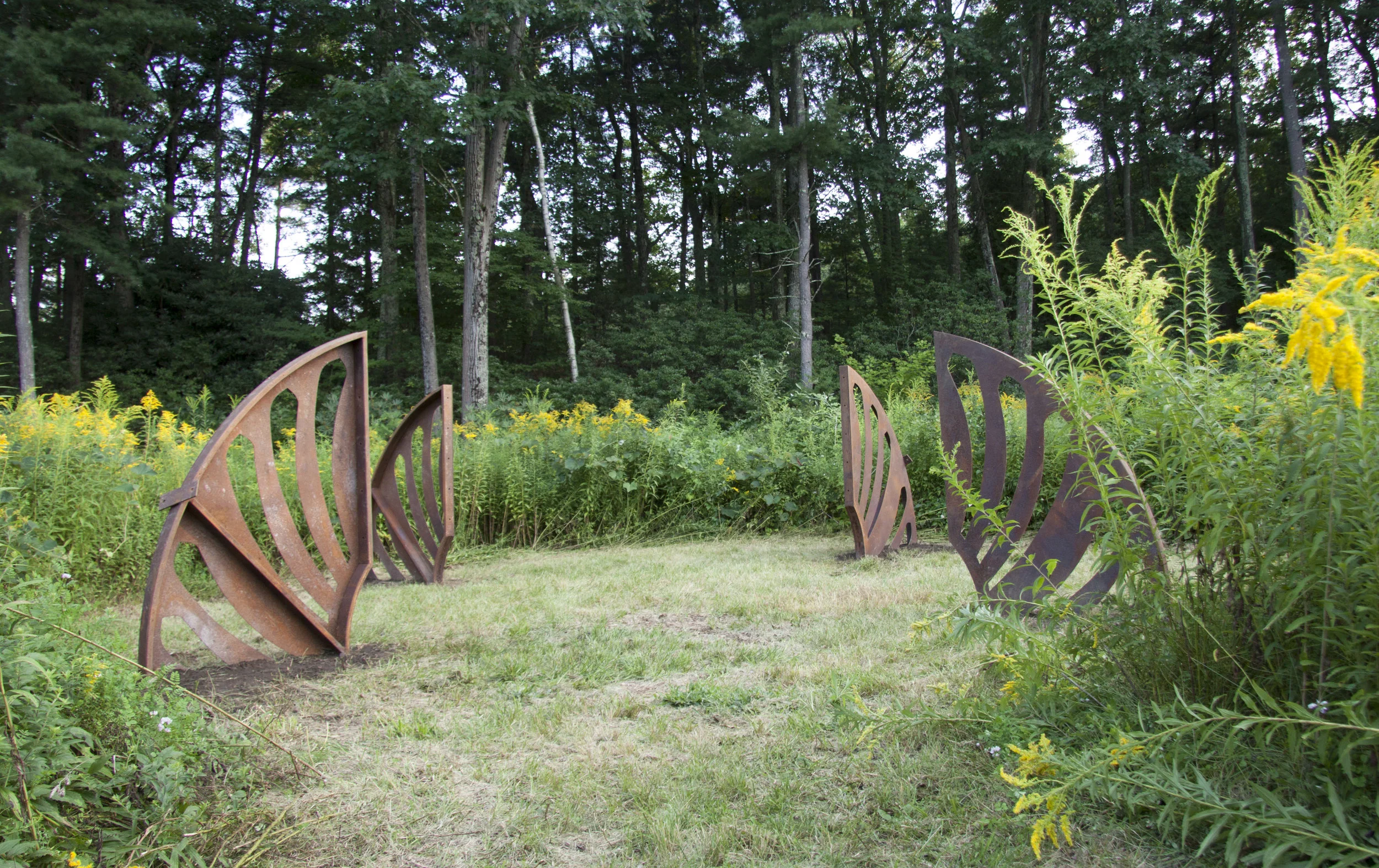
Scrap is also a sculptor. Inside the large U-haul truck were four identical heavy metal objects, fabricated initially for an installation on Randall’s Island, New York City. On Scrap’s website she explains Awakening Asylum was designed to commemorate both the General Slocum Steamship disaster (June 15, 1904) and Randall’s Island, an “Asylum” in the past for inebriates and the mentally ill.
The location of the sculpture commemorated the ship’s Hell Gate waterway passage where it is thought that the steamship fire likely began. Due to faulty unregulated flotation devices and poor crew response times, over a thousand people perished in the Northern East River on their way to a Lutheran picnic excursion on the sound in Queens.

Awakening Asylum, Scrap Wrenn
This installation has castings of flotation devices, wood beams suggestive of the old ship, and a collage in the center of the spiraling metal: it is complex and multi-layered. Scrap would be bringing to the farm only the fabricated metal now in four pieces. Sculptors often take apart old sculpture and reuse its materials. I like to re-purpose parts from sculptures in storage, drawn to pieces that I may not have finished my conversation with. Scrap had sent me photos of these four large elements early on. They made me think 'wings' or 'fins'. Though I had no idea what she would do with them, I trusted in the integrity of her artistic vision.

Scrap (left) and Jo.
On Wednesday morning, Scrap and Jo unloaded the U-Haul, loaded Blase's pick-up, and we drove around the pond to their site. That’s where I left them—with a digging bar and shovels, on a hot day. They worked till the Japanese bells sounded for lunch. Dirty, hot, and with two ‘wings’ installed, they went back to work with Holly Ciganiewicz, one of our farmers, and completed the installation just before five o’clock, when we planned to take a swim in Bear Hill Pond.
The working title is Ground Space. These four forms, dug deep into the earth, each rise like a whale’s dorsal fin and transform the space. When you walk among them, around them, or stand in the center, a curious energy also rises and surrounds you, as if walking in a biosphere. But I won’t say anymore. You have to experience it for yourself. Scrap Wrenn is one of the thirty-seven artists whose work will be on exhibit at the farm for our annual outdoor sculpture walk.
Around the Pond and through the Woods opens on Friday, September 7 and will be open to the public on Fridays, Saturdays, and Sundays, 11—5 pm through October 7. If those times don't work for you, we can make other arrangements for your visit. For information about the exhibit and other fall events at the farm check out our website. I’m excited to share this year’s exhibit with you.
Search Blog
-
2025
- May 9, 2025 A View from the Tractor Seat
- Apr 11, 2025 Dig
-
2024
- Jan 7, 2024 Winter Wassail
-
2022
- Dec 11, 2022 Keeping Time
- Jun 17, 2022 This Apple-Shaped Earth
- Jan 23, 2022 What is a Jizo?
- Jan 16, 2022 An Invite and Housekeeping Update
- Jan 1, 2022 The Year of the Frog: What Orchardists Do While Apple Trees are Chilling
-
2021
- Oct 24, 2021 Figs
- Oct 3, 2021 The Artist and the Orchard: A Memoir
- Aug 8, 2021 Red-Fleshed Apples
- Jul 25, 2021 When We Were Trees
- Jun 27, 2021 Castor Beans—Who Knew?
- Jun 13, 2021 Spring Training at a Zen Monastery
- May 4, 2021 Our Trees are in Bloom
- Apr 18, 2021 Hooray!
- Jan 24, 2021 Wassailing, virtually!
- Jan 1, 2021 Sitting
-
2020
- Dec 21, 2020 Darkness to Light
- Nov 28, 2020 One Heart
- Sep 18, 2020 Juggling Flowers, Fruit, and Vegetables
- Aug 23, 2020 Refuge
- Aug 9, 2020 Bags of Fertilizer
- Aug 2, 2020 The Sermon of the Blue Heron
- Jul 26, 2020 What's the Buzz?
- Jul 19, 2020 Farm Moments
- Jul 12, 2020 Lost Wax
- Jul 5, 2020 Catalpa: The Hugging Tree
- Jun 28, 2020 Pedaling Peace
- Jun 21, 2020 See Change
- Jun 14, 2020 Lalla Unveiled
- Jun 7, 2020 Pond Alchemy
- May 31, 2020 The Birth of Fruit
- May 24, 2020 An Artist in the Orchard
- May 17, 2020 Walking the Land: Returning Home
- May 10, 2020 Stinging Nettles: Gifts from the Great Mother
- May 3, 2020 The Mystery of Swallow
- Apr 26, 2020 Aerial Bruststrokes
- Apr 19, 2020 Simple Pleasures
- Apr 12, 2020 Weeds and Other Gifts
- Apr 5, 2020 Remembering the Seeds
- Mar 29, 2020 Blow on the Embers
- Mar 22, 2020 Ripples
-
2019
- Nov 16, 2019 Tibet Impressions
- Nov 9, 2019 Forest Tales
- Oct 13, 2019 The Gift
- Aug 4, 2019 The Season is Apples, Berries, and Grandfather Fire
- Jun 8, 2019 Pointers for a Writing Life
- May 12, 2019 Mothers of the Earth
- Apr 6, 2019 The Apple-Shaped Earth
- Mar 23, 2019 You Don’t Know What You Have Till It’s Gone
- Feb 23, 2019 Generations
- Feb 9, 2019 What Are We Doing to the Earth, John Chapman?
-
2018
- Dec 31, 2018 Long Shadows
- Oct 6, 2018 A Pilgrimage to India
- Aug 18, 2018 Scrap Wrenn
- Aug 11, 2018 Off-the-Wall Comments from an Ignorant Farmer
- Jul 28, 2018 Creative Connect
- Jul 14, 2018 How is the Orchard?
- Jun 30, 2018 Which Way?
- Jun 16, 2018 Geese, Herons, Beavers, and the Baby Steps of a Lapsed Blogger
- Feb 24, 2018 Mama's Coupons — Good Forever
- Jan 27, 2018 January Ice
- Jan 13, 2018 The Muse
-
2017
- Dec 30, 2017 A Dream for the New Year
- Dec 23, 2017 A New Year for Apples
- Dec 16, 2017 Intuition
- Nov 22, 2017 Thanksgiving OM
- Nov 4, 2017 East Fork Pottery
- Oct 28, 2017 Putting Down New Roots
- Oct 21, 2017 A is for Art
- Oct 14, 2017 Eve domesticus
- Oct 7, 2017 A String Workshop
- Sep 30, 2017 After Applepicking
- Sep 23, 2017 Two Bad Women and One Good Apple
- Sep 16, 2017 Plein Air Poetry
- Sep 9, 2017 Cutting Off a Leg
- Sep 2, 2017 The Changing Landscape
- Aug 26, 2017 All About Art
- Aug 19, 2017 My First Visit to the Farm
- Aug 12, 2017 The First Food
- Aug 5, 2017 A Teapot, a Woman, and maybe a Boat
- Jul 29, 2017 A Raspberry Dilemma
- Jul 22, 2017 Consider the Miracle
- Jul 15, 2017 Meeting Ekphrasis
- Jul 8, 2017 Ripening Fruit
- Jul 1, 2017 The Voice of The Caterpillar
- Jun 24, 2017 Goumi — An Unusual Fructus
- Jun 17, 2017 Concord, an American Bloomsbury
- Jun 10, 2017 The World Is Bonkers — Shall I Laugh or Cry?
- Jun 3, 2017 Bonkers, a Revolutionary Apple
- May 27, 2017 Guardians of the Swamp
- May 20, 2017 There are Mushrooms and There are Morels
- May 13, 2017 "What's in a Name?"
- May 6, 2017 Bloom Follows Pink: Orchard Pollination
- Apr 29, 2017 The Orchard Is at Pink
- Apr 22, 2017 Natural Farming — Part 2 (continuation from last Sunday's blog)
- Apr 15, 2017 Natural Farming — Part 1
- Apr 8, 2017 Boats, Figures, and Catching Fish
- Apr 1, 2017 A Man with a Mission: The Nuts and Bolts of Bronze Casting
- Mar 25, 2017 A Chalice of Spirit, Art, and Nature
- Mar 18, 2017 Hanami — Blossom Viewing
- Mar 11, 2017 Soil Redemption Song
- Mar 4, 2017 Food is Primary Care
- Feb 25, 2017 Pomme de Terre
- Feb 18, 2017 Organic Certification
- Feb 11, 2017 Tantalizing Fruit
- Feb 4, 2017 The Myths of History
- Jan 28, 2017 The Orchard in Winter
- Jan 21, 2017 The Hi-Line
- Jan 14, 2017 Artistic, Botanical, and Social Diversity
- Jan 7, 2017 Where is Eden?
-
2016
- Dec 31, 2016 The Creative Heart
- Dec 24, 2016 A Christmas Tale
- Dec 17, 2016 Who are the Crones?
- Dec 10, 2016 The Olympic Bell (Part Two)
- Dec 3, 2016 Overheard in the Apple Orchard in Early December
- Nov 26, 2016 The Lessons of a Tortoise
- Nov 19, 2016 In the Studio
- Nov 12, 2016 Even in Darkness
- Nov 5, 2016 Southern Apples, an Elephant, Monkey, Rabbit, and Bird, Two Mango Trees and a Birthday
- Oct 29, 2016 The Tools of Art
- Oct 22, 2016 Labyrinths
- Oct 15, 2016 Repairing the Broken
- Oct 8, 2016 When You Are No More
- Oct 1, 2016 Creation Rain
- Sep 24, 2016 Breaking the Glass
- Sep 17, 2016 String Art
- Sep 10, 2016 Poetry and Photosynthesis: It's all in the Leaves
- Sep 3, 2016 In the Plenty of Time
- Aug 27, 2016 Witch Doctors
- Aug 20, 2016 Listen Coyote
- Aug 13, 2016 Milkweed in the Orchard
- Aug 6, 2016 Some People See a Turtle
- Jul 30, 2016 Arborshaping
- Jul 23, 2016 Joseph Wheelwright: Sculptor of Stones and Trees
- Jul 16, 2016 Asian Pears
- Jul 9, 2016 Gold Leaf, Grief, and the Creative Process
- Jul 2, 2016 The Olympic Bell (Part One)
- Jun 25, 2016 Around the Mulberry Bush
- Jun 18, 2016 Avoiding Apples
- Jun 11, 2016 Fructus
- Jun 4, 2016 Astonishing Apples
- May 28, 2016 Scare the Caterpillars
- May 21, 2016 Join the Club!
- May 14, 2016 The Graft
- May 7, 2016 Rooster, Rhubarb, Rue
- Apr 30, 2016 What do Dolphins and Nettles Have in Common?
- Apr 23, 2016 Art Prunings
- Apr 16, 2016 A Few of the First Arrivals
- Apr 9, 2016 Taste the Spirit of Sustainable Agriculture
- Apr 2, 2016 First Orchard Spray - March 22-24, 2016
- Mar 26, 2016 Hawkeye Apple
- Mar 19, 2016 Desiring the Almata Apple
- Mar 12, 2016 Ugly Fruit
- Mar 5, 2016 Winter Tracks
- Feb 27, 2016 Splash
- Feb 20, 2016 Pruning
- Feb 13, 2016 Orchard Ruminants
- Feb 6, 2016 A Gathering of Seeds
- Jan 30, 2016 Orchard Dragons
- Jan 23, 2016 Tree Rings
- Jan 17, 2016 The Fallen Tree
- Jan 7, 2016 Wassailing the Apple Trees
- Jan 1, 2016 The New Year