LINDA HOFFMAN
Natural Farming — Part 2 (continuation from last Sunday's blog)
The comfrey I planted throughout the orchard did not spread as I had been warned. We experienced our area’s driest summer in history. We don’t have clay soil like the Japanese farmer, Fukuoka, but quite the opposite; our orchard soil is classified as Hinckley, an exceedingly rocky, fast-draining soil. It is definitely not choice soil for an orchard. The young trees struggled just like the comfrey. Only the older trees, with deep roots, tapped into water. I realized that if I wanted to plant more herbs and wildflowers, and create a natural environment like Fukuoka, I would need to have some way of delivering water to all the trees.
We applied to the Natural Resources Conservation Services (NRCS) for a grant to put in an irrigation system, and our grant was accepted. They knew that with our Hinckley soils, the apple trees would surely benefit from irrigation. We installed the system ourselves, pumping the water from the surrounding wetlands. Now I could plant all kinds of beneficial and medicinal plants in the orchard—plants that would be good for our soil, and that might help with pest management.
The beauty of the orchard delighted me as the summer progressed. Sunflowers, rudbeckia, mountain mint, asters, goldenrod, bee balm, and echinacea flowered and fed the pollinators. When Blase asked if he should mow in the orchard, I replied, “Not yet, no.” The Jerusalem artichoke flowers were six feet tall, and the valerian stalks were covered with delicate white flowers. A few weeks later, he said, “I really should mow the orchard.” Again, I said, “No mowing. Not yet.”

The orchard was beginning to feel like a natural woodland. The trees were loaded with fruit, and it seemed like an abundant crop. I finally asked Blase to mow between the apple tree rows to accommodate the pickers, but we left all the wildflowers and natural growth between and under the trees. We had a great harvest season, the farm quieted, and Blase and I turned to other pursuits.
Heavy snow fell during the month of January. The drifts were over three feet high, burying the lowest apple limbs. In early February, warmer temperatures brought a thaw, and I went for a walk among the trees. Snow melts first around the trunks, and my eye caught sight of gnawed wood close to the ground. It glowed a bright orange color. Shocked, I reached down and brushed more snow away. The gnawed wood went deeper.
Voles! They had scampered across the crust of the deep snow, climbed over the 18-inch high hardware cloth fence that encircles every trunk, and dropped down between the trunk and the protective screen. There they made soft, grassy nests, and ate and lived in the safety of their cozy burrows with a pantry of food close by. In tree after tree, especially in the back of the orchard, these rodents had eaten the bark, chewing their way around the base of the trees and down to the roots. Many trees were completely girdled. Girdling, when it is complete, kills the tree by cutting off the sap flow between the roots and the crown.

Voles girdled this tree.

Voles even ate the lower branches because of the height of the hard packed snow!
I panicked and called in reinforcements. With a couple of friends, we started shoveling the snow away from every trunk.
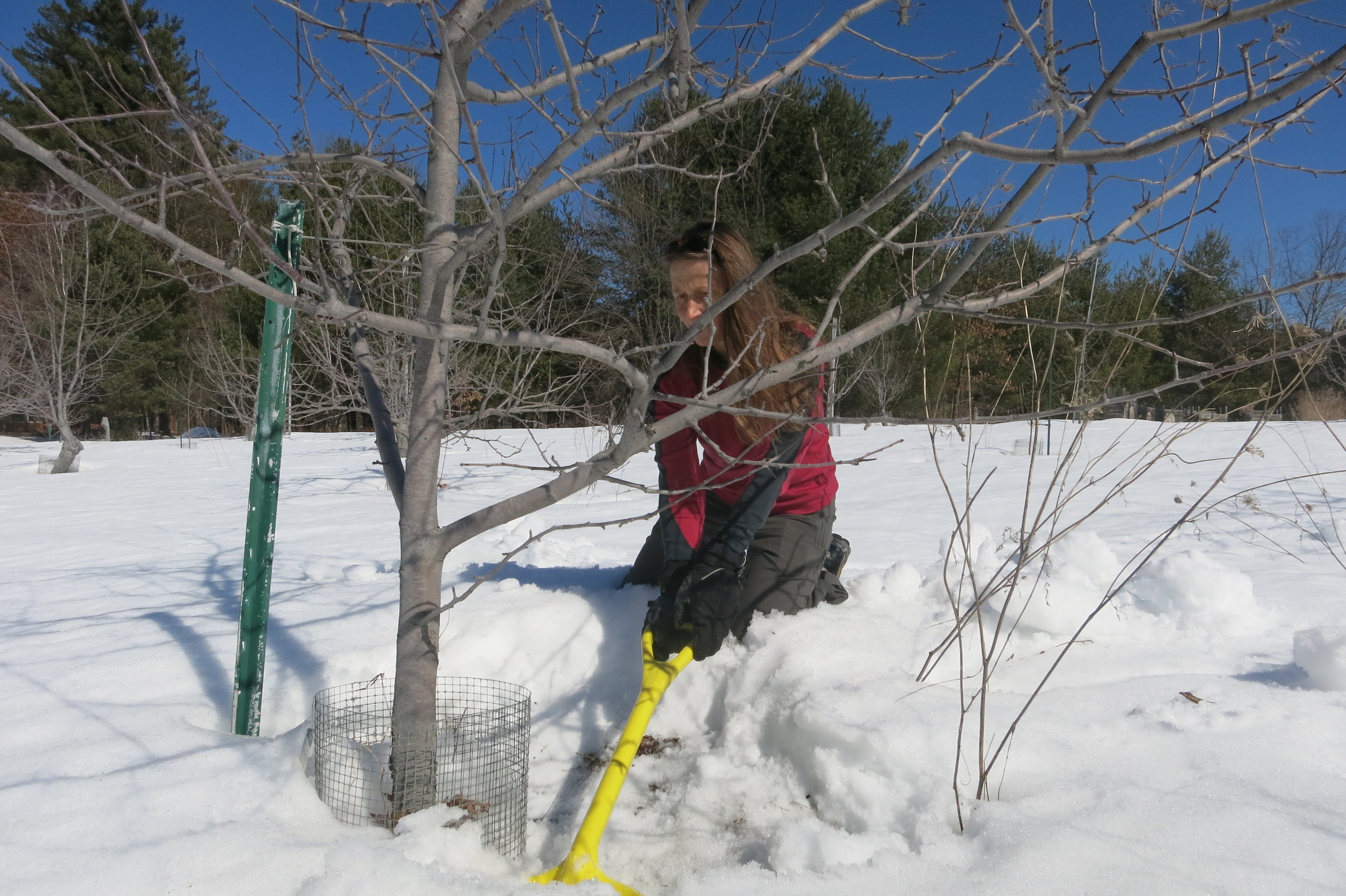
Gabi White tirelessly shoveling snow.
It was exhausting work. There was no way we could remove that much snow from around every tree. When we were too tired to shovel, we stomped the snow down with snowshoes. It felt like a war zone. Our hats, coats, shirts, and gloves were scattered everywhere.
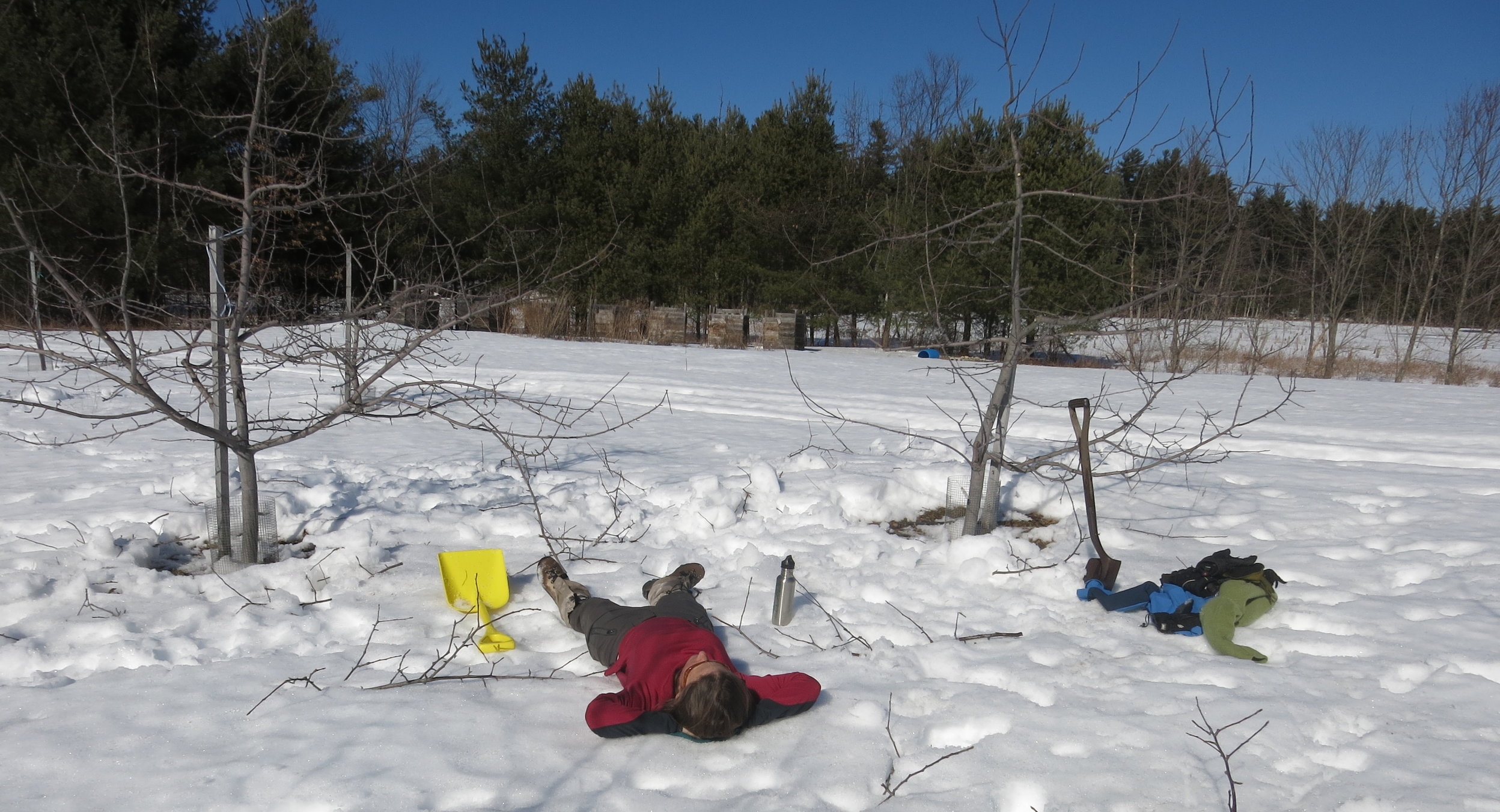
Gabi White — resting!
After a short break, we got back to work, shoveled more snow, heated up and stripped to tank tops, but it was too late. The damage was done.
Paige O’Brien, one of our farm workers, made a detailed map of all the injured trees and numbered them on a scale of one to four. One was one-quarter girdled, two was halfway, three was three-quarters, and four was completely girdled. We cut down the threes and fours, because they would either die or struggle mightily. A weak tree would attract more disease and pests. In all, fifty trees out of three hundred needed to be cut down. A saw blade to each trunk, and the task was done. Such quick work compared to years of cultivating growth.
Later, I learned it had been a bumper year for voles. Nature is like that—a bumper year for acorns, for apples, and now, for voles. Commercial growers knock down the vole population every fall with pellet poison. I had done the opposite. I had created a perfect vole habitat by growing delicious herbaceous perennials and cultivating long grasses and flowering plants. Following the irrigation drip lines, the voles had scampered freely from tree to tree.
So much for a wild orchard. I would have to rethink my approach and mow down all the perennials in the fall. Now, we mow several times throughout the season to dissuade the vole population from even considering making the orchard their home, but we leave patches of herbs and wildflowers growing between the trees. In preparation for winter, even these plants get mowed down to the ground. We also pull the drip lines away from the trees. In the spring, the hardy plants come back. I can already see the healing herbs like comfrey, valerian, and mountain mint unfolding their leaves. The orchard is not wild, but it’s not a monoculture either. We are trying to live peaceably with the other creatures who make their home nearby — definitely not offering them apples trees to chew — but encouraging a diversity and abundance of nature.
The challenge remains, however. I check on trees that aren't growing as well as I would expect and discover they are partially girdled, and two days ago I cut down a Crimson Crisp, a three-year-old ready to take off, but completely eaten around the graft. I'm discouraged. Then I smile at a dove sitting on a young tree as a blue heron flies by. I see pink buds on almost every branch of some eighty varieties of apples. I am blessed.
Natural Farming — Part 1
It may be that when we no longer know what to do,
we have come to our real work
and when we no longer know which way to go,
we have begun our real journey.
—Wendell Berry, Farmer, Poet, and Writer
In 2006, the once abandoned orchard at Old Frog Pond Farm received organic certification. But that didn’t mean I understood what I was doing as an orchardist. An experienced farmer tends the earth for years, season after season, noticing, altering her approach, and trying new ideas. I was following an instruction sheet that I only partially understood. In my search to improve my orchard practices, I came upon the writings of Masanobu Fukuoka (1913-2008), a Japanese rice and citrus grower, who discovered a way to farm that was in harmony with nature. His book, One Straw Revolution, published in English in 1978, became an underground manifesto for a new approach to agriculture: one that did no harm, that did not depend on chemical fertilizers, pesticides, or mountains of compost — one that emphasized ease.

As a young man, Fukuoka worked for the Customs Bureau’s Plant Inspection Division, having studied plant pathology at the university. His long hours led to a bout of acute pneumonia and hospitalization. He lay for days in his hospital room where a broken window let in cold and snow. He recounts that a nurse checked his temperature from time to time, but that was all. In the midst of this icy solitude, he started to fear death approaching. When he was finally released from the hospital, he fell into a terrible depression. The work that had fascinated him seemed useless. He could not sleep or focus on anything. One night on a hill overlooking the harbor, he collapsed with exhaustion. He woke the next morning at dawn, gazing over the water. “Everything I had held in firm conviction,” he wrote, “everything upon which I had ordinarily relied, was swept away with the wind. I felt that I understood nothing.” The next day he handed in his resignation and began wandering, trying to explain to people he met what he had experienced. “I challenged a lot of people with my conviction that everything is meaningless and of no value, that everything returns to nothingness. But this was too much, or too little, for the everyday world to conceive.” He returned to his father’s farm resolved to live a simple life.
I settled myself on the mountain and everything went well up until the time my father entrusted me with the richly bearing trees in the orchard. . . . My conviction was that crops grow themselves and should not have to be grown. I had acted in the belief that everything should be left to take its natural course, but I found that if you apply that way of thinking all at once, before long things do not go so well.
Fukuoka ruined the citrus crop and his father insisted that he leave and get a job and come back when his mind was right. Fukuoka left, and found a job as Head Researcher at a nearby agricultural research center. It was just when Japan was preparing for war and for the next eight years Fukuoka did research devoted to increasing the wartime food supply. Throughout this time, he was always pondering the idea of a natural approach to farming.
Fukuoka returned to his father’s farm, convinced that a grower could trust nature and not use any chemicals. On a clay hillside above the farm, he decided he would grow an orchard of mikan, a Japanese clementine. “The red clay was so hard you could not stick a shovel into it,” he wrote. People had previously grown potatoes there, exhausted the soil, and abandoned the fields. His father thought he was crazy.
To improve the soil, Fukuoka first tried digging holes in the compacted soil and adding organic matter, a physically demanding effort that led nowhere. Then he tried burying straw and ferns that he had carried on his back from higher up on the mountain. But hauling ninety pound loads and digging trenches was exhausting. The trenches eventually caved in, and there was barely any organic matter. He thought of building organic matter in the soil with decomposed wood, but it wasn’t available nearby. This was his “aha” moment — he could grow the wood himself.
Among his citrus trees, he planted pine, cedar, pear, loquats, cherries, and other native trees. On the bare ground under them, he sowed white clover and alfalfa. After several years, the clover grew and blanketed the hillside. He planted daikon, the large white Japanese radish. With its deep taproot, the daikon opened the way for water and air to circulate through the dense clay. The radish reseeded, softening the hard clay soil, and, after a few seasons, Fukuoka could plant root crops like potatoes and eventually more tender vegetables. He continued to sow clover, a nitrogen-fixing plant that returned more nitrogen to the soil than it used. The orchard soil became rich and dark, and the tall trees provided a windbreak protecting the smaller citrus trees. With the ground cover of nitrogen-producing plants, the orchard naturally had all the fertilizer necessary. With the diversity of plants and trees, insect pressure decreased, and he had no need for pesticides.
In Japan, after World War II, there was a great rush to emulate the West and use modern methods, specifically chemicals for farming. At first these new introductions from the West meant less work for the farmers, but it took only one generation before the minerals in the soil were depleted and the crops became dependent on chemical nutrients. Fukuoka knew intuitively that there must be another way.
Over the over the next decades, Fukuoka refined his approach to agriculture and called it natural farming (different from 'do-nothing' farming that had destroyed his father's citrus crop). He believed that farming should be pleasurable and in harmony with nature, not such oppressively hard work that the farmer is left with no time for other pursuits. “There is no time in modern agriculture for a farmer to write a poem or compose a song,” he would grumble. Fukuoka always sold his crops for less than chemically treated produce, because he felt natural food should be less expensive. “After all, natural food [is] easier to grow, even though it [is] more nutritious and tasty.” When Fukuoka learned that a distributor in Tokyo was selling his mikan for a high price, he immediately stopped selling to him.
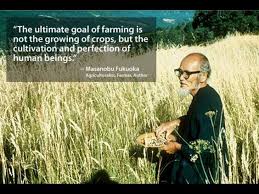
The ultimate goal of farming is not the growing of crops, but the cultivation and perfection of human beings.
—Masanobu Fukuoka
I aspired to Fukuoka’s ease and trust of nature. Having no idea what I would do, for several weeks, I carried around his book, as if the spirit contained within it would infuse the farm. My first real step was to plant comfrey throughout the orchard, a plant that also has a long taproot. People told me that I was really foolish, because comfrey spreads its seeds and will take over gardens, fields, and even orchards. The comfrey didn’t turn out to be a problem, because the deer kept it in check. But what happened next in my desire to create a natural orchard in the spirit of Fukuoka was devastating.
Natural Farming: Part 2 will follow next Sunday.
Soil Redemption Song
Michael Phillips, author of The Apple Grower and The Holistic Orchard, now has a new book, Mycorrhizal Planet, just published by Chelsea Green Publishing. There was some disagreement between Phillips and the publisher about the title for the book, so he conducted a poll asking friends for input. A cattle rancher, a regional publisher, a permaculture guru, a biodynamic herbalist, an academic, and an orchardist/artist, among others, all weighed in on which of three titles they preferred. I voted without hesitation for Mycorrhizal Alchemy, but Chelsea Green decided to go with Mycorrhizal Planet (Mycorrhizal Pathways was the other choice). Alchemy suggests transformation, mystery, and ancient practices, all of which I am drawn towards. It’s a little like taking old found objects and making them into art.
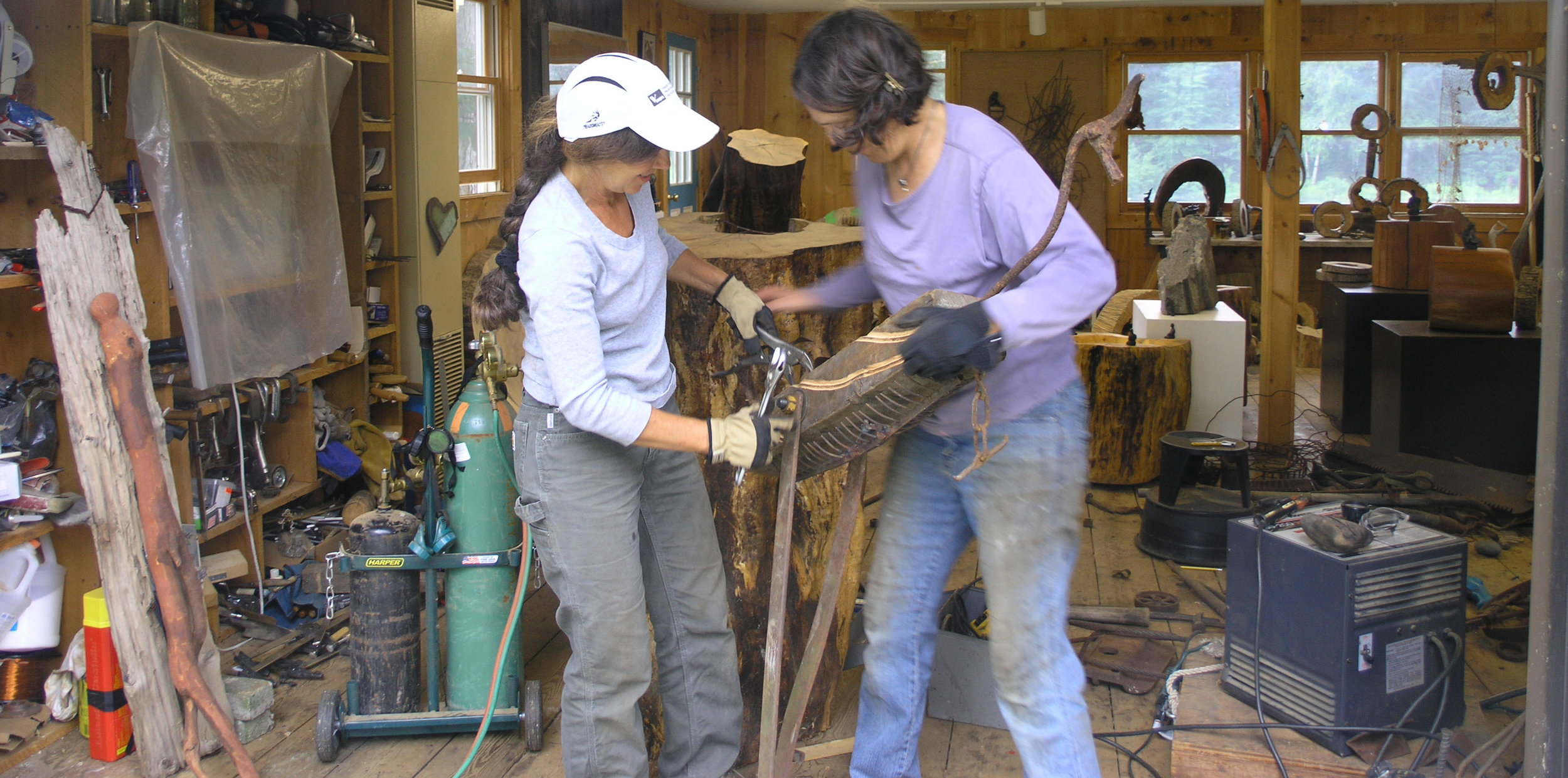
Linda Hoffman (left) and Madeleine Lord working on Belle the Bird in Hoffman's Studio, 2009
In the painting, The Alchemist by Cornelis Bega, a hunched figure sits in a cave-like room, intent on what is happening inside a glass jar. Books, notebooks, and earthenware pots surround him, suggesting a lifetime of mixing substances and studying their reactions. The alchemist is grounded and humble in Bega’s depiction. It’s a lonely art, much maligned as a materialistic quest to turn ore into gold; when, in fact, alchemists made considerable contributions to early science.
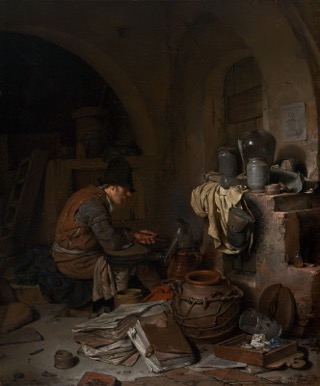
The Alchemist, Cornelis Bega
I think of Michael Phillips like this alchemist, studying the threads of life in the soil, appreciating them, and sharing their magic. Mycorrhizal fungi form a fibrous network stretching throughout the soil, attaching to roots, and connecting plant roots to each other. These fungi process minerals and feed them up to the plants, sending up just what is required. They will even provide storage for a plant’s bounty until leaner times, or pass on needed nutrients to other plants. It's a hidden world that scientists are only beginning to explore.

Photo courtesy of Larry Petersen, University of Guelph
“Each and every Mycorrhizal pulsating with nutrient flow, [is] making our lives possible,” Phillips writes. I consider Phillip’s passion to understand soil devotional.
Interestingly, Buddhism conceives of our world as one in which everything is interrelated and interdependent; nothing is separate in all of existence (or non-existence). Buddhism uses the analogy of the jeweled Net of Indra to describe this global interconnectedness. Imagine a vast net spreading out infinitely in all directions. At every crossing point in the net is a reflective jewel, and each jewel contains the reflection of every other jewel. If I were to put a mark on one gemstone, it would appear on every other one. How we treat one person ripples across the entire world.
The world under our feet is no different. Trees even share nutrients through Mycorrhizal fungi attached to their roots with trees of different species. It’s a little mind blowing — this network of fungi in the soil supporting the cosmic connection between all beings throughout space and time.
Phillips told me that he actually wanted the title to be Soil Redemption Song, inspired by Bob Marley’s haunting Redemption Song.
[…]
Won't you help to sing
These songs of freedom?
'Cause all I ever have
Redemption songs
Redemption songs
Emancipate yourselves from mental slavery
None but ourselves can free our minds
Have no fear for atomic energy
'Cause none of them can stop the time
How long shall they kill our prophets
While we stand aside and look? Ooh
Some say it's just a part of it
We've got to fulfill the Book
Won't you help to sing
These songs of freedom?
'Cause all I ever have
Redemption songs
Redemption songs
Redemption songs
Michael told me that as he pondered the lyrics of this song, he wrote, “Healthy plant metabolism begins with a molecule of water, a breath of carbon, and light energy from our nearest star. The tangible science behind all this unlocks the righteous way to farm and garden, give honor to trees, and plain do right by this earth. Nothing has ever excited me more.”
Mycorrhizal Planet provides practical information for the farmer, gardener, orchardist, and forester, as well as inspiration for all of us who have temporarily lost heart from following the daily news. If you’d like to order the book please go to Phillips’ website. He’ll sign a copy and send it to you.
Listen closely when you next walk among the trees. You might just hear the great alchemist Bob Marley singing — transforming our pain with his courage. Listen!
Food is Primary Care
Sometimes I will buy a big peach, a bright red tomato, or even an apple only to be disappointed when I bite into a mealy peach, a watery tomato, and a tasteless apple. I don’t like to throw out food, so I often eat it anyway. But sometimes, it’s just so bad that I guiltily toss the entire beautiful glob into the compost pile, burying it under some faded tulips or tough cabbage leaves.
Nutritionists say that we’re not getting the nutrients our bodies need from our food. Considering the obesity epidemic and the debilitating diseases in America, it’s hard not to agree. Soil health, crop health, and human health are interrelated. Since the 1950s, however, crop yield has gone up, but nutritional value has gone down. The great monocultures of agricultural production have focused on yield, pest resistance, appearance, and shelf life; not taste or nutrition.
Many of our food systems provide food that is low on both flavor and nutrition — for example, food served in hospitals to those who are ill, people who need healthy food. Turkey with corn might sound appealing when ticked off the menu, but when it arrives the next day, it’s a different story. Pre-frozen turkey rounds and corn niblets grown with chemical pesticides and herbicides, not to mention jiggles of artificially dyed red and orange Jello for dessert, is neither appealing nor nutritious.
The good news is that Marydale Debor, founder of the organization Fresh Advantage (their wonderful tagline is Food is Primary Care), works to put fresh and nutritious food back into hospitals, schools, and other institutions. It’s not easy – the old guard must be removed and new chefs who want to buy and cook with local ingredients need to be hired. Debor knows that buying food from a small local farm is the best way to get tasty and nutritious food.
A healthy diet contains a diversity of foods, but how to encourage diverse and nourishing meals when much of our food no longer has taste — especially when junk food has so much flavor? I heard a presentation by Mark Schatzker, author of The Dorito Effect: The Surprising New Truth about Food and Flavor. He explained that not only have our foods lost their flavor, but food is now separate from taste. He gave the example of the Frito-Lay Company that makes Dorito chips. In that product, for the first time, taste was manufactured; and flavor was added separately such that taste had no relation to the product’s food ingredients. Frito-Lay, Inc. (a subsidiary of PepsiCo) perfected the taste of their chip to be appealing to a wide group of people. This original manufactured taste opened the door to all kinds of manufactured food, in particular, the enormous category of junk food.
Humans can have associations with food taste from childhood like the sweetness of mother’s milk. If a manufactured food is high is corn fructose, it will satisfy this associative sugar craving, but, and here’s the catch, it will not satisfy the belly’s nutritive need because it’s only flavor. We don’t stop eating, because the craving doesn’t go away. We are caught like Tantalus reaching for the apples that are forever out of reach.
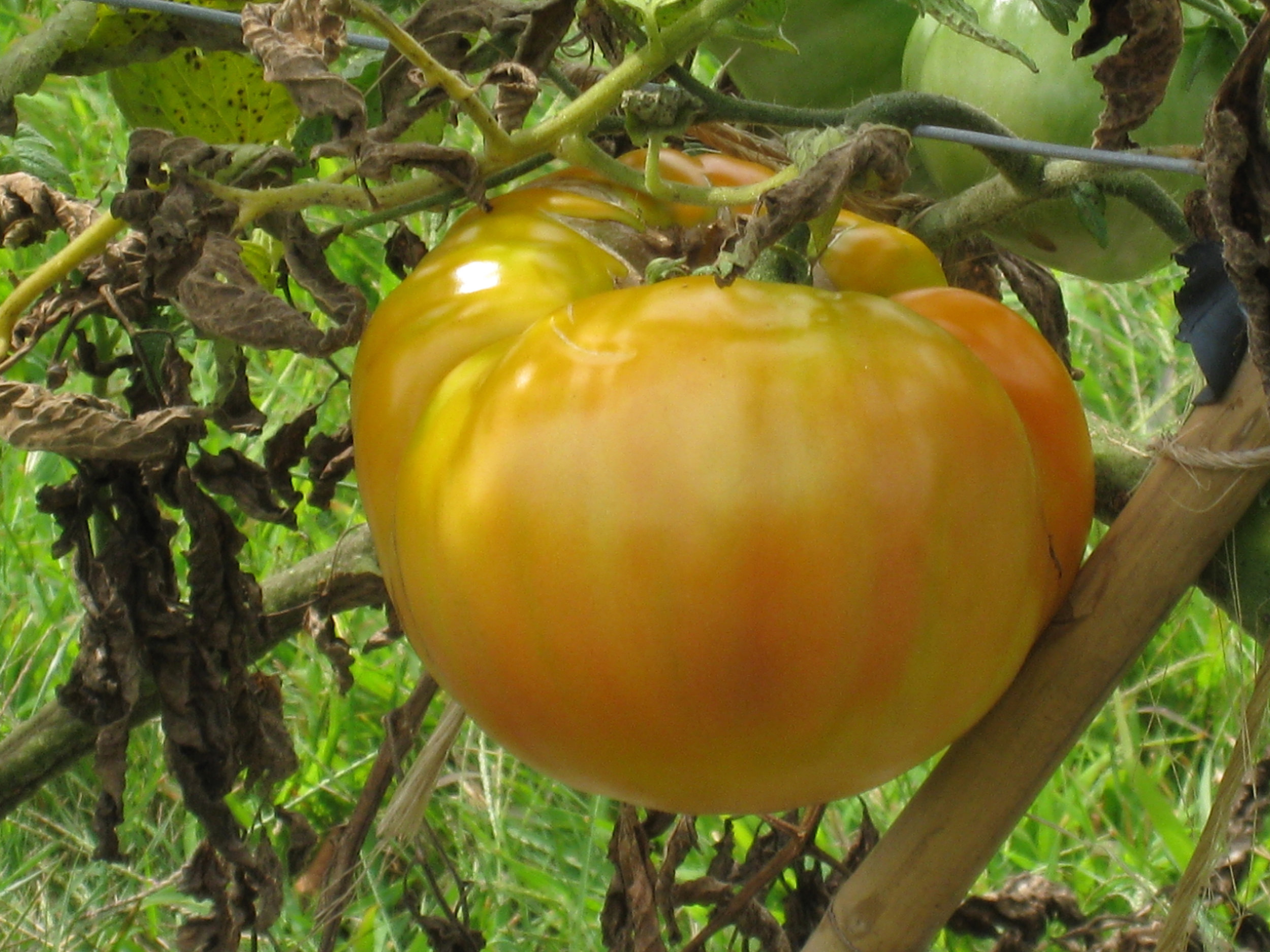
I love potato chips and eat more than I like to admit. But if that peach I had grabbed was warm, sweet, and juicy, or there was a basket of cherry tomatoes on the kitchen counter, I would eat a bellyful, be sated, and nutritionally fed. Healthy food needs to be the norm for people everywhere. Everyone should have access to nourishing and delicious food at a price that is affordable.
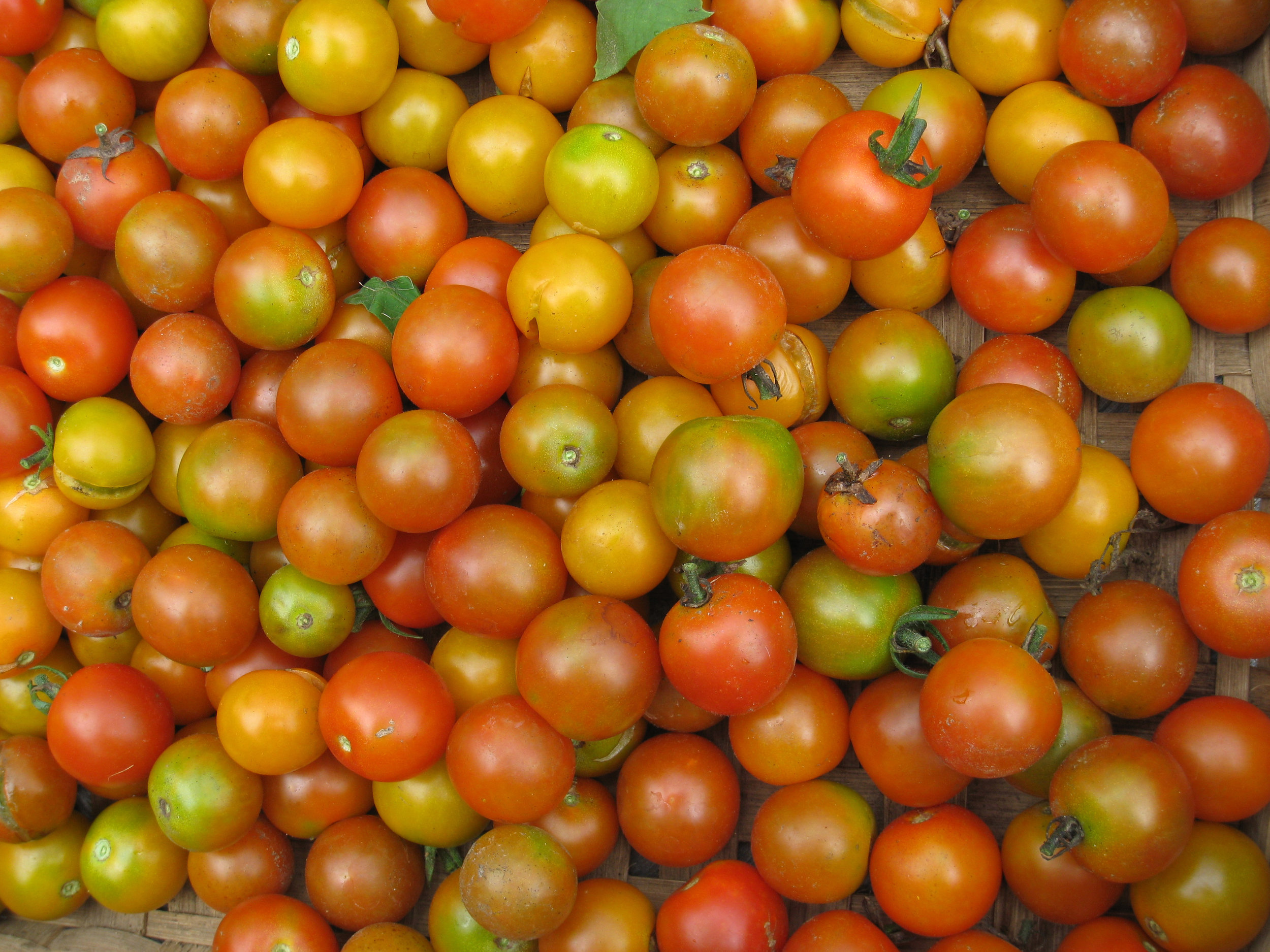
A Late Harvest of Cherry Tomatoes from Old Frog Pond Farm
Some people believe that our bodies can sense food grown with love and compassion; it feeds the spirit as well as the body, and sadly the opposite is also true. Food made by an angry cook can make a food unappealing or even repellent. ‘Food is primary care’ — and real food inspires wonderful poetry!
Ode to The Tomato
by Pablo Neruda
The street
filled with tomatoes,
midday,
summer,
light is
halved
like
a
tomato,
its juice
runs
through the streets.
In December,
unabated,
the tomato
invades
the kitchen,
it enters at lunchtime,
takes
its ease
on countertops,
among glasses,
butter dishes,
blue saltcellars.
It sheds
its own light,
benign majesty.
Unfortunately,
we must murder it:
the knife
sinks
into living flesh,
red
viscera
a cool
sun,
profound,
inexhaustible,
populates the salads
of Chile,
happily, it is wed
to the clear onion,
and to celebrate the union
we
pour
oil,
essential
child of the olive,
onto its halved hemispheres,
pepper
adds
its fragrance,
salt, its magnetism;
it is the wedding
of the day,
parsley
hoists
its flag,
potatoes
bubble vigorously,
the aroma
of the roast
knocks
at the door,
it's time!
come on!
and, on
the table, at the midpoint
of summer,
the tomato,
star of earth, recurrent
and fertile
star,
displays
its convolutions,
its canals,
its remarkable amplitude
and abundance,
no pit,
no husk,
no leaves or thorns,
the tomato offers
its gift
of fiery color
and cool completeness.
Search Blog
-
2025
- May 9, 2025 A View from the Tractor Seat
- Apr 11, 2025 Dig
-
2024
- Jan 7, 2024 Winter Wassail
-
2022
- Dec 11, 2022 Keeping Time
- Jun 17, 2022 This Apple-Shaped Earth
- Jan 23, 2022 What is a Jizo?
- Jan 16, 2022 An Invite and Housekeeping Update
- Jan 1, 2022 The Year of the Frog: What Orchardists Do While Apple Trees are Chilling
-
2021
- Oct 24, 2021 Figs
- Oct 3, 2021 The Artist and the Orchard: A Memoir
- Aug 8, 2021 Red-Fleshed Apples
- Jul 25, 2021 When We Were Trees
- Jun 27, 2021 Castor Beans—Who Knew?
- Jun 13, 2021 Spring Training at a Zen Monastery
- May 4, 2021 Our Trees are in Bloom
- Apr 18, 2021 Hooray!
- Jan 24, 2021 Wassailing, virtually!
- Jan 1, 2021 Sitting
-
2020
- Dec 21, 2020 Darkness to Light
- Nov 28, 2020 One Heart
- Sep 18, 2020 Juggling Flowers, Fruit, and Vegetables
- Aug 23, 2020 Refuge
- Aug 9, 2020 Bags of Fertilizer
- Aug 2, 2020 The Sermon of the Blue Heron
- Jul 26, 2020 What's the Buzz?
- Jul 19, 2020 Farm Moments
- Jul 12, 2020 Lost Wax
- Jul 5, 2020 Catalpa: The Hugging Tree
- Jun 28, 2020 Pedaling Peace
- Jun 21, 2020 See Change
- Jun 14, 2020 Lalla Unveiled
- Jun 7, 2020 Pond Alchemy
- May 31, 2020 The Birth of Fruit
- May 24, 2020 An Artist in the Orchard
- May 17, 2020 Walking the Land: Returning Home
- May 10, 2020 Stinging Nettles: Gifts from the Great Mother
- May 3, 2020 The Mystery of Swallow
- Apr 26, 2020 Aerial Bruststrokes
- Apr 19, 2020 Simple Pleasures
- Apr 12, 2020 Weeds and Other Gifts
- Apr 5, 2020 Remembering the Seeds
- Mar 29, 2020 Blow on the Embers
- Mar 22, 2020 Ripples
-
2019
- Nov 16, 2019 Tibet Impressions
- Nov 9, 2019 Forest Tales
- Oct 13, 2019 The Gift
- Aug 4, 2019 The Season is Apples, Berries, and Grandfather Fire
- Jun 8, 2019 Pointers for a Writing Life
- May 12, 2019 Mothers of the Earth
- Apr 6, 2019 The Apple-Shaped Earth
- Mar 23, 2019 You Don’t Know What You Have Till It’s Gone
- Feb 23, 2019 Generations
- Feb 9, 2019 What Are We Doing to the Earth, John Chapman?
-
2018
- Dec 31, 2018 Long Shadows
- Oct 6, 2018 A Pilgrimage to India
- Aug 18, 2018 Scrap Wrenn
- Aug 11, 2018 Off-the-Wall Comments from an Ignorant Farmer
- Jul 28, 2018 Creative Connect
- Jul 14, 2018 How is the Orchard?
- Jun 30, 2018 Which Way?
- Jun 16, 2018 Geese, Herons, Beavers, and the Baby Steps of a Lapsed Blogger
- Feb 24, 2018 Mama's Coupons — Good Forever
- Jan 27, 2018 January Ice
- Jan 13, 2018 The Muse
-
2017
- Dec 30, 2017 A Dream for the New Year
- Dec 23, 2017 A New Year for Apples
- Dec 16, 2017 Intuition
- Nov 22, 2017 Thanksgiving OM
- Nov 4, 2017 East Fork Pottery
- Oct 28, 2017 Putting Down New Roots
- Oct 21, 2017 A is for Art
- Oct 14, 2017 Eve domesticus
- Oct 7, 2017 A String Workshop
- Sep 30, 2017 After Applepicking
- Sep 23, 2017 Two Bad Women and One Good Apple
- Sep 16, 2017 Plein Air Poetry
- Sep 9, 2017 Cutting Off a Leg
- Sep 2, 2017 The Changing Landscape
- Aug 26, 2017 All About Art
- Aug 19, 2017 My First Visit to the Farm
- Aug 12, 2017 The First Food
- Aug 5, 2017 A Teapot, a Woman, and maybe a Boat
- Jul 29, 2017 A Raspberry Dilemma
- Jul 22, 2017 Consider the Miracle
- Jul 15, 2017 Meeting Ekphrasis
- Jul 8, 2017 Ripening Fruit
- Jul 1, 2017 The Voice of The Caterpillar
- Jun 24, 2017 Goumi — An Unusual Fructus
- Jun 17, 2017 Concord, an American Bloomsbury
- Jun 10, 2017 The World Is Bonkers — Shall I Laugh or Cry?
- Jun 3, 2017 Bonkers, a Revolutionary Apple
- May 27, 2017 Guardians of the Swamp
- May 20, 2017 There are Mushrooms and There are Morels
- May 13, 2017 "What's in a Name?"
- May 6, 2017 Bloom Follows Pink: Orchard Pollination
- Apr 29, 2017 The Orchard Is at Pink
- Apr 22, 2017 Natural Farming — Part 2 (continuation from last Sunday's blog)
- Apr 15, 2017 Natural Farming — Part 1
- Apr 8, 2017 Boats, Figures, and Catching Fish
- Apr 1, 2017 A Man with a Mission: The Nuts and Bolts of Bronze Casting
- Mar 25, 2017 A Chalice of Spirit, Art, and Nature
- Mar 18, 2017 Hanami — Blossom Viewing
- Mar 11, 2017 Soil Redemption Song
- Mar 4, 2017 Food is Primary Care
- Feb 25, 2017 Pomme de Terre
- Feb 18, 2017 Organic Certification
- Feb 11, 2017 Tantalizing Fruit
- Feb 4, 2017 The Myths of History
- Jan 28, 2017 The Orchard in Winter
- Jan 21, 2017 The Hi-Line
- Jan 14, 2017 Artistic, Botanical, and Social Diversity
- Jan 7, 2017 Where is Eden?
-
2016
- Dec 31, 2016 The Creative Heart
- Dec 24, 2016 A Christmas Tale
- Dec 17, 2016 Who are the Crones?
- Dec 10, 2016 The Olympic Bell (Part Two)
- Dec 3, 2016 Overheard in the Apple Orchard in Early December
- Nov 26, 2016 The Lessons of a Tortoise
- Nov 19, 2016 In the Studio
- Nov 12, 2016 Even in Darkness
- Nov 5, 2016 Southern Apples, an Elephant, Monkey, Rabbit, and Bird, Two Mango Trees and a Birthday
- Oct 29, 2016 The Tools of Art
- Oct 22, 2016 Labyrinths
- Oct 15, 2016 Repairing the Broken
- Oct 8, 2016 When You Are No More
- Oct 1, 2016 Creation Rain
- Sep 24, 2016 Breaking the Glass
- Sep 17, 2016 String Art
- Sep 10, 2016 Poetry and Photosynthesis: It's all in the Leaves
- Sep 3, 2016 In the Plenty of Time
- Aug 27, 2016 Witch Doctors
- Aug 20, 2016 Listen Coyote
- Aug 13, 2016 Milkweed in the Orchard
- Aug 6, 2016 Some People See a Turtle
- Jul 30, 2016 Arborshaping
- Jul 23, 2016 Joseph Wheelwright: Sculptor of Stones and Trees
- Jul 16, 2016 Asian Pears
- Jul 9, 2016 Gold Leaf, Grief, and the Creative Process
- Jul 2, 2016 The Olympic Bell (Part One)
- Jun 25, 2016 Around the Mulberry Bush
- Jun 18, 2016 Avoiding Apples
- Jun 11, 2016 Fructus
- Jun 4, 2016 Astonishing Apples
- May 28, 2016 Scare the Caterpillars
- May 21, 2016 Join the Club!
- May 14, 2016 The Graft
- May 7, 2016 Rooster, Rhubarb, Rue
- Apr 30, 2016 What do Dolphins and Nettles Have in Common?
- Apr 23, 2016 Art Prunings
- Apr 16, 2016 A Few of the First Arrivals
- Apr 9, 2016 Taste the Spirit of Sustainable Agriculture
- Apr 2, 2016 First Orchard Spray - March 22-24, 2016
- Mar 26, 2016 Hawkeye Apple
- Mar 19, 2016 Desiring the Almata Apple
- Mar 12, 2016 Ugly Fruit
- Mar 5, 2016 Winter Tracks
- Feb 27, 2016 Splash
- Feb 20, 2016 Pruning
- Feb 13, 2016 Orchard Ruminants
- Feb 6, 2016 A Gathering of Seeds
- Jan 30, 2016 Orchard Dragons
- Jan 23, 2016 Tree Rings
- Jan 17, 2016 The Fallen Tree
- Jan 7, 2016 Wassailing the Apple Trees
- Jan 1, 2016 The New Year