LINDA HOFFMAN
Splash
A realtor showed me A & M Orchards in Harvard, Massachusetts during mud season. Winter’s old snow and patches of bare ground met my eye. The farmhouse needed paint, and the outbuildings begged for repair, but I was captivated. I was leaving a marriage of almost twenty years and looking for a new place to live. A friend suggested I visit this small farm; she loved the place — for she had grown up here.
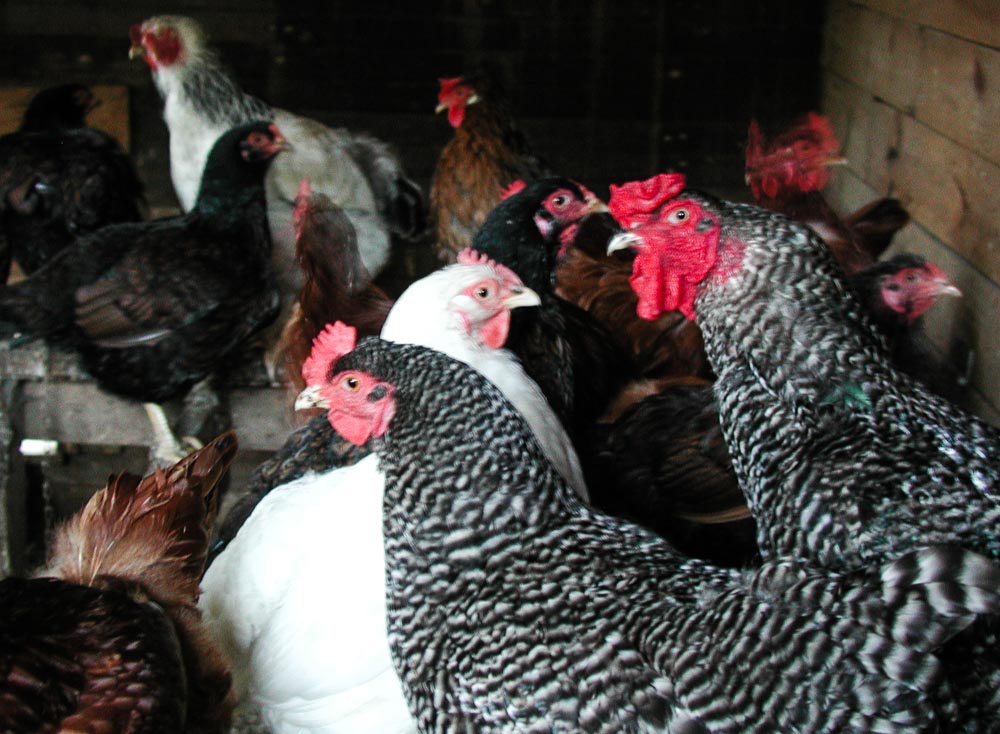
I asked to see the chicken coop. Inside I picked my way through shit-splattered sawdust, teasing away thick curtains of cobwebs. Some forty old hens squawked, panicked by my presence in their ordered world.
“What is going to happen to all these chickens?” I asked.
“Why? Would you want them?”
Why not? I thought to myself. How difficult could they be to care for?
“Sure,” I said, not knowing anything about chickens.
“I’ll ask the owners what they are doing with the chickens,” he replied.
“Where are the apple trees?” I asked.
He casually gestured across the street. We followed an old cart road that bordered the orchard and I gazed down the rows of bare branches.
“What would you do with the apples?” he asked.
“I don’t know. I’d have to learn,” I heard myself say.
“It’s hard to grow apples,” he cautioned.
I could feel a small delight rise inside me. Pears, cherries, peaches are all delicious; but apples are at the center of mythology, history, art, and even religion.
Could I do it? Can I grow apples? I wondered.
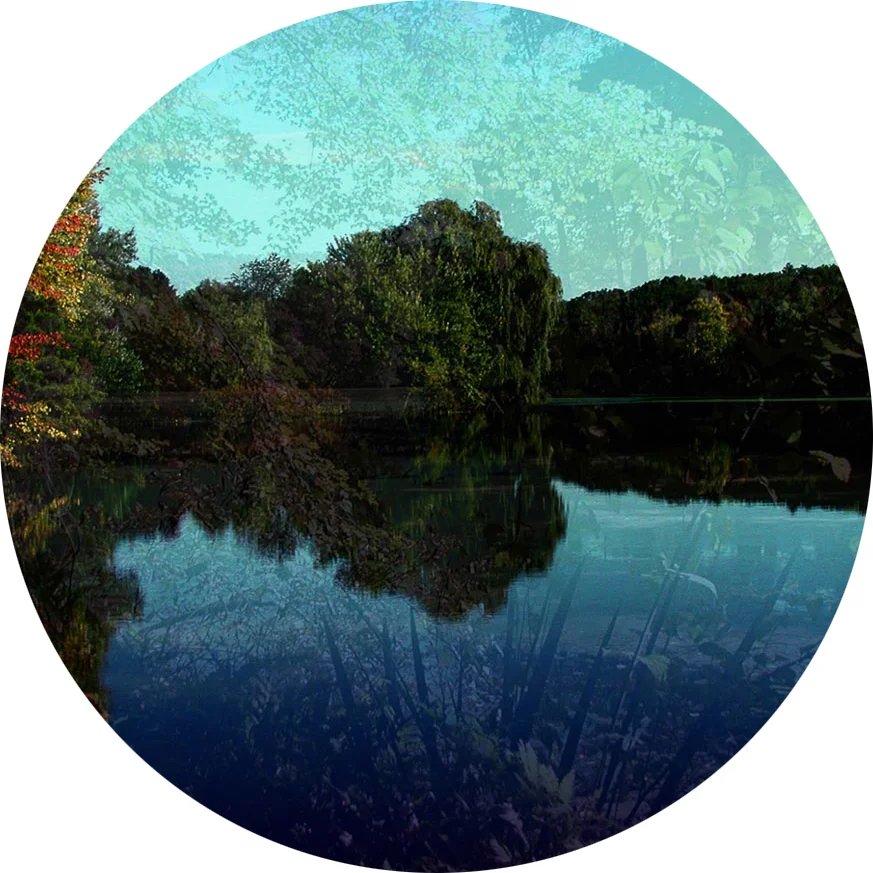
I changed the farm’s name from A & M Orchards named for the prior owners, Art and Marie Spaulding, to Old Frog Pond Farm, after the haiku by the seventeenth-century Japanese poet, Basho. I made a postcard and sent it to friends. It was a photograph of the pond, and floating above it, I added an image of a frog. The caption read, plunging into the unknown.
I’ve encountered a similar instruction in Zen practice. Daido Roshi, my first teacher at Zen Mountain Monastery, used the metaphor of a child leaping from a height into her parent’s arms to describe the trust we need to cultivate for true spiritual practice. We need to leap, to trust the world, and more importantly we need to learn to trust ourselves. It’s not a leaping away from life; it’s leaping into it, into more engagement.
It was a grand leap for me to leave to leave my marriage and move to the farm, but we make countless small leaps everyday, like in pruning when we have to make a large cut in the top of an apple tree or when we pick up the phone and call someone we haven’t talked with in a long time. It’s living a life where we continuously take small risks and don’t think that the water might be too cold, the person might not want to hear from us, or we might be making a mistake.

I try to remember this teaching of plunging into the unknown, of choosing the way of the unexpected, rather than following a map, but often I forget. Basho’s haiku continues to remind me.
Old pond
Frog jumps
Splash
Pruning
In the winter months when the apple trees are dormant, it is time to prune in the orchard. The buds, leaf buds as well as fruit buds, spiral around the bare branches. The trees hold only an occasional shriveled fruit. Winter light casts long shadows: the patterns on the snow, a perplexing labyrinth of the three-dimensional flattened into two.

A few days ago I walked into the orchard with a saw in its sheath hanging from my belt and sharpened loppers in hand. I was looking for a row of young trees, something easy, something to get started on, to get my head back into the routine of pruning. I stared at the first tree, a Crimson Crisp, one of the orchard’s new disease-resistant varieties. Its central leader was leaning too far to one side. We prune our trees to a main leader, a single trunk, and shape the branches similar to a Christmas tree, wanting the lower branches to extend farther than the ones above, a way to get light to all branches, to all fruit. Without light, the lower branches will die back and the tree will become umbrella-shaped. The apples won’t sweeten and color well.
With this lean, I stood hesitant. To cut it off would be to decapitate the tree. But to allow it to grow in the wrong direction would be irresponsible. I saw that my neighbor was also outside. Ed abuts the orchard on the east and he has always pruned a dozen trees along his property. We shouted hello like two sailors passing but then I decided to call him over. “Oh, the lean expert,” he said referring to himself when he saw the tree. A month ago Ed had helped me haul up a fallen tree (Blogpost: The Fallen Tree). At the time, we had debated the merits of how far to pull the tree. I hesitated to go beyond some innate flexibility that I intuited; he wanted us to pull it up straight and tall, the engineer in him. This time his was the voice of reason. He suggested I leave the leaning main trunk for now, but that I tie up a young, flexible horizontal branch to see if it might be trained to become the new leader.
He went back to his side of the orchard and I moved on to the next tree. This one was easier – only a few snips – a removal of a top branch that was already more than half the diameter of the trunk.
Then Ed called me over to one of his trees, a big old one with a lot of wood in the top third. I suggested removing a thick branch, one of those calloused elephant trunks. A large cut in the upper part of the tree rejuvenates. He agreed and I went for it with my saw. Pulling the blade back and forth, smoothly enough so it wouldn’t catch and chug, and carefully enough so it didn’t slip and scar the branch, the saw made a rhythmical rasping sound.
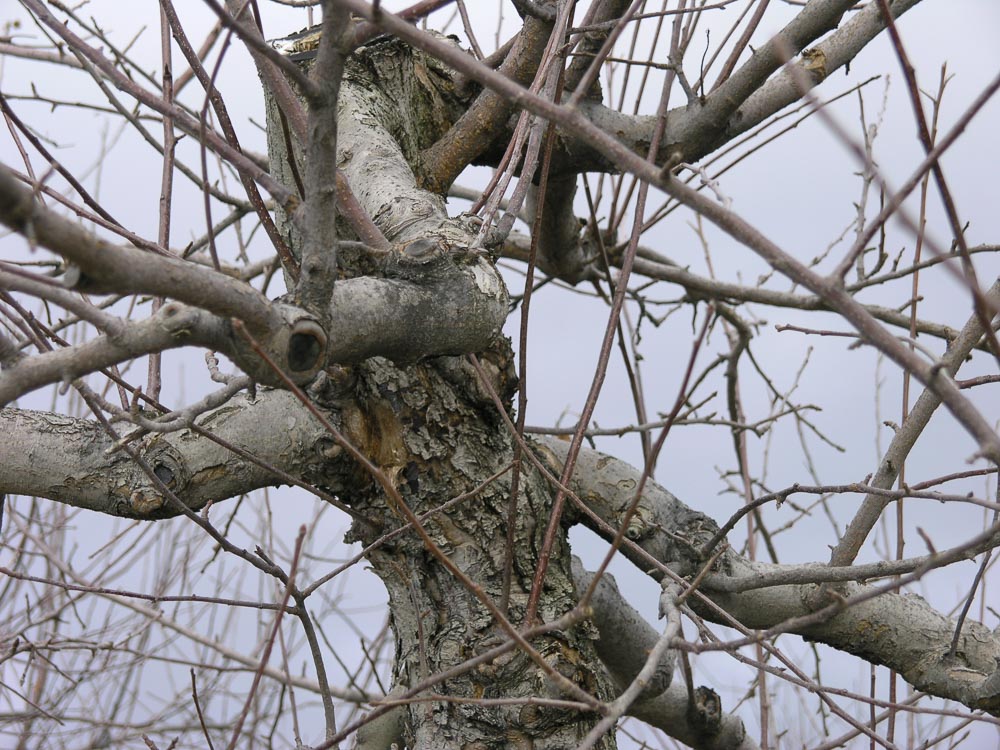
Pruning large apple trees changes one’s sensitivity to one’s own body. When I was diagnosed with breast cancer a few years ago, after the initial shock of the diagnosis, I was ready for surgery. Take off my breast. Let me be done with it. I knew from the orchard that quick removal prevents further spread of disease and I trusted that my body would heal. However, when I stand in front of a mirror my body is altered. Maybe I should accept another lesson the trees offer. We’re all lopsided, leaning in one direction or another, keen to hide our defects. The tree wears everything visibly. I can start at a twig tip and follow the growth in years right down the branch counting the unions. Branch collars signify large cuts; the jig-jag in a branch shows the annual reining in of fast-growing wood.
When pruning, I circle around each tree asking what is growing in the wrong direction, what is shading, where is the best fruiting wood? When I remove a large branch, I always look back at the new shape of the tree. I want to see that it was the right decision, that it was a good cut, that the tree is more open. And then there is that moment when I know I’ve done enough. I leave the tree trusting it will respond and move onto its neighbor.
I don’t know if the cancer has moved anywhere else in my body. There’s no snipping a branch to see its health. I learn to live with uncertainty. The prunings left in the orchard I will pick up and pile into a two-story mound. The apple buds that will never become fruit and the branches that contain so much history will be kindled, the fire will roar, and in the course of a day, it will all burn down to charred black bits and ash. When the embers are cold, I will rake what’s left and distribute a little to each tree. This dark carbon returns to the soil and the trees will benefit. They give of their bodies; then they receive.
Orchard Ruminants
Thoreau said that you must walk like a camel because it is said to be the only beast that ruminates while it walks. He got me pondering about this word ruminate. Chewing the cud is ruminating and pondering is also ruminating.
Ruminants are animals with multiple stomachs and the largest and first stomach is called the rumen. Cows, for example, have four stomachs. Grazing they fill their first one, the rumen, with barely chewed grass. Then they find a comfortable place to rest. From the rumen they bring back up this grass and chew and chew. They ruminate, they ponder, maybe even ask, “Who am I?” What is Cow?” The progressively smaller bits of grass when swallowed pass into the second stomach and then flow into the other two stomachs. Sharp thorns, crab grass — everything is broken down and all the nutrients are taken up. In this way cows and other ruminants eat plant materials that are indigestible by humans and animals with simple stomachs.

Sitting with Ox, wax: Sculpture, LH
Thoreau knew that camels are the only ruminants that walk when they ruminate. [1] I guess all the other ones sit on their duff. He chose the camel to chide us for sitting in libraries with our heads in books (or iPads) and not spending enough time outdoors. When he talked about walking and ruminating he meant that we should make the fields and woods our place to see and learn: we should be like the camel, walk and ruminate, be more present as we stride through this world.
Thoreau’s chiding got to me and I pulled myself out of my comfortable chair (away from my laptop), strapped my saw to my belt and grabbed loppers to begin pruning in the orchard. It was Ground Hog Day, an unseasonably warm day. Punxsutawney Phil (the ground hog in Pennsylvania) did not see his shadow, which meant that warm days were ahead. I tasted spring. It was like the instructions an enthusiastic French winemaker once told me for drinking a good wine, “Il faut le macher.” (You have to chew it.) I chewed spring, pondered over pruning decisions, and could even ruminate on the indigestible after a few hours among the trees.
Only three days later heavy snow fell. Punxsutawney Phil might make better predictions with a little more rumination, but I didn’t care. The snow was beautiful and because we prune apple trees every year they have strong limbs. A camel can carry two hundred pounds, but an apple tree easily holds this weight in fruit, or in snow. There is strength in walking as well as standing.

An apple tree doesn’t have one stomach or four stomachs, but you could consider the entire tree one great rumen. Sunlight, water, and minerals from the soil are turned into into complex carbohydrates, amino acids, and proteins. Not only do these trees grow healthy fruit, but they build organic soil and sequester carbon. Today Thoreau might say, we must stand still, grow deep roots: we must be more like the trees.
1. Technically camels are pseudo ruminants because they have three not four stomachs.
A Gathering of Seeds
Born in the industrial city of Chester, Pennsylvania, I lived in a cookie-cutter row house with a matchbox size front lawn. Agriculture was not part of my childhood, but there was one experience of the natural world that I remember vividly. Carrying a metal kitchen bowl I walked one day out of the house to the alley behind. Deliberately I sat in a patch of weeds and gathered the long stems that grew in abundance. Entranced by the seeds that grew along these stalks, I rubbed the thumb and fingers of my right hand along the stem against the grain. The seeds fell off in response to this slight pressure and began to accumulate in the bowl.
Dipping my hand into this primordial essence the most pleasurable experience ensued. I delighted in this touch as I herded the seeds from one side of the bowl to the other. A peace emerged from the motion and seemed to radiate out the way prayers flow out from prayer wheels. There was an affirmation that in touching these seeds I was complete and the world was whole. I didn’t notice the iron fence that separated me from the large cemetery abutting the alley. Nor did I think about the tent erected over a plot where three gravediggers were preparing for a burial. I was only attentive to the seeds in my bowl.
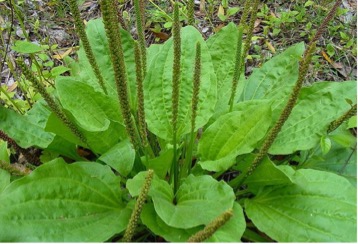
Broadleaf Plantain: photo from Herbal Cache
Now I recognize this weed as plantain and when I see it growing, I reach down, pluck a stem, and rub the seeds off the stalk. It’s also our ‘go to’ medicinal plant on the farm. When a bee stung me, Anna Fialkoff picked some plantain leaves, chewed them up, and globbed the macerated green paste on my leg. It soothed the ache and my ankle didn’t swell. Its long list of medicinal uses includes everything from cleaning the liver to treating fungal infections. Plantain teas, tinctures, and salves help with rashes, itching and irritations. It’s a universal cure.
Today I fear for the future of the polar bear, struggling to survive because the ice is melting and for the toothless African frog, endangered because its streams are dammed. Mountaintops are flattened and the erosion of topsoil is destroying our best agricultural land. I wish I could chew some plantain and heal the earth, but I know it’s not that simple.
However this common plant grows in vacant lots, between sidewalk cracks, in fields, along streams, and especially in poor or disturbed soil. As long as there is sunlight, plantain thrives and we can use it as medicine. You might try picking a stalk, running your fingers against the grain to remove the seeds, and offering them to the wind. I like to think these seeds will carry our prayers.

1/4 lb of rice: sculpture Linda Hoffman
Search Blog
-
2025
- May 9, 2025 A View from the Tractor Seat
- Apr 11, 2025 Dig
-
2024
- Jan 7, 2024 Winter Wassail
-
2022
- Dec 11, 2022 Keeping Time
- Jun 17, 2022 This Apple-Shaped Earth
- Jan 23, 2022 What is a Jizo?
- Jan 16, 2022 An Invite and Housekeeping Update
- Jan 1, 2022 The Year of the Frog: What Orchardists Do While Apple Trees are Chilling
-
2021
- Oct 24, 2021 Figs
- Oct 3, 2021 The Artist and the Orchard: A Memoir
- Aug 8, 2021 Red-Fleshed Apples
- Jul 25, 2021 When We Were Trees
- Jun 27, 2021 Castor Beans—Who Knew?
- Jun 13, 2021 Spring Training at a Zen Monastery
- May 4, 2021 Our Trees are in Bloom
- Apr 18, 2021 Hooray!
- Jan 24, 2021 Wassailing, virtually!
- Jan 1, 2021 Sitting
-
2020
- Dec 21, 2020 Darkness to Light
- Nov 28, 2020 One Heart
- Sep 18, 2020 Juggling Flowers, Fruit, and Vegetables
- Aug 23, 2020 Refuge
- Aug 9, 2020 Bags of Fertilizer
- Aug 2, 2020 The Sermon of the Blue Heron
- Jul 26, 2020 What's the Buzz?
- Jul 19, 2020 Farm Moments
- Jul 12, 2020 Lost Wax
- Jul 5, 2020 Catalpa: The Hugging Tree
- Jun 28, 2020 Pedaling Peace
- Jun 21, 2020 See Change
- Jun 14, 2020 Lalla Unveiled
- Jun 7, 2020 Pond Alchemy
- May 31, 2020 The Birth of Fruit
- May 24, 2020 An Artist in the Orchard
- May 17, 2020 Walking the Land: Returning Home
- May 10, 2020 Stinging Nettles: Gifts from the Great Mother
- May 3, 2020 The Mystery of Swallow
- Apr 26, 2020 Aerial Bruststrokes
- Apr 19, 2020 Simple Pleasures
- Apr 12, 2020 Weeds and Other Gifts
- Apr 5, 2020 Remembering the Seeds
- Mar 29, 2020 Blow on the Embers
- Mar 22, 2020 Ripples
-
2019
- Nov 16, 2019 Tibet Impressions
- Nov 9, 2019 Forest Tales
- Oct 13, 2019 The Gift
- Aug 4, 2019 The Season is Apples, Berries, and Grandfather Fire
- Jun 8, 2019 Pointers for a Writing Life
- May 12, 2019 Mothers of the Earth
- Apr 6, 2019 The Apple-Shaped Earth
- Mar 23, 2019 You Don’t Know What You Have Till It’s Gone
- Feb 23, 2019 Generations
- Feb 9, 2019 What Are We Doing to the Earth, John Chapman?
-
2018
- Dec 31, 2018 Long Shadows
- Oct 6, 2018 A Pilgrimage to India
- Aug 18, 2018 Scrap Wrenn
- Aug 11, 2018 Off-the-Wall Comments from an Ignorant Farmer
- Jul 28, 2018 Creative Connect
- Jul 14, 2018 How is the Orchard?
- Jun 30, 2018 Which Way?
- Jun 16, 2018 Geese, Herons, Beavers, and the Baby Steps of a Lapsed Blogger
- Feb 24, 2018 Mama's Coupons — Good Forever
- Jan 27, 2018 January Ice
- Jan 13, 2018 The Muse
-
2017
- Dec 30, 2017 A Dream for the New Year
- Dec 23, 2017 A New Year for Apples
- Dec 16, 2017 Intuition
- Nov 22, 2017 Thanksgiving OM
- Nov 4, 2017 East Fork Pottery
- Oct 28, 2017 Putting Down New Roots
- Oct 21, 2017 A is for Art
- Oct 14, 2017 Eve domesticus
- Oct 7, 2017 A String Workshop
- Sep 30, 2017 After Applepicking
- Sep 23, 2017 Two Bad Women and One Good Apple
- Sep 16, 2017 Plein Air Poetry
- Sep 9, 2017 Cutting Off a Leg
- Sep 2, 2017 The Changing Landscape
- Aug 26, 2017 All About Art
- Aug 19, 2017 My First Visit to the Farm
- Aug 12, 2017 The First Food
- Aug 5, 2017 A Teapot, a Woman, and maybe a Boat
- Jul 29, 2017 A Raspberry Dilemma
- Jul 22, 2017 Consider the Miracle
- Jul 15, 2017 Meeting Ekphrasis
- Jul 8, 2017 Ripening Fruit
- Jul 1, 2017 The Voice of The Caterpillar
- Jun 24, 2017 Goumi — An Unusual Fructus
- Jun 17, 2017 Concord, an American Bloomsbury
- Jun 10, 2017 The World Is Bonkers — Shall I Laugh or Cry?
- Jun 3, 2017 Bonkers, a Revolutionary Apple
- May 27, 2017 Guardians of the Swamp
- May 20, 2017 There are Mushrooms and There are Morels
- May 13, 2017 "What's in a Name?"
- May 6, 2017 Bloom Follows Pink: Orchard Pollination
- Apr 29, 2017 The Orchard Is at Pink
- Apr 22, 2017 Natural Farming — Part 2 (continuation from last Sunday's blog)
- Apr 15, 2017 Natural Farming — Part 1
- Apr 8, 2017 Boats, Figures, and Catching Fish
- Apr 1, 2017 A Man with a Mission: The Nuts and Bolts of Bronze Casting
- Mar 25, 2017 A Chalice of Spirit, Art, and Nature
- Mar 18, 2017 Hanami — Blossom Viewing
- Mar 11, 2017 Soil Redemption Song
- Mar 4, 2017 Food is Primary Care
- Feb 25, 2017 Pomme de Terre
- Feb 18, 2017 Organic Certification
- Feb 11, 2017 Tantalizing Fruit
- Feb 4, 2017 The Myths of History
- Jan 28, 2017 The Orchard in Winter
- Jan 21, 2017 The Hi-Line
- Jan 14, 2017 Artistic, Botanical, and Social Diversity
- Jan 7, 2017 Where is Eden?
-
2016
- Dec 31, 2016 The Creative Heart
- Dec 24, 2016 A Christmas Tale
- Dec 17, 2016 Who are the Crones?
- Dec 10, 2016 The Olympic Bell (Part Two)
- Dec 3, 2016 Overheard in the Apple Orchard in Early December
- Nov 26, 2016 The Lessons of a Tortoise
- Nov 19, 2016 In the Studio
- Nov 12, 2016 Even in Darkness
- Nov 5, 2016 Southern Apples, an Elephant, Monkey, Rabbit, and Bird, Two Mango Trees and a Birthday
- Oct 29, 2016 The Tools of Art
- Oct 22, 2016 Labyrinths
- Oct 15, 2016 Repairing the Broken
- Oct 8, 2016 When You Are No More
- Oct 1, 2016 Creation Rain
- Sep 24, 2016 Breaking the Glass
- Sep 17, 2016 String Art
- Sep 10, 2016 Poetry and Photosynthesis: It's all in the Leaves
- Sep 3, 2016 In the Plenty of Time
- Aug 27, 2016 Witch Doctors
- Aug 20, 2016 Listen Coyote
- Aug 13, 2016 Milkweed in the Orchard
- Aug 6, 2016 Some People See a Turtle
- Jul 30, 2016 Arborshaping
- Jul 23, 2016 Joseph Wheelwright: Sculptor of Stones and Trees
- Jul 16, 2016 Asian Pears
- Jul 9, 2016 Gold Leaf, Grief, and the Creative Process
- Jul 2, 2016 The Olympic Bell (Part One)
- Jun 25, 2016 Around the Mulberry Bush
- Jun 18, 2016 Avoiding Apples
- Jun 11, 2016 Fructus
- Jun 4, 2016 Astonishing Apples
- May 28, 2016 Scare the Caterpillars
- May 21, 2016 Join the Club!
- May 14, 2016 The Graft
- May 7, 2016 Rooster, Rhubarb, Rue
- Apr 30, 2016 What do Dolphins and Nettles Have in Common?
- Apr 23, 2016 Art Prunings
- Apr 16, 2016 A Few of the First Arrivals
- Apr 9, 2016 Taste the Spirit of Sustainable Agriculture
- Apr 2, 2016 First Orchard Spray - March 22-24, 2016
- Mar 26, 2016 Hawkeye Apple
- Mar 19, 2016 Desiring the Almata Apple
- Mar 12, 2016 Ugly Fruit
- Mar 5, 2016 Winter Tracks
- Feb 27, 2016 Splash
- Feb 20, 2016 Pruning
- Feb 13, 2016 Orchard Ruminants
- Feb 6, 2016 A Gathering of Seeds
- Jan 30, 2016 Orchard Dragons
- Jan 23, 2016 Tree Rings
- Jan 17, 2016 The Fallen Tree
- Jan 7, 2016 Wassailing the Apple Trees
- Jan 1, 2016 The New Year