LINDA HOFFMAN
There are Mushrooms and There are Morels
I’d heard people talk excitedly about hunting ‘morels,’ but never shared that experience. The only mushrooms I gather and eat are the shiitake we grow on logs here at the farm. When Holly, one of our farm workers, approached me in the orchard, and said, “What are those mushrooms under the trees?” I immediately went over to look.
Holly had been straightening out the irrigation drip lines, pulling them close to the trunks in the tree rows, so that when we mow they won’t get snagged. I had been weeding around young trees, putting cardboard down to suppress the weeds, and covering the cardboard with bark mulch. I followed Holly down one of the rows as she looked for a mushroom to show me. “Morels,” I said, instinctively, peering under the canopy of a large tree. I recognized the morels without really knowing I was familiar with them.
When I returned to the house I looked up morels, just to be sure. One photograph was all that was required. Sure enough, morels love growing under old apple trees. Morels have a distinctive shape, eerily similar to brain coral in surface, with elfin-like rounded turrets that poke up out of the ground, leaning this way and that.
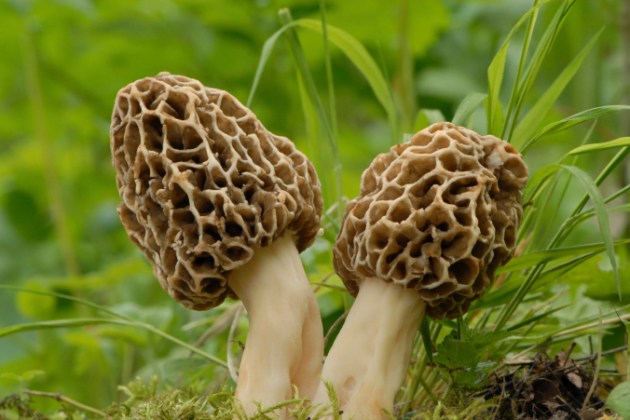
Photo credit: Thinkstock
Morels particularly like apple trees, poplar, and elm, but can be found just about anywhere. The challenge is to spot them. Sometimes you have to walk by a site several times, but once you notice one, you will usually see many more. Morels like days of sixty degrees and nights of forty degrees, and, of course, moisture — just the conditions we’ve had all spring. So perhaps we have had morels before, but so few that I didn’t notice. This is a bumper year for morels, they are calling out to be harvested. Otherwise, the mushrooms will dry up in a few days, resembling dark rice paper that will melt back into the ground. It did occur to me that I probably shouldn't be writing this blog—morel seekers guard their favorite gathering locations with religious fervor!
When I decided to collect the morels, I read about the best way to harvest them. Some aficionados claim that you should cut them just at ground level; others, that pulling with just a slight tug releases the mushroom with a little knob covered in dirt. The ones who favor cutting say that plucking may damage the mycelia threads and reduce future harvests. I decided to try both techniques. I went back to the orchard with a basket and pocket knife. Pulling them seemed so easy, as if they simply released willingly into your hand. It didn’t feel like I was doing any damage. Cutting them off is neat and clean, but left a hole in the hollow stem open to the air. After trying both approaches, I found myself preferring the pluck method, and harvested enough for lunch.
Blase and the day’s workers, Kevin, Mike, and Holly, were already in the kitchen. I sliced up the morels and added a few shiitake. In a heavy frying pan, I poured a little olive oil and a generous tad of butter. When the pan was hot and the butter melted, in went the mushrooms. While they were cooking, I added a little salt, a little rice bran oil with a very small amount of shoyu, and balsamic vinegar. We shared the exquisite, rich taste. I couldn’t imagine they would ever taste this good again. Two days later, my daughter, Ariel, and I went hunting, and brought home another basket full. I cooked them again, and they were scrumptious.
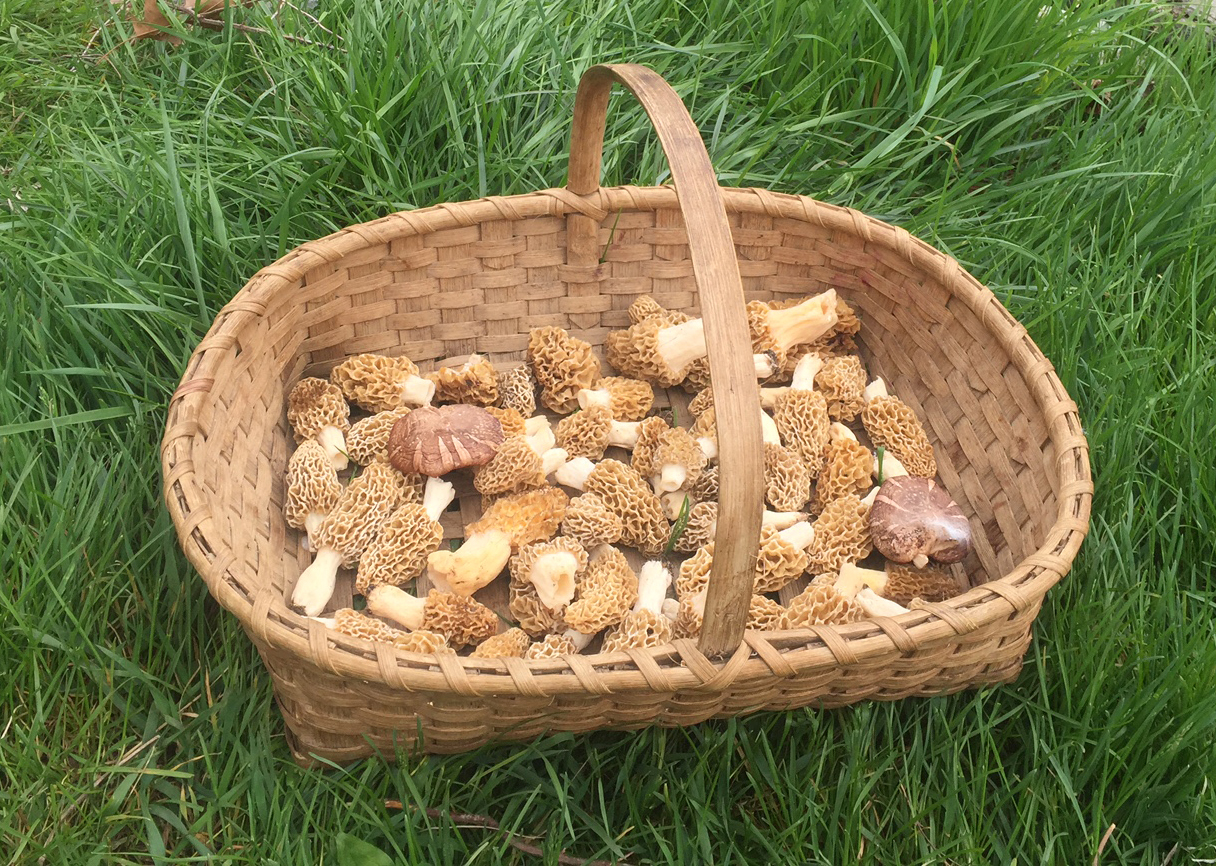
Morels with a couple of small shiitake.
"What's in a Name?"
Granny Smith, Bramley’s Seedling, and the picaresque Bloody Ploughman are names of apples with unique histories, but I, too, have had my own journey with names. I was born Linda Bess Weiner. When I was a child I disliked my middle name; it seemed too old fashioned. I got the sense from my mother that she really didn’t like it either. The name came from my father’s mother, an overbearing woman. I imagine that my mother must have felt pressured to do what her mother-in-law wanted and thus named me after my great-grandmother. When I was about ten, my mother said I could change it, and we decided together it would be Elizabeth. The initials, LEW, had a nice ring to them, and she gave me a necklace with those letters. We didn’t say anything to my grandmother. However, it never rolled off my tongue without a hiccup of some kind, a hemming and hawing, an exclamation that it wasn’t my real middle name. And then of course the question followed: “What is my middle name?”
After a few years, I simply dropped having a middle name. I was Linda Weiner. It wasn’t a last name that I particularly liked either. There was just too much childhood teasing — Oscar Meyer Weiner hotdogs and worse. Why couldn’t I have a normal last name? I especially felt this frustration given that my family had now moved from the working class refinery town of Chester, Pennsylvania, to Wynnewood, one of the towns of Philadelphia’s prominent Main Line. My schoolmates attended dances at the nearby Merion Cricket Club, but Jews were not allowed. We got along well enough at school, but clearly there were differences. My name gave away my legacy.
The English apple, Bloody Ploughman, was named after a ploughman who was shot by a local gamekeeper for stealing apples. And the popular, Granny Smith, was named after an Australian woman, Maria Smith, who rescued an apple growing in her compost heap. The Bramley, another English apple, was named for a Mr. Bramley who bought a house from Mary Ann Brailsford where she had planted a seedling which grew astonishingly good cooking apples. Bramley allowed a local nursery to propagate it on the condition that it would be named after him. I might have avoided planting this apple if I’d known its patriarchal history.
A group of new apples sport the name, ‘Crisp,’ including Honey Crisp, Golden Crisp, and Cosmic Crisp. The “crisp” in the name indicates that these apples have been bred to be particularly crispy, something the early 21st century public desires. One of my favorite new apples is Bonkers, a cross between a Delicious and a Liberty produced by Cornell University's apple breeding program in Geneva, New York. Bonkers is large, extremely crispy and juicy, and very red; and it is scab free, important for our organic orchard. The name, Bonkers, also has some kick, especially compared to other new scab-free apples like Pristine, Liberty, and Freedom.
When I moved to Cambridge, Massachusetts to live with Paul Matisse, the father of my three children, I told him that I didn’t particularly like my last name. How could I like ‘Weiner’ when I was living with a ‘Matisse,’ one of the most illustrious names in 20th century art? Paul said, “Why don’t you change it?” I immediately thought of the traditional Japanese poets who often took pen names. The Japanese haiku poet, Basho, over his lifetime published poems using three different names. Basho was the last one he adopted after his disciples built him a little hut and planted a basho, a banana tree, in front of it.
The idea appealed to me and I thought of a poetic name like River, a name taken from the natural world. Paul was quick to say, “No.” I think he imagined Linda River was too close to Joan Rivers or some Hollywood star’s stage name. “It should be a normal name,” he said, and he pulled out the Manhattan phone book, opened it at random to the H’s, and found Hoffman. So I took up Hoffman, and went to the Cambridge courthouse and officially changed my name. It was a sort of declaration that I no longer belonged to my family of origin. I was starting out fresh, a new person with Paul; I was a person without a family history.
When, twenty years later, I moved to a rundown farm with a large pond in Harvard, Massachusetts, I decided that I wanted to give this new home a name. I was a small frog leaping into a big pond, not knowing what was waiting for me under the water. I named the farm, Old Frog Pond Farm, after Basho’s haiku.
Old Pond
Frog Jumps
Splash of Water
It felt right to name the farm after a Japanese poem. It connected me to the time when I was living alone in Japan — young, inexperienced, and passionate about the Noh Theater.
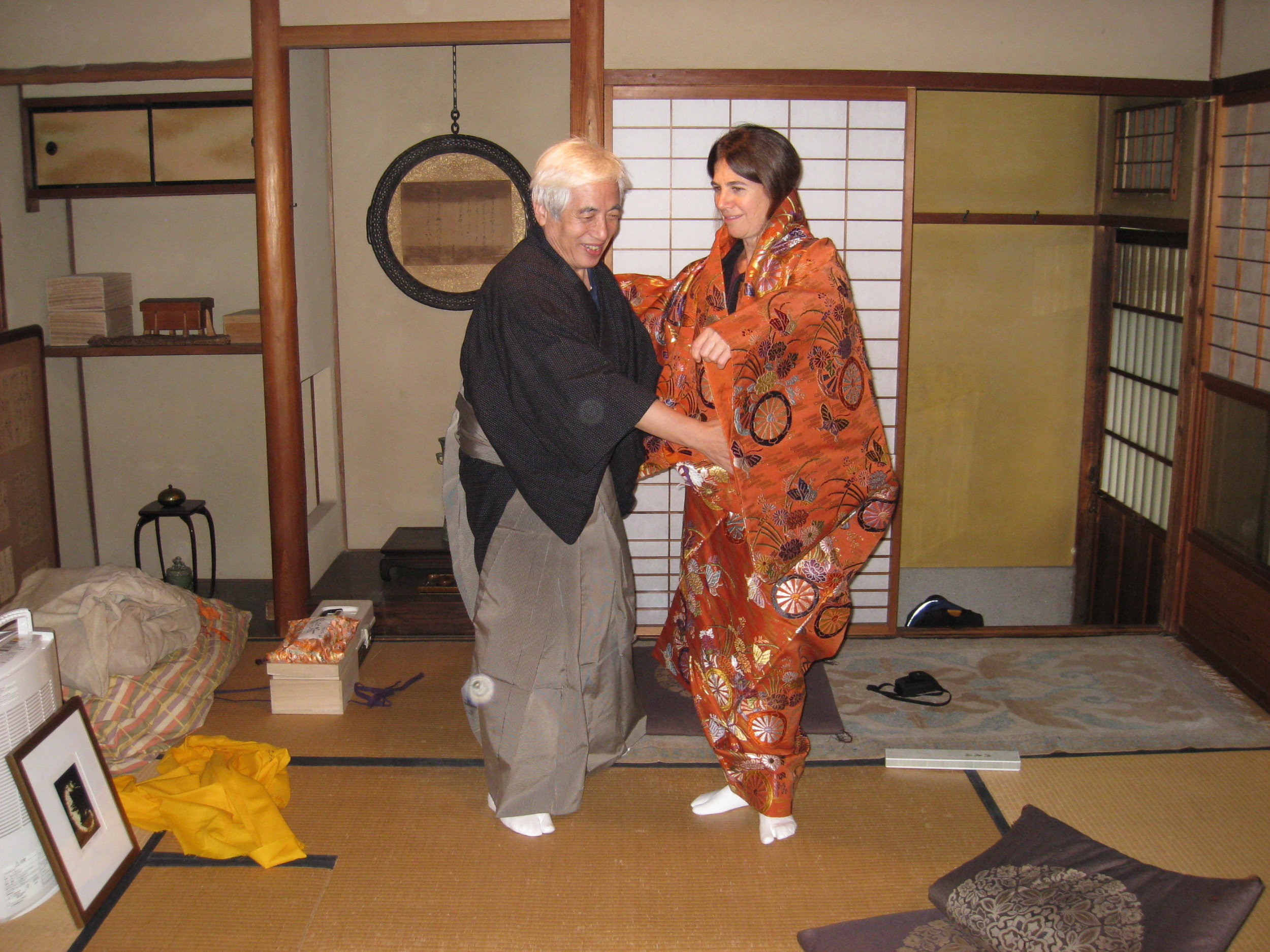
Trying on a silk kimono with my Noh teacher, Takabayashi Koji Sensei.
Naming the farm after Basho’s poem was the beginning of finding a true name, a place where I was grounded in the reality of the soil, physical work, and natural beauty. As I found firm ground beneath my feet, my old names no longer mattered.
Unlike us, an apple likely has no consciousness of its name; it simply grows, producing blossoms, leaves, and fruit regardless of what we call it. But the name can change our perception of an apple and create its market appeal. In a similar way, our own names can make a difference. Some names roll off the tongue easily, others are poetic, or connect us to a much-loved family member. Many people at midlife go back to their full birth name, and discard their childhood nickname, capturing a new identity in doing so. In 2010, I formally took Buddhist vows, and my teacher gave me the Buddhist name, Shinji. Shin means truth and ji means soil or earth. Truth in the soil. One’s Buddhist name is meant to be a teaching, something to aspire towards. I like when I am called Shinji by my Buddhist sangha and friends, and I am perfectly happy being called, Linda, or Mama, or Babe, the name my husband, Blase, uses, or Ama, the name my granddaughter uses.
We have a few seedling apples in the field near the Medicine Wheel with no names. These started growing from pips in the pumice we dumped from our apple pressing two years ago. If they continue to grow, they will each produce a unique variety of apple. Most likely the apples will be small and bitter, but you never know, one of them could be sweet and crisp, or be a great cooking apple like the Bramley seedling. And what would I name it? The Shinji apple has a nice ring, but I think the first seedling apple we grow will be named for my first granddaughter, the Vita Apple, the apple of my eye!
Bloom Follows Pink: Orchard Pollination

Bloom is the stage when the closed pink flower buds open to pale, white papery blossoms. This is when the party in the orchard really gets going. You can hear the swoosh of long dresses, the honeybees’ buzz; and follow the flight of the bumblebees, recklessly circling, then landing, the honeybees alighting on flowers, drinking in sweet nectar.
Bees visit a lot of flowers to gather this ambrosia, logging between several hundred and fifteen hundred flower visits on each trip through the orchard. They suck in the sweetness with their long proboscis, then store these sugars in their nectar stomach. Upon returning to the hive with a full belly, another bee will withdraw the nectar, process it, and transfer it into individual cells.

When the bees gather nectar from inside the apple blossoms, they brush across the pollen sitting on small pillows supported by stamens. The pollen grains attach to Velcro-like hairs on the bees’ bodies. When the bee visits another tree, the pollen from one tree is brushed from the bee onto the sticky female stigmas in the center of the blossom of another tree. The pollen grains travel down tubes to reach the ovary. There, sperm in the pollen grain meets the ovules in the ovary. These fertilized ovules become seeds, and the apple grows to protect the growing pips. We find this flesh delicious!
Honeybees need pollen and water, as well as nectar. The bees will divide up these responsibilities for the hive – some gathering pollen, their main source of protein; while others gather nectar for the sugars, and still others water. Some bees including honeybees have ‘pollen baskets’ on their hind legs formed by woven hairs. The bees also have hairs on the inside of their legs that they use like combs to gather the pollen sticking all over their bodies and push it into the basket, mixing in a little sticky nectar, so the pollen packs tightly. You can see the bees sporting bright yellow Turkish pants if you wander through the orchard when they are flying.
This year I am worried about pollination. I can’t remember a bigger bloom in the orchard — or this much spring rain! The bees don’t fly until the temperature reaches fifty-five degrees. In the last week, we’ve only had about five hours of honeybee pollinating temperatures without rain. Fortunately, the native pollinators, like the bumble bees, will fly in cooler temperatures. Only about five percent of apple blossoms need to be pollinated for a good harvest; the tree produces that many ‘extra’ flowers. But, maybe we should not consider them ‘extra.’ These flowers feed the many pollinators. The tree practices generosity. Giving and receiving are one.
If the apples practiced self-pollination, that is one flower on a tree pollinating other flowers on the same tree, it would require less flying. Peanuts, peas, tomatoes, and sunflowers are examples of self-pollinating plants. However, many plants, like most apples, have evolved to require cross-pollination to ensure genetic diversity. In scientific terms, this type of pollination is referred to as self-incompatible, or “unable to survive without another.” These plants all need another plant or tree in their life to bear fruit.
Cross-pollination is critical to a life cycle that ensures the continuity of the species. Maybe human beings aren’t so different. We are not self-compatible either. We need to interact with people different from ourselves to learn and grow. The cross-pollination of cultures, experiences, and ideas may be the ambrosia we need for a healthy, peace-filled world.

A Baltimore Oriole enjoying sweet nectar from a Macintosh tree.
The Orchard Is at Pink
apple buds fling
pink sweetness
spring frenzy
Apple growers, as well as beekeepers, fruit researchers, and orchard advisory consultants, all casually announce, “The orchard is at pink.” It’s their scientific way of saying, “The festivities are soon to begin.” Pink is one of the growth stages in fruit trees — when each tightly clustered fruit bud opens, and anywhere from five to seven individual flower buds, each enrobed in pink, magenta, or red petals, rise from a whorl of tender green leaves.

The King Bloom is encircled by buds.
Each one of these pink-robed buds is prepared to produce an apple. Before finding myself the owner of a small orchard, I assumed that one fruit bud would create one apple. But the apple tree wants to ensure its own longevity: each fruit bud opens to a cluster of blossoms, with each blossom capable of producing fruit. In the center is the King Bloom, the strongest and largest. All the others are in reserve, princes and princesses waiting to take over the throne should something happen to the King. The King Bloom opens first, and the others follow soon after. It’s possible that each of these pink buds will produce an apple with the King Bloom in the center.
Pink is the time when the banquet table is set. The scurrying and preparation is done. The orchard grasses have greened, the daffodils and dandelions are in bloom, and we have planted out our new trees. The first loud guests arrive. Robins and mourning doves hop from ground to tree; bluebirds flit through the branches. The herons are back and fly their pattern from Delaney wetlands to beyond the orchard and back again, necks stretching, wings flapping, achingly beautiful. Geese honk incessantly defending their nesting areas, and a pair of swans antagonizes any creature not respectful of their water rights.
Last Sunday I saw my first bumblebee, and on Monday, Melissa Ljosa brought two hives of honeybees who will live here all year. I had to take a sculpture to the Design Center in Boston that morning and when I returned, I heard the bees as I walked among our Asian pear trees. I didn't have to look; I could feel their buzzing energy.
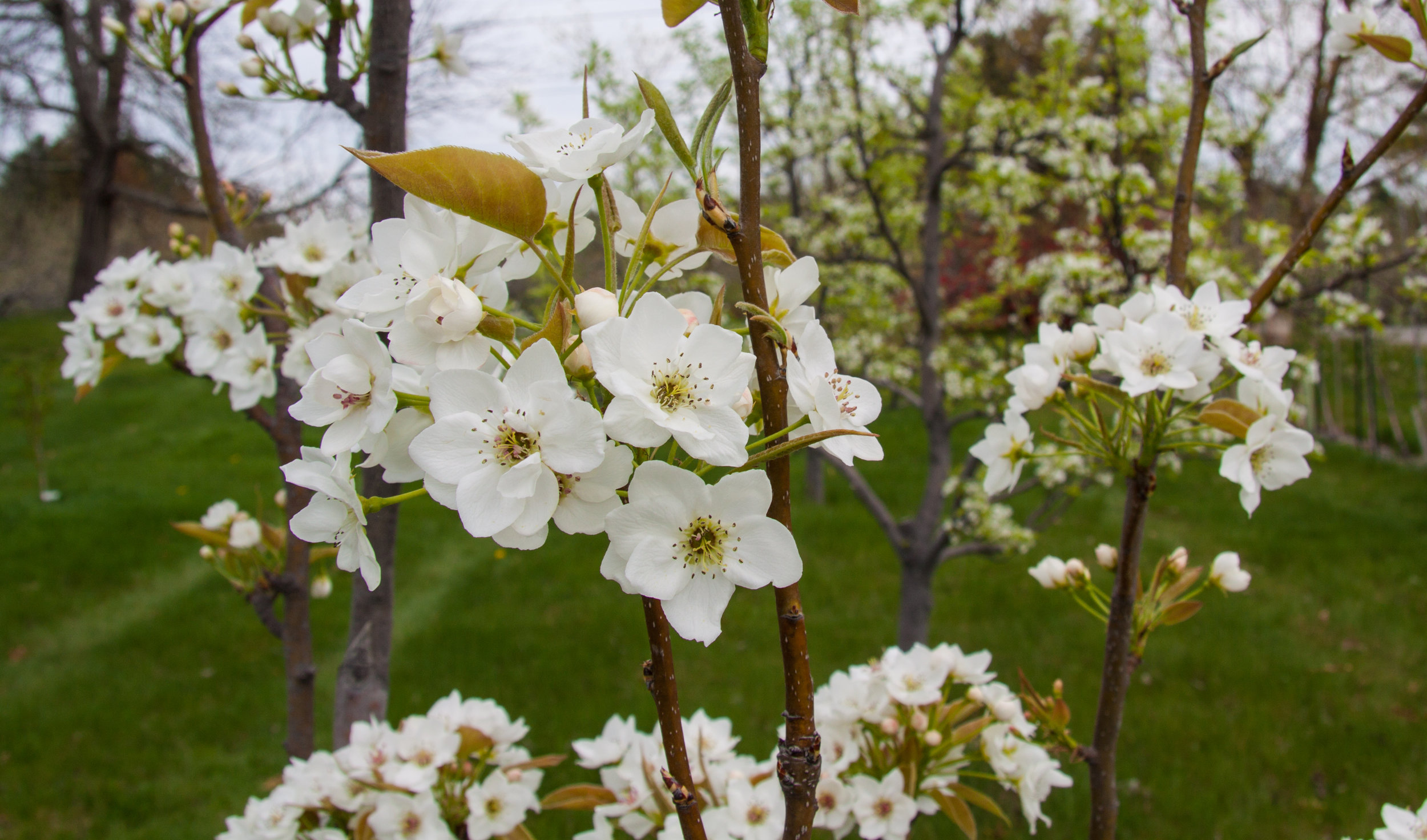
Asian pear white buds.
Our Asian pears are in full bloom, always one stage ahead of the apples. I smelled the trees’ sour scent. Asian pears, so delicious and sweet to eat, give off an unappealing odor, old cheese, (at least judged by this human). Pears, as well as plums and cherries, have white fruit buds, thus, orchardists don’t use the designation pink, but white bud. These clusters of white buds are beautiful, but only apples have a rosette of green leaves with pink rising. This contrast of color makes apple blossoms magical.
When the apple orchard was at pink, I used to call Gus Skamarycz, our beekeeper for many years before he retired. My call at pink would let him know the blossoms had donned their lipstick and were almost ready to greet the bees. He would wait a few days, and then arrive before sunup with two hives. I would meet him in the orchard, his bees still asleep.
“Why so early?” I asked the first year.
“I want the bees to open their eyes in a new place, see the blossoms, and go to work,” he replied.
When I asked, “How long does it take a hive to pollinate an orchard?” Looking around, Gus said, “A strong hive can pollinate this orchard in a few hours, but you have different varieties.”
Not all of our trees will bloom at the same time. The Macintosh apples are the first to open and the earliest to ripen; the Golden Blushing apples reach full blossom two weeks later—their ripening peaks in early October. Gus’s bees would stay for two weeks to provide pollination for all the trees. With Melissa’s two hives now in residence, we don’t worry about pollination and she doesn’t worry about food for her bees.
Next week we will be at bloom in the apple orchard, the stage when the pink buds open. Join us next Saturday, May 6 for Blossom Viewing. We’ll be in the orchard from 3 to 5 if the day is sunny. Bring paints, pen and paper or a poem to share; we’ll listen to the bees and toast the trees, our own free-form, apple blossom viewing.
Search Blog
-
2025
- May 9, 2025 A View from the Tractor Seat
- Apr 11, 2025 Dig
-
2024
- Jan 7, 2024 Winter Wassail
-
2022
- Dec 11, 2022 Keeping Time
- Jun 17, 2022 This Apple-Shaped Earth
- Jan 23, 2022 What is a Jizo?
- Jan 16, 2022 An Invite and Housekeeping Update
- Jan 1, 2022 The Year of the Frog: What Orchardists Do While Apple Trees are Chilling
-
2021
- Oct 24, 2021 Figs
- Oct 3, 2021 The Artist and the Orchard: A Memoir
- Aug 8, 2021 Red-Fleshed Apples
- Jul 25, 2021 When We Were Trees
- Jun 27, 2021 Castor Beans—Who Knew?
- Jun 13, 2021 Spring Training at a Zen Monastery
- May 4, 2021 Our Trees are in Bloom
- Apr 18, 2021 Hooray!
- Jan 24, 2021 Wassailing, virtually!
- Jan 1, 2021 Sitting
-
2020
- Dec 21, 2020 Darkness to Light
- Nov 28, 2020 One Heart
- Sep 18, 2020 Juggling Flowers, Fruit, and Vegetables
- Aug 23, 2020 Refuge
- Aug 9, 2020 Bags of Fertilizer
- Aug 2, 2020 The Sermon of the Blue Heron
- Jul 26, 2020 What's the Buzz?
- Jul 19, 2020 Farm Moments
- Jul 12, 2020 Lost Wax
- Jul 5, 2020 Catalpa: The Hugging Tree
- Jun 28, 2020 Pedaling Peace
- Jun 21, 2020 See Change
- Jun 14, 2020 Lalla Unveiled
- Jun 7, 2020 Pond Alchemy
- May 31, 2020 The Birth of Fruit
- May 24, 2020 An Artist in the Orchard
- May 17, 2020 Walking the Land: Returning Home
- May 10, 2020 Stinging Nettles: Gifts from the Great Mother
- May 3, 2020 The Mystery of Swallow
- Apr 26, 2020 Aerial Bruststrokes
- Apr 19, 2020 Simple Pleasures
- Apr 12, 2020 Weeds and Other Gifts
- Apr 5, 2020 Remembering the Seeds
- Mar 29, 2020 Blow on the Embers
- Mar 22, 2020 Ripples
-
2019
- Nov 16, 2019 Tibet Impressions
- Nov 9, 2019 Forest Tales
- Oct 13, 2019 The Gift
- Aug 4, 2019 The Season is Apples, Berries, and Grandfather Fire
- Jun 8, 2019 Pointers for a Writing Life
- May 12, 2019 Mothers of the Earth
- Apr 6, 2019 The Apple-Shaped Earth
- Mar 23, 2019 You Don’t Know What You Have Till It’s Gone
- Feb 23, 2019 Generations
- Feb 9, 2019 What Are We Doing to the Earth, John Chapman?
-
2018
- Dec 31, 2018 Long Shadows
- Oct 6, 2018 A Pilgrimage to India
- Aug 18, 2018 Scrap Wrenn
- Aug 11, 2018 Off-the-Wall Comments from an Ignorant Farmer
- Jul 28, 2018 Creative Connect
- Jul 14, 2018 How is the Orchard?
- Jun 30, 2018 Which Way?
- Jun 16, 2018 Geese, Herons, Beavers, and the Baby Steps of a Lapsed Blogger
- Feb 24, 2018 Mama's Coupons — Good Forever
- Jan 27, 2018 January Ice
- Jan 13, 2018 The Muse
-
2017
- Dec 30, 2017 A Dream for the New Year
- Dec 23, 2017 A New Year for Apples
- Dec 16, 2017 Intuition
- Nov 22, 2017 Thanksgiving OM
- Nov 4, 2017 East Fork Pottery
- Oct 28, 2017 Putting Down New Roots
- Oct 21, 2017 A is for Art
- Oct 14, 2017 Eve domesticus
- Oct 7, 2017 A String Workshop
- Sep 30, 2017 After Applepicking
- Sep 23, 2017 Two Bad Women and One Good Apple
- Sep 16, 2017 Plein Air Poetry
- Sep 9, 2017 Cutting Off a Leg
- Sep 2, 2017 The Changing Landscape
- Aug 26, 2017 All About Art
- Aug 19, 2017 My First Visit to the Farm
- Aug 12, 2017 The First Food
- Aug 5, 2017 A Teapot, a Woman, and maybe a Boat
- Jul 29, 2017 A Raspberry Dilemma
- Jul 22, 2017 Consider the Miracle
- Jul 15, 2017 Meeting Ekphrasis
- Jul 8, 2017 Ripening Fruit
- Jul 1, 2017 The Voice of The Caterpillar
- Jun 24, 2017 Goumi — An Unusual Fructus
- Jun 17, 2017 Concord, an American Bloomsbury
- Jun 10, 2017 The World Is Bonkers — Shall I Laugh or Cry?
- Jun 3, 2017 Bonkers, a Revolutionary Apple
- May 27, 2017 Guardians of the Swamp
- May 20, 2017 There are Mushrooms and There are Morels
- May 13, 2017 "What's in a Name?"
- May 6, 2017 Bloom Follows Pink: Orchard Pollination
- Apr 29, 2017 The Orchard Is at Pink
- Apr 22, 2017 Natural Farming — Part 2 (continuation from last Sunday's blog)
- Apr 15, 2017 Natural Farming — Part 1
- Apr 8, 2017 Boats, Figures, and Catching Fish
- Apr 1, 2017 A Man with a Mission: The Nuts and Bolts of Bronze Casting
- Mar 25, 2017 A Chalice of Spirit, Art, and Nature
- Mar 18, 2017 Hanami — Blossom Viewing
- Mar 11, 2017 Soil Redemption Song
- Mar 4, 2017 Food is Primary Care
- Feb 25, 2017 Pomme de Terre
- Feb 18, 2017 Organic Certification
- Feb 11, 2017 Tantalizing Fruit
- Feb 4, 2017 The Myths of History
- Jan 28, 2017 The Orchard in Winter
- Jan 21, 2017 The Hi-Line
- Jan 14, 2017 Artistic, Botanical, and Social Diversity
- Jan 7, 2017 Where is Eden?
-
2016
- Dec 31, 2016 The Creative Heart
- Dec 24, 2016 A Christmas Tale
- Dec 17, 2016 Who are the Crones?
- Dec 10, 2016 The Olympic Bell (Part Two)
- Dec 3, 2016 Overheard in the Apple Orchard in Early December
- Nov 26, 2016 The Lessons of a Tortoise
- Nov 19, 2016 In the Studio
- Nov 12, 2016 Even in Darkness
- Nov 5, 2016 Southern Apples, an Elephant, Monkey, Rabbit, and Bird, Two Mango Trees and a Birthday
- Oct 29, 2016 The Tools of Art
- Oct 22, 2016 Labyrinths
- Oct 15, 2016 Repairing the Broken
- Oct 8, 2016 When You Are No More
- Oct 1, 2016 Creation Rain
- Sep 24, 2016 Breaking the Glass
- Sep 17, 2016 String Art
- Sep 10, 2016 Poetry and Photosynthesis: It's all in the Leaves
- Sep 3, 2016 In the Plenty of Time
- Aug 27, 2016 Witch Doctors
- Aug 20, 2016 Listen Coyote
- Aug 13, 2016 Milkweed in the Orchard
- Aug 6, 2016 Some People See a Turtle
- Jul 30, 2016 Arborshaping
- Jul 23, 2016 Joseph Wheelwright: Sculptor of Stones and Trees
- Jul 16, 2016 Asian Pears
- Jul 9, 2016 Gold Leaf, Grief, and the Creative Process
- Jul 2, 2016 The Olympic Bell (Part One)
- Jun 25, 2016 Around the Mulberry Bush
- Jun 18, 2016 Avoiding Apples
- Jun 11, 2016 Fructus
- Jun 4, 2016 Astonishing Apples
- May 28, 2016 Scare the Caterpillars
- May 21, 2016 Join the Club!
- May 14, 2016 The Graft
- May 7, 2016 Rooster, Rhubarb, Rue
- Apr 30, 2016 What do Dolphins and Nettles Have in Common?
- Apr 23, 2016 Art Prunings
- Apr 16, 2016 A Few of the First Arrivals
- Apr 9, 2016 Taste the Spirit of Sustainable Agriculture
- Apr 2, 2016 First Orchard Spray - March 22-24, 2016
- Mar 26, 2016 Hawkeye Apple
- Mar 19, 2016 Desiring the Almata Apple
- Mar 12, 2016 Ugly Fruit
- Mar 5, 2016 Winter Tracks
- Feb 27, 2016 Splash
- Feb 20, 2016 Pruning
- Feb 13, 2016 Orchard Ruminants
- Feb 6, 2016 A Gathering of Seeds
- Jan 30, 2016 Orchard Dragons
- Jan 23, 2016 Tree Rings
- Jan 17, 2016 The Fallen Tree
- Jan 7, 2016 Wassailing the Apple Trees
- Jan 1, 2016 The New Year