LINDA HOFFMAN

Mothers of the Earth
It’s a rainy and cold Mother’s Day morning. I smile though, as I walk to the studio and meet two families of geese shuffling their puff balls away from my threatening presence. The tireless care of these geese parents for their young, the overprotection, their ceaseless devotion strikes me as radical. What if we offered this kind of care to the world?
This morning I have no sculpture installations, no farm workers, visitors, or meditators. I thought about what I wanted to do with my free morning—a yoga class for my body, meditation for the mind, painting for the muse. There has been so much doing in the last month. Good doing, yes. Caring for the trees and the land. Meeting and helping artists. Delicious lists of a new asparagus bed to dig, raspberries to weed, young apple trees to weed and mulch, potatoes to plant, mowers to fix, dead trees to take down, buried rice to feed (we’re growing our own effective microbes to inoculate compost and orchard teas) and so on. But writing this blog is not on my to-do list, it is not something I do and say, now that’s done. It grows from a particular seed of quiet with the shape and color that only comes from being alone. I have to weed the garden of its to-dos in order to uncover what is growing.
Last Sunday we had a Crone Ceremony for the first time at the farm. Thirty-three women gathered to celebrate and bless each other.
An Online Etymology Dictionary defines crone with a lot of negativity:
late 14c., "a feeble and withered old woman," in Middle English a strong term of abuse, from Anglo-French carogne "carrion, carcass; an old ewe . . ."
The defintion ends with:
Since mid-20c. The word has been somewhat reclaimed in feminism and neo-paganism as a symbol of mature female wisdom and power.
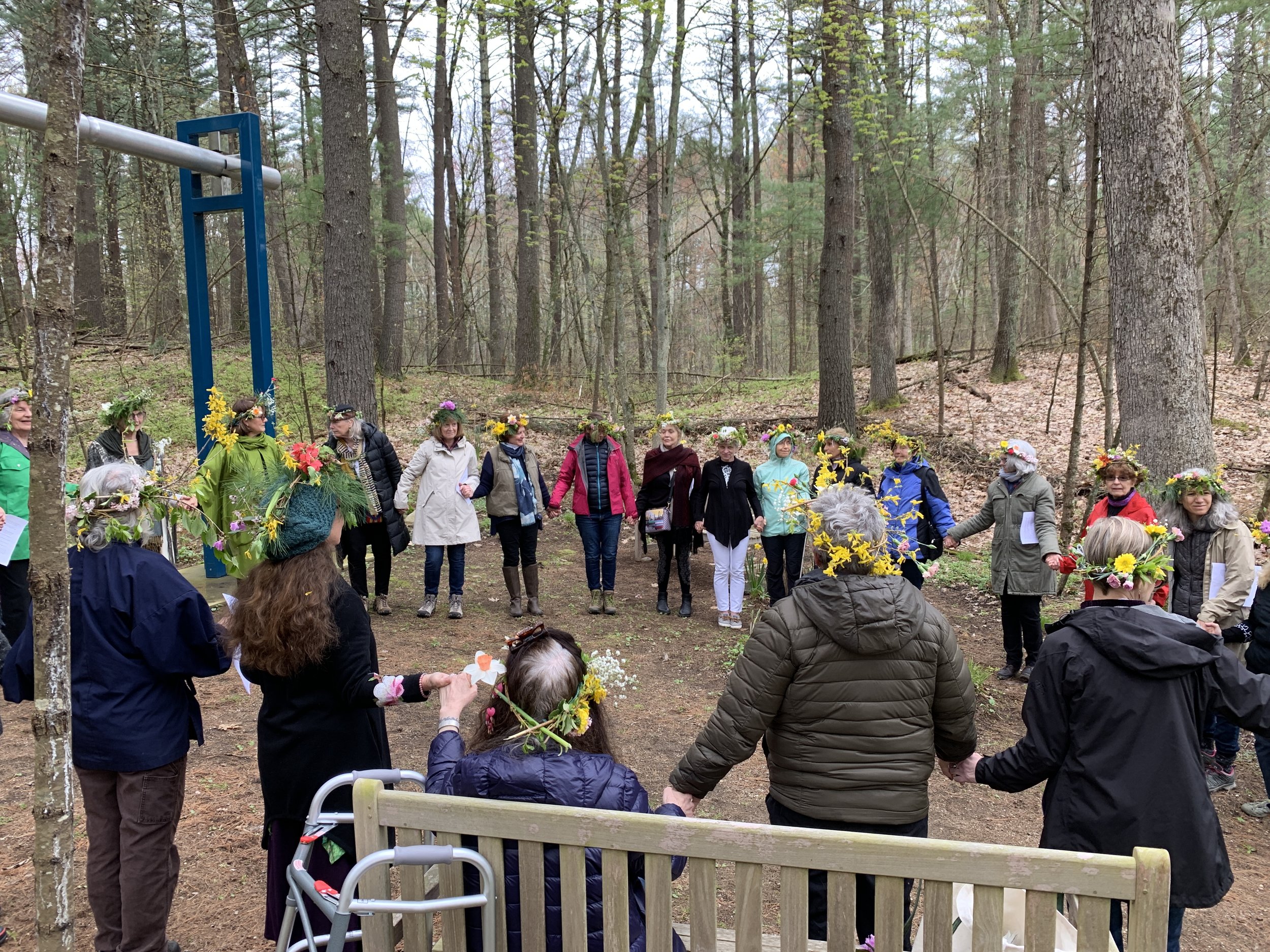
At our gathering, we made ourselves crowns with fresh forsythia branches and flowers. We joined to acknowledge the new shape of our lives as older women, as wise and creative women with enough experience to trust our intuition. We rang The Olympic Bell and listened as its deep note resounded through the grove of pine trees. We let go of habits that no longer serve our lives today by tossing a symbolic twig or stone into the current of the pond. We owned our creativity and freedom as we sang, Amazing Crones to the tune of Amazing Grace, and celebrated that we still have much to offer the world. We ended our ritual in a circle in The Medicine Wheel as each woman asked to be blessed, and the group chorused, We bless you, and spoke her name.

Like the cherry petals that have fallen, the flowers in our crowns faded quickly. I tossed mine into the woodstove the next morning. But, this week, the orchard apples opened their pink cloud hues and row upon row like trackless waves billow on every side. Will the Gods favor us with a good crop? Will the low temperatures forecast for Tuesday night freeze the about-to-open blossoms? Will bloom sustain the wind and rain long enough for the pollinators to do their work on the next sunny day?
Will our bodies trouble us too much so that we can no longer do the things we love? At our gathering we had one women who could no longer walk unsupported because of progressively debilitating Multiple Sclerosis. As she stepped with her walker into the middle of the circle, we felt her bravery and her struggle.
On this Mother’s Day, I offer a prayer for the earth and a blessing for our children and their children. May we do the work to provide good medicine to heal our beloved planet Earth. May we creatively cultivate the opening of all hearts for every sentient being. May we find the seeds of quiet to reconnect with what is important so that future generations will blossom and bear fruit.
We’re all mothers of the earth. Happy Mother’s Day!

The Apple-Shaped Earth
My last blog post was about the threat of one million square feet of warehouses being built not far from our orchard. With the concerned opposition of many citizens of Boxborough, we held back the tidal wave of development — at least for the moment. The planning board pulled their zoning articles from the upcoming town meeting warrant. There will be no vote on re-zoning until the fall. That change will give everyone time for regrouping and envisioning. The property at 1414 Massachusetts Avenue is still owned by Lincoln Properties, and warehouses are the most lucrative way for them to develop their land. The website of the Boxborough community group, Save Our Town Character says, “The potential for Zoning changes to allow warehouses as described below is still very high.” The need to protect the land and the character of the neighborhood is ongoing, but spring has officially arrived, and farm work has begun.
On our first day, Blase, Holly, our new farm worker, John, and I enjoyed the yearly ritual of burning the apple prunings. Ignited by a dry Christmas tree, crumbled newspaper, and kindling, the fire of prunings swayed in the wind. Sparks rose, and apple smoke filled a cloudless sky. Mallards, great blue herons, a woodpecker, and red-winged blackbirds chirped melodies.
I staked for the planting of fifty-three new trees from the apple rootstock we grafted one year ago. Blase attached the back hoe and has begun digging the holes. He is as much devoted to this farm and the orchard as I am.
It will be a marathon of planting. In each hole, the tap root will lead to the north. We’ll mix a little compost and our own bio-char from the burn, a great amendment for the soil, made by dousing the fire before it burns to ash. A cedar stake will go in each hole to support the tree as it grows, and we’ll back fill by hand, removing the large rocks, our most reliable crop. Trees will be watered, blessed, and mulched to suppress the competition with tough orchard grasses. We’d gladly welcome volunteers!
Next the airblast orchard sprayer needs to be tested and calibrated for the season. And oh, the hardest part for me, what are we going to spray? There are more options now for organic growers, and one tendency is to want to try everything. Another approach is to allow the trees to fend for themselves, building up their own immune system like a child must do who goes to preschool. I prefer the middle way, doing what we can to help build the immune system of the trees by improving the soil and spraying nutrients.
Last weekend we visited our grandchildren. Both girls had runny noses, and Blase came home with a nasty cold. As a friend remarked, “Young children are like Petri dishes.” Some might say apple leaves are similar. Every leaf is an incubator where good and bad bacteria and fungi duke it out, and the strongest wins and colonizes the leaf. We want to do what we can to encourage the good guys rather than spraying to get rid of the bad. And, once in a while, we will spray an organic pesticide for a particularly destructive pest, rather than lose the crop.

A mid-June apple hidden behind a leaf with spots of cedar apple rust.
The next two months will be the most crucial for the orchard. Will we have blossoms? Pollinators? Fruit set? A crop? Today, with the added pressures brought on by climate change, these are real questions. Orchards, like lands protected for conservation, keep us alive emotionally, spiritually, and physically. Our country was founded on the promises of agriculture, of self-sufficiency, of everyone growing food and fruit. The fruit orchard was a symbol of this belief in hard work, community, and opportunity for all. We are now far from this ideal as we destroy forests, oceans, and even the air.

Sculpture LH
But the apple remains a fruitful inspiration, as it was in the nineteenth century when Walt Whitman wrote in A Song of Occupations, decades before space ship photographs,
The sun and the stars that float in open air,
the apple-shaped earth and we upon it,
surely the drift of them is something grand.
You Don’t Know What You Have Till It’s Gone
Our farmhouse is in Harvard, but many people don’t know that our apple orchard is in Boxborough. We were recently told by a neighbor about a proposed zoning overlay district in Boxborough that would change the zoning of our farm as well as adversely affect our neighbors in Harvard, Boxborough and surrounding towns.
The proposed overlay district comprises 371 acres and will enable the Lincoln Property Company to build four warehouses, 1,020,000 square feet. These four giant ‘cubes’ would cover twenty-three acres of formerly forested land within several thousand feet of our property.
Elizabeth Brook feeds the large wetlands area that flows around our orchard, and into the 500+ acres of Delaney Conservation area. In the last two weeks we have had two sightings of a bald eagle flying over the orchard and Elizabeth Brook wetlands. This proposed development would massively disturb this fragile ecosystem and threaten the aquifer that feeds our wells.

Great Blue Returned on the Spring Equinox
Many of you who have been reading my blog know of the struggle I have faced in growing organic apples over the last few years. Climate change is one factor, but I recently learned of another issue when I attended the Holistic Apple Grower’s Meeting in Western Massachusetts earlier this year. A new fungus, Marssonina Leaf Blotch, causes apple leaf defoliation in apples when a fungicide is not sprayed throughout the growing season. Arriving in this country from Asia, it first appeared in the western part of the country, defoliating thousands of acres of aspens in Utah, but is now in New England. Orchards spray fungicides for scab, the fungal disease most serious for apple growers in New England where the summer weather is often warm and wet. Organic growers have less choice in sprays to control this disease, so I made the hard decision a year ago to remove our Macintosh trees, known to growers as scab magnets. Right after the trees came down, friends joined me to graft one hundred rootstocks with scab resistant apples. These one-year-old saplings grew well in our hoop house for the year and are ready to be planted.
The disappearance of the gnarly Macintosh trees in the first few rows of the orchard caused neighbors to wonder if we were cutting down the entire orchard. I assured people we were not giving up. I have shared my lessons and strivings in growing organic apples, but none-the-less have continued to remain faithful to the trees and the land that have nourished me since I moved here in 2001.
Giving up on the earth, our government, or any issue that is challenging doesn’t solve anything. We have to do the work and stand by our convictions. Liberty Property Company’s build might take ten years, and who is to say that in twenty years, these warehouses won’t be obsolete as everything will be drop-shipped. Tax revenue is an important consideration for all of our communities, but in preserving our towns’ rural nature, its conservation lands, farmland, wildlife, clean water and night sky we make sure that our town remains a desirable place to live and that our property values stay high. Warehouses will not serve the local community, and in fact will cause a serious disruption to our way of life.

Many Boxborough residents heard for the first time about the proposed changes to their bylaw only recently. It seems that there has been a quiet, but legal effort to slip this bylaw change through Town Meeting by highlighting the ‘gifts’ to the town, but not mentioning the warehouses. If you know anyone in Boxborough, please make sure they know about this change in their bylaws coming up for a vote at Town Meeting in May.
I look at the wetlands and the orchard now with a new set of eyes. The runoff into the wetlands might mean we can no longer irrigate. Boxborough neighbors say that with the twenty-acre solar panel array, phase one of Liberty Realty’s development plans, they hear Route 495 in their homes even with the windows closed. More traffic sound reflecting off twenty-three acres of roofs will certainly eclipse the twangs of red-winged blackbirds, chirps of robins and bluebirds, honks of geese, and squawks of herons. And it will be impossible to hear the apple trees. “They can speak, trees . . .” says the 14th century poet, Hafiz in his poem, An Apple Tree Was Concerned.
An apple tree was concerned
about a late frost and losing its gifts
that would help feed a poor family close by.
Can't the clouds be generous with what falls from them?
Can't the sun ration itself with precision?
They can speak, trees,
they can say the sweetest things
but it takes special ears to hear them,
ears that have listened to people
with great care.

My daughter, Ariel, picking Honey Crisp Apples in 2017
We face choices everyday about how we use the earth’s limited resources.
Let us choose wisely.

Generations
Dedicated to Annette Barbara Weiner (1933–1997)
I was recently prompted to read “Once More to the Lake,” the essay E. B. White wrote about returning to his childhood summer home, this time with his eleven-year-old son. For White, then 43, memories flooded back as he gazed at his son’s hands on the fishing rod. White no longer knew who he was—the son of his father or the father of his son. Disturbed by this unsettling dichotomy he wrote:
I looked at the boy, who was silently watching his fly, and it was my hands that held his rod, my eyes watching. I felt dizzy and didn't know which rod I was at the end of.
What is passed between parent and child, and how does this happen?
Generations is the title of the current exhibit at Hopkinton Center for the Arts, and the title refers to the relationship of the two exhibiting artists, my daughter, Ariel Matisse, and myself. Less than two years ago, Ariel decided to make an outdoor sculpture for our annual sculpture exhibit at the farm. This was the summer after she helped with the exhibit, After Apple Pruning . Taken with using wire while working on a collaborative sculpture for that exhibit, Ariel wanted to make a wire tree and asked to use a hollow log I had in the studio. I’m always fascinated with hollow logs—the form and the emptiness. The heart sutra, chanted daily in all Buddhists monasteries, says, Form is emptiness, emptiness is form. Ariel wanted to gold leaf the saw cut, the way I have done since making the six-part Inside the Ordinary Maple in 1998.

Inside the Ordinary Maple, wood and gold leaf, LH
“Of course, I will show you.” First you sand it smooth, gradually using finer sand paper. Then it needs to be urethaned to seal the wood. Moisture seeping up into the gold leaf will lift it. Then you need to apply the sizing and wait for it to be the perfect tackiness to receive the leaf.
Gold leaf is between .1 and .125 millionths of a meter or micrometers. One thousand sheets will equal an ordinary piece of paper. It’s not something you can grasp with your fingers. To pick up a small fragment, you will find a soft watercolor brush is useful, rubbing it first in your hair to create some static electricity. For large areas, I use a rolled leaf that comes with a thin backing material. Once the leaf is placed down on the sizing and pressed in gently, you lift off the backing.
Ariel and I sat around the log each on our stool, our hands moving together. I watched her fingers. They knew how to hold the tools, to feel the smooth surface of wood, to lift the backing. I showed her how to shine the gold, to burnish it with a cotton ball.
Then the project was all hers. Cutting wire to length, hanging this Medusa head of tangled wires from a hook on the ceiling, bending, shaping, counting the complex pattern. Twisting the roots and drilling the ends into the trunk. Where did she learn all of this? When? What is transferred between mother and daughter? Or, father and daughter ? Ariel’s father is a gifted ‘maker of things’, as he likes to say.
When the director of the Center, Kris Waldman, needed a show to fill the slot from January 25 to March 15, my name was suggested. She came to the studio on December 24th and took photos. As she was leaving, I said I’d like to do the exhibit with my daughter. She was surprised at first, but then I pointed out two of Ariel’s pieces, Spiral, on the wall, and Willow, her first tree, the one we had gold leafed together. Ariel then sent Kris photos of her newer work.

Tempo V, Ariel Matisse
Kris chose sculptures from each of us and suggested the title for the exhibit. One of my pieces is, Filling the Vessel, a large five-panel sculpture I made in memory of mother. In the gallery, it faces the wall of Ariel’s sculptures. I feel I am in between the two of them. I relate to E.B. White’s uncertain feeling of no longer knowing who he is.
I seemed to be living a dual existence. I would be in the middle of some simple act, I would be picking up a bait box or laying down a table fork, or I would be saying something, and suddenly it would be not I but my father who was saying the words or making the gesture.
Recently, my art no longer feels like something I own; it belongs to something more fluid, a stream, a flooding of creativity across generations. I’m playing my part, doing what is in front of me, inhabiting my life as fully as I can, yet letting it flow. E.B. White describes how, while in the boat with his son, “A school of minnows swam by, each minnow with its small, individual shadow, doubling the attendance, so clear and sharp in the sunlight.” He seems to be seeing himself as one of these minnows, insignificant, one of the schooling fish. It’s points to the conundrum of form and emptiness. The shadow and the real are inseparable. White is not father and not son; and both father and son—a beautiful rising and falling of creation. The living and the dying, and the what never dies.
We hope you will see the exhibit at the Hopkinton Center for the Arts, Hopkinton, MA, and perhaps join us at our reception on Friday, March 1; 6–7:30 p.m. The gallery is open Monday–Saturday, 9–5 p.m. and during the center’s evening events. The exhibit is up through March 15.

Left: Ariel Matisse, In the Garden, 2019, copper wire, walnut, 11" x 6" x 5½". Right: Linda Hoffman, Long-Legged Man, 2006, bronze, branch, wood block, 65" x 16" x 16".
My mother, Annette Weiner, would be so happy to see the exhibit. If I had thought of it earlier, I would have suggested we exhibit one of her paintings along with our sculpture.

Tree, Annette Weiner
When my mother went to college, she already had two children ages six and nine. Starting out as a Fine Arts major at the University of Pennsylvania, she then changed to anthropology and went on to earn a PhD the year I graduated from high school. As in the orchard, the cycle continues from seed, to blossom, to fruit. This poem by Dawna Markova says it well.
I Will Not Die an Unlived Life
I will not die an unlived life
I will not live in fear
of falling or catching fire.
I choose to inhabit my days,
to allow my living to open me,
to make me less afraid,
more accessible,
to loosen my heart
until it becomes a wing,
a torch, a promise.
I choose to risk my significance;
to live so that which came to me as seed
goes to the next as blossom
and that which came to me as blossom,
goes on as fruit.
Search Blog
-
2025
- May 9, 2025 A View from the Tractor Seat
- Apr 11, 2025 Dig
-
2024
- Jan 7, 2024 Winter Wassail
-
2022
- Dec 11, 2022 Keeping Time
- Jun 17, 2022 This Apple-Shaped Earth
- Jan 23, 2022 What is a Jizo?
- Jan 16, 2022 An Invite and Housekeeping Update
- Jan 1, 2022 The Year of the Frog: What Orchardists Do While Apple Trees are Chilling
-
2021
- Oct 24, 2021 Figs
- Oct 3, 2021 The Artist and the Orchard: A Memoir
- Aug 8, 2021 Red-Fleshed Apples
- Jul 25, 2021 When We Were Trees
- Jun 27, 2021 Castor Beans—Who Knew?
- Jun 13, 2021 Spring Training at a Zen Monastery
- May 4, 2021 Our Trees are in Bloom
- Apr 18, 2021 Hooray!
- Jan 24, 2021 Wassailing, virtually!
- Jan 1, 2021 Sitting
-
2020
- Dec 21, 2020 Darkness to Light
- Nov 28, 2020 One Heart
- Sep 18, 2020 Juggling Flowers, Fruit, and Vegetables
- Aug 23, 2020 Refuge
- Aug 9, 2020 Bags of Fertilizer
- Aug 2, 2020 The Sermon of the Blue Heron
- Jul 26, 2020 What's the Buzz?
- Jul 19, 2020 Farm Moments
- Jul 12, 2020 Lost Wax
- Jul 5, 2020 Catalpa: The Hugging Tree
- Jun 28, 2020 Pedaling Peace
- Jun 21, 2020 See Change
- Jun 14, 2020 Lalla Unveiled
- Jun 7, 2020 Pond Alchemy
- May 31, 2020 The Birth of Fruit
- May 24, 2020 An Artist in the Orchard
- May 17, 2020 Walking the Land: Returning Home
- May 10, 2020 Stinging Nettles: Gifts from the Great Mother
- May 3, 2020 The Mystery of Swallow
- Apr 26, 2020 Aerial Bruststrokes
- Apr 19, 2020 Simple Pleasures
- Apr 12, 2020 Weeds and Other Gifts
- Apr 5, 2020 Remembering the Seeds
- Mar 29, 2020 Blow on the Embers
- Mar 22, 2020 Ripples
-
2019
- Nov 16, 2019 Tibet Impressions
- Nov 9, 2019 Forest Tales
- Oct 13, 2019 The Gift
- Aug 4, 2019 The Season is Apples, Berries, and Grandfather Fire
- Jun 8, 2019 Pointers for a Writing Life
- May 12, 2019 Mothers of the Earth
- Apr 6, 2019 The Apple-Shaped Earth
- Mar 23, 2019 You Don’t Know What You Have Till It’s Gone
- Feb 23, 2019 Generations
- Feb 9, 2019 What Are We Doing to the Earth, John Chapman?
-
2018
- Dec 31, 2018 Long Shadows
- Oct 6, 2018 A Pilgrimage to India
- Aug 18, 2018 Scrap Wrenn
- Aug 11, 2018 Off-the-Wall Comments from an Ignorant Farmer
- Jul 28, 2018 Creative Connect
- Jul 14, 2018 How is the Orchard?
- Jun 30, 2018 Which Way?
- Jun 16, 2018 Geese, Herons, Beavers, and the Baby Steps of a Lapsed Blogger
- Feb 24, 2018 Mama's Coupons — Good Forever
- Jan 27, 2018 January Ice
- Jan 13, 2018 The Muse
-
2017
- Dec 30, 2017 A Dream for the New Year
- Dec 23, 2017 A New Year for Apples
- Dec 16, 2017 Intuition
- Nov 22, 2017 Thanksgiving OM
- Nov 4, 2017 East Fork Pottery
- Oct 28, 2017 Putting Down New Roots
- Oct 21, 2017 A is for Art
- Oct 14, 2017 Eve domesticus
- Oct 7, 2017 A String Workshop
- Sep 30, 2017 After Applepicking
- Sep 23, 2017 Two Bad Women and One Good Apple
- Sep 16, 2017 Plein Air Poetry
- Sep 9, 2017 Cutting Off a Leg
- Sep 2, 2017 The Changing Landscape
- Aug 26, 2017 All About Art
- Aug 19, 2017 My First Visit to the Farm
- Aug 12, 2017 The First Food
- Aug 5, 2017 A Teapot, a Woman, and maybe a Boat
- Jul 29, 2017 A Raspberry Dilemma
- Jul 22, 2017 Consider the Miracle
- Jul 15, 2017 Meeting Ekphrasis
- Jul 8, 2017 Ripening Fruit
- Jul 1, 2017 The Voice of The Caterpillar
- Jun 24, 2017 Goumi — An Unusual Fructus
- Jun 17, 2017 Concord, an American Bloomsbury
- Jun 10, 2017 The World Is Bonkers — Shall I Laugh or Cry?
- Jun 3, 2017 Bonkers, a Revolutionary Apple
- May 27, 2017 Guardians of the Swamp
- May 20, 2017 There are Mushrooms and There are Morels
- May 13, 2017 "What's in a Name?"
- May 6, 2017 Bloom Follows Pink: Orchard Pollination
- Apr 29, 2017 The Orchard Is at Pink
- Apr 22, 2017 Natural Farming — Part 2 (continuation from last Sunday's blog)
- Apr 15, 2017 Natural Farming — Part 1
- Apr 8, 2017 Boats, Figures, and Catching Fish
- Apr 1, 2017 A Man with a Mission: The Nuts and Bolts of Bronze Casting
- Mar 25, 2017 A Chalice of Spirit, Art, and Nature
- Mar 18, 2017 Hanami — Blossom Viewing
- Mar 11, 2017 Soil Redemption Song
- Mar 4, 2017 Food is Primary Care
- Feb 25, 2017 Pomme de Terre
- Feb 18, 2017 Organic Certification
- Feb 11, 2017 Tantalizing Fruit
- Feb 4, 2017 The Myths of History
- Jan 28, 2017 The Orchard in Winter
- Jan 21, 2017 The Hi-Line
- Jan 14, 2017 Artistic, Botanical, and Social Diversity
- Jan 7, 2017 Where is Eden?
-
2016
- Dec 31, 2016 The Creative Heart
- Dec 24, 2016 A Christmas Tale
- Dec 17, 2016 Who are the Crones?
- Dec 10, 2016 The Olympic Bell (Part Two)
- Dec 3, 2016 Overheard in the Apple Orchard in Early December
- Nov 26, 2016 The Lessons of a Tortoise
- Nov 19, 2016 In the Studio
- Nov 12, 2016 Even in Darkness
- Nov 5, 2016 Southern Apples, an Elephant, Monkey, Rabbit, and Bird, Two Mango Trees and a Birthday
- Oct 29, 2016 The Tools of Art
- Oct 22, 2016 Labyrinths
- Oct 15, 2016 Repairing the Broken
- Oct 8, 2016 When You Are No More
- Oct 1, 2016 Creation Rain
- Sep 24, 2016 Breaking the Glass
- Sep 17, 2016 String Art
- Sep 10, 2016 Poetry and Photosynthesis: It's all in the Leaves
- Sep 3, 2016 In the Plenty of Time
- Aug 27, 2016 Witch Doctors
- Aug 20, 2016 Listen Coyote
- Aug 13, 2016 Milkweed in the Orchard
- Aug 6, 2016 Some People See a Turtle
- Jul 30, 2016 Arborshaping
- Jul 23, 2016 Joseph Wheelwright: Sculptor of Stones and Trees
- Jul 16, 2016 Asian Pears
- Jul 9, 2016 Gold Leaf, Grief, and the Creative Process
- Jul 2, 2016 The Olympic Bell (Part One)
- Jun 25, 2016 Around the Mulberry Bush
- Jun 18, 2016 Avoiding Apples
- Jun 11, 2016 Fructus
- Jun 4, 2016 Astonishing Apples
- May 28, 2016 Scare the Caterpillars
- May 21, 2016 Join the Club!
- May 14, 2016 The Graft
- May 7, 2016 Rooster, Rhubarb, Rue
- Apr 30, 2016 What do Dolphins and Nettles Have in Common?
- Apr 23, 2016 Art Prunings
- Apr 16, 2016 A Few of the First Arrivals
- Apr 9, 2016 Taste the Spirit of Sustainable Agriculture
- Apr 2, 2016 First Orchard Spray - March 22-24, 2016
- Mar 26, 2016 Hawkeye Apple
- Mar 19, 2016 Desiring the Almata Apple
- Mar 12, 2016 Ugly Fruit
- Mar 5, 2016 Winter Tracks
- Feb 27, 2016 Splash
- Feb 20, 2016 Pruning
- Feb 13, 2016 Orchard Ruminants
- Feb 6, 2016 A Gathering of Seeds
- Jan 30, 2016 Orchard Dragons
- Jan 23, 2016 Tree Rings
- Jan 17, 2016 The Fallen Tree
- Jan 7, 2016 Wassailing the Apple Trees
- Jan 1, 2016 The New Year