LINDA HOFFMAN
Remembering the Seeds

Hoop House, Old Frog Pond Farm, Harvard, MA April 4, 2020
On this cold April day, many seeds still wait underground, but with a few days of warmth, they will crack open, the tiny rootlets will poke out, find their way to sustenance, and their first seed leaves will appear. A seed at birth is already programed to be the fullest expression of itself. It arrives on the planet with all the knowledge it needs. The seed knows when to grow and how to respond to warmth. As it develops leaves, it takes up nutrients, drinks in carbon dioxide and releases oxygen. The seed is a storehouse for a great reservoir of knowledge, of shared history, and experience. As it becomes a mature plant, it knows what to give another plant struggling nearby and to send out warnings to its tribe of approaching danger. The smallest seed only needs to find itself in a hospitable environment to flourish. For it will respond to whatever it encounters. The influences of the outside environment affect it, be it toxins, or a great flood, hail, a heat wave, or a blessed perfect growing season.
I lived my first seven years in a row house in the industrial city of Chester, Pennsylvania. I didn’t know about seeds, but I was always attracted to one plant. When I was about six years old, I remember walking alone into the alley behind our row house, carrying a metal kitchen bowl. It was the insert from the classic Revere Ware double boiler. Then, seating myself on the concrete near a patch of weeds, I gathered the seed stalks of this plant that grew in abundance. I rubbed my fingers up the stem against the grain, and the seeds, small, elongated, and soft, fell silently into the bowl. Myriads of individual entities.
In my world were my parents, my younger brother, Jon, Albert, a boy who lived across the street, Charlene who lived a few doors away and whose mother was always home when we came home from school, our housekeeper, Louise, and somewhere, further away, my parents’ drugstore where they worked every day. My world was small, but this bowl was filled with the largest number of anything I could imagine. So many small bits all neatly together filling the bowl. When it was almost full, I lowered my fingers into the bowl and trailed my fingers through the perfect seeds. Moving my hand around and through and under, the seeds shifted and tickled my fingers. Soothing and sensual is how I remember the experience. Even at this young age, or perhaps because of it, my hand in this bowl of seeds connected me to something peaceful and true.
Later, after I became an apple orchardist, I learned that the weed was plantain, an herbal remedy for insect stings and other skin abrasions. You only have to pick a few leaves, chew them, and rub them or poultice them onto a wound and they withdraw toxins and soothe. The taste is not sweet, not bitter, not pungent or sharp, just a mash of green leaves.

Sketch of Plantain Seed Stalks and Leaves, Linda Hoffman, 2020
I am allergic to bees. When I am stung, which inevitably happens several times a year, I know exactly where to find plantain. It grows on the side our farmhouse near the back door. Growing in this most unglamorous place, it doesn’t announce its presence, but it is tenacious enough to grow despite other weeds and grasses. It even survives the mower. In cities, plantain grows in vacant lots and in cracks of the sidewalk. Plantain seems to be totally nonchalant about its closest neighbors or the soil chemistry. It grows both where soils are poor and where they are fertile. It forges a home in forgotten nooks and crannies.

Plantain beginning to grow along the driveway in front of the Farmhouse, April 4, 2020
Plants offer their unique gifts. For example, poison ivy grows in disturbed areas. It also flourishes in unstable ecosystems like on the dunes on Cape Cod, appearing as if to say, “Keep off of this fragile bank.” When a friend recovering from chemo treatments, mentioned poison ivy had sprung up outside her front door, I smiled and said, “It wants to protect you.” And when I am feeling tired, I lean my head into a tall clump of mountain mint, and its strong menthol scent enlivens my spirit.
I no longer live in Chester, Pennsylvania, but on a small farm where I can plant seeds and tend the earth. I think of the billions of people who can’t do this, I think of my stepdaughters in their small apartment in Brooklyn, listening to sirens, eating rice and beans, and my grandchildren who have been told not to go out because there is sickness outside. I long to bring them to the farm and show them the rows of seeds growing, to listen to peepers and wood frogs, to share the plumping of the apple buds, and see plantain, the healer, poking out. But for now, this is the way it is.
The myriad seeds in that long ago bowl connected me to something outside myself, to something far beyond my immediate world. As I sit alone now in isolation, I think about this world with more people than I can conceive of—almost eight billion people. Every single person on the planet born a unique and perfect being. Like a seed, we must grow in this imperfect world. We, too, have much innate wisdom, we know what needs to be done.

Catalpa Tree, watercolor, Linda Hoffman, 2019
Blow on the Embers
Fire is sacred. Fire burns. Fire transforms.
The poet, Rumi, says:
Love is the fire and we are the wood.
Blase, my partner, adds:
And therein lies our freedom.
On Wednesday our fire blazed. Our household quintet, Blase, my partner, Ariel, my daughter, Ethan, her boyfriend, and Holly our housemate gathered, and burned heaps of apple prunings.
The prunings fall from the orchard trees in February. They’re lopped, snipped, and sawn off the trees over two weeks. We prune to vitalize the trees, direct their shape, remove dead and diseased wood, and most importantly, to let in light. We open up windows for sunlight to penetrate the tree, making sure all branches have a sky view. When one them doesn’t get enough light, they start to shrivel, even more shaded, become smaller, until they die back.
The pruned apple branches winter on the ground under the trees, providing healthy food for voles and mice who chew the bark. Then, when the snow is gone, and the small creatures have plenty of other foodstuff, we collect all the prunings and burn them. Fire blight, a bacterial infection is dormant in winter, and hides in the branches. Burning all the pruned wood help keep fire blight out of the orchard.
Holly and I gathered the tools, throwing them in the back of Blase’s old pickup truck—rakes, a shovel, a box of newspaper, kindling, matches, a portable gas water pump, and long hose. We also grabbed the canister of kerosene. Ariel and Ethan hopped into the bed of the truck.
Around this mountain of prunings we made small fires with newspaper and kindling. We had a Christmas tree dropped off by a friend. Ariel jammed it into the pile above my small fire. It took. Whoomm! Whoosh!
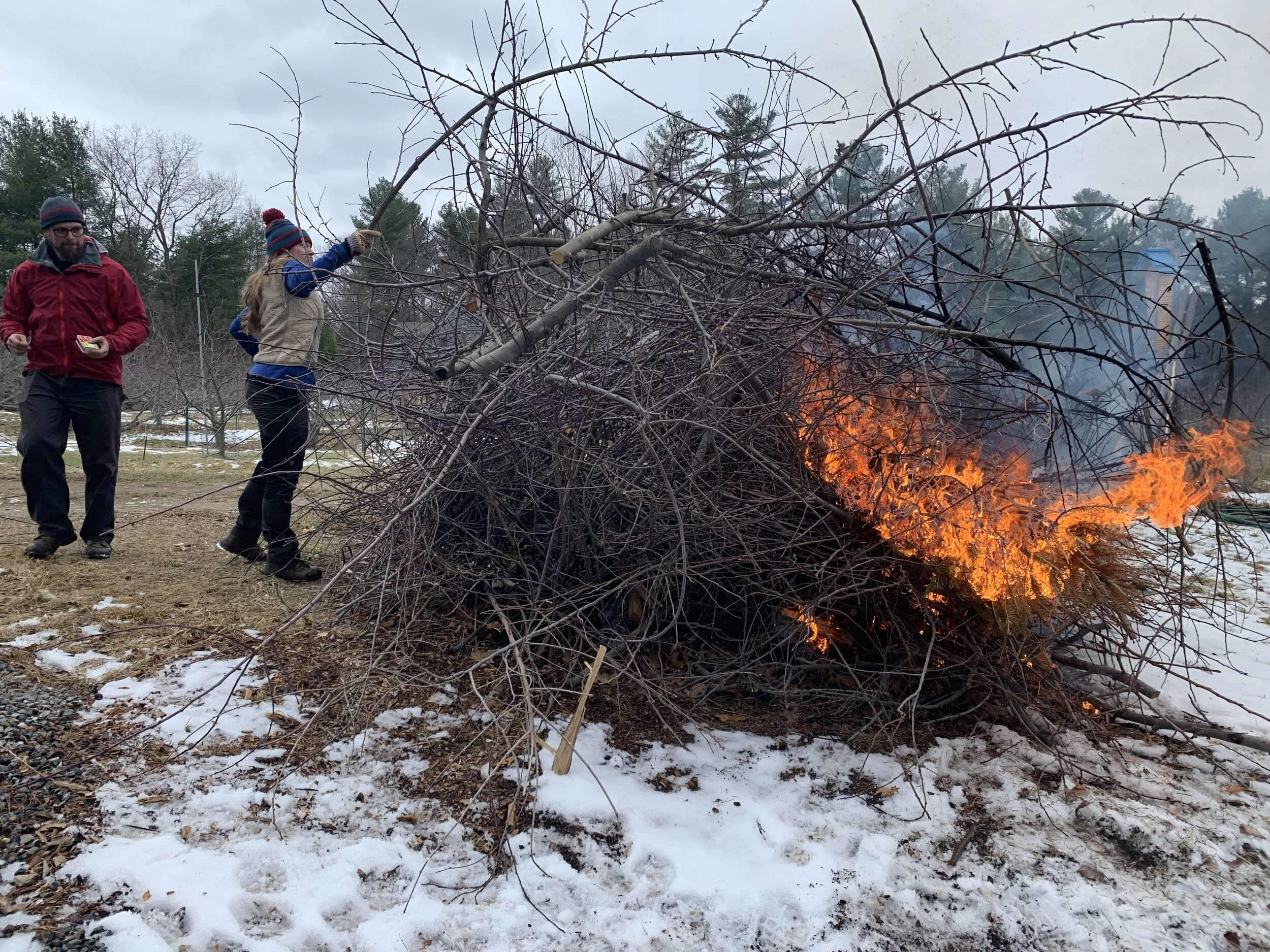
Ethan and Ariel lighting the fire.
The flames licked through the tree, disappearing the needles and small branches. Then there was quiet. We tried to whisper our small fires into blaze until Blase arrived. He took the container of kerosene and started pouring throughout. With his blazing instincts, the fire caught.
The apple wood is green so you need a hot fire to really get them to take. But they did and the fire burned. More wood caught, whirring and snapping, and the flames grew. Menorahs of little flames on sticks, candles on an altar, a pyre. Fire warming our hearts.
With the forks attached to the bucket of the tractor, I rumbled along the apple rows. Our bonfire contained only a small portion of the orchard prunings. Holly had piled the rest at the end of each row. I teased the forks under a pile at the far end of the orchard, lifted, and scooped, held the massive tangle high up in the air and drove back to the fire. Blase and Ethan were tending with pitchforks. Putting the tractor in low gear, I pulled as close to the flames as I dared. With the bucket held high, Blase signaled, and the bucket dumped. Flames leapt, Blase and Ethan teased out the caught stragglers, and I reversed, to circle back to the next row for another pile pick up.
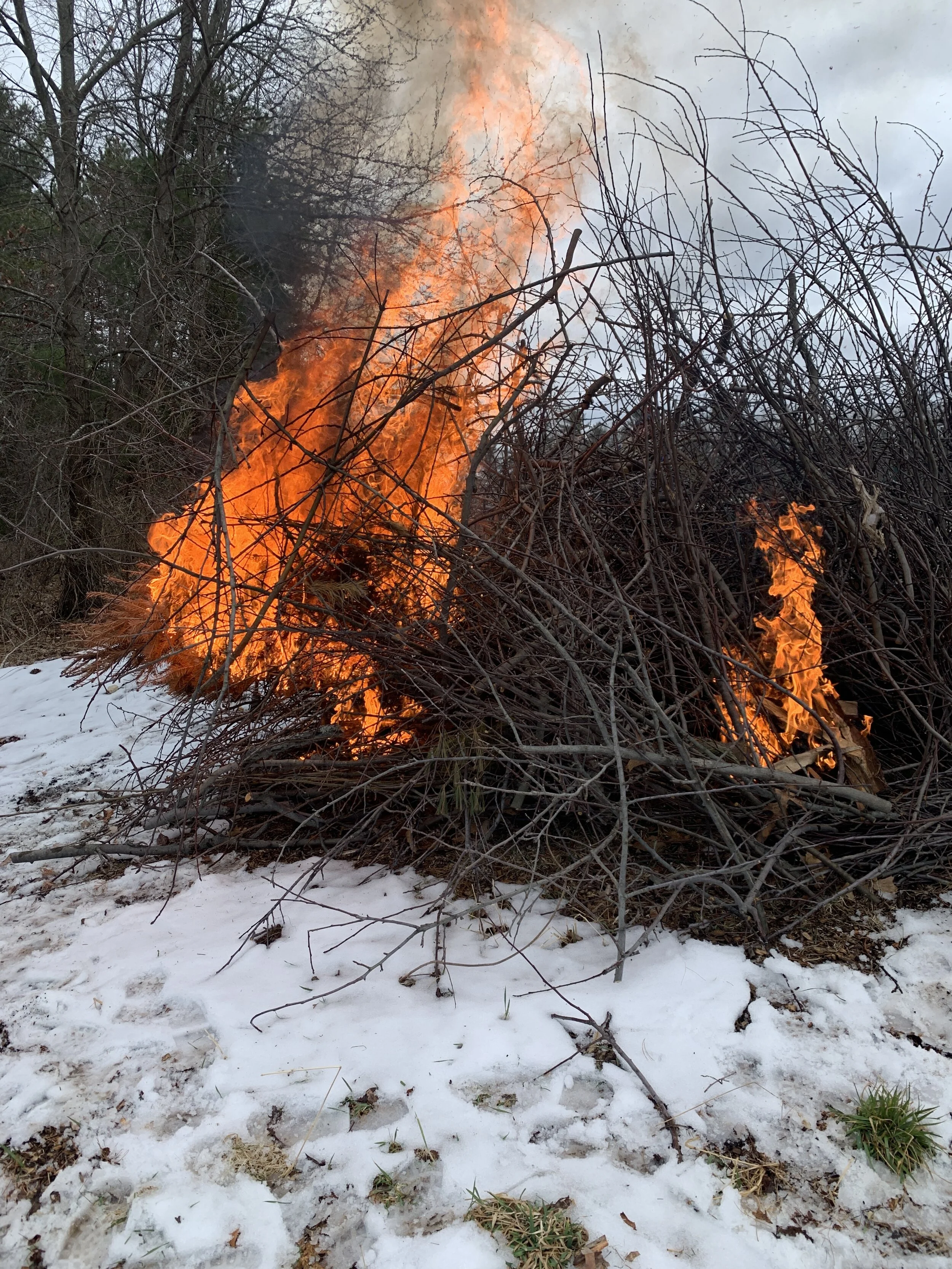
Meanwhile Holly and Ariel gathered blueberry prunings and white pine branches from across the road in the berry patch. We had little traffic jams on the cart road, but everyone has more patience these days: we’re in no hurry, we’re just here.
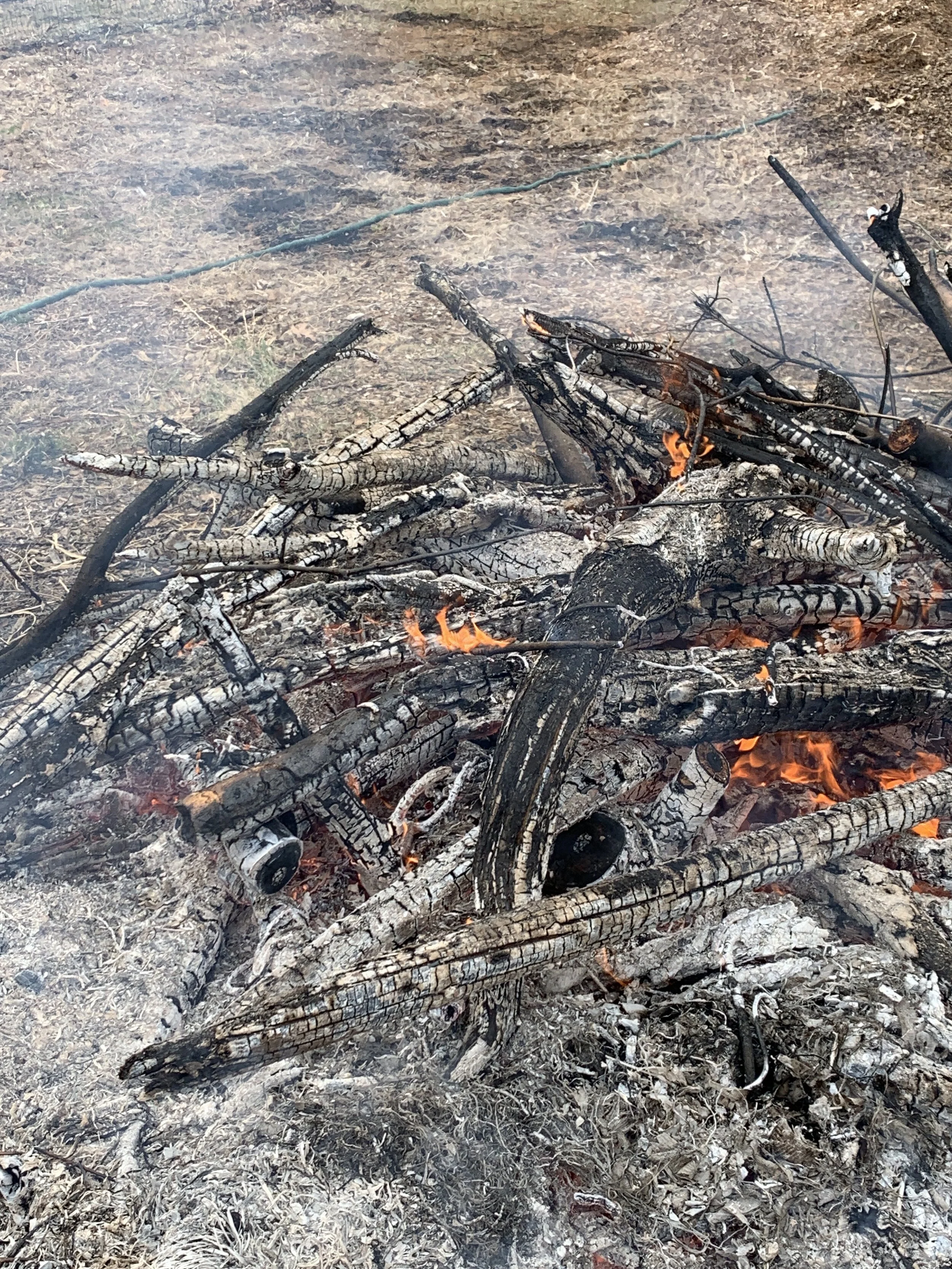
In only a few hours, we managed to burn what we needed to. As the fire ebbed, we listened to the last cracklings, and stared into the black sea of charred wood. Some embers transformed into white ash. With the breath of wind, snowflakes rose and fell.
In the final lines in Archibald MacLeish’s play, JB, his retelling of the story of Job, Sarah says to her husband,
Then blow on the coal of the heart, my darling,
It’s all the light now.
Blow on the coal of the heart.
The candles in the churches are out.
The lights have gone out of the sky.
Blow on the coal of the heart
And we’ll see by and by . . .
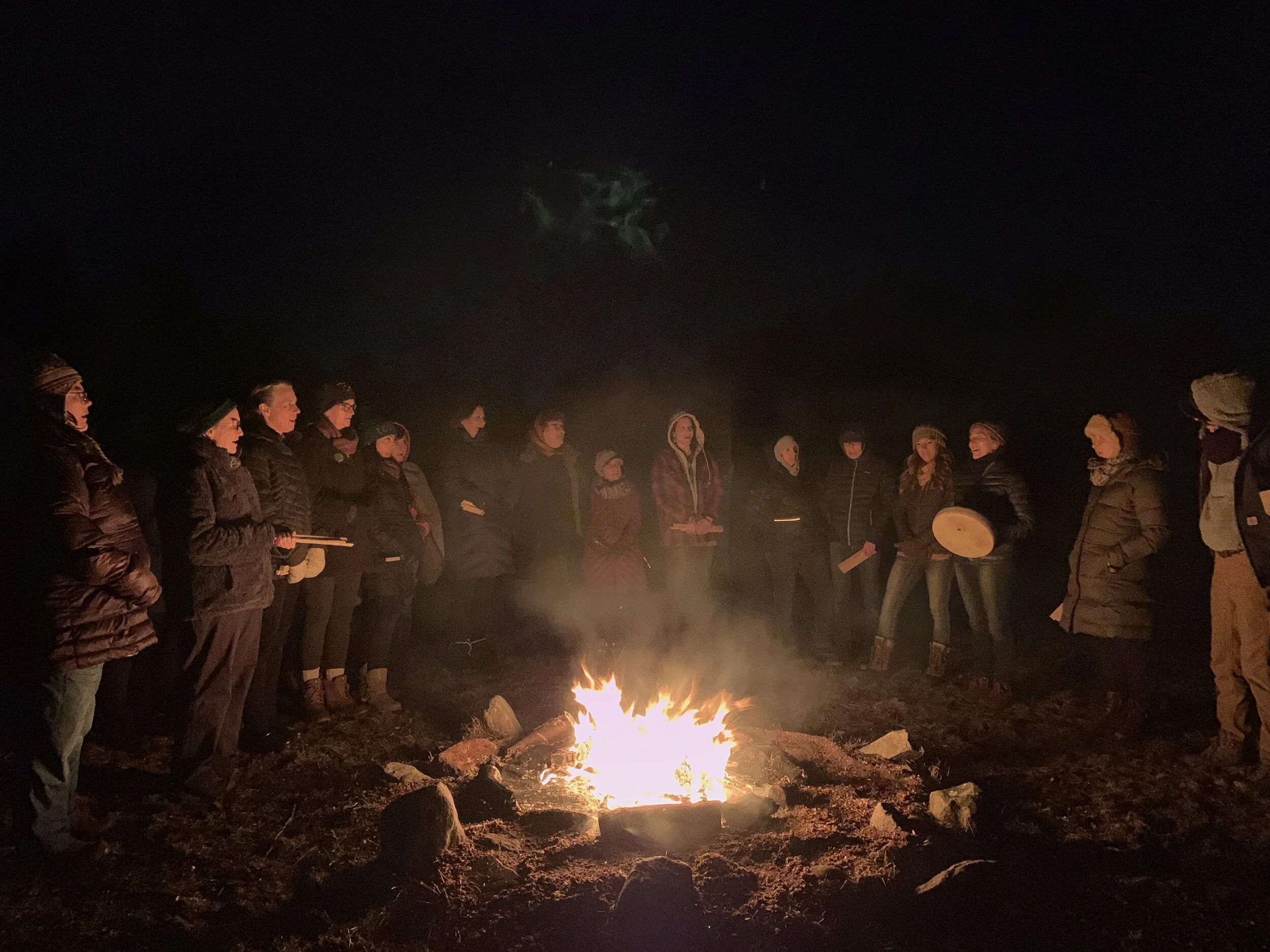
Strength, even in darkest times, can be found in a whisper. The dark and the light, the suffering and joy, have always been and will always be the human condition. We can choose to kindle the fires, to breathe love through it all. The photo below is from a women’s Full Moon Fire we had on March 7, 2020. It’s hard to believe our world has changed so much in less than a month. When we can be physically close to each other again, we will celebrate with a great bonfire. You are all invited!

Ripples
Sitting at the window in the loft above my studio I look over the pond. The reflections of the trees show only the slightest rippling. As if on cue, two geese quack through the air and splash-land. What are they communicating at this time of world crisis?
The poet Rilke wrote:
I live my life in widening circles
that reach out across the world.
I may not complete this last one
but I will give myself to it.
Their bobbing beaks pierce the flat surface of the water creating a pattern of two interlocking circles. As these two rings expand outwards, their individual rings dissolve and form one large circle, then another, each one widening into more circles. The geese have become a great concentric ring-making machine, the vibrations extend almost across the pond. Copernicus would have been charmed by this binary sun. I think of all the human beings on the planet, how we haven’t seen the rings of our interconnectivity and interdependence quite this graphically before the pandemic spread. Can we deeply know that everything we do has repercussions that extend far out into the world? Will we remember this lesson?
I am taking a breather. I enjoy this opportunity to focus my attention on the geese, and not on the airspace around us. I have only been watching for a few minutes; they will glide and bob hour after hour, day after day, week after week, month after month. I don’t live within this kind of repetition; I seek what’s new. Something to assert, or is it insert my presence into the world? I always have plans, projects, things to do.
The geese begin swimming towards shore. One goose approaches and looks back, its mate is not following, so it turns back. I lose track of them and then espy them floating in the reeds along the edge of the pond. They occupy their own world in the cold water, churning out circles as they bob down and up with precision.
I consider how the geese are oblivious to the virus. They don’t know that my daughter and her boyfriend have moved in with us or that we are isolating ourselves physically from the rest of the world. They don’t know the longer I watch them, the closer I feel towards them.

Two Geese on the Pond
I’ve lost track of the geese, where did they go? Meanwhile, raindrops fall from overhanging branches into the pond making their own gentle circles.
Then I see one goose chase its mate out to the center of the pond, its neck hammering forward with surprising violence. Is it propelling its mate to swim faster or propelling itself with this motion? The geese are responding to a competitor who has entered their airspace. The intruder kept flying, and my two friends are quiet again, tucked near shore, bobbing for food. A green noodle of pond weed hangs from one of their beaks. The other has its back to me and I watch its webbed feet vigorously paddling to keep its backside lifted with its head and neck submerged. Is it seeking something more delicious, or more difficult to pull up, or something deeper? The tipping point is so hard to maintain.
Even in the midst of social distancing, let’s keep our circles widening. There are so many people who will need help financially, emotionally, spiritually, and physically. Toss pebbles into the pond, send prayers, call your friends, let love ripple the world.
I watch a little longer. I begin to feel like I know which is male and which is female. It’s quite silly, why would I even think that? One goose seems quieter, more delicate, and maybe a little smaller. But, of course, that’s all wrong, my personal bias. There are many species where the female is larger than the male.
Compassion increases the more attention we give something. Isn’t that the way the world works? In this time of social isolation, we need to be in touch, send out our love, and share what others are experiencing.
I have recommitted to posting a blog on Sundays as a way for us to stay connected. It may not be polished prose, but I will try to offer some small distraction from the numbers and charts. I send my love to all of you, each of you facing your own challenges, each of you dear to me.
The second and last stanza of Rilke’s poem is :
I circle around God, around the primordial tower.
I’ve been circling for thousands of years
and I still don’t know: am I a falcon,
a storm, or a great song?
A storm is raging, let’s be the great song, bow our heads, and let the ripples echo across the planet.

We Are Connected, LH, 2020, wax.

Tibet Impressions

Our three-generational quartet, aged twenty-nine to ninety-two, received four visas for Tibet at our airport Beijing hotel less than twenty-four hours before our scheduled flight to Lhasa. We could hardly believe it, we were going to Tibet after so many hurdles.
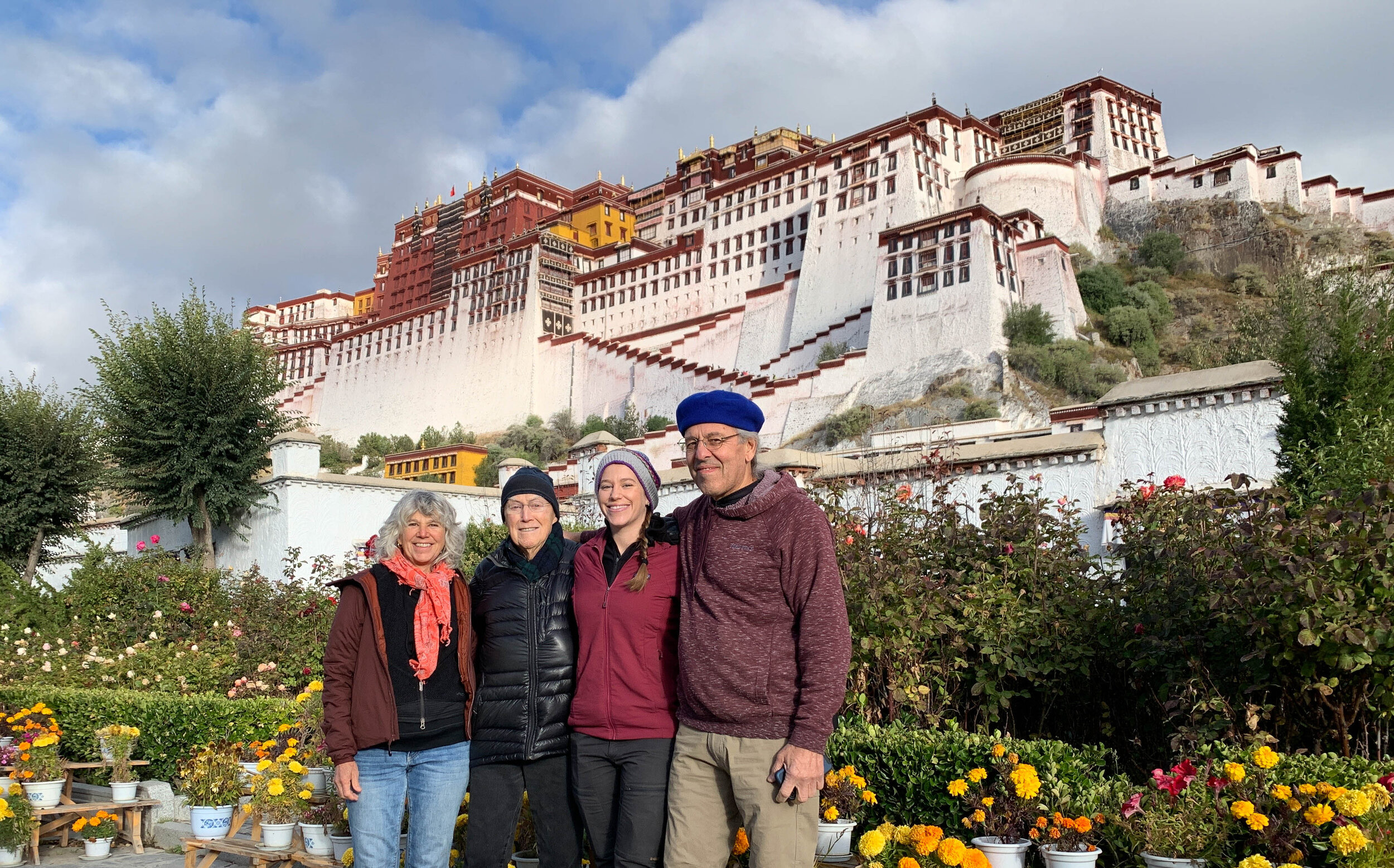
In front of the Potala Palace, built in the 7th century and then rebuilt in the 17th century, this masterpiece of Tibetan architecture, was home to the Dalai Lamas and Tibetan government from the 17th century until 1959 when the present Dalai Lama escaped to India.

Bill, my stepfather, and my daughter, Ariel, walking down the wet and slippery slope on the backside of the Potala Palace.
Our travels through Tibet climbed up and down—stairs and mountains, from thrilling sights to chilling realities. The first three shocks upon arrival:
Three fighter jets sat near the terminal at the Lhasa airport. Military presence we would learn is everywhere.
Our guide pointed to the two recording devices on the dashboard of the vehicle we would be traveling in for the next ten days. We needed to always be aware that what we were saying, not only in the car, but anywhere, might be overheard and reported.
Tibetans cannot have passports. No Tibetan person can leave the country.

Blase, my partner, and I send prayers by way of the smoke from burning juniper at a high pass above Lhasa.
Lhasa is seemingly undergoing more construction than any other city in the world. In downtown Lhasa, the snowcapped mountains are partially obscured by high-rise apartment buildings. The construction is primarily for the Chinese who are moving into Tibet. The population is changing. Tibet now has an estimated population of about 6 million Tibetans and 7.5 million Chinese settlers. The apartments are affordable only if you have a government job.
For five days, we stayed in the old part of Lhasa from where we could walk to monasteries, temples, nunneries, noodle shops, teahouses, and explore the narrow streets of old Tibet. We joined the devoted pilgrims walking clockwise around the Barkhor Circuit, Lhasa’s most important pilgrimage Kora.
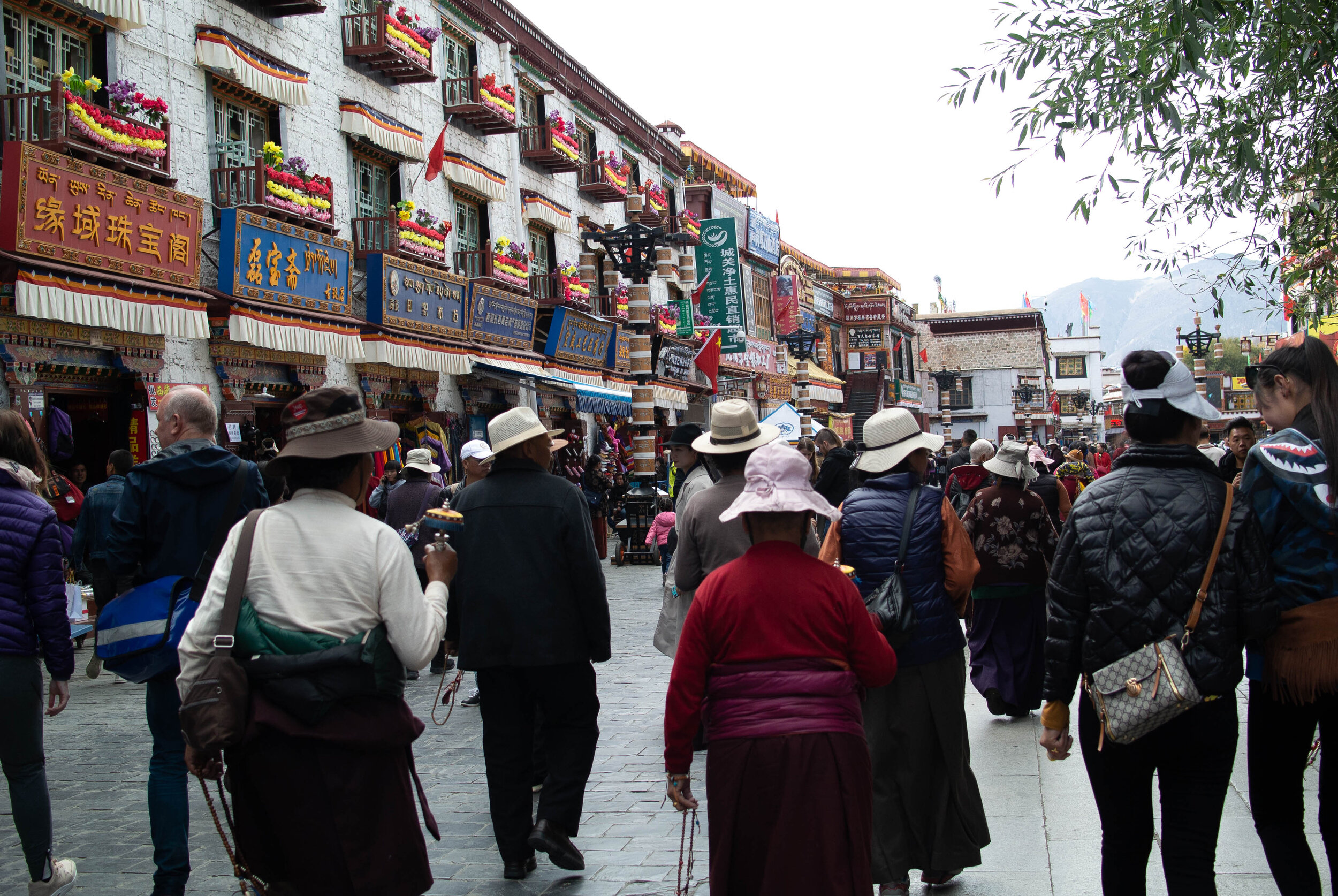
The Barkhor Kora, an everyday happening.
This walk takes you around the Jokhang, one of Tibet’s oldest temples. Pilgrims make the circuit multiple times, some walk, some do full body bows. Others stop at the plaza in front of the Jokhang, roll out their prostration mat, and do a hundred, or a thousand full prostrations, sliding out on their gloved hands or using wooden blocks strapped to their hands, to extend their arms fully out beyond their head, belly flat on the ground.

Before sunrise prostrations.
Inside the darkness of the old Jokhang pilgrims are moving always in a clockwise direction, making offerings to colorful thangkas and sculptures of Buddhas, deities, demons, and kings. Butter lamps burn, silver bowls of water glisten, cans of beer (some protectors favor beer) along with fruit, money, and yak butter decorations are packed into every nook and cranny. Gongs and drums, wood and cloth, bright colors, meditation cushions piled with burgundy meditation robes, people jostling, hurrying, determined to complete their rounds, Tibetan Buddhism is practiced here by Tibetans everyday.
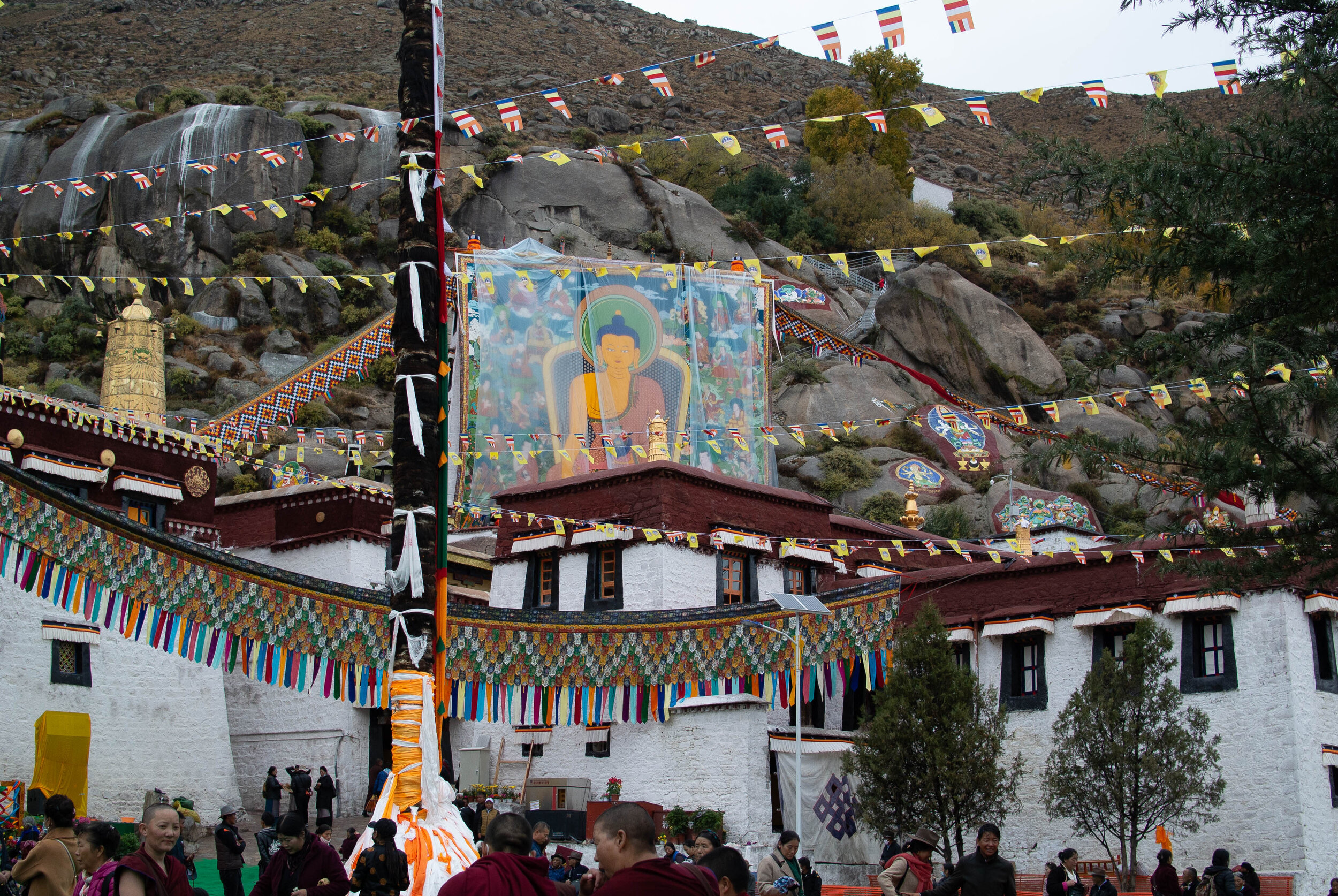
We arrived at Sera monastery during celebrations for their six-hundred year anniversary. The road was closed. The Police were limiting the number of people. Following our guide, we started walking to see if there was another way to enter and saw people slipping through a hole in a fence and running across a yak field. We followed at the fastest clip we could manage on day one at 12,000 feet, avoiding the entrance road and entering further up towards the monastery. Our timing worked. Another ten minutes and this alternate route would have been closed. The monastery was filled with pilgrims from all over Tibet in colorful traditional clothing, mala beads in hand, making offerings and chanting, We followed a group of people to see the Thangka unveiled for the occasion, about three hundred feet in length and hanging over a slap of flat rock, covered in plastic because of the rain.
Monasteries are traditionally built into the hillsides, and above many of them are rocky paths leading to caves where monks, and Dalai Lamas, and yogis like Milarepa and Guru Rinpoche once meditated for years at a time.

During the cultural revolution ninety-five percent of the monasteries were destroyed, but now the Central Government is rebuilding them, though limiting the number of monks who can live at each one. Tibetan families historically sent at least one son to become a monk, but today, you need to be approved by the Central Government. Monasteries were the principal sites of resistance—the government wants to make sure that this doesn’t happen again. The Police have a convincing presence at the large monasteries, the head Abbot is appointed by the Central Government. I imagine even in a monastery one must be careful with one’s opinions.
After visiting Gangden Monastery, a complex with some fifty buildings that was first destroyed during the 1959 Tibetan Uprising and then reduced to rubble during the 1966-67 Cultural Revolution, the brutality of the deaths kept me awake all night weeping. Throughout the trip I worried that we could be arrested for our sympathy for the Tibetans or that we would put our guide at risk.
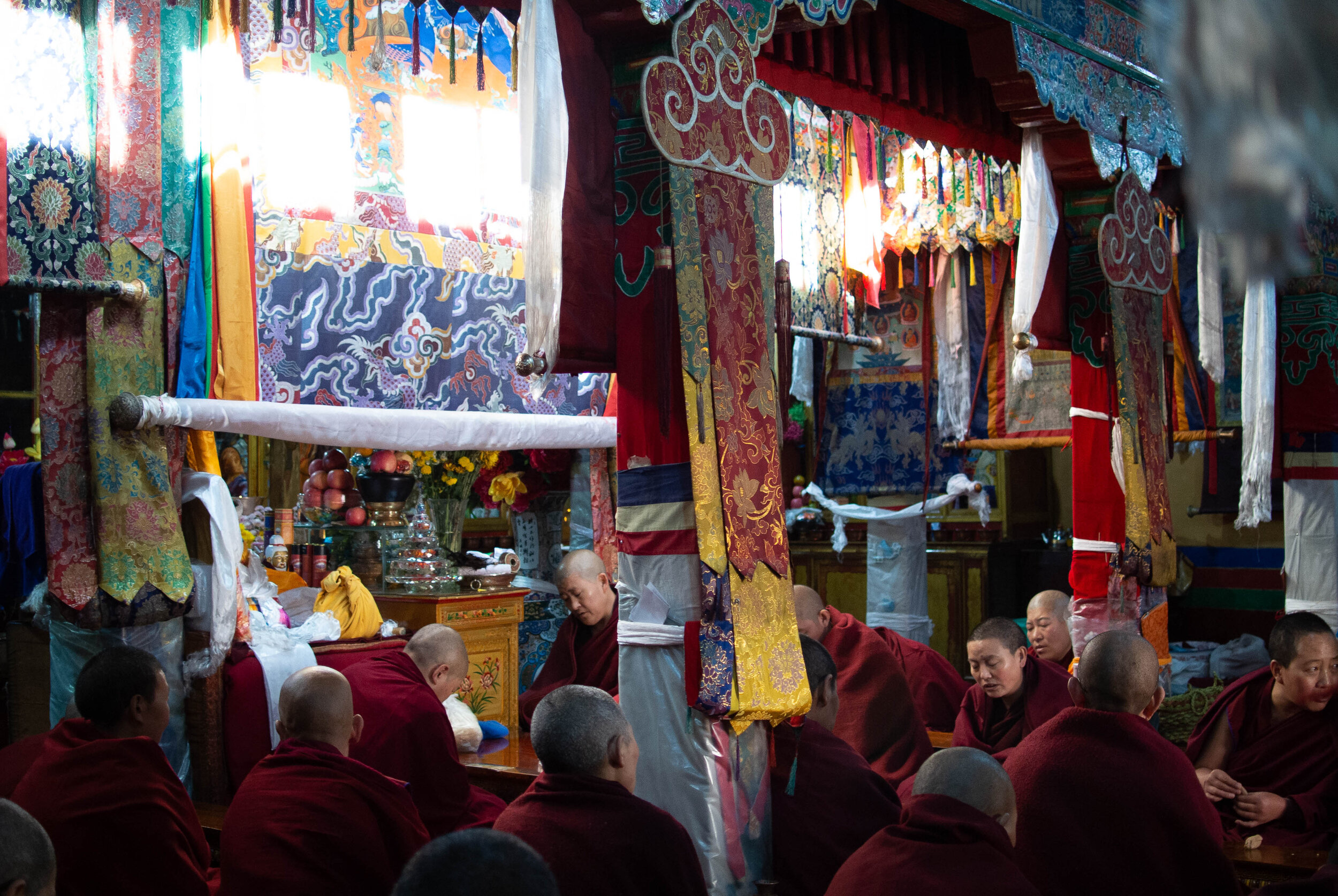
Nuns at morning service in the main assembly hall at the Nunnery in Chimpuk.
In spite of decades of persecution, the Tibetan people are among the most spiritually devoted people I have encountered. There was never a monastery, nunnery, or temple without pilgrims. In the streets, it seemed like everyone carried their mala beads, even while shopping. I wondered if it was prayer or a devotional peaceful resistance? We visited a small monastery in Lhasa that was completely packed with worshipers. People covered every inch of the courtyard and chapels.

We visited Samye, the first Buddhist monastery in Tibet, climbing the hill nearby to have a view of its mandala pattern and take in the fields and bare mountains.
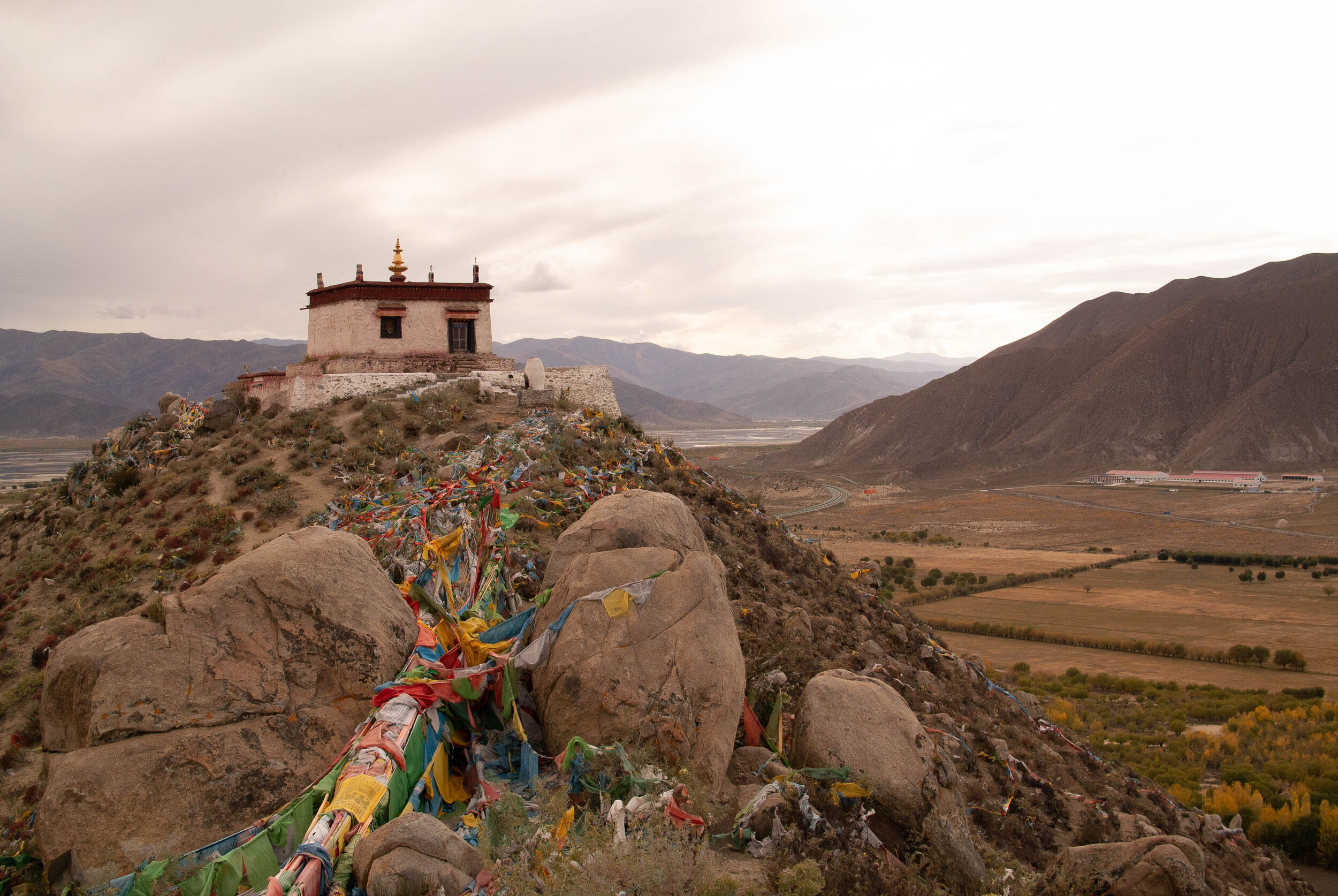
The hill above Samye Monastery.
We learned the local houses around Samye will soon be razed to the ground to clean up the area around the monastery. These local people will be given housing in several apartment buildings. How will they remain farmers and herders? Where will the cows return to at night?

An ancient world is changing. Roads are being built throughout the country. In the river valleys the Central Government has planted hundreds of thousands of trees. Power comes from gigantic solar arrays and large hydro dams that India and other countries downstream are concerned will affect their water supply. The Chinese say that Tibet has been part of China for centuries—the Tibetans and much of the Western world disagree. Tibet is rich in natural resources and strategically important to China: its square footage is larger than the United States. But our questions of why the Chinese are so determined to control Tibet, what are they really doing there, and what are their intentions for the Tibetan people remained unanswered.

“Are there Tibetan poets and writers today?” I asked our guide. He didn’t answer.
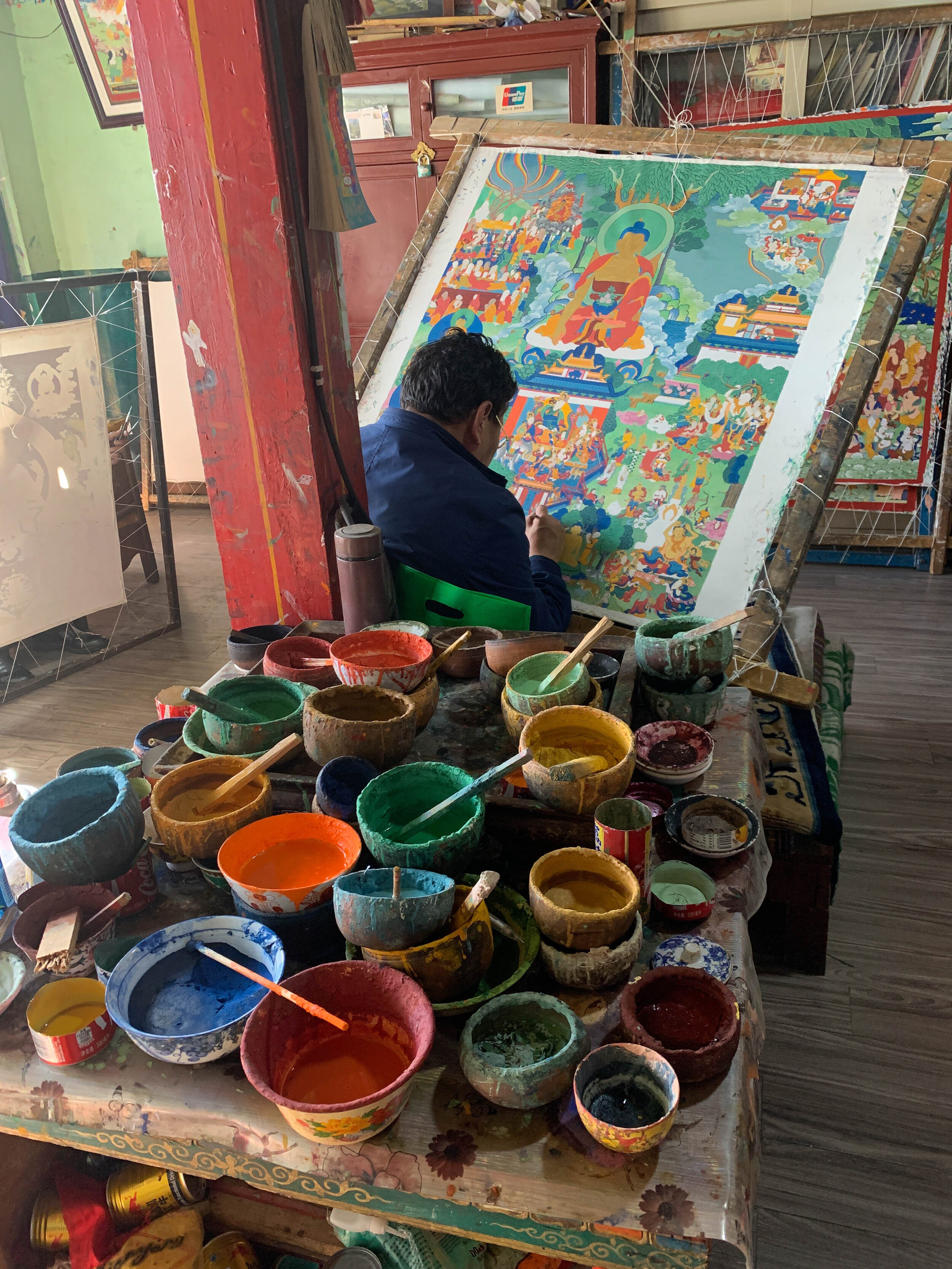
A visit to a painting workshop.
Monks still yak butter offerings as well as talk on their cell phones.

A view inside the monastery kitchen.
It was a trip that will take more time for me to realize how I have been affected. It was a trip to a third-world country with its close-to-the-earth living, inside a first-world-country with its money and high-rise bureaucracy. A trip made special because I shared it with my daughter, husband, and step-father.

Our wonderful guide with Blase and Ariel.
The memory of family members who died during and after the Chinese invasion is still very much alive for the present generation of Tibetans. They consider Tibet their country, though their language is no longer taught in the public schools. Many Tibetans are concerned about passing their culture onto their children.
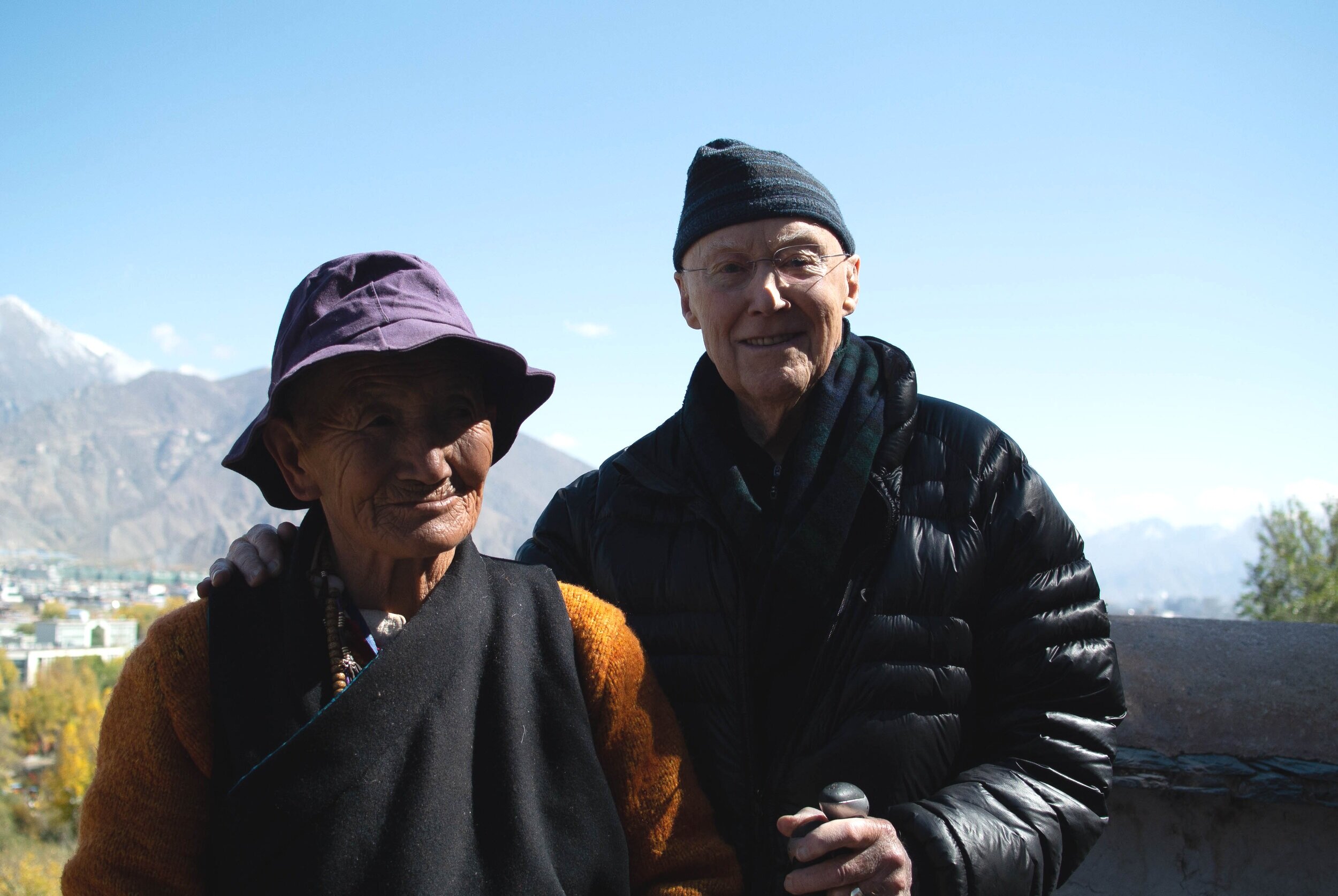
The Tibetans we met were honored that Bill would make such an arduous journey at his age.
The trip was an electrical jolt reminding us how fortunate we are to live with so much personal freedom.
How do we offer care to this country whose people have been sending prayers for peace from their once remote kingdom to the entire world for centuries? One thing we can do is learn what is happening today—Free Tibet has up-to-date information.
And send our love to all those in the world who are not free, who are living under totalitarian regimes or imprisoned for their views or choices. Let the prayers fly!

Search Blog
-
2025
- May 9, 2025 A View from the Tractor Seat
- Apr 11, 2025 Dig
-
2024
- Jan 7, 2024 Winter Wassail
-
2022
- Dec 11, 2022 Keeping Time
- Jun 17, 2022 This Apple-Shaped Earth
- Jan 23, 2022 What is a Jizo?
- Jan 16, 2022 An Invite and Housekeeping Update
- Jan 1, 2022 The Year of the Frog: What Orchardists Do While Apple Trees are Chilling
-
2021
- Oct 24, 2021 Figs
- Oct 3, 2021 The Artist and the Orchard: A Memoir
- Aug 8, 2021 Red-Fleshed Apples
- Jul 25, 2021 When We Were Trees
- Jun 27, 2021 Castor Beans—Who Knew?
- Jun 13, 2021 Spring Training at a Zen Monastery
- May 4, 2021 Our Trees are in Bloom
- Apr 18, 2021 Hooray!
- Jan 24, 2021 Wassailing, virtually!
- Jan 1, 2021 Sitting
-
2020
- Dec 21, 2020 Darkness to Light
- Nov 28, 2020 One Heart
- Sep 18, 2020 Juggling Flowers, Fruit, and Vegetables
- Aug 23, 2020 Refuge
- Aug 9, 2020 Bags of Fertilizer
- Aug 2, 2020 The Sermon of the Blue Heron
- Jul 26, 2020 What's the Buzz?
- Jul 19, 2020 Farm Moments
- Jul 12, 2020 Lost Wax
- Jul 5, 2020 Catalpa: The Hugging Tree
- Jun 28, 2020 Pedaling Peace
- Jun 21, 2020 See Change
- Jun 14, 2020 Lalla Unveiled
- Jun 7, 2020 Pond Alchemy
- May 31, 2020 The Birth of Fruit
- May 24, 2020 An Artist in the Orchard
- May 17, 2020 Walking the Land: Returning Home
- May 10, 2020 Stinging Nettles: Gifts from the Great Mother
- May 3, 2020 The Mystery of Swallow
- Apr 26, 2020 Aerial Bruststrokes
- Apr 19, 2020 Simple Pleasures
- Apr 12, 2020 Weeds and Other Gifts
- Apr 5, 2020 Remembering the Seeds
- Mar 29, 2020 Blow on the Embers
- Mar 22, 2020 Ripples
-
2019
- Nov 16, 2019 Tibet Impressions
- Nov 9, 2019 Forest Tales
- Oct 13, 2019 The Gift
- Aug 4, 2019 The Season is Apples, Berries, and Grandfather Fire
- Jun 8, 2019 Pointers for a Writing Life
- May 12, 2019 Mothers of the Earth
- Apr 6, 2019 The Apple-Shaped Earth
- Mar 23, 2019 You Don’t Know What You Have Till It’s Gone
- Feb 23, 2019 Generations
- Feb 9, 2019 What Are We Doing to the Earth, John Chapman?
-
2018
- Dec 31, 2018 Long Shadows
- Oct 6, 2018 A Pilgrimage to India
- Aug 18, 2018 Scrap Wrenn
- Aug 11, 2018 Off-the-Wall Comments from an Ignorant Farmer
- Jul 28, 2018 Creative Connect
- Jul 14, 2018 How is the Orchard?
- Jun 30, 2018 Which Way?
- Jun 16, 2018 Geese, Herons, Beavers, and the Baby Steps of a Lapsed Blogger
- Feb 24, 2018 Mama's Coupons — Good Forever
- Jan 27, 2018 January Ice
- Jan 13, 2018 The Muse
-
2017
- Dec 30, 2017 A Dream for the New Year
- Dec 23, 2017 A New Year for Apples
- Dec 16, 2017 Intuition
- Nov 22, 2017 Thanksgiving OM
- Nov 4, 2017 East Fork Pottery
- Oct 28, 2017 Putting Down New Roots
- Oct 21, 2017 A is for Art
- Oct 14, 2017 Eve domesticus
- Oct 7, 2017 A String Workshop
- Sep 30, 2017 After Applepicking
- Sep 23, 2017 Two Bad Women and One Good Apple
- Sep 16, 2017 Plein Air Poetry
- Sep 9, 2017 Cutting Off a Leg
- Sep 2, 2017 The Changing Landscape
- Aug 26, 2017 All About Art
- Aug 19, 2017 My First Visit to the Farm
- Aug 12, 2017 The First Food
- Aug 5, 2017 A Teapot, a Woman, and maybe a Boat
- Jul 29, 2017 A Raspberry Dilemma
- Jul 22, 2017 Consider the Miracle
- Jul 15, 2017 Meeting Ekphrasis
- Jul 8, 2017 Ripening Fruit
- Jul 1, 2017 The Voice of The Caterpillar
- Jun 24, 2017 Goumi — An Unusual Fructus
- Jun 17, 2017 Concord, an American Bloomsbury
- Jun 10, 2017 The World Is Bonkers — Shall I Laugh or Cry?
- Jun 3, 2017 Bonkers, a Revolutionary Apple
- May 27, 2017 Guardians of the Swamp
- May 20, 2017 There are Mushrooms and There are Morels
- May 13, 2017 "What's in a Name?"
- May 6, 2017 Bloom Follows Pink: Orchard Pollination
- Apr 29, 2017 The Orchard Is at Pink
- Apr 22, 2017 Natural Farming — Part 2 (continuation from last Sunday's blog)
- Apr 15, 2017 Natural Farming — Part 1
- Apr 8, 2017 Boats, Figures, and Catching Fish
- Apr 1, 2017 A Man with a Mission: The Nuts and Bolts of Bronze Casting
- Mar 25, 2017 A Chalice of Spirit, Art, and Nature
- Mar 18, 2017 Hanami — Blossom Viewing
- Mar 11, 2017 Soil Redemption Song
- Mar 4, 2017 Food is Primary Care
- Feb 25, 2017 Pomme de Terre
- Feb 18, 2017 Organic Certification
- Feb 11, 2017 Tantalizing Fruit
- Feb 4, 2017 The Myths of History
- Jan 28, 2017 The Orchard in Winter
- Jan 21, 2017 The Hi-Line
- Jan 14, 2017 Artistic, Botanical, and Social Diversity
- Jan 7, 2017 Where is Eden?
-
2016
- Dec 31, 2016 The Creative Heart
- Dec 24, 2016 A Christmas Tale
- Dec 17, 2016 Who are the Crones?
- Dec 10, 2016 The Olympic Bell (Part Two)
- Dec 3, 2016 Overheard in the Apple Orchard in Early December
- Nov 26, 2016 The Lessons of a Tortoise
- Nov 19, 2016 In the Studio
- Nov 12, 2016 Even in Darkness
- Nov 5, 2016 Southern Apples, an Elephant, Monkey, Rabbit, and Bird, Two Mango Trees and a Birthday
- Oct 29, 2016 The Tools of Art
- Oct 22, 2016 Labyrinths
- Oct 15, 2016 Repairing the Broken
- Oct 8, 2016 When You Are No More
- Oct 1, 2016 Creation Rain
- Sep 24, 2016 Breaking the Glass
- Sep 17, 2016 String Art
- Sep 10, 2016 Poetry and Photosynthesis: It's all in the Leaves
- Sep 3, 2016 In the Plenty of Time
- Aug 27, 2016 Witch Doctors
- Aug 20, 2016 Listen Coyote
- Aug 13, 2016 Milkweed in the Orchard
- Aug 6, 2016 Some People See a Turtle
- Jul 30, 2016 Arborshaping
- Jul 23, 2016 Joseph Wheelwright: Sculptor of Stones and Trees
- Jul 16, 2016 Asian Pears
- Jul 9, 2016 Gold Leaf, Grief, and the Creative Process
- Jul 2, 2016 The Olympic Bell (Part One)
- Jun 25, 2016 Around the Mulberry Bush
- Jun 18, 2016 Avoiding Apples
- Jun 11, 2016 Fructus
- Jun 4, 2016 Astonishing Apples
- May 28, 2016 Scare the Caterpillars
- May 21, 2016 Join the Club!
- May 14, 2016 The Graft
- May 7, 2016 Rooster, Rhubarb, Rue
- Apr 30, 2016 What do Dolphins and Nettles Have in Common?
- Apr 23, 2016 Art Prunings
- Apr 16, 2016 A Few of the First Arrivals
- Apr 9, 2016 Taste the Spirit of Sustainable Agriculture
- Apr 2, 2016 First Orchard Spray - March 22-24, 2016
- Mar 26, 2016 Hawkeye Apple
- Mar 19, 2016 Desiring the Almata Apple
- Mar 12, 2016 Ugly Fruit
- Mar 5, 2016 Winter Tracks
- Feb 27, 2016 Splash
- Feb 20, 2016 Pruning
- Feb 13, 2016 Orchard Ruminants
- Feb 6, 2016 A Gathering of Seeds
- Jan 30, 2016 Orchard Dragons
- Jan 23, 2016 Tree Rings
- Jan 17, 2016 The Fallen Tree
- Jan 7, 2016 Wassailing the Apple Trees
- Jan 1, 2016 The New Year