LINDA HOFFMAN
What's the Buzz?
Our bees had a productive spring, and our beekeeper, Don Rota, presented us with seven pounds of ravishing, golden, lucid, liquid gold. On Thursday afternoon, we bottled the honey in six- and twelve-ounce glass jars in the farmhouse kitchen.

But what exactly is honey? When bees gather nectar from the flowers, they receive a jolt of energy in the form of carbohydrates (sugars) to keep them going in the hot sun from flower to flower, but the excess is stored in their nectar stomachs. When they return to the hive, they regurgitate the nectar and offer it to another bee. As this nectar is passed from bee to bee, an enzyme in the bees’ stomachs begins the process of turning it into honey. Then the consolidated nectar is put into cells in the hive. Fanning completes the water evaporation process and what’s left is honey. Bees make honey so they can survive the winter.

Bees have been on the planet for 120,000,000 years. A bee was found preserved in amber from Myanmar dating back 100,000,000 years. Despite the longevity of the species, individual worker bees, all female, only live a month in the summer. It’s hard work to be a worker bee, but then they do have the glory of visiting flower after flower, and gorging on lovely nectar. In winter, however, their physiology changes and worker bees live up to three months.
Drones, the male bees, live longer, do no work, just laze around the hive waiting for a queen to be born. After her birth, the virgin makes a maiden voyage outside the hive, sending out a pheromone to attract the opposite sex. The drones mate with the nubile queen and then die soon after, completely spent after such their lovemaking. She stores this lifetime supply of sperm to use as needed, controlling fertilization of her eggs by releasing sperm as the egg passes through her oviduct. Come fall, any drones still hanging around are booted out of the hive, and left to starve to death.
Queens can live for five years. If the hive’s queen is old or ill, the new queen may fight her and possibly take over. Sometimes worker bees bring a new queen into a hive because it is large and needs a queen so part of the hive can swarm. It’s the decision of the workers to feed royal jelly to larvae bees to make new queens. The worker bees democratically decide about everything that happens in the hive. Depending on the size of the cells the worker bees create, the queen lays unfertilized eggs to become drones (male) or fertilized ones to become worker bees (female).
Some people consider bees to be mammals. They view the hive as an animal without its ‘skin bag.’ The different kinds of bees are like cells in a body with different functions. The ‘swarm’ is the offspring. I like this notion because the hive becomes a larger system, one creature, one body, one ecosystem.
In summer the hive may grow to over 30,000 bees, but in the winter they drop down to a thousand bees as they conserve resources to survive the winter. The life of the honey bee is one deep and abiding concern for their food supply. Surely this is why they have survived on the planet for so long. In comparison, our ancestors have occupied the planet for only six million years, and we have become dangerously complacent about our food supply.
Humans have a long desired honey. A drawing on a rock face in Spain dating back to 6000 BCE shows two people climbing a rope ladder to get to a hive high up on a flat rock wall. Another drawing found in Zimbabwe from 8000 BCE shows the wavy lines of natural honeycomb with a person approaching it holding some kind of smoker. People in remote areas of Nepal and Macedonia still ‘hunt’ for hives, sometimes climbing steep rock faces to gather prized honey. In Romania, bee hive trucks follow the flowering from the South to the North, parking for a few weeks off highways, giving their bees lots of wild forage. I imagine the colors and shapes help the bees return to their own hives.

Bee hive truck near Vitri, Romania, 2016
The Egyptians described keeping bees for the medicinal properties of the honey in paintings and writing. They used honey for all sorts of sicknesses from diabetes to contraception. There are even paintings depicting ritual circumcisions with the wound being dressed with honey. Today we know there are high levels of antimicrobial activity in raw honey.
Beekeepers are dedicated to their hives. They also are enthusiastic to share information and help each other. Melissa Ljosa used to keep two top bar hives here until she moved to Vermont a few months ago.

Don Rota is the one without the bee suit. Melissa (left), is checking a top bar hive. We miss her!
Don now takes care of ten hives at Old Frog Pond Farm. He loves to keep them here because we are committed to organic practices, and the farm grows healthy forage all season long for the bees. Don told me one spoon of honey takes twelve bees their entire lives to gather. I think of them each morning with my dollop of honey in my morning tea.
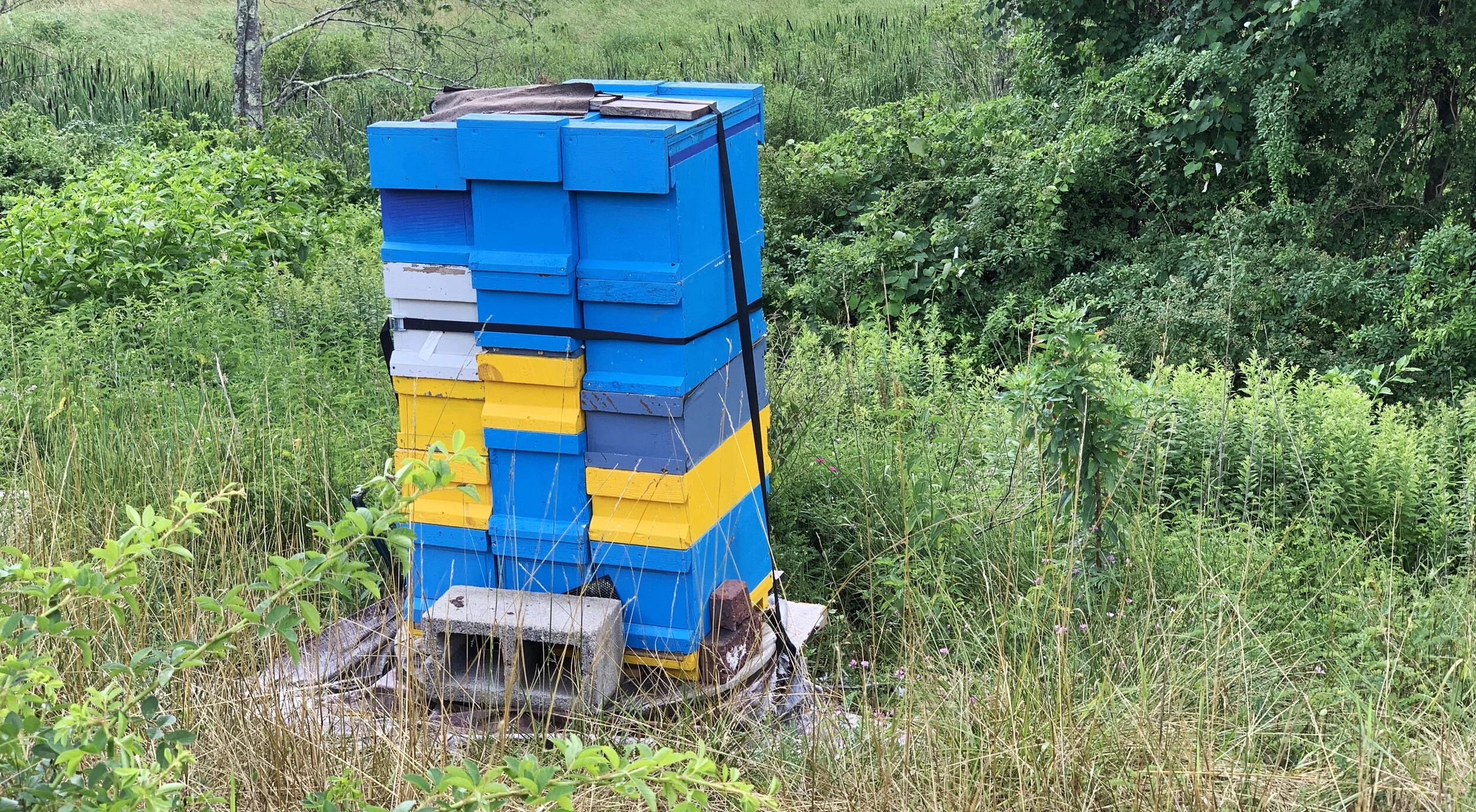
A few of Don’s more colorful hives at the farm. Yellow for the sun and blue for the dome above.
And what’s the buzz? As the bee beats its wings, we hear the vibration as buzzing. But the flower feels the buzzing as movement. Pollen may fall off the flower and onto the bee’s body. Some is carried to the next flower the bee visits; the rest is stashed in the bee’s pollen baskets on its hind legs. It will travel back to the hive for the nurse workers who stay in the hive to feed the young.
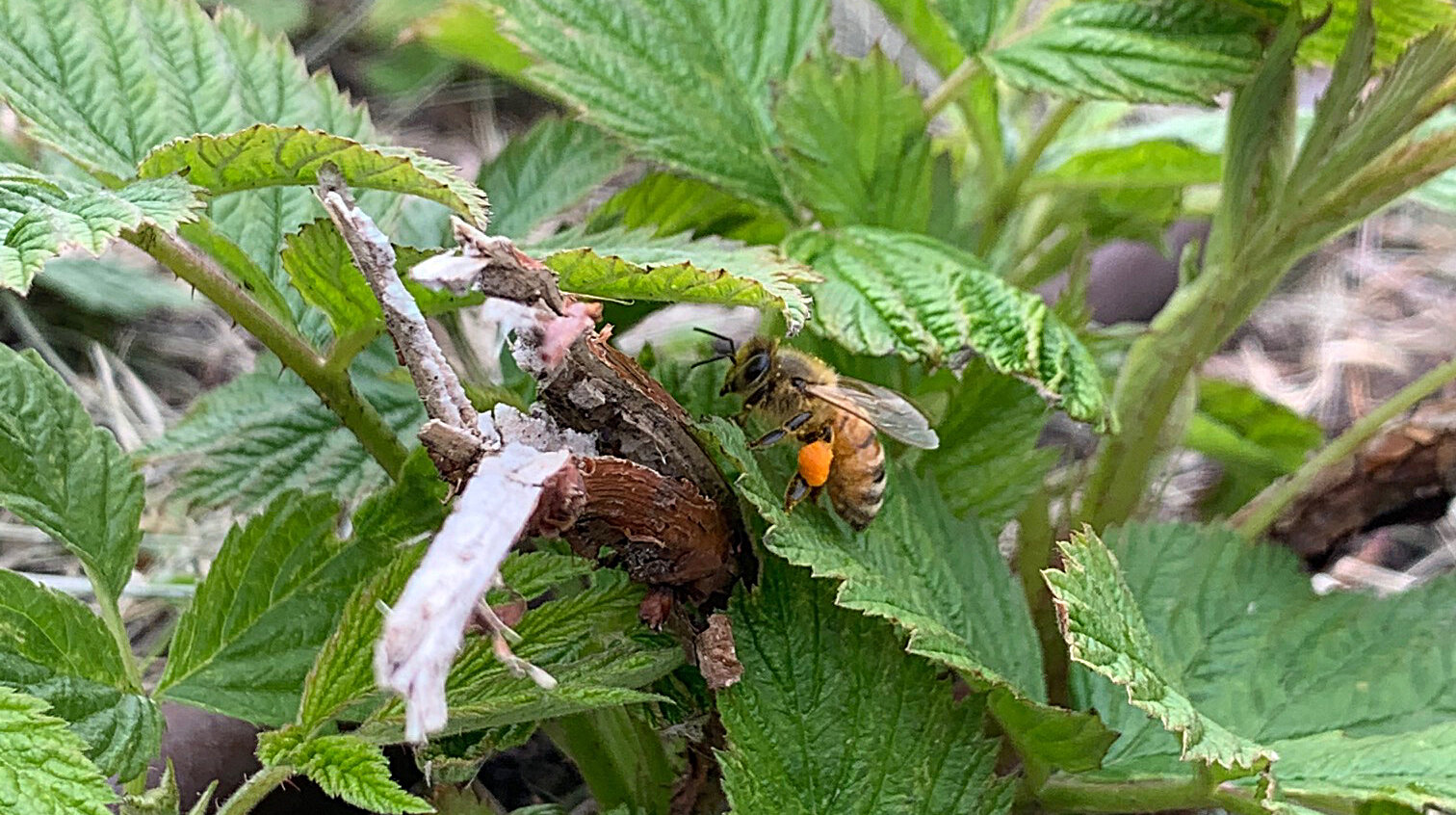
Pollen Baskets are Full
There’s so much more I could write about bees—but perhaps best to stop here and invite you to stop by our farm stand for a taste of local, raw honey. Its truest secrets are only conveyed by the spoonful on the tongue.
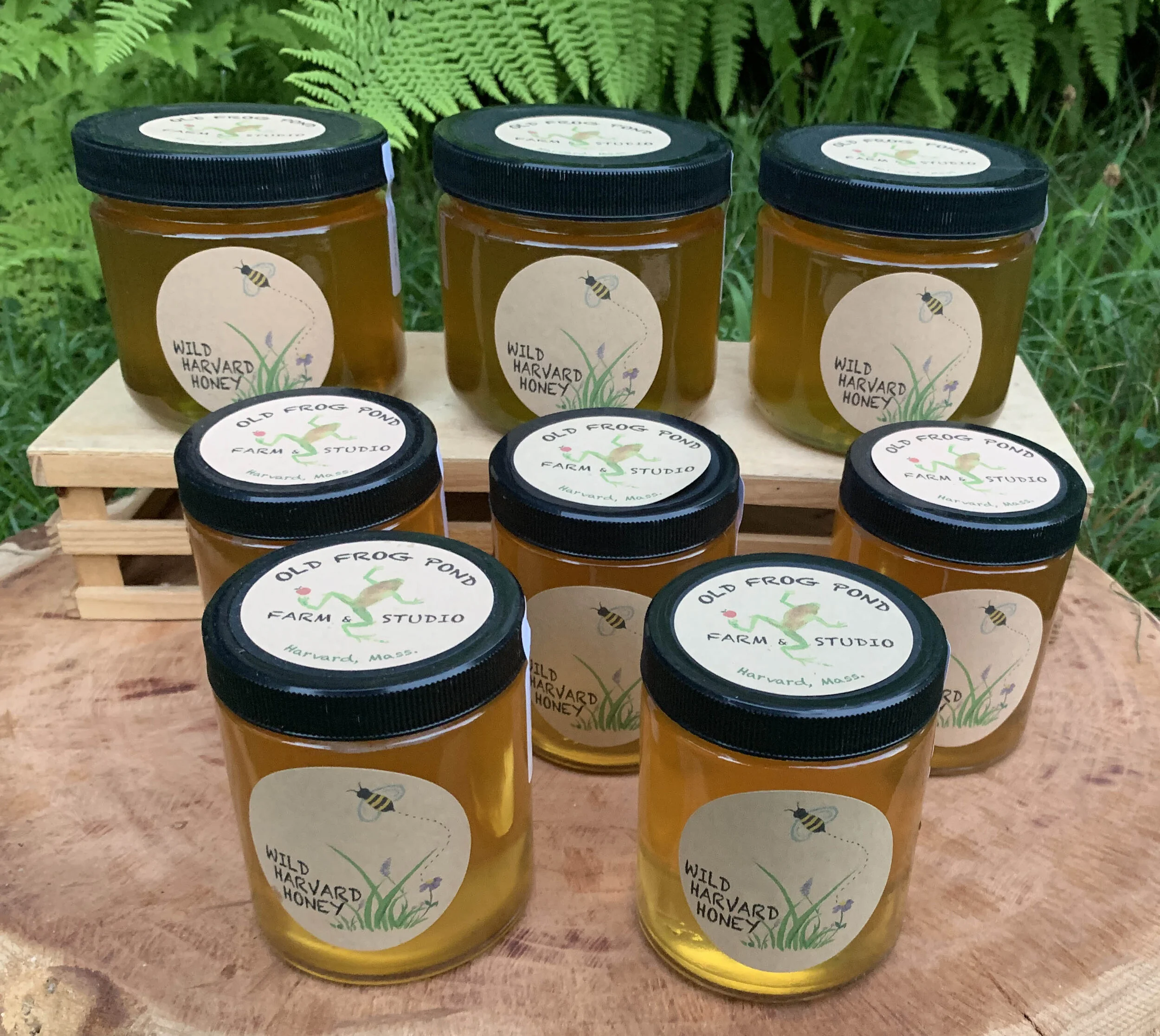
Raw honey for sale at our self-serve farm stand.
Farm Moments
We hear the earth’s joys and sorrows . . .

Sweet Peaches

Red Bartlett Pears

Passion from River Stones Installation, LH

Japanese Bell

Cocoon from Anne Eder’s Boneyard

Peering Around the Corner, Joseph Wheelwright

Wildflowers, detail, Zach Gabbard

Lovely Apple

Giant Broccoli

Tempo, Arial Matisse

Queen of the Prairie, Red Monarda, and Cattails near the Pond
. . . within our own heart.

Lost Wax
It’s crazy how a nose from one direction can look perfectly fine, and viewed from 180 degrees, it’s too close to the eye. When I work on small wax figures, I turn them continuously around in my hands, making sure, for example, the left elbow doesn’t extend below the hip while I carve the right side of the torso. Working on a larger piece, I circle continuously; this partner dance assures everything works from all perspectives.

Refuge, 2020, in wax in my studio. The endangered sea turtle and giraffe are rescuing the humans.
Our planet faces a ferocious loss of habitat, fifty percent of the species on the earth have disappeared in the last forty to fifty years. We’re a destructive species causing the acidifying of the ocean, the loss of precious topsoil, and the poisoning of the very air we breathe. The animals haven’t caused this harm—we have. But I like to think, despite our recklessness and selfishness, they would choose to save us.
I delivered Refuge to the foundry in early January, needing to cut off the giraffe’s legs to fit in my car.

The turtle arrives at the foundry.
Not a problem for Zach Gabbard, owner and sole fabricator at Mission Foundry in Hyde Park. He will be taking it further apart—flippers, turtle shell, giraffe head, giraffe tail, turtle tail, and each individual person to make rubber molds.
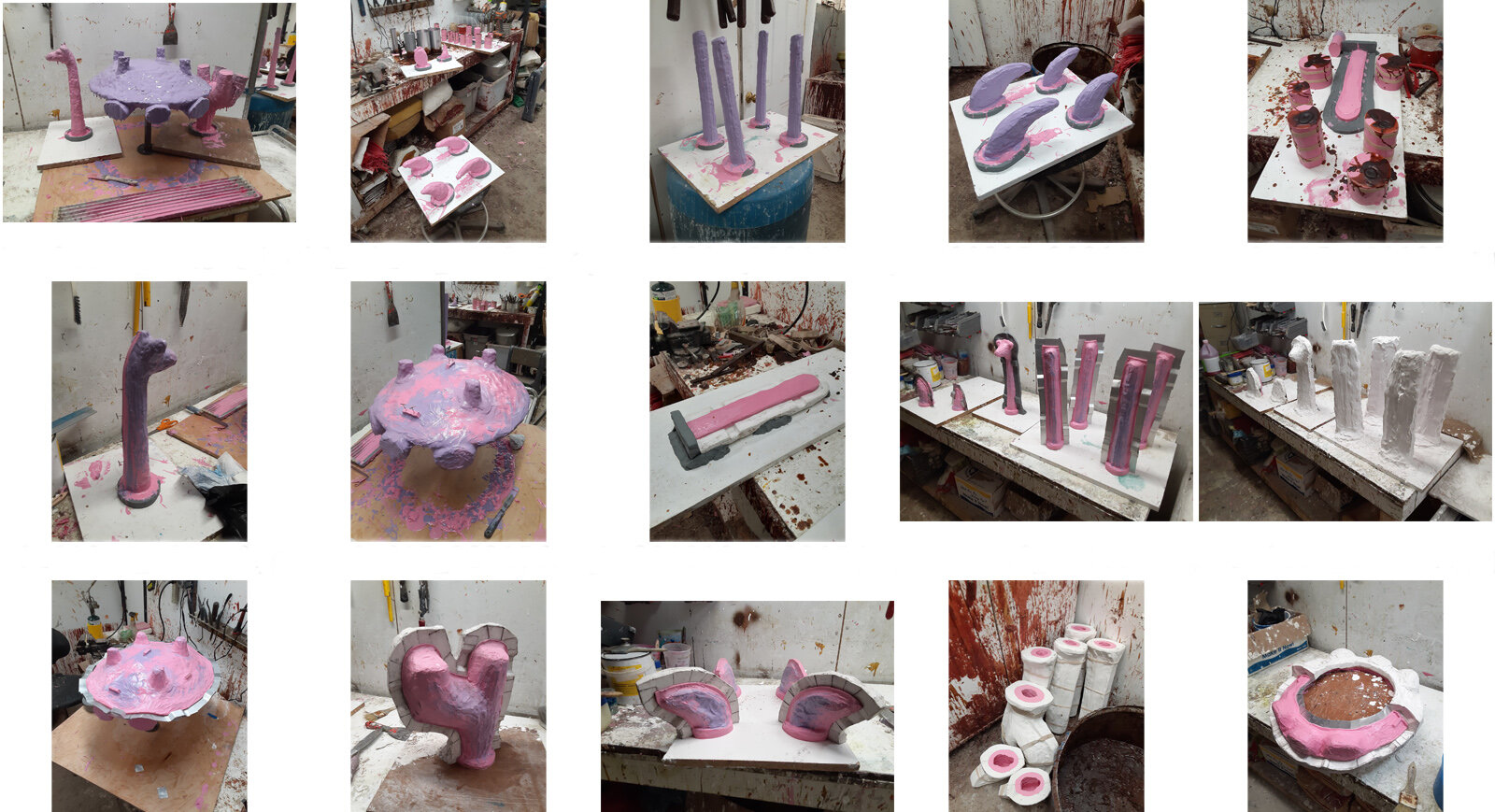
Once he has the rubber molds, he will pour casting wax into them—the small figures solid, the large shapes like the giraffe body receive a thin layer so they can be hollow. When Zach has these wax pieces complete, he will attach the small ones together and build a funnel above each one—the constructions, intriguing modern mobiles.

The next step is to create the molds to receive the molten bronze. Each of these wax mobiles are dipped into a silica slurry nine times to slowly building up the mold. They are dipped, then coated with sand, and hung to dry for at least a day between dips.

At the pour, the funnel on top of each mold receives the liquid bronze, the wax melts out, lost wax, and the bronze hardens. These hard shells are then hammered and broken to free them from the bronze inside.

There are still days of work ahead for Zach. He has to cut off the sprues and funnels. He has to sandblast each piece to get the specks of hard shell out of every crevice. Then the individual pieces will be welded together. Zach has to know how to replicate the textures I sculpt in my wax sculpture, and he has to do it in metal so the welded seams disappear. He has to care about the subtleties of the texture, with the deliberateness of a poet choosing words to describe the grooved furrows of an oak trunk.
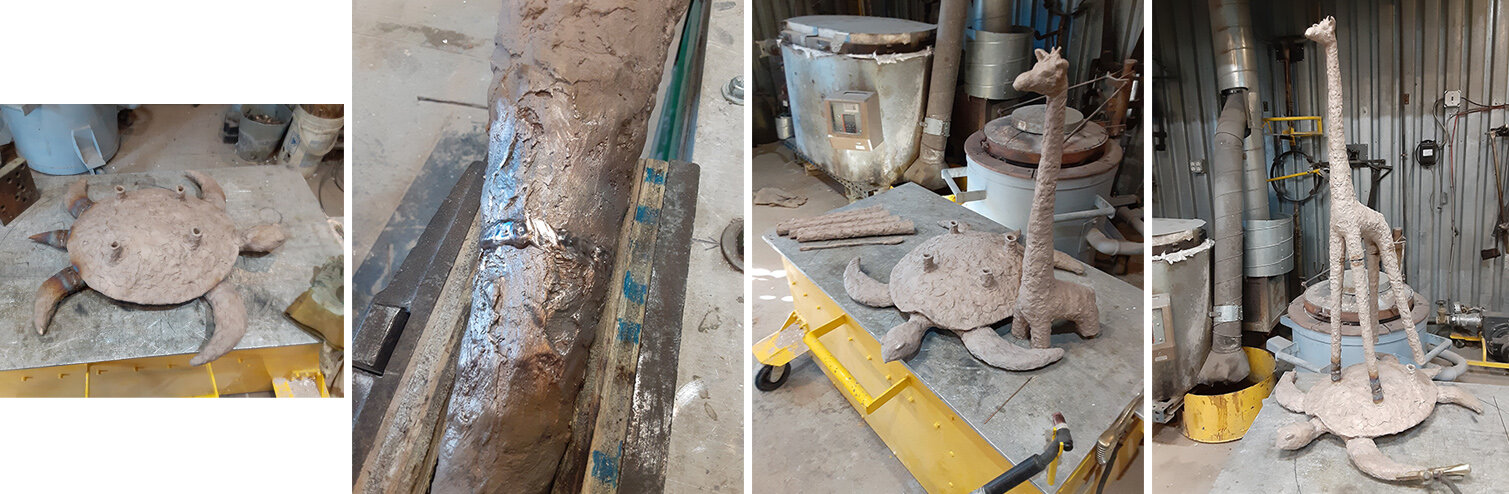
I returned to the foundry a few weeks ago to position each of the the small bronze figures on the backs of the giraffe and turtle. Zach welded each one in place.

Then Refuge received its final patina and wax polish. It’s a long process. This piece is signed and numbered 1/5. Though my original waxes have disappeared, I have the molds to make four more copies. But always, for each one, we have to first make a new wax model, then cast it into bronze. After five copies, we’ll destroy the molds.
Lost wax is an apt metaphor for these times: The only way to create something new is to lose something. While we are collectively facing tremendous loss, it is good to reflect on the space that allows for something new to arise. The loss is real—people’s lives, habitat, species, jobs, freedom. I am alarmed, but I dearly want to believe that we can turn things around. We need humility. We need respect for every living being on the planet. Then the turtle and the giraffe, the heron and the wasp, the oak, the waterlily, and even the gnat will all be helping because we are all interconnected.
Refuge would have been outdoors at the Fuller Museum this summer, but Covid has delayed the opening of the New England Sculptors Exhibit until spring 2021. It sits on a chunk of bedrock outside my studio. I’d love to send more casting work Zach’s way, so if you would be interested in a copy of Refuge for your own garden, let’s talk.
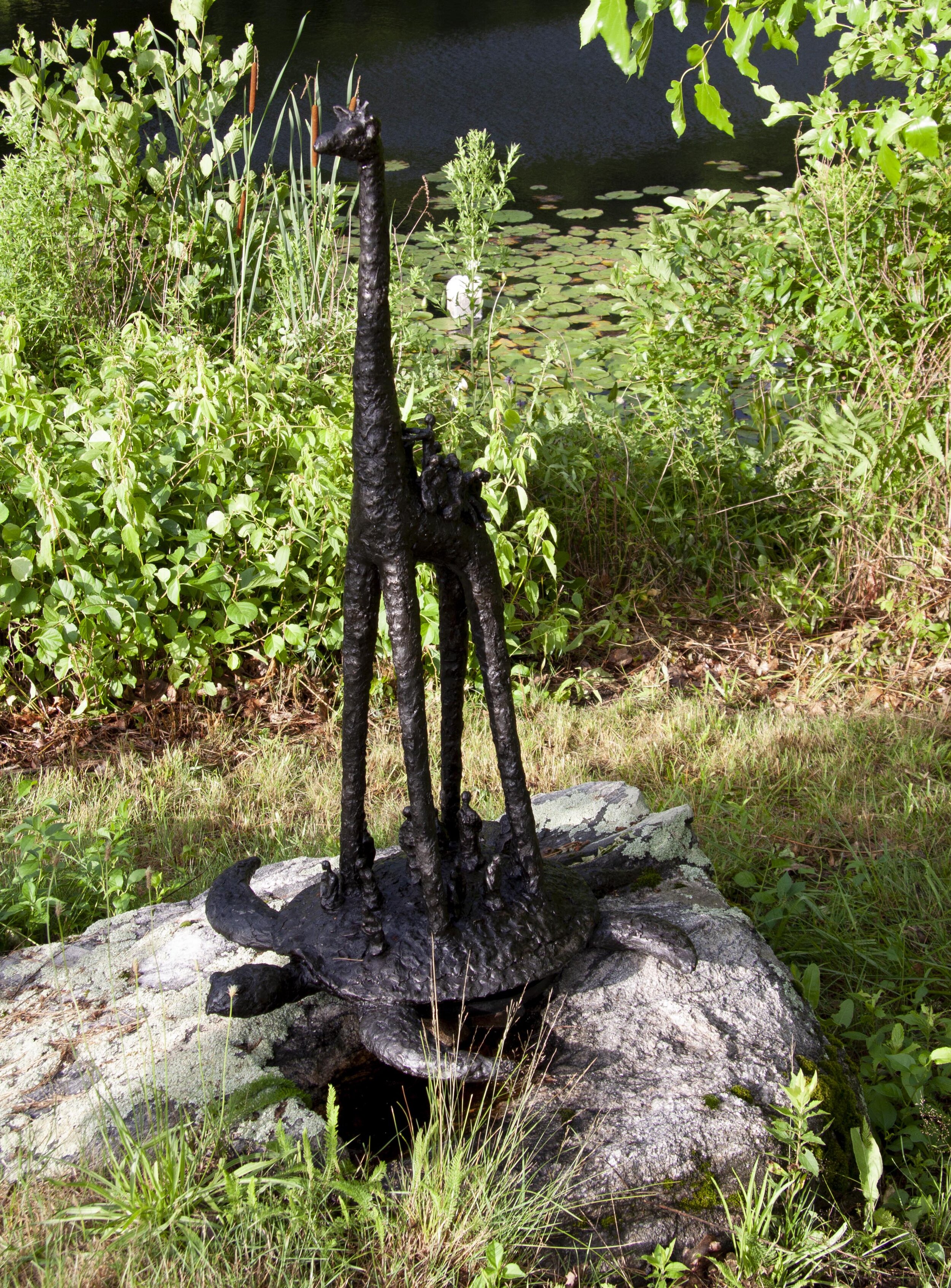
Refuge, bronze, 2020
Refuge is a hopeful piece. The determined, young giraffe and the tireless turtle are unconcerned with the enormity of their mission. They echo the world’s need for us to engage, to bring our gifts, and to offer help in this time of great loss. It’s a collective dance we can’t do alone.
Catalpa: The Hugging Tree
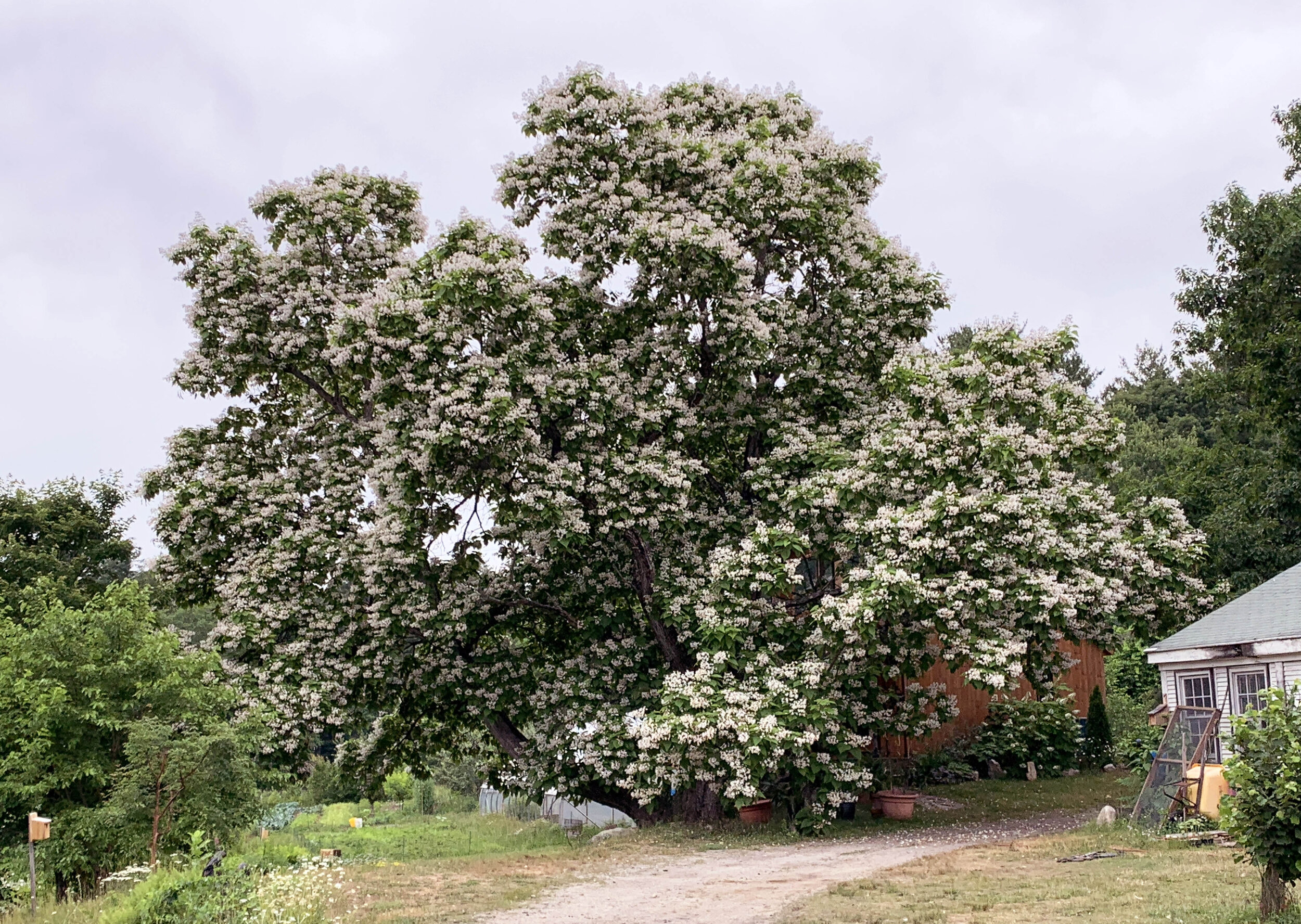
Catalpa Tree in Bloom, June 27, 2020
In full white flowering, a trillion frilly night moths perch on stems, sending out sweet scents of rose and bergamot. These clutches of flowers, each the size of a newborn child, balance at the end of every leaf cluster. The leaves, heart-shaped and lime green, lay open to the sky, each one positioned for the best photosynthesis. Catalpas reach peak bloom near the summer solstice, late for most trees in our climate. Summer is too hot for delicate blossoms.
Everything about this tree is large, embracing, and opulent. The wood, uprising from the ground, a trio of trunks, holds so much weight its steep ascent is inconceivable. It must be in the third octave of its life. Such a magnum opus. The tree dwarfs the building behind, my studio.
From the studio loft window I have watched a pair of swallows sit together, then fly off, soaring, and mating. Their brood began life in the bird box a few paces away. Red-winged blackbirds often sit on a branch and squawk, while nuthatches pace up and down the trunk. These tiny birds peck at bugs in the bark, quietly though, not like the red-hatted pileated woodpecker’s incessant jackhammering.
A few years back we had a tree company put two cables into the tree, worried about losing one of the trunks in a storm. This trinity of trunks now supports each other. One large branch broke two years ago. The branch dove to the ground and shattered, the wound along it—an accordion of frayed wood. But I wanted to leave it, not remove it, to see if it would heal. Now, buttressed by earth, new branches grow, flower, and bear fruit.
The tree grows twenty yards from the pond. I imagine it drinks heartily with every meal. Big tankards of H2O. Its size is quite out of scale for our small farm, but the Catalpa’s nature is to keep growing—water the source of its ecstasy.
The Catalpa makes its own shade, its own ecosystem, its own refuge. But now the bloom is over. The flowers are faded and brown, the scent has turned musky. It’s been such a presence in my life for the last ten days, I took my meditation cushion outside to sit near its trunk. That’s when I started using the pronoun “she” and “her” when I referred to the Catalpa. Her branches, her blossoms. She became more than tree to me. She became protector and guide.
While writing about her, I remembered that in my dream last night. I met an Indian woman, dressed in a drab brown and gray sari, with drab-colored brown and gray hair in a bun, and I knew it was Amaa, the hugging saint. I’ve never met her, but I’ve heard friends tell of their experiences, the process of waiting in a long line sometimes for hours, for the few seconds or minute it takes to receive her hug-blessing. In my meeting with Amaa, she cupped my shoulders with her hands, and then bowed my head so we lost eye contact but our foreheads joined. We were sisters, or mother and daughter, or some connected ancestor. She said, “Baruch Shalom” three times. Baruch is the beginning word of many Jewish prayers and means blessed. Shalom means peace.
The Catalpa tree became Amaa, became the carrier of this message of peace, strength, and resiliency. She communicated that we have untapped powers within us we are not aware of. The passing away of the blossoms became the rising of another voice, a steadfast and calming voice, reaching out to meet us. Inviting us into her embrace, always with open arms, the hugging tree, offering refuge.

Catalpa Tree, July 4, 2020
Search Blog
-
2025
- May 9, 2025 A View from the Tractor Seat
- Apr 11, 2025 Dig
-
2024
- Jan 7, 2024 Winter Wassail
-
2022
- Dec 11, 2022 Keeping Time
- Jun 17, 2022 This Apple-Shaped Earth
- Jan 23, 2022 What is a Jizo?
- Jan 16, 2022 An Invite and Housekeeping Update
- Jan 1, 2022 The Year of the Frog: What Orchardists Do While Apple Trees are Chilling
-
2021
- Oct 24, 2021 Figs
- Oct 3, 2021 The Artist and the Orchard: A Memoir
- Aug 8, 2021 Red-Fleshed Apples
- Jul 25, 2021 When We Were Trees
- Jun 27, 2021 Castor Beans—Who Knew?
- Jun 13, 2021 Spring Training at a Zen Monastery
- May 4, 2021 Our Trees are in Bloom
- Apr 18, 2021 Hooray!
- Jan 24, 2021 Wassailing, virtually!
- Jan 1, 2021 Sitting
-
2020
- Dec 21, 2020 Darkness to Light
- Nov 28, 2020 One Heart
- Sep 18, 2020 Juggling Flowers, Fruit, and Vegetables
- Aug 23, 2020 Refuge
- Aug 9, 2020 Bags of Fertilizer
- Aug 2, 2020 The Sermon of the Blue Heron
- Jul 26, 2020 What's the Buzz?
- Jul 19, 2020 Farm Moments
- Jul 12, 2020 Lost Wax
- Jul 5, 2020 Catalpa: The Hugging Tree
- Jun 28, 2020 Pedaling Peace
- Jun 21, 2020 See Change
- Jun 14, 2020 Lalla Unveiled
- Jun 7, 2020 Pond Alchemy
- May 31, 2020 The Birth of Fruit
- May 24, 2020 An Artist in the Orchard
- May 17, 2020 Walking the Land: Returning Home
- May 10, 2020 Stinging Nettles: Gifts from the Great Mother
- May 3, 2020 The Mystery of Swallow
- Apr 26, 2020 Aerial Bruststrokes
- Apr 19, 2020 Simple Pleasures
- Apr 12, 2020 Weeds and Other Gifts
- Apr 5, 2020 Remembering the Seeds
- Mar 29, 2020 Blow on the Embers
- Mar 22, 2020 Ripples
-
2019
- Nov 16, 2019 Tibet Impressions
- Nov 9, 2019 Forest Tales
- Oct 13, 2019 The Gift
- Aug 4, 2019 The Season is Apples, Berries, and Grandfather Fire
- Jun 8, 2019 Pointers for a Writing Life
- May 12, 2019 Mothers of the Earth
- Apr 6, 2019 The Apple-Shaped Earth
- Mar 23, 2019 You Don’t Know What You Have Till It’s Gone
- Feb 23, 2019 Generations
- Feb 9, 2019 What Are We Doing to the Earth, John Chapman?
-
2018
- Dec 31, 2018 Long Shadows
- Oct 6, 2018 A Pilgrimage to India
- Aug 18, 2018 Scrap Wrenn
- Aug 11, 2018 Off-the-Wall Comments from an Ignorant Farmer
- Jul 28, 2018 Creative Connect
- Jul 14, 2018 How is the Orchard?
- Jun 30, 2018 Which Way?
- Jun 16, 2018 Geese, Herons, Beavers, and the Baby Steps of a Lapsed Blogger
- Feb 24, 2018 Mama's Coupons — Good Forever
- Jan 27, 2018 January Ice
- Jan 13, 2018 The Muse
-
2017
- Dec 30, 2017 A Dream for the New Year
- Dec 23, 2017 A New Year for Apples
- Dec 16, 2017 Intuition
- Nov 22, 2017 Thanksgiving OM
- Nov 4, 2017 East Fork Pottery
- Oct 28, 2017 Putting Down New Roots
- Oct 21, 2017 A is for Art
- Oct 14, 2017 Eve domesticus
- Oct 7, 2017 A String Workshop
- Sep 30, 2017 After Applepicking
- Sep 23, 2017 Two Bad Women and One Good Apple
- Sep 16, 2017 Plein Air Poetry
- Sep 9, 2017 Cutting Off a Leg
- Sep 2, 2017 The Changing Landscape
- Aug 26, 2017 All About Art
- Aug 19, 2017 My First Visit to the Farm
- Aug 12, 2017 The First Food
- Aug 5, 2017 A Teapot, a Woman, and maybe a Boat
- Jul 29, 2017 A Raspberry Dilemma
- Jul 22, 2017 Consider the Miracle
- Jul 15, 2017 Meeting Ekphrasis
- Jul 8, 2017 Ripening Fruit
- Jul 1, 2017 The Voice of The Caterpillar
- Jun 24, 2017 Goumi — An Unusual Fructus
- Jun 17, 2017 Concord, an American Bloomsbury
- Jun 10, 2017 The World Is Bonkers — Shall I Laugh or Cry?
- Jun 3, 2017 Bonkers, a Revolutionary Apple
- May 27, 2017 Guardians of the Swamp
- May 20, 2017 There are Mushrooms and There are Morels
- May 13, 2017 "What's in a Name?"
- May 6, 2017 Bloom Follows Pink: Orchard Pollination
- Apr 29, 2017 The Orchard Is at Pink
- Apr 22, 2017 Natural Farming — Part 2 (continuation from last Sunday's blog)
- Apr 15, 2017 Natural Farming — Part 1
- Apr 8, 2017 Boats, Figures, and Catching Fish
- Apr 1, 2017 A Man with a Mission: The Nuts and Bolts of Bronze Casting
- Mar 25, 2017 A Chalice of Spirit, Art, and Nature
- Mar 18, 2017 Hanami — Blossom Viewing
- Mar 11, 2017 Soil Redemption Song
- Mar 4, 2017 Food is Primary Care
- Feb 25, 2017 Pomme de Terre
- Feb 18, 2017 Organic Certification
- Feb 11, 2017 Tantalizing Fruit
- Feb 4, 2017 The Myths of History
- Jan 28, 2017 The Orchard in Winter
- Jan 21, 2017 The Hi-Line
- Jan 14, 2017 Artistic, Botanical, and Social Diversity
- Jan 7, 2017 Where is Eden?
-
2016
- Dec 31, 2016 The Creative Heart
- Dec 24, 2016 A Christmas Tale
- Dec 17, 2016 Who are the Crones?
- Dec 10, 2016 The Olympic Bell (Part Two)
- Dec 3, 2016 Overheard in the Apple Orchard in Early December
- Nov 26, 2016 The Lessons of a Tortoise
- Nov 19, 2016 In the Studio
- Nov 12, 2016 Even in Darkness
- Nov 5, 2016 Southern Apples, an Elephant, Monkey, Rabbit, and Bird, Two Mango Trees and a Birthday
- Oct 29, 2016 The Tools of Art
- Oct 22, 2016 Labyrinths
- Oct 15, 2016 Repairing the Broken
- Oct 8, 2016 When You Are No More
- Oct 1, 2016 Creation Rain
- Sep 24, 2016 Breaking the Glass
- Sep 17, 2016 String Art
- Sep 10, 2016 Poetry and Photosynthesis: It's all in the Leaves
- Sep 3, 2016 In the Plenty of Time
- Aug 27, 2016 Witch Doctors
- Aug 20, 2016 Listen Coyote
- Aug 13, 2016 Milkweed in the Orchard
- Aug 6, 2016 Some People See a Turtle
- Jul 30, 2016 Arborshaping
- Jul 23, 2016 Joseph Wheelwright: Sculptor of Stones and Trees
- Jul 16, 2016 Asian Pears
- Jul 9, 2016 Gold Leaf, Grief, and the Creative Process
- Jul 2, 2016 The Olympic Bell (Part One)
- Jun 25, 2016 Around the Mulberry Bush
- Jun 18, 2016 Avoiding Apples
- Jun 11, 2016 Fructus
- Jun 4, 2016 Astonishing Apples
- May 28, 2016 Scare the Caterpillars
- May 21, 2016 Join the Club!
- May 14, 2016 The Graft
- May 7, 2016 Rooster, Rhubarb, Rue
- Apr 30, 2016 What do Dolphins and Nettles Have in Common?
- Apr 23, 2016 Art Prunings
- Apr 16, 2016 A Few of the First Arrivals
- Apr 9, 2016 Taste the Spirit of Sustainable Agriculture
- Apr 2, 2016 First Orchard Spray - March 22-24, 2016
- Mar 26, 2016 Hawkeye Apple
- Mar 19, 2016 Desiring the Almata Apple
- Mar 12, 2016 Ugly Fruit
- Mar 5, 2016 Winter Tracks
- Feb 27, 2016 Splash
- Feb 20, 2016 Pruning
- Feb 13, 2016 Orchard Ruminants
- Feb 6, 2016 A Gathering of Seeds
- Jan 30, 2016 Orchard Dragons
- Jan 23, 2016 Tree Rings
- Jan 17, 2016 The Fallen Tree
- Jan 7, 2016 Wassailing the Apple Trees
- Jan 1, 2016 The New Year