LINDA HOFFMAN
Keeping Time
Dear Friends,
The farming season is officially over! Whew! I haven’t written a blog for months. Not because I didn’t have time, but because the swirling activity was all geared towards outside, external, farm business, and necessary haste. I’ve written newsletters for Old Frog Pond Farm, but they promote the farm and encourage visitors. For blog writing, I like to travel on back roads, interior paths, to keep my finger on the pause button, to listen for thoughts that arrive in quiet moments and wend my way. A little like how I sometimes begin a sculpture. This morning I stayed in bed with my eyes closed and let the dreaming continue until seven! Instead of the darkness I was greeted with this view.
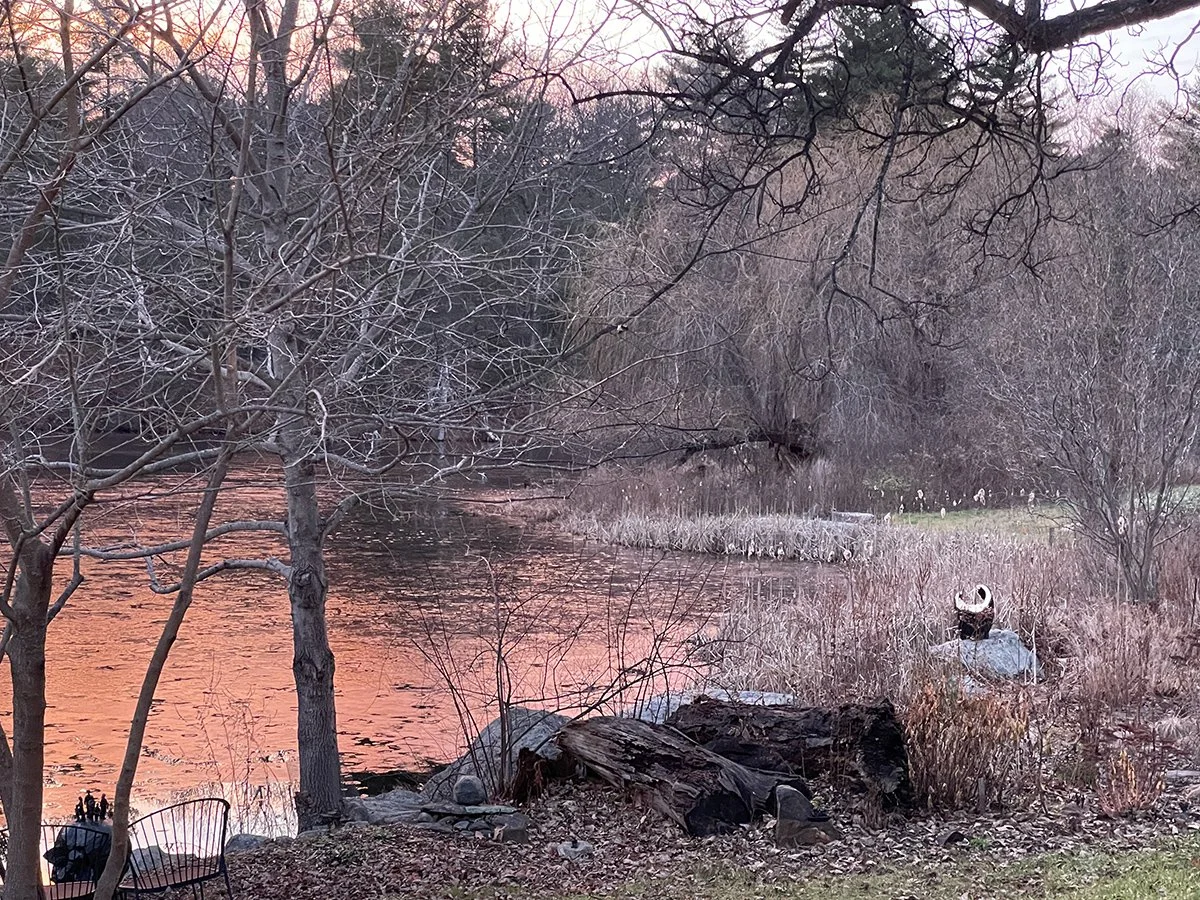
Sunrise Colors in the Pond
I share this poem by the great 13th century Chinese Zen Master Wumen, the compiler of The Gateless Gate koan collection.
Ten thousand flowers in spring, the moon in autumn,
a cool breeze in summer, snow in winter.
If your mind isn’t clouded by unnecessary things,
this is the best season of your life.
The great Zen master, Dogen Zenji, a 14th century philosopher, linguist, and poet, wrote in the fascicle, Uji, “The Time-Being.”
Since there is nothing but just this moment, the time-being is all the time there is. . . . Each moment is all being, is the entire world. Reflect now whether any being or any world is left out of the present moment.
Translated by Dan Welch and Kazuaki Tanahashi from The Moon in a Dewdrop, writings of Zen Master Dogen
Dogen’s Uji text is only a few pages long, but he completely twists and turns and challenges our view of time. As a teacher he wants us to realize the wonder and completeness of each moment and not be caught by the conventional view of time as a continuum. These and other writings about time are inspiring a new sculpture, The Keepers of Time, though the title is always provisional until it is complete.

It begins with a wheel, one of two old cart wheels leaning against the chicken coop. This wheel has eighteen spokes, six more than hours on a clock. The Timekeepers are women who will inhabit the wheel. I envision them placing the numerals for the clock in position around the perimeter of the wheel.
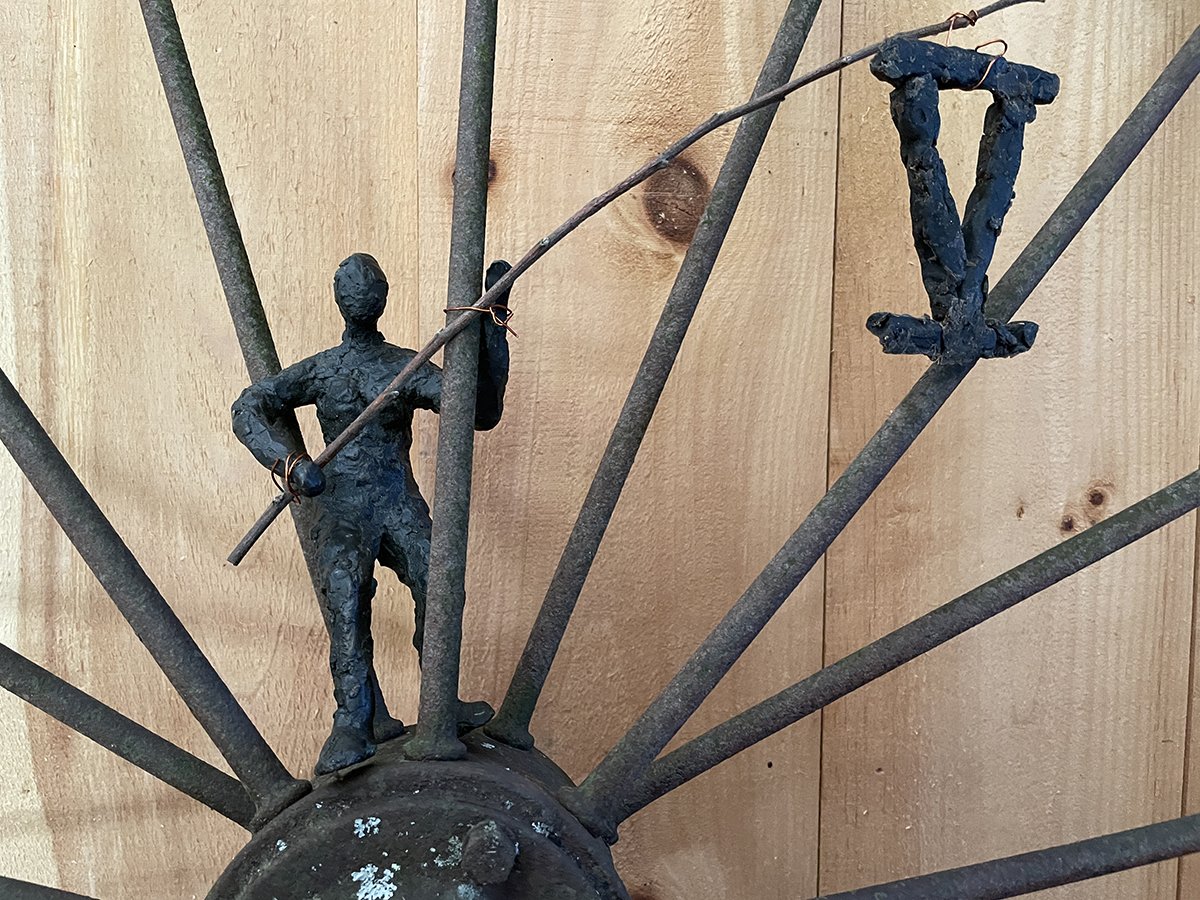
I'm not sure if the Timekeepers recognize that time is not an abstraction, but something they are creating. Do they know there is no time apart from their creating time? How will they each play with their hours, days, and weeks ahead?
How do I have more time to read and write? This thought arrived in my mind this morning? I held it as if it was lightly filled with helium. It had form. But as I stayed with my attention on this thought, it squirmed away. For a moment I couldn’t find it. Then as if it could slither like a ghost under a door, it appeared again. It wasn’t a shape any longer. It was detaching, losing meaning.
In mid-November I gave a Dharma talk, Time Present, at Zen Mountain Monastery. Writing this talk is what started me on this investigation of Time. If you’d like to listen click here.
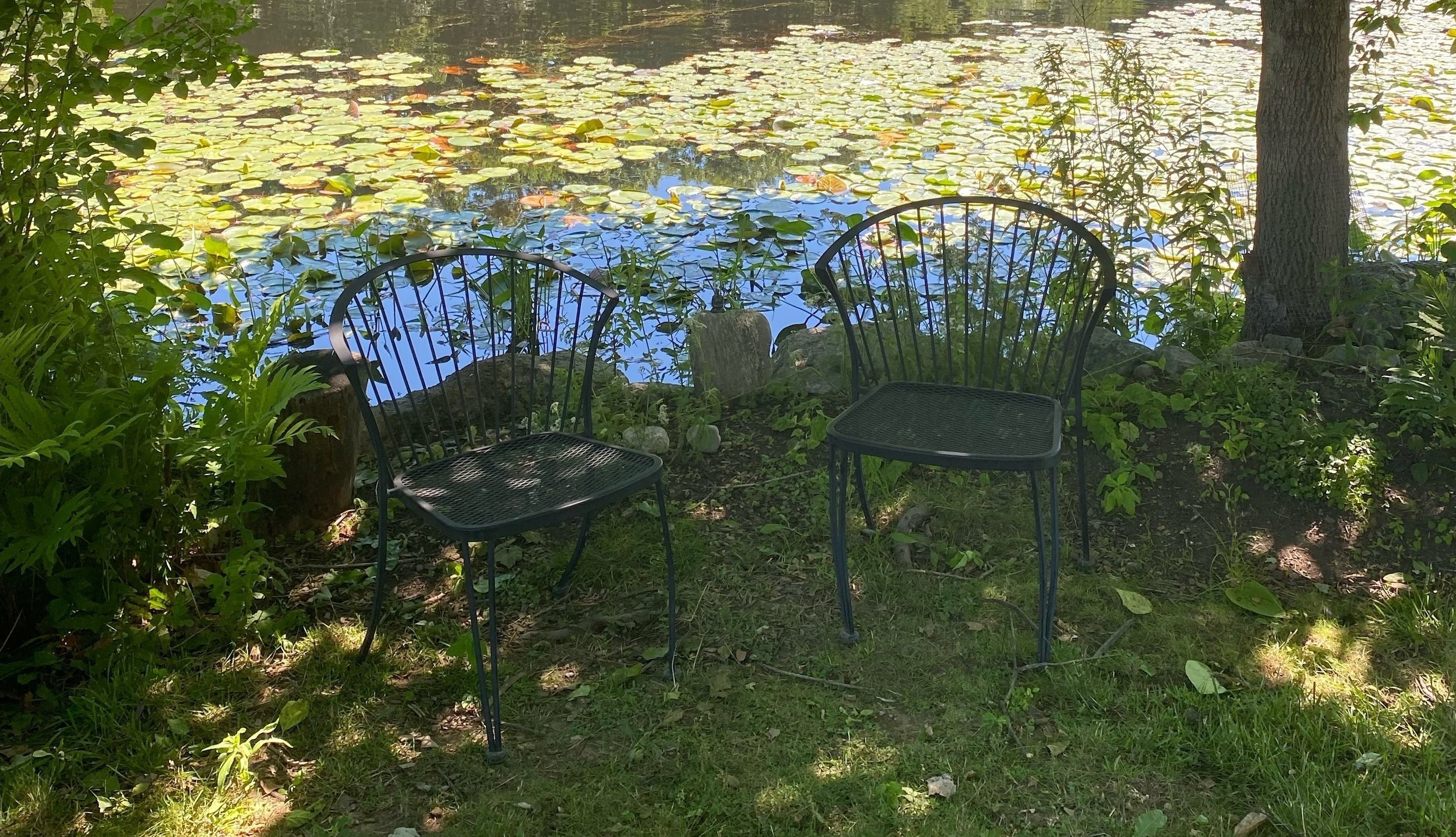
Another new project is Two Chairs—Conversations with my friend, Lyedie Geer. Posted on the farm’s youtube channel are the first two videos of this new collaboration. In the winter of 2022, inspired by a purple velvet chair I inherited from my mother, and Lyedie’s blue chair, we decided to get together for conversation. We didn’t know where or what we were doing, but it was a treat to be together in person and talk as the pandemic was losing its grip First, I went to Putney, Vermont, with my mother’s chair in tow, then Lyedie traveled down to the farm and we sat in two chairs outside my studio near the pond.
In the first Two Chairs—Conversations, we explore Pruning—daring to make those difficult cuts—in the orchard and in one’s own life. In the second, Splash, we dig into the creative process as we talk about one of my new sculptures. We’re grateful to be working with David Shapiro, who also made our farm’s video.
Finally, I want to let you know Lyedie is an amazing coach of creative women. Until December 21st, she is accepting applications for the Bluebird award! I suggest if you have any desire to be encouraged and inspired in your creative life, click here to learn about the three-month pro-bono coaching program she is offering.
That’s it for now!
With love, Linda
The Year of the Frog: What Orchardists Do While Apple Trees are Chilling
I’m working in the studio on a sculpture of a frog. I talk to it while I sculpt it. I ask questions. I stroke it and I pat it. You might say I have fallen in love with this frog—though I’m not intending to kiss it, and definitely not desiring to meet a prince. This is not a frog of fairytales, but the frog who is the subject of a haiku by Matsuo Basho, Japan’s most influential 17th century haiku master.
Haiku was originally a seventeen-syllable introductory verse to a longer series of linked poems. Then in the middle of the 15th century, people began to write these short poems as a separate form. They sent them to each other, shared them. They were often playful. Basho, a maverick, was keen to use this form of poetry to express something more serious. For almost all of his life he explored the writing of haiku. Haiku became an evocation of an experience, of a moment. As an art form, it aligned with the development of Zen Buddhism in Japan, and became an instantaneous presentation of the whole without intellectual commentary.
How much could be expressed in few words? How to express an emotion like loneliness without using the word?
In 2001, when I first visited this rundown farm with its old apple orchard, I was awed by its large pond. Years earlier I had lived in Japan and been influenced by the Zen poets and traditional Japanese arts. This pond reminded me of one of Basho’s haiku and I named the farm Old Frog Pond. There are at least a hundred translations of the poem—some quite strange—but literarily it is:
Furu ike ya/ old pond (‘ya’ is a word of emphasis but without specific meaning)
Kawazu tobikomu/ frog jumps
Mizu no oto/water’s sound
In a traditional haiku, the first line often sets the scene. In this poem, we are introduced to the view of the old pond. This ageless pond might make us think about the beauty of the moon’s reflection in water, or how an old willow’s branches coax ripples on its surface. The pond may hold in its depth old carp, ancient beings.
In the second line, our gaze narrows as we see a frog. In traditional haiku writing, “Frog” was considered a season word to indicate spring. In Basho’s poem this little frog appears, a small creature, perhaps just coming out of the mud on an early spring day. Our mind holds the fragility of the frog within the expansive pond. We hold the singular among the universal.
Then, all of sudden, we are woken from our musings with a ‘splash’—the sound caused by the frog’s jump breaking the surface of the water.
Suddenly, everything disappears—our thoughts about this old pond, about the frog, the season, the setting. Only the sound exists. We are no longer thinking or making up a story. No frog and princess here. For a moment we even forget ourselves—just splash!
What does it take to be absorbed in the moment? Why is this significant?
How do we absorb ourselves in an experience? How do we have an experience?
Who is this ‘we’ that experiences?
Basho trained for several years as a Zen monk. He continued to wear the robes of a monk as his daily garb. His writing of haiku was the practice of a Zen art. His language was always simple yet conveyed the complexity of our heart/mind. In Japanese the character for kokoro, carries the meaning of ‘heart’ and ‘mind’, unlike in English where these two words are distinct.
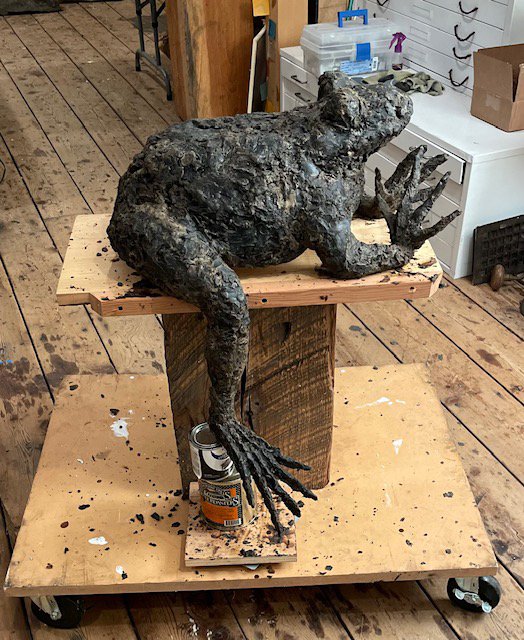
Working on sculpture is different from writing. I form the muscles of the leg with melted wax. I press and shape the thick and sinuous body parts. I carve into hard wax the lines of the nail ridges on its webbed feet. Wax sticks to my finger tips and palms, and hardened wax packs behind my nails. When I work on the frog, I touch only frog. When I gaze at the frog, I see only frog. This frog does not jump. It is sitting. Contemplative you might say. Prayerful even. There is no splash.
A concrete pillar stands in the water between the lower pond and the small stone bridge before the pond water flows into the vast Delaney wetlands. It’s been calling for a sculpture since I moved here. Once this frog is cast into bronze, it will live on the post and gaze east towards the rising sun. Its feet will dangle and tease the water.
While working on the sculpture, I wondered if the frog should be carrying anything on its back or holding anything in its hands. But the frog was adamant. I’m just a frog. I’m a frog that is completely myself. Not going anywhere, not doing anything. Maybe that’s why I love it. Maybe that’s what love is—not needing something or someone or ourselves to be any more than just what and who we are. Not needing to do anything, only experiencing this moment fully.
Next spring I hope you will come to see this Frog in its new home.
May we all find the stillness and wakefulness of Basho’s Frog in the New Year!

Juggling Flowers, Fruit, and Vegetables

The Garden: photo Robert Hesse
Raspberries, butternut squash, and tomatoes have taken over my Saturday mornings when I would normally write the blog for Sunday. I know how to juggle three balls from my days as a professional mime, but throw in a little art, add some poetry, and the juggling gets even more thrilling.
Our Outdoor Sculpture Exhibit, Around the Pond and through the Woods on the theme of REFUGE continues Thursdays through Sundays, 11 - 4 pm.

Refuge Within, Liz Fletcher: Photo Robert Hesse
Walt Whitman visits the farm on Saturday, September 19th at 2 pm.
We will be hosting a visit from the towering Walt Whitman. If you’ve never seen Stephen Collins’ portrayal of the young, questioning Whitman, as well as the aging brilliant raconteur of love and longing, this is a rare opportunity to enjoy it en plein air. Stephen will be performing in front of the pond near my studio. Flinging Whitman’s words to the open sky makes Whitman’s poetry soar. I imagine even the kingfishers will pause to listen. Seating is limited so RSVP to reserve your seat. Tickets: $15.
Live Plein Air Poetry on Sunday afternoon, September 20th at 3 pm.
Join 26 poets sharing the poems they have written for Refuge, our online chapbook of site-specific poetry, inspired by the fields, pond, garden, trees, and creatures who live at the farm. The Zoom event will feature photographs by Brent Mathison who traced the paths of the poets and captured the glow of their words. Lynn Horsky designed the elegant chapbook. Poetry Editor Susan Edwards Richmond will be our host. You can join the livestream of this event beginning at 3 pm Sunday, at facebook.com/OldFrogPondFarm and download the chapbook at at: penandanvil.com/hw/chapbooks. There will be an opportunity to order a digital print copy as well.

On Saturday, September 26th we celebrate Bolton Harvard Open Studios from 10—4 pm.

When the farm season ends, I look forward to returning to more intimate blog post writing. Meanwhile, I hope you are keeping all your balls in the air!

Linda Hoffman, A Mudhead Mime, 1975
Search Blog
-
2025
- May 9, 2025 A View from the Tractor Seat
- Apr 11, 2025 Dig
-
2024
- Jan 7, 2024 Winter Wassail
-
2022
- Dec 11, 2022 Keeping Time
- Jun 17, 2022 This Apple-Shaped Earth
- Jan 23, 2022 What is a Jizo?
- Jan 16, 2022 An Invite and Housekeeping Update
- Jan 1, 2022 The Year of the Frog: What Orchardists Do While Apple Trees are Chilling
-
2021
- Oct 24, 2021 Figs
- Oct 3, 2021 The Artist and the Orchard: A Memoir
- Aug 8, 2021 Red-Fleshed Apples
- Jul 25, 2021 When We Were Trees
- Jun 27, 2021 Castor Beans—Who Knew?
- Jun 13, 2021 Spring Training at a Zen Monastery
- May 4, 2021 Our Trees are in Bloom
- Apr 18, 2021 Hooray!
- Jan 24, 2021 Wassailing, virtually!
- Jan 1, 2021 Sitting
-
2020
- Dec 21, 2020 Darkness to Light
- Nov 28, 2020 One Heart
- Sep 18, 2020 Juggling Flowers, Fruit, and Vegetables
- Aug 23, 2020 Refuge
- Aug 9, 2020 Bags of Fertilizer
- Aug 2, 2020 The Sermon of the Blue Heron
- Jul 26, 2020 What's the Buzz?
- Jul 19, 2020 Farm Moments
- Jul 12, 2020 Lost Wax
- Jul 5, 2020 Catalpa: The Hugging Tree
- Jun 28, 2020 Pedaling Peace
- Jun 21, 2020 See Change
- Jun 14, 2020 Lalla Unveiled
- Jun 7, 2020 Pond Alchemy
- May 31, 2020 The Birth of Fruit
- May 24, 2020 An Artist in the Orchard
- May 17, 2020 Walking the Land: Returning Home
- May 10, 2020 Stinging Nettles: Gifts from the Great Mother
- May 3, 2020 The Mystery of Swallow
- Apr 26, 2020 Aerial Bruststrokes
- Apr 19, 2020 Simple Pleasures
- Apr 12, 2020 Weeds and Other Gifts
- Apr 5, 2020 Remembering the Seeds
- Mar 29, 2020 Blow on the Embers
- Mar 22, 2020 Ripples
-
2019
- Nov 16, 2019 Tibet Impressions
- Nov 9, 2019 Forest Tales
- Oct 13, 2019 The Gift
- Aug 4, 2019 The Season is Apples, Berries, and Grandfather Fire
- Jun 8, 2019 Pointers for a Writing Life
- May 12, 2019 Mothers of the Earth
- Apr 6, 2019 The Apple-Shaped Earth
- Mar 23, 2019 You Don’t Know What You Have Till It’s Gone
- Feb 23, 2019 Generations
- Feb 9, 2019 What Are We Doing to the Earth, John Chapman?
-
2018
- Dec 31, 2018 Long Shadows
- Oct 6, 2018 A Pilgrimage to India
- Aug 18, 2018 Scrap Wrenn
- Aug 11, 2018 Off-the-Wall Comments from an Ignorant Farmer
- Jul 28, 2018 Creative Connect
- Jul 14, 2018 How is the Orchard?
- Jun 30, 2018 Which Way?
- Jun 16, 2018 Geese, Herons, Beavers, and the Baby Steps of a Lapsed Blogger
- Feb 24, 2018 Mama's Coupons — Good Forever
- Jan 27, 2018 January Ice
- Jan 13, 2018 The Muse
-
2017
- Dec 30, 2017 A Dream for the New Year
- Dec 23, 2017 A New Year for Apples
- Dec 16, 2017 Intuition
- Nov 22, 2017 Thanksgiving OM
- Nov 4, 2017 East Fork Pottery
- Oct 28, 2017 Putting Down New Roots
- Oct 21, 2017 A is for Art
- Oct 14, 2017 Eve domesticus
- Oct 7, 2017 A String Workshop
- Sep 30, 2017 After Applepicking
- Sep 23, 2017 Two Bad Women and One Good Apple
- Sep 16, 2017 Plein Air Poetry
- Sep 9, 2017 Cutting Off a Leg
- Sep 2, 2017 The Changing Landscape
- Aug 26, 2017 All About Art
- Aug 19, 2017 My First Visit to the Farm
- Aug 12, 2017 The First Food
- Aug 5, 2017 A Teapot, a Woman, and maybe a Boat
- Jul 29, 2017 A Raspberry Dilemma
- Jul 22, 2017 Consider the Miracle
- Jul 15, 2017 Meeting Ekphrasis
- Jul 8, 2017 Ripening Fruit
- Jul 1, 2017 The Voice of The Caterpillar
- Jun 24, 2017 Goumi — An Unusual Fructus
- Jun 17, 2017 Concord, an American Bloomsbury
- Jun 10, 2017 The World Is Bonkers — Shall I Laugh or Cry?
- Jun 3, 2017 Bonkers, a Revolutionary Apple
- May 27, 2017 Guardians of the Swamp
- May 20, 2017 There are Mushrooms and There are Morels
- May 13, 2017 "What's in a Name?"
- May 6, 2017 Bloom Follows Pink: Orchard Pollination
- Apr 29, 2017 The Orchard Is at Pink
- Apr 22, 2017 Natural Farming — Part 2 (continuation from last Sunday's blog)
- Apr 15, 2017 Natural Farming — Part 1
- Apr 8, 2017 Boats, Figures, and Catching Fish
- Apr 1, 2017 A Man with a Mission: The Nuts and Bolts of Bronze Casting
- Mar 25, 2017 A Chalice of Spirit, Art, and Nature
- Mar 18, 2017 Hanami — Blossom Viewing
- Mar 11, 2017 Soil Redemption Song
- Mar 4, 2017 Food is Primary Care
- Feb 25, 2017 Pomme de Terre
- Feb 18, 2017 Organic Certification
- Feb 11, 2017 Tantalizing Fruit
- Feb 4, 2017 The Myths of History
- Jan 28, 2017 The Orchard in Winter
- Jan 21, 2017 The Hi-Line
- Jan 14, 2017 Artistic, Botanical, and Social Diversity
- Jan 7, 2017 Where is Eden?
-
2016
- Dec 31, 2016 The Creative Heart
- Dec 24, 2016 A Christmas Tale
- Dec 17, 2016 Who are the Crones?
- Dec 10, 2016 The Olympic Bell (Part Two)
- Dec 3, 2016 Overheard in the Apple Orchard in Early December
- Nov 26, 2016 The Lessons of a Tortoise
- Nov 19, 2016 In the Studio
- Nov 12, 2016 Even in Darkness
- Nov 5, 2016 Southern Apples, an Elephant, Monkey, Rabbit, and Bird, Two Mango Trees and a Birthday
- Oct 29, 2016 The Tools of Art
- Oct 22, 2016 Labyrinths
- Oct 15, 2016 Repairing the Broken
- Oct 8, 2016 When You Are No More
- Oct 1, 2016 Creation Rain
- Sep 24, 2016 Breaking the Glass
- Sep 17, 2016 String Art
- Sep 10, 2016 Poetry and Photosynthesis: It's all in the Leaves
- Sep 3, 2016 In the Plenty of Time
- Aug 27, 2016 Witch Doctors
- Aug 20, 2016 Listen Coyote
- Aug 13, 2016 Milkweed in the Orchard
- Aug 6, 2016 Some People See a Turtle
- Jul 30, 2016 Arborshaping
- Jul 23, 2016 Joseph Wheelwright: Sculptor of Stones and Trees
- Jul 16, 2016 Asian Pears
- Jul 9, 2016 Gold Leaf, Grief, and the Creative Process
- Jul 2, 2016 The Olympic Bell (Part One)
- Jun 25, 2016 Around the Mulberry Bush
- Jun 18, 2016 Avoiding Apples
- Jun 11, 2016 Fructus
- Jun 4, 2016 Astonishing Apples
- May 28, 2016 Scare the Caterpillars
- May 21, 2016 Join the Club!
- May 14, 2016 The Graft
- May 7, 2016 Rooster, Rhubarb, Rue
- Apr 30, 2016 What do Dolphins and Nettles Have in Common?
- Apr 23, 2016 Art Prunings
- Apr 16, 2016 A Few of the First Arrivals
- Apr 9, 2016 Taste the Spirit of Sustainable Agriculture
- Apr 2, 2016 First Orchard Spray - March 22-24, 2016
- Mar 26, 2016 Hawkeye Apple
- Mar 19, 2016 Desiring the Almata Apple
- Mar 12, 2016 Ugly Fruit
- Mar 5, 2016 Winter Tracks
- Feb 27, 2016 Splash
- Feb 20, 2016 Pruning
- Feb 13, 2016 Orchard Ruminants
- Feb 6, 2016 A Gathering of Seeds
- Jan 30, 2016 Orchard Dragons
- Jan 23, 2016 Tree Rings
- Jan 17, 2016 The Fallen Tree
- Jan 7, 2016 Wassailing the Apple Trees
- Jan 1, 2016 The New Year