LINDA HOFFMAN

What is a Jizo?
Ancient people made stone piles to mark a site as sacred, while today we use stone cairns to indicate the direction on a wilderness trail. For over a year I had a small pile of stones on one of my work tables. It just sat there and didn’t draw attention from visitors to the studio. It didn’t point me in any direction.
When I begin a sculpture, I sometimes don’t know where I’m going. I will let something sit for a long time. I know there is a seed there, but it is buried in the earth. It’s as if my life, the practical everyday side, needs to catch up to the trusting, mystical side. My cairn waited, occasionally toppling to the floor.
Then I was asked if I could make a Jizo for the garden at Zen Mountain Monastery. Jizos are protectors. In Japan, even today, they are along roadsides, on city street corners, in temples and shrines. These stone figures are particularly important for the protection they offer to women, children, and travelers. A wood roughly carved Jizo sculpture had been in the garden at the monastery, but when the Jizo House was completed, a small building designed to house monastery retreatants, this wooden Jizo moved to the front door of the Jizo House to be a welcoming presence.
Jizo first appeared in Buddhist iconography in the 7th century in China as a male monk with robes and a staff that had rings on the top that jingled when he walked.

Jizo Bosatsu by Zen-en (14th century) Collection Asia Society
The jingle-jangle would scare away predators as well as warn away small animals that might get stepped on. But Jizo as it came down the centuries became more often represented by rough stone carvings. Red bibs were often tied around them as prayers for a deceased child, and women would knit little caps for them, too. I remember visiting a temple in Kyoto where there was a venerable sea of Jizos. It was a temple where women came to offer their tears for a stillborn or aborted child.
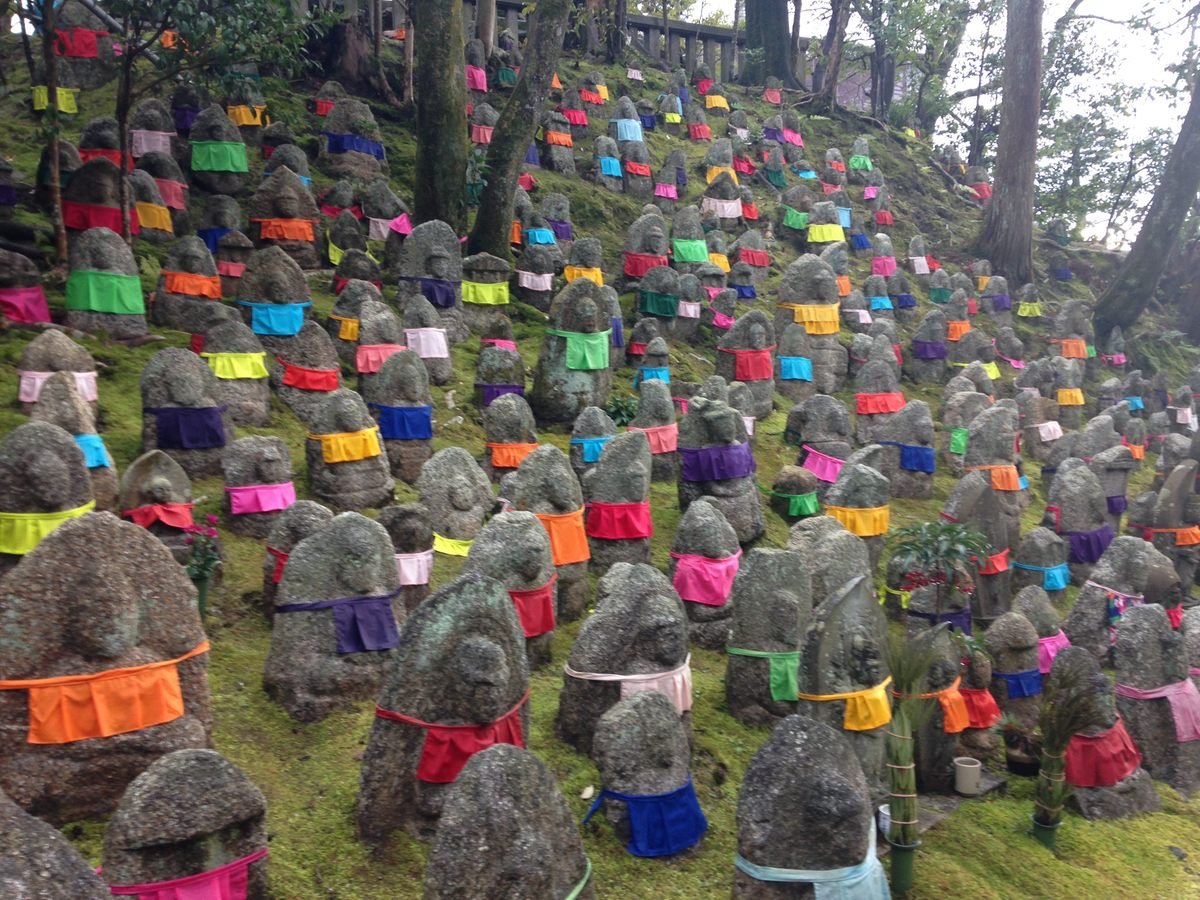
Jizos at Kiyomizudera Temple in Kyoto. Photo: https://www.atlasobscura.com/places/kiyomizudera-temple
Sometime during Jizo’s history, they became associated with the earth. The English translation of the word is “earth storehouse” or “earth womb.”
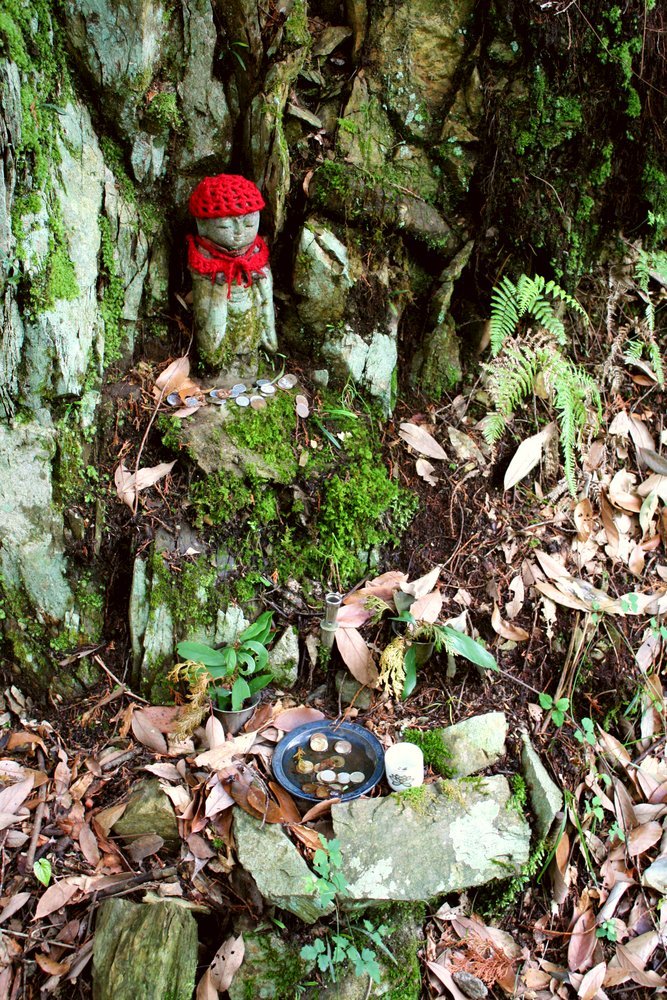
Forest Jizo, Photo credit: https://www.okujapan.com/blog/japanese-jizo-statues
When Yukon, the monk who is the gardener at the monastery asked me make a Jizo, I immediately said yes. That’s when I began to hear this small collection of stones on my table speak. Earth mother, protector, guardian. Jizo traditionally was male, but became non-binary. Jizo simply cares. Working on the sculpture, I began to think of all the beings Jizo cares for, and I placed them all over their body.

Jizo in Wax with Iris Stem
Yukon had made it very clear that this Jizo needed a staff, and it had to be one like the traditional Jizo with rings. I picked out a couple of stalks from the dried iris clump near my studio door. They were the right size and I liked the idea of using the dried seed pod for attaching the rings. Zach Gabbard at Mission Foundry did a masterful job casting, welding, and burning out the iris pods to make the staff.

Jizo installed at Zen Mountain Monastery Garden, 2022, bronze

Jizo Staff in Snow (detail), Photo: Mn.Yukon Grody
A Jizo’s vow ensures that they will help all beings no matter what misdeeds have caused their suffering. Makers of Jizos, as well as those who venerate them are said to receive gifts. How grateful I am for the opportunity to make this sculpture and install it in the garden at Zen Mountain Monastery. May this Jizo be a protector for the earth’s beings everywhere.
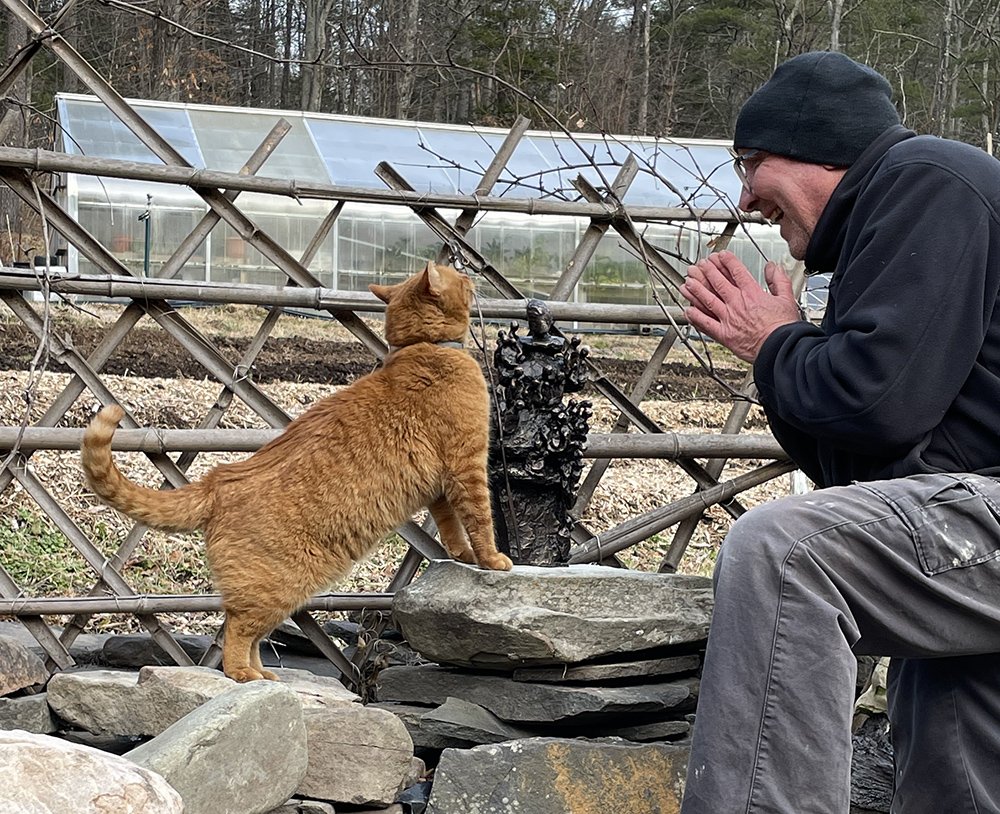
Rudy the Cat, Jizo, and Yukon
We can all make Jizos. Build stone cairns, or bake a stack of cookies for a friend. Offer flowers, smiles. Spread the care, extend the love. I’d love to offer a Jizo making workshop when we can all meet again in person. Let me know if this interests you.
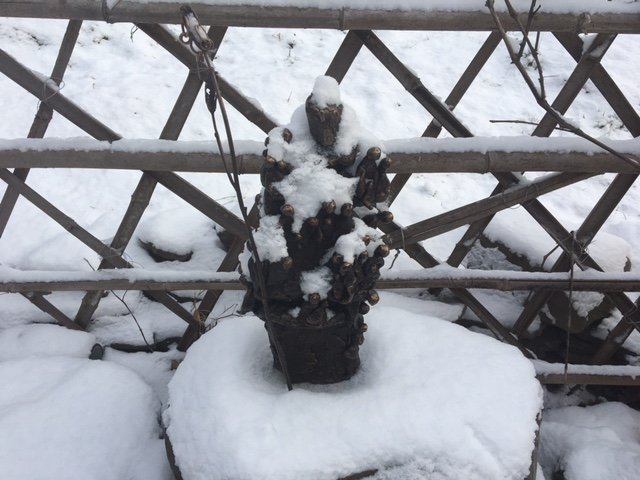
Jizo in the Snow, Photo: Mn.Yukon Grody
Meeting Ekphrasis
Ekphrasis is a genre of writing about a work of art. Homer’s lengthy and vivid description of Achilles' shield in The Iliad is one of the oldest examples, though Keat’s Ode to a Grecian Urn is more quoted, especially its enigmatic last lines.
Beauty is truth, truth beauty,—that is all
Ye know on earth, and all ye need to know.
The writer, and most often a poet, explores a work of art, responds to it, even adds elements from his or her own life. The Poetry Foundation defines an ekphrastic poem as follows: “Through the imaginative act of narrating and reflecting on the ‘action’ of a painting or sculpture, the poet may amplify and expand its meaning.” I love this description and thought about it when I sat down to write a statement about a new sculpture I am exhibiting at 6 Bridges Gallery in Maynard, Massachusetts (July 11 – August 12).

Meeting in the studio. sculpture, 2017
To write about, Meeting, I started by considering its materials — rope and wood. Rope is used to connect one object to another, a canoe to a tree or a skiff to a dock. A rope hammock connects two trees. What intrigued me when I placed the thick rope into the walnut trunk was that it connected back to itself. There was no connecting of two objects but a unifying of the whole. The ends disappeared as if there were no ends.
This section of a tug-of-war-size rope has been in my studio for six years ago. Back then, I suspended it, tied it, uncoiled part of it, and wove it back into itself. When I hung up the heavy coil, it made me think of a Japanese Enso, the circle that is an expression of enlightenment, the ultimate connection with everything because there is nothing inside or outside, nothing separate or divided, nothing to connect, no beginning and no ending.
I then wrapped a thin white twine around the rope, the way a snake coils around a stick. It reminded me of a painting I saw in a small church in Florence. Christ was nailed to the cross alone up on Calvary Hill. There was a simple white cloth wrapped around his pelvis, the cloth painted as if being blown by a gentle breeze. The body was dead, but life stirred in the simplicity of the white threads. The painter may have been suggesting that life is never completely extinguished.
The wood component of the sculpture, a walnut trunk, sawn twice to reveal its two hollow sections, has also been in my studio for a number of years. A bronze sculpture I made of Kwan Yin, the Goddess of Compassion, sat on it for a while, but I removed her knowing the wood had something else to reveal.
One day I took the tug-of-war rope and threaded it through and around the wood. I was intrigued by what I saw, but also by what I didn’t see. In Meeting, we don’t actually see whether the two ends of the rope meet. It’s a question that is unanswered. The rope, in its serpentine path around and into the trunk reveals only part of itself. It is like happening upon a snake, though the head and tail are hidden.
Meeting is the word for the worship practice of the Quakers. I went to a Quaker elementary school where we had ‘meeting for worship’ on Wednesday mornings. We sat in silence unless someone was moved to speak. In a Quaker Meeting, we meet ourselves, we meet God, we meet each other.
Art is a form of meeting. We meet the work, its materials, colors, and forms, the artist and ourselves. Ekphrasis writing is a form of meeting. When I write about my own work, I discover connections that I had never considered while making the piece. And when I read the writing of others who have been inspired my art, I encounter the work differently.
At another summer exhibit where I have a sculpture, Art on the Trails: Finding Solace in the Woods at the Beal Preserve in Southborough, MA (June 7 – September 24), there will be a reading of ekphrastic poems written about the works of the exhibiting artists. I have a new casting of Tree Harp in the exhibit and hope there will be a poem written about it. I much prefer to hear what others write about my sculpture. An ekphrastic poem that I treasure was written by Joanne Reynolds about my sculpture Ordinary Pine when it was installed at the Jackson Homestead in Newton, Massachusetts.
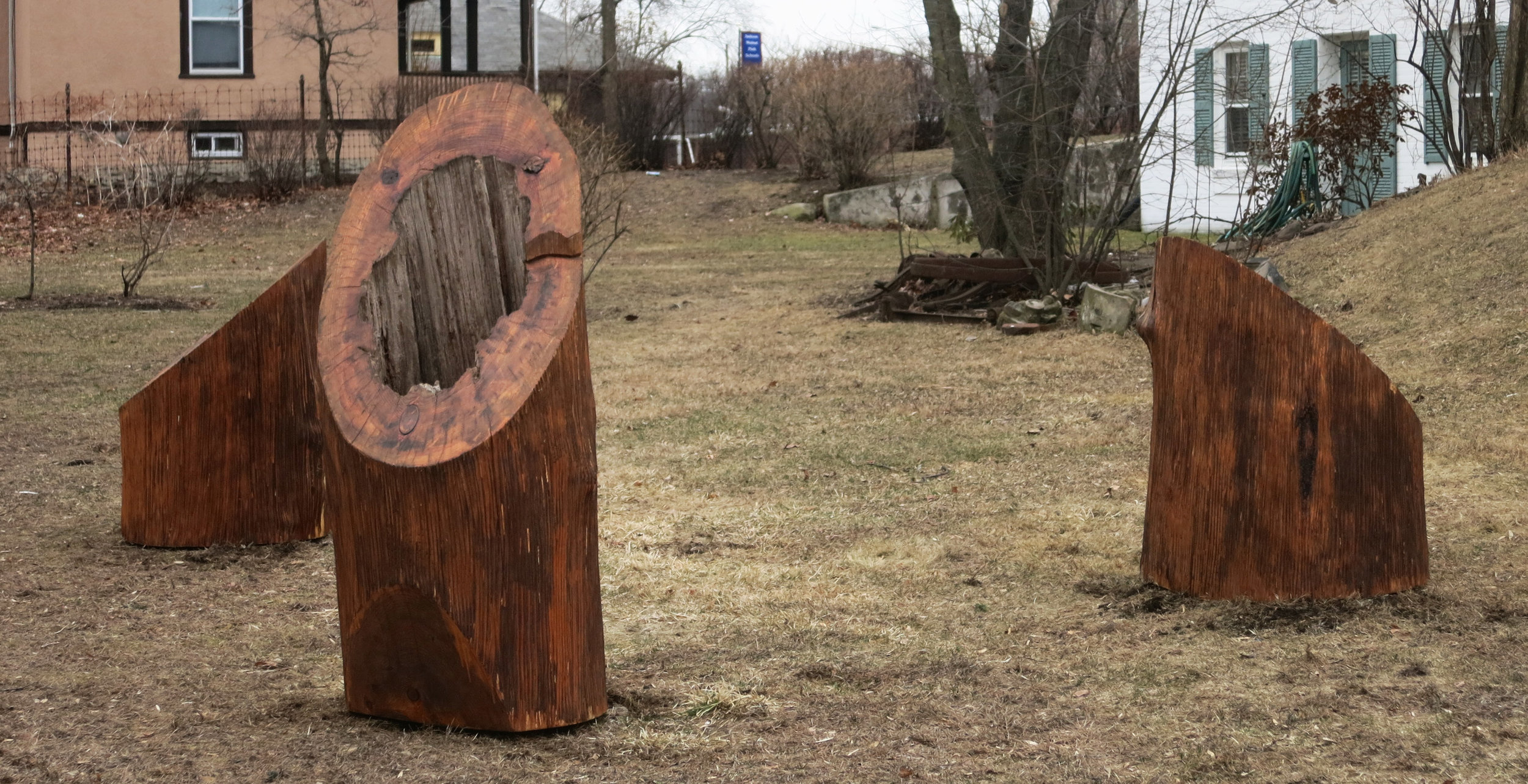
Ordinary Pine, partial view, installed at Jackson Homestead, Newton, MA
Ordinary Pine
What happened? That is to say, what happened
To us? Or between us? What
Will become of us now?
True, you were older. Suffered
The deluge. Cast a shadow
More borrowed than your own.
I came shortly after. Not so much a part
As a go-between - a link.
I remember the way you reached out
To the youngest - your great hands - how well they played!
Facing away from you now, each of us
Cut down, I long to see you.
Both of you.
Such a hole in each of us.
—Joanne Reynolds
The World Is Bonkers — Shall I Laugh or Cry?
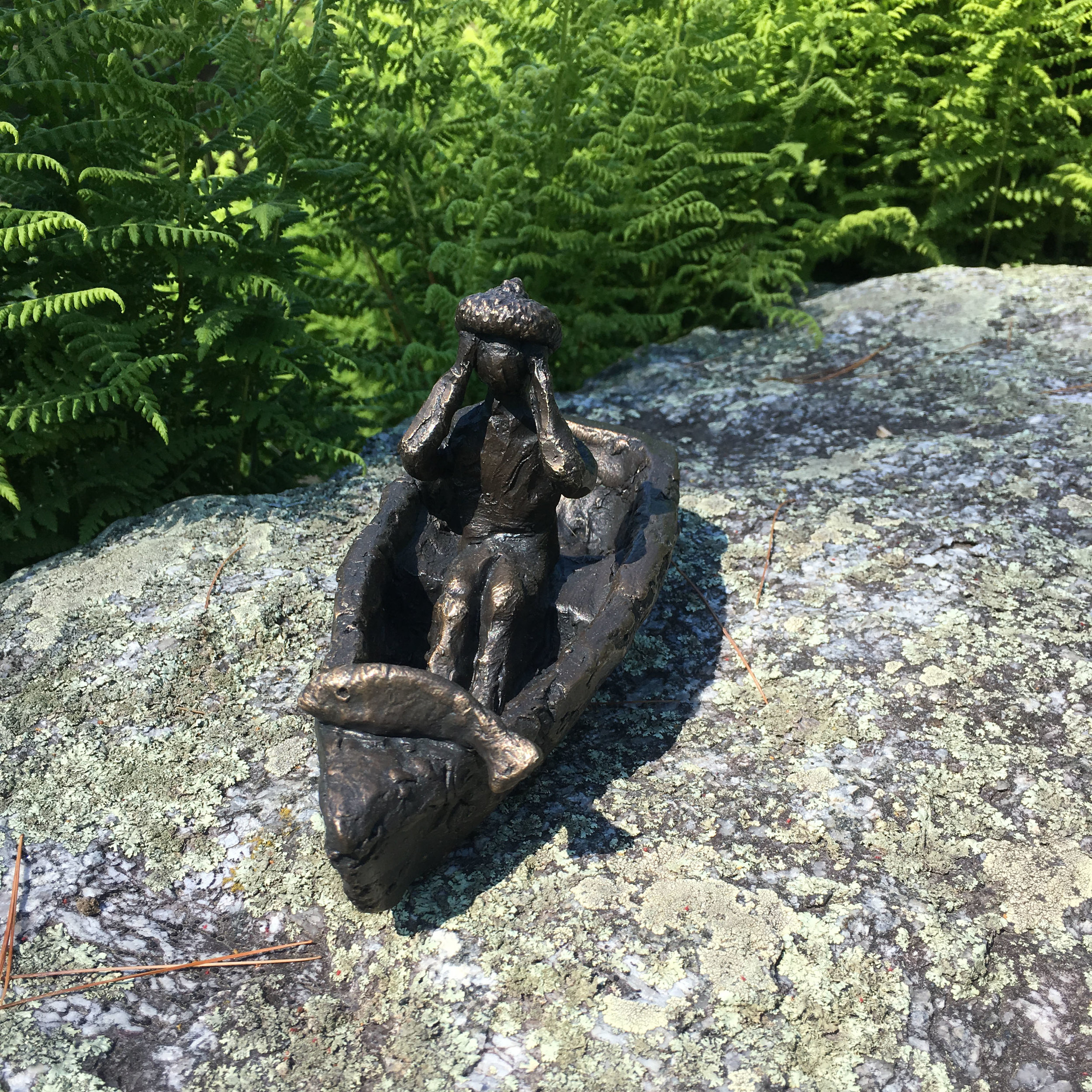
The World is Bonkers, 2017, bronze: Sculpture LH
Last week I wrote about Bonkers, the revolutionary apple – but unknown to me – the Atlantic, two weeks earlier, published an article, Why So Much is Bonkers Right Now. The Atlantic mentioned at least ten references to this imported British word. For example, Mother Jones had recently reassured its readers: “It’s Not Just You . . . This Week Was Bonkers,” referring to the latest Trump charades. And Vox used the word to describe Netflix’s newest film, Okja: “a bonkers corporate satire staring Tilda Swinton and a superpig.” I saw a two-page spread advertising the film in the New Yorker magazine. The image, a young woman leading a giant creature with a factory building as its saddle spewing out pollution from one of three smokestacks, was so fascinating I looked it up on Rotten Tomatoes and found that it is a story of an extraordinary human animal bond threatened by capitalist consumers.
The Atlantic article also mentions the word Bonkers’ first use on American soil in 1965, when an American film reviewer of the film Paranoia used the word to describe “Marcello Mastroianni as going slowly bonkers while sharing a bath, bed, and Bedouin with three co-stars.” In the 1980s, there was a candy named Bonkers. Its commercial takes the prize for worst of its kind, but you can watch it here. And there is a recent memoir by the comedian Jennifer Saunders, Bonkers: My Life in Laughs. What is the appeal of this Bonkers everyone is using? Zany, crazy, madcap, screwy, wacky? The Atlantic article ended with an appreciatory note, saying that this British word is “uniquely suited to this American moment: a time when news can be so often confusing, and overwhelming, and, all in all, a little bit bonkers.”
Yet to describe our world as Bonkers doesn’t feel right. After the Manchester killings and the London Bridge savagery, the world is not Bonkers, but alarming. Withdrawing America from the Paris Climate Accord is equally horrifying. Bonkers is a non-judgmental adjective; it resists condemnation. Faced with the harsh reality of innocent lives lost, the continued devastation of people’s homes from war and terrorism, and the loss of species and habitat because of climate change, Bonkers doesn’t describe the depth of suffering in our world.
Yet, at the same moment that devastation is happening all around, I watch young children skip merrily before climbing aboard a big yellow school bus and bike down our street with fishing rods tucked under their arms, knowing nothing about the follies of their parents’ generation. I feel similarly protective of the spotted brown and white eggs in a small nest high in a branch of the Saturn peach. These birds will know nothing of the perils facing the earth. This contrast between the news and what is happening in my backyard does make me feel like this world is Bonkers.
Today, a friend came by and we spent several hours removing peaches from the Saturn peach tree. Last week it was pruned to about half its size, and now we needed to thin the heavy fruit set. Packed together on the branches like sardines in a tin, the tree had produced a crazy number of apples. When this much fruit grows tightly together, disease spreads, the fruit is small, and it taxes the health of a tree. I heard myself say to her the ‘B’ word, ‘The tree is Bonkers – it has way too much fruit.’
Suffering is all around us, but miraculous beauty is too. Maybe the gift of the word Bonkers is that it describes craziness without being judgmental. We can do so much more to relieve suffering in the world if we don’t wallow in judging thoughts, but take up our lives wholeheartedly. Whether we grow miraculous peaches, listen to another’s pain, or spearhead an activist role to clean up the planet, every day we have the opportunity to hold back our anger, yet take in the grief; to feel the devastation, yet fight for change. Maybe to declare that this world is Bonkers is to bring lightness to the seriousness of our situation, and to let laughter wash over our tears.

Meditator with Acorn, 2017, bronze, Sculpture LH
Boats, Figures, and Catching Fish
Boats embody our life journey, each of us, adrift, on a vast ocean. We can only surrender to what life presents. We embark, not knowing where the wind will drive our craft. I first started making sculptures of boats in 2007, inspired by teachings of Dogen, a 13th century Japanese Zen master. His writings are short, poetic, beautiful, pithy, and quite challenging to parse. In Genjo Koan, Dogen writes:
When you ride in a boat and watch the shore, you might assume that the shore is moving. But when you keep your eyes closely on the boat, you can see that the boat moves. Similarly, if you examine myriad things with a confused body and mind you might suppose that your mind and nature are permanent. When you practice intimately and return to where you are, it will be clear that nothing at all has unchanging self. Tr. Tanahashi et al.
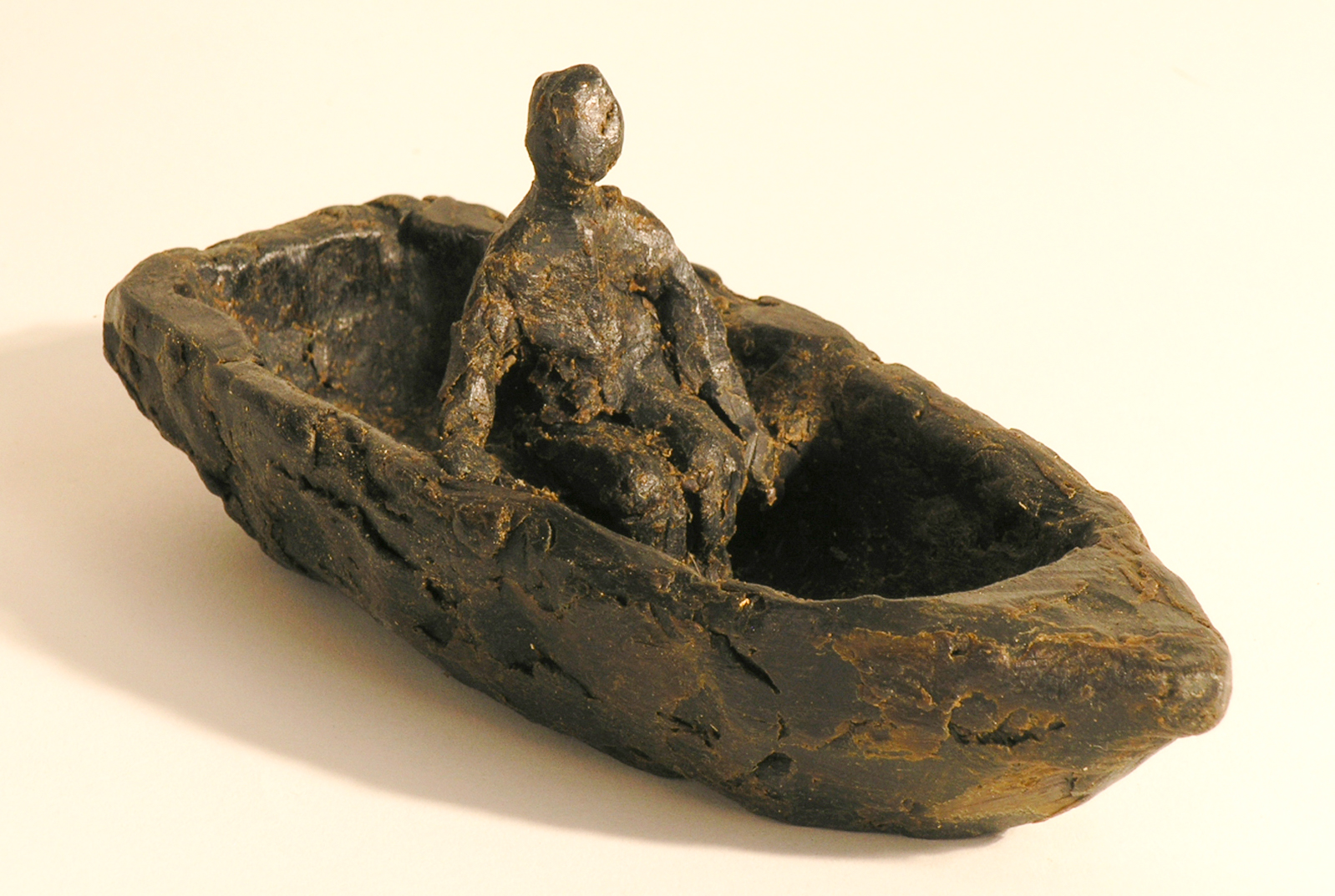
I made boats in wax — boats with one figure, boats with fish, boats with two figures, boats overturned on a beach, a figure emptying water from a boat, a figure birthing a boat. There was nothing fixed in my play with the wax sculptures — only an endless reconfiguring of figures, boats, and fish.

I showed some of these sculptures to friend and poet, Susan Edwards Richmond. She wrote, River Crossings, a poem in five parts based on several of the sculptures. It was originally published in Issue One of Wild Apples, A Journal of Nature, Art, and Inquiry that we founded together with two friends in 2005. [There are back copies still available].
A figure of wax, softened
by pinch of fingers, heel
of a hand . . .
Alone
in the river, bearing
the burden of flood, the stoking
rhythm of oars, molded to that
position, I brace for the sluice
wherever it takes me.
. . .
When I tried to push you
from the boat, a fish leapt
from the river, lodged in my arms.

Richmond’s poem has just been reprinted and is the final section in her first full full-length poetry collection, Before We Were Birds, published last month by Adastra Press. This fine collection begins with the poem sequence Boto, the mysterious freshwater Brazilian dolphin that rises from the Amazon River on full moon nights. A Boto is a shapeshifter who takes human form to catch humans, and even bring them back to live deep in the river.
In Dogen’s, Mountains and Rivers Sutra, he refers to sages who live near water and catch fish, and catch humans.
. . . from ancient times wise people and sages have often lived near water. When they live near water they catch fish, catch human beings, and catch the way. For long these have been genuine activities in water. Furthermore there is catching the self, catching catching, being caught by catching, and being caught by the way. . . Tr. Kotler and Tanahashi
In this same sutra, Dogen uses expressions like riding the clouds and following the wind to describe states of meditative practice and transcendence. The mountains and rivers are none other than our own body and mind. How do we ride the wind and cross each river?
River Crossings ends with:
…reeds
sprout back along the river, edges
grow dense with birds. I am called
neither forward nor back,
out of the water nor into it.
This is the art I practice,
the one that leaves no wake.
Susan Edwards Richmond has published four chapbooks of poetry, Increase, Purgatory Chasm, Birding in Winter, and Boto. A passionate birder, she works at Mass Audubon’s Drumlin Farm Wildlife Sanctuary. Richmond is poet-in-residence at Old Frog Pond Farm & Studio, edits the Plein Air poetry chapbook, and organizes our Plein Air Poetry event every fall. We are also working on a series of children’s books on sustainable agriculture. I am grateful, Susan, for our ever widening collaborations.
Search Blog
-
2025
- May 9, 2025 A View from the Tractor Seat
- Apr 11, 2025 Dig
-
2024
- Jan 7, 2024 Winter Wassail
-
2022
- Dec 11, 2022 Keeping Time
- Jun 17, 2022 This Apple-Shaped Earth
- Jan 23, 2022 What is a Jizo?
- Jan 16, 2022 An Invite and Housekeeping Update
- Jan 1, 2022 The Year of the Frog: What Orchardists Do While Apple Trees are Chilling
-
2021
- Oct 24, 2021 Figs
- Oct 3, 2021 The Artist and the Orchard: A Memoir
- Aug 8, 2021 Red-Fleshed Apples
- Jul 25, 2021 When We Were Trees
- Jun 27, 2021 Castor Beans—Who Knew?
- Jun 13, 2021 Spring Training at a Zen Monastery
- May 4, 2021 Our Trees are in Bloom
- Apr 18, 2021 Hooray!
- Jan 24, 2021 Wassailing, virtually!
- Jan 1, 2021 Sitting
-
2020
- Dec 21, 2020 Darkness to Light
- Nov 28, 2020 One Heart
- Sep 18, 2020 Juggling Flowers, Fruit, and Vegetables
- Aug 23, 2020 Refuge
- Aug 9, 2020 Bags of Fertilizer
- Aug 2, 2020 The Sermon of the Blue Heron
- Jul 26, 2020 What's the Buzz?
- Jul 19, 2020 Farm Moments
- Jul 12, 2020 Lost Wax
- Jul 5, 2020 Catalpa: The Hugging Tree
- Jun 28, 2020 Pedaling Peace
- Jun 21, 2020 See Change
- Jun 14, 2020 Lalla Unveiled
- Jun 7, 2020 Pond Alchemy
- May 31, 2020 The Birth of Fruit
- May 24, 2020 An Artist in the Orchard
- May 17, 2020 Walking the Land: Returning Home
- May 10, 2020 Stinging Nettles: Gifts from the Great Mother
- May 3, 2020 The Mystery of Swallow
- Apr 26, 2020 Aerial Bruststrokes
- Apr 19, 2020 Simple Pleasures
- Apr 12, 2020 Weeds and Other Gifts
- Apr 5, 2020 Remembering the Seeds
- Mar 29, 2020 Blow on the Embers
- Mar 22, 2020 Ripples
-
2019
- Nov 16, 2019 Tibet Impressions
- Nov 9, 2019 Forest Tales
- Oct 13, 2019 The Gift
- Aug 4, 2019 The Season is Apples, Berries, and Grandfather Fire
- Jun 8, 2019 Pointers for a Writing Life
- May 12, 2019 Mothers of the Earth
- Apr 6, 2019 The Apple-Shaped Earth
- Mar 23, 2019 You Don’t Know What You Have Till It’s Gone
- Feb 23, 2019 Generations
- Feb 9, 2019 What Are We Doing to the Earth, John Chapman?
-
2018
- Dec 31, 2018 Long Shadows
- Oct 6, 2018 A Pilgrimage to India
- Aug 18, 2018 Scrap Wrenn
- Aug 11, 2018 Off-the-Wall Comments from an Ignorant Farmer
- Jul 28, 2018 Creative Connect
- Jul 14, 2018 How is the Orchard?
- Jun 30, 2018 Which Way?
- Jun 16, 2018 Geese, Herons, Beavers, and the Baby Steps of a Lapsed Blogger
- Feb 24, 2018 Mama's Coupons — Good Forever
- Jan 27, 2018 January Ice
- Jan 13, 2018 The Muse
-
2017
- Dec 30, 2017 A Dream for the New Year
- Dec 23, 2017 A New Year for Apples
- Dec 16, 2017 Intuition
- Nov 22, 2017 Thanksgiving OM
- Nov 4, 2017 East Fork Pottery
- Oct 28, 2017 Putting Down New Roots
- Oct 21, 2017 A is for Art
- Oct 14, 2017 Eve domesticus
- Oct 7, 2017 A String Workshop
- Sep 30, 2017 After Applepicking
- Sep 23, 2017 Two Bad Women and One Good Apple
- Sep 16, 2017 Plein Air Poetry
- Sep 9, 2017 Cutting Off a Leg
- Sep 2, 2017 The Changing Landscape
- Aug 26, 2017 All About Art
- Aug 19, 2017 My First Visit to the Farm
- Aug 12, 2017 The First Food
- Aug 5, 2017 A Teapot, a Woman, and maybe a Boat
- Jul 29, 2017 A Raspberry Dilemma
- Jul 22, 2017 Consider the Miracle
- Jul 15, 2017 Meeting Ekphrasis
- Jul 8, 2017 Ripening Fruit
- Jul 1, 2017 The Voice of The Caterpillar
- Jun 24, 2017 Goumi — An Unusual Fructus
- Jun 17, 2017 Concord, an American Bloomsbury
- Jun 10, 2017 The World Is Bonkers — Shall I Laugh or Cry?
- Jun 3, 2017 Bonkers, a Revolutionary Apple
- May 27, 2017 Guardians of the Swamp
- May 20, 2017 There are Mushrooms and There are Morels
- May 13, 2017 "What's in a Name?"
- May 6, 2017 Bloom Follows Pink: Orchard Pollination
- Apr 29, 2017 The Orchard Is at Pink
- Apr 22, 2017 Natural Farming — Part 2 (continuation from last Sunday's blog)
- Apr 15, 2017 Natural Farming — Part 1
- Apr 8, 2017 Boats, Figures, and Catching Fish
- Apr 1, 2017 A Man with a Mission: The Nuts and Bolts of Bronze Casting
- Mar 25, 2017 A Chalice of Spirit, Art, and Nature
- Mar 18, 2017 Hanami — Blossom Viewing
- Mar 11, 2017 Soil Redemption Song
- Mar 4, 2017 Food is Primary Care
- Feb 25, 2017 Pomme de Terre
- Feb 18, 2017 Organic Certification
- Feb 11, 2017 Tantalizing Fruit
- Feb 4, 2017 The Myths of History
- Jan 28, 2017 The Orchard in Winter
- Jan 21, 2017 The Hi-Line
- Jan 14, 2017 Artistic, Botanical, and Social Diversity
- Jan 7, 2017 Where is Eden?
-
2016
- Dec 31, 2016 The Creative Heart
- Dec 24, 2016 A Christmas Tale
- Dec 17, 2016 Who are the Crones?
- Dec 10, 2016 The Olympic Bell (Part Two)
- Dec 3, 2016 Overheard in the Apple Orchard in Early December
- Nov 26, 2016 The Lessons of a Tortoise
- Nov 19, 2016 In the Studio
- Nov 12, 2016 Even in Darkness
- Nov 5, 2016 Southern Apples, an Elephant, Monkey, Rabbit, and Bird, Two Mango Trees and a Birthday
- Oct 29, 2016 The Tools of Art
- Oct 22, 2016 Labyrinths
- Oct 15, 2016 Repairing the Broken
- Oct 8, 2016 When You Are No More
- Oct 1, 2016 Creation Rain
- Sep 24, 2016 Breaking the Glass
- Sep 17, 2016 String Art
- Sep 10, 2016 Poetry and Photosynthesis: It's all in the Leaves
- Sep 3, 2016 In the Plenty of Time
- Aug 27, 2016 Witch Doctors
- Aug 20, 2016 Listen Coyote
- Aug 13, 2016 Milkweed in the Orchard
- Aug 6, 2016 Some People See a Turtle
- Jul 30, 2016 Arborshaping
- Jul 23, 2016 Joseph Wheelwright: Sculptor of Stones and Trees
- Jul 16, 2016 Asian Pears
- Jul 9, 2016 Gold Leaf, Grief, and the Creative Process
- Jul 2, 2016 The Olympic Bell (Part One)
- Jun 25, 2016 Around the Mulberry Bush
- Jun 18, 2016 Avoiding Apples
- Jun 11, 2016 Fructus
- Jun 4, 2016 Astonishing Apples
- May 28, 2016 Scare the Caterpillars
- May 21, 2016 Join the Club!
- May 14, 2016 The Graft
- May 7, 2016 Rooster, Rhubarb, Rue
- Apr 30, 2016 What do Dolphins and Nettles Have in Common?
- Apr 23, 2016 Art Prunings
- Apr 16, 2016 A Few of the First Arrivals
- Apr 9, 2016 Taste the Spirit of Sustainable Agriculture
- Apr 2, 2016 First Orchard Spray - March 22-24, 2016
- Mar 26, 2016 Hawkeye Apple
- Mar 19, 2016 Desiring the Almata Apple
- Mar 12, 2016 Ugly Fruit
- Mar 5, 2016 Winter Tracks
- Feb 27, 2016 Splash
- Feb 20, 2016 Pruning
- Feb 13, 2016 Orchard Ruminants
- Feb 6, 2016 A Gathering of Seeds
- Jan 30, 2016 Orchard Dragons
- Jan 23, 2016 Tree Rings
- Jan 17, 2016 The Fallen Tree
- Jan 7, 2016 Wassailing the Apple Trees
- Jan 1, 2016 The New Year