LINDA HOFFMAN
Off-the-Wall Comments from an Ignorant Farmer
Hugh Williams is an orchardist I admire. When I read his email reply to my recent blog about our difficulties with the apple crop, I knew I wanted to share some of his insights. I wrote to ask if I could quote him. “Of course you can use my name. More off-the-wall comments from an ignorant farmer!” was his reply.
Hugh and his wife, Hannah Ball, and their two children grow fruits and vegetables and raise a small herd of cows at Threshold Farm in Duchess County, New York. Everything they do is touched by the biodynamic practices first introduced to the world in the early 1900s by the philosopher-farmer, Rudolph Steiner. Hugh started farming on his family’s farm in Australia in the early 1960s. He has learned through careful observation what his plants and animals need to flourish.
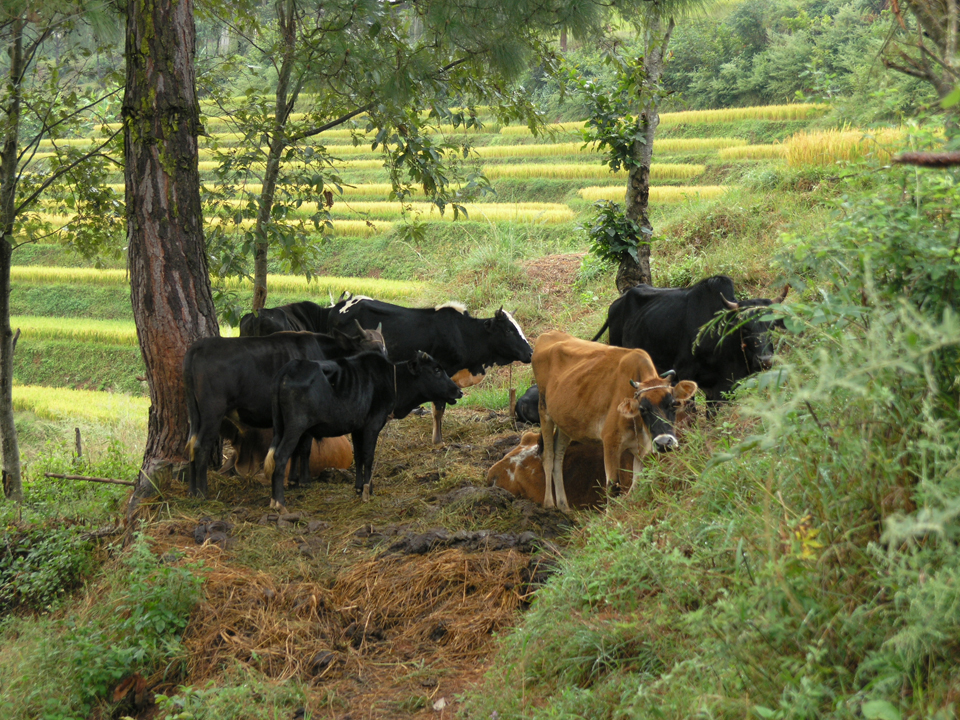
Cows in Bhutan ( Possibly the world's first organic country within the decade) Photo:LH
I first met Hugh at the annual Holistic Apple Growers meeting in western Massachusetts. At the beginning of each meeting, Michael Phillips, the organizer and champion of holistic apple growing, greets everyone and suggests we go around the room and introduce our orchards. The first year I attended, Bill McKintley from Potsdam, New York, then the owner but now retired, of St. Lawrence Nurseries, began. John Bunker, who runs Fedco trees in Maine spoke next. John lives in Palermo, Maine, and is passionate about Maine’s heirloom varieties. Brian Caldwell, a grower in New York, is an organic vegetable researcher at Cornell University. He has two small orchards near his home. I was intimidated when my turn approached.
“I recently moved to a farm with an abandoned apple orchard,” I said, “and I am trying to bring it back, using only organic materials. But I’m a sculptor, and I don’t know anything about apples. “
Everyone was polite; no one hinted I might be getting in over my head.
“How many trees do you have?” asked a handsome man with an Australian accent. That was Hugh Williams. When it was Hugh’s turn to speak, I remember he said he had been growing apples for forty years, and added coyly, “I’m waiting for the day I can be rid of my sprayer.” I wrote that down.
Over the last decade, Hugh has attended every apple growers meeting. Hugh always brings something original to our gatherings, a new enthusiasm, some relationship he hadn’t noticed before, an insight as to how a plant or animal grows. His cows are grass fed, and the calves run with the herd. An interviewer wrote, “We even saw Hugh milking from one side of a cow while a calf was nursing from the other side.”
Hugh knows about challenges. He and his family live solely off the profit from their farm. In a bad year, they have to be creative. Hugh wrote, “We have a very poor apple crop too, except on a few varieties. Enough for our fruit share members, and we have great plums, peaches and pears so we'll eke our way through another year.”
I had written that our crop failure was in part due to biennial production because we don’t thin the fruit from the mature trees. Hugh answered, “For us it was mostly poor pollination. There were no insects, even on the dandelions!” Hugh and Hannah think it's a “global phenomenon” and referred to a “thinning” of the insects. Hugh reminded me that when you stop at a gas station today, there is no longer the need to clean your windshield. It used to be de rigeur, so many squashed insects stuck to the glass. Where did these bugs go? I never clean my windshield anymore.
I think of the avalanche of toxic chemicals we have been releasing onto our planet every day since the end of World War II. The companies that made nerve gas and other toxic materials needed to change their product line in order to continue operating. Someone had the brilliant idea to manufacture chemical pesticides, herbicides, and fertilizers for the farmer. The corporate world is concerned with the bottom line. Inside brick and steel buildings, workers lose all connection to the natural world, to the subtlety of light, to beauty, to the richness of the insect, plant, and animal worlds, to the future of our children.

Two Girls in the Market, Bhutan Photo:LH
There is an article in the July 25, 2014 issue of Science, Defaunation in the Anthropocene. Defaunation is a new word used to describe not only the disappearance of a species but the decline in numbers. Farmers like Hugh and Hannah Williams don’t need scientific studies.
Hugh ended his note saying,
It raises the question of what actually is the function or purpose of agriculture, which certainly is not inherently tied to money, nor perhaps even to cropping! Our spiritual purpose becomes ever closer and more concrete. While yes, our farm is a temple precinct, we cannot avoid the conclusion it is also the very sensitive canary in the coal mine.
Hugh’s spirituality infuses his farm and all who know him, providing deep sustenance to all creatures. He shares his ideas easily, even when they are counter to how much of the world thinks. I admire Hugh because he cultivates the physical demands of being a farmer—the hard work, the selling, the making a living—all with dexterity and wit, and he attends equally to the spiritual, with passion and reverence. Perhaps he would say, these two realms are connected, or are in fact, one and the same. Maybe, that is why his farm is named Threshold, a place of connection between inner and outer, earth and sky, the physical and the spiritual, the material and the ethereal.

Turning a large Prayer Wheel, Bhutan Photo:LH
How is the Orchard?
It’s the question I am most often asked, and it has become my least favorite question to answer. Have you ever been in this situation? That which you most don’t want to talk about is exactly what elicits the most interest. The old Zen saying—you find your fate on the road you take to avoid it—is apropos.
No one asks, “How is your spirit, Linda?” A few ask, “How is the studio?” or about the children and about my husband, Blase. But a disproportionate number inquire, “How are the apples?” They know we’ve had some bad years.
To the apples, then. Well, maybe. . .
You see, I just don’t want to write about them. I love the trees, the land on which they grow, the wildflowers, the seasons of their lives, the bare branches in the winter, pruning, the blossoms, the buzz of pollination. In 2015, we had a magnificent bloom and gathered for apple blossom viewing with shakuhatchi music floating out from a hidden speaker in one of the trees.
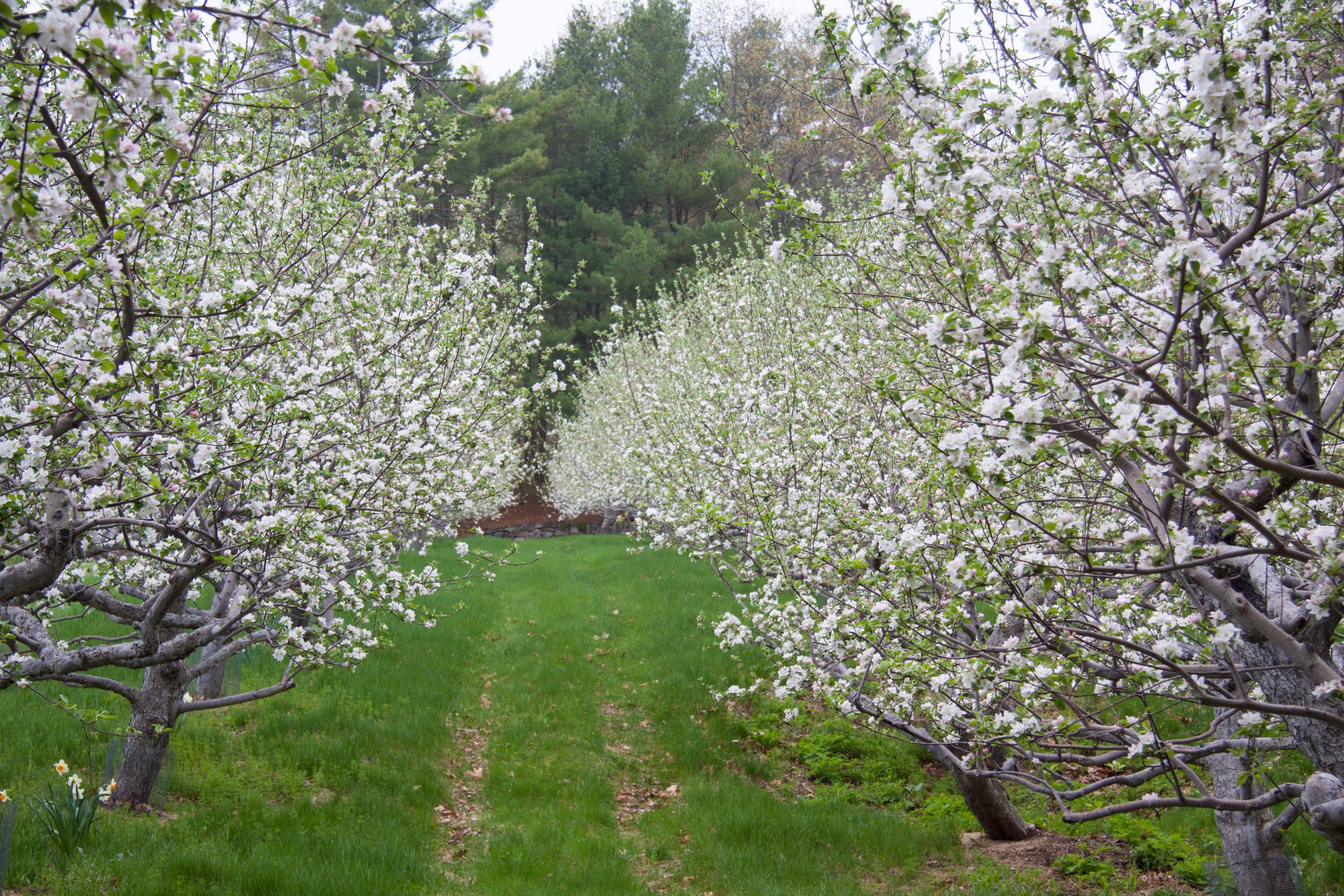
Apple Blossoms Macintosh Apples
The blossoms turned to fruit, and we had a splendid crop.
But the truth is that 2015 was the last year we had a munificent harvest. In 2016, we had no fruit because of an early frost. Last fall, we had a bumper crop, but horrible scab rendered all our Macintosh and Golden Delicious apples unsellable. Out of the last four years, we’ve had one great year and one all-right year. We need to look honestly at what is happening despite the amazing 2017 Honey Crisp harvest.

My daughter, Ariel, picking Honey Crisp apples in 2017.
Growing organic apples was never part of a get-rich scheme. When I moved into the farmhouse in 2001, the abandoned orchard across the road and I shared many characteristics. I was hurt, confused, and without solid ground under my feet. The orchard grew brambles, poison ivy, but no fruit. Bringing back the orchard became an artistic as well as spiritual passion; it grew and flourished as I healed, grafting a new life.
There is a great demand for local organic apples, and the orchard proved to be economically sustainable. However, our experience in recent years is changing the equation. Blase and I are questioning the orchard’s future. With a demanding schedule of time and resources for orchard care, growing organic apples on our scale is proving to not be sustainable. It’s not emotionally supportive: It’s downright depressing.
And why aren’t there any apples this year?
Among the multitude of interrelated answers, some I know and many I don’t. Thinning is certainly one reason. Most apple orchards thin their trees with chemical thinners when the fruit is only a few millimeters in size. This reduces the number of apples, fooling the tree into thinking it needs to produce a decent crop the following year to guarantee long-term survival. We thin our small trees by hand, too much fruit will impede healthy growth, but the mature trees are simply too big and too many so they produce a copious crop one year, and a pocket-sized one the following year—biennial production. I also think last year’s wildly successful scab fungi weakened the trees. Earlier this spring we took out seventy-five old trees—fifty Macintosh, the scab magnets, and twenty-five old. undesirable, meaning unsellable, Red Delicious trees. Fluctuating weather patterns accelerated by climate change are creating new challenges for orchardists and farmers in New England. Even though we have bees, the struggles facing our native pollinators makes pollination of apples in a cold spring a concern. Bees don’t go out of their hive unless the weather is over 55 degrees and they loathe rain. In spite of this litany, except for recent deer damage, the trees are leafy and healthy. Of course they are: No stress with no crop!
But the inexorable problem remains—there is no crop once again. This orchard that has meant so much to me, fed and nourished many others for the last fifteen years, this orchard that has been my companion, my lover, and a great teacher, is not sustainable. We are caring for some four hundred trees, too many to do this work part-time and unprofessionally. If we had a small mixed orchard it would be different.
What are we going to do? Blase and I are beginning to talk about how to make some kind of change. I have friends who decided reluctantly to move out of their house once their children fledged. I have an artist friend who moved with her husband to San Miquel d’Allende, Mexico, where, because the dollar stretches further, they built a magnificent glass and stucco house and studio. But we don't want to move. We don’t want to leave the farm.
Blase and I are both creating new directions as we live the decade of our sixties. Blase is organizing community events here and working with people one on one. He’s also returning more often to his woodworking shop in Maynard and fixing up his camp on the marsh on the North shore. He still tends a large kitchen garden and he repairs every dang machine that breaks, and they all do . . . .
I work with our part-time women farmers, Holly, Julia, and Hannah three days a week. We pull invasives, pick fruit, weed, mulch, and create new planting beds. Strawberry harvest is over and blueberries are next. On the last 90 degree Friday, we netted the blueberry rows. We were so fried by the heat, I let everyone go home at 4 o’clock instead of 5, had a shower, and promptly collapsed, forgetting about my dear friend Marion Stoddart’s party (I am so sorry, Marion).
Together, we also make art! Holly made a snake with all the sticks that needed to be picked up among the wildflowers near Paul Matisse’s Olympic Bell. Julia painted the signs for Which Way? Hannah has created some of our most memorable Instagram posts.

Planning is underway for our 12th Annual Outdoor Sculpture Exhibit, and the artists will be installing their work in August. I love finding just the right location for each sculptor's work. This year, artist Anne Eder, known at the farm for her extraordinary installations of mythical creatures, will be overseeing her students from the Harvard Ceramics Studio with their own interdisciplinary sculptural installations. And my studio will be open on September 15 & 16th, part of the Bolton Harvard Open Studio. There is much work, both farm and art, to do. In some ways it is a relief not to have a big apple crop, I have more time for other projects. Yet, when I look at the photo of Ariel and the Honey Crisp apples, I cringe with disappointment—no apple-picking, no biting into juicy organic apples, no cider-making.
What is our fate? And what road am I on trying to avoid my own? It’s right in front of me—and I can only say I am grateful.
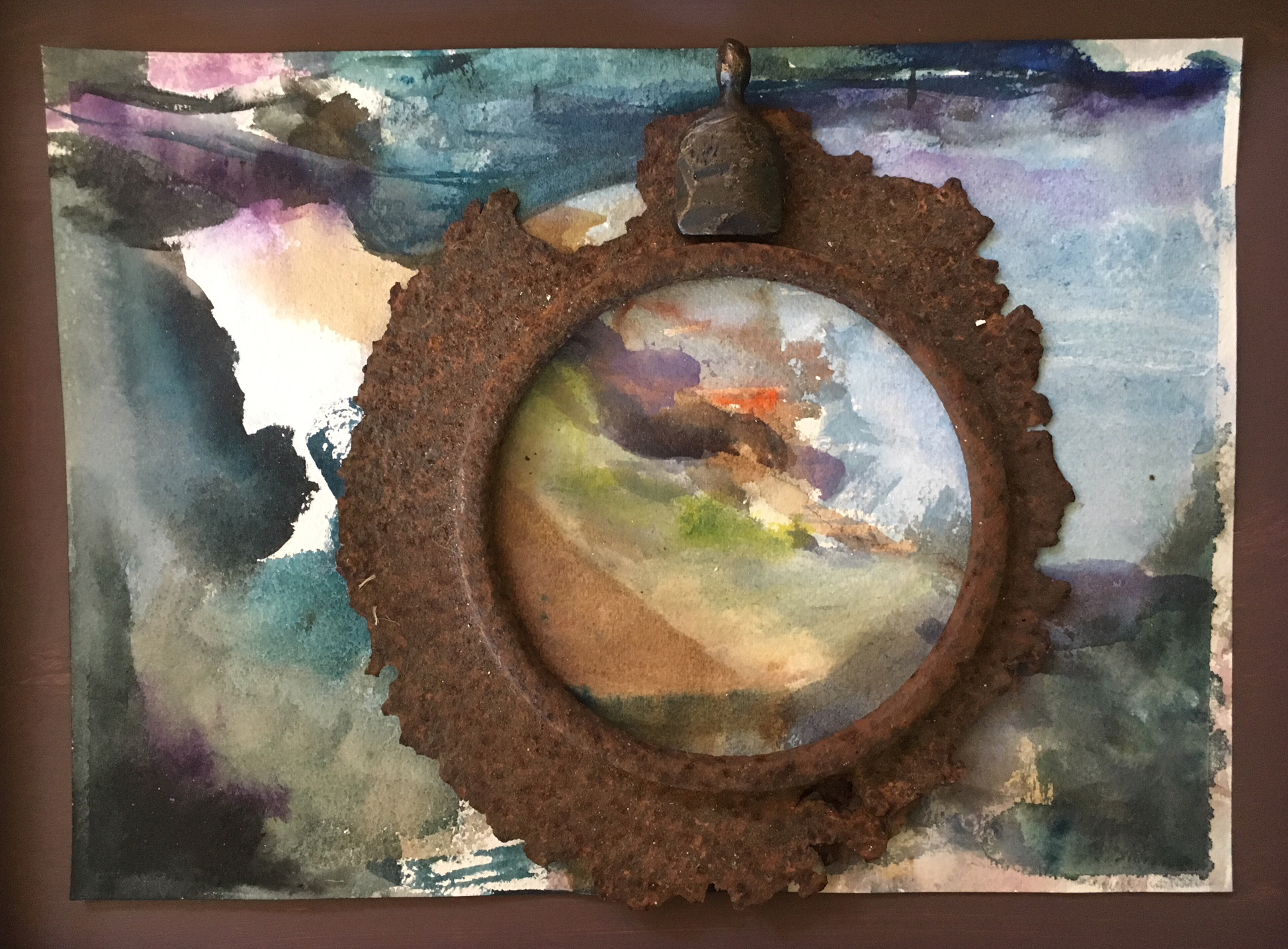
The Earth, experiment with found object, watercolor, and bronze figure, LH
After Applepicking

On the trees are only a few gnarled apples that the pickers have rejected. They look like the knuckles of Doctor Reefy's hands. One nibbles at them and they are delicious. One runs from tree to tree . . . picking the gnarled, twisted apples and filling his pockets with them. Only the few know the sweetness of the twisted apples.
― Sherwood Anderson
Applepicking is over. It’s early this year because two of our most plentiful varieties were hit by weather issues. We’ll pick and press those that remain for cider, cook and freeze applesauce, and store the Blushing Golden apples (they are good keepers), but otherwise it will be time to put the orchard to bed. We have nutrients to spread, mowing to do under the trees, and vole protection to install — actually quite a lot of work to do. It’s been a long year of preparation for such a short, and not very profitable, season.
The trees look sad with their limbs bare and their leaves fading and falling. It’s been a fall with summer temperatures, and the trees prefer it cooler. I can imagine the trees speaking among themselves these lines from Robert Frost’s poem, “After Apple-Picking,”
Of apple-picking: I am overtired
Of the great harvest I myself desired.
The trees do their best. They fight the wars with pests, they take up nourishment and water as they can, and they stand amidst the winds and hail. Their world is changing more quickly than they can adapt to. I visited a friend a few weeks ago, and the line of maples around her house were all brown. “Maple die back,” he said. I nodded. Whatever that means. For we don’t really know what is happening.
Mike Biltonen is a New York State orchard consultant who writes a newsletter at Knowyourroots.com about the pressing seasonal issues in his orchard world. In July he wrote:
But most importantly, the effects of climate change and apple tree decline are not avoiding any one. I am seeing orchards with many different problems and manifestations of sudden apple decline (SAD). Orchard management for climate resilience is the defining issue today.
One commonality – regardless of how you grow your trees and fruit – is that no farmers are going to escape the impacts of climate change. For some the consequences may be dire resulting in complete orchard collapse.
When I first read this in the newsletter, I put my head in the sand. It sounded so ominous. But reading his newsletter again, and with the season for applepicking over, I am looking at the reality in our orchard. The new trees, the trees I have planted from 2006 onward, produced a beautiful crop. The fruit was unblemished and tasty and their production was bountiful. The trees that succumbed to weather issues were the three varieties that were already in the orchard, Macintosh, Blushing Golden, and Golden Delicious, trees that are now over 35 to 40 years old. Is it that these trees are feeling the weight of their years? They are not standard size trees—these can live 100 years—but semi-dwarf, which have a considerably shorter life expectancy for optimum production. Maybe they are reaching that time in their lives, and I am expecting too much?
With climate change, an aging orchard, and, oh, yes, my own aging — I am conflicted about the prospect of continuing to make the orchard a viable place for pick-your-own organic fruit. Fall 2016 we had no fruit because of the spring freeze, and now this year we had only about 50 percent apple production. I want to jump ship, but as the captain I will stay on board. There is something about the orchard that demands this fidelity. We’re discussing a rejuvenation plan. We’ll take down some of the oldest trees and the two rows of Macintosh apples, the scab magnets, and plant more scab-resistant varieties.
The orchard has given me so much. Its branches have spread over the pages of my writing and its roots grown into my art.

From One Seed, Apple prunings and bronze figure, Linda Hoffman & Gabriele White
But, now, I can understand how the prior owners left the orchard on its own for years before they moved away. It can be just too much effort. I have learned so much from working intimately with the trees. We have had some great years of bumper crops, the orchard a ravishing vision of color and scent that delighted countless apple pickers. But fall is in the air. Both the trees and I need a rest. I turn to Mary Oliver’s words for repose.
Fall Song
Another year gone, leaving everywhere
its rich spiced residues: vines, leaves,
the uneaten fruits crumbling damply
in the shadows, unmattering back
from the particular island
of this summer, this NOW, that now is nowhere
except underfoot, moldering
in that black subterranean castle
of unobservable mysteries - roots and sealed seeds
and the wanderings of water. This
I try to remember when time's measure
painfully chafes, for instance when autumn
flares out at the last, boisterous and like us longing
to stay - how everything lives, shifting
from one bright vision to another, forever
in these momentary pastures.
The World Is Bonkers — Shall I Laugh or Cry?
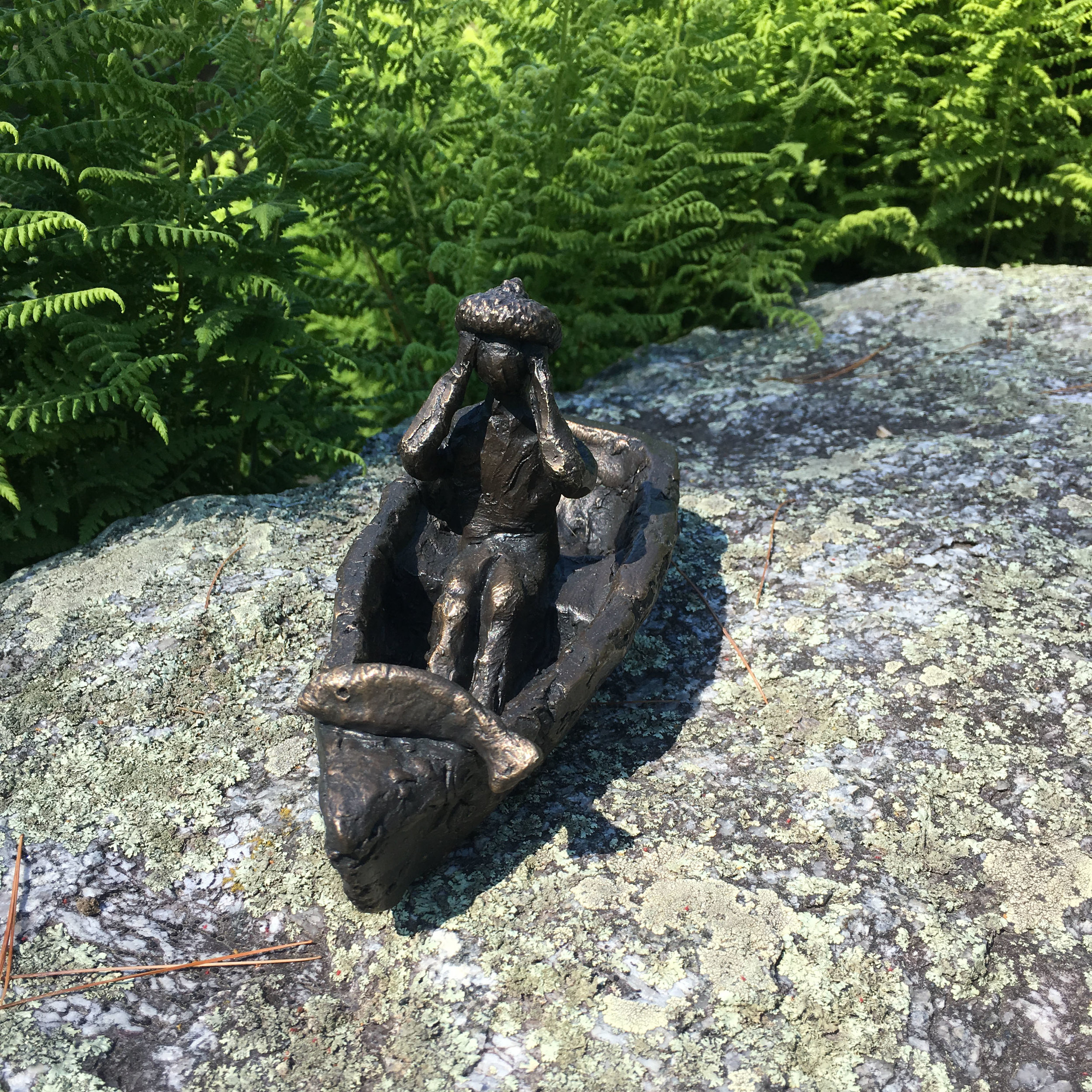
The World is Bonkers, 2017, bronze: Sculpture LH
Last week I wrote about Bonkers, the revolutionary apple – but unknown to me – the Atlantic, two weeks earlier, published an article, Why So Much is Bonkers Right Now. The Atlantic mentioned at least ten references to this imported British word. For example, Mother Jones had recently reassured its readers: “It’s Not Just You . . . This Week Was Bonkers,” referring to the latest Trump charades. And Vox used the word to describe Netflix’s newest film, Okja: “a bonkers corporate satire staring Tilda Swinton and a superpig.” I saw a two-page spread advertising the film in the New Yorker magazine. The image, a young woman leading a giant creature with a factory building as its saddle spewing out pollution from one of three smokestacks, was so fascinating I looked it up on Rotten Tomatoes and found that it is a story of an extraordinary human animal bond threatened by capitalist consumers.
The Atlantic article also mentions the word Bonkers’ first use on American soil in 1965, when an American film reviewer of the film Paranoia used the word to describe “Marcello Mastroianni as going slowly bonkers while sharing a bath, bed, and Bedouin with three co-stars.” In the 1980s, there was a candy named Bonkers. Its commercial takes the prize for worst of its kind, but you can watch it here. And there is a recent memoir by the comedian Jennifer Saunders, Bonkers: My Life in Laughs. What is the appeal of this Bonkers everyone is using? Zany, crazy, madcap, screwy, wacky? The Atlantic article ended with an appreciatory note, saying that this British word is “uniquely suited to this American moment: a time when news can be so often confusing, and overwhelming, and, all in all, a little bit bonkers.”
Yet to describe our world as Bonkers doesn’t feel right. After the Manchester killings and the London Bridge savagery, the world is not Bonkers, but alarming. Withdrawing America from the Paris Climate Accord is equally horrifying. Bonkers is a non-judgmental adjective; it resists condemnation. Faced with the harsh reality of innocent lives lost, the continued devastation of people’s homes from war and terrorism, and the loss of species and habitat because of climate change, Bonkers doesn’t describe the depth of suffering in our world.
Yet, at the same moment that devastation is happening all around, I watch young children skip merrily before climbing aboard a big yellow school bus and bike down our street with fishing rods tucked under their arms, knowing nothing about the follies of their parents’ generation. I feel similarly protective of the spotted brown and white eggs in a small nest high in a branch of the Saturn peach. These birds will know nothing of the perils facing the earth. This contrast between the news and what is happening in my backyard does make me feel like this world is Bonkers.
Today, a friend came by and we spent several hours removing peaches from the Saturn peach tree. Last week it was pruned to about half its size, and now we needed to thin the heavy fruit set. Packed together on the branches like sardines in a tin, the tree had produced a crazy number of apples. When this much fruit grows tightly together, disease spreads, the fruit is small, and it taxes the health of a tree. I heard myself say to her the ‘B’ word, ‘The tree is Bonkers – it has way too much fruit.’
Suffering is all around us, but miraculous beauty is too. Maybe the gift of the word Bonkers is that it describes craziness without being judgmental. We can do so much more to relieve suffering in the world if we don’t wallow in judging thoughts, but take up our lives wholeheartedly. Whether we grow miraculous peaches, listen to another’s pain, or spearhead an activist role to clean up the planet, every day we have the opportunity to hold back our anger, yet take in the grief; to feel the devastation, yet fight for change. Maybe to declare that this world is Bonkers is to bring lightness to the seriousness of our situation, and to let laughter wash over our tears.

Meditator with Acorn, 2017, bronze, Sculpture LH
Search Blog
-
2025
- May 9, 2025 A View from the Tractor Seat
- Apr 11, 2025 Dig
-
2024
- Jan 7, 2024 Winter Wassail
-
2022
- Dec 11, 2022 Keeping Time
- Jun 17, 2022 This Apple-Shaped Earth
- Jan 23, 2022 What is a Jizo?
- Jan 16, 2022 An Invite and Housekeeping Update
- Jan 1, 2022 The Year of the Frog: What Orchardists Do While Apple Trees are Chilling
-
2021
- Oct 24, 2021 Figs
- Oct 3, 2021 The Artist and the Orchard: A Memoir
- Aug 8, 2021 Red-Fleshed Apples
- Jul 25, 2021 When We Were Trees
- Jun 27, 2021 Castor Beans—Who Knew?
- Jun 13, 2021 Spring Training at a Zen Monastery
- May 4, 2021 Our Trees are in Bloom
- Apr 18, 2021 Hooray!
- Jan 24, 2021 Wassailing, virtually!
- Jan 1, 2021 Sitting
-
2020
- Dec 21, 2020 Darkness to Light
- Nov 28, 2020 One Heart
- Sep 18, 2020 Juggling Flowers, Fruit, and Vegetables
- Aug 23, 2020 Refuge
- Aug 9, 2020 Bags of Fertilizer
- Aug 2, 2020 The Sermon of the Blue Heron
- Jul 26, 2020 What's the Buzz?
- Jul 19, 2020 Farm Moments
- Jul 12, 2020 Lost Wax
- Jul 5, 2020 Catalpa: The Hugging Tree
- Jun 28, 2020 Pedaling Peace
- Jun 21, 2020 See Change
- Jun 14, 2020 Lalla Unveiled
- Jun 7, 2020 Pond Alchemy
- May 31, 2020 The Birth of Fruit
- May 24, 2020 An Artist in the Orchard
- May 17, 2020 Walking the Land: Returning Home
- May 10, 2020 Stinging Nettles: Gifts from the Great Mother
- May 3, 2020 The Mystery of Swallow
- Apr 26, 2020 Aerial Bruststrokes
- Apr 19, 2020 Simple Pleasures
- Apr 12, 2020 Weeds and Other Gifts
- Apr 5, 2020 Remembering the Seeds
- Mar 29, 2020 Blow on the Embers
- Mar 22, 2020 Ripples
-
2019
- Nov 16, 2019 Tibet Impressions
- Nov 9, 2019 Forest Tales
- Oct 13, 2019 The Gift
- Aug 4, 2019 The Season is Apples, Berries, and Grandfather Fire
- Jun 8, 2019 Pointers for a Writing Life
- May 12, 2019 Mothers of the Earth
- Apr 6, 2019 The Apple-Shaped Earth
- Mar 23, 2019 You Don’t Know What You Have Till It’s Gone
- Feb 23, 2019 Generations
- Feb 9, 2019 What Are We Doing to the Earth, John Chapman?
-
2018
- Dec 31, 2018 Long Shadows
- Oct 6, 2018 A Pilgrimage to India
- Aug 18, 2018 Scrap Wrenn
- Aug 11, 2018 Off-the-Wall Comments from an Ignorant Farmer
- Jul 28, 2018 Creative Connect
- Jul 14, 2018 How is the Orchard?
- Jun 30, 2018 Which Way?
- Jun 16, 2018 Geese, Herons, Beavers, and the Baby Steps of a Lapsed Blogger
- Feb 24, 2018 Mama's Coupons — Good Forever
- Jan 27, 2018 January Ice
- Jan 13, 2018 The Muse
-
2017
- Dec 30, 2017 A Dream for the New Year
- Dec 23, 2017 A New Year for Apples
- Dec 16, 2017 Intuition
- Nov 22, 2017 Thanksgiving OM
- Nov 4, 2017 East Fork Pottery
- Oct 28, 2017 Putting Down New Roots
- Oct 21, 2017 A is for Art
- Oct 14, 2017 Eve domesticus
- Oct 7, 2017 A String Workshop
- Sep 30, 2017 After Applepicking
- Sep 23, 2017 Two Bad Women and One Good Apple
- Sep 16, 2017 Plein Air Poetry
- Sep 9, 2017 Cutting Off a Leg
- Sep 2, 2017 The Changing Landscape
- Aug 26, 2017 All About Art
- Aug 19, 2017 My First Visit to the Farm
- Aug 12, 2017 The First Food
- Aug 5, 2017 A Teapot, a Woman, and maybe a Boat
- Jul 29, 2017 A Raspberry Dilemma
- Jul 22, 2017 Consider the Miracle
- Jul 15, 2017 Meeting Ekphrasis
- Jul 8, 2017 Ripening Fruit
- Jul 1, 2017 The Voice of The Caterpillar
- Jun 24, 2017 Goumi — An Unusual Fructus
- Jun 17, 2017 Concord, an American Bloomsbury
- Jun 10, 2017 The World Is Bonkers — Shall I Laugh or Cry?
- Jun 3, 2017 Bonkers, a Revolutionary Apple
- May 27, 2017 Guardians of the Swamp
- May 20, 2017 There are Mushrooms and There are Morels
- May 13, 2017 "What's in a Name?"
- May 6, 2017 Bloom Follows Pink: Orchard Pollination
- Apr 29, 2017 The Orchard Is at Pink
- Apr 22, 2017 Natural Farming — Part 2 (continuation from last Sunday's blog)
- Apr 15, 2017 Natural Farming — Part 1
- Apr 8, 2017 Boats, Figures, and Catching Fish
- Apr 1, 2017 A Man with a Mission: The Nuts and Bolts of Bronze Casting
- Mar 25, 2017 A Chalice of Spirit, Art, and Nature
- Mar 18, 2017 Hanami — Blossom Viewing
- Mar 11, 2017 Soil Redemption Song
- Mar 4, 2017 Food is Primary Care
- Feb 25, 2017 Pomme de Terre
- Feb 18, 2017 Organic Certification
- Feb 11, 2017 Tantalizing Fruit
- Feb 4, 2017 The Myths of History
- Jan 28, 2017 The Orchard in Winter
- Jan 21, 2017 The Hi-Line
- Jan 14, 2017 Artistic, Botanical, and Social Diversity
- Jan 7, 2017 Where is Eden?
-
2016
- Dec 31, 2016 The Creative Heart
- Dec 24, 2016 A Christmas Tale
- Dec 17, 2016 Who are the Crones?
- Dec 10, 2016 The Olympic Bell (Part Two)
- Dec 3, 2016 Overheard in the Apple Orchard in Early December
- Nov 26, 2016 The Lessons of a Tortoise
- Nov 19, 2016 In the Studio
- Nov 12, 2016 Even in Darkness
- Nov 5, 2016 Southern Apples, an Elephant, Monkey, Rabbit, and Bird, Two Mango Trees and a Birthday
- Oct 29, 2016 The Tools of Art
- Oct 22, 2016 Labyrinths
- Oct 15, 2016 Repairing the Broken
- Oct 8, 2016 When You Are No More
- Oct 1, 2016 Creation Rain
- Sep 24, 2016 Breaking the Glass
- Sep 17, 2016 String Art
- Sep 10, 2016 Poetry and Photosynthesis: It's all in the Leaves
- Sep 3, 2016 In the Plenty of Time
- Aug 27, 2016 Witch Doctors
- Aug 20, 2016 Listen Coyote
- Aug 13, 2016 Milkweed in the Orchard
- Aug 6, 2016 Some People See a Turtle
- Jul 30, 2016 Arborshaping
- Jul 23, 2016 Joseph Wheelwright: Sculptor of Stones and Trees
- Jul 16, 2016 Asian Pears
- Jul 9, 2016 Gold Leaf, Grief, and the Creative Process
- Jul 2, 2016 The Olympic Bell (Part One)
- Jun 25, 2016 Around the Mulberry Bush
- Jun 18, 2016 Avoiding Apples
- Jun 11, 2016 Fructus
- Jun 4, 2016 Astonishing Apples
- May 28, 2016 Scare the Caterpillars
- May 21, 2016 Join the Club!
- May 14, 2016 The Graft
- May 7, 2016 Rooster, Rhubarb, Rue
- Apr 30, 2016 What do Dolphins and Nettles Have in Common?
- Apr 23, 2016 Art Prunings
- Apr 16, 2016 A Few of the First Arrivals
- Apr 9, 2016 Taste the Spirit of Sustainable Agriculture
- Apr 2, 2016 First Orchard Spray - March 22-24, 2016
- Mar 26, 2016 Hawkeye Apple
- Mar 19, 2016 Desiring the Almata Apple
- Mar 12, 2016 Ugly Fruit
- Mar 5, 2016 Winter Tracks
- Feb 27, 2016 Splash
- Feb 20, 2016 Pruning
- Feb 13, 2016 Orchard Ruminants
- Feb 6, 2016 A Gathering of Seeds
- Jan 30, 2016 Orchard Dragons
- Jan 23, 2016 Tree Rings
- Jan 17, 2016 The Fallen Tree
- Jan 7, 2016 Wassailing the Apple Trees
- Jan 1, 2016 The New Year