LINDA HOFFMAN
Food is Primary Care
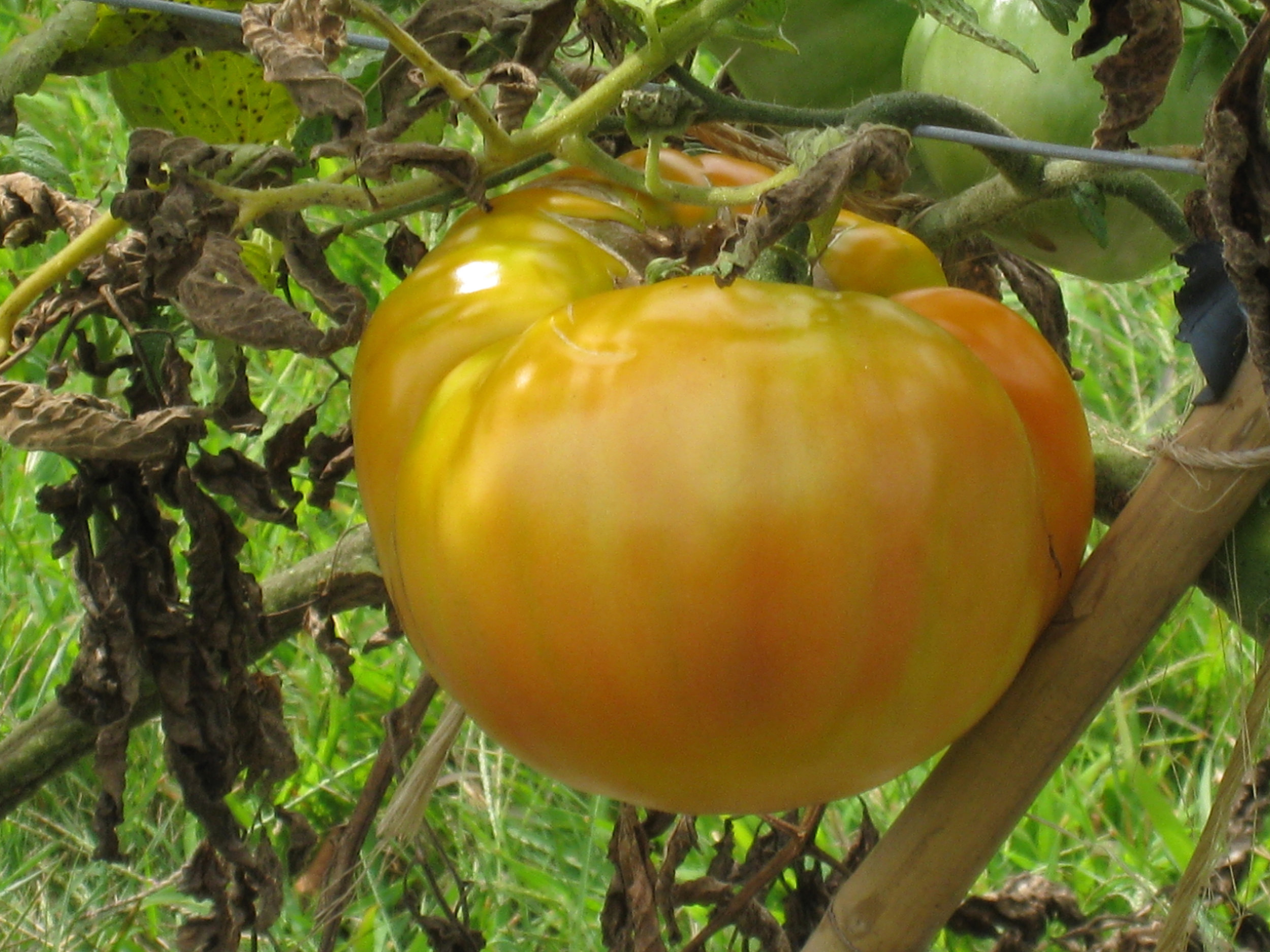
Sometimes I will buy a big peach, a bright red tomato, or even an apple only to be disappointed when I bite into a mealy peach, a watery tomato, and a tasteless apple. I don’t like to throw out food, so I often eat it anyway. But sometimes, it’s just so bad that I guiltily toss the entire beautiful glob into the compost pile, burying it under some faded tulips or tough cabbage leaves.
Nutritionists say that we’re not getting the nutrients our bodies need from our food. Considering the obesity epidemic and the debilitating diseases in America, it’s hard not to agree. Soil health, crop health, and human health are interrelated. Since the 1950s, however, crop yield has gone up, but nutritional value has gone down. The great monocultures of agricultural production have focused on yield, pest resistance, appearance, and shelf life; not taste or nutrition.
Many of our food systems provide food that is low on both flavor and nutrition — for example, food served in hospitals to those who are ill, people who need healthy food. Turkey with corn might sound appealing when ticked off the menu, but when it arrives the next day, it’s a different story. Pre-frozen turkey rounds and corn niblets grown with chemical pesticides and herbicides, not to mention jiggles of artificially dyed red and orange Jello for dessert, is neither appealing nor nutritious.
The good news is that Marydale Debor, founder of the organization Fresh Advantage (their wonderful tagline is Food is Primary Care), works to put fresh and nutritious food back into hospitals, schools, and other institutions. It’s not easy – the old guard must be removed and new chefs who want to buy and cook with local ingredients need to be hired. Debor knows that buying food from a small local farm is the best way to get tasty and nutritious food.
A healthy diet contains a diversity of foods, but how to encourage diverse and nourishing meals when much of our food no longer has taste — especially when junk food has so much flavor? I heard a presentation by Mark Schatzker, author of The Dorito Effect: The Surprising New Truth about Food and Flavor. He explained that not only have our foods lost their flavor, but food is now separate from taste. He gave the example of the Frito-Lay Company that makes Dorito chips. In that product, for the first time, taste was manufactured; and flavor was added separately such that taste had no relation to the product’s food ingredients. Frito-Lay, Inc. (a subsidiary of PepsiCo) perfected the taste of their chip to be appealing to a wide group of people. This original manufactured taste opened the door to all kinds of manufactured food, in particular, the enormous category of junk food.
Humans can have associations with food taste from childhood like the sweetness of mother’s milk. If a manufactured food is high is corn fructose, it will satisfy this associative sugar craving, but, and here’s the catch, it will not satisfy the belly’s nutritive need because it’s only flavor. We don’t stop eating, because the craving doesn’t go away. We are caught like Tantalus reaching for the apples that are forever out of reach.
I love potato chips and eat more than I like to admit. But if that peach I had grabbed was warm, sweet, and juicy, or there was a basket of cherry tomatoes on the kitchen counter, I would eat a bellyful, be sated, and nutritionally fed. Healthy food needs to be the norm for people everywhere. Everyone should have access to nourishing and delicious food at a price that is affordable.
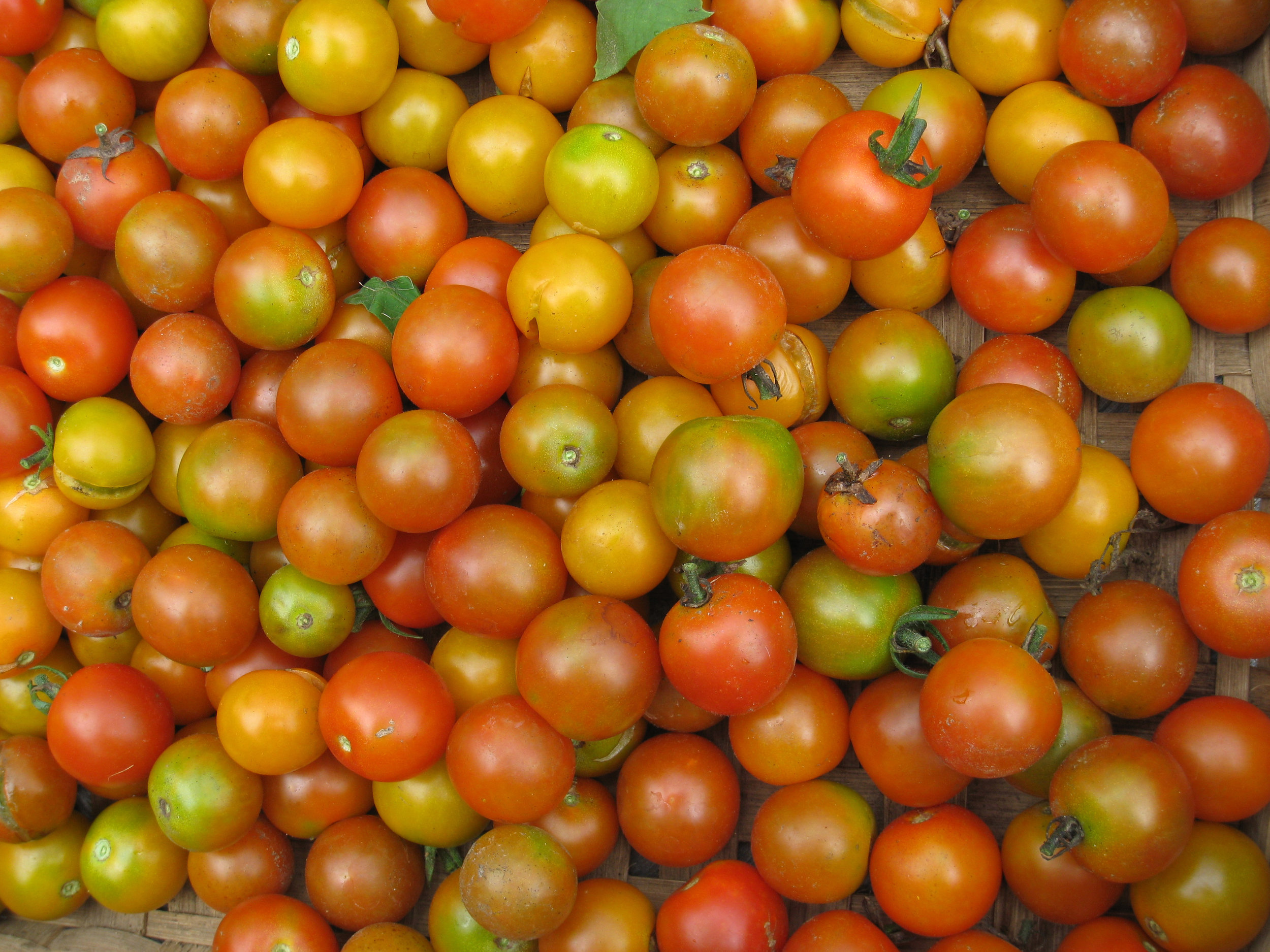
A Late Harvest of Cherry Tomatoes from Old Frog Pond Farm
Some people believe that our bodies can sense food grown with love and compassion; it feeds the spirit as well as the body, and sadly the opposite is also true. Food made by an angry cook can make a food unappealing or even repellent. ‘Food is primary care’ — and real food inspires wonderful poetry!
Ode to The Tomato
by Pablo Neruda
The street
filled with tomatoes,
midday,
summer,
light is
halved
like
a
tomato,
its juice
runs
through the streets.
In December,
unabated,
the tomato
invades
the kitchen,
it enters at lunchtime,
takes
its ease
on countertops,
among glasses,
butter dishes,
blue saltcellars.
It sheds
its own light,
benign majesty.
Unfortunately,
we must murder it:
the knife
sinks
into living flesh,
red
viscera
a cool
sun,
profound,
inexhaustible,
populates the salads
of Chile,
happily, it is wed
to the clear onion,
and to celebrate the union
we
pour
oil,
essential
child of the olive,
onto its halved hemispheres,
pepper
adds
its fragrance,
salt, its magnetism;
it is the wedding
of the day,
parsley
hoists
its flag,
potatoes
bubble vigorously,
the aroma
of the roast
knocks
at the door,
it's time!
come on!
and, on
the table, at the midpoint
of summer,
the tomato,
star of earth, recurrent
and fertile
star,
displays
its convolutions,
its canals,
its remarkable amplitude
and abundance,
no pit,
no husk,
no leaves or thorns,
the tomato offers
its gift
of fiery color
and cool completeness.
Pomme de Terre
To peel a boiled potato is a rare treat. —François Ponge
Pomme de terre in French means apple of the earth. Like apples, les pommes de terre have been on the planet for thousands of years and have been cultivated on all every continent except Antarctica. They sprout easily from the tuber itself: a rarity among plants, unlike a seed that is often surrounded by fleshy material or a hard pit.

A forgotten bag of potatoes!
The potato had its start in the soil of South America between 8000 and 5000 BCE. Today in the Andes about four hundred varieties of potatoes are grown. A single farmer in Peru might plant thirty to fifty different potatoes. Some of these potatoes she knows are resistant to drought or disease, others keep longer once they are dug, some crop early, some late. Peruvian potatoes, like heirloom apples, have many-shapes: round, oblong, conical, to name only a few, with hues of red, brown, yellow, purple, and blue that are marbled, speckled, streaked, striped, and mottled. Twenty-five or so varieties are sold in supermarkets and it seems that Peruvian shoppers are familiar with each potato’s unique characteristic.
Near Cuzco, Peru, six thousand families live in the world's first "Potato Park." Here residents and scientists test the tolerance of different potatoes to changing temperatures in a 22,700 acre living laboratory. Climate change has affected potato growing in Peru as it has crops across the globe. Potatoes that grew at 3000 feet now must be grown closer to 4000 feet because of the rise in average temperatures at these altitudes. And in low altitudes, it is now too warm to plant them. I am worried about our unseasonably warm local temperatures taking our fruit trees out of dormancy too early.
In his book, Potato: a history of the propitious esculent, John Reader writes that Juan, a Peruvian potato grower, told him that it had been a bad year for potatoes because an early frost had harmed the young plants. But his crop did all right. He had some plants that were frost tolerant, “and also tall enough to lean over and protect their weaker brothers.”
Farmers learn from their plants; being a farmer is being a nurturer. Humans need to eat, and if we are going to eat, we need to be kind to our crops. Today, so many people exchange money for food that we have moved far away from the mentality of being a nurturer towards plants. Money doesn’t grow on trees, and we don’t have to cultivate money with any sort of empathy. Is it any wonder that we have President Trump in the White House? His product, wealth, requires little compassion to grow, only aggressive boasting to propagate the Trump brand.
There is pressure on the Andean farmers to sell their land for profit. But it is organizations like the International Potato Center partnering with the “Potato Park” to support the Andean farmers so that their native knowledge will not be lost. Trialing the adaptive properties of hundreds of potatoes will hopefully insure that their children will eat food grown in the Andean soil, food will sustain them and their culture, as it has for millennia.
The French poet, Francis Ponge, wrote prose poems about single objects like the potato. Let’s not forget in these days of too much bad news to marvel at the simple potato.
La Pomme de Terre
To peel a boiled potato is a rare treat.
Between the cushion and the thumb and the point of the knife held by the other fingers, one seizes — after piercing— one of those lips of rough, thin parchment and pulls it towards one to detach it from the appetizing flesh of the tuber. […]
—François Ponge, in Selected Poems, edited and translated by Margaret Guiton
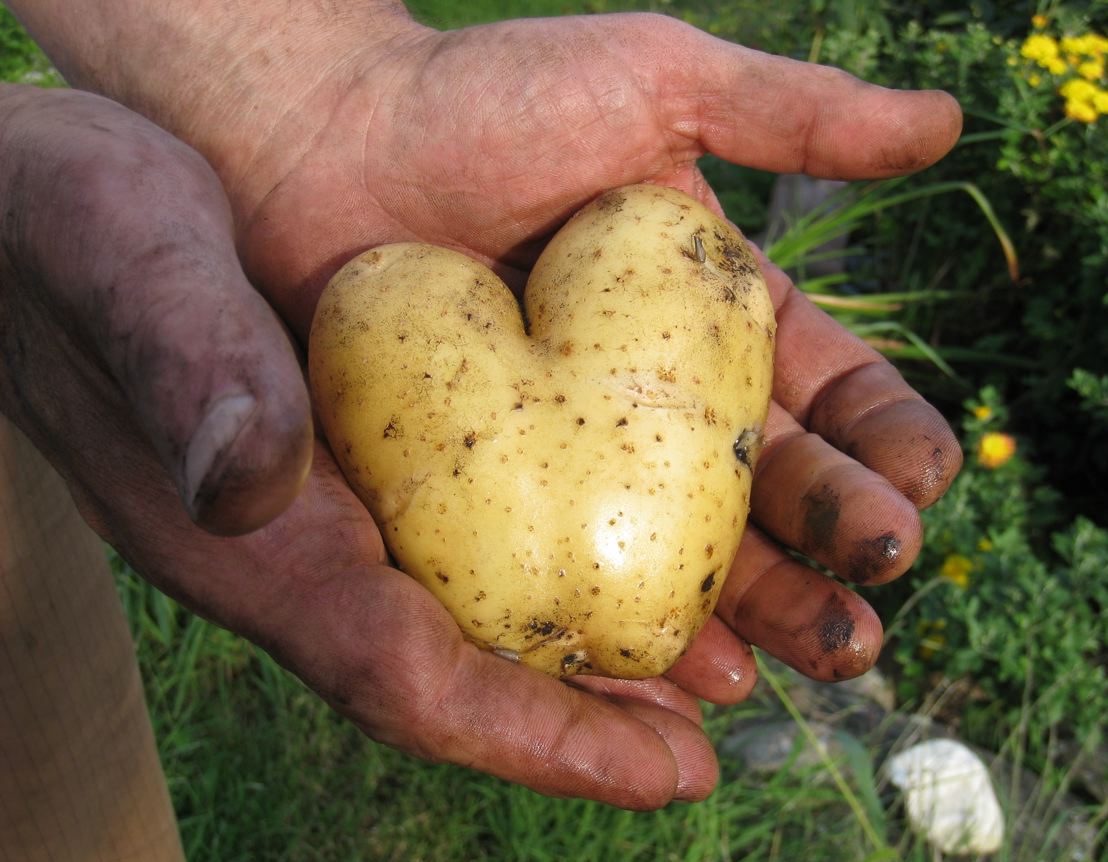
There are some potatoes with such papery thin skin that there is no need to peel away the parchment. And some are too beautiful to eat.
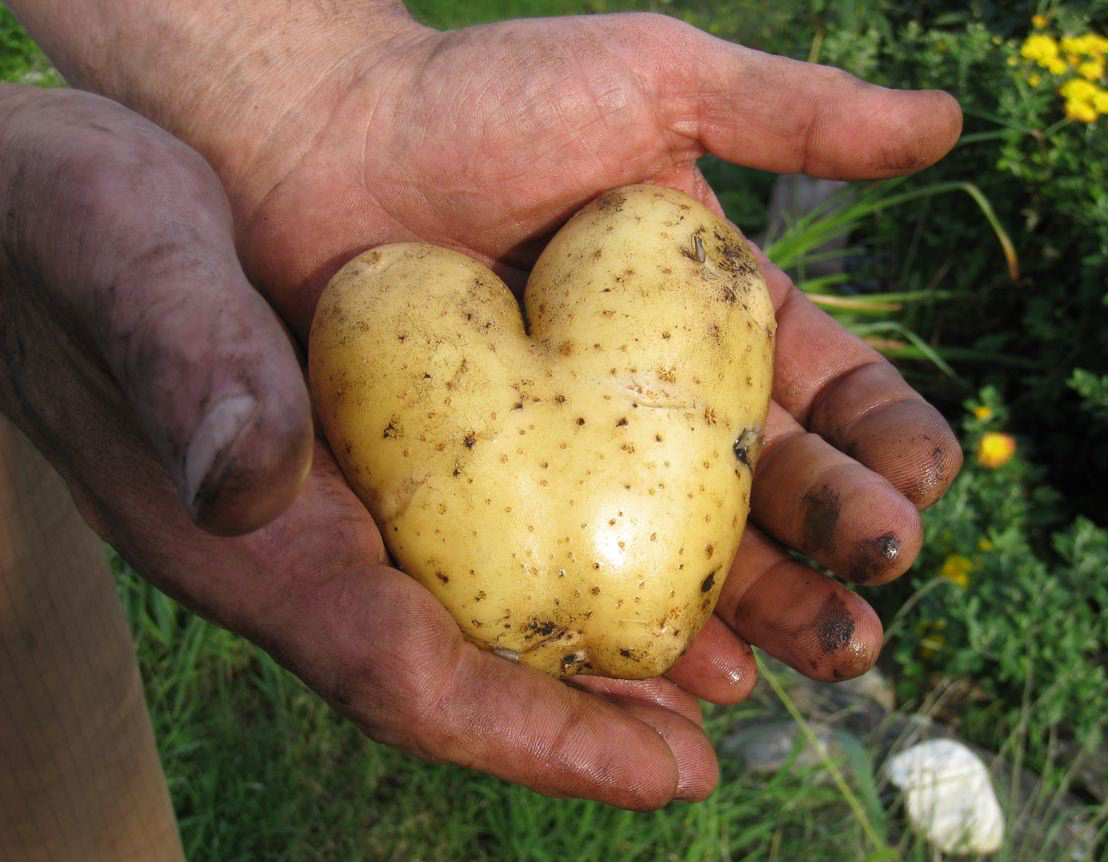
Freshly Dug Love!
Organic Certification
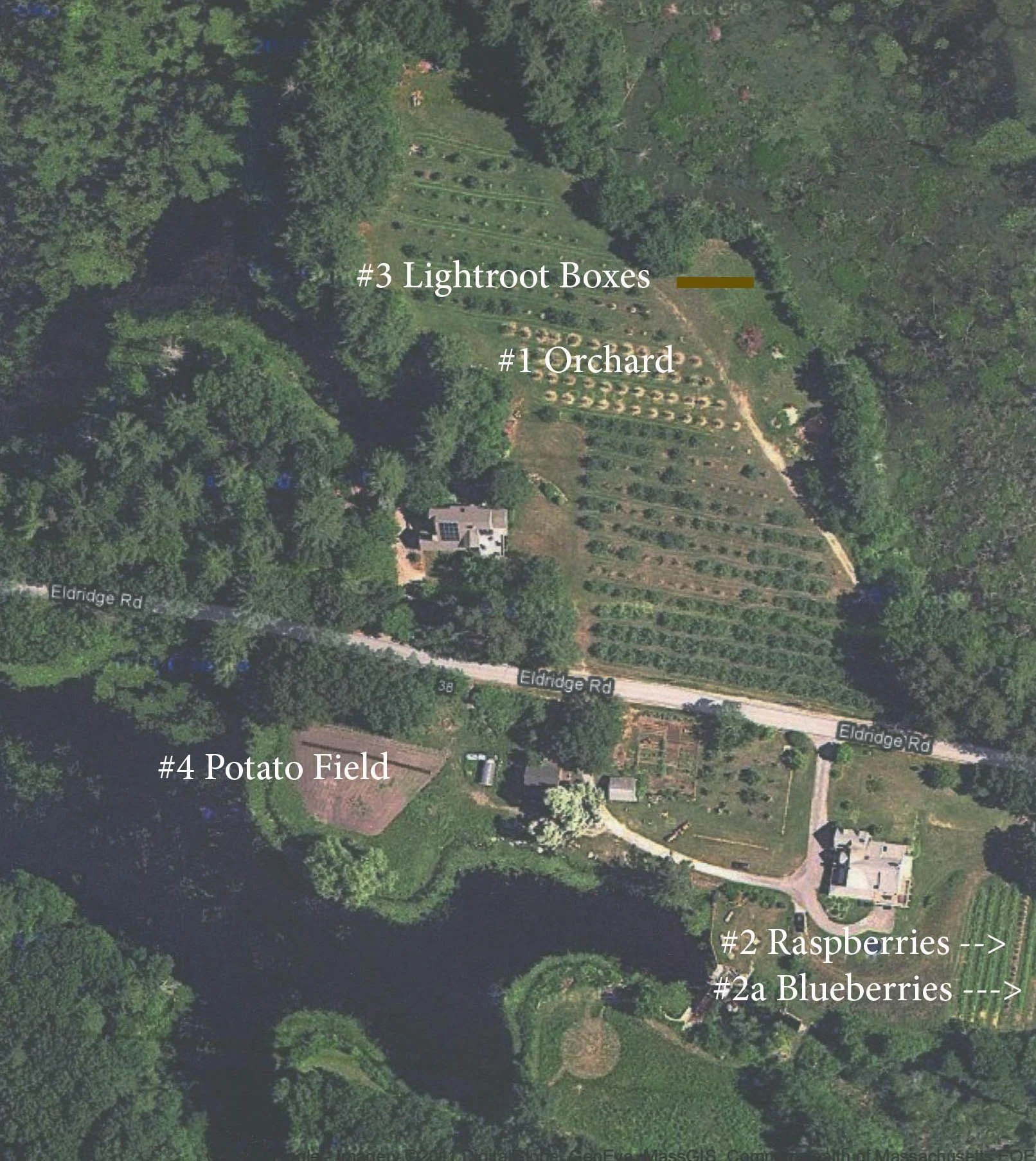
Last week I filled out our annual organic certification paperwork due February 15th. It’s one of those items on my To Do list that I often put off. When a farmer wants to be an organic grower and label her produce organic, each crop on the farm must be certified by a regional certifying agency. First, the applicant needs to demonstrate that for three years the land has been free from contaminating chemicals. Then, the crops must be grown according to organic standards; specifically, any material used on the crop must be on the Organic Materials Review Institute’s (OMRI) list of approved materials or individually approved by a certifying agency. If a farmer chooses not to become certified, yet still follows all the regulations, she can tell customers that the crop is grown according to organic standards, but cannot label it organic. The standards are stringent, and the United States Department of Agriculture can slap on a fine of up to $10,000 for each infraction.
Now that I am filling out the certification papers for the 11th year in a row it doesn’t take me as long as it used to. But I remember the first year I nervously submitted our thirty-page application, including maps of the land, a soil report, a list of materials I had used or planned to use, and harvest, selling, and storage plans. The certifier wanted to be sure that there was no possibility of contamination at any step in the process of delivering the crop to the consumer. The final requirement before receiving certification was the annual onsite inspector visit.
I knew that being certified would create our market. Our certifier had told me that there were no other pick-your-own certified organic orchards in Massachusetts. Without it, why would anyone be attracted to our little farm, when we were surrounded by so many commercial orchards that not only offered apples, but cider donuts, farmstands, mazes, petting zoos, and hay rides — big time agri-tainment?
On the day of our appointment, the inspector arrived with copies of our application and a clipboard of questions. He wanted to see the shed where we stored all of our materials, the tractor, the sprayer and other tools, our spray log, and receipts for all materials purchased—in short, everything related to the farm operation. It was a bit like having a nosy mother-in-law inspect your domestic abilities. I thought I’d done everything correctly, but the inspector noted some inconsistencies that needed to be addressed before the orchard could receive organic certification.
The most difficult issue to resolve was my early season copper spray for fire blight, a standard in the orchard arsenal. Copper is a mined material; I never imagined that it wouldn’t be organic. The product label said it contained copper sulfate and copper oxychloride, both Greek to me (I never took chemistry), and other inert materials. The inspector told me he was not worried about the first two materials, but that I would need to find out about the inert ingredients, which companies are hesitant to reveal because of trade secrets. Those inert ingredients could make us ineligible for certification for three years. With my friend Kavita’s help, we discovered that our product was on an older OMRI list. We were ecstatic and called the organic certifier. He said, “This is good news,” but he cautioned us. “The product might have changed—otherwise, why wasn’t it on the current list? If the material is the same as on the older list, you need to get the company to state that in writing.”
We called the company numerous times and sent beseeching emails. Fortunately, we reached a sympathetic person who explained that the product was changed to a different label due to a “consolidation of product line.” Neither the active nor inert ingredients had changed. He said the company didn’t list it because the paperwork was so arduous. We were very appreciative and the farm officially received organic certification a few weeks later. Now, I get approval for every product before I use it in the orchard. And because we are one of two organic pick-your-own orchards in the state, and still the only one in eastern MA, we are picked out every fall before Columbus Day.
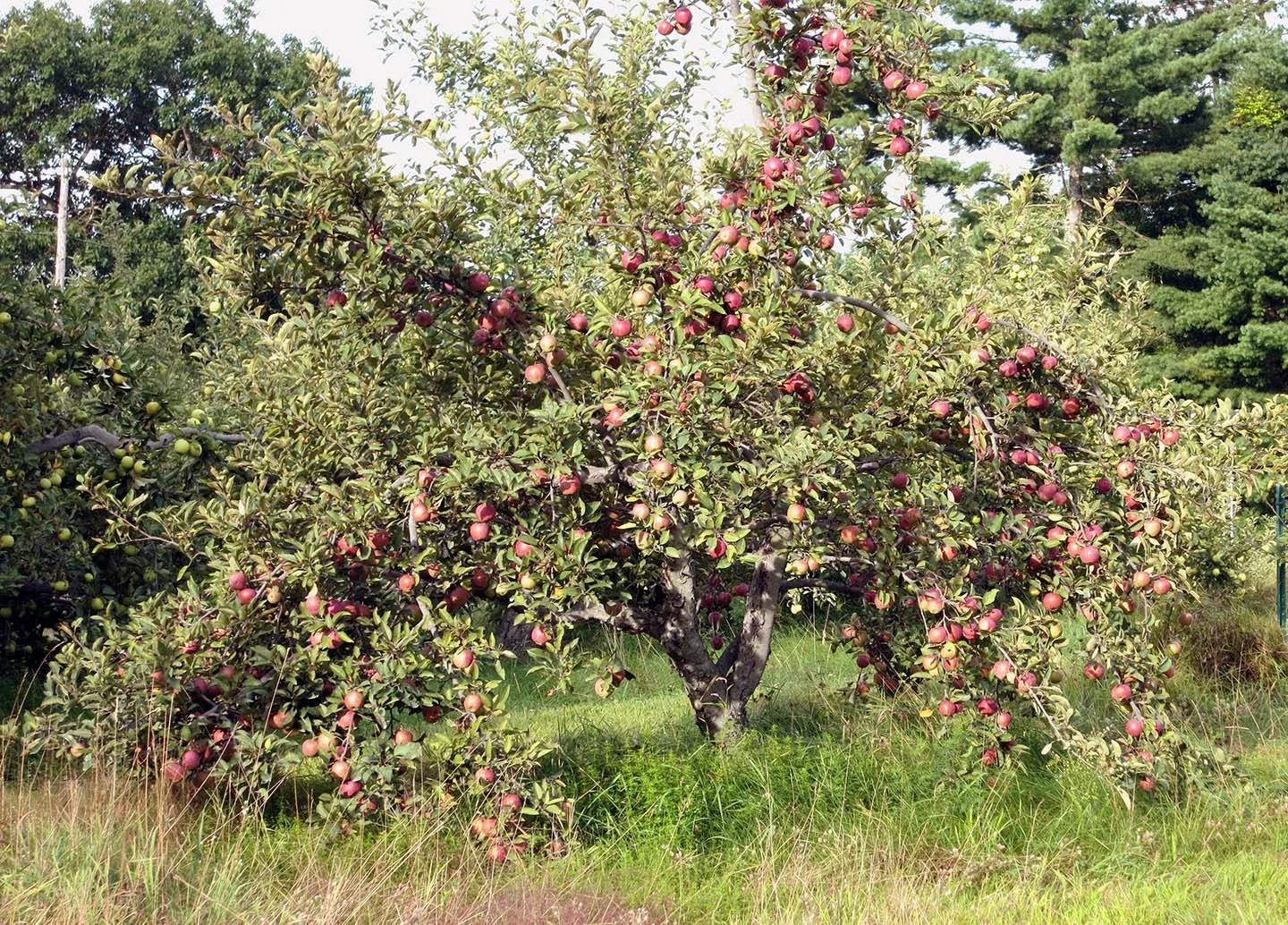
Apple Tree at Old Frog Pond Farm, 2013 Photo Credit: Linda Hoffman
Today, I wouldn't consider spraying a harsh chemical on our trees or herbicide under the trees, but I continue to apply for certification. Organic certification creates the market for our small farm. But I know that organic is only a minimum requirement for healthy food. The nutritional content of our food makes the big difference in human health and it’s the biological activity in the soil that feeds the plants that feed us. I’ll be writing about nutrient dense growing in a future blog. But that’s why it’s important to know your farm and know your farmer!
Milkweed in the Orchard
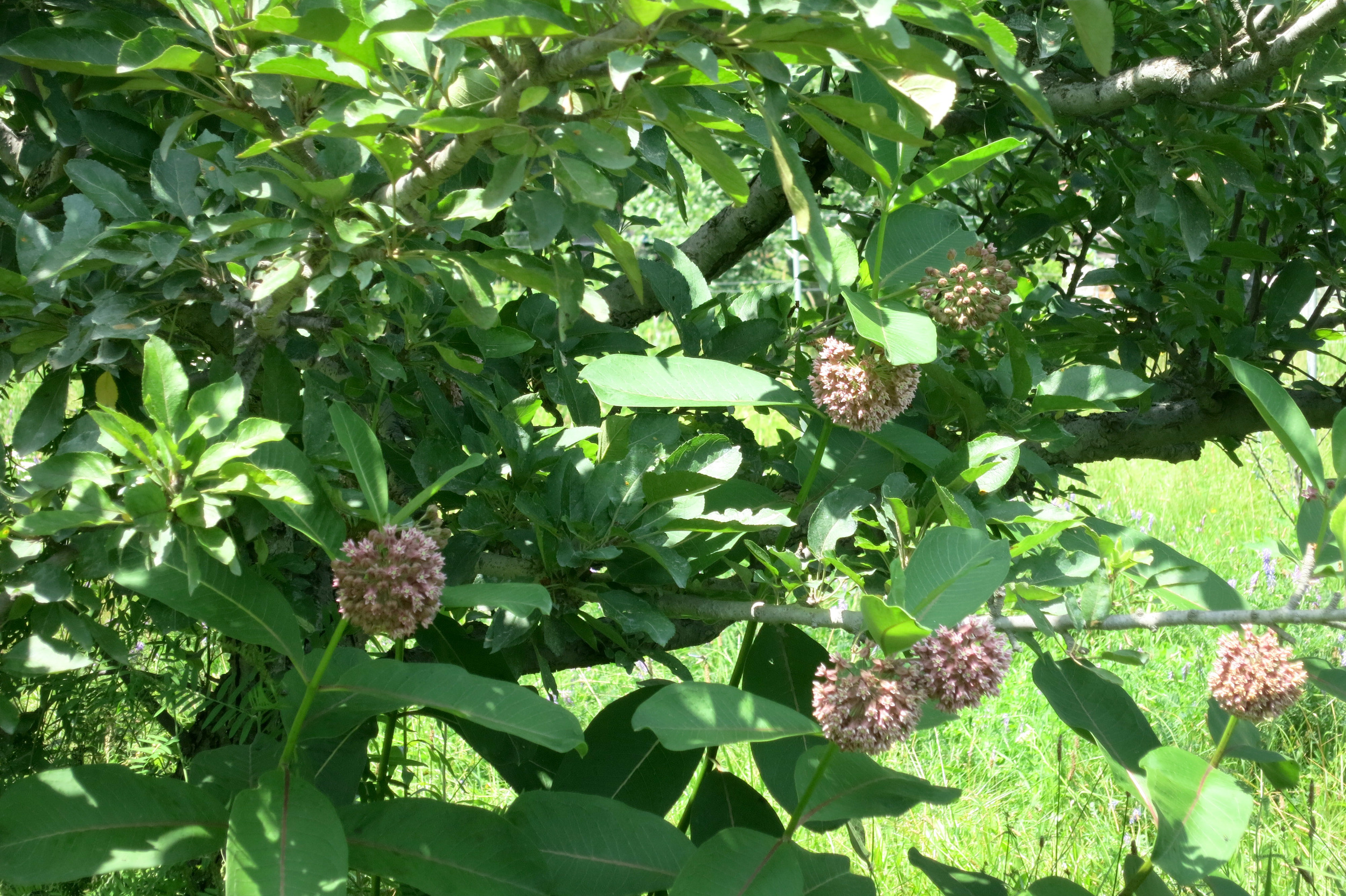
Milkweed under an Apple Tree
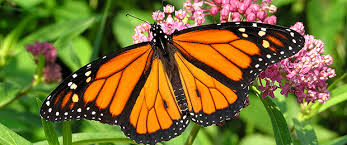
In the last few years, milkweed has spread exponentially throughout the orchard. We don’t mow it down, but we don’t plant it either. It is as if the earth herself has decided that we need more of it; that nature wants to help the monarch butterflies who depend on this plant for their survival. Every summer, monarchs lay their eggs on milkweed. The emerging black-, white-, and yellow-striped caterpillars begin eating around the edges of the leaves, and even absorb a substance from their host that provides a defense against predators.
But where are the monarchs? Their numbers have been decreasing steadily for the last twenty years. In fact, the Endangered Species Coalition reports that North American monarchs have declined by ninety percent since the mid 90’s. During the first few years of tending the orchard, I would see monarchs daily when the milkweed was in bloom. This year I have yet to see one.
One reason for their decline is the loss of milkweed habitat. Much of this acreage is now planted with corn and soybeans, and the fields are sprayed with Monsanto’s Roundup. (In 1995, 10 million pounds of Roundup was used on corn and soybeans, and, by 2013, the total pounds rose to 204 million.) Roundup destroys all weeds – including milkweed! I’ve known about the horrors of Roundup, but I didn’t realize that genetically modified corn seed, like Bt corn, produces pollen that kills monarch caterpillars and other insects. I am familiar with Bacillus thuringiensis, Bt, a bacteria-based organic pesticide that is approved for use in organic production. An organic grower uses it sparingly and for target pests. But in the case of Bt corn, the plant itself sends out this pesticide to all insects, pollinators as well as pests such as the corn borer.
When the first findings came out that Bt corn was killing off the monarchs, the agricultural giants who control the fate of millions of acres of farmland (as well as the U.S. Environmental Protection Agency and the U.S. Department of Agriculture) denied them. If you want to read further, Orion Magazine published a great article aptly titled, The Canary in the Cornfield.
In recent years, monarch butterfly decline also correlates with unprecedented fluctuations of temperatures caused by global warming. For example, in 2013, a cold period in May delayed the Monarch departure from their wintering grounds, so they arrived late and didn’t breed as well. Their numbers upon their return the following winter were the lowest ever. In early March this year, a sleet storm with high winds at their wintering ground in Mexico felled trees and buried large numbers of monarchs under sheets of ice.
It’s good we have milkweed growing throughout our orchard, and it is wonderful to read about all of the projects to encourage the survival of the monarch, like the Fresh Pond Monarch Watch in Cambridge, MA, who are planting milkweed, pulling out the invasive black swallow-wort vines, and breeding and releasing caterpillars. However, it will ultimately be the millions of acres in the Midwest that will make the most difference in monarch numbers.
Milkweed belongs to the Asclepiadaceae family, derived from Asclepius, the Greek god (actually demi-god because his father was Apollo but his mother was mortal) of medicine and healing. Athena gave Asclepius the gift to save mortals and even bring them back from the dead. Zeus was jealous when he saw his foes coming back from Hades and supposedly killed Asclepius with a thunderbolt. No one knows for sure since Asclepius became a living god. In ancient Greece there were 320 Asclepions, healing sanctuaries, actually the first hospitals in the world. Last year a 2,400-year-old temple dedicated to him was excavated. I hope he continues to use his healing powers through the proliferation of milkweed and helps to insure the survival of the Monarch butterfly.

Asclepius and his daughter Hygieia, goddess of health.
.
Search Blog
-
2025
- May 9, 2025 A View from the Tractor Seat
- Apr 11, 2025 Dig
-
2024
- Jan 7, 2024 Winter Wassail
-
2022
- Dec 11, 2022 Keeping Time
- Jun 17, 2022 This Apple-Shaped Earth
- Jan 23, 2022 What is a Jizo?
- Jan 16, 2022 An Invite and Housekeeping Update
- Jan 1, 2022 The Year of the Frog: What Orchardists Do While Apple Trees are Chilling
-
2021
- Oct 24, 2021 Figs
- Oct 3, 2021 The Artist and the Orchard: A Memoir
- Aug 8, 2021 Red-Fleshed Apples
- Jul 25, 2021 When We Were Trees
- Jun 27, 2021 Castor Beans—Who Knew?
- Jun 13, 2021 Spring Training at a Zen Monastery
- May 4, 2021 Our Trees are in Bloom
- Apr 18, 2021 Hooray!
- Jan 24, 2021 Wassailing, virtually!
- Jan 1, 2021 Sitting
-
2020
- Dec 21, 2020 Darkness to Light
- Nov 28, 2020 One Heart
- Sep 18, 2020 Juggling Flowers, Fruit, and Vegetables
- Aug 23, 2020 Refuge
- Aug 9, 2020 Bags of Fertilizer
- Aug 2, 2020 The Sermon of the Blue Heron
- Jul 26, 2020 What's the Buzz?
- Jul 19, 2020 Farm Moments
- Jul 12, 2020 Lost Wax
- Jul 5, 2020 Catalpa: The Hugging Tree
- Jun 28, 2020 Pedaling Peace
- Jun 21, 2020 See Change
- Jun 14, 2020 Lalla Unveiled
- Jun 7, 2020 Pond Alchemy
- May 31, 2020 The Birth of Fruit
- May 24, 2020 An Artist in the Orchard
- May 17, 2020 Walking the Land: Returning Home
- May 10, 2020 Stinging Nettles: Gifts from the Great Mother
- May 3, 2020 The Mystery of Swallow
- Apr 26, 2020 Aerial Bruststrokes
- Apr 19, 2020 Simple Pleasures
- Apr 12, 2020 Weeds and Other Gifts
- Apr 5, 2020 Remembering the Seeds
- Mar 29, 2020 Blow on the Embers
- Mar 22, 2020 Ripples
-
2019
- Nov 16, 2019 Tibet Impressions
- Nov 9, 2019 Forest Tales
- Oct 13, 2019 The Gift
- Aug 4, 2019 The Season is Apples, Berries, and Grandfather Fire
- Jun 8, 2019 Pointers for a Writing Life
- May 12, 2019 Mothers of the Earth
- Apr 6, 2019 The Apple-Shaped Earth
- Mar 23, 2019 You Don’t Know What You Have Till It’s Gone
- Feb 23, 2019 Generations
- Feb 9, 2019 What Are We Doing to the Earth, John Chapman?
-
2018
- Dec 31, 2018 Long Shadows
- Oct 6, 2018 A Pilgrimage to India
- Aug 18, 2018 Scrap Wrenn
- Aug 11, 2018 Off-the-Wall Comments from an Ignorant Farmer
- Jul 28, 2018 Creative Connect
- Jul 14, 2018 How is the Orchard?
- Jun 30, 2018 Which Way?
- Jun 16, 2018 Geese, Herons, Beavers, and the Baby Steps of a Lapsed Blogger
- Feb 24, 2018 Mama's Coupons — Good Forever
- Jan 27, 2018 January Ice
- Jan 13, 2018 The Muse
-
2017
- Dec 30, 2017 A Dream for the New Year
- Dec 23, 2017 A New Year for Apples
- Dec 16, 2017 Intuition
- Nov 22, 2017 Thanksgiving OM
- Nov 4, 2017 East Fork Pottery
- Oct 28, 2017 Putting Down New Roots
- Oct 21, 2017 A is for Art
- Oct 14, 2017 Eve domesticus
- Oct 7, 2017 A String Workshop
- Sep 30, 2017 After Applepicking
- Sep 23, 2017 Two Bad Women and One Good Apple
- Sep 16, 2017 Plein Air Poetry
- Sep 9, 2017 Cutting Off a Leg
- Sep 2, 2017 The Changing Landscape
- Aug 26, 2017 All About Art
- Aug 19, 2017 My First Visit to the Farm
- Aug 12, 2017 The First Food
- Aug 5, 2017 A Teapot, a Woman, and maybe a Boat
- Jul 29, 2017 A Raspberry Dilemma
- Jul 22, 2017 Consider the Miracle
- Jul 15, 2017 Meeting Ekphrasis
- Jul 8, 2017 Ripening Fruit
- Jul 1, 2017 The Voice of The Caterpillar
- Jun 24, 2017 Goumi — An Unusual Fructus
- Jun 17, 2017 Concord, an American Bloomsbury
- Jun 10, 2017 The World Is Bonkers — Shall I Laugh or Cry?
- Jun 3, 2017 Bonkers, a Revolutionary Apple
- May 27, 2017 Guardians of the Swamp
- May 20, 2017 There are Mushrooms and There are Morels
- May 13, 2017 "What's in a Name?"
- May 6, 2017 Bloom Follows Pink: Orchard Pollination
- Apr 29, 2017 The Orchard Is at Pink
- Apr 22, 2017 Natural Farming — Part 2 (continuation from last Sunday's blog)
- Apr 15, 2017 Natural Farming — Part 1
- Apr 8, 2017 Boats, Figures, and Catching Fish
- Apr 1, 2017 A Man with a Mission: The Nuts and Bolts of Bronze Casting
- Mar 25, 2017 A Chalice of Spirit, Art, and Nature
- Mar 18, 2017 Hanami — Blossom Viewing
- Mar 11, 2017 Soil Redemption Song
- Mar 4, 2017 Food is Primary Care
- Feb 25, 2017 Pomme de Terre
- Feb 18, 2017 Organic Certification
- Feb 11, 2017 Tantalizing Fruit
- Feb 4, 2017 The Myths of History
- Jan 28, 2017 The Orchard in Winter
- Jan 21, 2017 The Hi-Line
- Jan 14, 2017 Artistic, Botanical, and Social Diversity
- Jan 7, 2017 Where is Eden?
-
2016
- Dec 31, 2016 The Creative Heart
- Dec 24, 2016 A Christmas Tale
- Dec 17, 2016 Who are the Crones?
- Dec 10, 2016 The Olympic Bell (Part Two)
- Dec 3, 2016 Overheard in the Apple Orchard in Early December
- Nov 26, 2016 The Lessons of a Tortoise
- Nov 19, 2016 In the Studio
- Nov 12, 2016 Even in Darkness
- Nov 5, 2016 Southern Apples, an Elephant, Monkey, Rabbit, and Bird, Two Mango Trees and a Birthday
- Oct 29, 2016 The Tools of Art
- Oct 22, 2016 Labyrinths
- Oct 15, 2016 Repairing the Broken
- Oct 8, 2016 When You Are No More
- Oct 1, 2016 Creation Rain
- Sep 24, 2016 Breaking the Glass
- Sep 17, 2016 String Art
- Sep 10, 2016 Poetry and Photosynthesis: It's all in the Leaves
- Sep 3, 2016 In the Plenty of Time
- Aug 27, 2016 Witch Doctors
- Aug 20, 2016 Listen Coyote
- Aug 13, 2016 Milkweed in the Orchard
- Aug 6, 2016 Some People See a Turtle
- Jul 30, 2016 Arborshaping
- Jul 23, 2016 Joseph Wheelwright: Sculptor of Stones and Trees
- Jul 16, 2016 Asian Pears
- Jul 9, 2016 Gold Leaf, Grief, and the Creative Process
- Jul 2, 2016 The Olympic Bell (Part One)
- Jun 25, 2016 Around the Mulberry Bush
- Jun 18, 2016 Avoiding Apples
- Jun 11, 2016 Fructus
- Jun 4, 2016 Astonishing Apples
- May 28, 2016 Scare the Caterpillars
- May 21, 2016 Join the Club!
- May 14, 2016 The Graft
- May 7, 2016 Rooster, Rhubarb, Rue
- Apr 30, 2016 What do Dolphins and Nettles Have in Common?
- Apr 23, 2016 Art Prunings
- Apr 16, 2016 A Few of the First Arrivals
- Apr 9, 2016 Taste the Spirit of Sustainable Agriculture
- Apr 2, 2016 First Orchard Spray - March 22-24, 2016
- Mar 26, 2016 Hawkeye Apple
- Mar 19, 2016 Desiring the Almata Apple
- Mar 12, 2016 Ugly Fruit
- Mar 5, 2016 Winter Tracks
- Feb 27, 2016 Splash
- Feb 20, 2016 Pruning
- Feb 13, 2016 Orchard Ruminants
- Feb 6, 2016 A Gathering of Seeds
- Jan 30, 2016 Orchard Dragons
- Jan 23, 2016 Tree Rings
- Jan 17, 2016 The Fallen Tree
- Jan 7, 2016 Wassailing the Apple Trees
- Jan 1, 2016 The New Year