LINDA HOFFMAN
Weeds and Other Gifts

A Small Piece of Land, Watercolor LH, 2020
“The greatest fine art of the future will be the making of a comfortable living from a small piece of land.” —Abraham Lincoln
When I am anxious or out of balance, which is often these days, I turn to weeding. I can always find weeds on the farm. The weeds are tenacious; they want to grow. One definition of a weed is a plant growing in the wrong place. We have lots of plants growing in the wrong places. Most of them need to be dug up. On the farm ‘to do’ list, weeding sits in almost every category: blueberries, raspberries, rhubarb, asparagus, around the apples, pears, and peach trees, the hoop house, and the kitchen garden.
Sitting on the ground, along the rows of blueberries, as if at a banquet table, each of us brings our favorite utensil. Ariel’s preference is the triangular Korean hoe, Holly prefers a claw, and I use a pink-handled small trowel.

Holly weeding young blueberry bushes on a cold and windy day.
We yank, we pull, we dig, leveraging our tools into thick mats of grasses, and tug some more. Grass clumps lift out—these get a hearty shake sending the worms and the soil attached to the roots back into the row, while whatever is left finds new life in the compost pile.

Frederic G. Cooper, 1917, U.S. Food Administration
My mind is occupied by thoughts of farms and food. The largest apple grower in our town depends on two migrant workers, but he has yet to hear from the embassy about their arrival. The commercial vegetable market in California doesn’t know how they will manage not only because of their dependence on migrant workers, but the chain of supply, the connective system, the trucks, the transport, the weigh stations, the middle places where all the packaging happens, are facing their own challenges. Farmers in Florida are plowing under vegetables, and in the Midwest, dairies are dumping fresh milk, though stores limit the amount customers can buy. Small farms feel the pressure, too. The restaurant that bought fifty pounds of greens a week is now closed, and many farmer’s markets have been canceled.
Abraham Lincoln promoted the cultivation of land after the bloodshed of the Civil War. During and at the end of World War II, the American Victory Garden movement created sustainability and health. England had their own movement, Dig for Victory. Maybe the restoration of the world’s psyche after times of great suffering was in part due to the return of our connection to the soil, to food. Maybe, it is a time to build more resiliency into our communities. Food is basic to our needs along with water, clean air, and shelter. We need to return to the basics and provide this for all people on the planet. Let’s give up fighting for causes and beliefs that only divide us. Let’s rally around what truly supports us.
I think about these things, and obviously oversimplify them, while I grab a small clump of grass, and ease out its long root system, pure white and thick, from among the blueberry’s dark, thin roots. Pull too hard and the root snaps. Only by teasing gently but firmly, can I coax out a foot-length root, with grass nodules every few inches, to release its hold. Of course, some weeds will quickly regrow, we don’t get them all, but if we don’t weed, the mass of growth under the blueberry plants will rob the bushes of nutrients. We weed in order to ease the competition for resources, to encourage a bountiful crop.
Weeding is not glamorous work and It doesn’t save lives, but it offers a connection to something trustworthy that helps keep me balanced. I know not everyone has access to weeds, but even in a city, we can break for a moment, see a bit of earth or touch a tree, and know this is all part of us. Amid slicing an apple, or washing salad greens, we can pause within our anxiety, and connect to this gift from the earth, the ground that sustains us.

This morning’s surprise: blown by the wind from a pile of old materials outside my studio.
.
Remembering the Seeds

Hoop House, Old Frog Pond Farm, Harvard, MA April 4, 2020
On this cold April day, many seeds still wait underground, but with a few days of warmth, they will crack open, the tiny rootlets will poke out, find their way to sustenance, and their first seed leaves will appear. A seed at birth is already programed to be the fullest expression of itself. It arrives on the planet with all the knowledge it needs. The seed knows when to grow and how to respond to warmth. As it develops leaves, it takes up nutrients, drinks in carbon dioxide and releases oxygen. The seed is a storehouse for a great reservoir of knowledge, of shared history, and experience. As it becomes a mature plant, it knows what to give another plant struggling nearby and to send out warnings to its tribe of approaching danger. The smallest seed only needs to find itself in a hospitable environment to flourish. For it will respond to whatever it encounters. The influences of the outside environment affect it, be it toxins, or a great flood, hail, a heat wave, or a blessed perfect growing season.
I lived my first seven years in a row house in the industrial city of Chester, Pennsylvania. I didn’t know about seeds, but I was always attracted to one plant. When I was about six years old, I remember walking alone into the alley behind our row house, carrying a metal kitchen bowl. It was the insert from the classic Revere Ware double boiler. Then, seating myself on the concrete near a patch of weeds, I gathered the seed stalks of this plant that grew in abundance. I rubbed my fingers up the stem against the grain, and the seeds, small, elongated, and soft, fell silently into the bowl. Myriads of individual entities.
In my world were my parents, my younger brother, Jon, Albert, a boy who lived across the street, Charlene who lived a few doors away and whose mother was always home when we came home from school, our housekeeper, Louise, and somewhere, further away, my parents’ drugstore where they worked every day. My world was small, but this bowl was filled with the largest number of anything I could imagine. So many small bits all neatly together filling the bowl. When it was almost full, I lowered my fingers into the bowl and trailed my fingers through the perfect seeds. Moving my hand around and through and under, the seeds shifted and tickled my fingers. Soothing and sensual is how I remember the experience. Even at this young age, or perhaps because of it, my hand in this bowl of seeds connected me to something peaceful and true.
Later, after I became an apple orchardist, I learned that the weed was plantain, an herbal remedy for insect stings and other skin abrasions. You only have to pick a few leaves, chew them, and rub them or poultice them onto a wound and they withdraw toxins and soothe. The taste is not sweet, not bitter, not pungent or sharp, just a mash of green leaves.

Sketch of Plantain Seed Stalks and Leaves, Linda Hoffman, 2020
I am allergic to bees. When I am stung, which inevitably happens several times a year, I know exactly where to find plantain. It grows on the side our farmhouse near the back door. Growing in this most unglamorous place, it doesn’t announce its presence, but it is tenacious enough to grow despite other weeds and grasses. It even survives the mower. In cities, plantain grows in vacant lots and in cracks of the sidewalk. Plantain seems to be totally nonchalant about its closest neighbors or the soil chemistry. It grows both where soils are poor and where they are fertile. It forges a home in forgotten nooks and crannies.

Plantain beginning to grow along the driveway in front of the Farmhouse, April 4, 2020
Plants offer their unique gifts. For example, poison ivy grows in disturbed areas. It also flourishes in unstable ecosystems like on the dunes on Cape Cod, appearing as if to say, “Keep off of this fragile bank.” When a friend recovering from chemo treatments, mentioned poison ivy had sprung up outside her front door, I smiled and said, “It wants to protect you.” And when I am feeling tired, I lean my head into a tall clump of mountain mint, and its strong menthol scent enlivens my spirit.
I no longer live in Chester, Pennsylvania, but on a small farm where I can plant seeds and tend the earth. I think of the billions of people who can’t do this, I think of my stepdaughters in their small apartment in Brooklyn, listening to sirens, eating rice and beans, and my grandchildren who have been told not to go out because there is sickness outside. I long to bring them to the farm and show them the rows of seeds growing, to listen to peepers and wood frogs, to share the plumping of the apple buds, and see plantain, the healer, poking out. But for now, this is the way it is.
The myriad seeds in that long ago bowl connected me to something outside myself, to something far beyond my immediate world. As I sit alone now in isolation, I think about this world with more people than I can conceive of—almost eight billion people. Every single person on the planet born a unique and perfect being. Like a seed, we must grow in this imperfect world. We, too, have much innate wisdom, we know what needs to be done.

Catalpa Tree, watercolor, Linda Hoffman, 2019
What Are We Doing to the Earth, John Chapman?
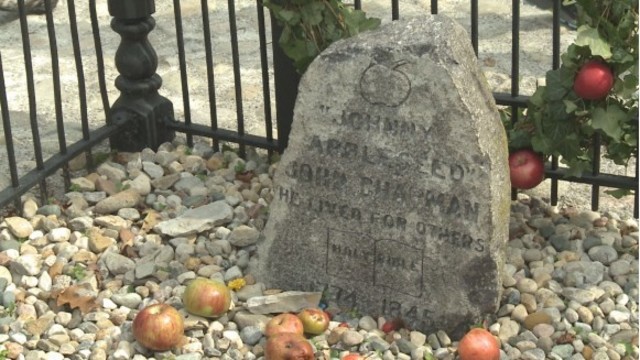
John Chapman (1774–1845) is familiar to most grade school students in the United States as Johnny Appleseed, the man who planted apple seeds. The irony is that John Chapman might have been sorely disappointed with this epitaph. John Chapman established nurseries of apple trees in Pennsylvania, Ohio, and as far west as Indiana, but these orchards were not his true raison d’etre. Selling apple trees for his livelihood gave him the possibility of travel where and when he wanted—and the freedom to practice and spread his religion of choice.
John followed the teachings of Emanuel Swedenborg (1688–1772), a Swedish mystic, scientist, and theologian who influenced Harriet Beecher Stowe and was praised by Ralph Waldo Emerson. Swedenborg believed we live in both the world of spirit and the material world, but that our eyes are often closed to the former. He was a Christian who formed a new religious movement, the Swedenborgian denomination, to advance the idea that God revealed himself in the world, in the earth, in all sentient life. Based on his own significant mystical experiences, he wrote that love is the “basic unit of reality.” He seemed determined to show people that there is more than what they see with their eyes and hear with their ears: There is a mystical world that everyone has access to.

Apple Bloom at Old Frog Pond Farm in 2017
John Chapman certainly seemed to want to have, or perhaps did have, his own mystical experiences—we will never know. But he did he carry the words of Swedenborg across the American frontier. Visiting homesteads, he would pull out his Bible and read passages with an ardor that calls to mind the approach of television evangelists today. Sometimes he would tear out a few pages and leave them, only to exchange them for new ones the next time he passed through. He was a vegetarian, wore no leather, and would never even cut down a tree.
Of course, on these journeys, he always had apple trees to sell. Fruit trees, often a requirement for anyone wanting to establish a land claim, provided the fruit to make applejack—hard cider—the drink of choice for the settlers at all three meals. From apple cider, settlers could make apple cider vinegar, a cleaning agent, as well as a preservative and medicinal drink. Even if the apples Chapman’s seedling produced were bitter and hard, ‘spitters’ I’ve heard them called, it didn’t matter, for they all mixed well in the grinder.
Chapman would travel into a new territory ahead of the homesteaders and establish a small nursery with seeds he picked up annually from a cider mill in Pennsylvania. He chose a protected spot near a river or stream, secured it with brambles, and traveled on. The following year he would return, dig up his one-year-old seedlings. Apple seedlings with the right conditions can grow five feet or more in a year.
My friend, Eric Schultz, who generously let me read his chapter on John Chapman in his book, Nation of Entrepreneurs, to be published by Greenleaf Publishing this fall wrote, “John Chapman was the oddest of evangelists, bringing gifts of heaven and alcohol in equal parts to the American frontier and running a business model that supported both.” There are not many followers of the Swedenborg religion today, but Chapman’s apples spread far and wide, and are certainly part of the proliferation of varieties of apples we now grow not only in America but all over the world. It’s interesting how one’s passion does not always create one’s legacy.
I think about John Chapman when I read that we have experienced the five warmest years in history. We will soon be planting Southern apples here in New England, for in not too many years, our older heirloom varieties will not have enough chill hours to produce buds. Much of this heating up of the earth is because of our selfishness and blindness to the interconnection of everything we do, build, use, and desire. Chapman was a minimalist, even during a time when there was not much to spare. His potato sack shirt had armholes cut for sleeves and probably did little to protect him from the elements, but apparently, he never complained. What would we think if we saw this man walking along our streets, barefoot with “horny” toes, wearing a tin can cap, bearded and hairy? We appreciate true iconoclasts often only after the person has died.
I came upon an interesting post, A Theology of Wild Apples, in the blog, American Orchard, Historical perspectives on food, farming and landscape.
Yet well-off travelers in the late 17th and throughout the 18th century frequently cast harsh moral judgments on the subsistence-minded farmer and his wild, disorderly orchards. And by the 1820s, many moralists found another reason to condemn the seedling orchard: most of its apples were destined to be converted to demon alcohol. Temperance societies called for the destruction of wild apple trees as an essential step toward sobering up the nation.
Chapman, born in 1774 in Leominster, Massachusetts, died in 1854 in Fort Wayne, Indiana. Fortunately, a few decades later, his younger compatriot, Henry David Thoreau, born in Concord in 1887, celebrated wilderness, wildness, and, thank goodness, wild apple trees, writing the long essay, Wild Apples, in celebration of them. There is room for both: the domesticated apple and the wild apple.
Which brings me to our orchard of ordered rows. Last Monday, we finished winter pruning, and now the twisting rhythms of branches play the ground between the trees. We pruned on those days of coldest cold stamping our feet to keep warm, and finished last Monday, a 50 degree day with honey bees out flying. Here’s to a bountiful year of apples, those planted by crow and deer, and the straight rows of nursery stock.

Pruned Row February, 2019
And to you, John Chapman, thank you! May we be inspired by your life to care more deeply for every apple, and to appreciate the miracle of every seed.
There are Mushrooms and There are Morels
I’d heard people talk excitedly about hunting ‘morels,’ but never shared that experience. The only mushrooms I gather and eat are the shiitake we grow on logs here at the farm. When Holly, one of our farm workers, approached me in the orchard, and said, “What are those mushrooms under the trees?” I immediately went over to look.
Holly had been straightening out the irrigation drip lines, pulling them close to the trunks in the tree rows, so that when we mow they won’t get snagged. I had been weeding around young trees, putting cardboard down to suppress the weeds, and covering the cardboard with bark mulch. I followed Holly down one of the rows as she looked for a mushroom to show me. “Morels,” I said, instinctively, peering under the canopy of a large tree. I recognized the morels without really knowing I was familiar with them.
When I returned to the house I looked up morels, just to be sure. One photograph was all that was required. Sure enough, morels love growing under old apple trees. Morels have a distinctive shape, eerily similar to brain coral in surface, with elfin-like rounded turrets that poke up out of the ground, leaning this way and that.
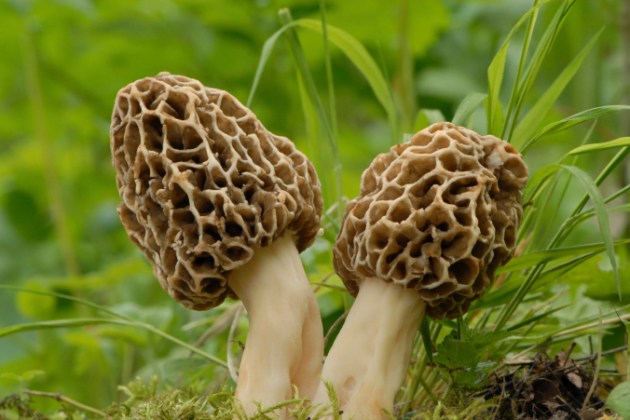
Photo credit: Thinkstock
Morels particularly like apple trees, poplar, and elm, but can be found just about anywhere. The challenge is to spot them. Sometimes you have to walk by a site several times, but once you notice one, you will usually see many more. Morels like days of sixty degrees and nights of forty degrees, and, of course, moisture — just the conditions we’ve had all spring. So perhaps we have had morels before, but so few that I didn’t notice. This is a bumper year for morels, they are calling out to be harvested. Otherwise, the mushrooms will dry up in a few days, resembling dark rice paper that will melt back into the ground. It did occur to me that I probably shouldn't be writing this blog—morel seekers guard their favorite gathering locations with religious fervor!
When I decided to collect the morels, I read about the best way to harvest them. Some aficionados claim that you should cut them just at ground level; others, that pulling with just a slight tug releases the mushroom with a little knob covered in dirt. The ones who favor cutting say that plucking may damage the mycelia threads and reduce future harvests. I decided to try both techniques. I went back to the orchard with a basket and pocket knife. Pulling them seemed so easy, as if they simply released willingly into your hand. It didn’t feel like I was doing any damage. Cutting them off is neat and clean, but left a hole in the hollow stem open to the air. After trying both approaches, I found myself preferring the pluck method, and harvested enough for lunch.
Blase and the day’s workers, Kevin, Mike, and Holly, were already in the kitchen. I sliced up the morels and added a few shiitake. In a heavy frying pan, I poured a little olive oil and a generous tad of butter. When the pan was hot and the butter melted, in went the mushrooms. While they were cooking, I added a little salt, a little rice bran oil with a very small amount of shoyu, and balsamic vinegar. We shared the exquisite, rich taste. I couldn’t imagine they would ever taste this good again. Two days later, my daughter, Ariel, and I went hunting, and brought home another basket full. I cooked them again, and they were scrumptious.
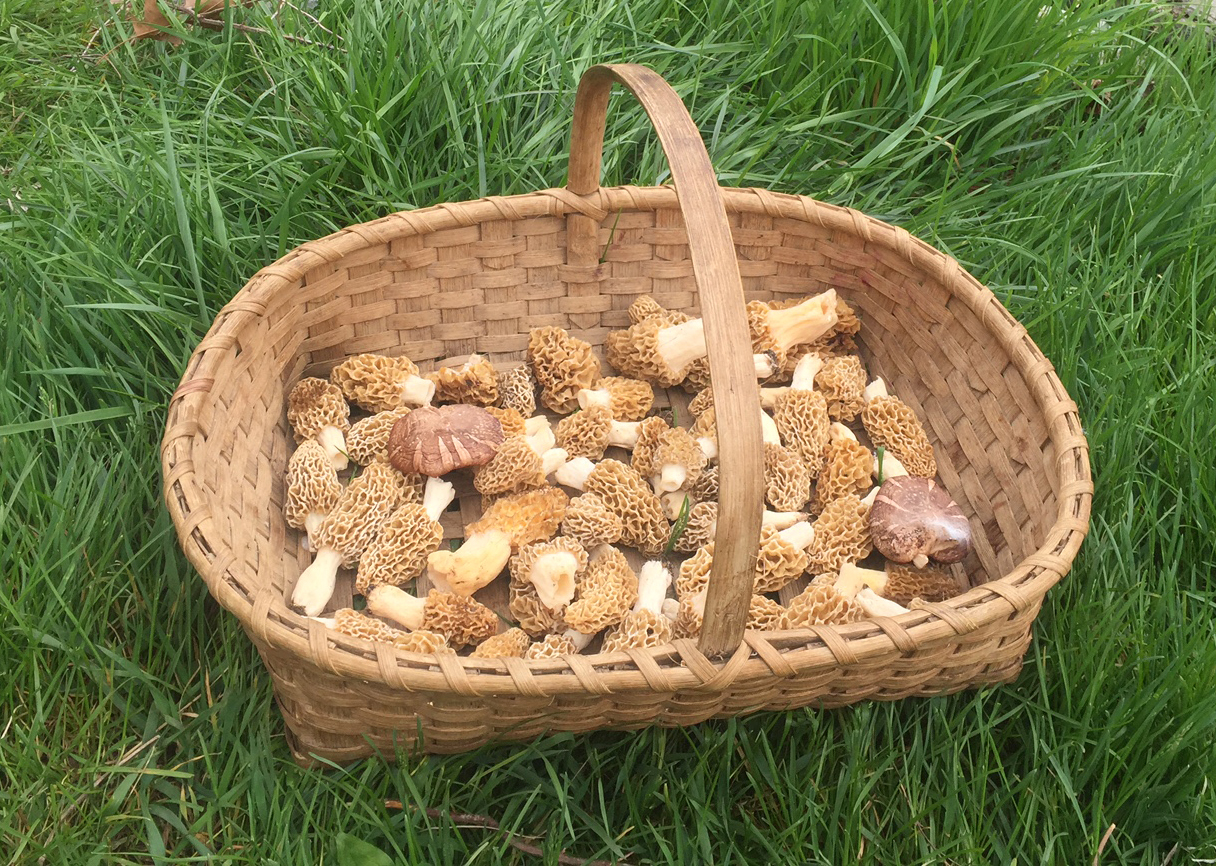
Morels with a couple of small shiitake.
Search Blog
-
2025
- May 9, 2025 A View from the Tractor Seat
- Apr 11, 2025 Dig
-
2024
- Jan 7, 2024 Winter Wassail
-
2022
- Dec 11, 2022 Keeping Time
- Jun 17, 2022 This Apple-Shaped Earth
- Jan 23, 2022 What is a Jizo?
- Jan 16, 2022 An Invite and Housekeeping Update
- Jan 1, 2022 The Year of the Frog: What Orchardists Do While Apple Trees are Chilling
-
2021
- Oct 24, 2021 Figs
- Oct 3, 2021 The Artist and the Orchard: A Memoir
- Aug 8, 2021 Red-Fleshed Apples
- Jul 25, 2021 When We Were Trees
- Jun 27, 2021 Castor Beans—Who Knew?
- Jun 13, 2021 Spring Training at a Zen Monastery
- May 4, 2021 Our Trees are in Bloom
- Apr 18, 2021 Hooray!
- Jan 24, 2021 Wassailing, virtually!
- Jan 1, 2021 Sitting
-
2020
- Dec 21, 2020 Darkness to Light
- Nov 28, 2020 One Heart
- Sep 18, 2020 Juggling Flowers, Fruit, and Vegetables
- Aug 23, 2020 Refuge
- Aug 9, 2020 Bags of Fertilizer
- Aug 2, 2020 The Sermon of the Blue Heron
- Jul 26, 2020 What's the Buzz?
- Jul 19, 2020 Farm Moments
- Jul 12, 2020 Lost Wax
- Jul 5, 2020 Catalpa: The Hugging Tree
- Jun 28, 2020 Pedaling Peace
- Jun 21, 2020 See Change
- Jun 14, 2020 Lalla Unveiled
- Jun 7, 2020 Pond Alchemy
- May 31, 2020 The Birth of Fruit
- May 24, 2020 An Artist in the Orchard
- May 17, 2020 Walking the Land: Returning Home
- May 10, 2020 Stinging Nettles: Gifts from the Great Mother
- May 3, 2020 The Mystery of Swallow
- Apr 26, 2020 Aerial Bruststrokes
- Apr 19, 2020 Simple Pleasures
- Apr 12, 2020 Weeds and Other Gifts
- Apr 5, 2020 Remembering the Seeds
- Mar 29, 2020 Blow on the Embers
- Mar 22, 2020 Ripples
-
2019
- Nov 16, 2019 Tibet Impressions
- Nov 9, 2019 Forest Tales
- Oct 13, 2019 The Gift
- Aug 4, 2019 The Season is Apples, Berries, and Grandfather Fire
- Jun 8, 2019 Pointers for a Writing Life
- May 12, 2019 Mothers of the Earth
- Apr 6, 2019 The Apple-Shaped Earth
- Mar 23, 2019 You Don’t Know What You Have Till It’s Gone
- Feb 23, 2019 Generations
- Feb 9, 2019 What Are We Doing to the Earth, John Chapman?
-
2018
- Dec 31, 2018 Long Shadows
- Oct 6, 2018 A Pilgrimage to India
- Aug 18, 2018 Scrap Wrenn
- Aug 11, 2018 Off-the-Wall Comments from an Ignorant Farmer
- Jul 28, 2018 Creative Connect
- Jul 14, 2018 How is the Orchard?
- Jun 30, 2018 Which Way?
- Jun 16, 2018 Geese, Herons, Beavers, and the Baby Steps of a Lapsed Blogger
- Feb 24, 2018 Mama's Coupons — Good Forever
- Jan 27, 2018 January Ice
- Jan 13, 2018 The Muse
-
2017
- Dec 30, 2017 A Dream for the New Year
- Dec 23, 2017 A New Year for Apples
- Dec 16, 2017 Intuition
- Nov 22, 2017 Thanksgiving OM
- Nov 4, 2017 East Fork Pottery
- Oct 28, 2017 Putting Down New Roots
- Oct 21, 2017 A is for Art
- Oct 14, 2017 Eve domesticus
- Oct 7, 2017 A String Workshop
- Sep 30, 2017 After Applepicking
- Sep 23, 2017 Two Bad Women and One Good Apple
- Sep 16, 2017 Plein Air Poetry
- Sep 9, 2017 Cutting Off a Leg
- Sep 2, 2017 The Changing Landscape
- Aug 26, 2017 All About Art
- Aug 19, 2017 My First Visit to the Farm
- Aug 12, 2017 The First Food
- Aug 5, 2017 A Teapot, a Woman, and maybe a Boat
- Jul 29, 2017 A Raspberry Dilemma
- Jul 22, 2017 Consider the Miracle
- Jul 15, 2017 Meeting Ekphrasis
- Jul 8, 2017 Ripening Fruit
- Jul 1, 2017 The Voice of The Caterpillar
- Jun 24, 2017 Goumi — An Unusual Fructus
- Jun 17, 2017 Concord, an American Bloomsbury
- Jun 10, 2017 The World Is Bonkers — Shall I Laugh or Cry?
- Jun 3, 2017 Bonkers, a Revolutionary Apple
- May 27, 2017 Guardians of the Swamp
- May 20, 2017 There are Mushrooms and There are Morels
- May 13, 2017 "What's in a Name?"
- May 6, 2017 Bloom Follows Pink: Orchard Pollination
- Apr 29, 2017 The Orchard Is at Pink
- Apr 22, 2017 Natural Farming — Part 2 (continuation from last Sunday's blog)
- Apr 15, 2017 Natural Farming — Part 1
- Apr 8, 2017 Boats, Figures, and Catching Fish
- Apr 1, 2017 A Man with a Mission: The Nuts and Bolts of Bronze Casting
- Mar 25, 2017 A Chalice of Spirit, Art, and Nature
- Mar 18, 2017 Hanami — Blossom Viewing
- Mar 11, 2017 Soil Redemption Song
- Mar 4, 2017 Food is Primary Care
- Feb 25, 2017 Pomme de Terre
- Feb 18, 2017 Organic Certification
- Feb 11, 2017 Tantalizing Fruit
- Feb 4, 2017 The Myths of History
- Jan 28, 2017 The Orchard in Winter
- Jan 21, 2017 The Hi-Line
- Jan 14, 2017 Artistic, Botanical, and Social Diversity
- Jan 7, 2017 Where is Eden?
-
2016
- Dec 31, 2016 The Creative Heart
- Dec 24, 2016 A Christmas Tale
- Dec 17, 2016 Who are the Crones?
- Dec 10, 2016 The Olympic Bell (Part Two)
- Dec 3, 2016 Overheard in the Apple Orchard in Early December
- Nov 26, 2016 The Lessons of a Tortoise
- Nov 19, 2016 In the Studio
- Nov 12, 2016 Even in Darkness
- Nov 5, 2016 Southern Apples, an Elephant, Monkey, Rabbit, and Bird, Two Mango Trees and a Birthday
- Oct 29, 2016 The Tools of Art
- Oct 22, 2016 Labyrinths
- Oct 15, 2016 Repairing the Broken
- Oct 8, 2016 When You Are No More
- Oct 1, 2016 Creation Rain
- Sep 24, 2016 Breaking the Glass
- Sep 17, 2016 String Art
- Sep 10, 2016 Poetry and Photosynthesis: It's all in the Leaves
- Sep 3, 2016 In the Plenty of Time
- Aug 27, 2016 Witch Doctors
- Aug 20, 2016 Listen Coyote
- Aug 13, 2016 Milkweed in the Orchard
- Aug 6, 2016 Some People See a Turtle
- Jul 30, 2016 Arborshaping
- Jul 23, 2016 Joseph Wheelwright: Sculptor of Stones and Trees
- Jul 16, 2016 Asian Pears
- Jul 9, 2016 Gold Leaf, Grief, and the Creative Process
- Jul 2, 2016 The Olympic Bell (Part One)
- Jun 25, 2016 Around the Mulberry Bush
- Jun 18, 2016 Avoiding Apples
- Jun 11, 2016 Fructus
- Jun 4, 2016 Astonishing Apples
- May 28, 2016 Scare the Caterpillars
- May 21, 2016 Join the Club!
- May 14, 2016 The Graft
- May 7, 2016 Rooster, Rhubarb, Rue
- Apr 30, 2016 What do Dolphins and Nettles Have in Common?
- Apr 23, 2016 Art Prunings
- Apr 16, 2016 A Few of the First Arrivals
- Apr 9, 2016 Taste the Spirit of Sustainable Agriculture
- Apr 2, 2016 First Orchard Spray - March 22-24, 2016
- Mar 26, 2016 Hawkeye Apple
- Mar 19, 2016 Desiring the Almata Apple
- Mar 12, 2016 Ugly Fruit
- Mar 5, 2016 Winter Tracks
- Feb 27, 2016 Splash
- Feb 20, 2016 Pruning
- Feb 13, 2016 Orchard Ruminants
- Feb 6, 2016 A Gathering of Seeds
- Jan 30, 2016 Orchard Dragons
- Jan 23, 2016 Tree Rings
- Jan 17, 2016 The Fallen Tree
- Jan 7, 2016 Wassailing the Apple Trees
- Jan 1, 2016 The New Year