LINDA HOFFMAN
Bonkers, a Revolutionary Apple
The origin of the word “Bonkers” is British, and refers to being mad or crazy, as in “the crowd went bonkers when the Beatles first appeared on stage.” As a word, it’s alive and fun to say, with the opening bon(g), almost like a deep bell, then the hard ‘k,’ leading to the ‘ssss’ finale. But the best part is that it’s a great apple. My Bonkers apples are bright red, hard, large, and unusually clean, meaning in apple lingo, blemish free. It’s a juicy apple, and while I can’t say I’m struck by its particular subtlety — lemony, or cinnamony woodsy or musky — I do really enjoy it. There’s a thwack sound when you bite it — sharp, clear, and crisp.
I first heard mention of the Bonkers apple at a round table discussion on apples, the twenty-four-hour meeting I attend every year with a group of iconoclast holistic apple growers. Michael Phillips, the organizer and author of the book, The Holistic Apple Grower, said how much he liked the Bonkers apple. I loved the name, so that’s all it took; a few words touting its merits, and I was sold.

Bonkers apple on June 2, 2017, twice the size of the Stayman in the background. (and all other apples). It's covered with white clay to protect it from the plum curculio beetle.
I ordered my Bonkers from Cummins Nursery, a small family nursery in Ithaca, New York. It was one among the many dwarf apples I bought for our wall of espaliered trees. Once it fruited, I started recommending it to other apple growing friends. They came back saying they couldn’t find it; the commercial nurseries had never even heard of it. It turns out there is good reason. Cornell’s apple breeding program named it NY73334-35 about fifteen years ago, and sent it around to a few nurseries for testing. Cummins was one of the nurseries that got it and grew it, and they in turn sent a free tree to Michael Phillips, who grew it and liked it, and decided to sell it to his customers. Michael told me that he would go out with his daughter, Gracie, to pick the first fruit, calling it NY followed by a long string of numbers. I can imagine their pleasure making up numbers, saying whatever came to mind, NY63587 or NY7575755, enjoying a certain silliness as father and daughter went out to pick fruit.
Cornell never did release the apple; and thus it never became an official variety. However, when Michael decided to sell these apples, he needed a real name:
I polled customers and someone suggested Yonkers for the New York connection. I shifted that to Bonkers, in part because these fruit develop parthenocarpically, and so there can be some irregularly shaped fruit. But mostly because it sounded fun.
Are you wondering about the word, ‘parthenocarpically’? I had to look it up, and learned that it’s like bananas and pineapples, when the fruit grows but doesn’t need a seed. I also asked Michael. He told me:
That whole partheno business is akin to seedless watermelons. Fruit can grow without the ovule-pollen connection. It’s absolutely bonkers that this apple does this! Not every flower becomes an apple. And this also explains the irregularly shaped fruit that sometimes I find.
Bonkers is a cross between Liberty, a tasty modern disease-resistant apple, and Red Delicious, the apple that is so often snubbed today. When our customers tell me that they don’t like Red Delicious, I explain that Red Delicious apples picked right from the tree are nothing like the insipid Red Delicious apples sold at most grocery stores. Ours are crunchy, and not too sweet, with a little lime flavor that I like in an apple. There is a reason that the Red Delicious apple was named, Delicious, and that it was the best-selling apple worldwide for decades. In India, the third largest grower of apples in the world, it’s still the number one apple.
So while production in the United States has dropped considerably, that artful dodger, the Red Delicious apple, is alive and well in its newest guise as Bonkers. It’s an underground revolutionary, making its way slowly throughout New England, from one apple grower to another. If you want to be part of this Bonkers movement, plant a Bonkers apple. And if you can’t find one, let me know. I will graft a few Bonkers apples with scion wood from one of our Bonkers apple trees. However, you’ll have to wait a few years, however, to taste this rebellious fruit.
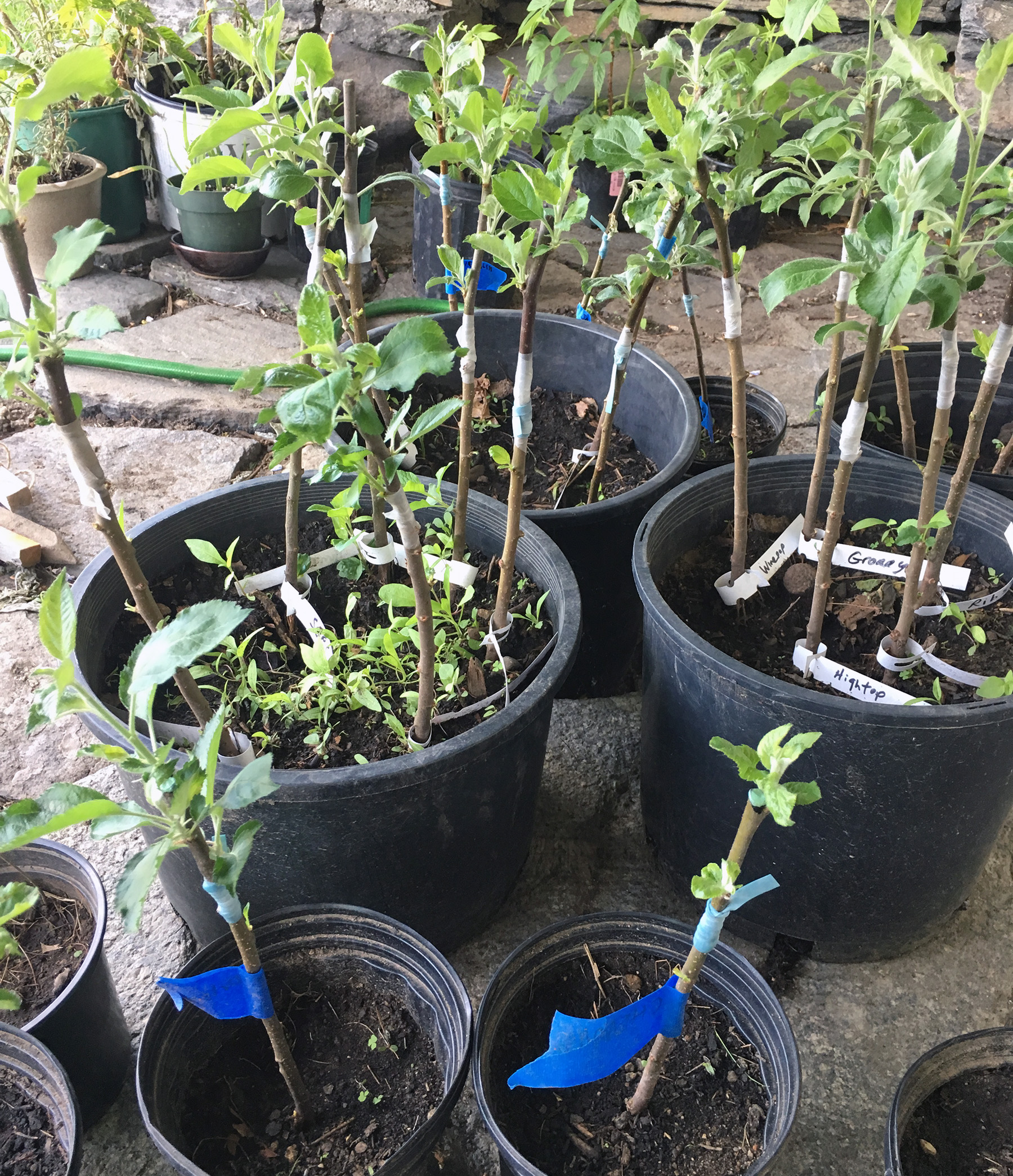
This spring's apple grafts on M7 rootstocks waiting to go into the orchard.
Natural Farming — Part 2 (continuation from last Sunday's blog)
The comfrey I planted throughout the orchard did not spread as I had been warned. We experienced our area’s driest summer in history. We don’t have clay soil like the Japanese farmer, Fukuoka, but quite the opposite; our orchard soil is classified as Hinckley, an exceedingly rocky, fast-draining soil. It is definitely not choice soil for an orchard. The young trees struggled just like the comfrey. Only the older trees, with deep roots, tapped into water. I realized that if I wanted to plant more herbs and wildflowers, and create a natural environment like Fukuoka, I would need to have some way of delivering water to all the trees.
We applied to the Natural Resources Conservation Services (NRCS) for a grant to put in an irrigation system, and our grant was accepted. They knew that with our Hinckley soils, the apple trees would surely benefit from irrigation. We installed the system ourselves, pumping the water from the surrounding wetlands. Now I could plant all kinds of beneficial and medicinal plants in the orchard—plants that would be good for our soil, and that might help with pest management.
The beauty of the orchard delighted me as the summer progressed. Sunflowers, rudbeckia, mountain mint, asters, goldenrod, bee balm, and echinacea flowered and fed the pollinators. When Blase asked if he should mow in the orchard, I replied, “Not yet, no.” The Jerusalem artichoke flowers were six feet tall, and the valerian stalks were covered with delicate white flowers. A few weeks later, he said, “I really should mow the orchard.” Again, I said, “No mowing. Not yet.”

The orchard was beginning to feel like a natural woodland. The trees were loaded with fruit, and it seemed like an abundant crop. I finally asked Blase to mow between the apple tree rows to accommodate the pickers, but we left all the wildflowers and natural growth between and under the trees. We had a great harvest season, the farm quieted, and Blase and I turned to other pursuits.
Heavy snow fell during the month of January. The drifts were over three feet high, burying the lowest apple limbs. In early February, warmer temperatures brought a thaw, and I went for a walk among the trees. Snow melts first around the trunks, and my eye caught sight of gnawed wood close to the ground. It glowed a bright orange color. Shocked, I reached down and brushed more snow away. The gnawed wood went deeper.
Voles! They had scampered across the crust of the deep snow, climbed over the 18-inch high hardware cloth fence that encircles every trunk, and dropped down between the trunk and the protective screen. There they made soft, grassy nests, and ate and lived in the safety of their cozy burrows with a pantry of food close by. In tree after tree, especially in the back of the orchard, these rodents had eaten the bark, chewing their way around the base of the trees and down to the roots. Many trees were completely girdled. Girdling, when it is complete, kills the tree by cutting off the sap flow between the roots and the crown.

Voles girdled this tree.

Voles even ate the lower branches because of the height of the hard packed snow!
I panicked and called in reinforcements. With a couple of friends, we started shoveling the snow away from every trunk.
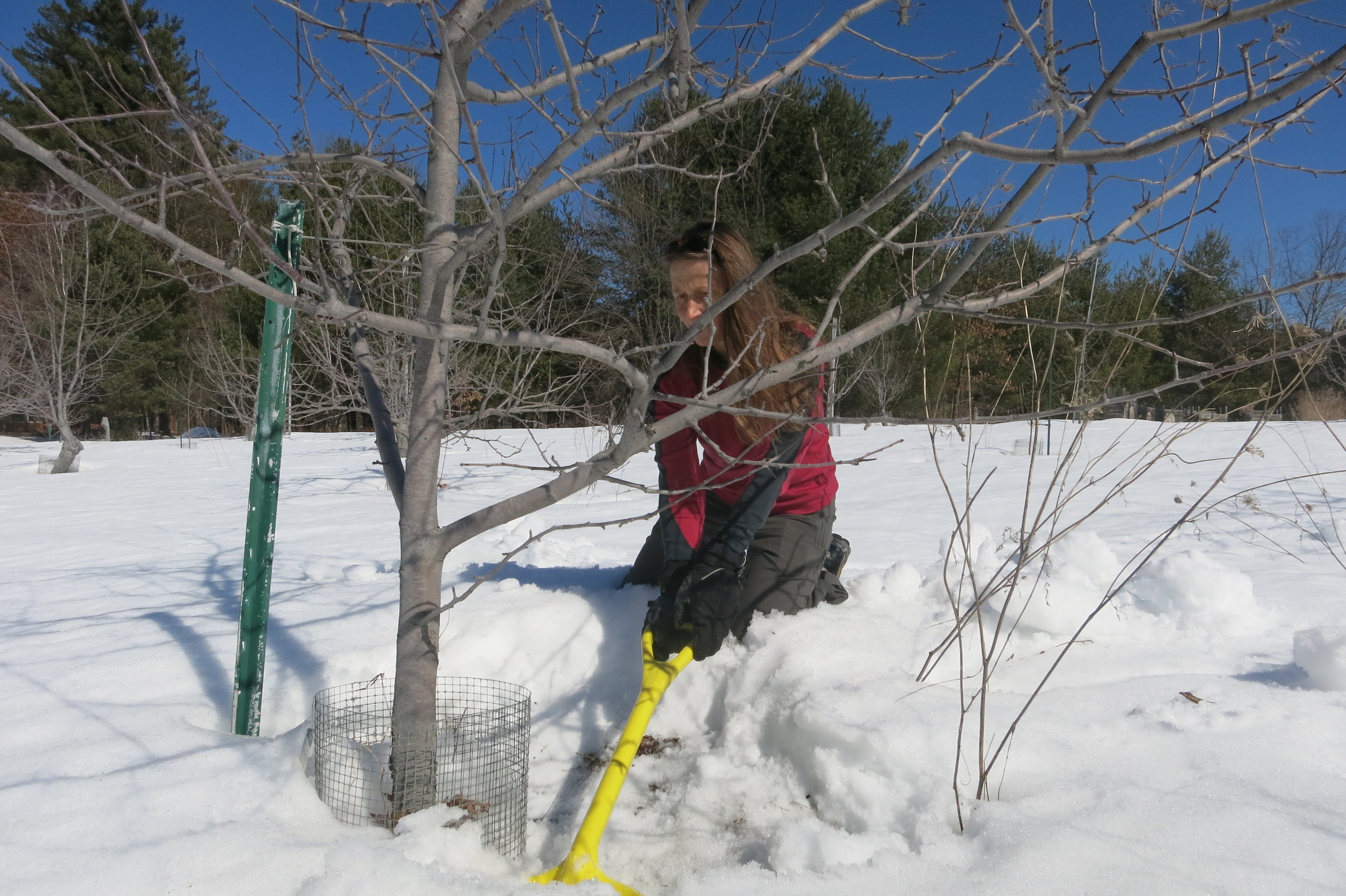
Gabi White tirelessly shoveling snow.
It was exhausting work. There was no way we could remove that much snow from around every tree. When we were too tired to shovel, we stomped the snow down with snowshoes. It felt like a war zone. Our hats, coats, shirts, and gloves were scattered everywhere.
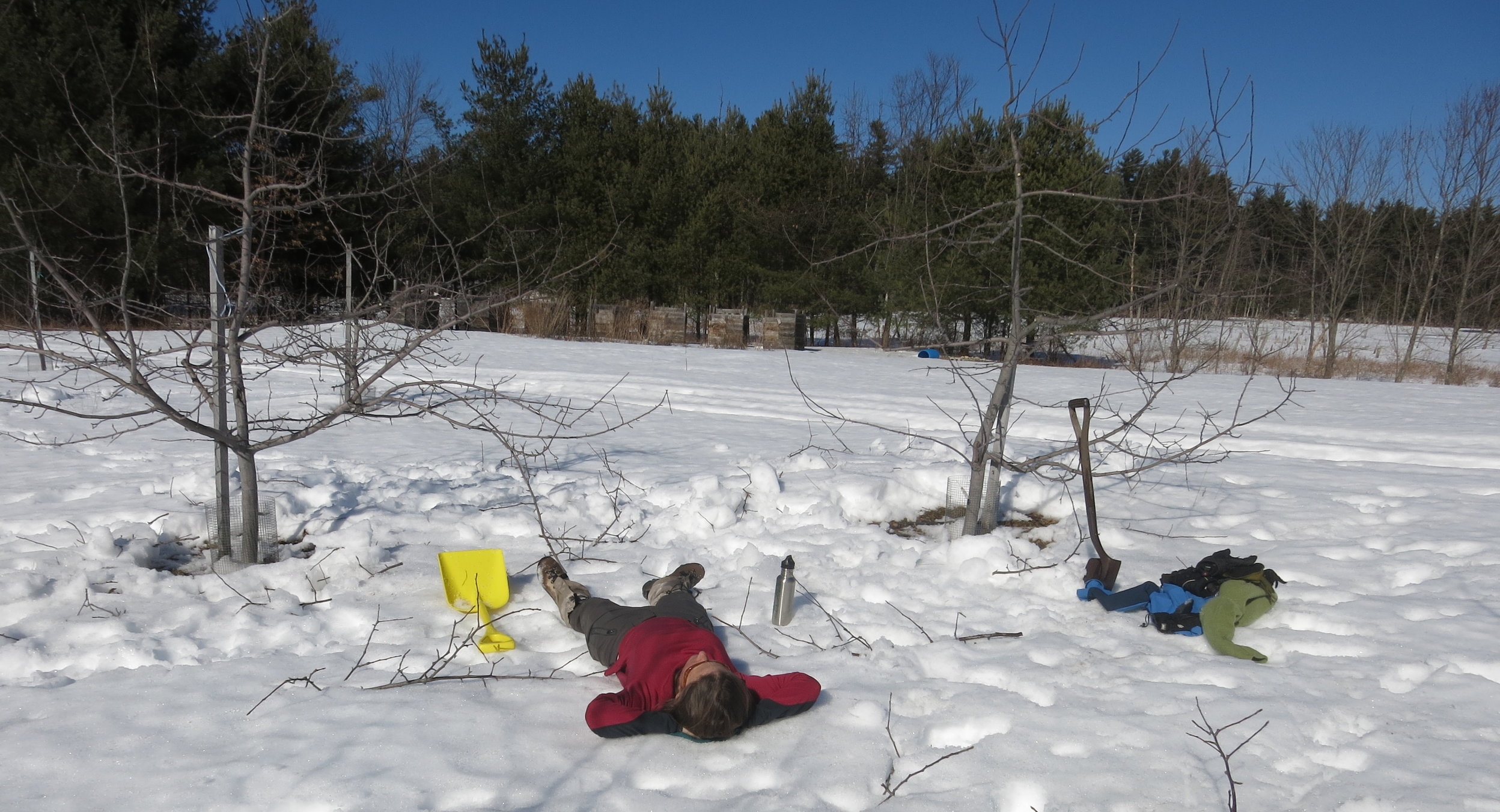
Gabi White — resting!
After a short break, we got back to work, shoveled more snow, heated up and stripped to tank tops, but it was too late. The damage was done.
Paige O’Brien, one of our farm workers, made a detailed map of all the injured trees and numbered them on a scale of one to four. One was one-quarter girdled, two was halfway, three was three-quarters, and four was completely girdled. We cut down the threes and fours, because they would either die or struggle mightily. A weak tree would attract more disease and pests. In all, fifty trees out of three hundred needed to be cut down. A saw blade to each trunk, and the task was done. Such quick work compared to years of cultivating growth.
Later, I learned it had been a bumper year for voles. Nature is like that—a bumper year for acorns, for apples, and now, for voles. Commercial growers knock down the vole population every fall with pellet poison. I had done the opposite. I had created a perfect vole habitat by growing delicious herbaceous perennials and cultivating long grasses and flowering plants. Following the irrigation drip lines, the voles had scampered freely from tree to tree.
So much for a wild orchard. I would have to rethink my approach and mow down all the perennials in the fall. Now, we mow several times throughout the season to dissuade the vole population from even considering making the orchard their home, but we leave patches of herbs and wildflowers growing between the trees. In preparation for winter, even these plants get mowed down to the ground. We also pull the drip lines away from the trees. In the spring, the hardy plants come back. I can already see the healing herbs like comfrey, valerian, and mountain mint unfolding their leaves. The orchard is not wild, but it’s not a monoculture either. We are trying to live peaceably with the other creatures who make their home nearby — definitely not offering them apples trees to chew — but encouraging a diversity and abundance of nature.
The challenge remains, however. I check on trees that aren't growing as well as I would expect and discover they are partially girdled, and two days ago I cut down a Crimson Crisp, a three-year-old ready to take off, but completely eaten around the graft. I'm discouraged. Then I smile at a dove sitting on a young tree as a blue heron flies by. I see pink buds on almost every branch of some eighty varieties of apples. I am blessed.
Southern Apples, an Elephant, Monkey, Rabbit, and Bird, Two Mango Trees and a Birthday
I celebrated my 60th birthday this week. My partner, Blase, gave me a first edition of the book Old Southern Apples, written by Lee Calhoun. Southern apples might sound like an oxymoron, since not many people think of the South as an Eden of apples. But over 1300 varieties originated south of the Mason-Dixon Line, and these apples are an important part of the area’s agrarian history. Old Southerners not only talk about Bloody Butcher corn and Red Ripper peas, but the now extinct apples like Fall Ambrosia (sounds so delicious), and the still available Limbertwigs.
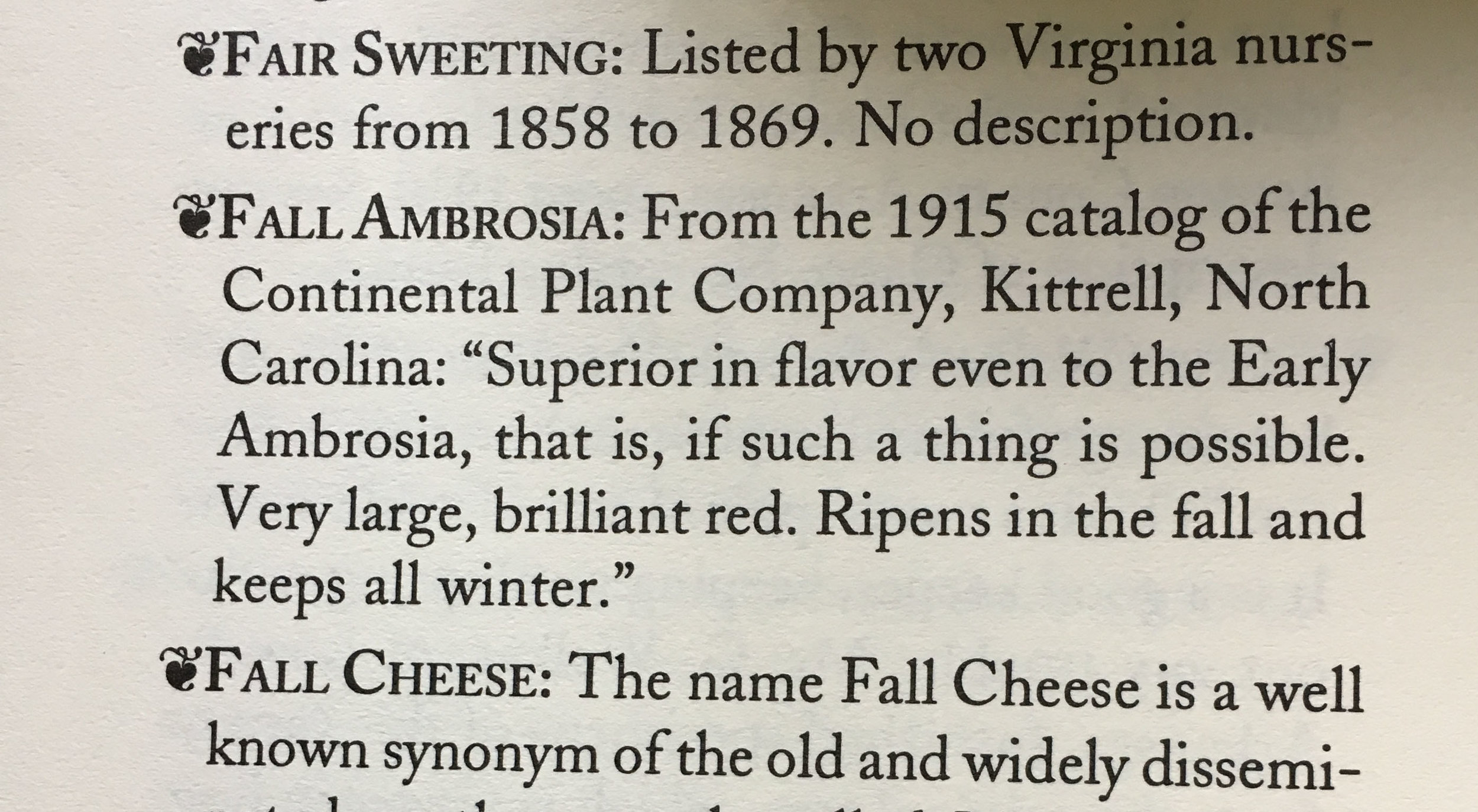
Old Southern Apples describes the unique features of over 1600 apple varieties (though 300 of them originated elsewhere but were grown in the South). The book divides these apples between 300 still growing or available at nurseries and 1300 now extinct Southern apples, the names and descriptions mostly taken from old nursery catalogues (a coincidence that both numbers are 300). The book also contains forty-eight plates of hand-painted apple pictures selected from the seven thousand in the collection of the National Agricultural Library. That was from the days when the United States Department of Agriculture hired artists!
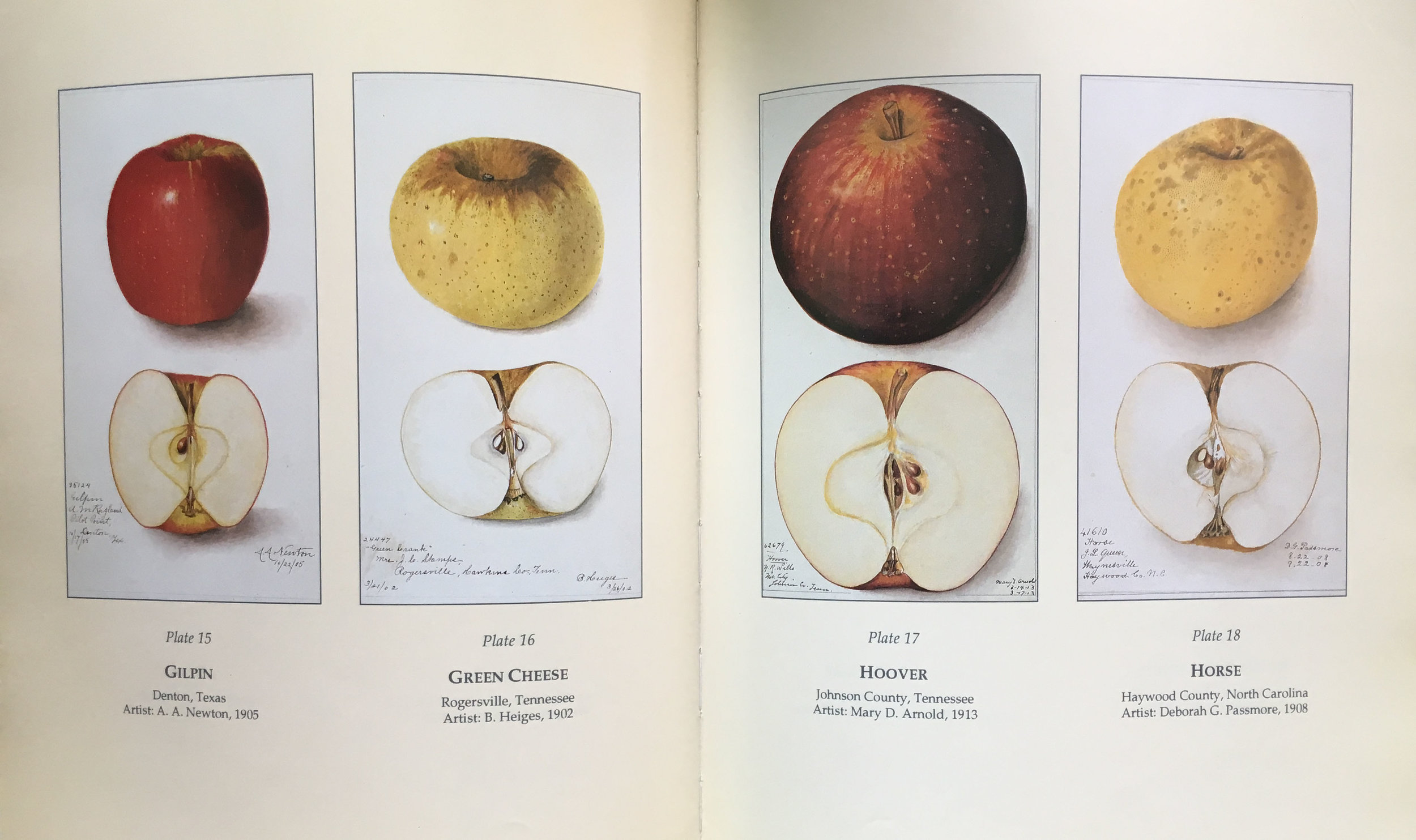
Old Southern Apples, Plates 15 - 18; Photos: Jerry Markatos
As you may know, apples grown from seed are the unique progeny of two parents, because the blossoms are cross pollinated. Most of these seeded trees crop with hard, sour, or small fruit, better for the hogs than for eating off the tree. Some apples are good for making hard cider and apple cider vinegar, but a few trees out of a thousand planted might produce unexpected, remarkable apples that would be given names and propagated. Of the 1600 apple varieties mentioned in this book, all of them grew from seed to be extraordinary apples. In the South, whether the settlers were large landowners or tenant farmers, they all planted out their orchards with seeds, they didn’t set out grafted rootstocks. It was the way it was done.
Today, it would be the rare individual who would scatter seeds to plant an orchard. After all, who would want a collection of wild apples? Large orchardists order sapling trees from wholesale nurseries in the thousands or even ten thousand. Blocks of the same variety, interspersed with another variety for pollinating, are planted. It is the researchers who cross apples and come up with new varieties for orchards to trial. A few apples become the darlings of the marketplace. This approach to apple growing is very different from the grand creativity that nature realizes with such ease. As Lao Tzu said, Nature does not hurry, yet everything is accomplished.
Inside my card, Blase tucked a print-out of a Buddhist tale. When King Mahajanaka, an earlier incarnation of the Buddha, was traveling through a park, he saw a monkey sitting on a branch of a mango tree. The King longed to stop and pick a few mangoes, but traveling with his large retinue, he had to continue without stopping. He decided he would sneak back alone that night to pick a few mangoes. That night, when he got to the grove, he lifted his torchlight and saw that someone had gotten there before him. The mango tree was stripped bare of fruit; its limbs were broken and its leaves lay scattered everywhere. He was saddened to think that this beautiful tree would likely not survive this ravagement. Then he saw another mango tree, one that had not been harmed. He realized that this tree avoided the carousing thieves because it had no fruit. The King returned and pondered his experience with the two mango trees. He decided he would renounce his title and give away everything he owned. He would become a tree without fruit. I love the story of the King Mahajanaka and the mango tree, but it could be taken as a teaching in renunciation. As many of you know, the orchard at Old Frog Pond Farm had no apples this year, and it was not because I renounced my title of orchardist.
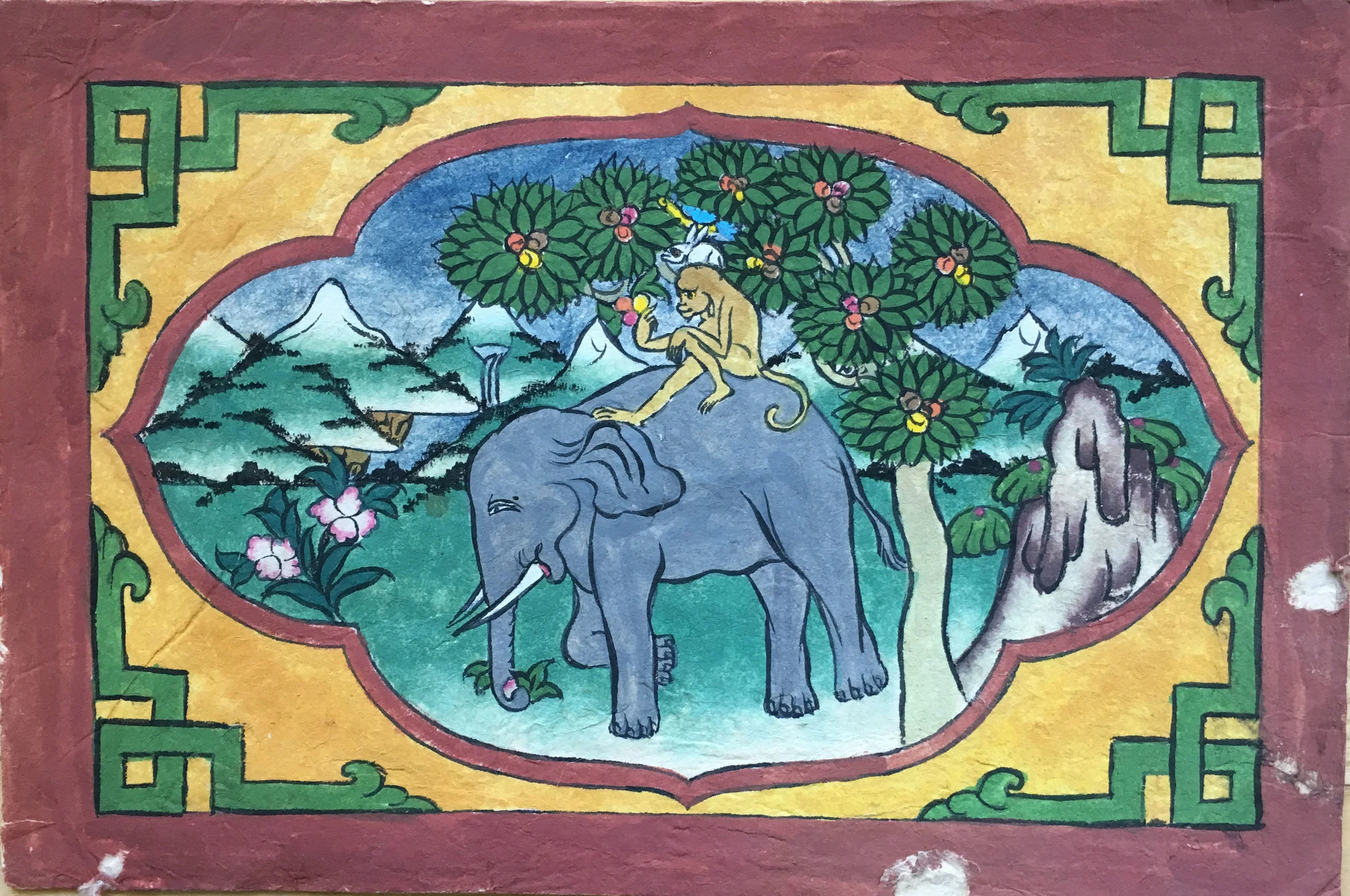
The Birthday card Blase gave me was hand painted in Bhutan; he had saved it from our trip seven years ago. It is of a bird on a rabbit on a monkey’s shoulder, on an elephant (the bird and rabbit are hard to see). They are walking under a mango tree laden with fruit. It is an illustration of the “Four Harmonious Friends,” a much loved Bhutanese tale. These animals worked together; the bird planted the seed, the rabbit watered the sapling, the monkey fertilized it, and the elephant protected it until it grew into a beautiful tree with fruit for all of them.
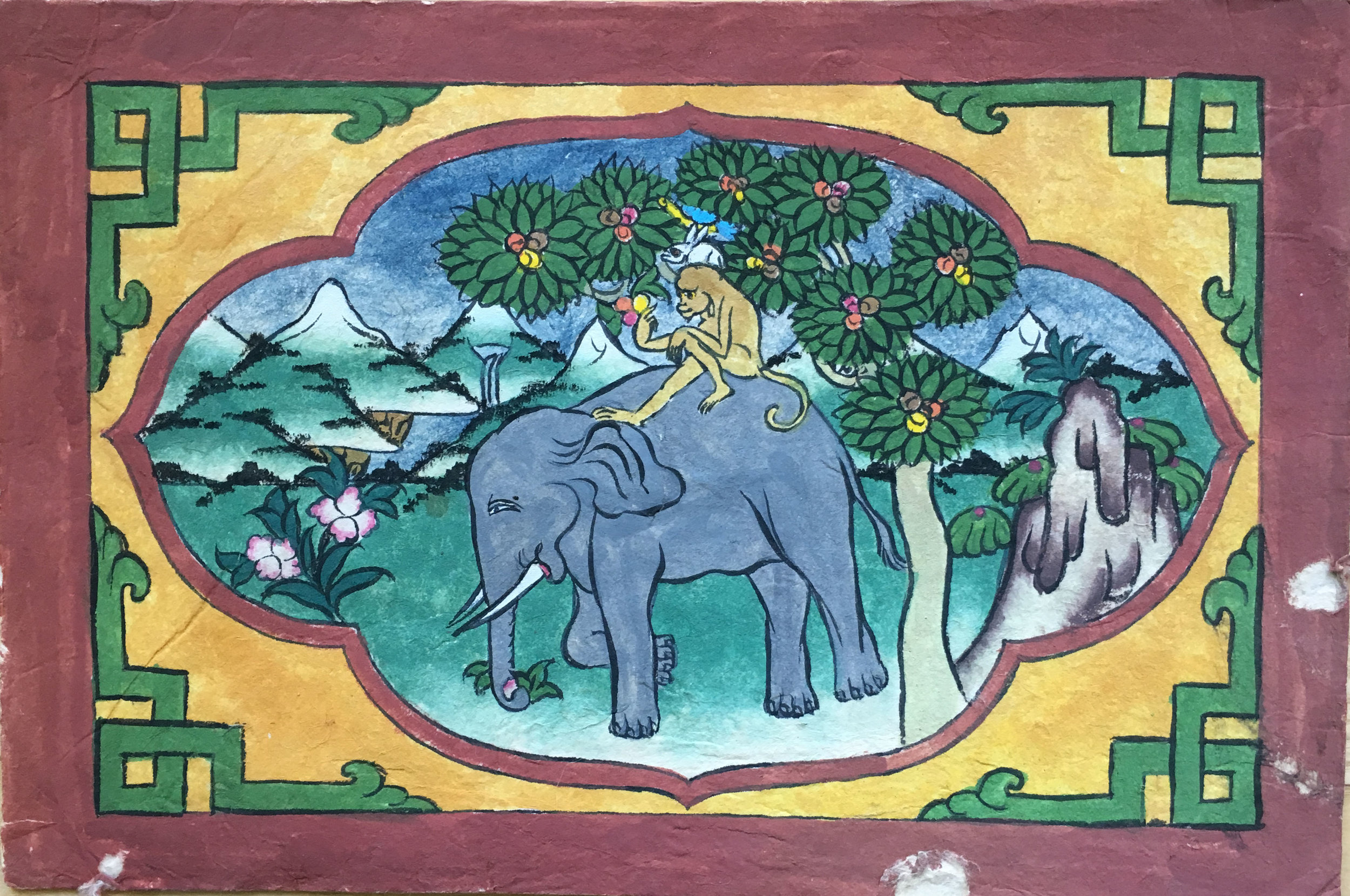
"Four Harmonious Friends" handpainted in Bhutan
I loved my gift of so many fruit related stories. Our orchard is so much more than its acres of grafted trees. It’s a language we speak and share; a wild grove of poetry, paintings, sunsets, clouds, blossoms, and, hopefully next year, delicious fruit.
Desiring the Almata Apple
Malus in Latin means apple, as well as evil. No wonder the apple embodies both good and bad, purity and eroticism.
When I moved to Old Frog Pond Farm, I found many rows of Red Delicious apples growing in the orchard. The flavor of Red Delicious is quite boring as apples go, so I decided I would change them over to another variety. To do this, you need scion wood — the term for the small twigs of first-year growth that are used to graft onto a trunk, branch or rootstock.
I went to a scion wood exchange and grabbed a twig of the Almata apple along with several other varieties that were spread across an old pool table. Not knowing anything about its characteristics, I chose Almata because it was named after one of the largest cities in Kazakhstan, Almaty which translates as “full of apples”. Almaty is near the foothills of the Tian Shan Mountains, the forests that are the birthplace of our domesticated apple. Today, apples, pears, plums, and cherries still grow in the wild in these forests and are sold in the markets of Almaty.
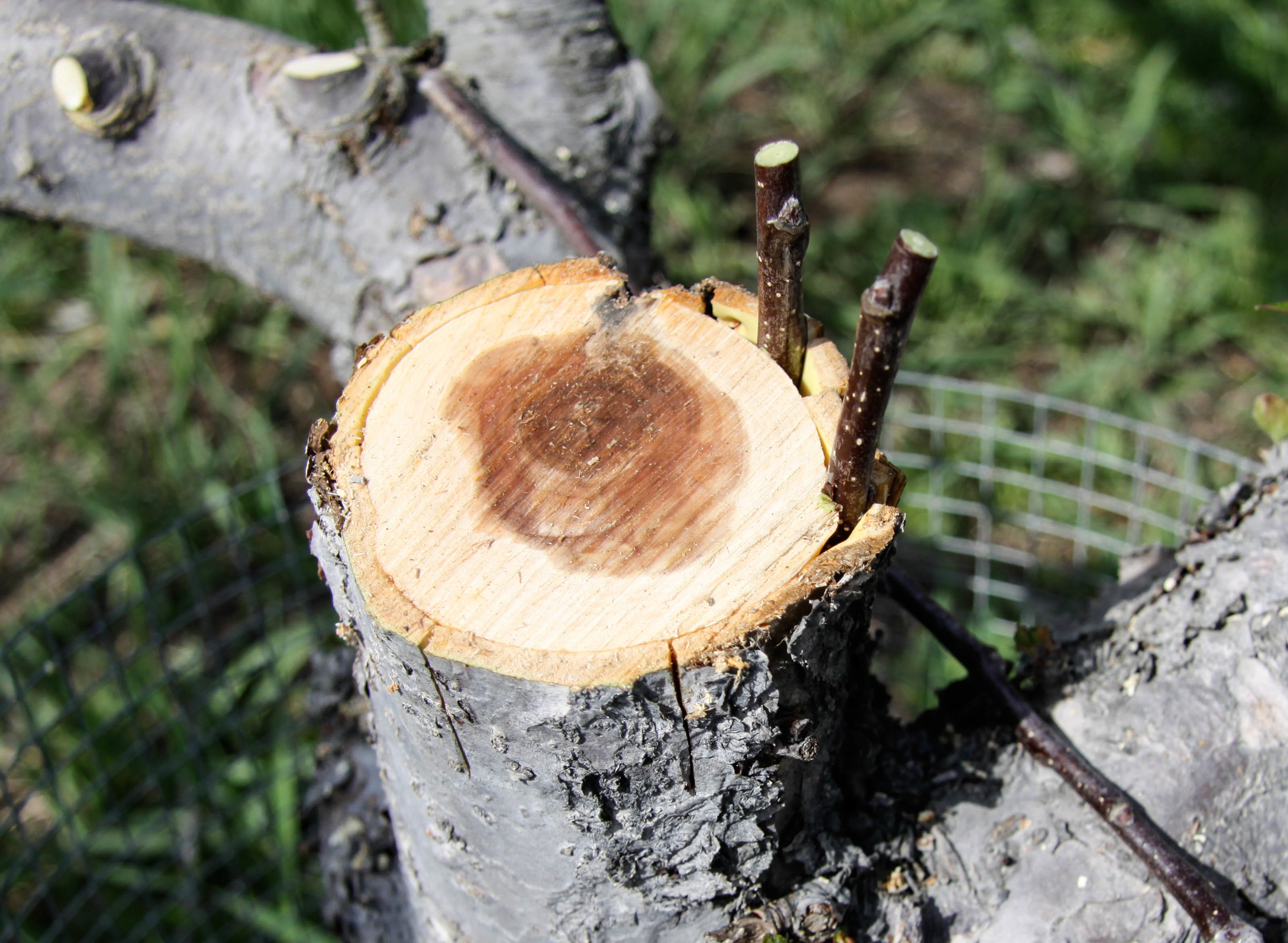
Scion wood in Red Delicious Trunk
I took my scion wood home and grafted a Red Delicious tree with the Almata twig. Three years later, when this tree developed its first flower buds, I was surprised. Apple blossom buds are usually enrobed in a pink sheath, which then open to pale white flower petals. The Almata buds weren’t pink, but dark red, like the scarlet letter adorning Hester Prynne’s chest in Nathaniel Hawthorne’s novel. Four days later, when the orchard was a cloud of white petals, this tree’s blossoms opened to a lovely pink. When the leaves came in, they were not green but a bronzy color similar to some crab apples. After pollination, its dime-sized apples were dark red, not green, like every other apple in the orchard.

Reddish Leaves on the Almata
All summer long I kept my eye on this tree. Friends walking with me through the orchard would remark, “What’s that?” pointing to the Almata. It was easy to see that this tree was marked. The apples were quite small, but perfectly formed and deep red. In mid-August, I stopped by the Almata to taste one of its fruits. My large bite of apple exposed deep plum-colored flesh. It was crazy and wonderful, and all wrong. It didn’t look like an apple at all, but more like a ravishing purple plum. It was hard and sour, not yet ripe.
Charmed, I hurried back to the house to share my discovery with my family. I looked up Almata and learned that this red-fleshed apple was developed by Dr. Nels Hansen at the South Dakota Agricultural Experiment Station. Dr. Hansen was inspired to breed a red-fleshed eating apple after seeing a red-fleshed wild apple on an 1897 trip to Russia. The Almata is the cross he made between a Russian apple, the Beautiful Arcade and Fluke 38, a crabapple.

Almata Fruit
Even though our Almatas were not quite ripe, I decided to use a few of them in an apple galette. The red Almata wove lovely red ribbons through the white apples of the dessert; it held its color even when cooked. I made a Russian apple cake next and was again delighted by the red slices of the Almata flowing through the cake.
Even when fully ripe, the Almata’s taste was still sharp. But biting through its deep red skin and into the ruby-colored flesh, the sensual appeal was greater than biting into any white-fleshed apple.
Although some people say that the fruit of the Tree of Knowledge of Good and Evil was actually a pomegranate, I disagree. I can imagine the serpent winding around a branch, tempting Eve with a ripe, red-fleshed apple. How could she have refused? Would you have resisted?
If you come for an orchard visit I'll show you the tree. But be prepared; there just might be a snake!
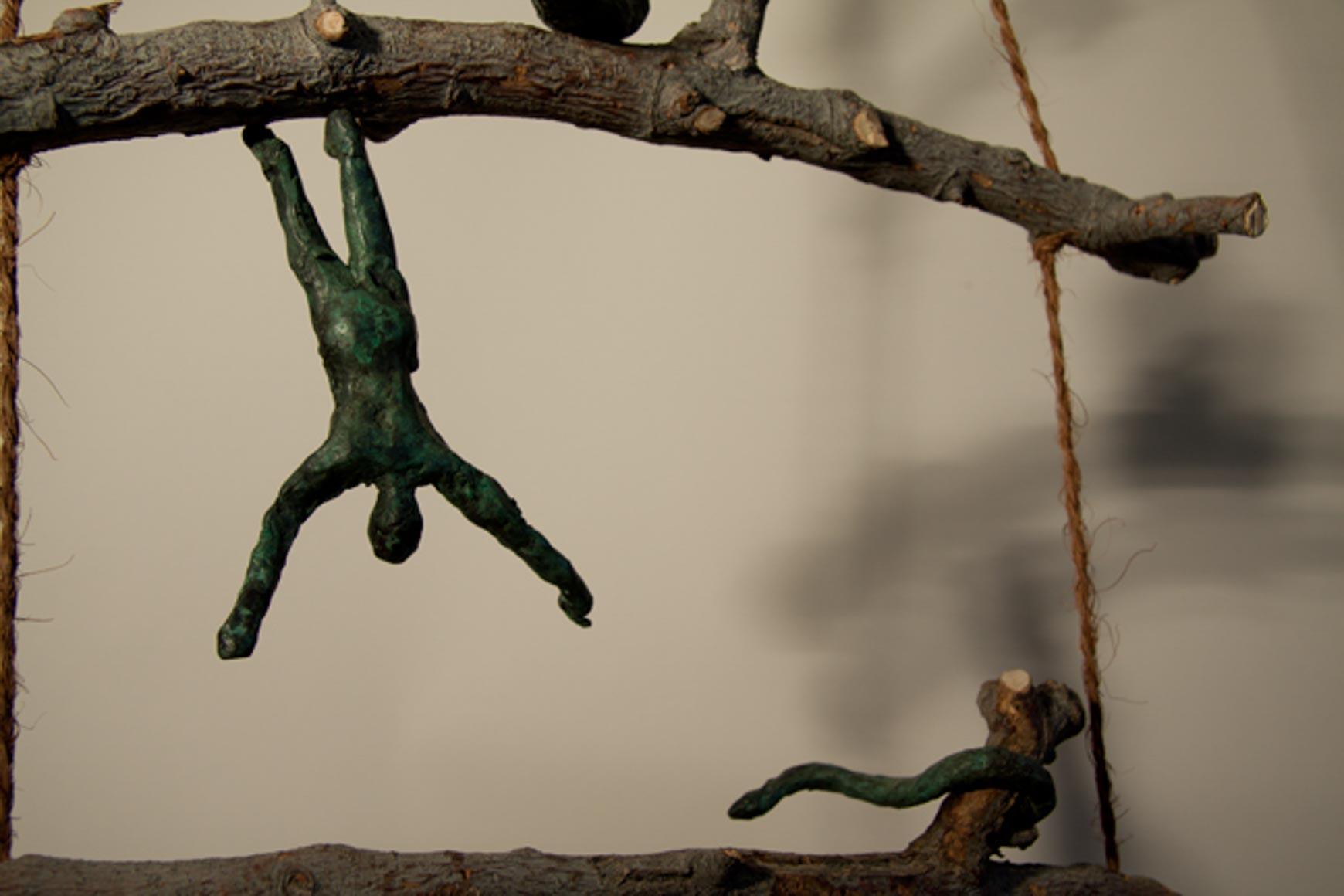
Detail from Apple Ladder: Sculpture LH (She's actually offering an apple to the snake)
Search Blog
-
2025
- May 9, 2025 A View from the Tractor Seat
- Apr 11, 2025 Dig
-
2024
- Jan 7, 2024 Winter Wassail
-
2022
- Dec 11, 2022 Keeping Time
- Jun 17, 2022 This Apple-Shaped Earth
- Jan 23, 2022 What is a Jizo?
- Jan 16, 2022 An Invite and Housekeeping Update
- Jan 1, 2022 The Year of the Frog: What Orchardists Do While Apple Trees are Chilling
-
2021
- Oct 24, 2021 Figs
- Oct 3, 2021 The Artist and the Orchard: A Memoir
- Aug 8, 2021 Red-Fleshed Apples
- Jul 25, 2021 When We Were Trees
- Jun 27, 2021 Castor Beans—Who Knew?
- Jun 13, 2021 Spring Training at a Zen Monastery
- May 4, 2021 Our Trees are in Bloom
- Apr 18, 2021 Hooray!
- Jan 24, 2021 Wassailing, virtually!
- Jan 1, 2021 Sitting
-
2020
- Dec 21, 2020 Darkness to Light
- Nov 28, 2020 One Heart
- Sep 18, 2020 Juggling Flowers, Fruit, and Vegetables
- Aug 23, 2020 Refuge
- Aug 9, 2020 Bags of Fertilizer
- Aug 2, 2020 The Sermon of the Blue Heron
- Jul 26, 2020 What's the Buzz?
- Jul 19, 2020 Farm Moments
- Jul 12, 2020 Lost Wax
- Jul 5, 2020 Catalpa: The Hugging Tree
- Jun 28, 2020 Pedaling Peace
- Jun 21, 2020 See Change
- Jun 14, 2020 Lalla Unveiled
- Jun 7, 2020 Pond Alchemy
- May 31, 2020 The Birth of Fruit
- May 24, 2020 An Artist in the Orchard
- May 17, 2020 Walking the Land: Returning Home
- May 10, 2020 Stinging Nettles: Gifts from the Great Mother
- May 3, 2020 The Mystery of Swallow
- Apr 26, 2020 Aerial Bruststrokes
- Apr 19, 2020 Simple Pleasures
- Apr 12, 2020 Weeds and Other Gifts
- Apr 5, 2020 Remembering the Seeds
- Mar 29, 2020 Blow on the Embers
- Mar 22, 2020 Ripples
-
2019
- Nov 16, 2019 Tibet Impressions
- Nov 9, 2019 Forest Tales
- Oct 13, 2019 The Gift
- Aug 4, 2019 The Season is Apples, Berries, and Grandfather Fire
- Jun 8, 2019 Pointers for a Writing Life
- May 12, 2019 Mothers of the Earth
- Apr 6, 2019 The Apple-Shaped Earth
- Mar 23, 2019 You Don’t Know What You Have Till It’s Gone
- Feb 23, 2019 Generations
- Feb 9, 2019 What Are We Doing to the Earth, John Chapman?
-
2018
- Dec 31, 2018 Long Shadows
- Oct 6, 2018 A Pilgrimage to India
- Aug 18, 2018 Scrap Wrenn
- Aug 11, 2018 Off-the-Wall Comments from an Ignorant Farmer
- Jul 28, 2018 Creative Connect
- Jul 14, 2018 How is the Orchard?
- Jun 30, 2018 Which Way?
- Jun 16, 2018 Geese, Herons, Beavers, and the Baby Steps of a Lapsed Blogger
- Feb 24, 2018 Mama's Coupons — Good Forever
- Jan 27, 2018 January Ice
- Jan 13, 2018 The Muse
-
2017
- Dec 30, 2017 A Dream for the New Year
- Dec 23, 2017 A New Year for Apples
- Dec 16, 2017 Intuition
- Nov 22, 2017 Thanksgiving OM
- Nov 4, 2017 East Fork Pottery
- Oct 28, 2017 Putting Down New Roots
- Oct 21, 2017 A is for Art
- Oct 14, 2017 Eve domesticus
- Oct 7, 2017 A String Workshop
- Sep 30, 2017 After Applepicking
- Sep 23, 2017 Two Bad Women and One Good Apple
- Sep 16, 2017 Plein Air Poetry
- Sep 9, 2017 Cutting Off a Leg
- Sep 2, 2017 The Changing Landscape
- Aug 26, 2017 All About Art
- Aug 19, 2017 My First Visit to the Farm
- Aug 12, 2017 The First Food
- Aug 5, 2017 A Teapot, a Woman, and maybe a Boat
- Jul 29, 2017 A Raspberry Dilemma
- Jul 22, 2017 Consider the Miracle
- Jul 15, 2017 Meeting Ekphrasis
- Jul 8, 2017 Ripening Fruit
- Jul 1, 2017 The Voice of The Caterpillar
- Jun 24, 2017 Goumi — An Unusual Fructus
- Jun 17, 2017 Concord, an American Bloomsbury
- Jun 10, 2017 The World Is Bonkers — Shall I Laugh or Cry?
- Jun 3, 2017 Bonkers, a Revolutionary Apple
- May 27, 2017 Guardians of the Swamp
- May 20, 2017 There are Mushrooms and There are Morels
- May 13, 2017 "What's in a Name?"
- May 6, 2017 Bloom Follows Pink: Orchard Pollination
- Apr 29, 2017 The Orchard Is at Pink
- Apr 22, 2017 Natural Farming — Part 2 (continuation from last Sunday's blog)
- Apr 15, 2017 Natural Farming — Part 1
- Apr 8, 2017 Boats, Figures, and Catching Fish
- Apr 1, 2017 A Man with a Mission: The Nuts and Bolts of Bronze Casting
- Mar 25, 2017 A Chalice of Spirit, Art, and Nature
- Mar 18, 2017 Hanami — Blossom Viewing
- Mar 11, 2017 Soil Redemption Song
- Mar 4, 2017 Food is Primary Care
- Feb 25, 2017 Pomme de Terre
- Feb 18, 2017 Organic Certification
- Feb 11, 2017 Tantalizing Fruit
- Feb 4, 2017 The Myths of History
- Jan 28, 2017 The Orchard in Winter
- Jan 21, 2017 The Hi-Line
- Jan 14, 2017 Artistic, Botanical, and Social Diversity
- Jan 7, 2017 Where is Eden?
-
2016
- Dec 31, 2016 The Creative Heart
- Dec 24, 2016 A Christmas Tale
- Dec 17, 2016 Who are the Crones?
- Dec 10, 2016 The Olympic Bell (Part Two)
- Dec 3, 2016 Overheard in the Apple Orchard in Early December
- Nov 26, 2016 The Lessons of a Tortoise
- Nov 19, 2016 In the Studio
- Nov 12, 2016 Even in Darkness
- Nov 5, 2016 Southern Apples, an Elephant, Monkey, Rabbit, and Bird, Two Mango Trees and a Birthday
- Oct 29, 2016 The Tools of Art
- Oct 22, 2016 Labyrinths
- Oct 15, 2016 Repairing the Broken
- Oct 8, 2016 When You Are No More
- Oct 1, 2016 Creation Rain
- Sep 24, 2016 Breaking the Glass
- Sep 17, 2016 String Art
- Sep 10, 2016 Poetry and Photosynthesis: It's all in the Leaves
- Sep 3, 2016 In the Plenty of Time
- Aug 27, 2016 Witch Doctors
- Aug 20, 2016 Listen Coyote
- Aug 13, 2016 Milkweed in the Orchard
- Aug 6, 2016 Some People See a Turtle
- Jul 30, 2016 Arborshaping
- Jul 23, 2016 Joseph Wheelwright: Sculptor of Stones and Trees
- Jul 16, 2016 Asian Pears
- Jul 9, 2016 Gold Leaf, Grief, and the Creative Process
- Jul 2, 2016 The Olympic Bell (Part One)
- Jun 25, 2016 Around the Mulberry Bush
- Jun 18, 2016 Avoiding Apples
- Jun 11, 2016 Fructus
- Jun 4, 2016 Astonishing Apples
- May 28, 2016 Scare the Caterpillars
- May 21, 2016 Join the Club!
- May 14, 2016 The Graft
- May 7, 2016 Rooster, Rhubarb, Rue
- Apr 30, 2016 What do Dolphins and Nettles Have in Common?
- Apr 23, 2016 Art Prunings
- Apr 16, 2016 A Few of the First Arrivals
- Apr 9, 2016 Taste the Spirit of Sustainable Agriculture
- Apr 2, 2016 First Orchard Spray - March 22-24, 2016
- Mar 26, 2016 Hawkeye Apple
- Mar 19, 2016 Desiring the Almata Apple
- Mar 12, 2016 Ugly Fruit
- Mar 5, 2016 Winter Tracks
- Feb 27, 2016 Splash
- Feb 20, 2016 Pruning
- Feb 13, 2016 Orchard Ruminants
- Feb 6, 2016 A Gathering of Seeds
- Jan 30, 2016 Orchard Dragons
- Jan 23, 2016 Tree Rings
- Jan 17, 2016 The Fallen Tree
- Jan 7, 2016 Wassailing the Apple Trees
- Jan 1, 2016 The New Year