LINDA HOFFMAN
In the Plenty of Time
In his autobiographical book, The Way to Rainy Mountain, N. Scott Momaday, describes summer on the plain in Oklahoma where he spent his childhood: “Great green-and-yellow grasshoppers are everywhere in the tall grass, popping up like corn to sting the flesh, and tortoises crawl about on the red earth, going nowhere in the plenty of time.”
I loved that phrase, going nowhere in the plenty of time. It reminded me of my time in New Guinea with my mother. No running water or electricity, but plenty of bugs, plants, sweat, babies crying, dogs barking, men with shaved heads and men with long hair, women wearing only grass skirts or thin calico shifts. When I talk about this experience, people always ask, what did you do there?
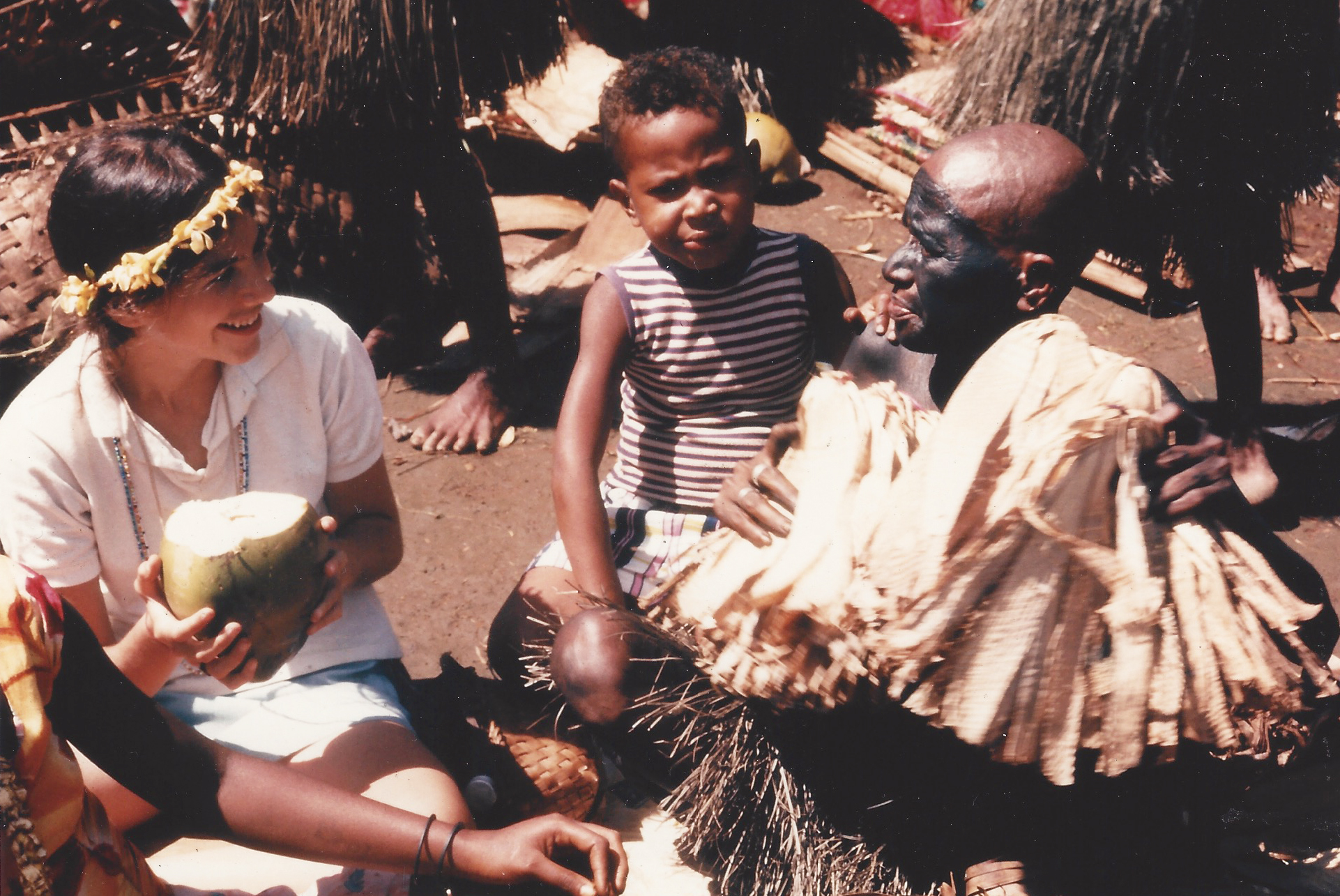
LH in the Trobriand Islands, Papua New Guinea, 1971
We would sit, walk to another hamlet in the village, walk out to the road to wait for a truck which might or might not come, make flower leis, braid dry grasses, roast beetles and eat them, maybe play cat’s cradle. Some villagers went to their gardens to dig up taro root or yams – their gardens looked just like the rest of the forest. There might be coconuts to gather and a delicious pudding to make. Smoking, of course, (but I didn’t), rolling sticky black tobacco in pieces of old newspaper; and chewing betelnut (slightly hallucinogenic) — mixing it with a little mustard and powdered lime that would turn bright red when you spit the combination out after chewing (I did a little.)
Elder women swept the bare ground clear of leaf litter every morning and burned their collections in small fires. Younger women walked to a cave a mile away to bring back the day’s drinking water.
The women sometimes would sit on the ground with legs out straight, a board with carved patterns on their lap, scraping sharp shells over fresh banana leaves, pressing them into this board to make doba, their currency. Men might be working on a wood carving to sell in the main town to a tourist or at the Methodist mission. All of this was going nowhere in the plenty of time.
There were highlights of course. The night a man died and we entered the hut to see his body laid out over his daughters’ legs. The mourners wailed, and then when the crying lapsed, they told stories and laughed. They decorated him with bands of red and white paint. And on my last night (my mother was staying on), one of the big chiefs announced he would kill a chicken! The villagers were ecstatic – they knew that this meant he would kill a pig, and we would feast and dance. They never did explain just how they knew.
Life seemed more about just living, not about producing. It was the fabric of relationships that always needed tending. Relationships between lovers, husbands and wives, children, clans, mother’s brothers, brother’s sisters, uncles, and when there was a death — the real work began. Mourning took many forms and was done by many people. Some blackened their bodies for a year, someone carried the deceased’s purse, which held his lime stick and lime pot, others shaved their heads. All of these mourners would eventually need to be paid back in elaborate ceremonies acknowledging their gifts of mourning, paid back with large baskets of doba, those banana leaf bundles, (that I carried on my head in the photo from last week’s blog.)
N. Scott Momaday returned to Rainy Mountain after the death of his grandmother and recalls his experience of the life that went on all around her:
There were frequent prayer meetings, and great nocturnal feasts. When I was a child, I played with my cousins outside, where the lamplight fell upon the ground and the singing of the old people rose up around us and carried away into the darkness. There were lots of good things to eat, a lot of laughter and surprise. And afterwards, when the quiet returned, I lay down with my grandmother and could hear the frogs away by the river and feel the motion of air.

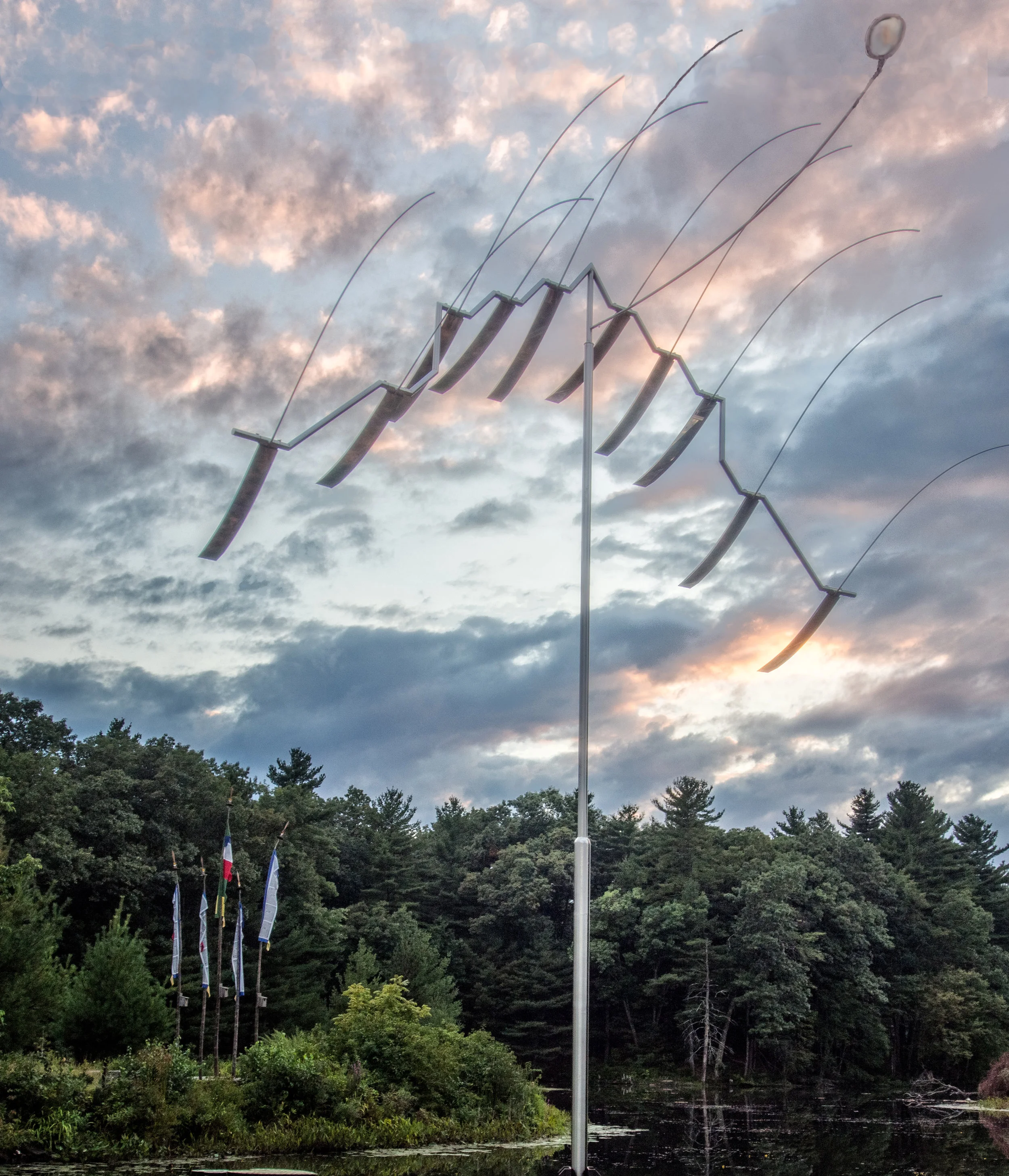
Wind Sculpture, Michio Ihara photo:Robert Hesse at Old Frog Pond Farm & Studio
I think about our Western fixation with time, with spending it wisely, with being productive, and compare it to the importance of being together, nurturing relationships, doing everything in the plenty of time.
we watched the crows
hard pears
in no hurry to ripen
—LH
Witch Doctors
To return to my dying Asian pear tree that I wrote about a month ago: I finally did call the nursery. The horticulturalist assured me that the tree was certainly a Hosui variety – because Hosui get fire blight very easily – and he was certain it was fire blight.
“Pull it right out!” he commanded. “Fire blight will spread to the other trees.” He added that you have to be super vigilant with Hosui, which essentially means spraying Streptomycin in the spring when fire blight is a possibility. He said many people plant Kosui instead of the Hosui, but even that variety isn’t all that resistant. Not like Olympic, for example. “Orchardists are always pulling the Hosui and replanting with more resistant varieties.
I didn’t ask, “Why then, are you selling them?”
It turns out that my tree isn’t a Hosui or a Kosui – it’s a Niitaka. And even though every leaf blackened and fell, I decided to try and save the tree using a poultice of carbonatite, clay, and aloe, and some rubbing and mumblings. After a week, I was excited to see that a few of the buds were plumping and showing some green tissue. Now a witch doctor is an interesting phenomenon.
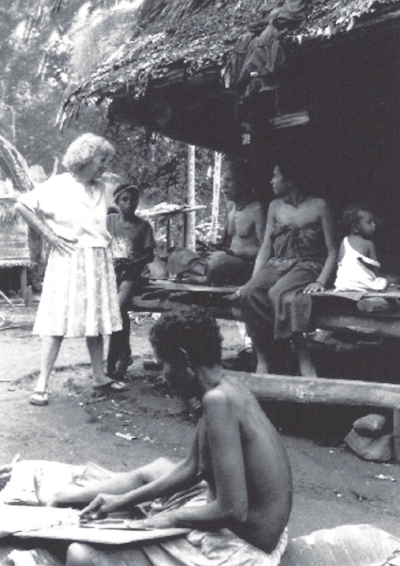
Dr. Annette Weiner, Kwaibwaga Village, Trobriand Islands, 1989
I had an experience firsthand when I lived with my anthropologist mother on a small coral atoll in New Guinea. Ours was an inland village, but one day some of my mother’s informants (the anthropological jargon for those who provide answers to the anthropologist’s questions) said, let’s go visit a coastal village. We walked a few miles over sharp coral to the far side of the island. As we neared the coastal village, I was struck by the trees we walked by. Their roots were above ground, tall intertwining webs formed tent-like structures that I could imagine hiding inside of.
When we entered the village, we felt oddly unwelcomed. The men were out fishing and the women were wary. That’s when I got something in one of my eyes. A piece of dirt or an insect. My eye stung, but no one could see anything in it. After hanging out for only a short while, we turned around to make the trip home. The suspicious looks from the villagers didn’t feel good, and we didn’t want to cause trouble.
We traveled back through the forest of amazing trees, back along the rough coral trails, and finally entered our village towards nightfall. By the time we were back, I was feverish and dizzy. Word buzzed around the village. Questions were asked. Had anyone said magic to protect me against flying witches. Flying witches inhabit the buttressed roots of those mysterious trees. Of course, the witches are jealous of young girls. They were certain that I had been attacked by a flying witch.
My mother was nervous. Even though she had aspirin and antibiotics to give me, and we were both taking quinine for malaria, she wondered what it could be. She was also fascinated to know what the villagers would do. They told her they had called a witch doctor from another village who specializes in flying witches. A skinny old man came in carrying his satchel of herbs. He checked me over, bending my limbs, looking into my eyes. He rubbed herbs into my skin and mumbled prayers. He was paid. And when my mother looked at him expectantly, he said, “The witch is only playing with your daughter; it won’t kill her.”

LH in Kwaibwaga Village in 1971 (fully recovered)
Norman Cousins, one of the early proponents of the mind-body connection, relates how when he visited the Schweitzer Hospital in Gabon, Africa, he commented to Dr. Schweitzer, “The local people are lucky to have access to the Schweitzer clinic and not have to depend on witch-doctor supernaturalism.” One look at Dr. Schweitzer and Cousins recognized his ignorance. The next day, Dr. Schweitzer took him to observe native African medicine. The witch doctor gave herbs in a brown paper bag to some patients and incantations in a brown paper bag to others, while still others he directed towards the Western doctor.
Dr. Schweitzer explained the three groups. The first had what he called functional issues; these would go away easily and the herbs would help. The next group had what he called psychogenic problems, and they were treated with African psychotherapy. The third had physical problems, like a tumor or broken bone, and these he sent to the Western doctor. When Cousins pushed for an explanation, Schweitzer said,
The witch doctor succeeds for the same reason all the rest of us succeed. Each patient carries his own doctor inside him. They come to us knowing the truth. We are at our best when we give the doctor who resides inside within each patient a chance to go to work.
—From The Mysterious Placebo, Norman Cousins
I believe plants aren’t so different from us. There is a doctor inside the trees that I hope I can motivate. I don't know if it has fire blight or a fungal disease. But rather than pull it, I will wait and see if its own wisdom along with my herbs will help.
Listen Coyote
A large silver coyote approached me in a clearing in the woods where I stood. She seemed hungry and threatening and I was terrified. So terrified that I couldn't find my voice to shout or wildly wave my arms to scare her away. I turned to run and then saw that coyotes were coming out of the woods and approaching from all directions. They would surely tear my body apart and feast on my bloodied limbs.
I considered this picture, then paused for a moment. Something in me changed. “No!” I screamed and I began madly gesticulating The coyotes were silenced as if struck mute, and they turned back in the direction from where they had come. I woke up with a good feeling — something I use as a barometer for my dreaming. Inside the fear, I was paralyzed, but when I found my ground and let go of my fear, I could act effectively. This change happened in a split second. There was no lengthy dialogue, but there was a listening, a facing the reality of the situation without projections.
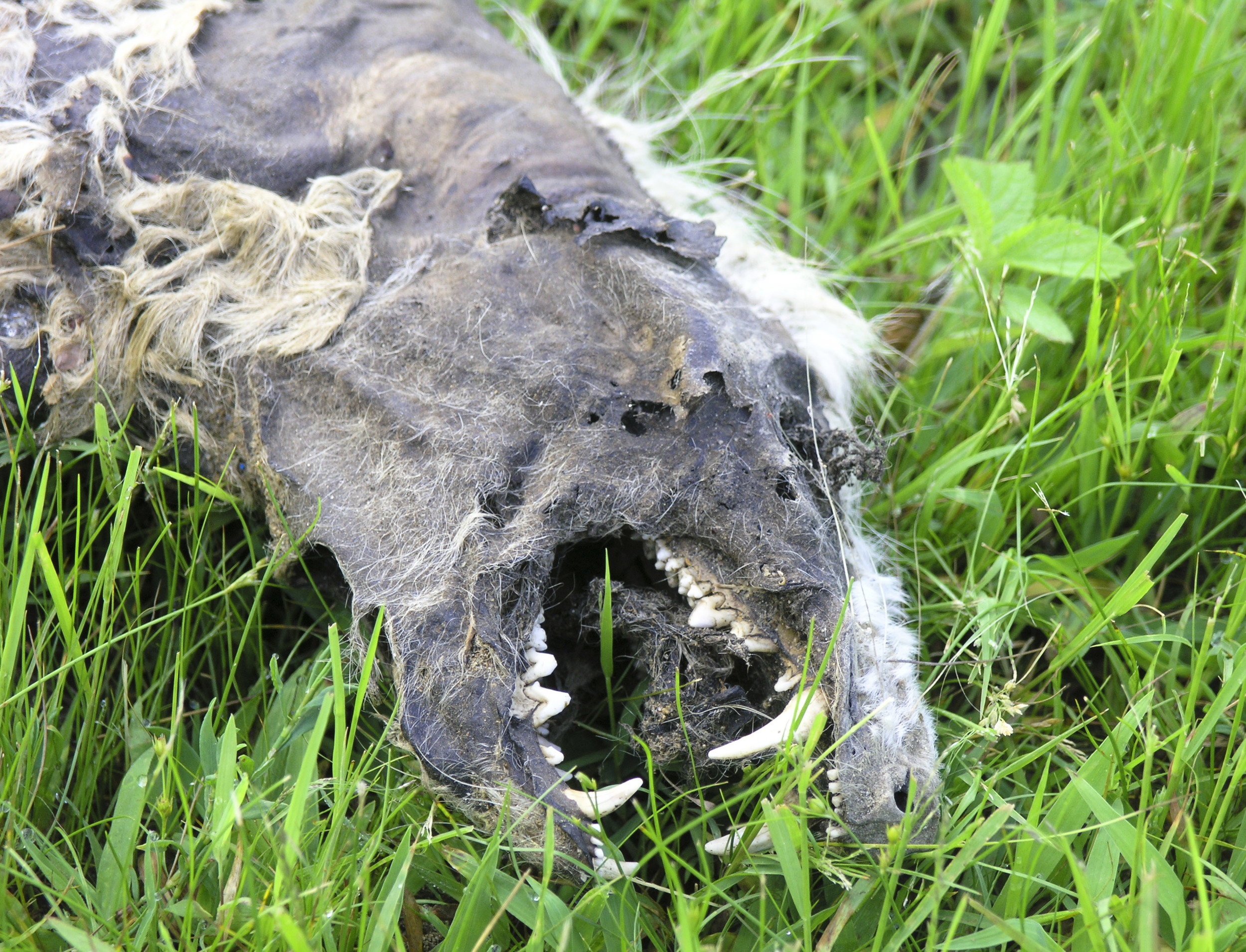
Photo:LH
I had another experience with a coyote — a real one! I was alone meditating in the winter in the hut behind the orchard. The snow was deep and I had snowshoed out to the hut. I entered, left the window shades down for extra warmth, lit a stick of incense, a candle, and took my seat. In the Zen meditation I practice, you don’t move during a sitting period. You don’t shift position, scratch an itch, or brush off a mosquito. You sit through it all, accepting everything with all the equanimity you can muster.
As I was sitting, I began to feel an eerie presence; someone was outside the hut. I decided to go against all of my Zen training and get up from my meditation cushion. I cautiously pulled up the shade. A great silver coyote stared into my eyes. She gazed and I gaped back unblinking for more than a minute. Then she turned and plunged into the deep snow, and I sat back down enlivened by the gift of her presence. The coyote must have been sleeping under the hut, which sits on pillars a foot off the ground, when she realized I was inside.
Tamarack Song, a tracker and guide who uses traditional hunter-gatherer skills he learned from elders and aboriginal people all over the world, writes of his early apprenticeship:
Irritated by my endless string of questions while I tagged after him [a Blackfoot Elder], he turned around and said, “Tamarack, when you talk, there’s no room for listening. When you ask a question, you are not really questioning, because you think you know what you need to learn. If you’d let yourself listen, you’d get answers to the questions you don’t know how to ask. Only when we listen do we learn . . .
The Blackfoot elder is instructing Tamarack to really listen to the person who is speaking to him; he is also telling Tamarack to trust his inner voice. My experience with the coyote in the snow affirmed that it was good to listen to my inner voice and not rigidly follow a set of rules. Of course, I wouldn’t stand up in the middle of the Meditation Hall with a hundred other meditators, but in my own hut, alone, I could, and I was grateful that I did.
Lately, I’ve been trying to listen to this inner voice — to really hear it, to be a better listener. It’s not easy. It’s hard to distinguish it from all the yips and yaps, my own desires and judgements. That’s why silence is so important. It’s only in silence that we hear. Mozart is supposed to have said, “The music is not in the notes, but in the silence in between.” The book I was reading yesterday attributed the same quotation to Debussy. I guess it doesn’t matter who said it. The gift of listening is that it takes us to a place we might not have gone on our own.
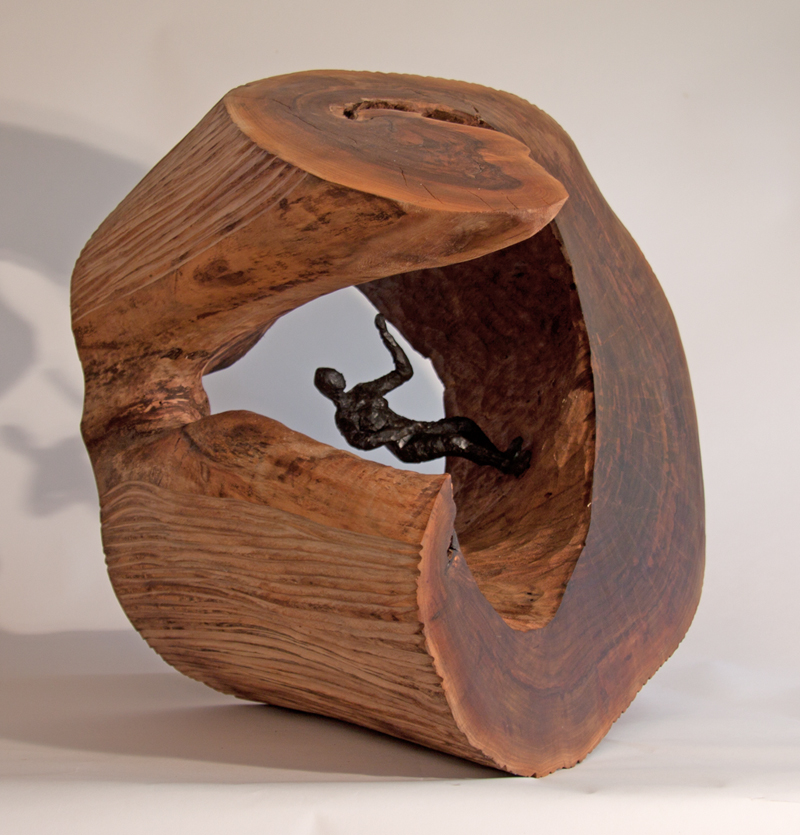
Inside the Wave, Sculpture:LH
Some People See a Turtle
My son, Nick, was young when he fell in love with turtles. He had a pet box turtle, Pebble, and she would eat every night in our kitchen sink. Nick offered her greens, vegetables, and cottage cheese on a small cutting board he put in the shallow water next to her — and we all watched amazed as her snakelike neck extended, she cracked open her sharp beak, and ate surprisingly quickly. Then Nick would take her back to her box in his room with a lamp for heat, and she would root around through the newspapers until she was nicely hidden.
When we traveled, Nick started collecting small turtles made from stone and wood. Friends and family would send him turtle mementos from Russia, Guatemala, and Thailand, in ebony, teak, alabaster, jade, cloth, and corn husk. Nick’s dad made him small shelves in his bedroom to hold this growing collection.
When Nick was a little older, he started making turtles with stones and leaving them in the landscape: a flat large stone for the body, one stone for her head, a narrow one for the tail, and four stones for each leg. We made some together on the sandy beaches of Cape Cod and even on the summit of Mt. Washington after a harrowing climb together.
When I first came to see the farm and walked around the lower pond, I stopped in my tracks. In the middle of the pond was a turtle—a round boulder the size of a Volkswagen bug, with a smaller rock for its head. This monumental rock formation was gazing east toward the rising sun. When I spoke with the owners later, they said they had never seen it.
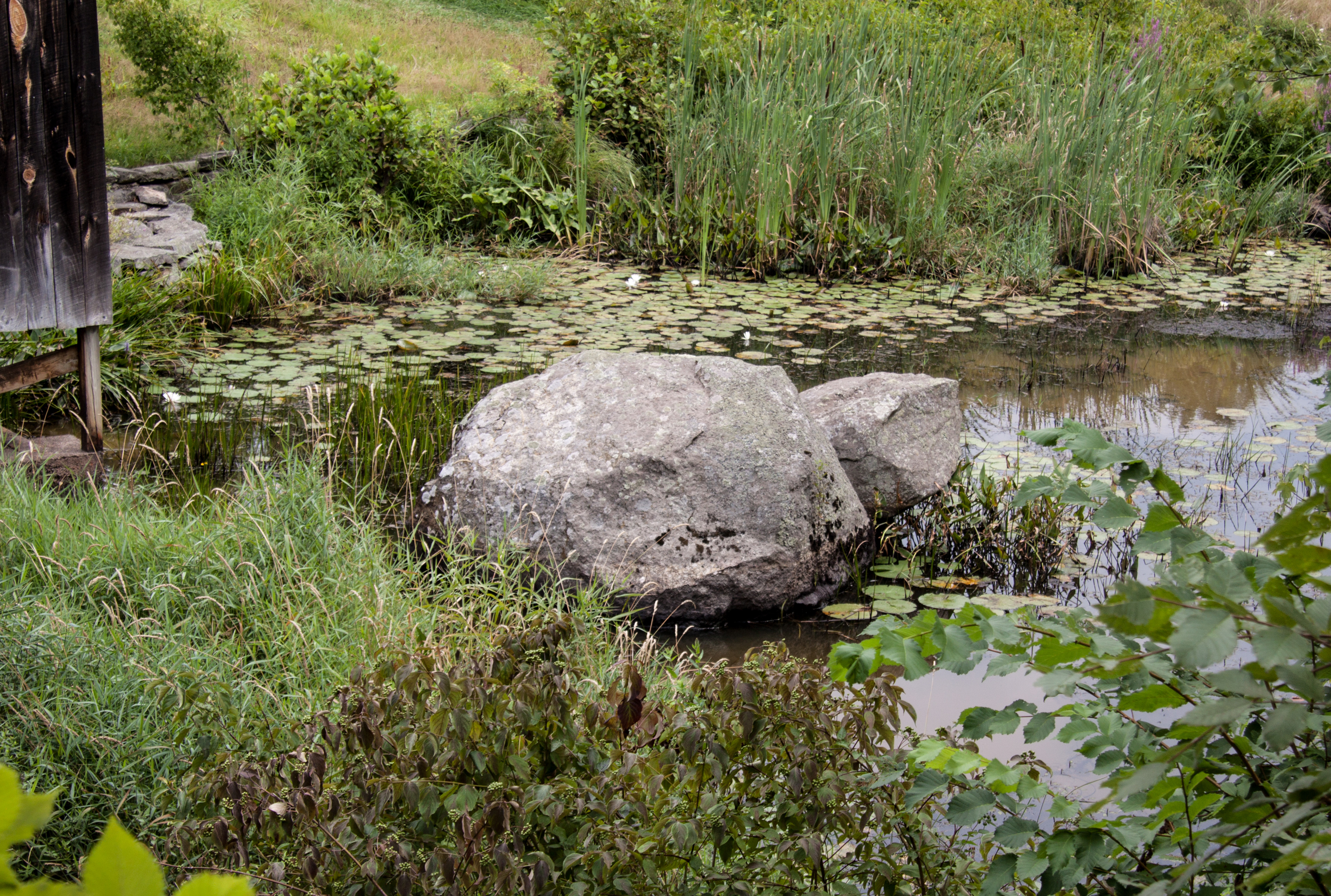
Stone Turtle in Lower Pond, August 2016
In the creation stories of the Oneida and Iroquois, Skywoman fell through a hole in the sky, pirouetting down towards the dark water below. Geese saw this falling woman with long dark hair, and quickly flew up to break her fall. They caught her in their soft feathers and held her safely. But they couldn't hold her for long, and they didn’t know what to do. They gathered all the other water animals together in council — otters, fish, swans, beavers, and a large turtle. The turtle offered his back for her to stand on. But what to do next? The animals knew she wasn’t a water creature and needed solid ground, so they decided to dive deeply and bring up mud from the bottom of the water. It was far for them to dive, and they each in turn returned empty handed. At last, muskrat, the weakest diver among them said, “I will go.” They waited anxiously for muskrat’s return. Finally, they saw a few bubbles, and then his small, limp body surfaced. He had died on the return, but in his paw he still clutched a bit of mud from the bottom. “This mud,” Turtle said, “spread it on my back.” They spread the mud over Turtle’s shell, and Skywoman danced and the land grew.
That’s how we came to live on Turtle Island. It’s a creation myth of sacrifice and caring, of recognizing that the earth sustains us all. It acknowledges that we humans are all immigrants, that the animals were here before us. It is a creation story that affirms life, that recognizes death; one in which there is communication between all species.
Finding the large stone turtle on my first visit to the farm was a good omen. I see this turtle almost every day. The Turtle Island creation myth is in stark contrast to the Western creation myth of the Garden of Eden with its story of banishment, guilt, and wrongdoing. Fratricide follows in the next generation, and Snake gets a really bad rap.
Perhaps the West needs a new creation story, one that is earth centered. We can learn from this Native American legend of the earth as a giant turtle, and be reminded that we are still precariously standing on Turtle’s back. Maybe we also need to dance more to celebrate and heal our earth. Maybe, like Nick, we can all make stone turtle and leave it as a marker in the landscape of our recognition of the precariousness of where we stand.

LH making a stone turtle in 2006 for Garden in the Woods, Framingham, MA
Search Blog
-
2025
- May 9, 2025 A View from the Tractor Seat
- Apr 11, 2025 Dig
-
2024
- Jan 7, 2024 Winter Wassail
-
2022
- Dec 11, 2022 Keeping Time
- Jun 17, 2022 This Apple-Shaped Earth
- Jan 23, 2022 What is a Jizo?
- Jan 16, 2022 An Invite and Housekeeping Update
- Jan 1, 2022 The Year of the Frog: What Orchardists Do While Apple Trees are Chilling
-
2021
- Oct 24, 2021 Figs
- Oct 3, 2021 The Artist and the Orchard: A Memoir
- Aug 8, 2021 Red-Fleshed Apples
- Jul 25, 2021 When We Were Trees
- Jun 27, 2021 Castor Beans—Who Knew?
- Jun 13, 2021 Spring Training at a Zen Monastery
- May 4, 2021 Our Trees are in Bloom
- Apr 18, 2021 Hooray!
- Jan 24, 2021 Wassailing, virtually!
- Jan 1, 2021 Sitting
-
2020
- Dec 21, 2020 Darkness to Light
- Nov 28, 2020 One Heart
- Sep 18, 2020 Juggling Flowers, Fruit, and Vegetables
- Aug 23, 2020 Refuge
- Aug 9, 2020 Bags of Fertilizer
- Aug 2, 2020 The Sermon of the Blue Heron
- Jul 26, 2020 What's the Buzz?
- Jul 19, 2020 Farm Moments
- Jul 12, 2020 Lost Wax
- Jul 5, 2020 Catalpa: The Hugging Tree
- Jun 28, 2020 Pedaling Peace
- Jun 21, 2020 See Change
- Jun 14, 2020 Lalla Unveiled
- Jun 7, 2020 Pond Alchemy
- May 31, 2020 The Birth of Fruit
- May 24, 2020 An Artist in the Orchard
- May 17, 2020 Walking the Land: Returning Home
- May 10, 2020 Stinging Nettles: Gifts from the Great Mother
- May 3, 2020 The Mystery of Swallow
- Apr 26, 2020 Aerial Bruststrokes
- Apr 19, 2020 Simple Pleasures
- Apr 12, 2020 Weeds and Other Gifts
- Apr 5, 2020 Remembering the Seeds
- Mar 29, 2020 Blow on the Embers
- Mar 22, 2020 Ripples
-
2019
- Nov 16, 2019 Tibet Impressions
- Nov 9, 2019 Forest Tales
- Oct 13, 2019 The Gift
- Aug 4, 2019 The Season is Apples, Berries, and Grandfather Fire
- Jun 8, 2019 Pointers for a Writing Life
- May 12, 2019 Mothers of the Earth
- Apr 6, 2019 The Apple-Shaped Earth
- Mar 23, 2019 You Don’t Know What You Have Till It’s Gone
- Feb 23, 2019 Generations
- Feb 9, 2019 What Are We Doing to the Earth, John Chapman?
-
2018
- Dec 31, 2018 Long Shadows
- Oct 6, 2018 A Pilgrimage to India
- Aug 18, 2018 Scrap Wrenn
- Aug 11, 2018 Off-the-Wall Comments from an Ignorant Farmer
- Jul 28, 2018 Creative Connect
- Jul 14, 2018 How is the Orchard?
- Jun 30, 2018 Which Way?
- Jun 16, 2018 Geese, Herons, Beavers, and the Baby Steps of a Lapsed Blogger
- Feb 24, 2018 Mama's Coupons — Good Forever
- Jan 27, 2018 January Ice
- Jan 13, 2018 The Muse
-
2017
- Dec 30, 2017 A Dream for the New Year
- Dec 23, 2017 A New Year for Apples
- Dec 16, 2017 Intuition
- Nov 22, 2017 Thanksgiving OM
- Nov 4, 2017 East Fork Pottery
- Oct 28, 2017 Putting Down New Roots
- Oct 21, 2017 A is for Art
- Oct 14, 2017 Eve domesticus
- Oct 7, 2017 A String Workshop
- Sep 30, 2017 After Applepicking
- Sep 23, 2017 Two Bad Women and One Good Apple
- Sep 16, 2017 Plein Air Poetry
- Sep 9, 2017 Cutting Off a Leg
- Sep 2, 2017 The Changing Landscape
- Aug 26, 2017 All About Art
- Aug 19, 2017 My First Visit to the Farm
- Aug 12, 2017 The First Food
- Aug 5, 2017 A Teapot, a Woman, and maybe a Boat
- Jul 29, 2017 A Raspberry Dilemma
- Jul 22, 2017 Consider the Miracle
- Jul 15, 2017 Meeting Ekphrasis
- Jul 8, 2017 Ripening Fruit
- Jul 1, 2017 The Voice of The Caterpillar
- Jun 24, 2017 Goumi — An Unusual Fructus
- Jun 17, 2017 Concord, an American Bloomsbury
- Jun 10, 2017 The World Is Bonkers — Shall I Laugh or Cry?
- Jun 3, 2017 Bonkers, a Revolutionary Apple
- May 27, 2017 Guardians of the Swamp
- May 20, 2017 There are Mushrooms and There are Morels
- May 13, 2017 "What's in a Name?"
- May 6, 2017 Bloom Follows Pink: Orchard Pollination
- Apr 29, 2017 The Orchard Is at Pink
- Apr 22, 2017 Natural Farming — Part 2 (continuation from last Sunday's blog)
- Apr 15, 2017 Natural Farming — Part 1
- Apr 8, 2017 Boats, Figures, and Catching Fish
- Apr 1, 2017 A Man with a Mission: The Nuts and Bolts of Bronze Casting
- Mar 25, 2017 A Chalice of Spirit, Art, and Nature
- Mar 18, 2017 Hanami — Blossom Viewing
- Mar 11, 2017 Soil Redemption Song
- Mar 4, 2017 Food is Primary Care
- Feb 25, 2017 Pomme de Terre
- Feb 18, 2017 Organic Certification
- Feb 11, 2017 Tantalizing Fruit
- Feb 4, 2017 The Myths of History
- Jan 28, 2017 The Orchard in Winter
- Jan 21, 2017 The Hi-Line
- Jan 14, 2017 Artistic, Botanical, and Social Diversity
- Jan 7, 2017 Where is Eden?
-
2016
- Dec 31, 2016 The Creative Heart
- Dec 24, 2016 A Christmas Tale
- Dec 17, 2016 Who are the Crones?
- Dec 10, 2016 The Olympic Bell (Part Two)
- Dec 3, 2016 Overheard in the Apple Orchard in Early December
- Nov 26, 2016 The Lessons of a Tortoise
- Nov 19, 2016 In the Studio
- Nov 12, 2016 Even in Darkness
- Nov 5, 2016 Southern Apples, an Elephant, Monkey, Rabbit, and Bird, Two Mango Trees and a Birthday
- Oct 29, 2016 The Tools of Art
- Oct 22, 2016 Labyrinths
- Oct 15, 2016 Repairing the Broken
- Oct 8, 2016 When You Are No More
- Oct 1, 2016 Creation Rain
- Sep 24, 2016 Breaking the Glass
- Sep 17, 2016 String Art
- Sep 10, 2016 Poetry and Photosynthesis: It's all in the Leaves
- Sep 3, 2016 In the Plenty of Time
- Aug 27, 2016 Witch Doctors
- Aug 20, 2016 Listen Coyote
- Aug 13, 2016 Milkweed in the Orchard
- Aug 6, 2016 Some People See a Turtle
- Jul 30, 2016 Arborshaping
- Jul 23, 2016 Joseph Wheelwright: Sculptor of Stones and Trees
- Jul 16, 2016 Asian Pears
- Jul 9, 2016 Gold Leaf, Grief, and the Creative Process
- Jul 2, 2016 The Olympic Bell (Part One)
- Jun 25, 2016 Around the Mulberry Bush
- Jun 18, 2016 Avoiding Apples
- Jun 11, 2016 Fructus
- Jun 4, 2016 Astonishing Apples
- May 28, 2016 Scare the Caterpillars
- May 21, 2016 Join the Club!
- May 14, 2016 The Graft
- May 7, 2016 Rooster, Rhubarb, Rue
- Apr 30, 2016 What do Dolphins and Nettles Have in Common?
- Apr 23, 2016 Art Prunings
- Apr 16, 2016 A Few of the First Arrivals
- Apr 9, 2016 Taste the Spirit of Sustainable Agriculture
- Apr 2, 2016 First Orchard Spray - March 22-24, 2016
- Mar 26, 2016 Hawkeye Apple
- Mar 19, 2016 Desiring the Almata Apple
- Mar 12, 2016 Ugly Fruit
- Mar 5, 2016 Winter Tracks
- Feb 27, 2016 Splash
- Feb 20, 2016 Pruning
- Feb 13, 2016 Orchard Ruminants
- Feb 6, 2016 A Gathering of Seeds
- Jan 30, 2016 Orchard Dragons
- Jan 23, 2016 Tree Rings
- Jan 17, 2016 The Fallen Tree
- Jan 7, 2016 Wassailing the Apple Trees
- Jan 1, 2016 The New Year