LINDA HOFFMAN
You Don’t Know What You Have Till It’s Gone
Our farmhouse is in Harvard, but many people don’t know that our apple orchard is in Boxborough. We were recently told by a neighbor about a proposed zoning overlay district in Boxborough that would change the zoning of our farm as well as adversely affect our neighbors in Harvard, Boxborough and surrounding towns.
The proposed overlay district comprises 371 acres and will enable the Lincoln Property Company to build four warehouses, 1,020,000 square feet. These four giant ‘cubes’ would cover twenty-three acres of formerly forested land within several thousand feet of our property.
Elizabeth Brook feeds the large wetlands area that flows around our orchard, and into the 500+ acres of Delaney Conservation area. In the last two weeks we have had two sightings of a bald eagle flying over the orchard and Elizabeth Brook wetlands. This proposed development would massively disturb this fragile ecosystem and threaten the aquifer that feeds our wells.

Great Blue Returned on the Spring Equinox
Many of you who have been reading my blog know of the struggle I have faced in growing organic apples over the last few years. Climate change is one factor, but I recently learned of another issue when I attended the Holistic Apple Grower’s Meeting in Western Massachusetts earlier this year. A new fungus, Marssonina Leaf Blotch, causes apple leaf defoliation in apples when a fungicide is not sprayed throughout the growing season. Arriving in this country from Asia, it first appeared in the western part of the country, defoliating thousands of acres of aspens in Utah, but is now in New England. Orchards spray fungicides for scab, the fungal disease most serious for apple growers in New England where the summer weather is often warm and wet. Organic growers have less choice in sprays to control this disease, so I made the hard decision a year ago to remove our Macintosh trees, known to growers as scab magnets. Right after the trees came down, friends joined me to graft one hundred rootstocks with scab resistant apples. These one-year-old saplings grew well in our hoop house for the year and are ready to be planted.
The disappearance of the gnarly Macintosh trees in the first few rows of the orchard caused neighbors to wonder if we were cutting down the entire orchard. I assured people we were not giving up. I have shared my lessons and strivings in growing organic apples, but none-the-less have continued to remain faithful to the trees and the land that have nourished me since I moved here in 2001.
Giving up on the earth, our government, or any issue that is challenging doesn’t solve anything. We have to do the work and stand by our convictions. Liberty Property Company’s build might take ten years, and who is to say that in twenty years, these warehouses won’t be obsolete as everything will be drop-shipped. Tax revenue is an important consideration for all of our communities, but in preserving our towns’ rural nature, its conservation lands, farmland, wildlife, clean water and night sky we make sure that our town remains a desirable place to live and that our property values stay high. Warehouses will not serve the local community, and in fact will cause a serious disruption to our way of life.

Many Boxborough residents heard for the first time about the proposed changes to their bylaw only recently. It seems that there has been a quiet, but legal effort to slip this bylaw change through Town Meeting by highlighting the ‘gifts’ to the town, but not mentioning the warehouses. If you know anyone in Boxborough, please make sure they know about this change in their bylaws coming up for a vote at Town Meeting in May.
I look at the wetlands and the orchard now with a new set of eyes. The runoff into the wetlands might mean we can no longer irrigate. Boxborough neighbors say that with the twenty-acre solar panel array, phase one of Liberty Realty’s development plans, they hear Route 495 in their homes even with the windows closed. More traffic sound reflecting off twenty-three acres of roofs will certainly eclipse the twangs of red-winged blackbirds, chirps of robins and bluebirds, honks of geese, and squawks of herons. And it will be impossible to hear the apple trees. “They can speak, trees . . .” says the 14th century poet, Hafiz in his poem, An Apple Tree Was Concerned.
An apple tree was concerned
about a late frost and losing its gifts
that would help feed a poor family close by.
Can't the clouds be generous with what falls from them?
Can't the sun ration itself with precision?
They can speak, trees,
they can say the sweetest things
but it takes special ears to hear them,
ears that have listened to people
with great care.

My daughter, Ariel, picking Honey Crisp Apples in 2017
We face choices everyday about how we use the earth’s limited resources.
Let us choose wisely.
Off-the-Wall Comments from an Ignorant Farmer
Hugh Williams is an orchardist I admire. When I read his email reply to my recent blog about our difficulties with the apple crop, I knew I wanted to share some of his insights. I wrote to ask if I could quote him. “Of course you can use my name. More off-the-wall comments from an ignorant farmer!” was his reply.
Hugh and his wife, Hannah Ball, and their two children grow fruits and vegetables and raise a small herd of cows at Threshold Farm in Duchess County, New York. Everything they do is touched by the biodynamic practices first introduced to the world in the early 1900s by the philosopher-farmer, Rudolph Steiner. Hugh started farming on his family’s farm in Australia in the early 1960s. He has learned through careful observation what his plants and animals need to flourish.
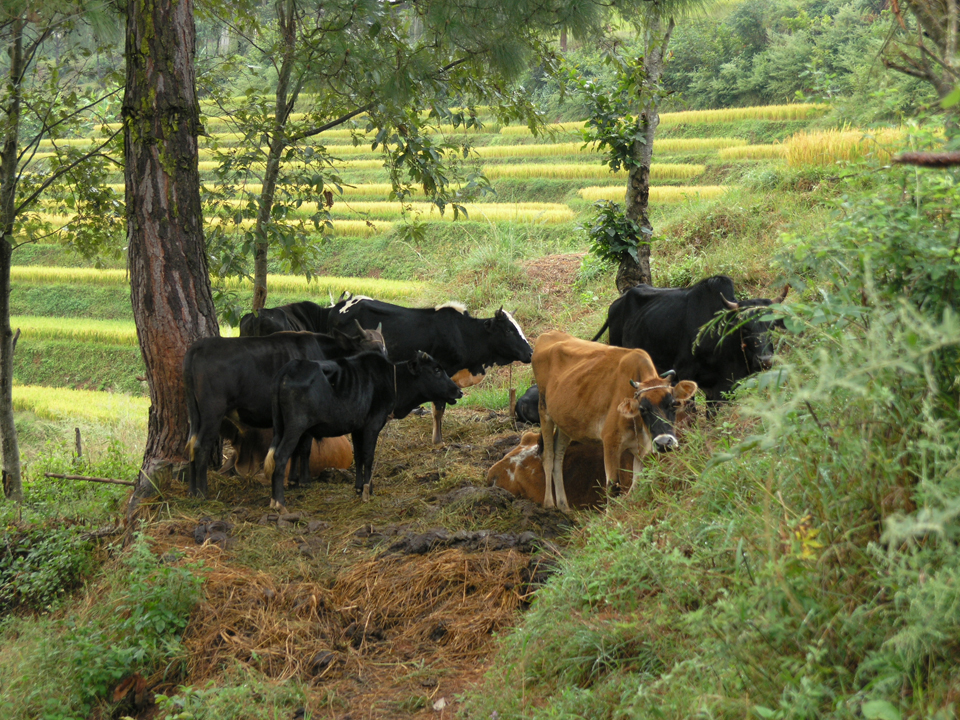
Cows in Bhutan ( Possibly the world's first organic country within the decade) Photo:LH
I first met Hugh at the annual Holistic Apple Growers meeting in western Massachusetts. At the beginning of each meeting, Michael Phillips, the organizer and champion of holistic apple growing, greets everyone and suggests we go around the room and introduce our orchards. The first year I attended, Bill McKintley from Potsdam, New York, then the owner but now retired, of St. Lawrence Nurseries, began. John Bunker, who runs Fedco trees in Maine spoke next. John lives in Palermo, Maine, and is passionate about Maine’s heirloom varieties. Brian Caldwell, a grower in New York, is an organic vegetable researcher at Cornell University. He has two small orchards near his home. I was intimidated when my turn approached.
“I recently moved to a farm with an abandoned apple orchard,” I said, “and I am trying to bring it back, using only organic materials. But I’m a sculptor, and I don’t know anything about apples. “
Everyone was polite; no one hinted I might be getting in over my head.
“How many trees do you have?” asked a handsome man with an Australian accent. That was Hugh Williams. When it was Hugh’s turn to speak, I remember he said he had been growing apples for forty years, and added coyly, “I’m waiting for the day I can be rid of my sprayer.” I wrote that down.
Over the last decade, Hugh has attended every apple growers meeting. Hugh always brings something original to our gatherings, a new enthusiasm, some relationship he hadn’t noticed before, an insight as to how a plant or animal grows. His cows are grass fed, and the calves run with the herd. An interviewer wrote, “We even saw Hugh milking from one side of a cow while a calf was nursing from the other side.”
Hugh knows about challenges. He and his family live solely off the profit from their farm. In a bad year, they have to be creative. Hugh wrote, “We have a very poor apple crop too, except on a few varieties. Enough for our fruit share members, and we have great plums, peaches and pears so we'll eke our way through another year.”
I had written that our crop failure was in part due to biennial production because we don’t thin the fruit from the mature trees. Hugh answered, “For us it was mostly poor pollination. There were no insects, even on the dandelions!” Hugh and Hannah think it's a “global phenomenon” and referred to a “thinning” of the insects. Hugh reminded me that when you stop at a gas station today, there is no longer the need to clean your windshield. It used to be de rigeur, so many squashed insects stuck to the glass. Where did these bugs go? I never clean my windshield anymore.
I think of the avalanche of toxic chemicals we have been releasing onto our planet every day since the end of World War II. The companies that made nerve gas and other toxic materials needed to change their product line in order to continue operating. Someone had the brilliant idea to manufacture chemical pesticides, herbicides, and fertilizers for the farmer. The corporate world is concerned with the bottom line. Inside brick and steel buildings, workers lose all connection to the natural world, to the subtlety of light, to beauty, to the richness of the insect, plant, and animal worlds, to the future of our children.

Two Girls in the Market, Bhutan Photo:LH
There is an article in the July 25, 2014 issue of Science, Defaunation in the Anthropocene. Defaunation is a new word used to describe not only the disappearance of a species but the decline in numbers. Farmers like Hugh and Hannah Williams don’t need scientific studies.
Hugh ended his note saying,
It raises the question of what actually is the function or purpose of agriculture, which certainly is not inherently tied to money, nor perhaps even to cropping! Our spiritual purpose becomes ever closer and more concrete. While yes, our farm is a temple precinct, we cannot avoid the conclusion it is also the very sensitive canary in the coal mine.
Hugh’s spirituality infuses his farm and all who know him, providing deep sustenance to all creatures. He shares his ideas easily, even when they are counter to how much of the world thinks. I admire Hugh because he cultivates the physical demands of being a farmer—the hard work, the selling, the making a living—all with dexterity and wit, and he attends equally to the spiritual, with passion and reverence. Perhaps he would say, these two realms are connected, or are in fact, one and the same. Maybe, that is why his farm is named Threshold, a place of connection between inner and outer, earth and sky, the physical and the spiritual, the material and the ethereal.

Turning a large Prayer Wheel, Bhutan Photo:LH
A New Year for Apples
Many of you who have been following my weekly blog know that this fall I became quite discouraged about farming and the orchard and so much that I’ve poured myself into over the last ten years. In large part, my frustration was due to a fungal pathogen, Venturia inaequalis, better known as scab. But thanks to a persuasive mentor and the researchers at PRI, I’m finding the door is opening and there is light on the other side.
PRI refers not to Public Radio International, but to Purdie, Rutgers, and Illinois Universities, the name of the cooperative disease resistant apple breeding program that has patented apples such as Scarlett O'Hara, Sundance, Pixie Crunch, and CrimsonCrisp — all apples bred to be crunchy, attractive, tasty and most importantly, resistant to apple scab.
When I started growing apples in 2005, my mentor Denis Wagner’s first concern was what we were going to do about apple scab, one of the worst problems for organic orchardists in New England. Denis advised I spray micronized sulfur, a common material used in agriculture to fight fungal infections. It is a mined material and permitted under organic regulations. The Sumerians used sulfur 4,500 years ago to combat disease in their crops.
The scab fungus overwinters in the orchard floor. In the spring, after a warm, rainy period — millions of spores float upwards into the tree like dust motes in sunlight. Landing on warm and wet, fresh green leaves, the scab shows up as innocuous-looking dark spots on the leaves. But gradually, these black cloudy patches grow darker and spread over the leaf surface. Unchecked, the fungus becomes rampant and jumps from leaf to fruit.
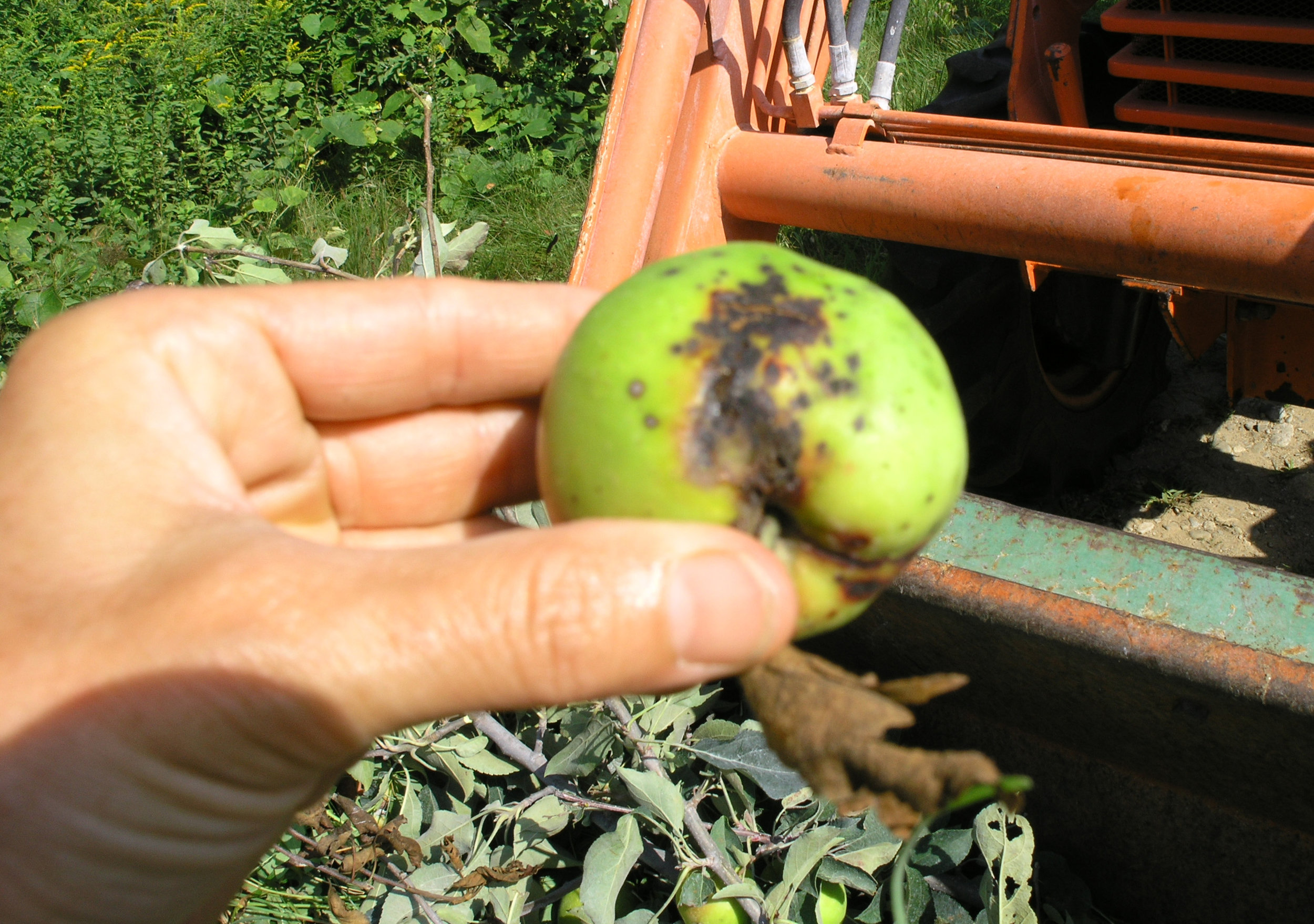
The apples develop brown crusty scabs and eventually crack. Sulfur applied to the leaves changes the pH and makes them an inhospitable host. The problem is getting spray onto every leaf surface — next to impossible — and renewing the coverage after it rains. An organic orchardist might need to spray sulfur fifteen times or more.
Over next few years, I learned through my holistic apple grower’s network how to calculate the spore release and not spray at every threat of precipitation. I would spray only when there was a large percentage of inoculant. I found I could keep the virus in check, unless we have a bad year – meaning a very wet spring. Then it becomes impossible to control. Ten years ago was a ghastly season. The scab was so ugly on the Macintosh trees that I decided to take down every Mac that wasn’t in the first three rows. My thinking was that I could confine these scab-susceptible trees and control it better. Macintosh trees are notorious scab magnets.
This year was again a banner year for scab. We lost half our fruit. Scab jumped from the Macintosh to the Golden Delicious, and then to the Blushing Golden, varieties that are normally scab resistant. With the Macs in the front three rows of the orchard, it was not a welcoming site for those entering the orchard: for people coming to pick apples for the first time, it was alarming.
I consulted with Denis again. “Remove them,” he said. “The trees are old and very densely planted.” I hemmed and hawed. I didn’t want to take down any trees. But I knew that even when I sprayed I got only about 50% coverage because of the tree size and density. I told Denis I would consider removing them and began my Macintosh cogitation.
What to do? Take down thirty-five beautiful trees? Take down only one row to start? I spoke with another apple grower and he suggested leaving a few Macs – because they make lovely early season cider. ‘Ah, what a good idea,’ I thought. I mentioned this to Denis.
“Linda,” he said. “You made the decision to get rid of them, just get rid of them.”
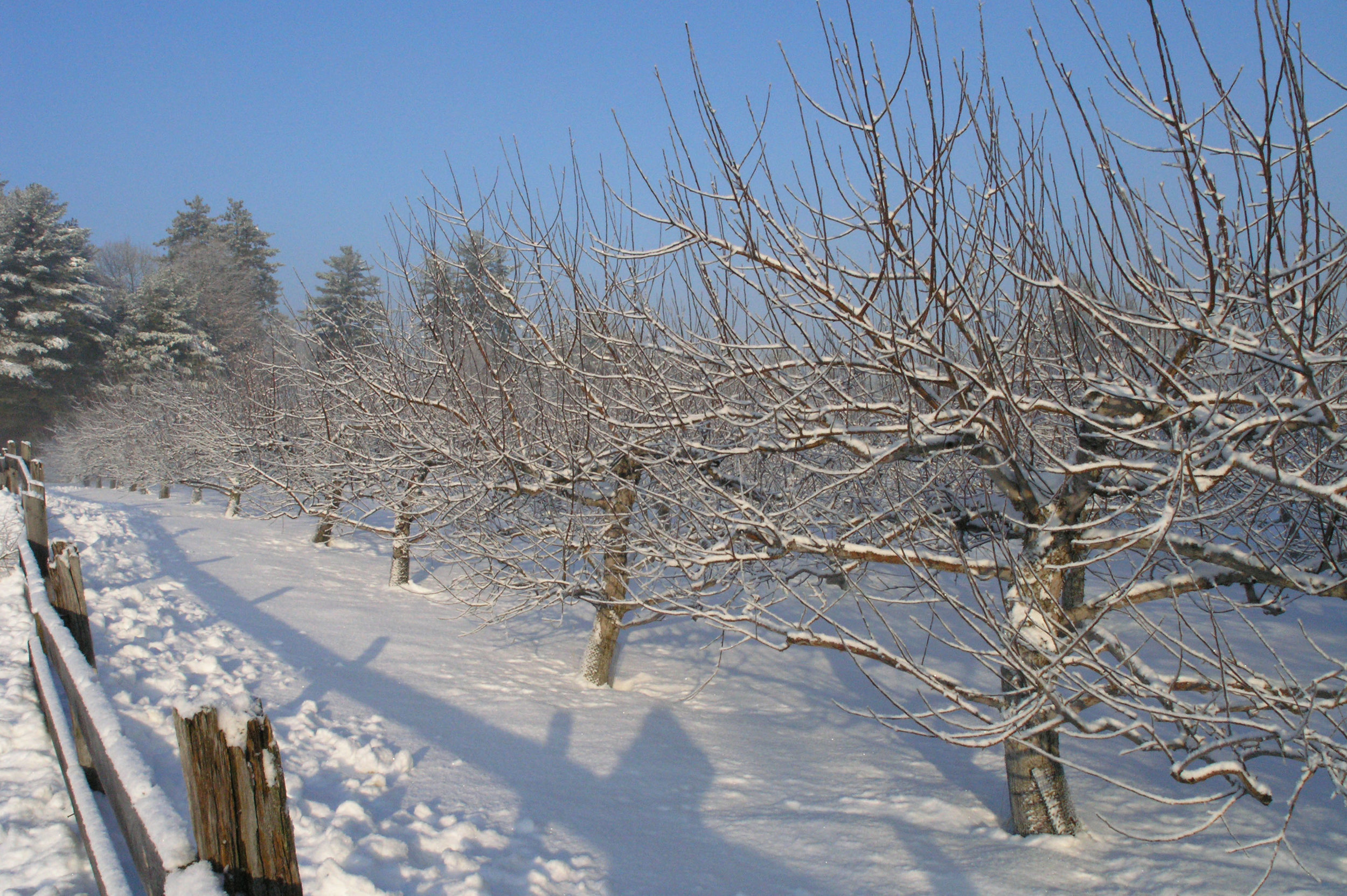
First Row of Macintosh Trees
A phone call came in.
“Don't hang up!” a gentleman said. “This isn’t a solicitation. I’m interested in organic apple wood.”
I would have hung up, but at that moment I was stewing in apple wood decisions. It would take considerable labor to cut down thirty-five full size trees, pile the branches, burn them, and stack the burnable logs.
“We’re looking for some organic apple wood to make charcoal,” the man said. “We think we can sell it to high end organic restaurants.”
He had my attention. He was in Arizona, but coming to New England and wanted to visit the farm, meet me, and see the trees. I explained that this year, I actually had a few large trees that I was planning to take down. We agreed to meet.
Len Kronman visited along with his business partner, Dave Santos. I don’t know how they are related, but Dave is younger and Len is older. Dave seems to be the on the ground man and Len is perhaps a financial backer. While we were walking through the orchard I told Len about my attempt at creating a wild orchard pointing out Valerian and Jerusalem artichokes growing between the trees.
“My daughter-in-law had just published a book on wildflowers. Would you like a copy?” he asked.
“Oh yes,” I replied.
“Please send her a copy,” he directed Dave.
Len is also an art collector; he specializes in Native American art. But as he said a few times, he just loves to collect. We took a tour of sculpture on the farm, and he chose a piece of mine, a small figure sitting on a tall rock. All this from organic apple wood . . .
Dave and I chose a date when he would come with a few men, a chipper, and a truck. Then he called back, apologetically.
“Would it be all right if we chipped and left the branches less than 2” in diameter? It will be too small for charcoal,” he explained. “If we take it away we will need to bring two trucks – one for the charcoal making wood and the other for the twig stuff.”
Chipped wood from the smaller branches is called ramial wood chips. They have more nutrients than older wood. They’re hard to come by unless you have your own chipper. We always burn our prunings in a huge bonfire and then spread the ashes around the trees.
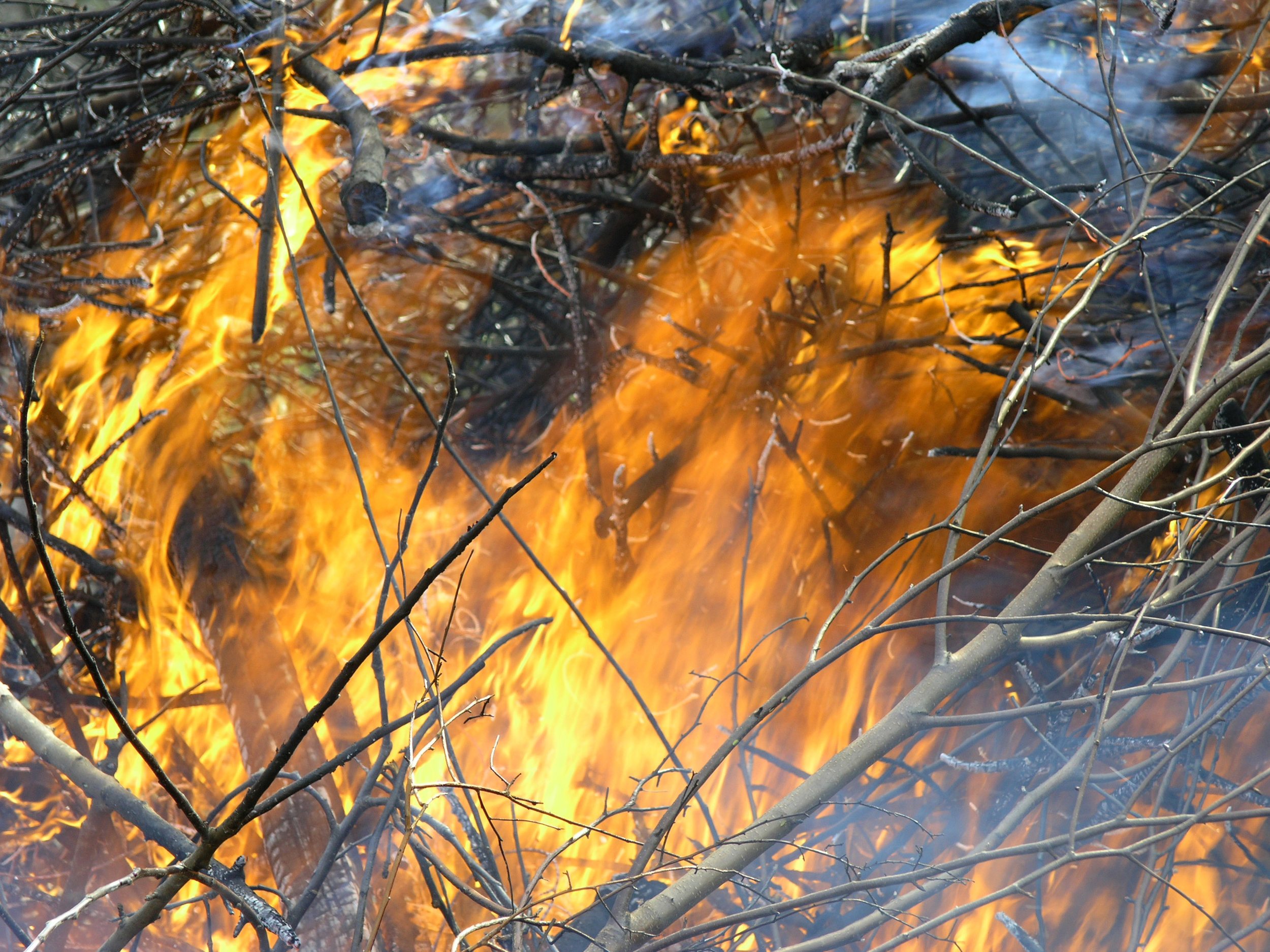
Bonfire of Apple Prunings
‘Nutrients for the trees,’ I thought. “I would love to have them!”
Dave and his crew won’t be here until after Christmas, but I am feeling better about removing the Macintosh trees. I’ve already ordered replacements — two early season, scab resistant varieties from the PRI breeding program. In the front row will be Pristine, a hardy yellow apple, with crunch and sweetness, that I already grow. And for the second row, Redfree, another early season apple with skin color 90% red wash over yellow. The tree salesman also convinced me to put in an order for the new Evercrisp apple. He said, “You might have to wait a year or so, but you’ll love it!” I’m looking forward to the ripening of the new year filled with things not yet known, not yet tasted, not yet seen. I hope you are, too! All best for the Holdiays!
The World Is Bonkers — Shall I Laugh or Cry?
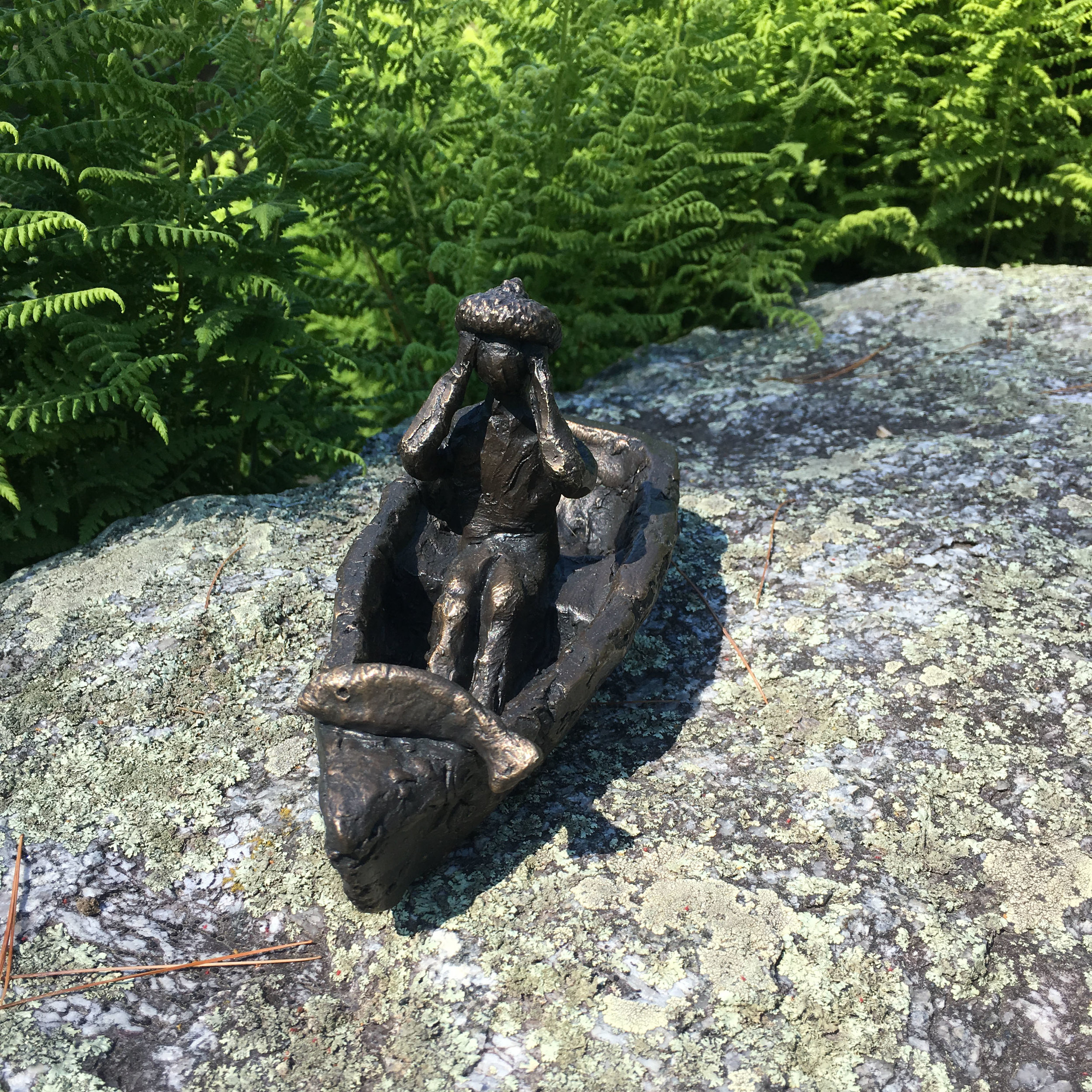
The World is Bonkers, 2017, bronze: Sculpture LH
Last week I wrote about Bonkers, the revolutionary apple – but unknown to me – the Atlantic, two weeks earlier, published an article, Why So Much is Bonkers Right Now. The Atlantic mentioned at least ten references to this imported British word. For example, Mother Jones had recently reassured its readers: “It’s Not Just You . . . This Week Was Bonkers,” referring to the latest Trump charades. And Vox used the word to describe Netflix’s newest film, Okja: “a bonkers corporate satire staring Tilda Swinton and a superpig.” I saw a two-page spread advertising the film in the New Yorker magazine. The image, a young woman leading a giant creature with a factory building as its saddle spewing out pollution from one of three smokestacks, was so fascinating I looked it up on Rotten Tomatoes and found that it is a story of an extraordinary human animal bond threatened by capitalist consumers.
The Atlantic article also mentions the word Bonkers’ first use on American soil in 1965, when an American film reviewer of the film Paranoia used the word to describe “Marcello Mastroianni as going slowly bonkers while sharing a bath, bed, and Bedouin with three co-stars.” In the 1980s, there was a candy named Bonkers. Its commercial takes the prize for worst of its kind, but you can watch it here. And there is a recent memoir by the comedian Jennifer Saunders, Bonkers: My Life in Laughs. What is the appeal of this Bonkers everyone is using? Zany, crazy, madcap, screwy, wacky? The Atlantic article ended with an appreciatory note, saying that this British word is “uniquely suited to this American moment: a time when news can be so often confusing, and overwhelming, and, all in all, a little bit bonkers.”
Yet to describe our world as Bonkers doesn’t feel right. After the Manchester killings and the London Bridge savagery, the world is not Bonkers, but alarming. Withdrawing America from the Paris Climate Accord is equally horrifying. Bonkers is a non-judgmental adjective; it resists condemnation. Faced with the harsh reality of innocent lives lost, the continued devastation of people’s homes from war and terrorism, and the loss of species and habitat because of climate change, Bonkers doesn’t describe the depth of suffering in our world.
Yet, at the same moment that devastation is happening all around, I watch young children skip merrily before climbing aboard a big yellow school bus and bike down our street with fishing rods tucked under their arms, knowing nothing about the follies of their parents’ generation. I feel similarly protective of the spotted brown and white eggs in a small nest high in a branch of the Saturn peach. These birds will know nothing of the perils facing the earth. This contrast between the news and what is happening in my backyard does make me feel like this world is Bonkers.
Today, a friend came by and we spent several hours removing peaches from the Saturn peach tree. Last week it was pruned to about half its size, and now we needed to thin the heavy fruit set. Packed together on the branches like sardines in a tin, the tree had produced a crazy number of apples. When this much fruit grows tightly together, disease spreads, the fruit is small, and it taxes the health of a tree. I heard myself say to her the ‘B’ word, ‘The tree is Bonkers – it has way too much fruit.’
Suffering is all around us, but miraculous beauty is too. Maybe the gift of the word Bonkers is that it describes craziness without being judgmental. We can do so much more to relieve suffering in the world if we don’t wallow in judging thoughts, but take up our lives wholeheartedly. Whether we grow miraculous peaches, listen to another’s pain, or spearhead an activist role to clean up the planet, every day we have the opportunity to hold back our anger, yet take in the grief; to feel the devastation, yet fight for change. Maybe to declare that this world is Bonkers is to bring lightness to the seriousness of our situation, and to let laughter wash over our tears.

Meditator with Acorn, 2017, bronze, Sculpture LH
Search Blog
-
2025
- May 9, 2025 A View from the Tractor Seat
- Apr 11, 2025 Dig
-
2024
- Jan 7, 2024 Winter Wassail
-
2022
- Dec 11, 2022 Keeping Time
- Jun 17, 2022 This Apple-Shaped Earth
- Jan 23, 2022 What is a Jizo?
- Jan 16, 2022 An Invite and Housekeeping Update
- Jan 1, 2022 The Year of the Frog: What Orchardists Do While Apple Trees are Chilling
-
2021
- Oct 24, 2021 Figs
- Oct 3, 2021 The Artist and the Orchard: A Memoir
- Aug 8, 2021 Red-Fleshed Apples
- Jul 25, 2021 When We Were Trees
- Jun 27, 2021 Castor Beans—Who Knew?
- Jun 13, 2021 Spring Training at a Zen Monastery
- May 4, 2021 Our Trees are in Bloom
- Apr 18, 2021 Hooray!
- Jan 24, 2021 Wassailing, virtually!
- Jan 1, 2021 Sitting
-
2020
- Dec 21, 2020 Darkness to Light
- Nov 28, 2020 One Heart
- Sep 18, 2020 Juggling Flowers, Fruit, and Vegetables
- Aug 23, 2020 Refuge
- Aug 9, 2020 Bags of Fertilizer
- Aug 2, 2020 The Sermon of the Blue Heron
- Jul 26, 2020 What's the Buzz?
- Jul 19, 2020 Farm Moments
- Jul 12, 2020 Lost Wax
- Jul 5, 2020 Catalpa: The Hugging Tree
- Jun 28, 2020 Pedaling Peace
- Jun 21, 2020 See Change
- Jun 14, 2020 Lalla Unveiled
- Jun 7, 2020 Pond Alchemy
- May 31, 2020 The Birth of Fruit
- May 24, 2020 An Artist in the Orchard
- May 17, 2020 Walking the Land: Returning Home
- May 10, 2020 Stinging Nettles: Gifts from the Great Mother
- May 3, 2020 The Mystery of Swallow
- Apr 26, 2020 Aerial Bruststrokes
- Apr 19, 2020 Simple Pleasures
- Apr 12, 2020 Weeds and Other Gifts
- Apr 5, 2020 Remembering the Seeds
- Mar 29, 2020 Blow on the Embers
- Mar 22, 2020 Ripples
-
2019
- Nov 16, 2019 Tibet Impressions
- Nov 9, 2019 Forest Tales
- Oct 13, 2019 The Gift
- Aug 4, 2019 The Season is Apples, Berries, and Grandfather Fire
- Jun 8, 2019 Pointers for a Writing Life
- May 12, 2019 Mothers of the Earth
- Apr 6, 2019 The Apple-Shaped Earth
- Mar 23, 2019 You Don’t Know What You Have Till It’s Gone
- Feb 23, 2019 Generations
- Feb 9, 2019 What Are We Doing to the Earth, John Chapman?
-
2018
- Dec 31, 2018 Long Shadows
- Oct 6, 2018 A Pilgrimage to India
- Aug 18, 2018 Scrap Wrenn
- Aug 11, 2018 Off-the-Wall Comments from an Ignorant Farmer
- Jul 28, 2018 Creative Connect
- Jul 14, 2018 How is the Orchard?
- Jun 30, 2018 Which Way?
- Jun 16, 2018 Geese, Herons, Beavers, and the Baby Steps of a Lapsed Blogger
- Feb 24, 2018 Mama's Coupons — Good Forever
- Jan 27, 2018 January Ice
- Jan 13, 2018 The Muse
-
2017
- Dec 30, 2017 A Dream for the New Year
- Dec 23, 2017 A New Year for Apples
- Dec 16, 2017 Intuition
- Nov 22, 2017 Thanksgiving OM
- Nov 4, 2017 East Fork Pottery
- Oct 28, 2017 Putting Down New Roots
- Oct 21, 2017 A is for Art
- Oct 14, 2017 Eve domesticus
- Oct 7, 2017 A String Workshop
- Sep 30, 2017 After Applepicking
- Sep 23, 2017 Two Bad Women and One Good Apple
- Sep 16, 2017 Plein Air Poetry
- Sep 9, 2017 Cutting Off a Leg
- Sep 2, 2017 The Changing Landscape
- Aug 26, 2017 All About Art
- Aug 19, 2017 My First Visit to the Farm
- Aug 12, 2017 The First Food
- Aug 5, 2017 A Teapot, a Woman, and maybe a Boat
- Jul 29, 2017 A Raspberry Dilemma
- Jul 22, 2017 Consider the Miracle
- Jul 15, 2017 Meeting Ekphrasis
- Jul 8, 2017 Ripening Fruit
- Jul 1, 2017 The Voice of The Caterpillar
- Jun 24, 2017 Goumi — An Unusual Fructus
- Jun 17, 2017 Concord, an American Bloomsbury
- Jun 10, 2017 The World Is Bonkers — Shall I Laugh or Cry?
- Jun 3, 2017 Bonkers, a Revolutionary Apple
- May 27, 2017 Guardians of the Swamp
- May 20, 2017 There are Mushrooms and There are Morels
- May 13, 2017 "What's in a Name?"
- May 6, 2017 Bloom Follows Pink: Orchard Pollination
- Apr 29, 2017 The Orchard Is at Pink
- Apr 22, 2017 Natural Farming — Part 2 (continuation from last Sunday's blog)
- Apr 15, 2017 Natural Farming — Part 1
- Apr 8, 2017 Boats, Figures, and Catching Fish
- Apr 1, 2017 A Man with a Mission: The Nuts and Bolts of Bronze Casting
- Mar 25, 2017 A Chalice of Spirit, Art, and Nature
- Mar 18, 2017 Hanami — Blossom Viewing
- Mar 11, 2017 Soil Redemption Song
- Mar 4, 2017 Food is Primary Care
- Feb 25, 2017 Pomme de Terre
- Feb 18, 2017 Organic Certification
- Feb 11, 2017 Tantalizing Fruit
- Feb 4, 2017 The Myths of History
- Jan 28, 2017 The Orchard in Winter
- Jan 21, 2017 The Hi-Line
- Jan 14, 2017 Artistic, Botanical, and Social Diversity
- Jan 7, 2017 Where is Eden?
-
2016
- Dec 31, 2016 The Creative Heart
- Dec 24, 2016 A Christmas Tale
- Dec 17, 2016 Who are the Crones?
- Dec 10, 2016 The Olympic Bell (Part Two)
- Dec 3, 2016 Overheard in the Apple Orchard in Early December
- Nov 26, 2016 The Lessons of a Tortoise
- Nov 19, 2016 In the Studio
- Nov 12, 2016 Even in Darkness
- Nov 5, 2016 Southern Apples, an Elephant, Monkey, Rabbit, and Bird, Two Mango Trees and a Birthday
- Oct 29, 2016 The Tools of Art
- Oct 22, 2016 Labyrinths
- Oct 15, 2016 Repairing the Broken
- Oct 8, 2016 When You Are No More
- Oct 1, 2016 Creation Rain
- Sep 24, 2016 Breaking the Glass
- Sep 17, 2016 String Art
- Sep 10, 2016 Poetry and Photosynthesis: It's all in the Leaves
- Sep 3, 2016 In the Plenty of Time
- Aug 27, 2016 Witch Doctors
- Aug 20, 2016 Listen Coyote
- Aug 13, 2016 Milkweed in the Orchard
- Aug 6, 2016 Some People See a Turtle
- Jul 30, 2016 Arborshaping
- Jul 23, 2016 Joseph Wheelwright: Sculptor of Stones and Trees
- Jul 16, 2016 Asian Pears
- Jul 9, 2016 Gold Leaf, Grief, and the Creative Process
- Jul 2, 2016 The Olympic Bell (Part One)
- Jun 25, 2016 Around the Mulberry Bush
- Jun 18, 2016 Avoiding Apples
- Jun 11, 2016 Fructus
- Jun 4, 2016 Astonishing Apples
- May 28, 2016 Scare the Caterpillars
- May 21, 2016 Join the Club!
- May 14, 2016 The Graft
- May 7, 2016 Rooster, Rhubarb, Rue
- Apr 30, 2016 What do Dolphins and Nettles Have in Common?
- Apr 23, 2016 Art Prunings
- Apr 16, 2016 A Few of the First Arrivals
- Apr 9, 2016 Taste the Spirit of Sustainable Agriculture
- Apr 2, 2016 First Orchard Spray - March 22-24, 2016
- Mar 26, 2016 Hawkeye Apple
- Mar 19, 2016 Desiring the Almata Apple
- Mar 12, 2016 Ugly Fruit
- Mar 5, 2016 Winter Tracks
- Feb 27, 2016 Splash
- Feb 20, 2016 Pruning
- Feb 13, 2016 Orchard Ruminants
- Feb 6, 2016 A Gathering of Seeds
- Jan 30, 2016 Orchard Dragons
- Jan 23, 2016 Tree Rings
- Jan 17, 2016 The Fallen Tree
- Jan 7, 2016 Wassailing the Apple Trees
- Jan 1, 2016 The New Year