LINDA HOFFMAN
Repairing the Broken
“The world breaks everyone, then some become strong in the broken places.”
—Ernest Hemmingway
In the Japanese pottery world there is an old tradition, Kintsugi (golden joinery), of repairing a broken pot with gold. The pot might have been a prized tea ceremony bowl, revered with the eye and treasured with the hand. Instead of tossing the pot broken by some mishap into the rubbish pile, the pieces would be fitted back together and held by lacquer mixed with gold powder. Kintsugi became an art form. A newly repaired bowl with threads of gold has more appeal than the unbroken one.
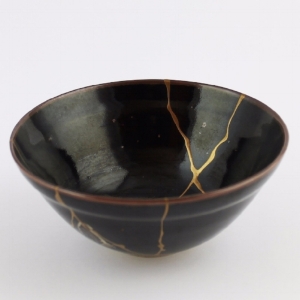
Teabowl, Yamamoto Gempo (1866-1961) photo courtesy of Backmann Eckenstein Newsletter
Kintsugi is connected to the Japanese philosophy of wabi-sabi. Wabi might translate as loneliness or solitariness —the sight of a lone crow on a crooked branch or a plum blossom peeking through light snow. Sabi refers to objects that exude the well-worn, rustic patina of age. Wabi-sabi informs the aesthetics of the traditional Japanese arts. An object doesn’t need to be discarded because it is worn and old. On the contrary, we treasure it even more.
I lived in Japan in my early twenties, and I consider wabi-sabi to be a strong influence on my own aesthetics. I love using old tools, worn objects, and wood in my art. Wood, its knots, rings, and branch collars, carries the history of the life of the tree. Similarly, pottery carries its past; the clay was created in the earth hundreds of years ago. We have an intuitive attraction to that which is old and from the earth. We trust its wisdom. Without knowing about Kintsugi, when I made my first large-scale outdoor sculpture using tree logs from a hundred-year-old maple that fell in a winter storm, I gold leafed its sawn surfaces to highlight its beauty and give it new life.
The repairs of Kintsugi draw our attention to the impermanence of life. In fact, it is emphasized and celebrated. The repairs to the bowl add to its beauty. How is it that our culture wants to deny this reality? From blemish-free apples to wrinkle-free faces to the ideal relationship, we are directed to strive for perfection as if it was attainable and permanent.
In the third stanza of Jane Hirshfield’s poem, For What Binds Us, she writes:
And see how the flesh grows back
across a wound, with a great vehemence,
more strong
than the simple, untested surface before.
There's a name for it on horses,
when it comes back darker and raised: proud flesh,
I can recall as a child sitting with friends as we showed off our scars and shared our battle stories.
I have a tea mug I use every day. It’s one that my son, Alex, a potter and the founder of East Fork Pottery, made over ten years ago when he was a freshman at Guilford College. It’s the only piece of pottery that still exists from that time. At home, we keep all of our mugs on two open shelves in the kitchen. When my beloved Alex mug is on the shelf and a houseguest decides to choose a cup, they infallibly choose this one. There is little about it that would make you prefer it from among the two shelves of mugs. Yet there must be something that communicates, whether it is our intuitive attraction to the patina of age or the subtle power of something treasured. No one seems to be concerned with the hairline crack down the inside of it. I care for this mug tenderly.

Mug, Alex Matisse, fourth from right on bottom shelf
Eventually, my Alex mug will likely break. I will need to learn how to make a Kintsugi repair in preparation for that day.
The gold we need for each repair is available in many forms — a hot bowl of soup, a knitted scarf, a poem, acts of courage, love and compassion — we can see them all as gold threads we offer to heal this earth and each other.
Milkweed in the Orchard
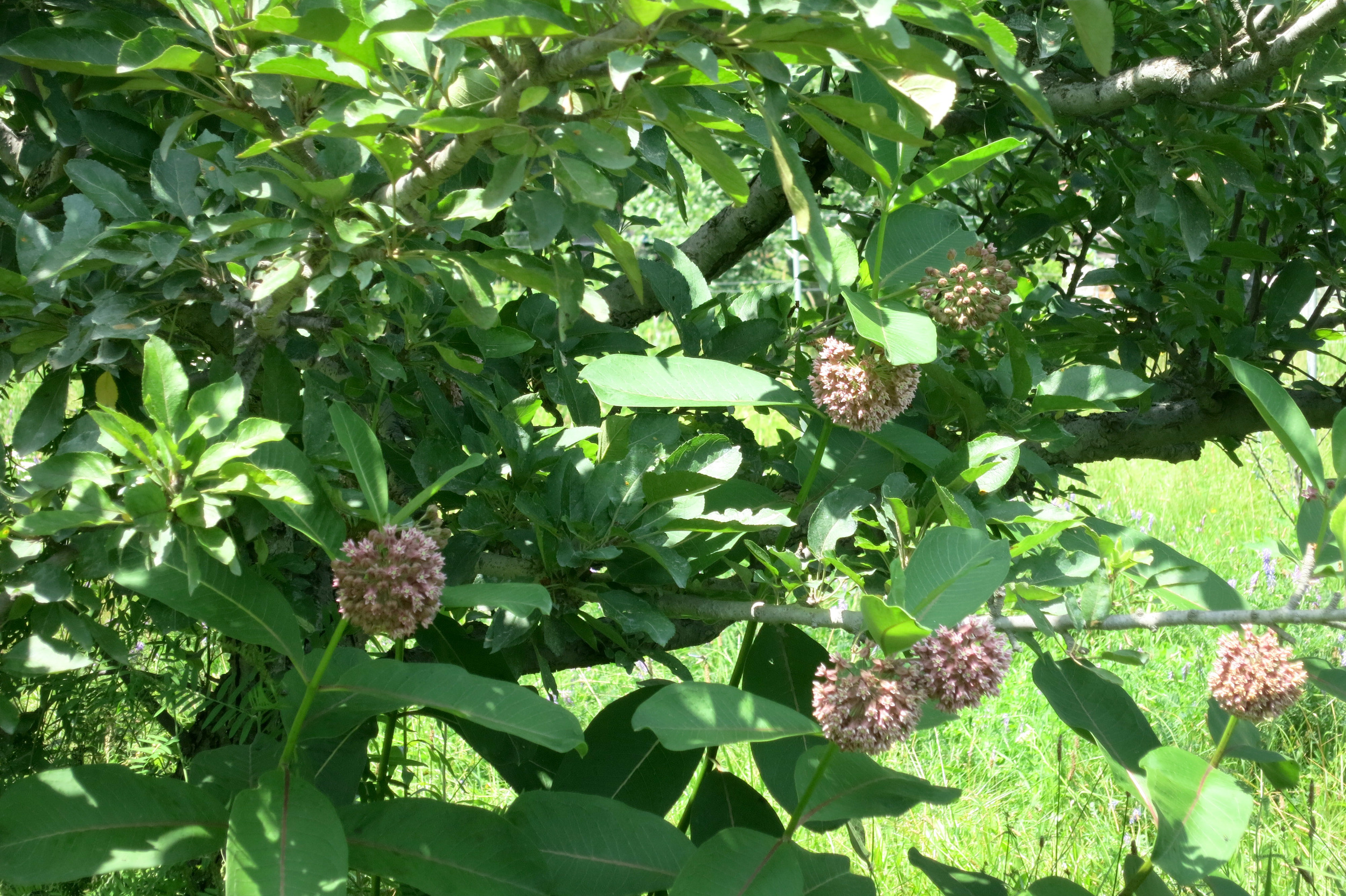
Milkweed under an Apple Tree
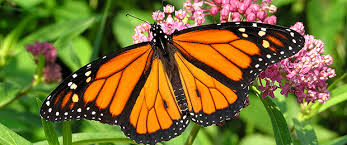
In the last few years, milkweed has spread exponentially throughout the orchard. We don’t mow it down, but we don’t plant it either. It is as if the earth herself has decided that we need more of it; that nature wants to help the monarch butterflies who depend on this plant for their survival. Every summer, monarchs lay their eggs on milkweed. The emerging black-, white-, and yellow-striped caterpillars begin eating around the edges of the leaves, and even absorb a substance from their host that provides a defense against predators.
But where are the monarchs? Their numbers have been decreasing steadily for the last twenty years. In fact, the Endangered Species Coalition reports that North American monarchs have declined by ninety percent since the mid 90’s. During the first few years of tending the orchard, I would see monarchs daily when the milkweed was in bloom. This year I have yet to see one.
One reason for their decline is the loss of milkweed habitat. Much of this acreage is now planted with corn and soybeans, and the fields are sprayed with Monsanto’s Roundup. (In 1995, 10 million pounds of Roundup was used on corn and soybeans, and, by 2013, the total pounds rose to 204 million.) Roundup destroys all weeds – including milkweed! I’ve known about the horrors of Roundup, but I didn’t realize that genetically modified corn seed, like Bt corn, produces pollen that kills monarch caterpillars and other insects. I am familiar with Bacillus thuringiensis, Bt, a bacteria-based organic pesticide that is approved for use in organic production. An organic grower uses it sparingly and for target pests. But in the case of Bt corn, the plant itself sends out this pesticide to all insects, pollinators as well as pests such as the corn borer.
When the first findings came out that Bt corn was killing off the monarchs, the agricultural giants who control the fate of millions of acres of farmland (as well as the U.S. Environmental Protection Agency and the U.S. Department of Agriculture) denied them. If you want to read further, Orion Magazine published a great article aptly titled, The Canary in the Cornfield.
In recent years, monarch butterfly decline also correlates with unprecedented fluctuations of temperatures caused by global warming. For example, in 2013, a cold period in May delayed the Monarch departure from their wintering grounds, so they arrived late and didn’t breed as well. Their numbers upon their return the following winter were the lowest ever. In early March this year, a sleet storm with high winds at their wintering ground in Mexico felled trees and buried large numbers of monarchs under sheets of ice.
It’s good we have milkweed growing throughout our orchard, and it is wonderful to read about all of the projects to encourage the survival of the monarch, like the Fresh Pond Monarch Watch in Cambridge, MA, who are planting milkweed, pulling out the invasive black swallow-wort vines, and breeding and releasing caterpillars. However, it will ultimately be the millions of acres in the Midwest that will make the most difference in monarch numbers.
Milkweed belongs to the Asclepiadaceae family, derived from Asclepius, the Greek god (actually demi-god because his father was Apollo but his mother was mortal) of medicine and healing. Athena gave Asclepius the gift to save mortals and even bring them back from the dead. Zeus was jealous when he saw his foes coming back from Hades and supposedly killed Asclepius with a thunderbolt. No one knows for sure since Asclepius became a living god. In ancient Greece there were 320 Asclepions, healing sanctuaries, actually the first hospitals in the world. Last year a 2,400-year-old temple dedicated to him was excavated. I hope he continues to use his healing powers through the proliferation of milkweed and helps to insure the survival of the Monarch butterfly.

Asclepius and his daughter Hygieia, goddess of health.
.
The Olympic Bell (Part One)
This year for our tenth annual outdoor Sculpture Walk, we are excited to welcome the installation of a new sculpture, the Olympic Bell by Paul Matisse. First installed in Athens, Greece, in 2004 at the Summer Olympic Games, the bell then came home to Groton, Massachusetts, and has since been quietly awaiting its next home.
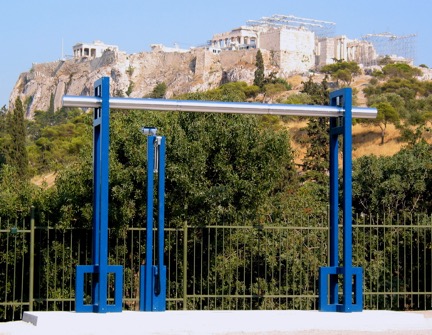
A few pulls on the heavy rope provides the momentum to lift the hammer and strike the bell, producing a deep, harmonious tone that can be heard for several minutes. My beloved partner, Blase, is doing the work of digging and preparing the ground for pouring the concrete foundation. We are all clearing the forested area of branches and fallen trees to let the stalwart white pines come forward with their presence creating, not the Parthenon, but nature’s own temple.
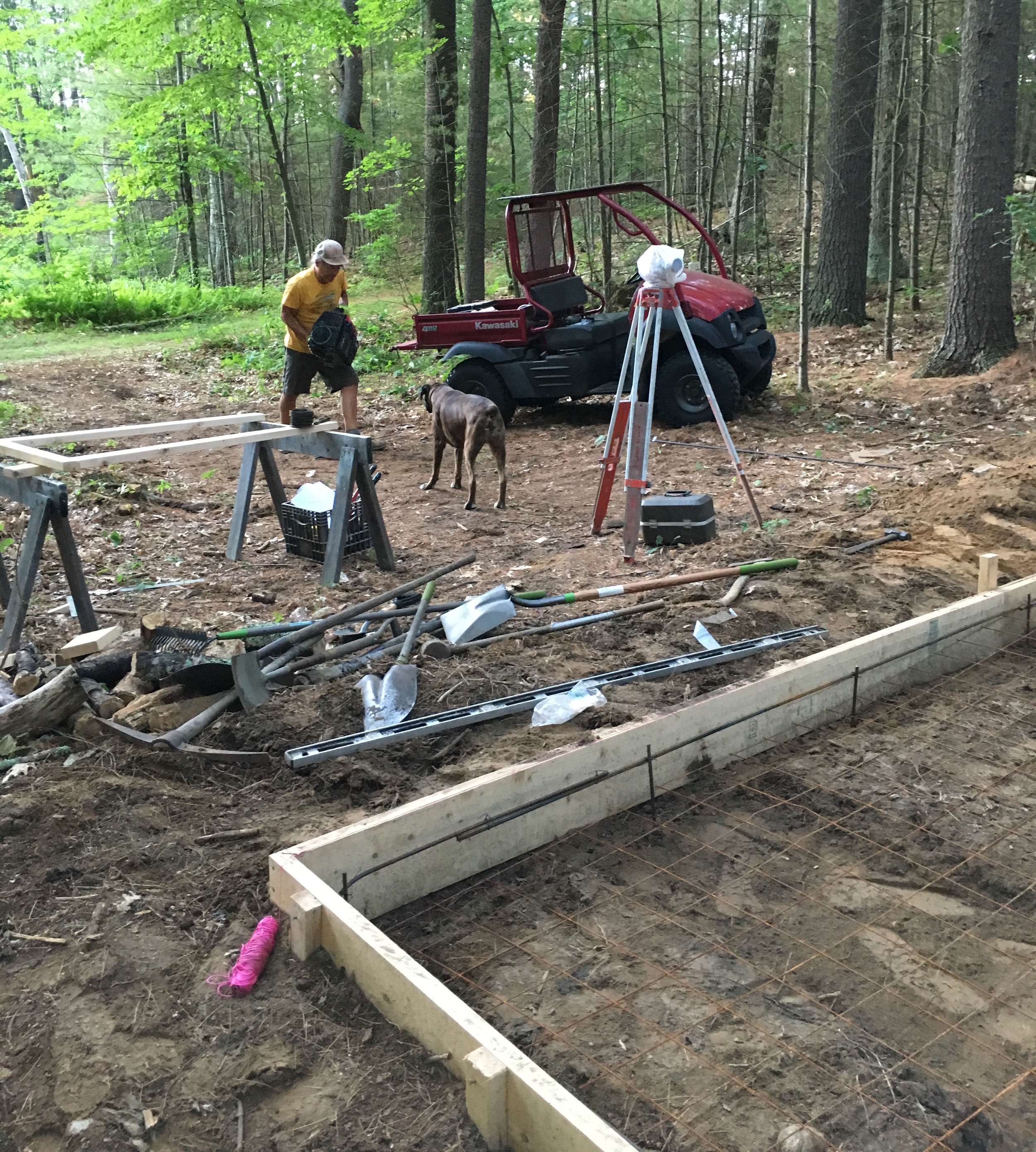
Paul Matisse is my former husband and the father of our three children. When we separated, I moved to the farm and created a new life here. We rarely saw each other, only speaking briefly on the phone when it involved the children. But over the years I think we both felt that our relationship continued, albeit in another form. The arrival of the bell feels like a reunion of the creativity and beauty that we both believe in and shared during our married time together. I look forward to its first rings echoing out over the pond.
I am reminded of Mary Oliver’s poem, The Journey.
One day you finally knew
what you had to do, and began,
though the voices around you
kept shouting
their bad advice--
though the whole house
began to tremble
and you felt the old tug
at your ankles.
"Mend my life!"
each voice cried.
But you didn't stop.
You knew what you had to do,
though the wind pried
with its stiff fingers
at the very foundations,
though their melancholy
was terrible.
It was already late
enough, and a wild night,
and the road full of fallen
branches and stones.
But little by little,
as you left their voices behind,
the stars began to burn
through the sheets of clouds,
and there was a new voice
which you slowly
recognized as your own,
that kept you company
as you strode deeper and deeper
into the world,
determined to do
the only thing you could do--
determined to save
the only life you could save.
This bell for me echoes the powerful directive in this journey. How challenging it can be to make a decision to change one’s life. How painful for those connected to you. But when we feel we need to act and we do, we create karma from this action. But the karma is also influenced by how we do it and what intention we hold afterwards. Equally, I believe, what came before also influences the future.
Paul and I shared an apple when we first met in Japan. We were on a long bus ride through the Wakayama Prefecture south of Kyoto when I brought out an apple to eat. Paul asked for it, took out his pocketknife, and cut it into two sections. But the two pieces were not halves like you would imagine; they formed an interlocking puzzle with the halves fitting mysteriously back together, seeds intact, stem still attached, a mysterious marvel. I took the section with the stem and perhaps emboldened by his creativity, I ate my entire half of the apple, seeds and all, then held up the stem. Paul took it from me.
Paul still has that stem in a tiny jar. He also has many sculptures in cloth I made for him over the twenty years we were together. And we share the continuing lives of our three children. Now, the Olympic Bell will share its deep sonorous prayers with visitors to the farm and stand as a symbol that love takes many forms.
Fructus
I am sitting with a bowl of cherries beside me and am reminded of the little-known painter, Giovanna Garzoni (1600 -1670). Garzoni spent most of her life in Rome painting vibrant still life paintings which were collected by her many patrons who appreciated her earthy sensuality and botanical realism. The fruits she painted are not idealized specimens, but real fruit, perhaps picked from trees nearby, with blemishes and crinkled leaves, even an occasional insect hovering. Her choice of watercolor and tempera rather than oils gives spontaneity to her paintings.

Bowl of Cherries, Giovanna Garzoni
Garzoni clearly loved to paint fruit. In common usage, the word fruit refers to the sweet and fleshy product of a tree or plant that contains seeds and is eaten as food. An apple, as well as mango or pear all fit this description. The botanical explanation is a little more specific — any part of a seed-bearing plant that contains the fertilized seeds that will produce a new plant. But I like the definition of fruit that comes from the derivation of the word — from Middle English, via Old French, from the Latin fructus meaning enjoyment.
Giovanna Garzoni was also known as the chaste Giovanna. Though she married briefly, her marriage was annulled (you couldn’t divorce back then) because it had never been consummated. Her male biographer wrote that she took a vow of chastity; also, that her father thought her husband was practicing witchcraft and urged her to divorce him.
These explanations seem a little confusing. It’s men, after all, who have written her biography. She was one of the few women in the 17th century who received an education and was financially independent. She worked in Venice, Florence, Turin, Naples, and finally settled in Rome. She traveled to Paris and London. Apparently her paintings were in so much demand that she could charge whatever she wanted.
From my perspective, because of her dedication to her art, she knew that she needed to create a life where she could be free. Had she had children, she would not have been able to work full-time as a painter, traveling from city to city, often staying for weeks or months with patrons.
Who can determine whether someone is chaste or not and what exactly does this mean? Who knows, maybe the chaste Giovanna was concocted so she could annul that marriage. Maybe she had women lovers — and they didn't count in those days. How do we know that she didn’t have secret trysts? After all, her subjects were rarely allegorical or religious, heady stuff, but fruit and nature, the tactile tangible world. And remember, the derivation of fructus is enjoyment!
Her rapturous paintings certainly suggest that she experienced intimate connection with the 'other', with the world, and knew love and desire, betrayal and beauty. Unlike Cezanne’s art, her work did not influence the direction of modern art, but I think of her life and art as an inspiration, especially to other women artists.
Looking at Garzoni’s paintings reminded me of a friend, Cita Scott, I hadn’t been in contact with for 15 years, also a woman painter of exuberant still lifes. She responded immediately to my email saying, “I have always loved this fig painting — without paying any attention to who painted it. In fact, I still have some postcards of it in my desk.”
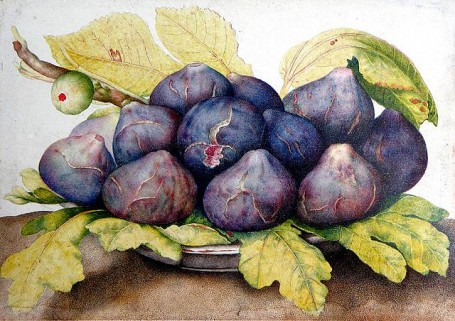
Plums and Fig Leaves, Giovanna Garzoni
My email prompted her to look through more of Garzoni’s work. She described scrolling through her paintings as a decadent indulgence . . .
Her pears are frequently ripe to spoiling, their curvilinear shapes, abstractions; her peas become beauty queens; her hazelnuts are visited and revisited, frocked and defrocked…her asparagus kick their pink heels sideways in a cancan at the Folies Bergère, with carnations in their hair… these are dreams and fantasies... delightful, highly personalized poems and messages, which leave me wondering about Giovanna herself. remarkable! (what do you think she was like? what drove her?…)
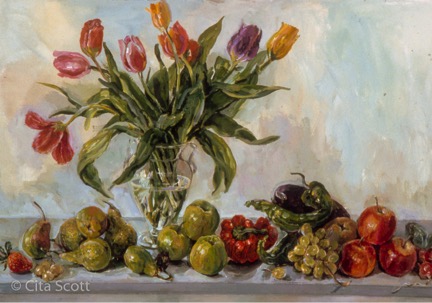
Stillscape, Cita Scott
Cita’s Scott’s still life paintings of flowers and fruit make me think that they are revelers at a wild bacchanalia. In the painting above the apples tantalizingly touch each other, the pepper desires the eggplant, and the grapes are about to burst with juice. (You can see more of her work at citascott.com.) I don’t’ know if Scott would agree that Garzoni influenced her painting, but I certainly see a connection. And I am grateful that Garzoni’s art helped to reconnect us.
When you next pick up an apple or cherry or grape, take a good look at it, it’s color, shape, substance, light — and, be a painter for a moment, appreciate its ecstatic presence. Then enjoy.
Search Blog
-
2025
- May 9, 2025 A View from the Tractor Seat
- Apr 11, 2025 Dig
-
2024
- Jan 7, 2024 Winter Wassail
-
2022
- Dec 11, 2022 Keeping Time
- Jun 17, 2022 This Apple-Shaped Earth
- Jan 23, 2022 What is a Jizo?
- Jan 16, 2022 An Invite and Housekeeping Update
- Jan 1, 2022 The Year of the Frog: What Orchardists Do While Apple Trees are Chilling
-
2021
- Oct 24, 2021 Figs
- Oct 3, 2021 The Artist and the Orchard: A Memoir
- Aug 8, 2021 Red-Fleshed Apples
- Jul 25, 2021 When We Were Trees
- Jun 27, 2021 Castor Beans—Who Knew?
- Jun 13, 2021 Spring Training at a Zen Monastery
- May 4, 2021 Our Trees are in Bloom
- Apr 18, 2021 Hooray!
- Jan 24, 2021 Wassailing, virtually!
- Jan 1, 2021 Sitting
-
2020
- Dec 21, 2020 Darkness to Light
- Nov 28, 2020 One Heart
- Sep 18, 2020 Juggling Flowers, Fruit, and Vegetables
- Aug 23, 2020 Refuge
- Aug 9, 2020 Bags of Fertilizer
- Aug 2, 2020 The Sermon of the Blue Heron
- Jul 26, 2020 What's the Buzz?
- Jul 19, 2020 Farm Moments
- Jul 12, 2020 Lost Wax
- Jul 5, 2020 Catalpa: The Hugging Tree
- Jun 28, 2020 Pedaling Peace
- Jun 21, 2020 See Change
- Jun 14, 2020 Lalla Unveiled
- Jun 7, 2020 Pond Alchemy
- May 31, 2020 The Birth of Fruit
- May 24, 2020 An Artist in the Orchard
- May 17, 2020 Walking the Land: Returning Home
- May 10, 2020 Stinging Nettles: Gifts from the Great Mother
- May 3, 2020 The Mystery of Swallow
- Apr 26, 2020 Aerial Bruststrokes
- Apr 19, 2020 Simple Pleasures
- Apr 12, 2020 Weeds and Other Gifts
- Apr 5, 2020 Remembering the Seeds
- Mar 29, 2020 Blow on the Embers
- Mar 22, 2020 Ripples
-
2019
- Nov 16, 2019 Tibet Impressions
- Nov 9, 2019 Forest Tales
- Oct 13, 2019 The Gift
- Aug 4, 2019 The Season is Apples, Berries, and Grandfather Fire
- Jun 8, 2019 Pointers for a Writing Life
- May 12, 2019 Mothers of the Earth
- Apr 6, 2019 The Apple-Shaped Earth
- Mar 23, 2019 You Don’t Know What You Have Till It’s Gone
- Feb 23, 2019 Generations
- Feb 9, 2019 What Are We Doing to the Earth, John Chapman?
-
2018
- Dec 31, 2018 Long Shadows
- Oct 6, 2018 A Pilgrimage to India
- Aug 18, 2018 Scrap Wrenn
- Aug 11, 2018 Off-the-Wall Comments from an Ignorant Farmer
- Jul 28, 2018 Creative Connect
- Jul 14, 2018 How is the Orchard?
- Jun 30, 2018 Which Way?
- Jun 16, 2018 Geese, Herons, Beavers, and the Baby Steps of a Lapsed Blogger
- Feb 24, 2018 Mama's Coupons — Good Forever
- Jan 27, 2018 January Ice
- Jan 13, 2018 The Muse
-
2017
- Dec 30, 2017 A Dream for the New Year
- Dec 23, 2017 A New Year for Apples
- Dec 16, 2017 Intuition
- Nov 22, 2017 Thanksgiving OM
- Nov 4, 2017 East Fork Pottery
- Oct 28, 2017 Putting Down New Roots
- Oct 21, 2017 A is for Art
- Oct 14, 2017 Eve domesticus
- Oct 7, 2017 A String Workshop
- Sep 30, 2017 After Applepicking
- Sep 23, 2017 Two Bad Women and One Good Apple
- Sep 16, 2017 Plein Air Poetry
- Sep 9, 2017 Cutting Off a Leg
- Sep 2, 2017 The Changing Landscape
- Aug 26, 2017 All About Art
- Aug 19, 2017 My First Visit to the Farm
- Aug 12, 2017 The First Food
- Aug 5, 2017 A Teapot, a Woman, and maybe a Boat
- Jul 29, 2017 A Raspberry Dilemma
- Jul 22, 2017 Consider the Miracle
- Jul 15, 2017 Meeting Ekphrasis
- Jul 8, 2017 Ripening Fruit
- Jul 1, 2017 The Voice of The Caterpillar
- Jun 24, 2017 Goumi — An Unusual Fructus
- Jun 17, 2017 Concord, an American Bloomsbury
- Jun 10, 2017 The World Is Bonkers — Shall I Laugh or Cry?
- Jun 3, 2017 Bonkers, a Revolutionary Apple
- May 27, 2017 Guardians of the Swamp
- May 20, 2017 There are Mushrooms and There are Morels
- May 13, 2017 "What's in a Name?"
- May 6, 2017 Bloom Follows Pink: Orchard Pollination
- Apr 29, 2017 The Orchard Is at Pink
- Apr 22, 2017 Natural Farming — Part 2 (continuation from last Sunday's blog)
- Apr 15, 2017 Natural Farming — Part 1
- Apr 8, 2017 Boats, Figures, and Catching Fish
- Apr 1, 2017 A Man with a Mission: The Nuts and Bolts of Bronze Casting
- Mar 25, 2017 A Chalice of Spirit, Art, and Nature
- Mar 18, 2017 Hanami — Blossom Viewing
- Mar 11, 2017 Soil Redemption Song
- Mar 4, 2017 Food is Primary Care
- Feb 25, 2017 Pomme de Terre
- Feb 18, 2017 Organic Certification
- Feb 11, 2017 Tantalizing Fruit
- Feb 4, 2017 The Myths of History
- Jan 28, 2017 The Orchard in Winter
- Jan 21, 2017 The Hi-Line
- Jan 14, 2017 Artistic, Botanical, and Social Diversity
- Jan 7, 2017 Where is Eden?
-
2016
- Dec 31, 2016 The Creative Heart
- Dec 24, 2016 A Christmas Tale
- Dec 17, 2016 Who are the Crones?
- Dec 10, 2016 The Olympic Bell (Part Two)
- Dec 3, 2016 Overheard in the Apple Orchard in Early December
- Nov 26, 2016 The Lessons of a Tortoise
- Nov 19, 2016 In the Studio
- Nov 12, 2016 Even in Darkness
- Nov 5, 2016 Southern Apples, an Elephant, Monkey, Rabbit, and Bird, Two Mango Trees and a Birthday
- Oct 29, 2016 The Tools of Art
- Oct 22, 2016 Labyrinths
- Oct 15, 2016 Repairing the Broken
- Oct 8, 2016 When You Are No More
- Oct 1, 2016 Creation Rain
- Sep 24, 2016 Breaking the Glass
- Sep 17, 2016 String Art
- Sep 10, 2016 Poetry and Photosynthesis: It's all in the Leaves
- Sep 3, 2016 In the Plenty of Time
- Aug 27, 2016 Witch Doctors
- Aug 20, 2016 Listen Coyote
- Aug 13, 2016 Milkweed in the Orchard
- Aug 6, 2016 Some People See a Turtle
- Jul 30, 2016 Arborshaping
- Jul 23, 2016 Joseph Wheelwright: Sculptor of Stones and Trees
- Jul 16, 2016 Asian Pears
- Jul 9, 2016 Gold Leaf, Grief, and the Creative Process
- Jul 2, 2016 The Olympic Bell (Part One)
- Jun 25, 2016 Around the Mulberry Bush
- Jun 18, 2016 Avoiding Apples
- Jun 11, 2016 Fructus
- Jun 4, 2016 Astonishing Apples
- May 28, 2016 Scare the Caterpillars
- May 21, 2016 Join the Club!
- May 14, 2016 The Graft
- May 7, 2016 Rooster, Rhubarb, Rue
- Apr 30, 2016 What do Dolphins and Nettles Have in Common?
- Apr 23, 2016 Art Prunings
- Apr 16, 2016 A Few of the First Arrivals
- Apr 9, 2016 Taste the Spirit of Sustainable Agriculture
- Apr 2, 2016 First Orchard Spray - March 22-24, 2016
- Mar 26, 2016 Hawkeye Apple
- Mar 19, 2016 Desiring the Almata Apple
- Mar 12, 2016 Ugly Fruit
- Mar 5, 2016 Winter Tracks
- Feb 27, 2016 Splash
- Feb 20, 2016 Pruning
- Feb 13, 2016 Orchard Ruminants
- Feb 6, 2016 A Gathering of Seeds
- Jan 30, 2016 Orchard Dragons
- Jan 23, 2016 Tree Rings
- Jan 17, 2016 The Fallen Tree
- Jan 7, 2016 Wassailing the Apple Trees
- Jan 1, 2016 The New Year