LINDA HOFFMAN
A Dream for the New Year
I went to sleep not having written a blog and this dream woke me . . .
I was in a room and it was time. My mind was clear and present. I agreed to have the injection that would end my life. But when a tall man with a black suit and white shirt arrived with a syringe ready to plunge the needle through my skin, I freaked. “No! No, no!” I shouted as I pulled away. He was determined and latched on, but I was thrashing wildly and ripped free of his grip. I would not give in easily, I wanted to live.
With every particle of my being, I fought back. Then I said, “Please, if I am to die now, I must tell my Zen teacher and community.” He agreed to let me go make a phone call if afterwards I would return for the needle.
I ran out of the room, ran as far and as fast I could. I was on the lam. Up and over bridges, staircases, down alleys, and across lonely boulevards. In an area with small shops I saw some boxes of biscuits and thought of snatching one, but resisted.
Then I saw my daughter. I called, “Ariel!” and again, “Ariel, come with me, please!”
She came over, I grabbed her hand, and we sprinted until we arrived on a grassy plateau. I was about to tell her what was happening when the tall man with the black suit and white shirt arrived waving the syringe. He grabbed my arm and said, “You will not escape me, now!” He jerked my right hand towards his body to plunge the needle into my wrist. He injected the fluid with great glee and strode away. But I had seen the needle catch on my sweater’s knitted cuff, the poison had not entered my body.
I had outsmarted death. I didn’t know how many more times I would be able to avoid him, but I secretly hoped for nine lives like a cat — and that when the ninth time came — I would be ready. I want no regrets, I want to go with grace.
You might wonder why such a strong dream at this turning of the year. A few days ago, I had breakfast with a friend who lost her partner to a re-occurrence of breast cancer. I have a friend struggling with depression, another paralyzed by the political turmoil in the world, and another beside herself with grief because of the destruction of the natural world. Many of us carry serious fear, and even terror.
Confucius told his followers, 'Bring peace to the old, have trust in your friends, and cherish the young.' And he lived during turbulent times. The message I received in my dream is to live life to the fullest. I am grateful for my Zen Mountain Monastery community who helped me survive in my dream as they have through difficult times. I am grateful for my daughter who brought her angelic presence to the dream as she so often does in daily life.

Ariel and I on a Hike, Selfie, 2016
Dreams have a lot to offer us. I tried to go deeper into sensing this ‘being alive’. I felt each thing awake — the singular blade of grass, the snowflake, the pink salmon. We shape the world with what we do, what we see, and what we think. Mind is what I cherish because it connects us all — each person born and unborn — each tree and star. And just maybe, the poison to my body had no effect because it will never have power over mind.
I wish you happiness and well-being in the coming year!
May you receive and offer gifts of kindness, generosity, and creativity.

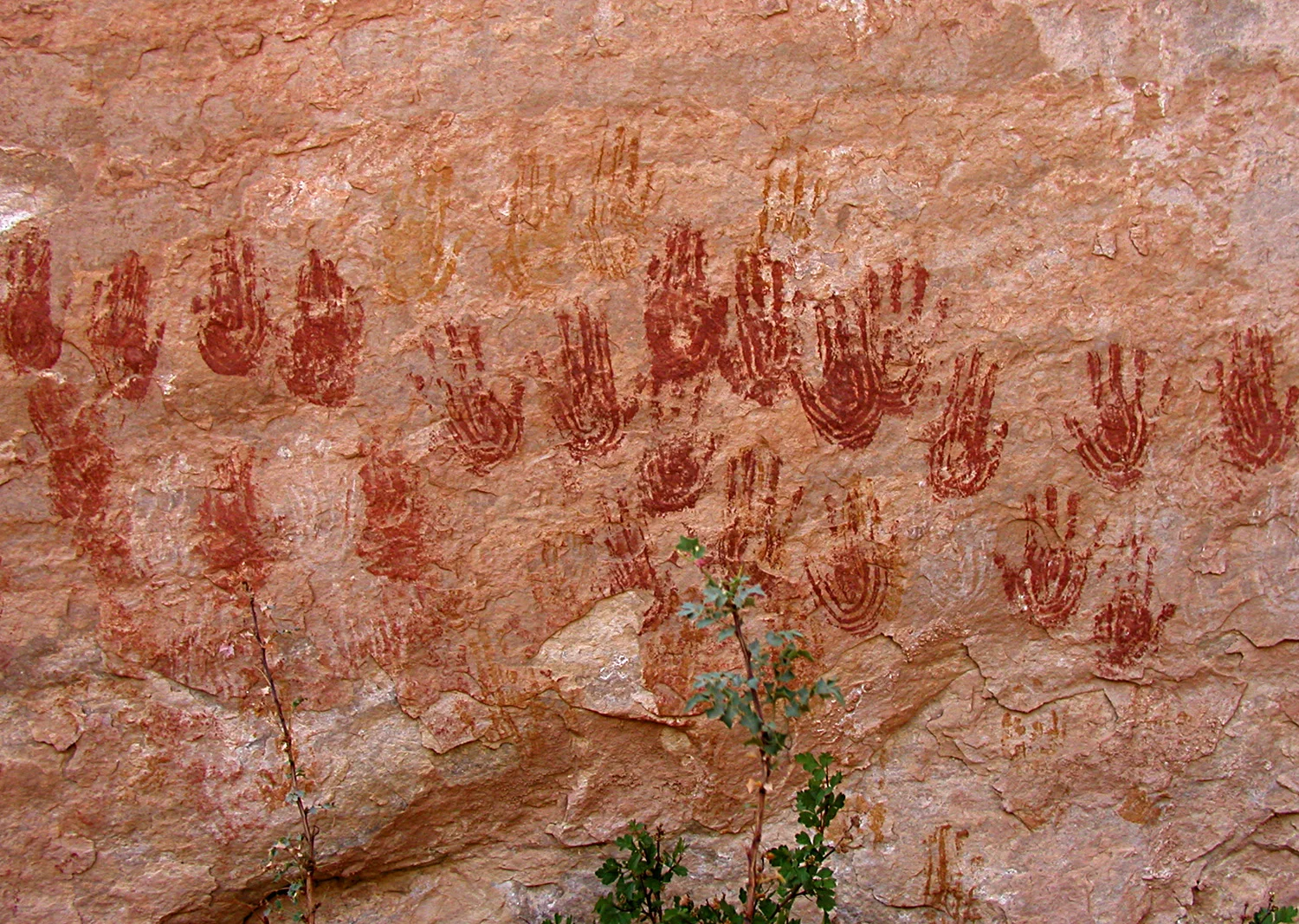
Many Hands Blessing Earth
Happy New Year 2018
Boats, Figures, and Catching Fish
Boats embody our life journey, each of us, adrift, on a vast ocean. We can only surrender to what life presents. We embark, not knowing where the wind will drive our craft. I first started making sculptures of boats in 2007, inspired by teachings of Dogen, a 13th century Japanese Zen master. His writings are short, poetic, beautiful, pithy, and quite challenging to parse. In Genjo Koan, Dogen writes:
When you ride in a boat and watch the shore, you might assume that the shore is moving. But when you keep your eyes closely on the boat, you can see that the boat moves. Similarly, if you examine myriad things with a confused body and mind you might suppose that your mind and nature are permanent. When you practice intimately and return to where you are, it will be clear that nothing at all has unchanging self. Tr. Tanahashi et al.
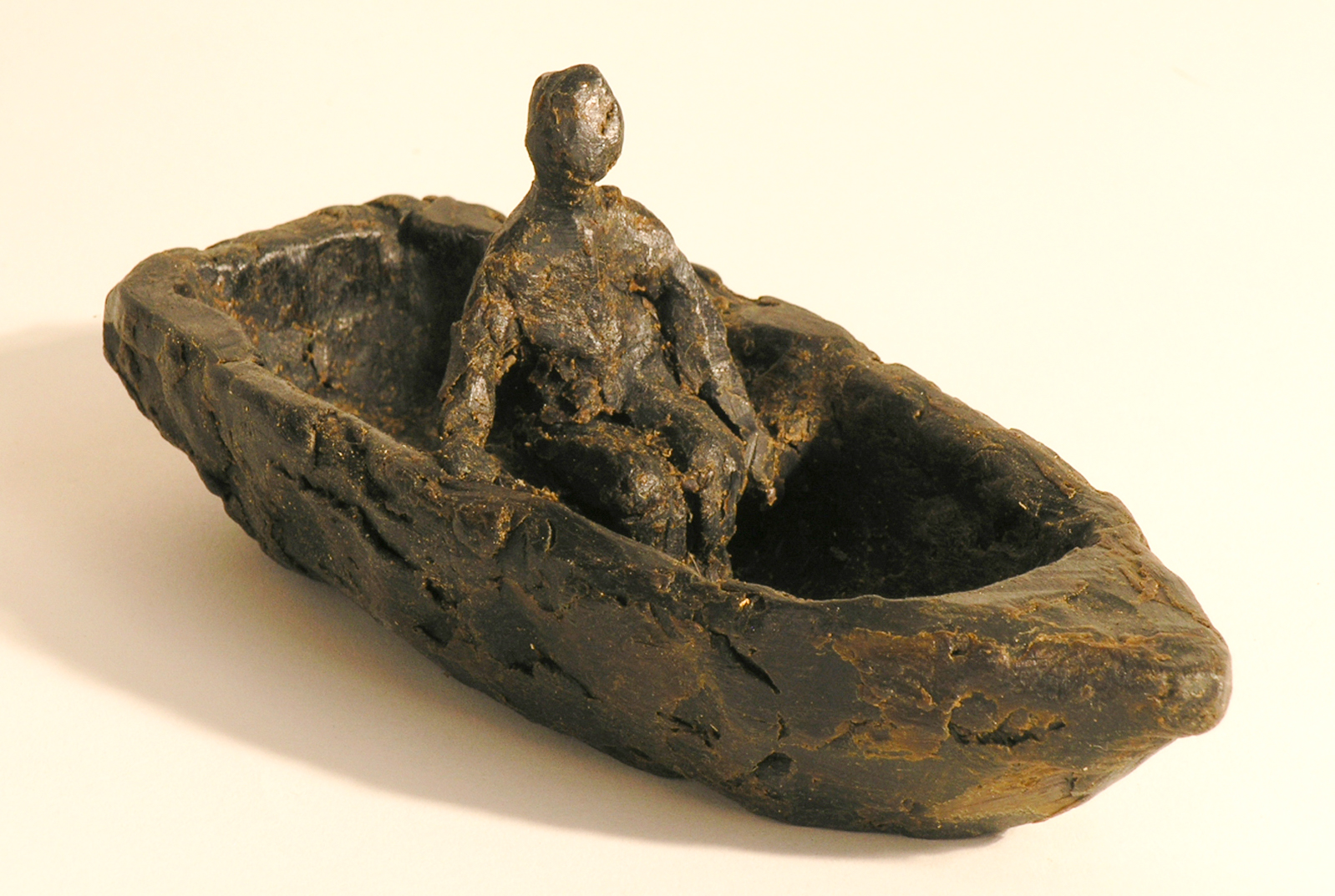
I made boats in wax — boats with one figure, boats with fish, boats with two figures, boats overturned on a beach, a figure emptying water from a boat, a figure birthing a boat. There was nothing fixed in my play with the wax sculptures — only an endless reconfiguring of figures, boats, and fish.

I showed some of these sculptures to friend and poet, Susan Edwards Richmond. She wrote, River Crossings, a poem in five parts based on several of the sculptures. It was originally published in Issue One of Wild Apples, A Journal of Nature, Art, and Inquiry that we founded together with two friends in 2005. [There are back copies still available].
A figure of wax, softened
by pinch of fingers, heel
of a hand . . .
Alone
in the river, bearing
the burden of flood, the stoking
rhythm of oars, molded to that
position, I brace for the sluice
wherever it takes me.
. . .
When I tried to push you
from the boat, a fish leapt
from the river, lodged in my arms.

Richmond’s poem has just been reprinted and is the final section in her first full full-length poetry collection, Before We Were Birds, published last month by Adastra Press. This fine collection begins with the poem sequence Boto, the mysterious freshwater Brazilian dolphin that rises from the Amazon River on full moon nights. A Boto is a shapeshifter who takes human form to catch humans, and even bring them back to live deep in the river.
In Dogen’s, Mountains and Rivers Sutra, he refers to sages who live near water and catch fish, and catch humans.
. . . from ancient times wise people and sages have often lived near water. When they live near water they catch fish, catch human beings, and catch the way. For long these have been genuine activities in water. Furthermore there is catching the self, catching catching, being caught by catching, and being caught by the way. . . Tr. Kotler and Tanahashi
In this same sutra, Dogen uses expressions like riding the clouds and following the wind to describe states of meditative practice and transcendence. The mountains and rivers are none other than our own body and mind. How do we ride the wind and cross each river?
River Crossings ends with:
…reeds
sprout back along the river, edges
grow dense with birds. I am called
neither forward nor back,
out of the water nor into it.
This is the art I practice,
the one that leaves no wake.
Susan Edwards Richmond has published four chapbooks of poetry, Increase, Purgatory Chasm, Birding in Winter, and Boto. A passionate birder, she works at Mass Audubon’s Drumlin Farm Wildlife Sanctuary. Richmond is poet-in-residence at Old Frog Pond Farm & Studio, edits the Plein Air poetry chapbook, and organizes our Plein Air Poetry event every fall. We are also working on a series of children’s books on sustainable agriculture. I am grateful, Susan, for our ever widening collaborations.
Southern Apples, an Elephant, Monkey, Rabbit, and Bird, Two Mango Trees and a Birthday
I celebrated my 60th birthday this week. My partner, Blase, gave me a first edition of the book Old Southern Apples, written by Lee Calhoun. Southern apples might sound like an oxymoron, since not many people think of the South as an Eden of apples. But over 1300 varieties originated south of the Mason-Dixon Line, and these apples are an important part of the area’s agrarian history. Old Southerners not only talk about Bloody Butcher corn and Red Ripper peas, but the now extinct apples like Fall Ambrosia (sounds so delicious), and the still available Limbertwigs.
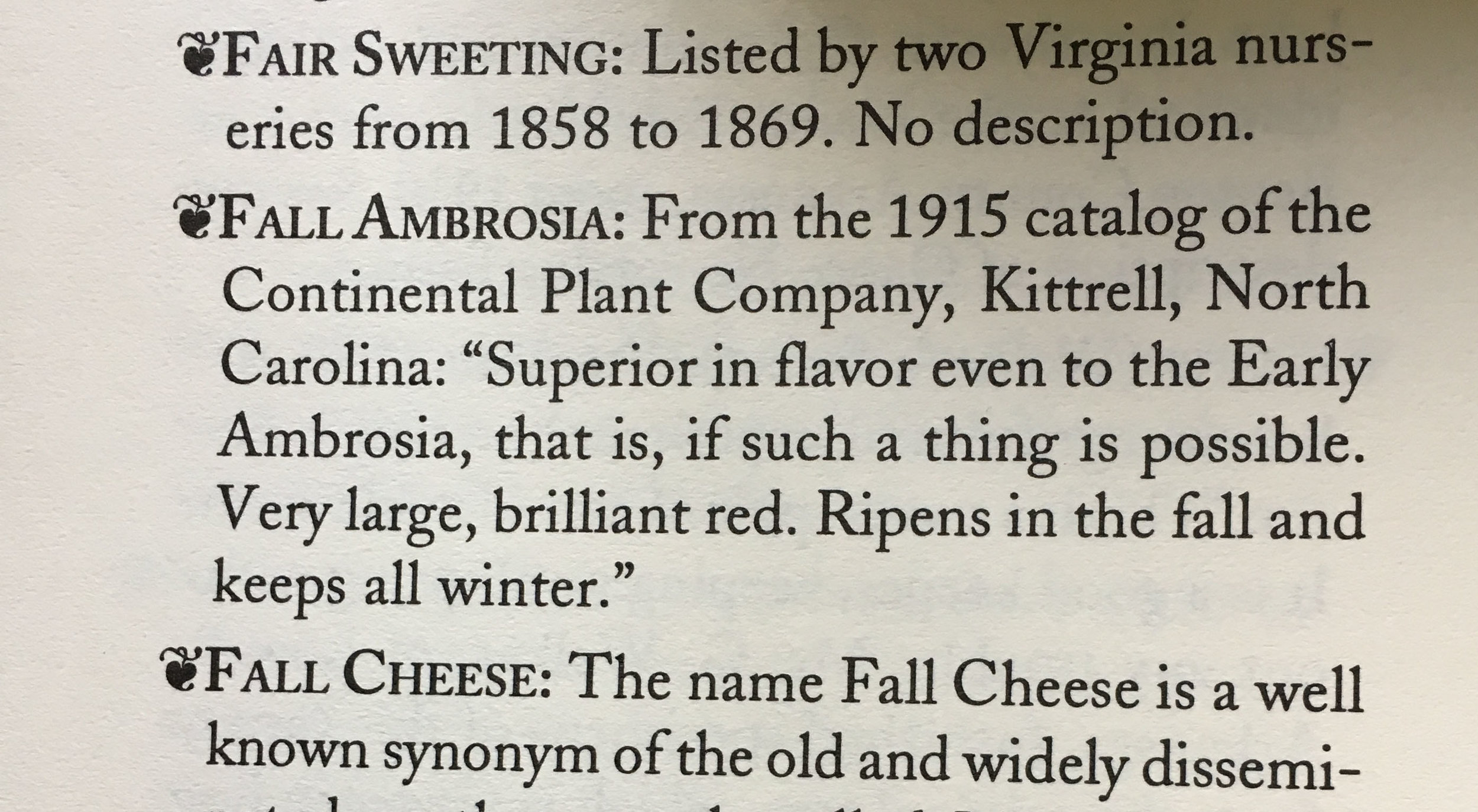
Old Southern Apples describes the unique features of over 1600 apple varieties (though 300 of them originated elsewhere but were grown in the South). The book divides these apples between 300 still growing or available at nurseries and 1300 now extinct Southern apples, the names and descriptions mostly taken from old nursery catalogues (a coincidence that both numbers are 300). The book also contains forty-eight plates of hand-painted apple pictures selected from the seven thousand in the collection of the National Agricultural Library. That was from the days when the United States Department of Agriculture hired artists!
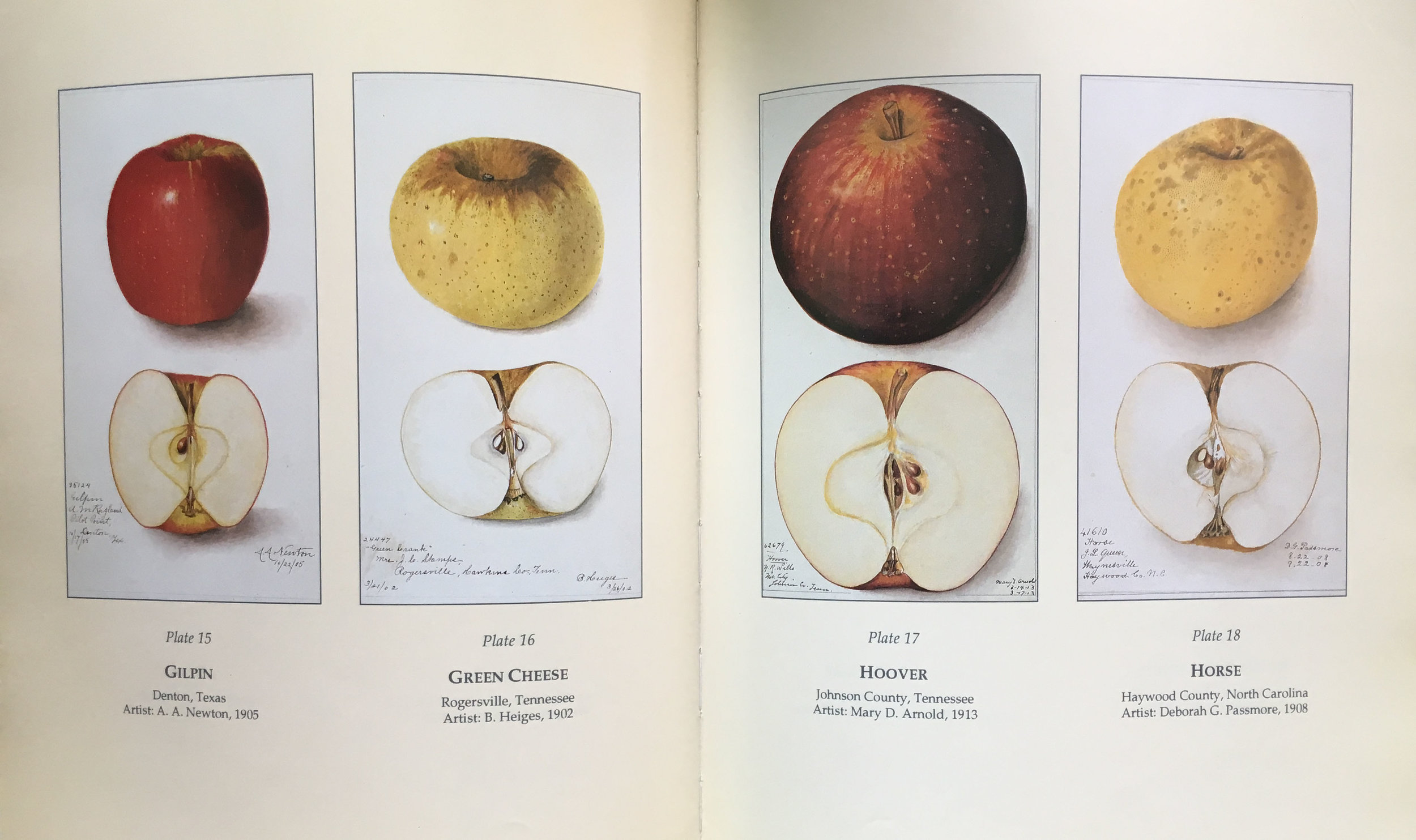
Old Southern Apples, Plates 15 - 18; Photos: Jerry Markatos
As you may know, apples grown from seed are the unique progeny of two parents, because the blossoms are cross pollinated. Most of these seeded trees crop with hard, sour, or small fruit, better for the hogs than for eating off the tree. Some apples are good for making hard cider and apple cider vinegar, but a few trees out of a thousand planted might produce unexpected, remarkable apples that would be given names and propagated. Of the 1600 apple varieties mentioned in this book, all of them grew from seed to be extraordinary apples. In the South, whether the settlers were large landowners or tenant farmers, they all planted out their orchards with seeds, they didn’t set out grafted rootstocks. It was the way it was done.
Today, it would be the rare individual who would scatter seeds to plant an orchard. After all, who would want a collection of wild apples? Large orchardists order sapling trees from wholesale nurseries in the thousands or even ten thousand. Blocks of the same variety, interspersed with another variety for pollinating, are planted. It is the researchers who cross apples and come up with new varieties for orchards to trial. A few apples become the darlings of the marketplace. This approach to apple growing is very different from the grand creativity that nature realizes with such ease. As Lao Tzu said, Nature does not hurry, yet everything is accomplished.
Inside my card, Blase tucked a print-out of a Buddhist tale. When King Mahajanaka, an earlier incarnation of the Buddha, was traveling through a park, he saw a monkey sitting on a branch of a mango tree. The King longed to stop and pick a few mangoes, but traveling with his large retinue, he had to continue without stopping. He decided he would sneak back alone that night to pick a few mangoes. That night, when he got to the grove, he lifted his torchlight and saw that someone had gotten there before him. The mango tree was stripped bare of fruit; its limbs were broken and its leaves lay scattered everywhere. He was saddened to think that this beautiful tree would likely not survive this ravagement. Then he saw another mango tree, one that had not been harmed. He realized that this tree avoided the carousing thieves because it had no fruit. The King returned and pondered his experience with the two mango trees. He decided he would renounce his title and give away everything he owned. He would become a tree without fruit. I love the story of the King Mahajanaka and the mango tree, but it could be taken as a teaching in renunciation. As many of you know, the orchard at Old Frog Pond Farm had no apples this year, and it was not because I renounced my title of orchardist.
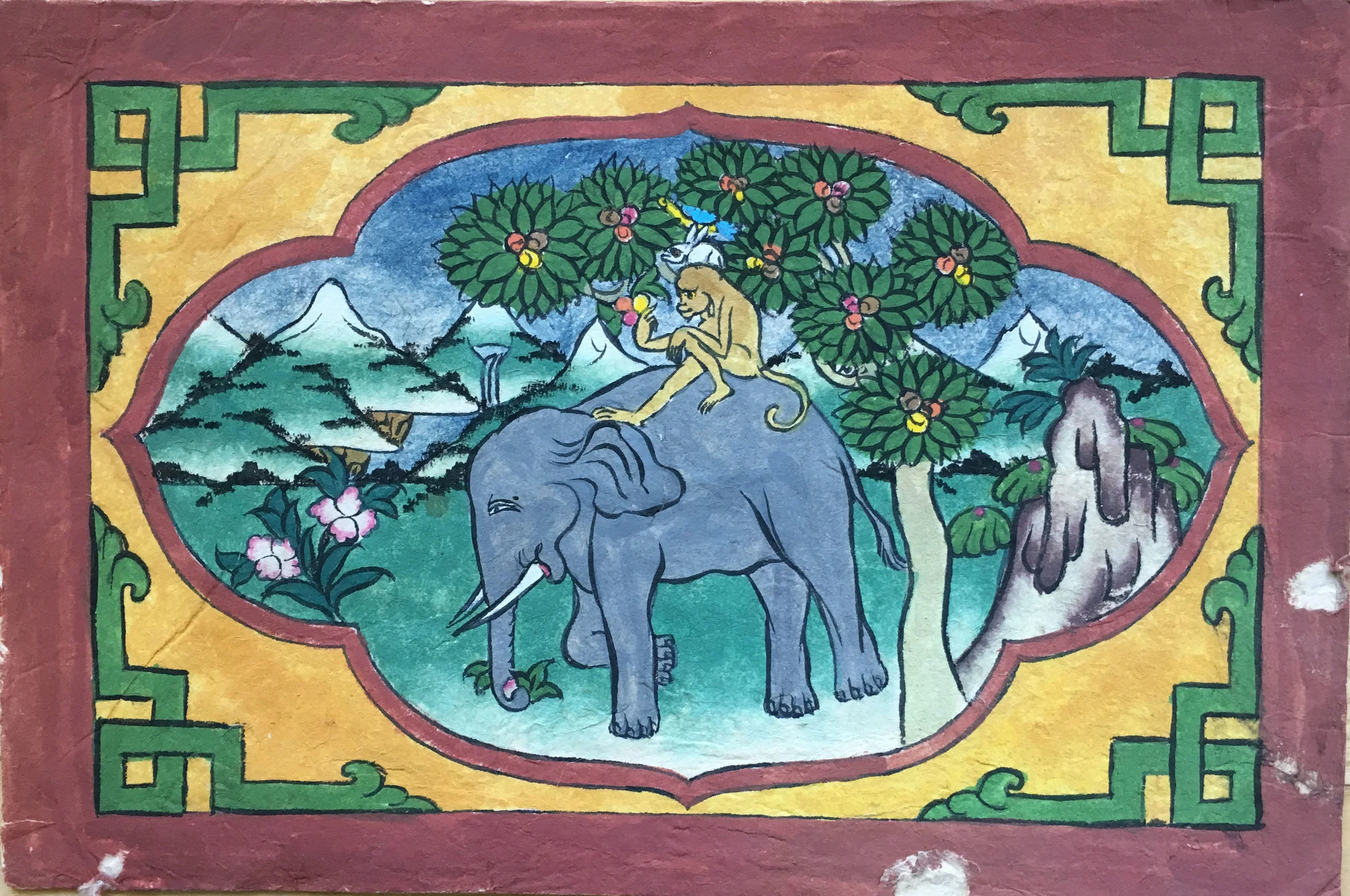
The Birthday card Blase gave me was hand painted in Bhutan; he had saved it from our trip seven years ago. It is of a bird on a rabbit on a monkey’s shoulder, on an elephant (the bird and rabbit are hard to see). They are walking under a mango tree laden with fruit. It is an illustration of the “Four Harmonious Friends,” a much loved Bhutanese tale. These animals worked together; the bird planted the seed, the rabbit watered the sapling, the monkey fertilized it, and the elephant protected it until it grew into a beautiful tree with fruit for all of them.
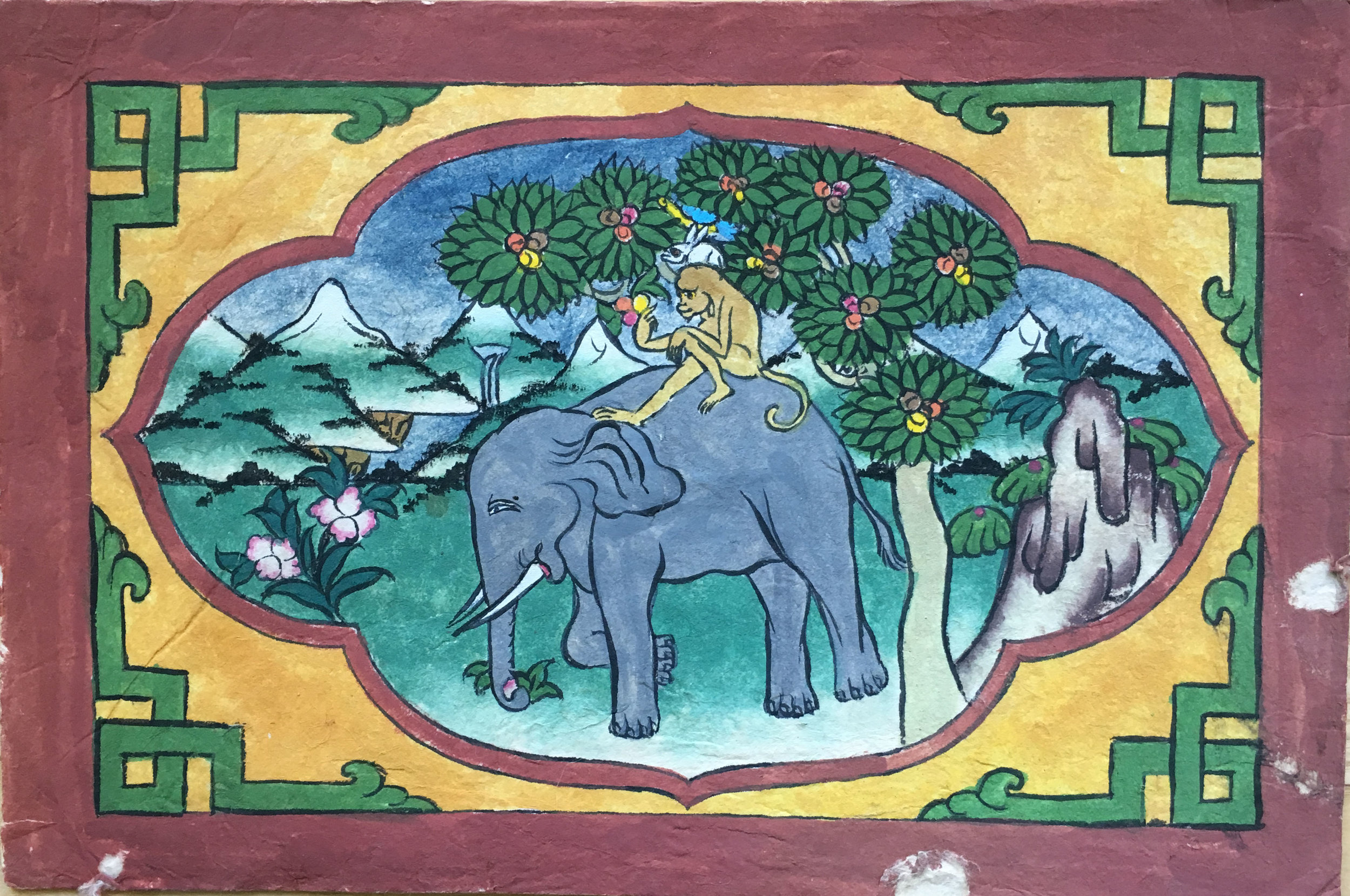
"Four Harmonious Friends" handpainted in Bhutan
I loved my gift of so many fruit related stories. Our orchard is so much more than its acres of grafted trees. It’s a language we speak and share; a wild grove of poetry, paintings, sunsets, clouds, blossoms, and, hopefully next year, delicious fruit.
Winter Tracks
A pack of hungry coyotes visited the orchard. I didn’t know until the next morning when I saw clumps of reddish brown scat — big and fat and filled with seeds and fur and rotten apples — a rich scat bursting with life. Deep holes dotted the rows. The coyotes had smelled the burrowed voles and dug to catch and eat them. I could see their tracks. My neighbor, Ed, asked if I had heard the coyotes. He said they were yipping most of the night. I said regretfully, “No. When temperatures are in the single digits we sleep with the windows closed.”
When I saw Ed the next day he said that he had seen a lone coyote leaping and twirling among the trees. He imagined she was trying to impress his border collie, Sneakers, and invite him for a tryst. Ed brought Sneakers inside the house — there’s a difference between wild and domestic creatures.
A tracker told me that the way to tell the difference between dog and coyote prints is that the coyote’s are straight, economical, and efficient while the dog’s weave back and forth, wandering here and there, as if continuously distracted. Coyote tracks are more like the long lines of an artist who is confident about her drawing. She is determined to get it right. In fact, before making a brush painting, an artist will often gather mind and body into one great ball of concentration. The release is a very decisive yet spontaneous brushstroke.
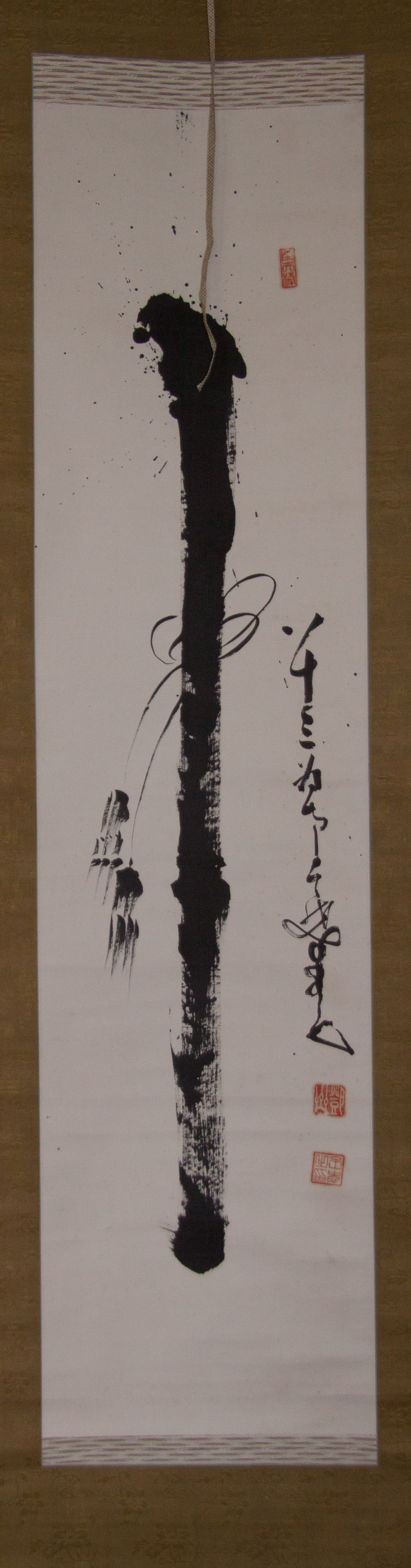
This brush painting by Nantenbo (1839-1925), a Japanese Zen teacher, is of his teaching stick. Whack! The thick black line is in your face. When I first saw the painting I felt the sting of the stick across my back. Looking at the Nantenbo calligraphy now, I think of the coyotes. That’s how hungry one has to be for food — physical as well as spiritual. Like the coyote, one has to be willing to dig deep, to prowl the darkness of lonely nights; to dig and come up empty and not give up.
Then I wondered about the delicate tassels tied around the stick. Perhaps we need to hold this powerful stick of keen determination lightly. Like that lone coyote dancing among the trees, we need light-heartedness and joy along with disciplined work. The coyote finds balance, and so can we.

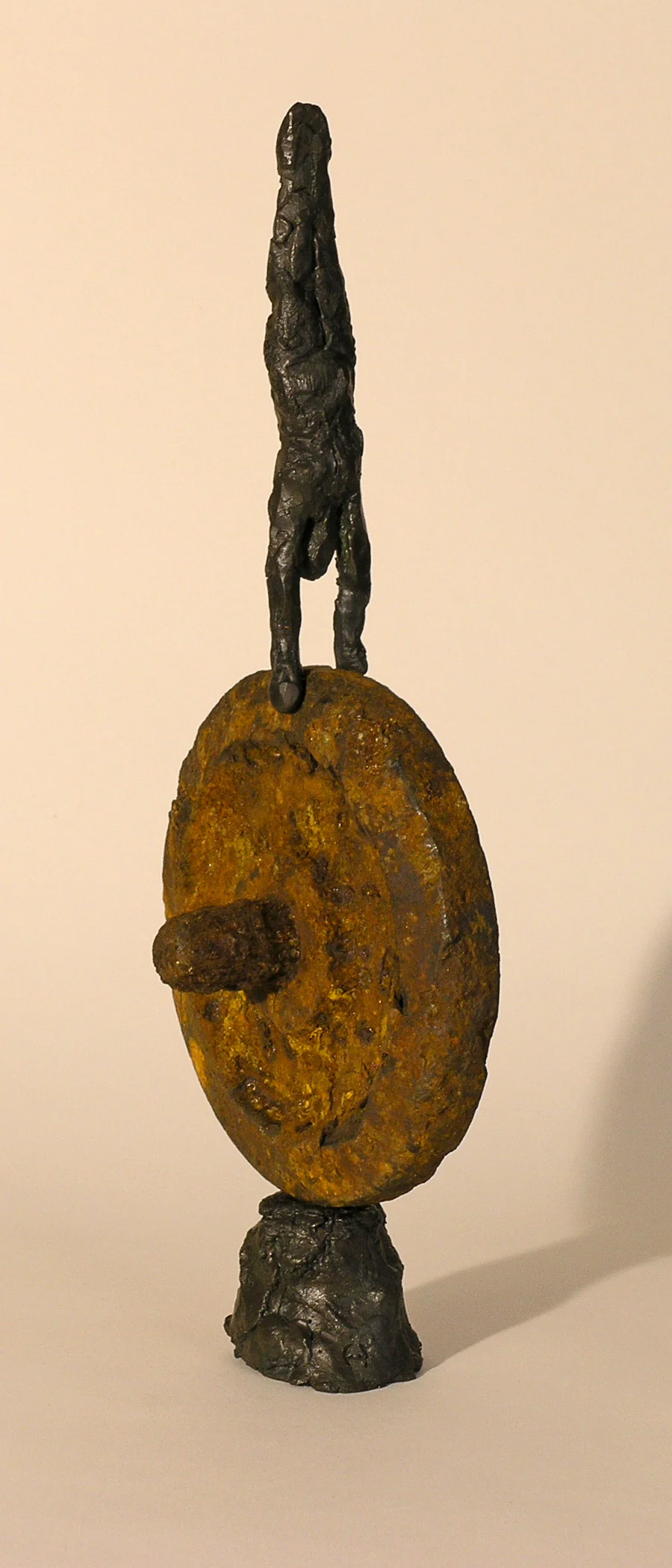
Handstand, bronze figure with found object, LH
Search Blog
-
2025
- May 9, 2025 A View from the Tractor Seat
- Apr 11, 2025 Dig
-
2024
- Jan 7, 2024 Winter Wassail
-
2022
- Dec 11, 2022 Keeping Time
- Jun 17, 2022 This Apple-Shaped Earth
- Jan 23, 2022 What is a Jizo?
- Jan 16, 2022 An Invite and Housekeeping Update
- Jan 1, 2022 The Year of the Frog: What Orchardists Do While Apple Trees are Chilling
-
2021
- Oct 24, 2021 Figs
- Oct 3, 2021 The Artist and the Orchard: A Memoir
- Aug 8, 2021 Red-Fleshed Apples
- Jul 25, 2021 When We Were Trees
- Jun 27, 2021 Castor Beans—Who Knew?
- Jun 13, 2021 Spring Training at a Zen Monastery
- May 4, 2021 Our Trees are in Bloom
- Apr 18, 2021 Hooray!
- Jan 24, 2021 Wassailing, virtually!
- Jan 1, 2021 Sitting
-
2020
- Dec 21, 2020 Darkness to Light
- Nov 28, 2020 One Heart
- Sep 18, 2020 Juggling Flowers, Fruit, and Vegetables
- Aug 23, 2020 Refuge
- Aug 9, 2020 Bags of Fertilizer
- Aug 2, 2020 The Sermon of the Blue Heron
- Jul 26, 2020 What's the Buzz?
- Jul 19, 2020 Farm Moments
- Jul 12, 2020 Lost Wax
- Jul 5, 2020 Catalpa: The Hugging Tree
- Jun 28, 2020 Pedaling Peace
- Jun 21, 2020 See Change
- Jun 14, 2020 Lalla Unveiled
- Jun 7, 2020 Pond Alchemy
- May 31, 2020 The Birth of Fruit
- May 24, 2020 An Artist in the Orchard
- May 17, 2020 Walking the Land: Returning Home
- May 10, 2020 Stinging Nettles: Gifts from the Great Mother
- May 3, 2020 The Mystery of Swallow
- Apr 26, 2020 Aerial Bruststrokes
- Apr 19, 2020 Simple Pleasures
- Apr 12, 2020 Weeds and Other Gifts
- Apr 5, 2020 Remembering the Seeds
- Mar 29, 2020 Blow on the Embers
- Mar 22, 2020 Ripples
-
2019
- Nov 16, 2019 Tibet Impressions
- Nov 9, 2019 Forest Tales
- Oct 13, 2019 The Gift
- Aug 4, 2019 The Season is Apples, Berries, and Grandfather Fire
- Jun 8, 2019 Pointers for a Writing Life
- May 12, 2019 Mothers of the Earth
- Apr 6, 2019 The Apple-Shaped Earth
- Mar 23, 2019 You Don’t Know What You Have Till It’s Gone
- Feb 23, 2019 Generations
- Feb 9, 2019 What Are We Doing to the Earth, John Chapman?
-
2018
- Dec 31, 2018 Long Shadows
- Oct 6, 2018 A Pilgrimage to India
- Aug 18, 2018 Scrap Wrenn
- Aug 11, 2018 Off-the-Wall Comments from an Ignorant Farmer
- Jul 28, 2018 Creative Connect
- Jul 14, 2018 How is the Orchard?
- Jun 30, 2018 Which Way?
- Jun 16, 2018 Geese, Herons, Beavers, and the Baby Steps of a Lapsed Blogger
- Feb 24, 2018 Mama's Coupons — Good Forever
- Jan 27, 2018 January Ice
- Jan 13, 2018 The Muse
-
2017
- Dec 30, 2017 A Dream for the New Year
- Dec 23, 2017 A New Year for Apples
- Dec 16, 2017 Intuition
- Nov 22, 2017 Thanksgiving OM
- Nov 4, 2017 East Fork Pottery
- Oct 28, 2017 Putting Down New Roots
- Oct 21, 2017 A is for Art
- Oct 14, 2017 Eve domesticus
- Oct 7, 2017 A String Workshop
- Sep 30, 2017 After Applepicking
- Sep 23, 2017 Two Bad Women and One Good Apple
- Sep 16, 2017 Plein Air Poetry
- Sep 9, 2017 Cutting Off a Leg
- Sep 2, 2017 The Changing Landscape
- Aug 26, 2017 All About Art
- Aug 19, 2017 My First Visit to the Farm
- Aug 12, 2017 The First Food
- Aug 5, 2017 A Teapot, a Woman, and maybe a Boat
- Jul 29, 2017 A Raspberry Dilemma
- Jul 22, 2017 Consider the Miracle
- Jul 15, 2017 Meeting Ekphrasis
- Jul 8, 2017 Ripening Fruit
- Jul 1, 2017 The Voice of The Caterpillar
- Jun 24, 2017 Goumi — An Unusual Fructus
- Jun 17, 2017 Concord, an American Bloomsbury
- Jun 10, 2017 The World Is Bonkers — Shall I Laugh or Cry?
- Jun 3, 2017 Bonkers, a Revolutionary Apple
- May 27, 2017 Guardians of the Swamp
- May 20, 2017 There are Mushrooms and There are Morels
- May 13, 2017 "What's in a Name?"
- May 6, 2017 Bloom Follows Pink: Orchard Pollination
- Apr 29, 2017 The Orchard Is at Pink
- Apr 22, 2017 Natural Farming — Part 2 (continuation from last Sunday's blog)
- Apr 15, 2017 Natural Farming — Part 1
- Apr 8, 2017 Boats, Figures, and Catching Fish
- Apr 1, 2017 A Man with a Mission: The Nuts and Bolts of Bronze Casting
- Mar 25, 2017 A Chalice of Spirit, Art, and Nature
- Mar 18, 2017 Hanami — Blossom Viewing
- Mar 11, 2017 Soil Redemption Song
- Mar 4, 2017 Food is Primary Care
- Feb 25, 2017 Pomme de Terre
- Feb 18, 2017 Organic Certification
- Feb 11, 2017 Tantalizing Fruit
- Feb 4, 2017 The Myths of History
- Jan 28, 2017 The Orchard in Winter
- Jan 21, 2017 The Hi-Line
- Jan 14, 2017 Artistic, Botanical, and Social Diversity
- Jan 7, 2017 Where is Eden?
-
2016
- Dec 31, 2016 The Creative Heart
- Dec 24, 2016 A Christmas Tale
- Dec 17, 2016 Who are the Crones?
- Dec 10, 2016 The Olympic Bell (Part Two)
- Dec 3, 2016 Overheard in the Apple Orchard in Early December
- Nov 26, 2016 The Lessons of a Tortoise
- Nov 19, 2016 In the Studio
- Nov 12, 2016 Even in Darkness
- Nov 5, 2016 Southern Apples, an Elephant, Monkey, Rabbit, and Bird, Two Mango Trees and a Birthday
- Oct 29, 2016 The Tools of Art
- Oct 22, 2016 Labyrinths
- Oct 15, 2016 Repairing the Broken
- Oct 8, 2016 When You Are No More
- Oct 1, 2016 Creation Rain
- Sep 24, 2016 Breaking the Glass
- Sep 17, 2016 String Art
- Sep 10, 2016 Poetry and Photosynthesis: It's all in the Leaves
- Sep 3, 2016 In the Plenty of Time
- Aug 27, 2016 Witch Doctors
- Aug 20, 2016 Listen Coyote
- Aug 13, 2016 Milkweed in the Orchard
- Aug 6, 2016 Some People See a Turtle
- Jul 30, 2016 Arborshaping
- Jul 23, 2016 Joseph Wheelwright: Sculptor of Stones and Trees
- Jul 16, 2016 Asian Pears
- Jul 9, 2016 Gold Leaf, Grief, and the Creative Process
- Jul 2, 2016 The Olympic Bell (Part One)
- Jun 25, 2016 Around the Mulberry Bush
- Jun 18, 2016 Avoiding Apples
- Jun 11, 2016 Fructus
- Jun 4, 2016 Astonishing Apples
- May 28, 2016 Scare the Caterpillars
- May 21, 2016 Join the Club!
- May 14, 2016 The Graft
- May 7, 2016 Rooster, Rhubarb, Rue
- Apr 30, 2016 What do Dolphins and Nettles Have in Common?
- Apr 23, 2016 Art Prunings
- Apr 16, 2016 A Few of the First Arrivals
- Apr 9, 2016 Taste the Spirit of Sustainable Agriculture
- Apr 2, 2016 First Orchard Spray - March 22-24, 2016
- Mar 26, 2016 Hawkeye Apple
- Mar 19, 2016 Desiring the Almata Apple
- Mar 12, 2016 Ugly Fruit
- Mar 5, 2016 Winter Tracks
- Feb 27, 2016 Splash
- Feb 20, 2016 Pruning
- Feb 13, 2016 Orchard Ruminants
- Feb 6, 2016 A Gathering of Seeds
- Jan 30, 2016 Orchard Dragons
- Jan 23, 2016 Tree Rings
- Jan 17, 2016 The Fallen Tree
- Jan 7, 2016 Wassailing the Apple Trees
- Jan 1, 2016 The New Year