LINDA HOFFMAN
Avoiding Apples
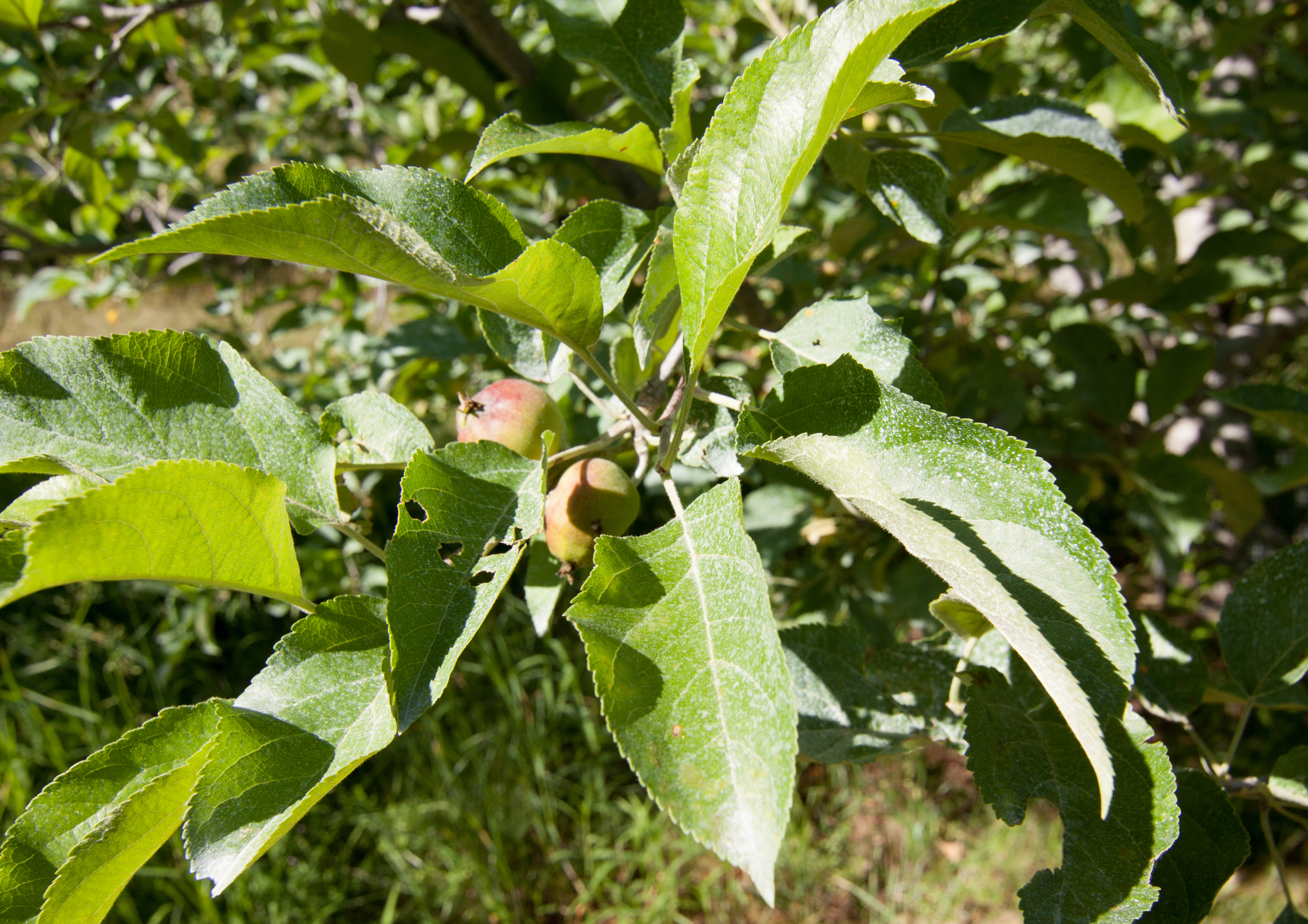
Last week I got an email from our local Harvard weekly newspaper asking about the crop this year.
Hi Linda,
I’m doing a piece this week on this year’s apple crop damage. Frank Carlson is estimating a crop that will be about 50 to 75 percent of an average year’s crop. Are you seeing that kind of damage to your crop? He said his Cortlands were hit the hardest, but Macs are also off.
Are your raspberries ok?
Let me know, sad year for the orchards, especially those who grow peaches.
Thanks,
Joan
Frank Carlson is the patriarch of the orchard world in Harvard. When I first decided to bring back our trees, I called him. I felt shy about disturbing the man who was running the largest orchard in town, but I needed to make a connection with someone who knew about apples. Frank told me to come by, but when I arrived, I wasn’t really sure why I was there. It was harvest time, and there were towers of wooden crates filled with freshly picked apples. Frank was a mini-cyclone, answering his pager, cell phone, and loudspeaker calls, but he still took the time to chat with me in between answering questions that came at him from all sides.
Nodding, he said, “I’m familiar with A & M Orchards.” I told him that its new name was Old Frog Pond Farm and that I wanted to grow organic apples. “A small operation that is organic might work,” he continued. I sensed a sympathetic familiarity among anyone growing apples. I appreciated Frank’s openness and drove away with a glimmer of hope. This year is a different story.
I wrote back to the Harvard Press reporter,
Dear Joan,
Yes - a sad year!
Our apples are certainly down 50 percent. It is variety dependent. The late flowering ones are all right, but varieties that flowered early were killed off by the frost.
Raspberries are doing well and it seems like a bumper crop of blueberries.
We have a few peaches…enough for us to eat; but indeed a very sad year for peach growers.
I think climate change is wreaking havoc with our perennial fruit crops. They suffer from these wild temperature fluctuations early in the season when the buds and blossoms are so vulnerable.
Linda

Climate change is the biggest factor affecting all of us. Plants don’t evolve as quickly as climate change is happening. Some good news is that one approach to lowering the amount of carbon dioxide in the atmosphere is to store more carbon in the soil. The soil benefits, the plants benefit, and the earth becomes healthier.
Much of the carbon originally came from the soil and was released into the atmosphere since the industrial revolution. We have agreed that we need to reduce the carbon in the atmosphere but where can it go? Water covers 70 percent of our planet and when carbon combines with water it forms carbonic acid raising the acidity of the water and killing off plant life. Soil can take back and store carbon if we change our approach to industrial agriculture and land use.
One of the most important practices is to cover every square foot of soil with plants. Erosion is a number one cause of the loss of carbon. The second practice is to avoid tilling the soiling or minimally till. Tilling exposes soil to the air and releases carbon. Plants do the opposite through photosynthesis. Even if our fruit trees aren’t producing peaches and apples, they are removing carbon from the atmosphere.
The French government recently put forward an initiative, 4p1000.org with the goal of mitigating climate change effects through agriculture. Already 28 countries have signed on including France, Mexico, Japan — no, not the United States. The benefit of carbon rich soils is that the plants become more resilient. When we eat the food produced by these healthier plants, human health also improves.
While this year we may not have a good apple crop, hopefully by continuing to support our trees and encouraging their growth, they will become stronger and be able to adjust better to the fluctuations in temperatures that are certainly going to be part of our lives for the next decades. Climate Change Boston has just released their projections for Boston that include 90 days of summer over 90 degrees, which is essentially all of summer.
Still, it’s a sad year for fruit growers and the reason I have been avoiding writing about apples. The trees may be luscious with leaves, but there is really very little fruit. Truthfully, my estimate is far less than 50 percent, but I hate to say it. It’s so disappointing, and then I think that maybe I did something wrong, or that I could have done something differently.
Frank Carlson said that people are already calling for peaches. Their annual peach festival attracts a large following every year. It won’t happen this year, but they will be celebrating their 80th anniversary this summer. When the fruit is not as plentiful, your orchards need your support even more. Even if our apples aren’t plentiful, we hope you will come for raspberry picking, vegetables, workshops, our Plein Air Poetry Walk, and Outdoor Sculpture exhibits. This year we celebrate our 15th anniversary!
Fructus
I am sitting with a bowl of cherries beside me and am reminded of the little-known painter, Giovanna Garzoni (1600 -1670). Garzoni spent most of her life in Rome painting vibrant still life paintings which were collected by her many patrons who appreciated her earthy sensuality and botanical realism. The fruits she painted are not idealized specimens, but real fruit, perhaps picked from trees nearby, with blemishes and crinkled leaves, even an occasional insect hovering. Her choice of watercolor and tempera rather than oils gives spontaneity to her paintings.

Bowl of Cherries, Giovanna Garzoni
Garzoni clearly loved to paint fruit. In common usage, the word fruit refers to the sweet and fleshy product of a tree or plant that contains seeds and is eaten as food. An apple, as well as mango or pear all fit this description. The botanical explanation is a little more specific — any part of a seed-bearing plant that contains the fertilized seeds that will produce a new plant. But I like the definition of fruit that comes from the derivation of the word — from Middle English, via Old French, from the Latin fructus meaning enjoyment.
Giovanna Garzoni was also known as the chaste Giovanna. Though she married briefly, her marriage was annulled (you couldn’t divorce back then) because it had never been consummated. Her male biographer wrote that she took a vow of chastity; also, that her father thought her husband was practicing witchcraft and urged her to divorce him.
These explanations seem a little confusing. It’s men, after all, who have written her biography. She was one of the few women in the 17th century who received an education and was financially independent. She worked in Venice, Florence, Turin, Naples, and finally settled in Rome. She traveled to Paris and London. Apparently her paintings were in so much demand that she could charge whatever she wanted.
From my perspective, because of her dedication to her art, she knew that she needed to create a life where she could be free. Had she had children, she would not have been able to work full-time as a painter, traveling from city to city, often staying for weeks or months with patrons.
Who can determine whether someone is chaste or not and what exactly does this mean? Who knows, maybe the chaste Giovanna was concocted so she could annul that marriage. Maybe she had women lovers — and they didn't count in those days. How do we know that she didn’t have secret trysts? After all, her subjects were rarely allegorical or religious, heady stuff, but fruit and nature, the tactile tangible world. And remember, the derivation of fructus is enjoyment!
Her rapturous paintings certainly suggest that she experienced intimate connection with the 'other', with the world, and knew love and desire, betrayal and beauty. Unlike Cezanne’s art, her work did not influence the direction of modern art, but I think of her life and art as an inspiration, especially to other women artists.
Looking at Garzoni’s paintings reminded me of a friend, Cita Scott, I hadn’t been in contact with for 15 years, also a woman painter of exuberant still lifes. She responded immediately to my email saying, “I have always loved this fig painting — without paying any attention to who painted it. In fact, I still have some postcards of it in my desk.”
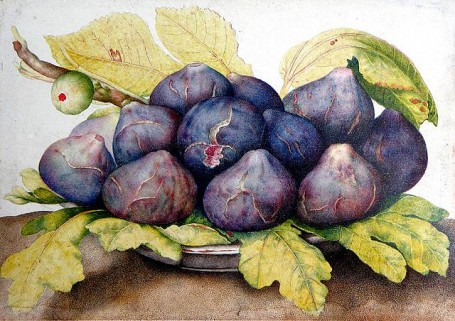
Plums and Fig Leaves, Giovanna Garzoni
My email prompted her to look through more of Garzoni’s work. She described scrolling through her paintings as a decadent indulgence . . .
Her pears are frequently ripe to spoiling, their curvilinear shapes, abstractions; her peas become beauty queens; her hazelnuts are visited and revisited, frocked and defrocked…her asparagus kick their pink heels sideways in a cancan at the Folies Bergère, with carnations in their hair… these are dreams and fantasies... delightful, highly personalized poems and messages, which leave me wondering about Giovanna herself. remarkable! (what do you think she was like? what drove her?…)
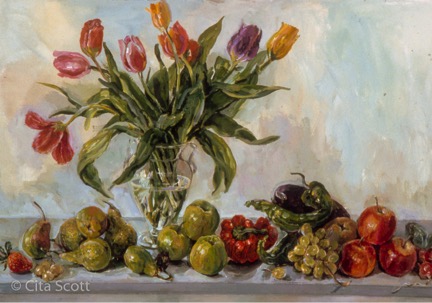
Stillscape, Cita Scott
Cita’s Scott’s still life paintings of flowers and fruit make me think that they are revelers at a wild bacchanalia. In the painting above the apples tantalizingly touch each other, the pepper desires the eggplant, and the grapes are about to burst with juice. (You can see more of her work at citascott.com.) I don’t’ know if Scott would agree that Garzoni influenced her painting, but I certainly see a connection. And I am grateful that Garzoni’s art helped to reconnect us.
When you next pick up an apple or cherry or grape, take a good look at it, it’s color, shape, substance, light — and, be a painter for a moment, appreciate its ecstatic presence. Then enjoy.
Astonishing Apples
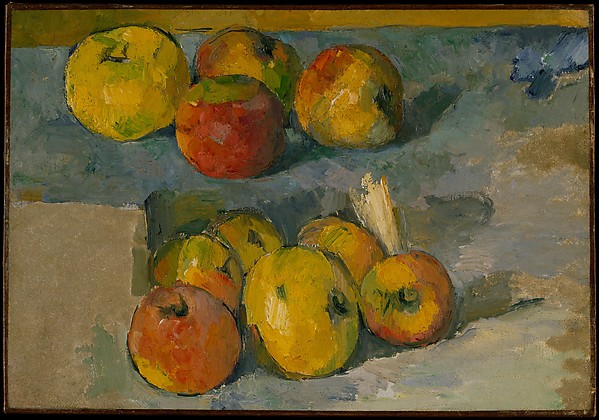
Apples, Paul Cézanne, Metropolitan Museum
The painter Paul Cézanne once said, I will astonish Paris with an apple! He painted the apple over and over — more than 250 still life paintings with apples. Some feel dark and foreboding while others are raucously joyful; but Cézanne wasn’t interested in depicting emotions, he painted light. He painted light that created shape. With small brushstrokes of color, he crafted the landscape he loved near Aix-en-Provence, the nestled houses, Mont Sainte-Victoire, rocks and trees; and back in the studio, his many magnificent still life paintings and portraits.
In the history of art, Cézanne is the beginning of modern painting. He didn’t paint like the Impressionists, with their luminous pictures of an ephemeral moment, but created solidity, the absoluteness of shape — or presence — the reality of an object as it embodies itself.
I was telling my friend, Jody Hojin Kimmel, a Buddhist priest and artist, that I was hoping to write a blog about apples and Cézanne. She told me about a little book, World View of Paul Cézanne: Psychic Interpretation, by Jane Roberts. Roberts wrote that she channeled the book from Cézanne. I found it on Amazon and looked for references to apples. (I also ordered a copy.)
The apple’s color doesn’t stay in the apple, for if you observe carefully, you will notice that the colors bleed outward, escaping the apple’s shape; and that the colors of nearby objects are also contained, however minutely, in the apple . . .
Roberts (or Cézanne) is saying that the apple is not an isolated object, but part of its surroundings. Taking this idea further suggests that the lines we give to objects are not hard and fast boundaries. And extending the idea to ourselves, to our own bodies, means we are not distinct entities. I think Cézanne would agree that there is a continuum between object and ground, between subject and object, between tree, rock, and sky. One of the important realizations of the Buddha was that we are all connected, interdependent, not separate. You might say that Cézanne’s paintings of apples were explorations into the very nature of the spiritual life.
In another reference to Cézanne’s apples, Roberts wrote,
Apples seem to have their own colors made of many combinations, and almost just above these, other colors stain the original ones. And these top colors carry more of light’s shifting characteristics, for they will seem to float above the apple in uneven layers, with peaks and valleys-‑like a colorful sea of surrounding objects, through which we peer to see the objects underneath.
Roberts is describing how Cézanne painted the layers of his perceptions, as he built up the painting of an apple with transparent colors. It’s as if the skin of the apple was multi-dimensional, kaleidoscopic.
Cézanne was completely attentive to his subject. His paintings don’t express any commentary or subtext. The apples are apples; the rocks are rocks — and the painter disappears. When people say, Oh, I can’t paint, they are talking about creating a likeness. If they really want to paint, they must become their subject completely, and the result will be art. It might not be a likeness, and it might not be great art — that takes great skill, patience, and a lifetime of dedicated practice every day. But no matter, others will sense the truth in their work, the truth of the artist’s experience. That’s why I find abstract art can be so powerful; there is a profound merging, beyond meaning, where subject and object cannot be differentiated subject.
This fall we will have an Apple Painting workshop at the farm. We’ll look at some photographs of Cézanne’s paintings and then choose apples from the orchard to arrange and paint. Let me know if you’d like to be on the list to receive information. Cézanne said, Painting from nature is not copying the object . . . it is realizing one’s sensations. We can all do that.
Scare the Caterpillars

New Apples Trees Planted in the Potato Field
What do you do about winter moth? I am considering taking over the care of some apple trees, a woman wrote in an email. Winter moths have been epidemic along the New England coast and they will defoliate mature trees and leave them vulnerable to other pests and disease. The email went unanswered, but was on my mind.
A few days later, checking the new apple trees planted this spring in the upper part of the potato field, I saw small, dark caterpillars, three to six on each of the trees. Usually at this time of year I see a few green fruit moth caterpillars, but mostly I am troubled by the pale larvae of the leaf rollers bound inside the terminal buds. These little black caterpillars were new to me. The first day, I picked them off by hand rolling them between my thumb and a finger to end their lives. The next day I returned and saw a similar number on each tree. This time I had brought a small plastic container so I could take a few back to the house to identify the pest. I even wondered if it could be the winter moth caterpillar.
I looked with my loupe, a viewer that magnifies 15 times. The caterpillar was so energetic I had trouble keeping it in the center of the loupe. It was banded, meaning it had sections evenly spaced along its body. There were orange dots in each section and two stripes, one yellow and one white, running along each side. It had tufts of black hair sticking out all over its body and a large shiny black nose. Even with all these details, after an hour of combing through hundreds of photos, I still couldn’t positively identify it. But the more awkward part was that once I engaged with this caterpillar so intimately, it became a creature that I cared about. He or she was inquisitive and determined, two characteristics that I admire in my fellow humans. I no longer felt comfortable squeezing it to death. I put these specimens into our compost pile.
I do know how serious an infestation of winter moth can be. I’ve seen two-hundred-year-old beech trees completely denuded in Falmouth and a blueberry crop decimated. There is an option of spraying an early season oil that might smother the eggs. Then there is the certified organic spray, Entrust, an insecticide made by fermenting the soil bacterium, spinosad, which will kill caterpillars who ingest it. And, of course, it will kill any other insects, friend or foe, who also ingest the spray.
I choose not to spray organic insecticides on our fruit trees, but I don’t know what I will do if I am confronted with an epidemic of winter moth. We have caterpillar damage in the main orchard, but accept it. For now, I go out with some reluctance and pick off the caterpillars from the leaves of the new, young trees. Yesterday, there were fewer. My experience with pests is that unless there is an epidemic, there’s a first flush and then given a few days, it lessens. Maybe the tree produces what it needs to repel them after identifying the problem or the birds get to them as they grow bigger. I wonder whether the caterpillars are falling off the nearby oaks and then crawling over to the apples trees or coming up from the soil where they have incubated all winter. Curiously there’s a row of blueberries running through these trees without any caterpillars. Why are they only attracted to apples?
I could go on endlessly asking questions. I am comfortable with this state of not knowing. It’s what I cultivate in meditation and it’s where my art begins. Infused with both my desire to use apple branches in my art [art prunings blog post] and this caterpillar dilemma — though not thinking about it, yesterday, I went into the studio for a few hours and finished a piece I had started a few days earlier.

“Tufted Shovel with Apple Antennae”.
Finding a title for a piece is always an important part of my art making process. It feels like the final crystallization of the work. I would never have discovered this title without the caterpillar dilemma.
Maybe like a good scarecrow, it might work if I installed it among the apple trees.
Search Blog
-
2025
- May 9, 2025 A View from the Tractor Seat
- Apr 11, 2025 Dig
-
2024
- Jan 7, 2024 Winter Wassail
-
2022
- Dec 11, 2022 Keeping Time
- Jun 17, 2022 This Apple-Shaped Earth
- Jan 23, 2022 What is a Jizo?
- Jan 16, 2022 An Invite and Housekeeping Update
- Jan 1, 2022 The Year of the Frog: What Orchardists Do While Apple Trees are Chilling
-
2021
- Oct 24, 2021 Figs
- Oct 3, 2021 The Artist and the Orchard: A Memoir
- Aug 8, 2021 Red-Fleshed Apples
- Jul 25, 2021 When We Were Trees
- Jun 27, 2021 Castor Beans—Who Knew?
- Jun 13, 2021 Spring Training at a Zen Monastery
- May 4, 2021 Our Trees are in Bloom
- Apr 18, 2021 Hooray!
- Jan 24, 2021 Wassailing, virtually!
- Jan 1, 2021 Sitting
-
2020
- Dec 21, 2020 Darkness to Light
- Nov 28, 2020 One Heart
- Sep 18, 2020 Juggling Flowers, Fruit, and Vegetables
- Aug 23, 2020 Refuge
- Aug 9, 2020 Bags of Fertilizer
- Aug 2, 2020 The Sermon of the Blue Heron
- Jul 26, 2020 What's the Buzz?
- Jul 19, 2020 Farm Moments
- Jul 12, 2020 Lost Wax
- Jul 5, 2020 Catalpa: The Hugging Tree
- Jun 28, 2020 Pedaling Peace
- Jun 21, 2020 See Change
- Jun 14, 2020 Lalla Unveiled
- Jun 7, 2020 Pond Alchemy
- May 31, 2020 The Birth of Fruit
- May 24, 2020 An Artist in the Orchard
- May 17, 2020 Walking the Land: Returning Home
- May 10, 2020 Stinging Nettles: Gifts from the Great Mother
- May 3, 2020 The Mystery of Swallow
- Apr 26, 2020 Aerial Bruststrokes
- Apr 19, 2020 Simple Pleasures
- Apr 12, 2020 Weeds and Other Gifts
- Apr 5, 2020 Remembering the Seeds
- Mar 29, 2020 Blow on the Embers
- Mar 22, 2020 Ripples
-
2019
- Nov 16, 2019 Tibet Impressions
- Nov 9, 2019 Forest Tales
- Oct 13, 2019 The Gift
- Aug 4, 2019 The Season is Apples, Berries, and Grandfather Fire
- Jun 8, 2019 Pointers for a Writing Life
- May 12, 2019 Mothers of the Earth
- Apr 6, 2019 The Apple-Shaped Earth
- Mar 23, 2019 You Don’t Know What You Have Till It’s Gone
- Feb 23, 2019 Generations
- Feb 9, 2019 What Are We Doing to the Earth, John Chapman?
-
2018
- Dec 31, 2018 Long Shadows
- Oct 6, 2018 A Pilgrimage to India
- Aug 18, 2018 Scrap Wrenn
- Aug 11, 2018 Off-the-Wall Comments from an Ignorant Farmer
- Jul 28, 2018 Creative Connect
- Jul 14, 2018 How is the Orchard?
- Jun 30, 2018 Which Way?
- Jun 16, 2018 Geese, Herons, Beavers, and the Baby Steps of a Lapsed Blogger
- Feb 24, 2018 Mama's Coupons — Good Forever
- Jan 27, 2018 January Ice
- Jan 13, 2018 The Muse
-
2017
- Dec 30, 2017 A Dream for the New Year
- Dec 23, 2017 A New Year for Apples
- Dec 16, 2017 Intuition
- Nov 22, 2017 Thanksgiving OM
- Nov 4, 2017 East Fork Pottery
- Oct 28, 2017 Putting Down New Roots
- Oct 21, 2017 A is for Art
- Oct 14, 2017 Eve domesticus
- Oct 7, 2017 A String Workshop
- Sep 30, 2017 After Applepicking
- Sep 23, 2017 Two Bad Women and One Good Apple
- Sep 16, 2017 Plein Air Poetry
- Sep 9, 2017 Cutting Off a Leg
- Sep 2, 2017 The Changing Landscape
- Aug 26, 2017 All About Art
- Aug 19, 2017 My First Visit to the Farm
- Aug 12, 2017 The First Food
- Aug 5, 2017 A Teapot, a Woman, and maybe a Boat
- Jul 29, 2017 A Raspberry Dilemma
- Jul 22, 2017 Consider the Miracle
- Jul 15, 2017 Meeting Ekphrasis
- Jul 8, 2017 Ripening Fruit
- Jul 1, 2017 The Voice of The Caterpillar
- Jun 24, 2017 Goumi — An Unusual Fructus
- Jun 17, 2017 Concord, an American Bloomsbury
- Jun 10, 2017 The World Is Bonkers — Shall I Laugh or Cry?
- Jun 3, 2017 Bonkers, a Revolutionary Apple
- May 27, 2017 Guardians of the Swamp
- May 20, 2017 There are Mushrooms and There are Morels
- May 13, 2017 "What's in a Name?"
- May 6, 2017 Bloom Follows Pink: Orchard Pollination
- Apr 29, 2017 The Orchard Is at Pink
- Apr 22, 2017 Natural Farming — Part 2 (continuation from last Sunday's blog)
- Apr 15, 2017 Natural Farming — Part 1
- Apr 8, 2017 Boats, Figures, and Catching Fish
- Apr 1, 2017 A Man with a Mission: The Nuts and Bolts of Bronze Casting
- Mar 25, 2017 A Chalice of Spirit, Art, and Nature
- Mar 18, 2017 Hanami — Blossom Viewing
- Mar 11, 2017 Soil Redemption Song
- Mar 4, 2017 Food is Primary Care
- Feb 25, 2017 Pomme de Terre
- Feb 18, 2017 Organic Certification
- Feb 11, 2017 Tantalizing Fruit
- Feb 4, 2017 The Myths of History
- Jan 28, 2017 The Orchard in Winter
- Jan 21, 2017 The Hi-Line
- Jan 14, 2017 Artistic, Botanical, and Social Diversity
- Jan 7, 2017 Where is Eden?
-
2016
- Dec 31, 2016 The Creative Heart
- Dec 24, 2016 A Christmas Tale
- Dec 17, 2016 Who are the Crones?
- Dec 10, 2016 The Olympic Bell (Part Two)
- Dec 3, 2016 Overheard in the Apple Orchard in Early December
- Nov 26, 2016 The Lessons of a Tortoise
- Nov 19, 2016 In the Studio
- Nov 12, 2016 Even in Darkness
- Nov 5, 2016 Southern Apples, an Elephant, Monkey, Rabbit, and Bird, Two Mango Trees and a Birthday
- Oct 29, 2016 The Tools of Art
- Oct 22, 2016 Labyrinths
- Oct 15, 2016 Repairing the Broken
- Oct 8, 2016 When You Are No More
- Oct 1, 2016 Creation Rain
- Sep 24, 2016 Breaking the Glass
- Sep 17, 2016 String Art
- Sep 10, 2016 Poetry and Photosynthesis: It's all in the Leaves
- Sep 3, 2016 In the Plenty of Time
- Aug 27, 2016 Witch Doctors
- Aug 20, 2016 Listen Coyote
- Aug 13, 2016 Milkweed in the Orchard
- Aug 6, 2016 Some People See a Turtle
- Jul 30, 2016 Arborshaping
- Jul 23, 2016 Joseph Wheelwright: Sculptor of Stones and Trees
- Jul 16, 2016 Asian Pears
- Jul 9, 2016 Gold Leaf, Grief, and the Creative Process
- Jul 2, 2016 The Olympic Bell (Part One)
- Jun 25, 2016 Around the Mulberry Bush
- Jun 18, 2016 Avoiding Apples
- Jun 11, 2016 Fructus
- Jun 4, 2016 Astonishing Apples
- May 28, 2016 Scare the Caterpillars
- May 21, 2016 Join the Club!
- May 14, 2016 The Graft
- May 7, 2016 Rooster, Rhubarb, Rue
- Apr 30, 2016 What do Dolphins and Nettles Have in Common?
- Apr 23, 2016 Art Prunings
- Apr 16, 2016 A Few of the First Arrivals
- Apr 9, 2016 Taste the Spirit of Sustainable Agriculture
- Apr 2, 2016 First Orchard Spray - March 22-24, 2016
- Mar 26, 2016 Hawkeye Apple
- Mar 19, 2016 Desiring the Almata Apple
- Mar 12, 2016 Ugly Fruit
- Mar 5, 2016 Winter Tracks
- Feb 27, 2016 Splash
- Feb 20, 2016 Pruning
- Feb 13, 2016 Orchard Ruminants
- Feb 6, 2016 A Gathering of Seeds
- Jan 30, 2016 Orchard Dragons
- Jan 23, 2016 Tree Rings
- Jan 17, 2016 The Fallen Tree
- Jan 7, 2016 Wassailing the Apple Trees
- Jan 1, 2016 The New Year