LINDA HOFFMAN
Milkweed in the Orchard
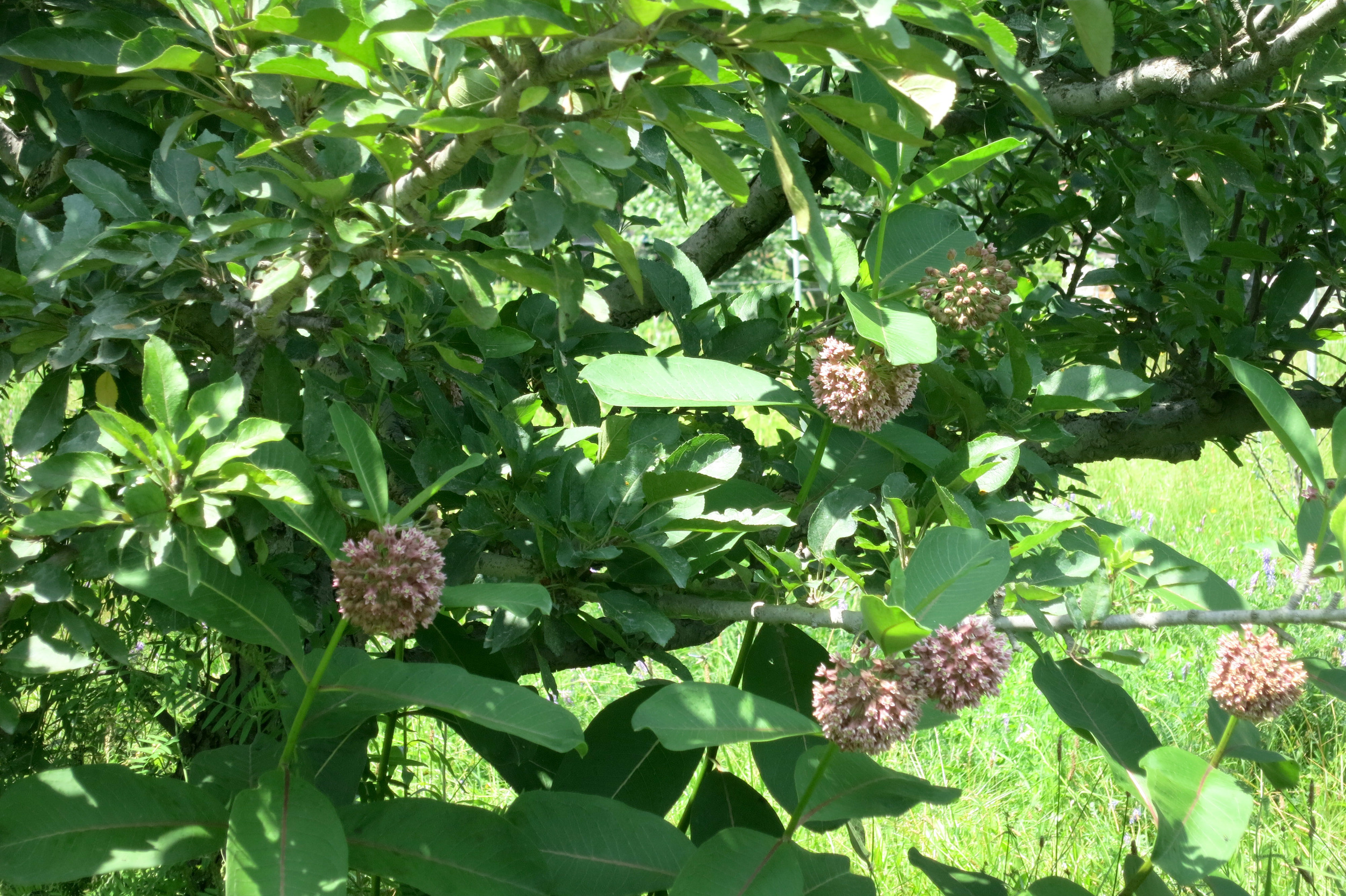
Milkweed under an Apple Tree
In the last few years, milkweed has spread exponentially throughout the orchard. We don’t mow it down, but we don’t plant it either. It is as if the earth herself has decided that we need more of it; that nature wants to help the monarch butterflies who depend on this plant for their survival. Every summer, monarchs lay their eggs on milkweed. The emerging black-, white-, and yellow-striped caterpillars begin eating around the edges of the leaves, and even absorb a substance from their host that provides a defense against predators.
But where are the monarchs? Their numbers have been decreasing steadily for the last twenty years. In fact, the Endangered Species Coalition reports that North American monarchs have declined by ninety percent since the mid 90’s. During the first few years of tending the orchard, I would see monarchs daily when the milkweed was in bloom. This year I have yet to see one.
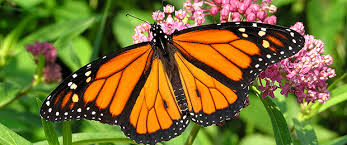
One reason for their decline is the loss of milkweed habitat. Much of this acreage is now planted with corn and soybeans, and the fields are sprayed with Monsanto’s Roundup. (In 1995, 10 million pounds of Roundup was used on corn and soybeans, and, by 2013, the total pounds rose to 204 million.) Roundup destroys all weeds – including milkweed! I’ve known about the horrors of Roundup, but I didn’t realize that genetically modified corn seed, like Bt corn, produces pollen that kills monarch caterpillars and other insects. I am familiar with Bacillus thuringiensis, Bt, a bacteria-based organic pesticide that is approved for use in organic production. An organic grower uses it sparingly and for target pests. But in the case of Bt corn, the plant itself sends out this pesticide to all insects, pollinators as well as pests such as the corn borer.
When the first findings came out that Bt corn was killing off the monarchs, the agricultural giants who control the fate of millions of acres of farmland (as well as the U.S. Environmental Protection Agency and the U.S. Department of Agriculture) denied them. If you want to read further, Orion Magazine published a great article aptly titled, The Canary in the Cornfield.
In recent years, monarch butterfly decline also correlates with unprecedented fluctuations of temperatures caused by global warming. For example, in 2013, a cold period in May delayed the Monarch departure from their wintering grounds, so they arrived late and didn’t breed as well. Their numbers upon their return the following winter were the lowest ever. In early March this year, a sleet storm with high winds at their wintering ground in Mexico felled trees and buried large numbers of monarchs under sheets of ice.
It’s good we have milkweed growing throughout our orchard, and it is wonderful to read about all of the projects to encourage the survival of the monarch, like the Fresh Pond Monarch Watch in Cambridge, MA, who are planting milkweed, pulling out the invasive black swallow-wort vines, and breeding and releasing caterpillars. However, it will ultimately be the millions of acres in the Midwest that will make the most difference in monarch numbers.
Milkweed belongs to the Asclepiadaceae family, derived from Asclepius, the Greek god (actually demi-god because his father was Apollo but his mother was mortal) of medicine and healing. Athena gave Asclepius the gift to save mortals and even bring them back from the dead. Zeus was jealous when he saw his foes coming back from Hades and supposedly killed Asclepius with a thunderbolt. No one knows for sure since Asclepius became a living god. In ancient Greece there were 320 Asclepions, healing sanctuaries, actually the first hospitals in the world. Last year a 2,400-year-old temple dedicated to him was excavated. I hope he continues to use his healing powers through the proliferation of milkweed and helps to insure the survival of the Monarch butterfly.

Asclepius and his daughter Hygieia, goddess of health.
.
Some People See a Turtle
My son, Nick, was young when he fell in love with turtles. He had a pet box turtle, Pebble, and she would eat every night in our kitchen sink. Nick offered her greens, vegetables, and cottage cheese on a small cutting board he put in the shallow water next to her — and we all watched amazed as her snakelike neck extended, she cracked open her sharp beak, and ate surprisingly quickly. Then Nick would take her back to her box in his room with a lamp for heat, and she would root around through the newspapers until she was nicely hidden.
When we traveled, Nick started collecting small turtles made from stone and wood. Friends and family would send him turtle mementos from Russia, Guatemala, and Thailand, in ebony, teak, alabaster, jade, cloth, and corn husk. Nick’s dad made him small shelves in his bedroom to hold this growing collection.
When Nick was a little older, he started making turtles with stones and leaving them in the landscape: a flat large stone for the body, one stone for her head, a narrow one for the tail, and four stones for each leg. We made some together on the sandy beaches of Cape Cod and even on the summit of Mt. Washington after a harrowing climb together.
When I first came to see the farm and walked around the lower pond, I stopped in my tracks. In the middle of the pond was a turtle—a round boulder the size of a Volkswagen bug, with a smaller rock for its head. This monumental rock formation was gazing east toward the rising sun. When I spoke with the owners later, they said they had never seen it.
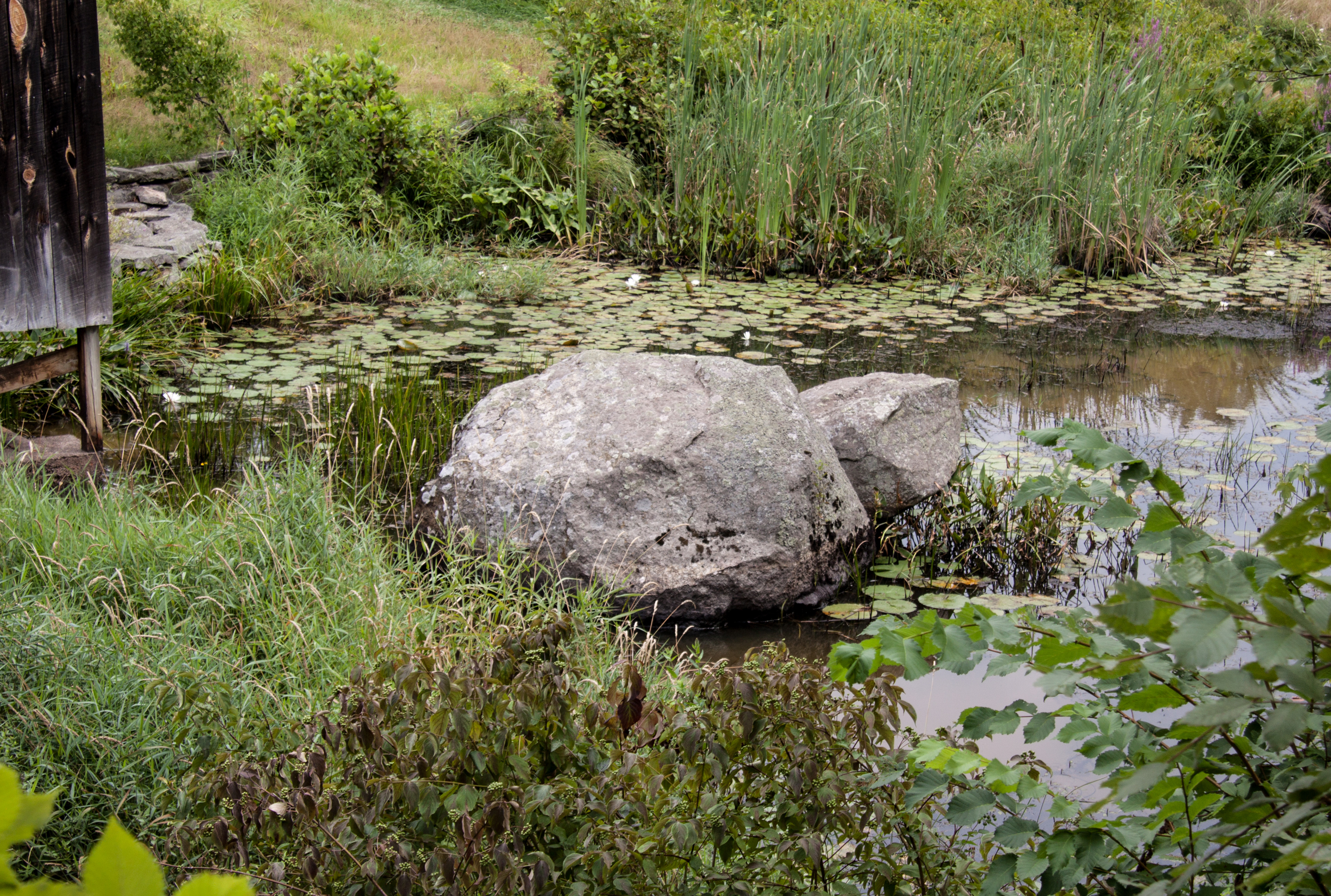
Stone Turtle in Lower Pond, August 2016
In the creation stories of the Oneida and Iroquois, Skywoman fell through a hole in the sky, pirouetting down towards the dark water below. Geese saw this falling woman with long dark hair, and quickly flew up to break her fall. They caught her in their soft feathers and held her safely. But they couldn't hold her for long, and they didn’t know what to do. They gathered all the other water animals together in council — otters, fish, swans, beavers, and a large turtle. The turtle offered his back for her to stand on. But what to do next? The animals knew she wasn’t a water creature and needed solid ground, so they decided to dive deeply and bring up mud from the bottom of the water. It was far for them to dive, and they each in turn returned empty handed. At last, muskrat, the weakest diver among them said, “I will go.” They waited anxiously for muskrat’s return. Finally, they saw a few bubbles, and then his small, limp body surfaced. He had died on the return, but in his paw he still clutched a bit of mud from the bottom. “This mud,” Turtle said, “spread it on my back.” They spread the mud over Turtle’s shell, and Skywoman danced and the land grew.
That’s how we came to live on Turtle Island. It’s a creation myth of sacrifice and caring, of recognizing that the earth sustains us all. It acknowledges that we humans are all immigrants, that the animals were here before us. It is a creation story that affirms life, that recognizes death; one in which there is communication between all species.
Finding the large stone turtle on my first visit to the farm was a good omen. I see this turtle almost every day. The Turtle Island creation myth is in stark contrast to the Western creation myth of the Garden of Eden with its story of banishment, guilt, and wrongdoing. Fratricide follows in the next generation, and Snake gets a really bad rap.
Perhaps the West needs a new creation story, one that is earth centered. We can learn from this Native American legend of the earth as a giant turtle, and be reminded that we are still precariously standing on Turtle’s back. Maybe we also need to dance more to celebrate and heal our earth. Maybe, like Nick, we can all make stone turtle and leave it as a marker in the landscape of our recognition of the precariousness of where we stand.

LH making a stone turtle in 2006 for Garden in the Woods, Framingham, MA
Arborshaping
In the forested Delaney Conservation Area behind the farm, I saw a white pine growing with what looked like a large clenched fist halfway up the trunk. When I looked more closely I saw that it was a twisted knot. Then I saw other pines growing with similarly knotted trunks. Intrigued and baffled, I wondered what had happened in these woods.
Further along the trail, a young sapling’s central leader was not growing straight, but circled around itself. That was the aha moment. Someone was going around and looping the tops of these young pines. Then, as the tree grew, the loose loop tightened into a knot. I noticed a few young trees missing the top of their trunks, their central leaders. Unable to submit to the pressure of this forced bending, they had sadly snapped off. I continued along the trail, unraveling any looped tree I found. Later I learned that one of my neighbors had knotted the trees when he was a young child; and he continues to do it haphazardly even now.
In the 16th century painting The Lament of Nature to the Wandering Alchemist by the French artist, Jean Perréal, a scantily clad angel with arms crossed below her breasts sits in a regal seat, which when you look closely, is really a tree with a trellised back of sinuous trunks. Why the naked angel, the well-dressed alchemist, the fire under her seat? The angel appears to be either defending herself or rebuking the alchemist. However, what interests me most is her chair. The upright branches have been twisted to grow and touch; they have grafted themselves to each other creating this fantastical throne chair. I wondered if this was the wildly imaginative idea of the painter or whether he had seen such a tree chair.

If you had been driving along the California coast near Santa Cruz in the 1940’s you could have seen even more fantastical tree creations. Axel Erlandson, a farmer, created what he called a Tree Circus — eccentric, fanciful, and bizarre shapes created by training trees to grow in particular shapes. One of his trees has a heart right in the center of the main trunk. Another had two trunks that spiral around each other as they both support the large tree canopy. His ‘Basket’ tree is made from several trees planted in a circle, then he grafted overlapping limbs together to form a basket weave pattern.
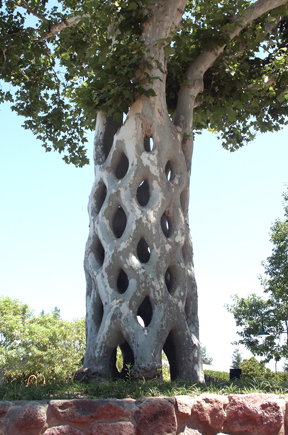
Image from Wikipedia article on Axel Erlandson.
Today, a tree shaper in Oregon, Richard Reames, calls his work arbor sculpture. He makes living trees into furniture. Chairs, he says, are relatively easy to grow, but he has also created arbors, a spiral staircase, and even a boat. In Germany, Konstantin Kirsch and Herman Block have created several living tree houses. For one house, they planted 1,300 ash saplings, seven every foot, and wove them together to make the walls to form an interior court surrounded by six rooms.
Arborshaping is grafting carried to its limits; we humans do seem to be wired to go to extremes. When I look at these images of arborshaping, I have simultaneous reactions of awe and horror. There is something ghastly about forcing nature to grow in such unnatural ways, and yet the growth patterns are astonishing. I do, however, love the idea of incorporating a living tree into the building of a house. One of my favorite examples is from Homer’s Odyssey. (Though I can’t quite tell if the tree continued to live.)
There was the bole of an olive tree with long leaves growing strongly in the courtyard, and it was thick, like a column. I laid down my chamber around this … Then I cut away the foliage of the long-leaved olive, and trimmed the trunk from the roots up, planning it with a brazen adze, well and expertly, and trued it straight to a chalkline, making a bedpost of it, and bored all hones with an auger. (23.190-288).
When Odysseus returned home in the guise of a beggar after ten years of wandering, Penelope tested him by saying she had moved their bed. From Odysseus’ reaction of indignation, she was certain that she was speaking to her husband.
And that angel representing Nature? I think she is saying, “I don’t need your alchemy, your thick red robes, your ivory tower of mysterious pursuits. Look what magic I can do on my own. Nature has plenty of mystery, just embrace her!
Joseph Wheelwright: Sculptor of Stones and Trees
A few days ago my partner Blase and I went to visit the artist, Joseph Wheelwright, to choose some work for the fall outdoor sculpture exhibit. Entering a high-ceilinged warehouse space in Dorchester, I immediately felt the presence of stone – stone dust, stone chunks, and many finished stone heads — decades of carved work on the floor, and on tables and carts. Machines and air compressors to run the stone-carving power tools crammed one area, a large work table occupied the central space, and in the back were stairs to a small office and gallery.
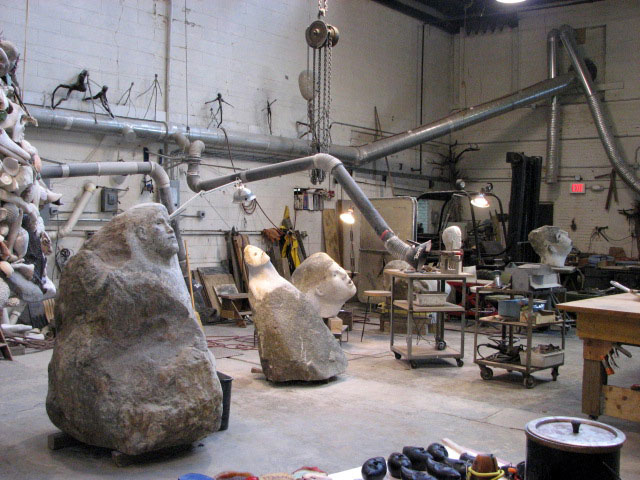
Photo from Joseph Wheelwright Website.
I saw a few of Joe’s tree figures, ones he constructed out of bifurcated tree trunks turned upside down, the trees found in the woods near his summer studio in Vermont. Before cutting down a tree, Wheelwright first checks the root area to make sure it would provide a good set of “shoulders.” A few years ago, an assembly of his giant tree creatures strode across the landscape at Fruitlands Museum in Harvard.
“Choose,” he said, gesturing to the entire studio. “Anything you want.”
“Wow!” I thought. It’s interesting to have the freedom to choose. Just how does one begin to make a choice when there is such richness? Some of the stone heads must have weighed a few thousand pounds — far too big for us to move in Blase’s pickup truck. Some older pieces made with bones and other fragile material would not be fitting for an outdoor exhibit. One recent sculpture was a small figure standing on a tall rectangular stone. It reminded me of the small figures I cast into bronze and place on rocks or inside wood sections. I recognized that attraction to what I know and feel comfortable with, and turned away to take in the range of really different work. There were so many stone faces, each with a unique expression – it was difficult to decide on one.
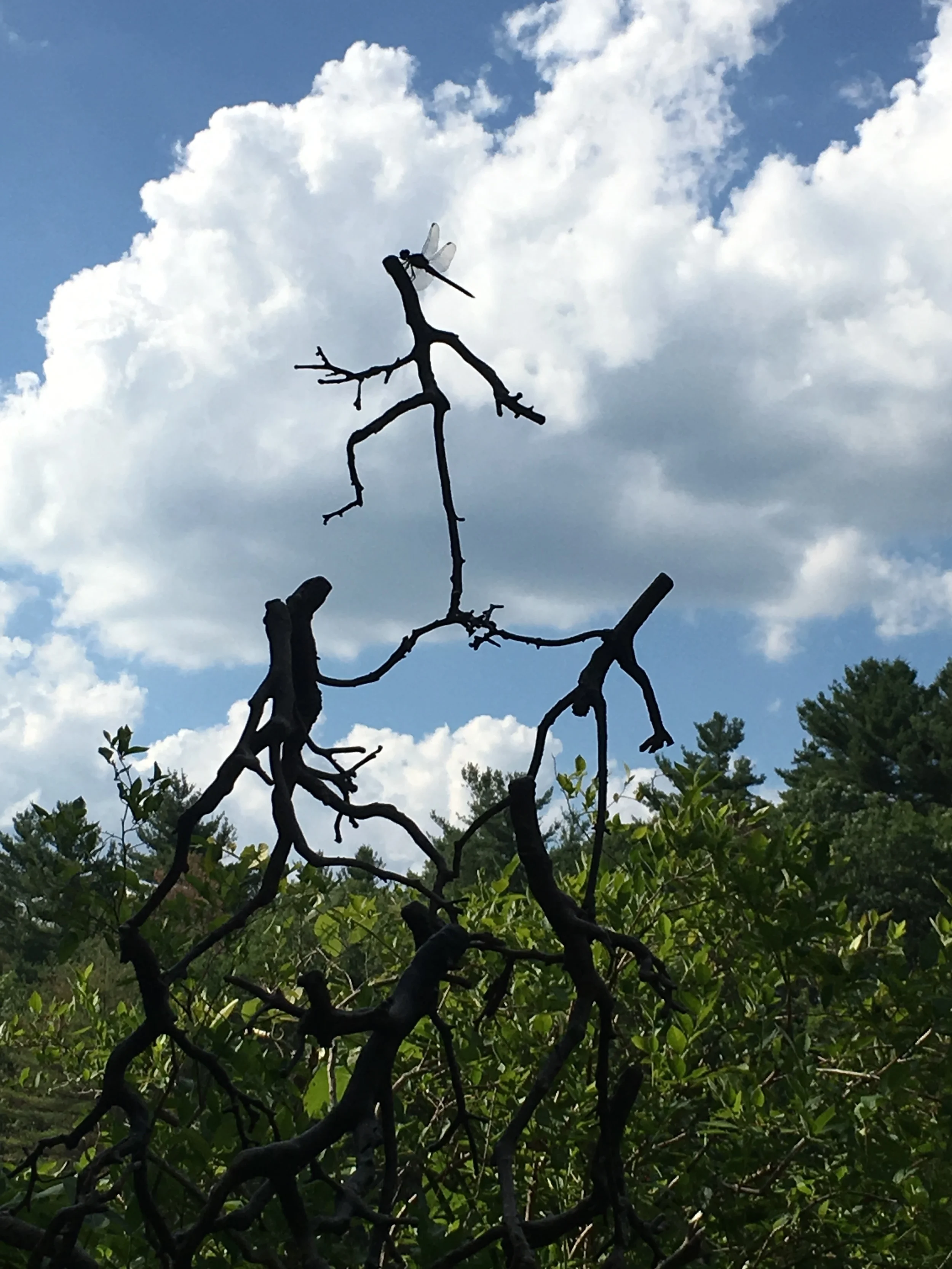
Joe asked if we wanted to go upstairs. “Of course, yes, let’s see everything,” I answered. There, in the middle of a small gallery, my eyes alighted on a tower of branch figures. I was familiar with Joe’s wonderful small bronze figures created from delicate tree branches, most of them less than a foot high. They are immediately likable, posed so energetically in sprightly postures. But this sculpture was a three-dimensional ladder, a tower of figure after figure welded together at the point where a leg rests on a knee or a foot on an arm – all interdependent and interconnected. Like a circus act where the performers create a human pyramid with the stronger ensemble members on the bottom, the bronze figures at the base of the sculpture had thicker branches. Then these branch personages became progressively thinner as together they supported the smallest figure, atop them all.
“How about this one?” I asked.
“Well it’s a little fragile to transport,” he said, then paused. “It has one side, I think it’s this one,” he said, pointing, “where you can lay it down.”
“Has it been outside?” Blase asked.
Joe didn’t answer. I’m not sure if he remembered.
I was riveted by this sculpture and did not want to move on. “Could we have it?” My enthusiasm gave me the audacity to ask.
“Blase, I think you and I can carry it down the stairs,” Joe responded.
As they carried it out to the truck, his wife, Susan, said, “That’s one of my favorites.”

Joseph Wheelwright's Tower of Figures (partial view with visiting dragonfly)
All these figures mutually support each other. If one moves, many will tumble. It’s a sublime balancing act. I look at Joe’s sculpture and think how we are all in this world supporting each other and connected, though not in such a physically obvious way.
Once we loaded the sculpture into the truck on a thick blanket and tied it in so it wouldn’t roll, Joe asked if we wanted some stones. Blase chose one with a small bird perched on its head; I selected one that seemed to be peering around a corner.
Joe was so generous — the pieces will be for sale — but he declined to give me prices. I think he knew the price tag would be shocking. There’s a lot more work than meets the eye in all of Joe’s work. He has a long lifetime of dedication to his art. We’re so honored to have his sculpture at the farm this fall. Opening Day will be Saturday, September 3rd and the exhibit will be open through Columbus Day.
Search Blog
-
2025
- May 9, 2025 A View from the Tractor Seat
- Apr 11, 2025 Dig
-
2024
- Jan 7, 2024 Winter Wassail
-
2022
- Dec 11, 2022 Keeping Time
- Jun 17, 2022 This Apple-Shaped Earth
- Jan 23, 2022 What is a Jizo?
- Jan 16, 2022 An Invite and Housekeeping Update
- Jan 1, 2022 The Year of the Frog: What Orchardists Do While Apple Trees are Chilling
-
2021
- Oct 24, 2021 Figs
- Oct 3, 2021 The Artist and the Orchard: A Memoir
- Aug 8, 2021 Red-Fleshed Apples
- Jul 25, 2021 When We Were Trees
- Jun 27, 2021 Castor Beans—Who Knew?
- Jun 13, 2021 Spring Training at a Zen Monastery
- May 4, 2021 Our Trees are in Bloom
- Apr 18, 2021 Hooray!
- Jan 24, 2021 Wassailing, virtually!
- Jan 1, 2021 Sitting
-
2020
- Dec 21, 2020 Darkness to Light
- Nov 28, 2020 One Heart
- Sep 18, 2020 Juggling Flowers, Fruit, and Vegetables
- Aug 23, 2020 Refuge
- Aug 9, 2020 Bags of Fertilizer
- Aug 2, 2020 The Sermon of the Blue Heron
- Jul 26, 2020 What's the Buzz?
- Jul 19, 2020 Farm Moments
- Jul 12, 2020 Lost Wax
- Jul 5, 2020 Catalpa: The Hugging Tree
- Jun 28, 2020 Pedaling Peace
- Jun 21, 2020 See Change
- Jun 14, 2020 Lalla Unveiled
- Jun 7, 2020 Pond Alchemy
- May 31, 2020 The Birth of Fruit
- May 24, 2020 An Artist in the Orchard
- May 17, 2020 Walking the Land: Returning Home
- May 10, 2020 Stinging Nettles: Gifts from the Great Mother
- May 3, 2020 The Mystery of Swallow
- Apr 26, 2020 Aerial Bruststrokes
- Apr 19, 2020 Simple Pleasures
- Apr 12, 2020 Weeds and Other Gifts
- Apr 5, 2020 Remembering the Seeds
- Mar 29, 2020 Blow on the Embers
- Mar 22, 2020 Ripples
-
2019
- Nov 16, 2019 Tibet Impressions
- Nov 9, 2019 Forest Tales
- Oct 13, 2019 The Gift
- Aug 4, 2019 The Season is Apples, Berries, and Grandfather Fire
- Jun 8, 2019 Pointers for a Writing Life
- May 12, 2019 Mothers of the Earth
- Apr 6, 2019 The Apple-Shaped Earth
- Mar 23, 2019 You Don’t Know What You Have Till It’s Gone
- Feb 23, 2019 Generations
- Feb 9, 2019 What Are We Doing to the Earth, John Chapman?
-
2018
- Dec 31, 2018 Long Shadows
- Oct 6, 2018 A Pilgrimage to India
- Aug 18, 2018 Scrap Wrenn
- Aug 11, 2018 Off-the-Wall Comments from an Ignorant Farmer
- Jul 28, 2018 Creative Connect
- Jul 14, 2018 How is the Orchard?
- Jun 30, 2018 Which Way?
- Jun 16, 2018 Geese, Herons, Beavers, and the Baby Steps of a Lapsed Blogger
- Feb 24, 2018 Mama's Coupons — Good Forever
- Jan 27, 2018 January Ice
- Jan 13, 2018 The Muse
-
2017
- Dec 30, 2017 A Dream for the New Year
- Dec 23, 2017 A New Year for Apples
- Dec 16, 2017 Intuition
- Nov 22, 2017 Thanksgiving OM
- Nov 4, 2017 East Fork Pottery
- Oct 28, 2017 Putting Down New Roots
- Oct 21, 2017 A is for Art
- Oct 14, 2017 Eve domesticus
- Oct 7, 2017 A String Workshop
- Sep 30, 2017 After Applepicking
- Sep 23, 2017 Two Bad Women and One Good Apple
- Sep 16, 2017 Plein Air Poetry
- Sep 9, 2017 Cutting Off a Leg
- Sep 2, 2017 The Changing Landscape
- Aug 26, 2017 All About Art
- Aug 19, 2017 My First Visit to the Farm
- Aug 12, 2017 The First Food
- Aug 5, 2017 A Teapot, a Woman, and maybe a Boat
- Jul 29, 2017 A Raspberry Dilemma
- Jul 22, 2017 Consider the Miracle
- Jul 15, 2017 Meeting Ekphrasis
- Jul 8, 2017 Ripening Fruit
- Jul 1, 2017 The Voice of The Caterpillar
- Jun 24, 2017 Goumi — An Unusual Fructus
- Jun 17, 2017 Concord, an American Bloomsbury
- Jun 10, 2017 The World Is Bonkers — Shall I Laugh or Cry?
- Jun 3, 2017 Bonkers, a Revolutionary Apple
- May 27, 2017 Guardians of the Swamp
- May 20, 2017 There are Mushrooms and There are Morels
- May 13, 2017 "What's in a Name?"
- May 6, 2017 Bloom Follows Pink: Orchard Pollination
- Apr 29, 2017 The Orchard Is at Pink
- Apr 22, 2017 Natural Farming — Part 2 (continuation from last Sunday's blog)
- Apr 15, 2017 Natural Farming — Part 1
- Apr 8, 2017 Boats, Figures, and Catching Fish
- Apr 1, 2017 A Man with a Mission: The Nuts and Bolts of Bronze Casting
- Mar 25, 2017 A Chalice of Spirit, Art, and Nature
- Mar 18, 2017 Hanami — Blossom Viewing
- Mar 11, 2017 Soil Redemption Song
- Mar 4, 2017 Food is Primary Care
- Feb 25, 2017 Pomme de Terre
- Feb 18, 2017 Organic Certification
- Feb 11, 2017 Tantalizing Fruit
- Feb 4, 2017 The Myths of History
- Jan 28, 2017 The Orchard in Winter
- Jan 21, 2017 The Hi-Line
- Jan 14, 2017 Artistic, Botanical, and Social Diversity
- Jan 7, 2017 Where is Eden?
-
2016
- Dec 31, 2016 The Creative Heart
- Dec 24, 2016 A Christmas Tale
- Dec 17, 2016 Who are the Crones?
- Dec 10, 2016 The Olympic Bell (Part Two)
- Dec 3, 2016 Overheard in the Apple Orchard in Early December
- Nov 26, 2016 The Lessons of a Tortoise
- Nov 19, 2016 In the Studio
- Nov 12, 2016 Even in Darkness
- Nov 5, 2016 Southern Apples, an Elephant, Monkey, Rabbit, and Bird, Two Mango Trees and a Birthday
- Oct 29, 2016 The Tools of Art
- Oct 22, 2016 Labyrinths
- Oct 15, 2016 Repairing the Broken
- Oct 8, 2016 When You Are No More
- Oct 1, 2016 Creation Rain
- Sep 24, 2016 Breaking the Glass
- Sep 17, 2016 String Art
- Sep 10, 2016 Poetry and Photosynthesis: It's all in the Leaves
- Sep 3, 2016 In the Plenty of Time
- Aug 27, 2016 Witch Doctors
- Aug 20, 2016 Listen Coyote
- Aug 13, 2016 Milkweed in the Orchard
- Aug 6, 2016 Some People See a Turtle
- Jul 30, 2016 Arborshaping
- Jul 23, 2016 Joseph Wheelwright: Sculptor of Stones and Trees
- Jul 16, 2016 Asian Pears
- Jul 9, 2016 Gold Leaf, Grief, and the Creative Process
- Jul 2, 2016 The Olympic Bell (Part One)
- Jun 25, 2016 Around the Mulberry Bush
- Jun 18, 2016 Avoiding Apples
- Jun 11, 2016 Fructus
- Jun 4, 2016 Astonishing Apples
- May 28, 2016 Scare the Caterpillars
- May 21, 2016 Join the Club!
- May 14, 2016 The Graft
- May 7, 2016 Rooster, Rhubarb, Rue
- Apr 30, 2016 What do Dolphins and Nettles Have in Common?
- Apr 23, 2016 Art Prunings
- Apr 16, 2016 A Few of the First Arrivals
- Apr 9, 2016 Taste the Spirit of Sustainable Agriculture
- Apr 2, 2016 First Orchard Spray - March 22-24, 2016
- Mar 26, 2016 Hawkeye Apple
- Mar 19, 2016 Desiring the Almata Apple
- Mar 12, 2016 Ugly Fruit
- Mar 5, 2016 Winter Tracks
- Feb 27, 2016 Splash
- Feb 20, 2016 Pruning
- Feb 13, 2016 Orchard Ruminants
- Feb 6, 2016 A Gathering of Seeds
- Jan 30, 2016 Orchard Dragons
- Jan 23, 2016 Tree Rings
- Jan 17, 2016 The Fallen Tree
- Jan 7, 2016 Wassailing the Apple Trees
- Jan 1, 2016 The New Year